Why Does Topsoil Have the Most Humus? Formation and Benefits
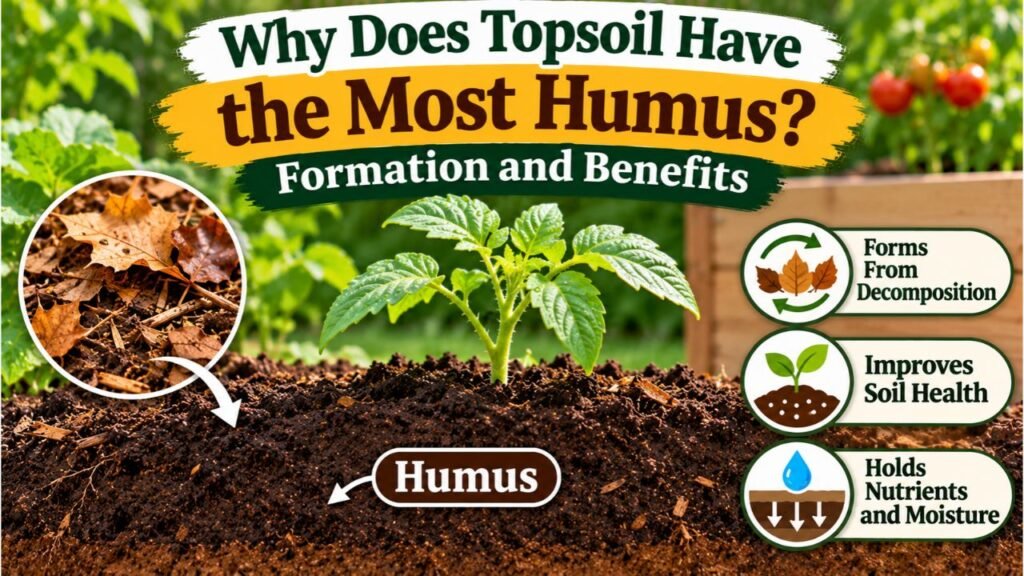
Topsoil usually has the most humus because dead leaves, plant litter, and roots supply organic material near the ground’s surface, where soil organisms break it down and mix it with mineral particles. Over time, some of that material becomes relatively stable organic matter, often called humus, making the upper mineral soil darker and better able to hold water and nutrients.
The upper part of a soil profile receives a continuous supply of fallen vegetation and new root growth. Earthworms, fungi, bacteria, and other organisms transform these materials. Deeper layers generally receive fewer fresh inputs, so they often contain less organic matter.
There is one important distinction: in forests, an organic surface layer called the O horizon can contain more organic material than the mineral topsoil beneath it. Therefore, topsoil has the most humus among the mineral horizons in many soils, not necessarily across every layer of every soil.
In this article, I explain how humus forms, why it accumulates near the surface, and how topsoil compares with subsoil. You’ll also learn what humus does for plant growth, why it can decline, and practical ways to maintain it in garden soil.
Why Does Topsoil Have the Most Humus? 6 Main Reasons
Topsoil, commonly identified as the A horizon, is the upper mineral layer of soil.
It usually contains more organic matter than deeper mineral layers because most organic inputs enter the soil near the surface.
Several biological and environmental processes contribute to this pattern.
1. Dead Leaves and Plant Materials Collect Near the Surface
Plants continuously contribute organic material to the ground.
Examples include:
- Fallen leaves.
- Dead grass.
- Small branches.
- Plant stems.
- Crop residues.
- Shed plant tissues.
- Dead roots.
Much of this material accumulates on or near the soil surface.
As it decomposes, some of its carbon enters the soil’s organic matter pool.
Because the material is concentrated near the surface, the upper soil receives a greater supply than deeper layers in many ecosystems.
For example, a woodland receives fallen leaves each year.
These leaves gradually break down and contribute organic material to the upper soil.
In a grassland, dead roots and plant residues also contribute substantial organic matter.
The continuous supply of plant residues is one of the main reasons topsoil becomes enriched with humus.
2. Most Biological Activity Is Concentrated Near the Surface
Topsoil is commonly a biologically active part of the soil profile.
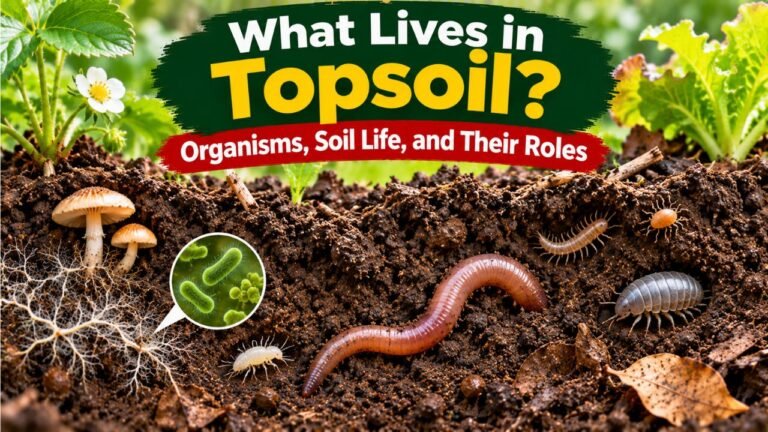
It contains organisms such as:
- Bacteria.
- Fungi.
- Earthworms.
- Springtails.
- Mites.
- Other soil invertebrates.
These organisms help break down and transform organic materials.
Bacteria and fungi produce enzymes that decompose plant residues.
Earthworms and other soil animals fragment organic matter and mix it with soil particles.
The exact abundance of organisms depends on moisture, temperature, vegetation, soil chemistry, and disturbance.
Although deeper soil also supports biological activity, the surface layers often receive more fresh organic material to support decomposer populations.
3. Plant Roots Contribute Organic Matter
Humus does not come only from fallen leaves.
Roots are another major source of soil organic matter.
Plants contribute carbon through:
- Dead roots.
- Fine-root turnover.
- Shed root cells.
- Root exudates.
- Microbial activity associated with roots.
Root exudates are substances released by living roots into the surrounding soil.
These compounds support microorganisms and contribute to carbon cycling.
Many plants have substantial root activity in the upper soil, where water, oxygen, and nutrients are often available.
As roots die and decompose, their materials can contribute to soil organic matter.
The importance of roots varies by ecosystem.
In many grasslands, root contributions are especially significant.
4. Earthworms and Soil Organisms Mix Organic Matter With Minerals
Organic material deposited at the surface does not necessarily remain there.
Earthworms, insects, and other organisms help move it into the soil.
For example, earthworms may pull plant debris into their burrows.
They also process organic material together with mineral soil.
This helps distribute organic compounds through parts of the upper soil.
Soil organisms can also contribute to the formation of aggregates, which are small groups of soil particles held together.
Some organic matter becomes protected inside these aggregates or through associations with clay and other minerals.
This protection can slow further decomposition.
5. Upper Soil Receives More Organic Inputs Than Deeper Layers
The amount of organic matter in soil depends on the balance between inputs and losses.
Inputs include plant residues, roots, and materials produced by soil organisms.
Losses occur through decomposition, erosion, and other processes.
In many soils, organic inputs are concentrated in the upper layers.
The Sustainable Agriculture Research and Education program’s soil organic matter guide explains that organic matter is generally more concentrated near the surface, with substantial contributions from roots and aboveground plant residues.
It also notes that soil animals help incorporate organic material into the soil.
Although organic carbon occurs at greater depths, the highest concentrations commonly occur near the surface.
6. Some Organic Matter Becomes Protected in the Upper Soil
Not all organic matter decomposes at the same rate.
Some materials are broken down rapidly.
Other organic compounds persist longer because of their chemical characteristics or their interactions with minerals.
For example, organic compounds can become associated with clay particles.
They may also become physically protected within soil aggregates.
These processes can help organic matter remain in soil for longer periods.
However, humus is not permanently resistant to decomposition.
The amount present can increase or decrease depending on the balance between organic inputs and losses.
Key Takeaway: Topsoil usually contains the most humus because it receives more plant residues and root inputs, supports active decomposer communities, and allows some transformed organic matter to accumulate.
What Is Humus in Topsoil?
Humus is a general term for the dark, relatively decomposed organic material in soil that no longer clearly resembles the original plant or animal remains.
It is commonly associated with the more persistent fraction of soil organic matter.
However, modern soil science recognizes that soil organic matter contains many different substances rather than one uniform material called humus.
What Is Humus Made Of?
Humus develops from the transformation of once-living materials.
Its sources include:
- Leaves.
- Roots.
- Stems.
- Dead microorganisms.
- Animal remains.
- Other biological residues.
These materials undergo decomposition and transformation.
The resulting organic matter contains carbon and other elements, including nitrogen, phosphorus, and sulfur.
Its exact chemical composition varies.
Is Humus the Same as Organic Matter?
Not exactly.
Soil organic matter is the broader category.
It includes fresh residues, decomposing material, living organisms, and more persistent organic compounds.
Humus traditionally refers to a relatively well-decomposed portion of that material.
| Material | Meaning |
| Fresh organic residue | Leaves, stems, and other recognizable plant material |
| Decomposing organic matter | Material actively being broken down |
| Humus | Relatively decomposed, often dark organic matter |
| Soil organic matter | Broad category including fresh, active, and more persistent material |
| Compost | Material produced through a managed decomposition process |
These categories overlap.
They should not be treated as completely separate substances with fixed boundaries.
Why Is Humus Dark?
Many decomposed organic compounds are dark brown or nearly black.
When mixed with mineral particles, they can darken soil.
This is one reason fertile topsoil often appears darker than the underlying subsoil.
However, soil color alone does not prove that humus content is high.
Minerals, moisture conditions, and other soil properties can also affect color.
How Does Humus Form in Topsoil?
Humus formation is a gradual biological process.
Plants supply organic materials, decomposers transform them, and some of the resulting compounds remain in the soil.
Step 1: Plants Produce Organic Materials
Plants grow by using sunlight, water, carbon dioxide, and nutrients.
During growth, they produce leaves, stems, roots, and other tissues.
Some of these tissues eventually die.
They become organic residues that enter the soil system.
Step 2: Decomposers Break Down the Residues
Microorganisms begin using the residues as sources of energy and nutrients.
Fungi and bacteria break complex materials into smaller compounds.
Some carbon returns to the atmosphere as carbon dioxide through respiration.
Other carbon becomes part of microbial cells or additional soil organic compounds.
Step 3: Soil Animals Fragment and Mix the Material
Earthworms and other soil animals can break organic residues into smaller pieces.
They also help mix organic material with mineral soil.
This increases contact between organic compounds, microorganisms, and soil particles.
Step 4: Organic Compounds Become Associated With Soil Minerals
Some decomposed materials interact with clay and other mineral surfaces.
Others become enclosed within soil aggregates.
These associations may reduce their accessibility to decomposers.
As a result, portions of soil organic matter can persist longer.
Step 5: Organic Matter Accumulates or Declines
Humus accumulation is not a one-way process.
Some organic matter continues decomposing.
The overall amount depends on the balance between additions and losses.
If a soil receives substantial organic inputs while losses remain relatively low, its organic matter content may increase.
If decomposition and erosion remove material faster than it is replaced, the organic matter content declines.
How Long Does Humus Take to Form?
There is no fixed formation time.
Some plant residues decompose within weeks or months under favorable conditions.
Other soil organic compounds may remain for years, decades, or longer.
The process depends on:
- Climate.
- Soil moisture.
- Temperature.
- Oxygen availability.
- Soil texture.
- Microorganisms.
- Vegetation.
- Management practices.
Adding compost to garden soil contributes organic matter, but it does not instantly create a permanent supply of humus.
Which Soil Layer Contains the Most Humus?
In many mineral soil profiles, the A horizon contains the highest concentration of humus.
However, some soils have an organic O horizon above the A horizon.
That organic layer may contain more organic matter overall.
Understanding the difference prevents confusion.
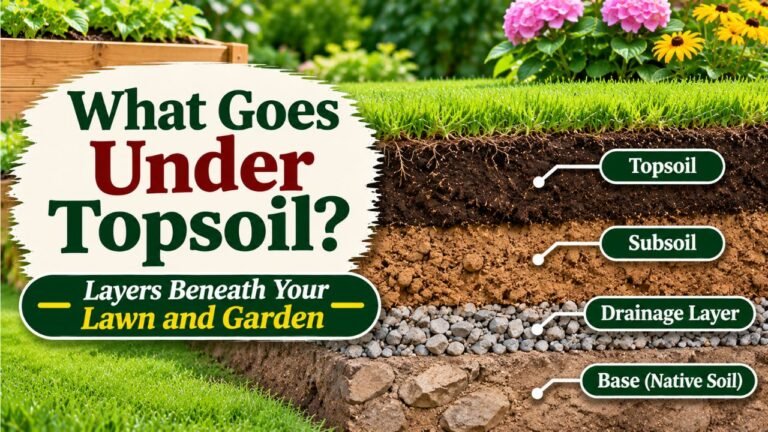
Soil Horizons and Humus Distribution
According to the USDA Natural Resources Conservation Service’s soil profile guide, soil scientists distinguish layers called horizons using designations such as O, A, E, B, and C.
These horizons differ in properties such as color, structure, texture, and composition.
| Soil horizon | Main characteristics | Typical organic matter pattern |
| O horizon | Mostly organic materials such as litter and decomposed residues | Often very high |
| A horizon | Mineral topsoil mixed with organic matter | Usually high relative to deeper mineral layers |
| E horizon | Mineral layer affected by removal of some constituents | Often relatively low |
| B horizon | Subsoil where materials accumulate or are transformed | Usually lower, but varies |
| C horizon | Relatively unaltered parent material | Usually low |
| R layer | Hard bedrock | Not a soil horizon containing ordinary humus-rich topsoil |
Not every soil contains every horizon.
The arrangement also varies with climate, vegetation, drainage, and geological history.
O Horizon: Organic Surface Layer
The O horizon is commonly found in forests and some other undisturbed environments.
It consists primarily of organic materials.
Examples include:
- Fallen leaves.
- Needles.
- Twigs.
- Decomposed vegetation.
- Other accumulated organic residues.
Some materials remain recognizable.
Others are highly decomposed.
Because the O horizon consists predominantly of organic material, it may contain a greater organic matter concentration than the mineral topsoil below it.
A Horizon: Topsoil
The A horizon is the upper mineral soil layer.
It contains mineral particles mixed with organic matter.
Its mineral components include:
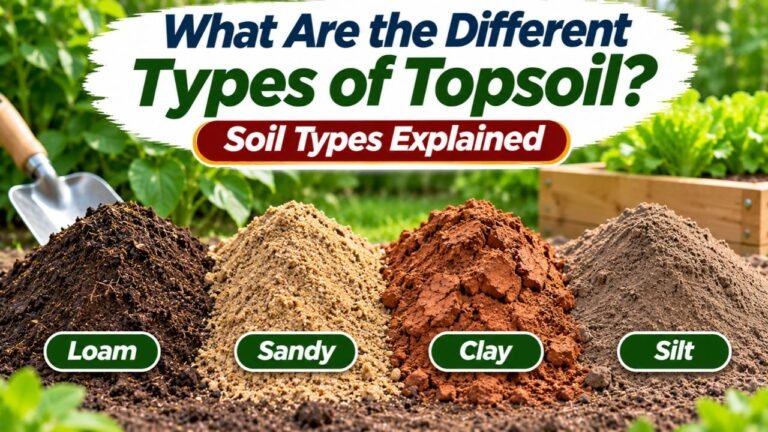
- Sand.
- Silt.
- Clay.
The organic fraction contributes to its structure and often its darker color.
Plant roots and soil organisms are frequently abundant in this layer.
For this reason, the A horizon is commonly the most biologically active and productive mineral layer.
E Horizon: Leached Layer
Some soils have an E horizon below the A horizon.
This layer has experienced the removal of certain materials through soil-forming processes.
It may be lighter in color than the surrounding horizons.
Not every soil has an E horizon.
B Horizon: Subsoil
The B horizon lies beneath the upper horizons.
It may contain accumulated clay, iron, aluminum, and other materials.
Organic matter can also move into or accumulate in parts of the B horizon.
However, it usually receives fewer direct organic inputs than the upper soil.
C Horizon: Parent Material
The C horizon consists largely of relatively unaltered material from which the soil develops.
It generally contains less organic matter than the A horizon.
Biological activity and root abundance are often lower.
Does Topsoil Always Have More Humus Than Every Other Layer?
No.
The statement is a useful generalization for many mineral soils, but it has exceptions.
For example:
- Forest O horizons can contain more organic material than the A horizon.
- Peat soils can contain thick organic-rich layers.
- Some subsoils contain accumulated organic compounds.
- Buried surface soils may retain substantial organic carbon.
- Eroded or heavily disturbed topsoil may contain little humus.
Therefore, it is more accurate to say that topsoil usually contains more organic matter than the mineral subsoil beneath it.
Why Does Subsoil Have Less Humus Than Topsoil?
Subsoil commonly contains less humus because fewer fresh organic materials enter it directly.
Several factors contribute to this difference.
Less Plant Litter Reaches the Subsoil
Most fallen leaves and stems collect at the ground surface.
They are not deposited directly in deeper soil layers.
Some decomposed materials move downward, but the supply is usually smaller than at the surface.
Root Inputs Are Often Lower
Many plants produce substantial fine-root growth near the surface.
Deeper roots can contribute organic carbon too, but their abundance and turnover depend on plant species and soil conditions.
In many soils, carbon input decreases with depth.
Biological Activity Often Decreases With Depth
Microorganisms exist throughout the soil profile.
However, their abundance and activity frequently decline with depth because less fresh organic material is available.
Temperature, oxygen, and moisture conditions may also differ.
This can affect decomposition and organic matter transformation.
Mineral Processes Become More Important
Subsoil development often involves mineral weathering and the movement of dissolved or suspended materials.
Clay, iron, and other constituents can accumulate in certain horizons.
Organic compounds may also accumulate locally.
However, the subsoil usually has less direct contact with surface litter.
Does Subsoil Contain Any Humus?
Yes.
Subsoil is not necessarily free of organic matter.
Deep roots, dissolved organic compounds, buried soil layers, and interactions with minerals can all contribute organic carbon below the surface.
The amount varies considerably.
Some deep soil carbon can remain protected for long periods.
Key Takeaway: Subsoil typically contains less humus because it receives fewer fresh organic inputs, not because organic matter cannot exist at greater depths.
Why Is Humus Important for Soil Fertility?
Humus and other soil organic matter contribute to several properties that support plant growth.
Their benefits involve water, nutrients, soil structure, and biological activity.
Improves Soil Structure
Organic matter helps soil particles form aggregates.
These aggregates create spaces that allow water and air to move through soil.
Well-aggregated soil is often easier for roots to penetrate.
It can also be easier to cultivate without producing large, hard clods.
However, soil structure depends on mineral composition, management, and moisture as well as organic matter.
Helps Soil Hold Water
Organic matter can retain water.
This can be particularly beneficial in sandy soils, which often drain quickly.
Improved soil structure can also help water infiltrate rather than run off.
In clay-rich soils, organic matter may help improve aggregation and manageability.
The effect depends on soil texture and existing conditions.
Helps Retain Nutrients
Humus contains chemical groups that can hold certain nutrient ions.
This contributes to a soil property called cation exchange capacity, or CEC.
CEC describes a soil’s ability to retain and exchange positively charged ions, including potassium, calcium, and magnesium.
Organic matter can therefore help reduce the immediate loss of some nutrients.
However, humus does not supply every nutrient in the correct quantity for all plants.
Supports Nutrient Cycling
Soil organisms continue breaking down organic materials.
During this process, nutrients can be released into forms plants can absorb.
This is called mineralization.
The rate depends on temperature, moisture, and the materials being decomposed.
For example, decomposition may proceed more slowly in cold soil.
Supports Soil Life
Organic materials provide energy and habitat resources for many soil organisms.
These organisms contribute to nutrient cycling and soil structure.
Healthy soil biological activity is associated with a functioning soil ecosystem.
However, the number of organisms alone does not determine soil fertility.
Reduces Some Erosion Risks
Organic matter can help stabilize soil aggregates.
Surface plant residues and mulch also protect the ground from direct rainfall and wind.
Together, these practices can reduce soil loss.
This is important because erosion can remove the humus-rich upper soil.
Humus Benefits at a Glance
| Benefit | How it helps |
| Better soil structure | Supports aggregation and pore formation |
| Water retention | Helps soil hold moisture |
| Nutrient retention | Contributes to cation exchange capacity |
| Nutrient cycling | Stores organic nutrients that may be released during decomposition |
| Root development | Supports favorable physical soil conditions |
| Biological activity | Contributes resources for soil organisms |
| Erosion resistance | Helps stabilize soil when combined with protective management |
Key Takeaway: Humus contributes to soil fertility by improving physical structure, water retention, nutrient storage, and biological processes. It is important, but it is not a substitute for suitable drainage, pH, or balanced nutrients.
Why Is Topsoil Usually Darker Than Subsoil?
Topsoil often appears dark because it contains relatively high amounts of organic matter.
As organic materials decompose and mix with mineral particles, they can produce dark brown or nearly black coloration.
This is especially noticeable in soils that have received plant residues for many years.
Does Black Soil Always Have More Humus?
No.
Dark coloration is a useful observation, but it is not a reliable measurement by itself.
Other factors can influence soil color.
Examples include:
- Moisture.
- Iron compounds.
- Parent material.
- Drainage conditions.
- Charcoal.
- Soil mineral composition.
Some wet soils appear dark because of chemical and drainage conditions.
Some fertile soils may also be lighter in color.
How Can You Measure Soil Organic Matter?
A laboratory soil test provides more reliable information than visual inspection.
Many soil-testing laboratories offer an organic matter measurement.
Results are commonly reported as a percentage.
However, soil organic matter percentage is not identical to a direct measurement of humus alone.
Organic matter includes several forms of carbon-containing material.
Ask the laboratory which method it uses and how to interpret the result for your soil.
What Factors Affect the Amount of Humus in Topsoil?
Not every topsoil contains the same amount of organic matter.
Climate, vegetation, soil texture, and human activity influence the balance between accumulation and loss.
Climate
Temperature and moisture affect plant growth and decomposition.
In warm, moist conditions, microorganisms may break down residues rapidly.
In cool conditions, decomposition can be slower.
Therefore, a location with vigorous plant growth does not necessarily have the highest organic matter concentration.
Accumulation depends on both organic inputs and the rate of loss.
Vegetation
Different plant communities contribute different amounts of organic material.
Grasslands can contribute substantial material through roots.
Forests receive fallen leaves, needles, branches, and root residues.
Managed gardens may receive compost, mulch, and crop residues.
Soil Texture
Clay and fine silt can interact with organic compounds.
These interactions may help protect some organic matter from rapid decomposition.
Sandy soils generally have less capacity for certain forms of mineral-associated organic matter.
However, soil texture is only one of several influences.
Drainage
Very wet soil can limit oxygen availability.
This may slow decomposition and allow organic matter to accumulate.
Wetlands and peat-forming environments are important examples.
However, waterlogged conditions are not desirable for most garden vegetables.
Tillage and Disturbance
Frequent intensive tillage can disrupt aggregates and expose protected organic matter to decomposition.
It can also leave soil vulnerable to erosion.
The effects depend on the intensity and frequency of disturbance.
Erosion
Wind and water erosion can remove humus-rich surface soil.
Once the upper soil is lost, less fertile subsoil may become exposed.
Replacing the original soil structure and organic matter supply can be difficult.
Organic Matter Additions
Compost, crop residues, cover crops, and living roots contribute organic materials.
Their effects depend on how much material is added, its composition, and the conditions under which it decomposes.
How to Increase Humus in Garden Topsoil
Gardeners cannot produce a permanent layer of humus overnight.
However, they can improve soil organic matter over time.
The goal is to supply suitable organic materials while reducing unnecessary losses.
1. Add Finished Compost
Finished compost contributes decomposed organic material to soil.
It can help improve structure, water management, and nutrient cycling.
Use mature compost from a reliable source.
Avoid excessive applications.
The appropriate quantity depends on soil conditions, compost composition, and the crop.
A soil test can help guide application rates.
2. Keep the Soil Covered With Mulch
Organic mulch protects the surface from direct rain and sunlight.
Examples include:
- Shredded leaves.
- Clean straw.
- Appropriate grass clippings.
- Other suitable plant-based mulches.
As these materials decompose, they contribute organic matter.
However, mulch is not immediately equivalent to humus.
It must undergo biological transformation.
Keep mulch away from plant stems where necessary.
3. Grow Cover Crops
Cover crops provide living roots and additional plant residues.
Common cover crop choices include:
- Cereal rye.
- Oats.
- Clover.
- Hairy vetch.
- Other regionally suitable species.
The best choice depends on climate, planting date, and the following vegetable crop.
Cover crops can help protect bare soil and contribute organic matter.
However, they require proper termination and management.
4. Reduce Unnecessary Soil Disturbance
Avoid repeatedly turning the entire soil profile without a clear purpose.
Excessive disturbance can disrupt aggregates and increase organic matter exposure to decomposition.
When preparing a garden bed, use the least disruptive method that still creates suitable conditions for planting.
Reduced disturbance is not the same as never loosening compacted soil.
Choose practices based on actual soil needs.
5. Protect Topsoil From Erosion
Prevent bare soil from being repeatedly washed or blown away.
Useful practices include:
- Mulching.
- Maintaining groundcover.
- Growing cover crops.
- Managing runoff.
- Avoiding unnecessary disturbance.
- Keeping paths stable.
In raised beds, avoid directing concentrated runoff onto exposed soil.
6. Maintain Living Roots When Practical
Living plants contribute organic carbon through roots and related biological activity.
Planting suitable crops or cover crops during available growing periods can help maintain this input.
However, do not force crops into unsuitable weather conditions.
Use regionally appropriate planting schedules.
7. Avoid Overloading the Soil With Fresh Organic Material
Fresh organic residues can be useful.
However, burying large amounts of undecomposed grass, leaves, or wood-based material can create temporary nutrient or aeration problems.
Compost materials appropriately when necessary.
Use suitable amendments rather than assuming more organic material is always better.
Garden Soil Improvement Checklist
- Test soil before making major amendments.
- Add suitable finished compost when needed.
- Maintain appropriate organic mulch.
- Use cover crops where practical.
- Reduce unnecessary intensive tillage.
- Protect exposed soil from erosion.
- Maintain suitable drainage.
- Keep living roots in the soil when possible.
- Monitor soil conditions over multiple seasons.
Key Takeaway: Increasing soil organic matter requires consistent inputs and protection from losses. Compost, mulch, cover crops, and careful soil management are useful long-term practices.
Why Can Topsoil Lose Its Humus?
Topsoil does not always remain rich in humus.
Organic matter levels can decline when decomposition and physical losses exceed new inputs.
Repeated Intensive Tillage
Tillage breaks apart soil aggregates.
It can expose previously protected organic compounds to microorganisms.
This may increase decomposition under suitable conditions.
Leaving Soil Bare
Bare soil receives fewer protective benefits from plant cover.
It may also receive fewer organic inputs.
Rainfall and wind can remove exposed soil particles.
Soil Erosion
Erosion removes the upper layer that often contains the most organic matter.
This can reduce soil quality.
Subsoil exposed by erosion commonly contains fewer nutrients and less organic material.
Removing All Plant Residues
Harvesting and removing crops is a normal part of agriculture and gardening.
However, if nearly all residues are removed over many years and little organic material is returned, soil organic matter may decline.
Adding suitable compost or growing cover crops can help replenish inputs.
Rapid Decomposition
Warm temperatures and suitable moisture can support rapid microbial activity.
Organic matter may decompose quickly.
If the soil does not receive enough replacement material, its organic matter content can decrease.
Can Lost Humus Be Replaced?
Soil organic matter can be rebuilt, but the process takes time.
The rate depends on climate, soil texture, biological activity, and management.
A heavily eroded soil may also need improvements to structure, drainage, and fertility.
Adding compost helps, but it does not instantly restore a mature natural topsoil horizon.
Does Bagged Topsoil Have the Most Humus?
Not necessarily.
Bagged topsoil products vary considerably.
Some contain natural mineral soil.
Others include screened soil mixed with compost or other organic materials.
A dark appearance does not guarantee a high humus content or suitable growing quality.
What Should You Check Before Buying Topsoil?
Look for information about:
- Soil source.
- Organic matter content, if measured.
- Texture.
- Drainage characteristics.
- Added compost.
- Screening.
- Intended garden use.
For vegetable beds, also consider whether the material is suitable for edible crops.
Is Bagged Humus the Same as Natural Soil Humus?
Products marketed as humus may contain composted organic materials rather than a chemically defined humus fraction.
Product names do not necessarily indicate standardized organic matter composition.
Read the label and ingredient information.
For most gardeners, a suitable raised-bed soil or mineral soil combined with an appropriate amount of mature compost is more useful than choosing a product solely because it says “humus.”
Common Misconceptions About Humus in Topsoil
Several simplified explanations can lead to confusion.
Misconception 1: Humus Is Just Dead Leaves
Dead leaves are an important source of organic matter.
However, fresh leaves are not the same as relatively decomposed humus.
Microorganisms must transform the material.
Misconception 2: Topsoil Always Has the Most Humus of Every Horizon
Not always.
An O horizon may contain more organic material.
Some organic soils also have thick, carbon-rich layers.
The general statement applies mainly to comparisons between topsoil and deeper mineral soil.
Misconception 3: Humus Is a Complete Fertilizer
Humus contributes to nutrient storage and cycling.
However, it does not guarantee that every essential plant nutrient is present in the correct amount.
Soil testing may still be necessary.
Misconception 4: Darker Soil Is Always Better
Dark soil often contains substantial organic matter.
However, color alone does not establish drainage quality, pH, nutrient balance, or suitability for a particular crop.
Misconception 5: Compost Immediately Becomes Stable Humus
Compost contains decomposed organic material.
However, soil organisms continue processing it after application.
Only part of the added carbon may remain in the soil over the long term.
Misconception 6: Subsoil Contains No Organic Matter
Subsoil can contain organic carbon from roots, dissolved compounds, and other sources.
The concentration is usually lower than in surface mineral soil, but it is not necessarily zero.
Misconception 7: More Humus Always Means Healthier Soil
Organic matter is important, but soil health also depends on mineral composition, drainage, aeration, nutrient balance, and other factors.
For example, extremely wet organic soils may contain abundant carbon but be unsuitable for many garden plants without specialized management.
Conclusion
So, why does topsoil have the most humus? In most mineral soils, the upper layer receives the greatest supply of plant residues and substantial root inputs, while soil organisms transform those materials and mix them with mineral particles.
Some of the resulting organic matter persists through interactions with soil minerals and aggregates.
This helps make topsoil relatively rich in organic material compared with the subsoil beneath it.
Humus contributes to soil structure, moisture retention, nutrient storage, and biological activity.
However, its concentration varies with climate, vegetation, soil texture, drainage, and land management.
The statement also has exceptions, particularly where an organic O horizon lies above the mineral topsoil.
My recommendation for gardeners is to protect existing topsoil, add suitable organic materials, keep the ground covered, and avoid unnecessary disturbance.
These practices support organic matter accumulation and help maintain a productive growing environment over time.
FAQs About Why Does Topsoil Have the Most Humus
Why Is There More Humus in Topsoil Than Subsoil?
Topsoil generally receives more organic material from plant litter, dead roots, and other biological residues. Soil organisms break down and mix those materials with minerals. Deeper soil usually receives fewer fresh organic inputs, so it often contains less humus.
Which Soil Horizon Contains the Most Humus?
The A horizon usually contains the most humus among the mineral soil horizons. However, an organic O horizon above it may contain even more organic material. The exact distribution varies by soil type.
Why Is Topsoil Darker Than Subsoil?
Topsoil often contains more dark-colored organic matter. This can make it appear darker than the mineral soil below. However, moisture, iron compounds, and other factors also influence soil color.
How Does Humus Form in the Topsoil?
Humus develops as microorganisms and other decomposers transform dead plant and animal materials. Some resulting compounds become associated with minerals or protected within soil aggregates. These processes contribute to relatively persistent soil organic matter.
Does Humus Make Topsoil Fertile?
Humus contributes to fertility by improving soil structure, water retention, nutrient storage, and biological activity. However, it does not guarantee an ideal nutrient balance or suitable pH. Soil fertility depends on several factors.
Can Topsoil Lose Its Humus?
Yes. Intensive tillage, erosion, low organic matter inputs, and ongoing decomposition can reduce soil organic matter. Cover crops, compost, mulch, and appropriate soil management can help maintain or rebuild it over time.
Is Humus the Same as Compost?
No. Compost is organic material processed through managed decomposition. Humus traditionally refers to relatively well-decomposed organic matter within soil. Compost can contribute to soil organic matter, but it does not instantly become a permanent humus reserve.

I’m Maya L. Greenwood, a lifelong plant lover who believes anyone can grow something beautiful with the right guidance. After years of testing soil mixes, pruning methods, irrigation tricks, and pest-safe solutions, I started EasyGardenTips.com to turn hard-won lessons into step-by-step advice. From seed starting and container gardens to composting and seasonal checklists, my goal is to make gardening simple, sustainable, and fun.