Do Raised Garden Beds Need Drainage? Holes, Soil, and Solutions
Yes, raised garden beds need proper drainage, but most open-bottom raised beds do not need additional drainage holes. When a raised bed sits directly on well-drained natural ground, excess water can move through the growing soil into the earth below. However, raised beds with solid bottoms, including elevated planters, need suitable drainage openings to prevent water from collecting around plant roots.
Good drainage helps maintain the balance between moisture and oxygen in the soil. If water remains trapped for too long, roots may struggle to absorb oxygen, increasing the risk of poor growth and root diseases.
The drainage requirements also depend on the bed’s location, soil mixture, and construction. A wooden raised bed on clay soil behaves differently from a metal bed on sandy ground or an elevated planter on a concrete patio.
In this article, I explain when raised garden beds need drainage holes, how to improve drainage in different bed types, which soil mixtures work best, and how to fix standing water or soggy soil. You’ll also learn whether gravel, liners, and bottom drainage layers are necessary.
Do Raised Garden Beds Need Drainage Holes?
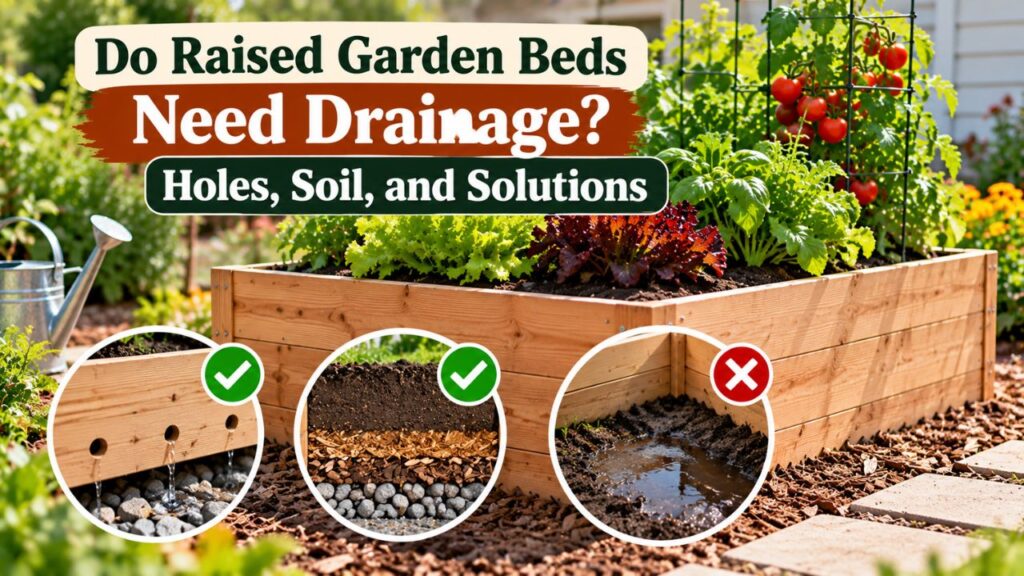
Raised garden beds need drainage holes only when their construction prevents excess water from escaping naturally. An open-bottom bed placed on suitable natural soil usually drains without additional openings, while a solid-bottom planter needs a reliable drainage outlet.
The first step is to identify how your raised bed is constructed.
Drainage Requirements for Different Raised Bed Types
| Raised Bed Type | Drainage Holes Needed? | How Water Escapes |
| Wooden bed with open bottom | Usually no | Through native soil |
| Metal bed with open bottom | Usually no | Through native soil |
| Concrete block bed on soil | Usually no | Through soil and available base openings |
| Raised bed on concrete | Depends on base design | Through an open outlet or drainage gaps |
| Elevated bed with solid bottom | Yes | Through drainage holes or slots |
| Self-watering raised planter | Specialized system | Through designed overflow outlets |
These are general guidelines. A bed may still drain poorly if the underlying ground is compacted, saturated, or blocked by an impermeable barrier.
Open-Bottom Raised Beds Usually Drain Naturally
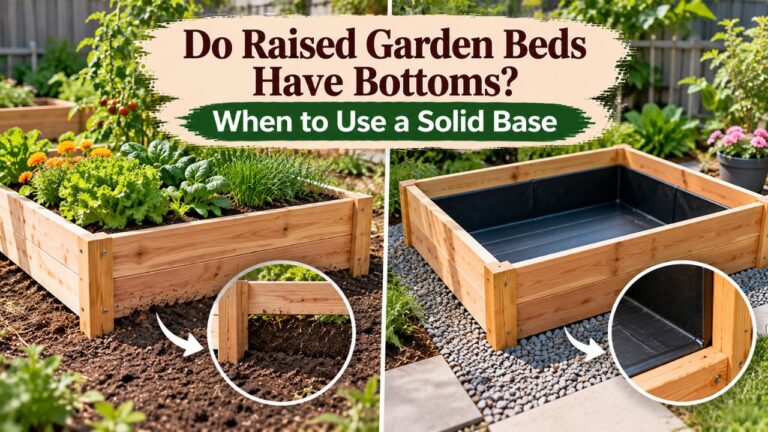
Traditional raised garden beds are built directly over the ground.
Their wooden, metal, or stone sides hold the growing medium in place, while the bottom remains open.
Water moves downward through the raised bed soil and into the native ground.
According to the University of Maryland Extension’s raised bed gardening guidance, raised beds generally drain well because of their loose growing medium and elevated soil level. The guidance also explains that roots can grow into the underlying soil when the bed is placed directly on the ground.
However, the native soil must be able to accept excess water.
If the ground underneath contains severely compacted clay or remains saturated for extended periods, water may accumulate in the raised growing layer.
Raised Beds With Solid Bottoms Need Drainage Openings
An elevated raised garden bed is usually supported on legs and contains a structural bottom.
Unlike an open-bottom bed, water cannot move directly into native soil.
Instead, it must escape through holes, slots, or another designed drainage outlet.
Without these openings, excess water can remain trapped inside the planter.
This creates a saturated root environment, particularly after heavy rain or excessive irrigation.
If you’re building a wooden elevated planter, include a supported base with drainage gaps or a solid base with appropriately designed holes.
Key Takeaway: An open-bottom raised bed generally relies on natural ground drainage. A closed-bottom raised bed needs an engineered outlet for excess water.
Why Proper Drainage Matters in Raised Garden Beds
Drainage is not simply about preventing visible puddles.
Plant roots need both moisture and oxygen to function properly.
Healthy soil contains small spaces between particles and aggregates. Some hold water, while others contain air.
When excess water fills too many of those spaces for too long, oxygen becomes less available to roots.
Poor Drainage Can Restrict Root Growth
Roots use oxygen during respiration, a process that supports their normal functions.
Prolonged saturation can interfere with root growth and nutrient uptake.
Vegetables growing in waterlogged soil may develop:
- Yellowing leaves
- Slow or weak growth
- Wilting despite wet soil
- Poor root development
- Reduced flowering or fruit production
- Increased susceptibility to certain root diseases
These symptoms can also result from unrelated problems.
For example, yellow leaves may indicate nutrient deficiencies or pest damage rather than poor drainage.
Checking the soil’s moisture condition is necessary before identifying waterlogging as the cause.
Excessive Drainage Can Also Cause Problems
Although raised beds need drainage, water should not move through the growing medium so quickly that roots cannot access enough moisture.
Very sandy or coarse soil mixtures may dry rapidly.
This can become especially troublesome during hot weather.
A productive raised bed needs balanced drainage: enough water retention to support plants and enough pore space for air movement.
The goal is not to remove water as quickly as possible.
Instead, excess water should leave the root zone while useful moisture remains available between waterings.
How to Improve Drainage in an Open-Bottom Raised Garden Bed
An open-bottom bed may drain poorly when its growing medium is compacted or the ground beneath it prevents water movement.
If you’re constructing a new bed, preparing the location before filling it can prevent many drainage problems.
Step 1: Choose a Location That Does Not Collect Water
Start by examining the garden after rainfall.
Avoid areas where water consistently collects and remains standing.
Low spots can receive runoff from surrounding slopes, patios, roofs, or other surfaces.
Even a raised planting area can experience drainage problems when the surrounding ground stays saturated.
Choose a reasonably level site where excess water can move away without creating erosion or damaging nearby structures.
If the yard has serious drainage problems, correcting the site’s water movement may be necessary before installing raised beds.
Step 2: Remove Persistent Grass and Weeds
Clear unwanted vegetation from the bed’s footprint.
Pay particular attention to perennial weeds with aggressive underground roots.
Remove large stones, construction debris, and other materials that could interfere with soil preparation.
You do not necessarily need to excavate the entire growing area.
For a conventional open-bottom bed, preparing the existing soil surface is often sufficient.
Step 3: Loosen Compacted Soil Beneath the Bed
If the underlying ground is hard or compacted, use a garden fork to loosen it.
Insert the fork into the soil and gently rock it backward.
Repeat across the planting area without turning over large amounts of subsoil unnecessarily.
This can improve the continuity between the raised growing layer and the native soil.
It also helps roots extend downward when conditions are suitable.
Avoid working wet clay soil because digging or pressing it while saturated can damage its structure.
Important: Loosening compacted soil can improve drainage, but it cannot permanently solve problems caused by a high water table or a site that regularly floods.
Step 4: Add a Well-Draining Soil Mixture
Once the underlying ground is prepared, fill the bed with a suitable growing medium.
For permanent open-bottom beds, good-quality mineral topsoil combined with finished compost is often practical.
A starting mixture may contain:
- Two parts clean, well-structured topsoil
- One part mature compost
These proportions are measured by volume and should be adjusted according to the original soil.
Heavy clay may need more structural improvement, while already fertile loam may require little additional compost.
Avoid using a mixture that contains excessive amounts of fine, compacted soil or poorly decomposed organic matter.
Step 5: Avoid Compressing the Soil During Filling
Add the growing medium gradually and spread it evenly.
Do not repeatedly press or tamp the soil into dense layers.
Excessive compaction reduces the large pore spaces through which water and air move.
Once the bed is filled, keep foot traffic outside the planting area.
A raised bed that can be reached comfortably from the surrounding paths is easier to maintain without stepping on its soil.
Step 6: Check Drainage Before Planting
Water the new growing medium evenly and observe how it responds.
Water should enter the soil rather than repeatedly running across the surface or remaining in prolonged puddles.
After watering, check the moisture below the surface.
If the growing medium remains saturated long after excess water should have drained, investigate the underlying soil and possible obstructions.
A newly filled bed may settle after its first watering, but settling alone does not indicate poor drainage.
How to Add Drainage Holes to Raised Beds With Bottoms
Elevated raised beds, tabletop planters, and other contained growing structures need drainage openings.
The appropriate arrangement depends on the base material, planter dimensions, and intended growing medium.
Drainage Holes in Wooden Raised Planters
Wooden elevated planters commonly use either spaced bottom slats or a solid panel with drainage holes.
If the bottom contains slats, leave suitable gaps that allow water to escape without compromising the strength of the structure.
If the bottom is solid, drill drainage openings according to the planter’s design.
Before drilling:
- Confirm that the bottom is structurally supported.
- Identify locations that won’t damage important framing members.
- Mark openings across the base rather than concentrating them in one small area.
- Drill openings using a suitable bit for the material.
- Remove loose debris and check that water can escape freely.
- Add a water-permeable liner if needed to retain growing medium.
The number and diameter of holes depend on the planter’s size, base design, and growing medium.
There is no single hole pattern suitable for every elevated raised bed.
Avoid drilling through structural supports or weakening load-bearing components.
Drainage Holes in Plastic Raised Planters
Plastic raised planters with solid bottoms need drainage openings unless they have a manufacturer-designed reservoir and overflow system.
Some products already include drainage holes or removable plugs.
Check the instructions before modifying the planter.
If additional openings are permitted, use a suitable drill bit and avoid creating cracks around the holes.
Keep the openings clear so growing medium and debris don’t block water movement.
Drainage in Metal Raised Garden Beds
Most conventional metal raised bed kits have open bottoms.
When installed directly over suitable natural ground, they generally don’t require extra drainage holes in their sidewalls.
However, metal planters with enclosed bottoms need appropriate drainage openings.
Check the manufacturer’s construction details before drilling or modifying the metal.
Use proper tools and protect exposed edges from corrosion when necessary.
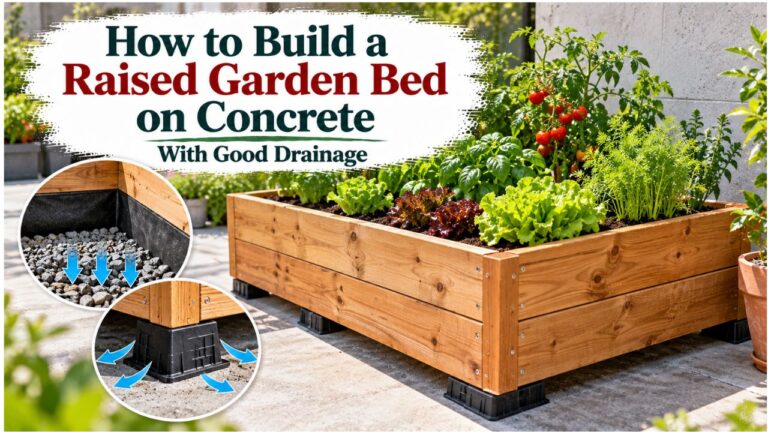
Do Raised Garden Beds on Concrete Need Drainage?
Yes. Raised garden beds installed on concrete need a reliable way for water to escape.
Concrete is generally an impermeable surface, so water cannot drain downward through it as it would through healthy natural soil.
The bed must therefore provide another drainage route.
Open-Bottom Raised Beds on Concrete
An open-bottom frame placed directly on concrete may allow water to move sideways and exit around its lower edges.
However, this only works when the construction actually provides a clear drainage path.
A tightly sealed frame can trap water against the concrete.
When installing a raised bed over pavement:
- Check whether water can escape beneath or around the frame.
- Avoid sealing the entire perimeter without drainage outlets.
- Use suitable spacers or designed openings where necessary.
- Make sure discharged water can flow away safely.
- Avoid allowing runoff to collect against building foundations.
The surrounding concrete’s slope and drainage arrangement also affect the result.
Elevated Raised Beds on Patios
Elevated planters supported on legs behave more like large containers.
They need drainage openings through the bottom and enough clearance for water to escape.
The University of Maryland Extension’s container vegetable gardening guidance recommends adequate drainage holes or slits in containers to prevent saturated growing media and root problems.
For elevated planters, the base must also support the weight of wet growing medium.
Water-permeable landscape fabric can help retain soil above drainage gaps, but it cannot replace a structural bottom.
Should You Put a Drainage Tray Under an Elevated Bed?
A tray can help collect runoff when a planter is located on a patio or deck.
However, it should not keep the planter sitting in accumulated water.
Empty the tray when necessary and maintain clearance between the drainage outlets and collected water.
For large elevated planters, a designed drainage collection system may be more convenient than a shallow tray.
Should You Put Gravel or Rocks at the Bottom of Raised Beds for Drainage?
No, adding a gravel or rock layer beneath the growing medium is generally unnecessary and does not automatically improve drainage.
This is especially important for raised planters with solid bottoms.
A coarse layer beneath finer growing medium can create a sharp difference in pore sizes.
Water may remain in the finer material above the gravel until enough moisture accumulates for water to move into the coarse layer.
This condition is commonly associated with a perched water table.
Why Gravel Layers Can Make Drainage Worse
A layer of rocks occupies space that could otherwise support plant roots.
It also fails to correct blocked outlets, compacted growing media, or poor site drainage.
For contained planters, adding gravel can raise the zone of saturated soil closer to the roots.
Instead of filling the bottom with rocks, use:
- A suitable, well-aerated growing medium
- Working drainage openings
- A properly supported planter base
- Adequate soil depth for the crops
Gravel may have a role in engineered drainage systems with appropriate outlets and separation materials, but that’s different from casually placing stones beneath potting mix.
Should You Put Sand at the Bottom?
A separate sand layer is generally not necessary for ordinary raised garden beds.
Sand does not automatically improve drainage when placed beneath a different soil mixture.
If the main growing soil is compacted clay, a small amount of added sand may provide little benefit.
Improving the existing soil structure, choosing suitable topsoil, or correcting the drainage route is usually more effective.
What Soil Is Best for Raised Garden Bed Drainage?
The ideal growing medium depends on whether the bed is connected to native soil or has a contained bottom.
Drainage depends on soil structure, the balance of particle sizes, organic matter, and the availability of connected pore spaces.
Soil for Open-Bottom Raised Beds
For permanent beds placed over natural ground, a combination of suitable mineral topsoil and mature compost is often effective.
Good mineral soil provides structural stability and nutrient-holding capacity.
Compost can help improve soil aggregation and moisture management.
Avoid excessive quantities of compost, particularly if the existing soil already contains high levels of organic matter.
The goal is a workable, crumbly growing medium rather than a mixture that is unusually coarse or lightweight.
Soil for Elevated Raised Beds
Elevated planters have restricted rooting volume and cannot drain directly into natural ground.
A lightweight growing mix designed for containers or elevated planters is often preferable.
These mixes may contain materials such as:
- Coconut coir or peat
- Composted bark
- Perlite
- Vermiculite
- Mature compost
The proportions vary between products.
Choose a growing medium that provides moisture retention and adequate aeration for the intended crops.
Avoid filling a shallow elevated planter entirely with dense native clay soil.
How Soil Type Affects Drainage
| Soil Type | Drainage Behavior | Main Consideration |
| Sandy soil | Usually drains quickly | May dry out too fast |
| Loamy soil | Often balances drainage and retention | Maintain good structure |
| Clay-heavy soil | Can drain slowly when compacted | Improve structure and site drainage |
| Compost-rich mix | Depends on ingredients and maturity | Avoid excessive organic matter |
| Container potting mix | Designed for contained growing | Choose suitable water retention |
The same soil type may behave differently depending on compaction, moisture, and how the bed is constructed.
How to Tell if Your Raised Garden Bed Has Poor Drainage
Waterlogging isn’t always obvious from the soil surface.
The upper layer may look relatively dry while the soil deeper around the roots remains saturated.
Check more than one location before deciding that drainage is the problem.
Signs of Poor Raised Bed Drainage
Common warning signs include:
- Water remaining in puddles after irrigation or rainfall
- Soil staying excessively wet for extended periods
- Plants wilting despite consistently damp soil
- Yellow leaves accompanied by wet growing conditions
- A sour or unpleasant smell from saturated soil
- Roots appearing soft, dark, or decayed
- Slow plant growth in an otherwise suitable location
None of these signs confirms a drainage problem on its own.
For example, wilting may also result from heat, root damage, or insufficient water.
Evaluate soil moisture and root conditions before choosing a treatment.
How to Check Drainage in an Existing Raised Bed
Use the following process to investigate suspected waterlogging:
- Check below the surface. Use a hand trowel to examine soil several inches deep without damaging major roots.
- Feel the soil. Determine whether it is moist and crumbly or saturated and sticky.
- Inspect for standing water. Look for puddles around the bed or water accumulating at drainage outlets.
- Check the bottom construction. Confirm that the bed does not have a blocked or waterproof base.
- Examine the growing medium. Look for dense compaction or unsuitable layers.
- Review watering habits. Determine whether frequent irrigation is keeping the soil saturated.
Compare the results with nearby beds or areas that support healthy plants.
If the bed remains consistently wet despite moderate watering, investigate its drainage pathway before adding more amendments.
How to Fix Poor Drainage in Raised Garden Beds
The best solution depends on the cause.
Adding extra holes will not solve every problem, particularly when the bed already has an open bottom.
Raised Bed Drainage Problems and Solutions
| Problem | Likely Cause | Practical Solution |
| Water pools on the surface | Compacted soil or poor infiltration | Improve structure and reduce compaction |
| Soil stays wet near the bottom | Blocked outlet or saturated underlying ground | Check and correct drainage pathway |
| Elevated planter holds water | Missing or blocked drainage holes | Provide adequate outlets |
| Clay soil stays sticky | Dense soil structure | Loosen when workable and amend as appropriate |
| Water trapped above plastic | Waterproof bottom liner | Remove or redesign the barrier |
| Soil dries very quickly | Coarse mix or limited soil volume | Improve moisture retention and watering |
| Water collects around the bed | Low site or poor surrounding drainage | Redirect runoff or relocate the bed |
Fixing Drainage in Heavy Clay Soil
Clay-rich soil often has small pore spaces that can slow water movement, especially when compacted.
If your raised bed contains heavy clay, avoid digging while the soil is saturated.
Wait until it becomes workable, then gently loosen compacted areas.
Mature compost may improve aggregation over time.
If the soil is extremely dense, incorporating suitable, well-structured topsoil into a new raised growing layer may help.
However, soil amendments cannot correct every drainage problem beneath the bed.
Persistent waterlogging may require choosing a better site or installing a properly designed drainage solution.
Fixing Drainage in a Bed With a Plastic Bottom Liner
If waterproof plastic covers the entire bottom, check whether it prevents water from escaping.
For a traditional open-bottom bed, removing the bottom plastic is usually preferable to relying on a few improvised punctures.
Plastic can remain along wooden sidewalls if it serves a useful protective purpose.
For a solid-bottom planter, drainage outlets must be properly designed and remain open.
Fixing Drainage in an Elevated Raised Bed
Inspect the bottom drainage holes and the space beneath the planter.
Remove any debris that blocks water movement.
If the growing medium is compacted or unsuitable, it may need partial or complete replacement with a container-style growing mix.
Avoid adding rocks to the bottom as a substitute for working drainage outlets.
If the planter is structurally sound, improving the medium and restoring the drainage path may be enough.
How to Prevent Raised Bed Soil From Becoming Waterlogged
Good drainage starts with construction and soil preparation, but watering practices also matter.
Even a well-designed raised bed can remain excessively wet if irrigation continues when the soil is already saturated.
Water According to Soil Moisture
Don’t assume every raised bed needs water on the same schedule.
Check the soil below the surface before irrigating.
For many vegetables, examining moisture approximately 2–3 inches below the surface provides a useful starting check, although deeper-rooted crops also need moisture farther down.
Water thoroughly when needed, then allow excess water to drain.
Adjust frequency according to weather, plant maturity, soil type, and the bed’s construction.
Use Drip Irrigation When Appropriate
Drip irrigation can apply water directly to the root zone.
It can help reduce unnecessary surface wetting and make watering more consistent.
However, the system must still be adjusted to match the soil’s moisture needs.
A drip system running too frequently can contribute to waterlogging just like overhead watering.
Add Mulch to Moderate Moisture Changes
Organic mulch helps protect the surface from excessive drying and rainfall impact.
Suitable materials include clean straw and shredded leaves.
Mulch does not replace functional drainage, but it can help maintain more consistent moisture conditions between watering periods.
Avoid placing thick mulch directly against plant stems.
Keep the Growing Area Free From Foot Traffic
Repeated walking compresses soil and reduces pore spaces.
Keep paths outside the raised bed and use a garden fork gently if localized compaction develops.
Maintaining soil structure helps water and air move more effectively through the growing medium.
Conclusion
So, do raised garden beds need drainage? Yes. Every raised garden bed needs a reliable way for excess water to escape, but that doesn’t mean every bed requires drilled holes or a special drainage layer.
Traditional open-bottom beds placed over well-drained natural soil usually drain without additional openings. Elevated planters and beds with solid bottoms need appropriate drainage outlets.
For beds on concrete or poorly drained ground, the most important consideration is where the water will go after leaving the growing medium.
Avoid unnecessary gravel layers, waterproof bottom liners, and excessive soil compaction. Instead, focus on a suitable growing medium, an unobstructed drainage route, and watering based on actual soil moisture.
A well-drained raised bed should retain enough water for healthy plant growth without keeping the root zone saturated for prolonged periods.
FAQs About Do Raised Garden Beds Need Drainage
Do Raised Garden Beds Need Holes in the Bottom?
Open-bottom raised garden beds usually don’t need drilled holes because water can drain into the soil underneath. Raised beds with solid bottoms need suitable drainage holes, slots, or another designed outlet.
Should I Put Rocks at the Bottom of My Raised Garden Bed for Drainage?
No. A rock or gravel layer is generally unnecessary and does not improve drainage in a contained planter. It may leave water perched in the finer soil above the rocks and reduce the space available for roots.
Do Metal Raised Garden Beds Need Drainage Holes?
Most metal raised bed kits have open bottoms and can drain naturally into suitable soil. If a metal planter has a solid bottom, it needs an effective drainage system.
Can a Raised Garden Bed Have Too Much Drainage?
Yes. Extremely coarse or sandy growing media can lose water quickly, especially during hot weather. Plants still need sufficient moisture retention, so the goal is balanced drainage rather than removing water as fast as possible.
Do Raised Garden Beds Drain Better Than In-Ground Gardens?
Often, yes. Their elevated soil level and loose growing medium can improve drainage compared with compacted ground-level soil. However, drainage still depends on the underlying ground, soil structure, and bed design.
Can I Use Landscape Fabric at the Bottom of a Raised Bed?
Yes, water-permeable landscape fabric can help retain growing medium in some elevated planters. However, it isn’t usually needed beneath an open-bottom bed on healthy natural soil, and it does not replace a proper drainage route.
How Do I Fix a Raised Bed That Holds Too Much Water?
First, check whether the bottom is blocked and whether the underlying soil drains adequately. Correct any drainage obstructions, avoid overwatering, and improve compacted soil when it is workable. Persistent site drainage problems may require a different location or a designed drainage system.

I’m Maya L. Greenwood, a lifelong plant lover who believes anyone can grow something beautiful with the right guidance. After years of testing soil mixes, pruning methods, irrigation tricks, and pest-safe solutions, I started EasyGardenTips.com to turn hard-won lessons into step-by-step advice. From seed starting and container gardens to composting and seasonal checklists, my goal is to make gardening simple, sustainable, and fun.