3 Best Hydroponic LED Grow Lights for Serious Indoor Growing
Hydroponic plants can grow rapidly when light, nutrient solution, temperature, oxygenation, and environmental conditions remain well balanced. The best hydroponic LED grow lights should therefore provide strong usable photon output without creating severe hotspots or forcing every plant in the system to grow under a different intensity.
For larger DWC, drip, ebb-and-flow, Dutch-bucket, and other indoor hydroponic systems, I would prioritize PPF, system PPE, canopy PPFD uniformity, dimming, thermal management, and realistic footprint. A powerful LED cannot compensate for poor nutrient management, but a well-matched fixture makes it much easier to maintain a productive, evenly illuminated canopy.
My primary recommendation is the Spider Farmer SF7000 650W LED Grow Light. I would choose it for most large hydroponic gardens because its current listing combines 650W actual power, Samsung LM301B diodes, 2.8 µmol/J efficiency, approximately 1,786 µmol/s PPF, dimming, uniform-PPFD emphasis, and commercial 5×5 coverage.
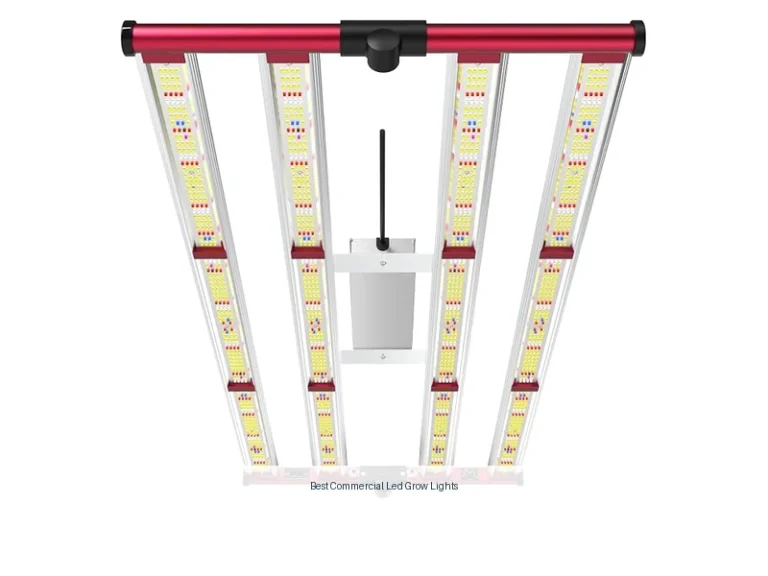
I would choose the MARS HYDRO FC-E8000 800W LED Grow Light when maximum photon headroom matters more than minimizing electrical load. Its current listing specifies 800W input, 2.8 µmol/J system PPE, approximately 2,240 µmol/s PPF, Bridgelux 2835 diodes, Osram 660nm supplementation, a foldable bar layout, and maximum 5×5 coverage.
For growers who want automation and multi-light scalability, I would choose the Spider Farmer SE7000 730W LED Grow Light. The current listing specifies 730W power, approximately 2,146 µmol/s output, app control, bar-style construction, dimming, daisy chaining, detachable-driver capability, and 5×5/vertical-rack positioning.
3 Best Hydroponic LED Grow Lights Reviewed
| Image | Product Name | Check Price |
|---|---|---|
Best Choice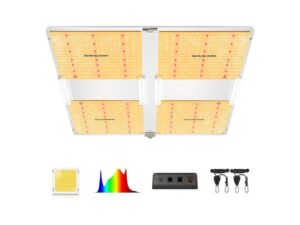 | Spider Farmer SF7000 650W LED Grow Light | Check Price |
Second Best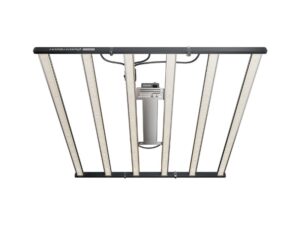 | MARS HYDRO FC-E8000 800W LED Grow Light | Check Price |
Third Choice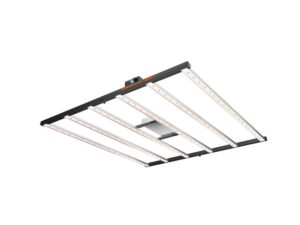 | Spider Farmer SE7000 730W LED Grow Light | Check Price |
1. Spider Farmer SF7000 650W LED Grow Light
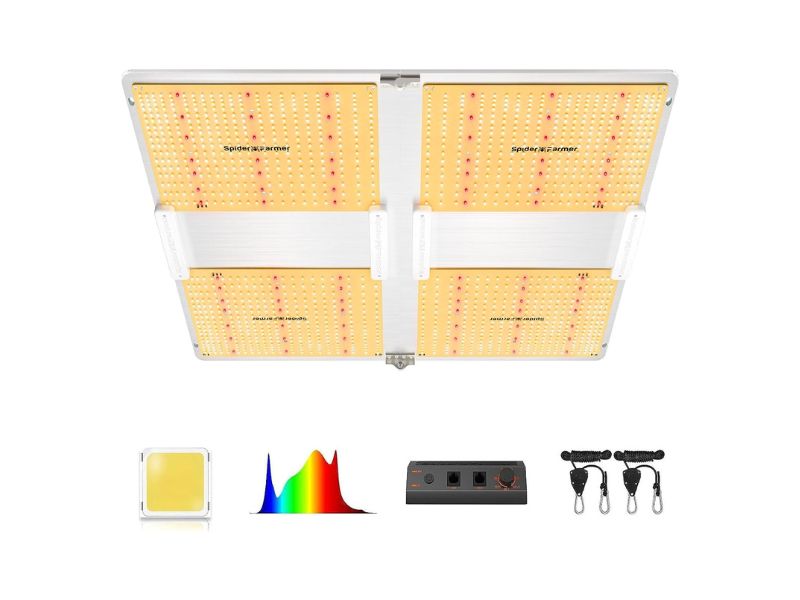
Key Features
- 650W actual power
- Samsung LM301B diodes
- 2.8 µmol/J photon efficiency
- Approx. 1,786 µmol/s PPF
- Full-spectrum output
- Dimmable
- Uniform-PPFD design emphasis
- Fanless operation
- Commercial 5×5 coverage
The Spider Farmer SF7000 is my primary recommendation because 650W is a useful middle ground for a serious hydroponic canopy.
Its current Amazon listing specifies 650W power, Samsung LM301B LEDs, 2.8 µmol/J efficiency, approximately 1,786 µmol/s PPF, and commercial 5×5 coverage.
That combination gives a hydroponic grower considerable photon capacity without automatically jumping to the 730–800W electrical range.
This matters because hydroponic systems already contain several electrical loads.
A typical indoor setup may include:
- Water pumps
- Air pumps
- Circulation fans
- Exhaust equipment
- Dehumidification
- Environmental controllers
Lighting is only one part of the system.
Reducing unnecessary light wattage can therefore make heat and circuit management easier.
The 1,786 µmol/s PPF figure describes the total photosynthetically active photon output produced by the fixture.
That is useful because hydroponic plants can quickly form a dense canopy under favorable conditions.
Once leaves cover most of a 5×5 footprint, total available photon output becomes much more important than it was during early propagation.
I would consider the SF7000 particularly useful for hydroponic:
- Tomatoes
- Peppers
- Cucumbers
- Large herbs
- Leafy greens at scale
- Fruiting vegetables
- Mixed high-light systems
The wide light-emitting layout is also valuable.
Hydroponic systems often create very regular plant spacing.
For example, sites in a DWC or Dutch-bucket layout may be arranged evenly across a reservoir or frame.
That makes inconsistent lighting particularly obvious.
If center plants receive significantly higher PPFD than plants at the edges, you can end up with:
- Different growth rates
- Different nutrient demand
- Different water use
- Different canopy heights
Uniform lighting helps keep the crop more predictable.
Spider Farmer specifically markets the SF7000 around uniform PPFD and 5×5 commercial coverage.
Dimming is essential for hydroponics because plant growth can accelerate quickly.
Small rooted cuttings or seedlings do not need the same intensity as a mature canopy.
Instead of starting at full 650W, I would adjust output according to plant size and response.
A practical progression is:
Lower intensity during establishment → moderate intensity as roots and leaves expand → higher intensity for a mature canopy.
That approach helps prevent wasting electricity when plants cannot yet intercept most of the available photons.
The 2.8 µmol/J efficiency figure is also useful for hydroponic growers operating lights for long daily photoperiods.
PPE measures photon output for each joule of electrical input.
Higher efficiency can help reduce the amount of electrical energy needed for a given photon target.
The fanless construction avoids small fixture fans and their associated noise.
That is useful in a grow room already containing air pumps, water pumps, and ventilation equipment.
But fanless does not mean heatless.
A 650W fixture still adds substantial heat to the room.
Hydroponic systems deserve particular attention to temperature because warm grow rooms can also warm reservoirs.
That can influence dissolved oxygen and root-zone conditions.
I would therefore treat lighting and reservoir management as connected parts of the same environment.
What I Like
- Strong 1,786 µmol/s photon output
- Efficient 2.8 µmol/J system
- Samsung LM301B diode platform
- Good 5×5-class coverage
- Dimming
- Strong Amazon rating history
- Lower electrical load than 730–800W alternatives
What I Do Not Like
- Still too large for compact hydroponic herb systems
- Significant heat load
- Large fixture requires dedicated overhead space
- No deeply integrated smart-control platform
The SF7000 is the fixture I would choose for most large home hydroponic setups because it balances photon output, efficiency, 5×5 coverage, and manageable power demand better than the higher-wattage alternatives.
2. MARS HYDRO FC-E8000 800W LED Grow Light
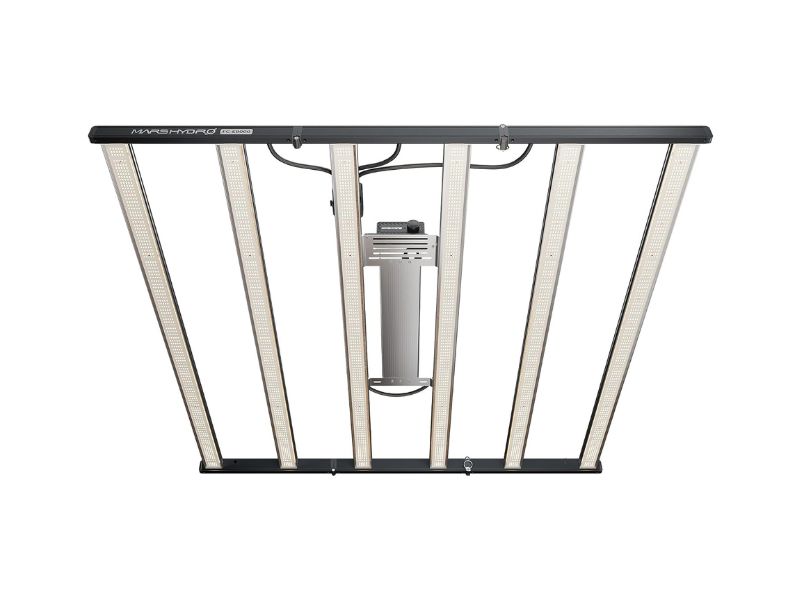
Key Features
- 800W actual input
- 2.8 µmol/J system PPE
- Approx. 2,240 µmol/s PPF
- Bridgelux 2835 LEDs
- Osram 660nm red LEDs
- Full-spectrum output
- Foldable multi-bar construction
- Dimmable
- Maximum 5×5 coverage
The FC-E8000 is my choice for a large hydroponic grower who wants more photon capacity than the SF7000 provides.
Its current Amazon listing specifies 800W input, 2.8 µmol/J PPE, approximately 2,240 µmol/s PPF, Bridgelux 2835 diodes, enhanced Osram 660nm output, and maximum 5×5 coverage.
Approximately 2,240 µmol/s is a substantial photon budget.
That can be valuable in a mature hydroponic garden where rapid vegetative development has produced a full canopy.
The key word is mature.
A hydroponic system can grow plants quickly, but running an 800W fixture at full output over a partially filled canopy is still inefficient.
Much of the light may fall onto:
- Reservoir lids
- Floor
- Walls
- Empty spaces between young plants
rather than leaves.
Dimming lets you scale output as the plant canopy catches up.
The multi-bar layout is particularly appropriate for hydroponics.
Hydroponic beds and bucket systems tend to occupy rectangular areas.
A physically distributed fixture can spread diodes over more of that same footprint.
That improves the chance that each plant site receives similar intensity.
The bar format can also allow better airflow around the fixture compared with one dense central light source.
The FC-E8000’s 2.8 µmol/J system PPE is another reason I would consider it for intensive indoor production.
At 800W, efficiency becomes financially and thermally important.
If a large fixture operates every day, even relatively small efficiency differences accumulate over time.
The current configuration includes Bridgelux 2835 diodes and Osram 660nm deep-red supplementation.
That broad-spectrum design works across multiple growth stages.
However, I would not buy the FC-E8000 because of the 660nm specification alone.
The bigger reasons are:
total PPF + system PPE + wide distribution + dimming.
Hydroponic growing is especially sensitive to environmental balance.
High photon intensity can drive:
- Faster transpiration
- Faster nutrient uptake
- Higher water use
- Greater cooling demand
If light intensity increases dramatically but nutrient strength, root oxygen, temperature, and humidity remain poorly controlled, the extra photons may not translate into proportional growth.
This is why I would consider the FC-E8000 more appropriate for growers who already have a stable hydroponic environment.
The 800W electrical load also requires thermal planning.
At 12 hours per day:
0.8 kW × 12 = 9.6 kWh/day
Over 30 days:
288 kWh/month
At 16 hours:
0.8 × 16 = 12.8 kWh/day
Over 30 days:
384 kWh/month
Those calculations are for full power.
Actual use falls when the fixture is dimmed.
The FC-E8000’s foldable design also helps during installation.
Hydroponic systems often occupy a lot of floor space, leaving limited room to maneuver a large rigid fixture.
A foldable frame is easier to transport through a grow room before opening it over the canopy.
What I Like
- Highest total photon output here
- Approx. 2,240 µmol/s PPF
- Strong 2.8 µmol/J system PPE
- Distributed multi-bar architecture
- Excellent mature 5×5 canopy potential
- Dimmable
- Foldable design
What I Do Not Like
- 800W creates the highest heat load here
- Large electrical demand
- Excessive for small hydroponic systems
- Full output requires strong environmental management
The FC-E8000 is the hydroponic light I would choose when maximum 5×5 photon headroom is the priority and the grow room is already equipped to manage the additional heat and electrical load.
3. Spider Farmer SE7000 730W LED Grow Light
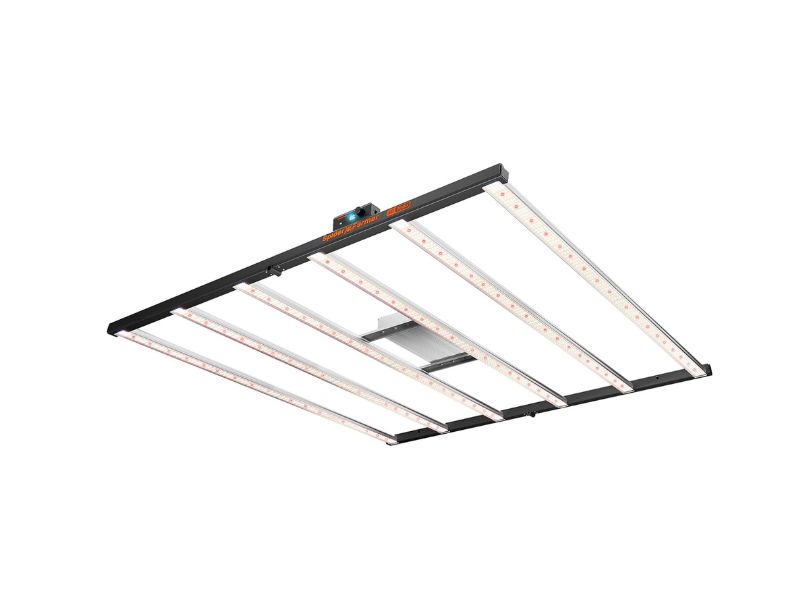
Key Features
- 730W actual power
- Approx. 2,146 µmol/s PPF
- Premium Bridgelux diode platform
- Osram Hyper Red supplementation
- Full-spectrum output
- Bar-style construction
- App control
- Digital dimming
- Daisy-chain operation
- Detachable driver
- 5×5 grow-tent / vertical-rack positioning
The SE7000 is my choice for hydroponic growers who value automation and multi-fixture scalability.
The current Amazon listing identifies the 2026 SE7000 as a 730W commercial LED fixture producing approximately 2,146 µmol/s, with app control, dimming, bar-style construction, daisy-chain operation, a detachable driver, and support for 5×5 grow tents or vertical grow racks.
That feature combination is particularly relevant to hydroponics.
Hydroponic systems are already highly equipment-driven.
You may be managing:
- Pump cycles
- Aeration
- Nutrient EC
- pH
- Temperature
- Humidity
- Ventilation
Adding lighting automation can reduce one more repetitive manual task.
The app and digital dimming make it easier to maintain a repeatable lighting schedule.
That can be useful when comparing crop cycles or changing intensity as a hydroponic canopy develops.
Spider Farmer also supports multi-light daisy-chain operation on the current SE7000.
That becomes useful when a single reservoir or grow room expands into multiple production zones.
Instead of adjusting several fixtures independently, compatible lights can be coordinated from a master system.
The 2,146 µmol/s listed photon output is very high for a 730W fixture.
Using the published figures:
2,146 ÷ 730 ≈ 2.94 µmol/J
That is a calculated output-to-input relationship based on the current listing, not a separately certified manufacturer system-PPE figure.
Still, it shows why the SE7000 is technically attractive.
The bar architecture also suits hydroponic beds well.
Plants arranged in rows or grids benefit from a wide fixture that distributes light across the same geometry.
Uniform PPFD can help maintain more even:
- Growth rate
- Canopy height
- Water demand
- Maturation
throughout the system.
The detachable driver gives you more flexibility with heat management.
Drivers produce heat, and moving the driver away from the immediate canopy can help keep that localized heat away from the plants and reservoir.
This does not eliminate total room heat.
It simply changes where part of it is released.
That can still be valuable in hydroponic systems where keeping nutrient-solution temperature stable is important.
The current listing also positions the SE7000 for vertical grow racks.
That makes it particularly interesting for advanced hydroponic operations using stacked production.
Fixture shape and distributed output become more important in racks because vertical clearance is more constrained than in a standard tent.
The primary downside is complexity.
If you have one hydroponic bucket and one light, app control and large-scale daisy chaining may be unnecessary.
A simpler manually dimmed fixture can work perfectly well.
The SE7000 becomes more compelling as the grow system becomes larger.
What I Like
- High ~2,146 µmol/s output
- 730W commercial power class
- Wide bar-style distribution
- App control
- Digital dimming
- Daisy chaining
- Detachable driver
- Vertical-rack compatibility
What I Do Not Like
- More control complexity than simple setups need
- Significant heat and electrical load
- Large fixture footprint
- Current exact Amazon listing has much less rating history than SF7000
The SE7000 is the light I would choose when a hydroponic garden needs high output plus smart scheduling, centralized dimming, and room to scale into multiple fixtures or vertical production.
Hydroponic LED Grow Lights Comparison
| Product | Actual Power | Published PPF | Efficiency | Fixture Style | Smart Control | Best Hydroponic Use |
| Spider Farmer SF7000 | 650W | ~1,786 µmol/s | 2.8 µmol/J | Broad distributed fixture | Manual dimming | Balanced 5×5 hydroponics |
| MARS HYDRO FC-E8000 | 800W | ~2,240 µmol/s | 2.8 µmol/J | Foldable multi-bar | Controller dependent | Maximum-output 5×5 |
| Spider Farmer SE7000 | 730W | ~2,146 µmol/s | ~2.94 µmol/J calculated | Bar style | App + daisy chain | Smart/vertical systems |
The SF7000 offers the most balanced electrical load, FC-E8000 delivers the highest published total photon output, and SE7000 provides the strongest automation and multi-fixture control package.
How to Choose the Best Hydroponic LED Grow Lights
Start With Hydroponic Canopy Size
Do not size the light only by reservoir dimensions.
Measure the canopy you expect when plants mature.
A young tomato in one bucket may occupy very little space.
Several weeks later, the same plant can occupy several square feet.
Lighting should be sized around the mature active canopy.
PPF Matters More Than Marketing Wattage
PPF measures the total photosynthetically active photons emitted per second.
The three selected fixtures range from approximately 1,786 to 2,240 µmol/s.
That tells you much more about total horticultural output than a model number.
System PPE Helps Compare Efficiency
PPE measures photosynthetic photon output per joule of electricity.
SF7000 and FC-E8000 both publish approximately 2.8 µmol/J.
For hydroponic systems running many hours daily, efficiency can materially affect power consumption and cooling requirements.
PPFD Tells You What Plants Actually Receive
PPF measures total fixture output.
PPFD measures photon density reaching a particular area of the canopy.
That makes PPFD especially useful for hydroponics because plant sites are often evenly spaced.
Check the entire PPFD map rather than one peak center value.
Uniformity Is Critical in Hydroponics
Uniform lighting can help keep plants growing at similar rates.
That is particularly useful in:
- DWC systems
- NFT channels
- Dutch-bucket rows
- Ebb-and-flow tables
- Drip systems
A powerful hotspot over one section can cause uneven growth even when irrigation and nutrients are identical.
Best LED Grow Light for DWC
For a large DWC canopy, I would choose SF7000 for balanced output or SE7000 if smart controls are useful.
Both provide broad large-area illumination.
For a smaller DWC bucket setup, I would move down to a lower-wattage fixture rather than dim one of these large lights permanently.
Best LED Grow Light for NFT
NFT systems are often long and narrow.
The ideal light geometry should follow the channel layout.
For a large rectangular NFT bed, distributed bars can work very well.
For narrow vertical or shelf-based NFT channels, smaller linear fixtures may be more appropriate than these 5×5-class lights.
Best LED Grow Light for Dutch Buckets
Large fruiting crops grown in Dutch buckets can develop substantial canopies.
That makes the SF7000, FC-E8000, and SE7000 more relevant than they would be for small leafy greens.
For maximum photon headroom, FC-E8000 is the strongest of these three.
Best Hydroponic Grow Light for Tomatoes
Hydroponic tomatoes can become large and light-demanding.
For a mature 5×5 tomato canopy, I would favor SF7000 for balanced electrical demand.
If the environment can fully support greater intensity, FC-E8000 provides additional photon capacity.
Best Hydroponic Grow Light for Peppers
Peppers also benefit from strong, evenly distributed illumination once mature.
SE7000 is particularly attractive when you want programmable intensity changes throughout the crop cycle.
Best Hydroponic Grow Light for Lettuce
These fixtures are usually excessive for a small lettuce system.
Large commercial-style lettuce beds may benefit from broad uniform lighting, but full 650–800W output may be unnecessary.
For leafy greens, uniform moderate PPFD can be more useful than extreme intensity.
Best Hydroponic Grow Light for Herbs
For a small basil or herb system, I would buy a smaller LED.
These large fixtures make more sense for broad multi-plant installations.
If using one over a large herb canopy, dim it to match the crop rather than operating at maximum power unnecessarily.
Hydroponic Seedlings Need Less Light
Young seedlings do not need 650–800W at full intensity.
A large dimmable fixture can still be used if seedlings will remain in the same grow room, but start at much lower output.
A dedicated propagation light is often more efficient for seedling-only systems.
Dimming Is Essential
Hydroponic plant growth can change quickly.
A dimmer lets output track canopy development.
This helps reduce:
- Excess electricity
- Heat
- Light stress
- Wasted photons on empty growing area
All three selected fixtures support intensity adjustment.
Light Intensity and Nutrient Demand Are Connected
More light can support faster growth when all other conditions are suitable.
Faster growth may increase:
- Water consumption
- Nutrient uptake
- Transpiration
That means lighting changes should be considered alongside nutrient and environmental monitoring rather than in isolation.
Reservoir Temperature Matters
High-wattage grow lights can warm the surrounding air.
That can indirectly raise hydroponic nutrient-solution temperature.
A large system should therefore monitor both:
- Air temperature
- Reservoir temperature
Remote or detachable driver placement can help manage localized heat, although it does not eliminate total heat production.
Root Oxygen Still Matters
A brighter grow light cannot compensate for poorly oxygenated roots.
DWC growers in particular should treat lighting and aeration as independent essentials.
Healthy leaves require both adequate photons and healthy root-zone conditions.
Smart Controls Are Useful, Not Necessary
SE7000 offers app control and daisy chaining.
That is useful for larger rooms.
A simple timer and manual dimmer can still produce an excellent hydroponic lighting schedule.
Automation helps with consistency rather than creating a unique biological advantage.
Bar Fixtures Work Well Over Hydroponic Tables
Hydroponic systems frequently use rectangular beds.
Bar fixtures naturally spread diodes across that area.
This can improve:
- Edge PPFD
- Air movement
- Uniformity
- Heat distribution
compared with a highly concentrated central source.
Electricity Use of a 650W Hydroponic Light
At 16 hours daily:
0.65 × 16 = 10.4 kWh/day
Over 30 days:
312 kWh/month
Electricity Use of a 730W Hydroponic Light
At 16 hours:
0.73 × 16 = 11.68 kWh/day
Over 30 days:
350.4 kWh/month
Electricity Use of an 800W Hydroponic Light
At 16 hours:
0.8 × 16 = 12.8 kWh/day
Over 30 days:
384 kWh/month
These figures assume full output.
Dimming can reduce actual consumption.
Electrical Load Includes Pumps Too
Do not calculate circuit capacity from the light alone.
A hydroponic system can include:
- Air pumps
- Water pumps
- Fans
- Dehumidifier
- Heater or chiller
- Controllers
Use actual input wattage for all connected equipment.
Protect Electricity From Water
Hydroponic gardens combine water and electrical equipment.
Keep:
- Plugs
- Power strips
- Controllers
- Drivers
- Connections
away from leaks, splashes, and standing nutrient solution.
Use appropriately rated electrical equipment for the environment.
Common Hydroponic Grow-Light Mistakes
Buying by Wattage Alone
Compare PPF, PPE, and PPFD distribution.
Using Full Power Too Early
Match intensity to canopy development.
Ignoring Edge Plants
Uniformity affects the whole crop.
Ignoring Reservoir Heat
Large lights can affect the entire grow-room temperature.
Assuming More Light Always Means Faster Growth
Nutrition, roots, CO₂ availability, water, and climate can become limiting.
Buying a 5×5 Fixture for a Tiny Hydroponic System
Match output to the actual canopy.
Ignoring Electrical Load From Pumps and HVAC
Calculate the whole system.
Letting Electrical Connections Sit Near Water
Design for separation between irrigation and power equipment.
Frequently Asked Questions
What are the best hydroponic LED grow lights?
Spider Farmer SF7000, MARS HYDRO FC-E8000, and Spider Farmer SE7000 are my three choices.
They combine strong photon output, broad coverage, dimming, and large-canopy suitability for serious indoor hydroponic systems.
Which hydroponic LED grow light is my primary recommendation?
Spider Farmer SF7000 is my primary recommendation for balanced 5×5 hydroponic performance.
It combines 650W input, Samsung LM301B diodes, approximately 1,786 µmol/s PPF, and 2.8 µmol/J efficiency.
Which hydroponic light has the highest PPF?
MARS HYDRO FC-E8000 publishes approximately 2,240 µmol/s PPF.
That gives it the highest listed total photon output among these three fixtures.
Which hydroponic grow light has the best smart controls?
Spider Farmer SE7000 is the strongest automation-focused choice here.
Its current configuration supports app control, digital dimming, and multi-light daisy chaining.
Is 650W enough for a 5×5 hydroponic grow?
Yes, an efficient 650W fixture can provide substantial photon output across a 5×5 canopy.
SF7000 is specifically positioned for commercial 5×5 coverage.
Is 800W too much for hydroponics?
It can be excessive for small systems but useful for a mature high-light 5×5 canopy.
The FC-E8000 is dimmable, allowing output to be reduced when full 800W capacity is unnecessary.
Is 730W good for hydroponic growing?
Yes, particularly for large canopies that can use substantial photon output.
The SE7000 currently produces approximately 2,146 µmol/s from its 730W platform.
Which light is best for hydroponic tomatoes?
I would start with SF7000 for balance and FC-E8000 when greater photon headroom is justified.
Mature hydroponic tomato plants can fill large canopies and benefit from broad overhead distribution.
Which light is best for hydroponic peppers?
SF7000 and SE7000 are both strong choices for a large mature pepper canopy.
SE7000 becomes especially useful when programmable intensity and remote control matter.
Which light is best for hydroponic lettuce?
A smaller fixture is usually more proportionate unless the lettuce system occupies a large growing area.
Leafy greens often benefit from uniform moderate intensity rather than maximizing available wattage.
Which light is best for DWC?
For a large DWC canopy, I would favor SF7000 for balanced power and distribution.
Smaller DWC buckets should use a correspondingly smaller fixture.
Which light is best for Dutch buckets?
FC-E8000 is attractive for a mature high-light Dutch-bucket canopy needing substantial photon capacity.
Its multi-bar architecture helps distribute output over multiple plant sites.
What does PPF mean?
PPF measures the total photosynthetically active photons emitted by a fixture each second.
It helps compare total grow-light output.
What does PPE mean?
PPE measures photosynthetic photon output produced per joule of electrical energy.
Higher comparable system PPE generally means more efficient horticultural lighting.
What does PPFD mean?
PPFD measures photosynthetic photon density reaching a specific part of the plant canopy.
It varies with hanging height, dimming, fixture geometry, and measurement position.
Why does uniform PPFD matter in hydroponics?
Uniform PPFD helps evenly spaced hydroponic plants develop under more consistent light intensity.
This can reduce large differences between center and edge plant growth.
Are bar lights good for hydroponics?
Yes, bar fixtures work particularly well over rectangular grow beds and broad plant grids.
Their distributed architecture can improve edge coverage and airflow.
Do hydroponic grow lights need dimming?
I strongly recommend dimming on high-output fixtures because plant requirements change rapidly.
It helps match light intensity to canopy size and growth stage.
Do hydroponic systems need special LED spectra?
No unique “hydroponic spectrum” is required simply because roots grow without soil.
Broad full-spectrum horticultural LEDs work well when intensity and daily light are properly matched to the crop.
Do LED grow lights heat hydroponic water?
They can indirectly raise reservoir temperature by warming the surrounding grow environment.
High-wattage systems should monitor both canopy and nutrient-solution temperature.
Can grow lights run 24 hours in hydroponics?
Continuous lighting is generally unnecessary; use an appropriate photoperiod for the crop.
Hydroponics changes root management, not the basic need to manage plant light and dark cycles appropriately.
Conclusion
The best hydroponic LED grow lights should provide enough photon capacity for fast-growing indoor plants while maintaining good canopy uniformity, controllable intensity, and manageable thermal load. I would focus on PPF, system PPE, PPFD distribution, dimming, footprint, and environmental compatibility rather than simply choosing the largest wattage.
The Spider Farmer SF7000 remains my primary recommendation. Its 650W input, Samsung LM301B diodes, 2.8 µmol/J efficiency, approximately 1,786 µmol/s PPF, and 5×5 commercial coverage provide a strong balance for large home hydroponic gardens.
The MARS HYDRO FC-E8000 is my choice when maximum photon capacity matters most. Its 800W input, 2.8 µmol/J system PPE, approximately 2,240 µmol/s PPF, and wide foldable bar design give a mature 5×5 hydroponic canopy substantial output headroom.
The Spider Farmer SE7000 is the strongest smart alternative. Its 730W input, approximately 2,146 µmol/s output, bar architecture, app control, digital dimming, daisy chaining, and detachable driver make it especially useful for scalable hydroponic rooms and vertical systems.
For most large hydroponic setups, I would choose Spider Farmer SF7000. For maximum 5×5 output, I would choose MARS HYDRO FC-E8000. For smart control and multi-fixture expansion, I would choose Spider Farmer SE7000.

I’m Maya L. Greenwood, a lifelong plant lover who believes anyone can grow something beautiful with the right guidance. After years of testing soil mixes, pruning methods, irrigation tricks, and pest-safe solutions, I started EasyGardenTips.com to turn hard-won lessons into step-by-step advice. From seed starting and container gardens to composting and seasonal checklists, my goal is to make gardening simple, sustainable, and fun.