3 Best Small LED Grow Lights for Compact Indoor Growing
You do not need a large grow panel to keep a few houseplants, herbs, or seedlings under useful artificial light. The best small LED grow lights combine a compact footprint with practical intensity control, easy positioning, full-spectrum output, and a timer that keeps daily lighting consistent.
For compact setups, I would focus more on fixture placement and coverage than chasing high wattage. A flexible clip lamp is excellent for several closely grouped plants, a pot-mounted fixture minimizes desk space, while a small tabletop system provides better coverage for seedlings or a compact group of plants.
My primary recommendation is the GooingTop 6000K Full Spectrum LED Grow Light. I would choose it for most small indoor plant setups because its current Amazon listing combines 6000K white/red LEDs, five brightness levels, a flexible clamp and gooseneck, and 4/8/12-hour automatic timing. It also has the largest current Amazon rating history of these selections.
I would choose the SANSI 10W Pot Clip Grow Lights 2-Pack when I want dedicated lighting for one or two individual pots without taking up separate shelf space. Each compact light uses a 10W full-spectrum design with 4000K output, four-level dimming, and 3/6/12-hour timing.
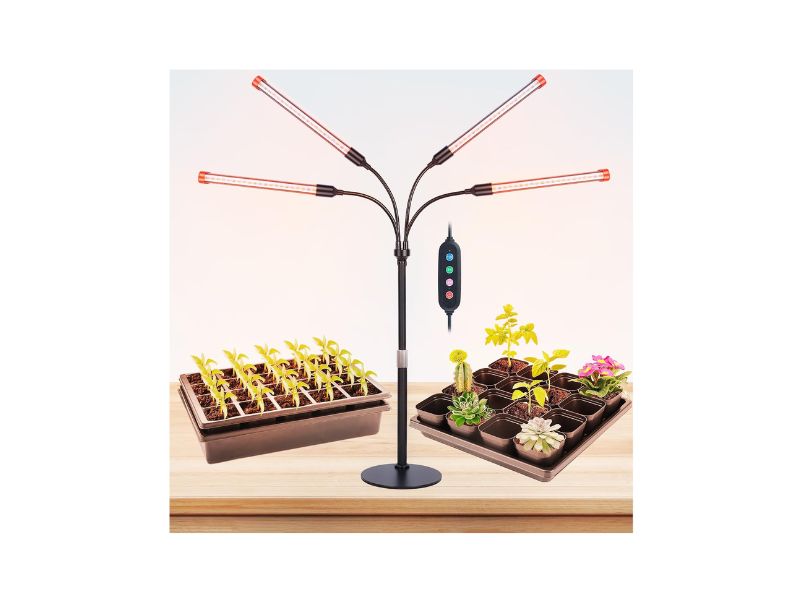
For a small seed-starting station or several plants grouped together, I would choose the FECiDA 2026 4-Head Tabletop Grow Light. Its current listing specifies 36W actual draw, 168 LEDs, four light heads, full-spectrum output, a 4/8/12/16/20-hour timer, and 16–24-inch adjustable height.
3 Best Small LED Grow Lights Reviewed
| Image | Product Name | Check Price |
|---|---|---|
Best Choice | GooingTop 6000K Full Spectrum LED Grow Light | Check Price |
Second Best | SANSI 10W Pot Clip Grow Lights 2-Pack | Check Price |
Third Choice | FECiDA 2026 4-Head Tabletop Grow Light | Check Price |
1. GooingTop 6000K Full Spectrum LED Grow Light
Key Features
- 6000K full-spectrum-style output
- White and red LEDs
- Five brightness levels
- 4/8/12-hour automatic timer
- Flexible gooseneck
- Clamp mounting
- Compact footprint
- Excellent for a few nearby plants
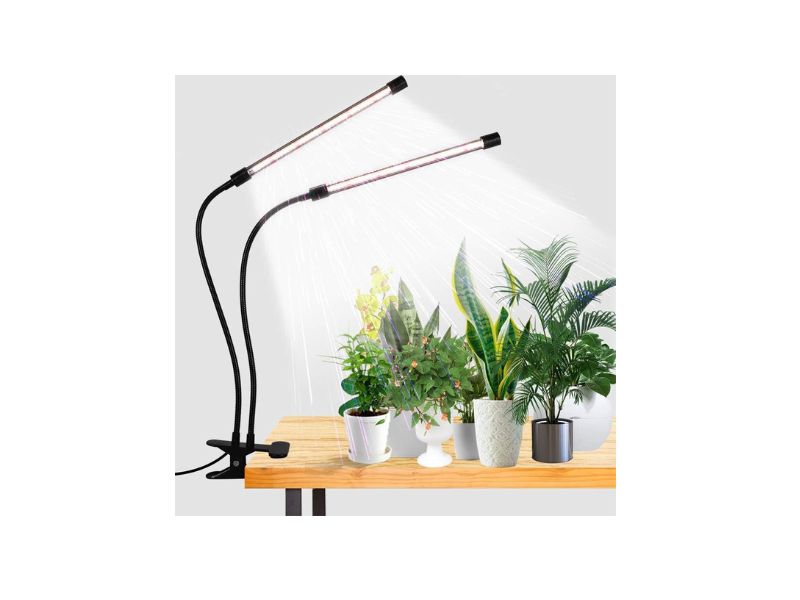
The GooingTop is my primary recommendation because it solves the two biggest problems with small grow lights: positioning and convenience.
Its current Amazon listing specifies a 6000K full-spectrum-style design with white and red LEDs, five-level dimming, and automatic 4-, 8-, or 12-hour timing.
The clamp means you do not need a dedicated floor stand or tabletop base.
It can attach to:
- A desk
- Shelf
- Plant stand
- Counter edge
- Small table
The flexible gooseneck then allows the light to be aimed downward over the canopy.
That flexibility is particularly valuable because light intensity drops substantially as distance increases.
With a small fixture, placing the LEDs properly is often more useful than buying a larger lamp and positioning it poorly.
I would use GooingTop for:
- Pothos
- Philodendrons
- Herbs
- Small succulents
- Young tomato seedlings
- Pepper seedlings
- Small foliage plants
- A few closely grouped pots
The five brightness levels make the fixture more adaptable.
A plant sitting beside a bright window may need only supplemental illumination.
Plants in a darker corner may need the fixture closer and at a stronger setting.
Instead of treating one brightness level as correct for everything, you can adjust the output according to the plant and location.
The integrated timer is another major advantage.
Small-space setups can quickly become cluttered when they need:
- A light
- Power supply
- External timer
- Extension cord
GooingTop builds the timing function into the lamp.
The current listing provides repeating 4-, 8-, and 12-hour cycles.
For houseplants receiving natural daylight, those settings can work well for supplemental lighting.
For seedlings relying almost entirely on artificial illumination, however, the 12-hour maximum may be restrictive depending on fixture intensity and crop.
That is one of the main limitations.
Coverage is the other.
This is a genuinely small light.
It works much better over a few compact plants than a whole nursery flat.
If plants at the edges begin leaning inward or stretching, you have exceeded the useful coverage area.
What I Like
- Extremely easy to position
- Five brightness settings
- Built-in repeating timer
- Compact clamp format
- Natural-looking white light
- Excellent current Amazon rating history
What I Do Not Like
- Limited growing footprint
- Timer tops out at 12 hours
- Not appropriate for a large tray or shelf
The GooingTop is the small grow light I would choose for the widest range of compact home-growing situations. Its combination of flexible placement, dimming, timer control, and small footprint makes it particularly easy to fit around existing furniture.
2. SANSI 10W Pot Clip Grow Lights 2-Pack
Key Features
- Two compact plant lights
- 10W per light
- 4000K full-spectrum output
- Four brightness levels
- 3/6/12-hour timer
- Pot-mounted clip format
- SANSI ceramic-technology design
- Excellent for individual plants
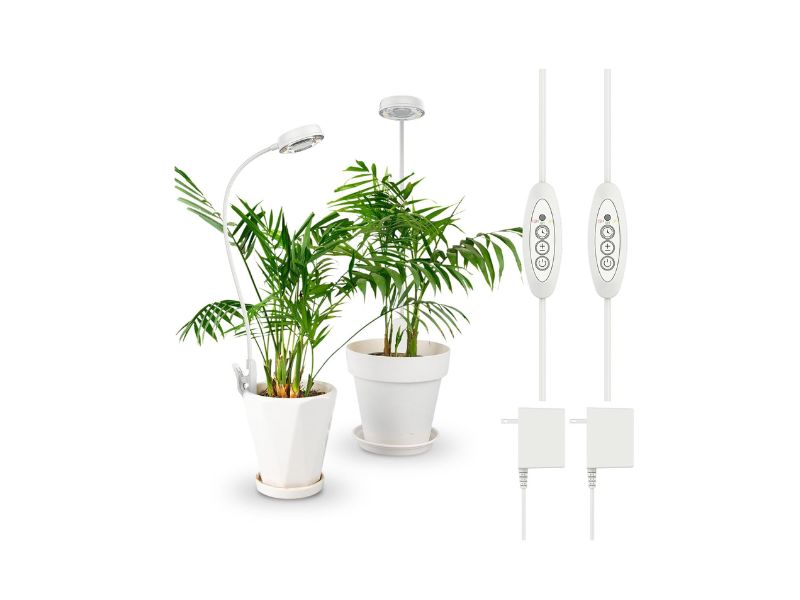
The SANSI 10W Pot Clip system is the most space-efficient choice here.
Its current Amazon listing specifies a two-pack of 10W pot-mounted grow lights with 4000K full-spectrum LEDs, four-level dimming, and 3-, 6-, or 12-hour automatic timing.
The major advantage is that the light attaches to the pot itself.
You do not need:
- A desk clamp
- Shelf
- Ceiling hook
- Floor stand
- Separate lamp base
That makes SANSI especially useful on a crowded desk or windowsill.
I would consider it for:
- One or two succulents
- Small pothos plants
- Herbs
- Bonsai
- Compact foliage plants
- Individual seedlings
- Window plants needing supplementation
The 4000K output has a relatively neutral appearance.
That makes it easier to live with in an office, bedroom, or living room than older purple-looking grow lamps.
The four-level dimmer is useful because pot-mounted lights are naturally positioned quite close to plants.
If the fixture cannot easily be moved farther away, lowering the output provides another way to control intensity.
This is particularly useful when switching between plants with different light requirements.
A succulent may tolerate stronger illumination than a shade-adapted foliage plant.
The timer provides 3-, 6-, and 12-hour settings.
That is convenient for supplemental houseplant lighting.
Again, I would not assume 12 hours automatically gives every plant enough daily light.
Total usable light depends on:
- Output
- Distance
- Plant species
- Available window light
- Daily duration
The two-pack format is also more useful than buying one pot light if you have plants in separate locations.
Each plant can receive its own dedicated source instead of forcing both pots to crowd under one lamp.
The biggest weakness is coverage.
A pot-mounted light is intentionally narrow.
It is an efficient solution when the illuminated area is one compact plant.
It becomes inefficient once the collection grows.
If you have ten plants on one shelf, ten separate pot lights create unnecessary wires and controls.
At that point, linear bars or one broader overhead fixture make more sense.
What I Like
- Almost no independent footprint
- Two lights in the selected pack
- 10W per fixture
- Four brightness levels
- Built-in timer
- Neutral-looking 4000K output
- Easy individual-plant placement
What I Do Not Like
- Very limited coverage per fixture
- Multiple lights can create cable clutter
- Maximum built-in timer is 12 hours
The SANSI 10W Pot Clip is the option I would choose when I want dedicated lighting for one or two plants while preserving as much desk and shelf space as possible.
3. FECiDA 2026 4-Head Tabletop Grow Light
Key Features
- 36W actual power
- 168 LEDs
- Four light heads
- Natural-light-style full spectrum
- 4/8/12/16/20-hour timer
- 16–24-inch adjustable height
- Tabletop format
- No separate adapter required
- Good for seedlings and small plant groups
The FECiDA 2026 4-Head Tabletop light is the strongest option here when “small” refers to the size of the growing station rather than the lowest possible wattage.
Its current Amazon listing specifies 36W actual power, 168 LEDs, four light heads, full-spectrum output, five timer choices from 4 to 20 hours, and adjustable height from approximately 16 to 24 inches.
That makes it especially interesting for:
- Seed starting
- Several herb pots
- Bonsai
- Small houseplant groups
- Young vegetable plants
- Compact propagation setups
The four-head arrangement gives it a major coverage advantage over a single clip lamp.
Instead of concentrating all output in one spot, the light can spread illumination over a broader tabletop canopy.
This is particularly helpful with seedlings.
A small tray contains multiple plants.
If only the center receives enough light, seedlings near the edges can begin:
- Leaning
- Stretching
- Developing long internodes
- Growing unevenly
A broader overhead arrangement reduces that problem.
The 36W actual power also gives FECiDA considerably more output headroom than a single 10W pot light.
That does not make it automatically better.
The extra power only makes sense when several plants occupy the illuminated area.
For one tiny succulent, 36W and four heads would be unnecessary.
The most useful feature for seed starting may be the timer.
FECiDA provides:
- 4 hours
- 8 hours
- 12 hours
- 16 hours
- 20 hours
according to the current listing.
That provides much more scheduling flexibility than small grow lamps capped at 12 hours.
A long timer is especially useful when artificial lighting supplies most or all of a seedling’s daily light.
The adjustable height also matters.
Plants change height quickly.
Seedlings may begin only inches tall and grow substantially over several weeks.
A fixture with 16–24-inch height adjustment is easier to adapt than a completely fixed tabletop lamp.
The four heads also allow light direction to be adjusted across uneven groups.
For example, one taller plant can occupy one section while several smaller pots use the remaining area.
The primary disadvantage is its physical footprint.
Unlike SANSI, FECiDA needs actual tabletop space.
It is still compact compared with a grow tent fixture, but you must dedicate a portion of a desk, counter, or plant table to the stand.
What I Like
- 36W actual draw
- Four light heads
- 168 LEDs
- Excellent timer range
- 16–24-inch height adjustment
- Strong option for seedlings
- Better small-area coverage than single clip lamps
What I Do Not Like
- Takes up actual tabletop space
- Larger than clip or pot-mounted designs
- Excessive for one tiny plant
The FECiDA 4-Head light is the option I would choose when I want a compact but more capable seed-starting or multi-plant station rather than a light aimed at only one pot.
Small LED Grow Lights Comparison
| Product | Format | Power Class | Dimming | Timer | Coverage | Best Use |
| GooingTop 6000K | Clamp/gooseneck | Compact | 5 levels | 4/8/12 hr | Small | A few grouped plants |
| SANSI Pot Clip 2-Pack | Pot-mounted | 10W each | 4 levels | 3/6/12 hr | Very small | One or two plants |
| FECiDA 4-Head | Tabletop | 36W | Adjustable system | 4/8/12/16/20 hr | Small-medium | Seedlings/multiple plants |
GooingTop provides the strongest all-around flexibility, SANSI occupies the least independent space, and FECiDA provides more output and coverage for a compact multi-plant station.
How to Choose the Best Small LED Grow Lights
Match the Light to the Number of Plants
This should come before wattage.
For one plant, a pot-mounted SANSI light may be enough.
For several closely grouped pots, GooingTop makes more sense.
For a seedling tray or several plants covering a broader area, FECiDA provides better coverage.
Small Does Not Mean Weak
A physically small fixture can still be useful when the illuminated area is equally small.
The key is concentration.
A modest 10W lamp positioned appropriately over one plant can be more useful than a much larger light wasting most of its output on empty space.
Best Small Grow Light for One Plant
I would choose SANSI 10W Pot Clip.
Because it attaches directly to the pot, it requires virtually no separate footprint.
It is particularly convenient for desks and windowsills.
Best Small Grow Light for Two Plants
The SANSI two-pack is useful when the plants are separated.
If the plants sit close together, one GooingTop lamp may be simpler.
The best arrangement depends on canopy width.
Best Small Grow Light for Several Plants
I would choose GooingTop for a compact cluster.
Its flexible neck lets you center the light above several nearby pots.
Once the plants spread beyond the useful coverage area, move to FECiDA or a larger shelf light.
Best Small Grow Light for Seedlings
The FECiDA 4-Head is my preferred choice.
The 36W output and four-head design provide broader illumination, while the 16- and 20-hour timer settings add useful flexibility for propagation.
Best Small Grow Light for Herbs
For one basil or parsley pot, SANSI is convenient.
For several herb pots grouped together, GooingTop or FECiDA provides more efficient coverage.
Best Small Grow Light for Succulents
For one succulent, SANSI works particularly well.
For a few compact succulents, GooingTop gives you better aiming flexibility.
Sun-loving succulents still require adequate intensity, so watch for stretching rather than assuming any small light is automatically strong enough.
Best Small Grow Light for Houseplants
GooingTop is my first choice.
Common houseplants are often distributed around furniture rather than placed in dedicated grow tents.
A flexible clamp lamp adapts easily to that environment.
Clip Light vs Pot-Mounted Light
Clip Lights
Better when:
- Several plants are grouped together
- A desk or shelf edge is available
- Flexible aiming matters
Pot-Mounted Lights
Better when:
- One plant needs dedicated light
- Desk space is very limited
- There is nowhere convenient to attach a clamp
Neither design is universally better.
Tabletop Grow Lights
A tabletop stand makes sense when a small area contains several plants.
The FECiDA fixture creates a mini growing station without needing ceiling hooks or shelving above the plants.
That makes it useful for renters or temporary setups.
Why Dimming Matters
Small spaces often force LEDs relatively close to plants.
Dimming gives you another way to reduce intensity when distance cannot be increased.
GooingTop offers five brightness levels, while SANSI provides four.
That flexibility is particularly useful when plants with different light requirements share a room.
Why Timers Matter
Consistency is more useful than manually remembering to switch lights on every morning.
A timer provides a repeatable photoperiod.
GooingTop and SANSI include built-in timing, while FECiDA goes significantly further with 4/8/12/16/20-hour settings.
Is a 20-Hour Timer Better?
Not automatically.
A longer timer simply provides more flexibility.
The correct daily photoperiod depends on:
- Plant species
- Growth stage
- Fixture intensity
- Natural sunlight
More hours are not always better.
Plants should generally receive a regular dark period rather than continuous 24-hour illumination.
4000K vs 6000K
SANSI uses 4000K output, while GooingTop uses 6000K white/red lighting.
Both can support indoor plants.
4000K appears more neutral.
6000K looks cooler and more daylight-like.
For plant growth, I would prioritize useful intensity and coverage over choosing solely by color temperature.
Full Spectrum Is Practical Indoors
Broad white full-spectrum-style grow lights make it easier to evaluate natural plant color.
That helps when checking for:
- Yellow leaves
- Bleaching
- Brown edges
- Pest damage
- General plant health
They are also less visually intrusive in living areas than traditional purple grow lamps.
How Close Should a Small Grow Light Be?
There is no universal distance.
A 10W pot clip and a 36W four-head fixture have very different output.
Start with manufacturer guidance and monitor plant response.
Signs of insufficient light may include:
- Stretching
- Leaning
- Long internodes
- Pale growth
Signs of excessive intensity may include:
- Bleaching
- Curling
- Pale upper leaves
- Localized stress
Adjust gradually.
Small Grow Lights and PPFD
PPFD measures how many photosynthetically active photons reach a square meter of canopy each second.
It is much more relevant to plant growth than asking whether the light looks bright to a human.
Many small consumer lamps do not provide comprehensive independent PPFD maps.
When reliable PPFD data are unavailable, pay close attention to:
- Distance
- Coverage
- Actual power
- Plant response
- Dimmer setting
Small Grow Lights and Electricity Use
A 10W light operating 12 hours daily consumes:
0.01 kW × 12 = 0.12 kWh/day
Over 30 days:
3.6 kWh/month
A 36W fixture operating 16 hours daily uses:
0.036 × 16 = 0.576 kWh/day
Over 30 days:
17.28 kWh/month
Multiply those figures by your local electricity rate to estimate lighting cost.
Small Grow Lights Still Need Airflow
The heat output is modest compared with a 500W grow panel, but the fixture and power electronics still need ventilation.
Avoid burying adapters or electrical connections beneath:
- Clothing
- Curtains
- Cushions
- Other clutter
Keep electrical components away from standing water.
Common Small Grow-Light Buying Mistakes
Buying by Wattage Alone
Coverage and placement matter just as much.
Expecting One Tiny Light to Cover a Shelf
Stay within the useful illuminated footprint.
Hanging the Fixture Too Far Away
Small lights lose effectiveness quickly when distance increases.
Ignoring Dimming
Close placement makes intensity control useful.
Running Lights 24 Hours
Maintain a regular dark period.
Choosing by Lumens Alone
Human-visible brightness is not the same as plant-useful photon delivery.
Using Strong Side Lighting Only
Overhead placement generally encourages more symmetrical growth.
Frequently Asked Questions
What are the best small LED grow lights?
GooingTop, SANSI Pot Clip, and FECiDA 4-Head are my three selections.
They cover the most useful small-space formats: flexible clamp lighting, individual-pot lighting, and compact tabletop propagation.
What is my primary recommendation?
GooingTop 6000K is my primary choice for most small indoor growing setups.
Its five-level dimming, flexible clamp design, and automatic timer make it adaptable to many houseplant arrangements.
What is the smallest grow light here?
SANSI Pot Clip requires the least independent desk or shelf space.
The fixture attaches directly to the plant pot instead of needing its own stand.
Which small grow light is best for one plant?
I would choose the SANSI 10W Pot Clip for one compact plant.
It combines 4000K full-spectrum output, four-level dimming, and automatic timing.
Which small grow light is best for several plants?
GooingTop works well when several small pots are grouped closely together.
Its flexible gooseneck makes it easy to position the light over the center of the group.
Which small grow light is best for seedlings?
FECiDA 4-Head is my preferred option for a compact seed-starting station.
It provides 36W actual power, four light heads, adjustable height, and timers up to 20 hours.
Is 10W enough for one plant?
Yes, 10W can be useful when concentrated appropriately over one small plant.
Canopy size, distance, and plant light requirements determine whether it is sufficient.
Is 36W enough for seedlings?
Yes, 36W can work well over a compact seedling area with appropriate placement.
The four-head FECiDA design distributes its output more broadly than a single pot-mounted lamp.
Are small grow lights effective?
Yes, as long as the illuminated plant area matches the fixture’s actual coverage.
Small grow lights become disappointing primarily when they are expected to cover too much space.
Are clip grow lights good?
Yes, clip lights are particularly useful when flexibility and easy mounting matter.
GooingTop is a good example because its flexible neck allows frequent repositioning.
Are pot grow lights good?
Yes, pot-mounted fixtures are efficient for individual plants and crowded desks.
Their weakness is collection-wide coverage rather than individual-plant convenience.
Is 4000K good for plants?
Yes, 4000K full-spectrum-style white lighting works well for many indoor plants.
SANSI uses 4000K output in the selected pot-clip model.
Is 6000K good for plants?
Yes, 6000K cool-white lighting is useful for many vegetative and supplemental applications.
GooingTop combines 6000K-style white light with red LEDs.
How many hours should a small grow light stay on?
The correct duration depends on plant type, intensity, growth stage, and natural daylight.
Use a timer for consistency but do not assume the longest available setting is always appropriate.
Should small grow lights stay on 24 hours?
No, most ordinary indoor-growing routines should include a regular dark period.
If plants stretch, improve intensity or placement rather than automatically using continuous light.
Can I use a small grow light for herbs?
Yes, herbs are an excellent use case for compact full-spectrum grow lights.
Match the fixture to the number and width of the herb pots.
Can I start tomatoes with a small grow light?
Yes, small grow lights can support tomato seedlings while the canopy remains compact.
As tomatoes become larger, they may outgrow the useful coverage area and require a broader fixture.
Can I grow succulents under a small LED light?
Yes, provided the lamp delivers enough usable intensity for the species.
Watch for stretched growth, which can indicate the fixture is too weak, too far away, or covering too much area.
Which small grow light has the longest timer range?
FECiDA provides the widest built-in timer range among these three selections.
Its current listing offers 4-, 8-, 12-, 16-, and 20-hour timer settings.
Do small LED grow lights cost much to run?
Their electricity use is usually modest compared with large grow-tent fixtures.
Actual cost depends on wattage, daily runtime, dimmer setting, and your local electricity rate.
When should I upgrade to a larger grow light?
Upgrade when the plant canopy consistently extends beyond the fixture’s useful illuminated area.
Edge stretching, leaning, or increasingly uneven growth can indicate that the current small fixture no longer provides enough coverage.
Conclusion
The best small LED grow lights should fit naturally into the room while providing enough usable light for the actual size of the plant canopy. For compact setups, I would prioritize positioning, coverage, dimming, timer flexibility, and full-spectrum output before simply buying the strongest fixture available.
The GooingTop 6000K remains my primary recommendation. Its flexible clamp and gooseneck, five brightness levels, 6000K white/red spectrum, and 4/8/12-hour timer make it especially versatile for a few houseplants, herbs, or seedlings.
The SANSI 10W Pot Clip 2-Pack is my choice when saving space matters most. Each fixture mounts directly to a pot while providing 4000K full-spectrum output, four brightness levels, and built-in timing.
The FECiDA 2026 4-Head Tabletop Grow Light is the stronger compact solution for seedlings or several plants. Its 36W actual power, 168 LEDs, four heads, adjustable 16–24-inch height, and 4/8/12/16/20-hour timer give it much more multi-plant flexibility.
For most compact setups, I would choose GooingTop. For one or two individual plants with almost no spare space, I would choose SANSI Pot Clip. For a small seed-starting or multi-plant station, I would choose FECiDA 4-Head.

I’m Maya L. Greenwood, a lifelong plant lover who believes anyone can grow something beautiful with the right guidance. After years of testing soil mixes, pruning methods, irrigation tricks, and pest-safe solutions, I started EasyGardenTips.com to turn hard-won lessons into step-by-step advice. From seed starting and container gardens to composting and seasonal checklists, my goal is to make gardening simple, sustainable, and fun.