10 Best Commercial Led Grow Lights: Compared With Buying Guide
Choosing the best commercial led grow lights means balancing usable coverage, electrical efficiency, heat management, controls, durability, and the kind of growing space you actually operate. A powerful fixture is not automatically the right fixture if it leaves edge plants dim, overloads your circuit, or creates more heat than your ventilation can handle.
My first choice is AGLEX 420W Full Spectrum LED Grow Light M400. It stands at the top of this 10-product list because it offers the strongest overall fit for the buying priorities covered below.
My alternative is Spider Farmer G1000W Commercial 1000W LED Grow Light, which ranks second for growers needing substantially more output and uniformity across larger or densely planted areas. Its eight-bar layout, 2,940 µmol/s output, app control, and five-year coverage make it a strong choice when scalable management matters more than minimizing fixture wattage.
My third choice is Ion 720W Full Spectrum Commercial LED Grow Light – High-Output OSRAM Diodes because it offers a credible commercial package with OSRAM diodes, 0-10V controller compatibility, IP65 protection, ETL certification, and a five-year warranty. It is especially compelling for buyers who want a more professional installation and a fixture that can replace a 1000W HPS system with lower stated power use.
My first choice is AGLEX 420W Full Spectrum LED Grow Light because it combines broad 4-by-5-foot coverage, a useful full spectrum, high claimed PPFD, dimming, and commercial-friendly daisy chaining in a relatively efficient 420W fixture. Its fanless aluminum construction should also appeal to growers who want quiet operation in tents, racks, or smaller production rooms.
.amz-product-card:hover{transform:translateY(-3px)!important;box-shadow:0 10px 26px rgba(20,70,110,.12)!important;border-color:#bdd7ea!important;}
Best Commercial Led Grow Lights
I selected these fixtures for their direct relevance to commercial and serious indoor growing, the amount of useful technical information supplied for each model, customer-feedback evidence when available, and a practical mix of brands and form factors. The ranking weighs output and coverage alongside controls, service life, environmental protection, installation effort, and the trade-offs a buyer will face in real use.
| # | Image | Product | Price on Amazon |
|---|---|---|---|
| 1 |  |
AGLEX 420W Full Spectrum LED Grow Light M400 | Check Price |
| 2 |  |
Spider Farmer G1000W Commercial 1000W LED Grow Light | Check Price |
| 3 |  |
Ion 720W Full Spectrum Commercial LED Grow Light | Check Price |
| 4 |  |
A ANLEOLIFE 730W Stretchable LED Grow Light | Check Price |
| 5 |  |
Aevorium Edge X720 Modular 720W LED Grow Light | Check Price |
| 6 |  |
FGI CTB-6-V2 720W Commercial LED Grow Light | Check Price |
| 7 |  |
VIPARSPECTRA P4000 450W Full Spectrum LED Grow Light | Check Price |
| 8 |  |
VIVOSUN Lumalight 400W Full Spectrum LED Grow Light | Check Price |
| 9 |  |
SAMPHON 600W Six-Bar Foldable LED Grow Light | Check Price |
| 10 | 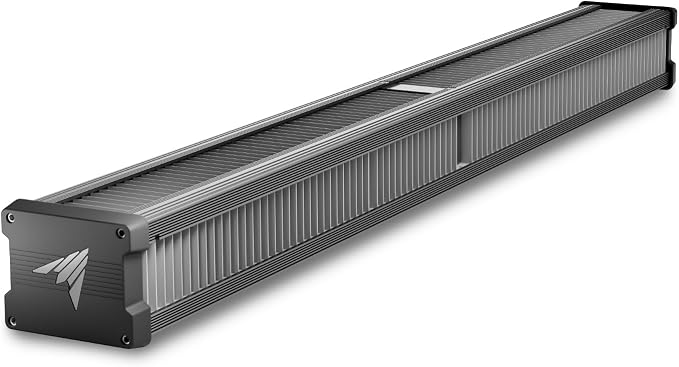 |
AC Infinity IONFRAME A7 700W Full Spectrum LED Grow Light | Check Price |
AGLEX 420W Full Spectrum LED Grow Light M400
The AGLEX M400 is an unusually balanced option for growers who want commercial-style features without jumping immediately to a 700W or 1000W fixture. Its 1,360 LEDs combine 3000K warm white, 5000K white, blue, 660nm red, 730nm infrared, and 405nm ultraviolet light. That broad mix is intended to support seedlings, vegetative plants, and flowering under one fixture rather than requiring separate lamps for each phase.
AGLEX lists a 4-by-5-foot growing area and a claimed PPFD of 1,238 µmol/m²/s. Coverage still depends on hanging height, plant density, and dimmer settings, but the stated footprint makes it a sensible match for a medium tent, rack, greenhouse section, or compact commercial bay. The 0–100% dimmer gives a beginner more control during propagation, while the ability to connect up to 100 lights can simplify a larger installation.
Because the fixture is fanless, it should operate quietly and avoid the maintenance burden of a cooling fan. Its aluminum construction helps move heat away from the diodes, although the room still has to remove the fixture’s electrical heat. The 110–277V input range is useful for both residential and commercial electrical environments. Buyers should verify the actual circuit and connector arrangement before scaling to many units.
Pros
- Broad spectrum includes blue, red, UV, and IR wavelengths.
- 4-by-5-foot stated coverage with 0–100% dimming.
- Daisy chain supports up to 100 fixtures.
- Fanless aluminum design provides quiet operation.
Cons
- UV and IR output may require careful scheduling and plant observation.
- Large daisy-chain installations still require careful electrical planning.
- Its 420W output may not suit very dense commercial canopies.
My Opinion
The AGLEX M400 earns the top spot by offering the most approachable combination of coverage, controls, spectrum, efficiency, and expansion potential. It is a particularly good fit for growers moving from hobby equipment toward a more organized production setup.
Spider Farmer G1000W Commercial 1000W LED Grow Light
Spider Farmer’s G1000W is the high-output choice in this group. Its eight-bar design spreads light toward the edges of the growing area, which can help reduce the common problem of a bright center and weaker perimeter. The fixture is listed at 1,000W with 2,940 µmol/s output and 2.9 µmol/J PPE, making it appropriate for demanding canopies, 5-by-5-foot tents, racks, and larger commercial layouts where intensity and uniformity are priorities.
Bridgelux diodes and Osram red diodes are selected for efficient, powerful illumination, while the bar arrangement provides more surface distribution than a single concentrated board. That does not eliminate the need to measure or observe the canopy, but it gives the grower a better physical foundation for even coverage. The stated compatibility with horizontal and 4-by-4-foot vertical farming also makes it adaptable to different room designs.
Control is one of its strongest advantages. Multiple units can be linked for synchronized dimming, with support for up to 50 fixtures, and the Spider Farmer app adds scheduling, sunrise and sunset simulation, and remote brightness adjustment. The five-year coverage and U.S.-based service center are valuable in a commercial setting where downtime can cost more than the original fixture difference. The trade-off is obvious: 1,000W consumes considerably more power and produces more heat than the lower-wattage alternatives, so ventilation and circuit capacity matter.
Pros
- High 2,940 µmol/s output and stated 2.9 µmol/J efficiency.
- Eight-bar layout is intended to improve edge coverage.
- App control supports schedules and remote brightness changes.
- Five-year coverage and U.S.-based service support add ownership value.
Cons
- 1,000W demand requires serious attention to circuits and room cooling.
- May be excessive for seedlings or small tents.
- Large-scale daisy chaining needs a carefully planned installation.
My Opinion
This is the strongest selection for growers who need maximum output and centralized control. It ranks below AGLEX because its power, heat, and infrastructure demands make it less universally practical, not because it lacks capability.
Ion 720W Full Spectrum Commercial LED Grow Light
The ION 720W takes a distinctly commercial approach. Its high-output OSRAM LM-80 diodes are rated for consistent spectral performance over more than 54,000 hours, while the full-spectrum FSG configuration is intended to carry plants from vegetative growth through flowering. The stated ability to replace a 1000W HPS system at up to 40% lower power consumption gives this fixture a clear role in facilities looking to reduce energy and HVAC demand.
Control integration is a major reason to consider it. The built-in 0–10V dimming works with most commercial controllers, allowing intensity to be coordinated across a room rather than adjusted manually at each fixture. That is a better match for repeatable production schedules and multi-zone environments than a basic local knob alone.
Its IP65-rated aluminum housing is dust-tight and protected against water exposure, while the foldable 180-degree design can make transport and installation easier. ETL certification adds an important safety signal for professional buyers. Even so, IP protection does not mean the fixture can be treated casually around water, and the 720W electrical load still contributes meaningful room heat. The limited supplied customer-feedback sample also means buyers may want to confirm current service terms and controller compatibility before purchasing many units.
Pros
- OSRAM diodes are specified for long-term spectral stability.
- 0–10V dimming works with most commercial controllers.
- IP65 housing and ETL certification suit professional installations.
- Foldable aluminum design and five-year warranty support ownership.
Cons
- Controller compatibility should be confirmed before a large deployment.
- 720W still requires adequate circuit capacity and heat removal.
- There is less customer-feedback volume than for several established consumer models.
My Opinion
ION is my third choice for a facility that values commercial controls, environmental sealing, and documented construction more than the lowest purchase complexity. It is a well-targeted upgrade from HPS-style infrastructure.
A ANLEOLIFE 730W Stretchable LED Grow Light
A ANLEOLIFE stands out because its light bars can extend or retract to alter spacing. That is useful when a grower changes from a smaller early-stage canopy to a wider flowering area, or when a fixture needs to fit different benches over time. The plug-and-play bar structure is also easier to position than a rigid panel when room geometry is irregular.
The 730W fixture uses Samsung LM301H EVO and LM281B+ Pro LEDs, with a claimed 2.8 µmol/J PPE and 1,508 µmol/m²/s PPFD across a 5-by-5-foot core area. Those figures make it a serious full-cycle fixture, but they should be treated as performance claims that depend on height, measurement location, and environmental conditions. Its 3000K, 5000K, and 660nm combination keeps the spectrum straightforward for growers who prefer one setting through the crop.
Dimming is handled through a 0–100% four-level knob, and up to 50 fixtures can be daisy chained for simultaneous adjustment. The detachable driver and 9.8-foot power cord can help move heat away from the canopy and simplify placement. Aluminum heat sinks, side ventilation, and an IP65 rating add protection in humid rooms. The stretchable structure offers flexibility, but moving parts and adjustable spacing give the owner more components to inspect than a simple fixed frame.
Pros
- Adjustable bar spacing adapts to different canopy sizes.
- Samsung diode mix and 730W output suit demanding 5-by-5-foot coverage.
- Detachable driver and long power cord help with heat placement.
- IP65 protection and 54,000-plus-hour stated lifespan support humid environments.
Cons
- Four-level dimming is less precise than continuously adjustable control.
- Adjustable hardware should be handled carefully during repeated repositioning.
- Its 730W draw may be more than small growers need.
My Opinion
This is a strong choice for a greenhouse or multi-purpose room where canopy dimensions change. The extend-retract design is more meaningful than a cosmetic feature because it can help the fixture remain useful as the operation grows.
Aevorium Edge X720 Modular 720W LED Grow Light
The Edge X720 focuses on serviceability rather than simply advertising more diodes. Its 6+2 bar architecture allows an individual LED strip to be replaced instead of discarding the entire fixture after one component fails. For a commercial room with many lights running on long cycles, that modular approach could reduce downtime, shipping, and long-term maintenance expense.
Installation is another practical strength. The tool-free push-lock system is intended to let each bar snap into the main rail quickly, reducing the labor associated with screws, zip ties, and complicated wiring. A rigid aviation-grade aluminum frame is used instead of a foldable arrangement, so the fixture should remain level and resist the sag that can make bar lights uneven over time.
The manufacturer lists 720W consumption, 1,944 PPF, 5-by-5-foot coverage, 0–10V knob dimming, and full-spectrum output using 3000K, 5000K, and enhanced 660nm red. Dual-side light emission is intended to push more light laterally toward the edges. IP54 protection makes it suitable for high-humidity rooms up to the stated 90% RH, but it is not as sealed as IP65 or IP67 fixtures. Buyers should also verify replacement-strip availability and controller details before committing to a room-wide system.
Pros
- Replaceable strips can reduce maintenance disruption and waste.
- Tool-free assembly is useful for repeated commercial installations.
- Rigid frame resists sag and helps keep the light level.
- 0–10V dimming, 5-by-5-foot coverage, and IP54 protection suit production rooms.
Cons
- IP54 offers less water protection than higher-rated alternatives.
- Replacement parts should be confirmed before purchase.
- Its specialized modular system may be less familiar to first-time buyers.
My Opinion
Edge X720 is compelling when maintenance labor and fixture uptime matter. It is not automatically the best fit for a damp, spray-heavy room, but its repairable design deserves serious attention from commercial operators.
FGI CTB-6-V2 720W Commercial LED Grow Light
FGI’s CTB-6-V2 is built around quick deployment in professional spaces. The lightweight, compact fixture can be unfolded, hung, and plugged in with the included hardware, and the company states that it weighs 30% less than the prior V1 model. That reduced weight can make a difference when installing many fixtures overhead or when the room’s support structure has limited capacity.
Its integrated driver-on-board design removes the need to mount separate driver boxes. This keeps the installation cleaner and can reduce driver-related heat near the canopy, although the fixture still releases the heat associated with its 720W electrical consumption into the room. The wide 200–277V input range is aimed at commercial electrical systems rather than ordinary low-voltage household arrangements.
FGI lists 1,864 µmol/s output and 2.6 µmol/J efficiency, along with a full spectrum intended for strong canopy penetration. The diode lenses are sealed for ETL/UL moisture and shock isolation requirements, and the lenses are described as UV optimized to resist clouding. DLC listing may make the fixture eligible for certain utility rebates, with support offered for identifying incentives and navigating applications. Rebate eligibility varies by location and program, so it should be verified rather than included in the budget automatically.
Pros
- Lightweight design and included hardware support fast installation.
- Integrated driver avoids external boxes and extra mounting work.
- 200–277V input suits many commercial electrical systems.
- DLC listing may support utility rebate applications.
Cons
- Rebate availability depends on the local utility and program rules.
- 2.6 µmol/J is lower than the leading efficiency claims in this selection.
- Commercial voltage requirements may not suit a typical household circuit.
My Opinion
FGI is a practical fleet fixture for a licensed facility or vertical farm that values fast installation, low fixture weight, and rebate support. It is less attractive if the buyer cannot provide the required commercial electrical service.
VIPARSPECTRA P4000 450W Full Spectrum LED Grow Light
The VIPARSPECTRA P4000 offers a straightforward entry into higher-output indoor growing. It uses 450W while being positioned as comparable to a traditional 1000W HPS/MH fixture, and its stated coverage is 5-by-4 feet for vegetative growth or 5-by-3 feet during flowering. Those different footprints are useful reminders that lighting needs become more demanding as plants mature and the canopy fills in.
The spectrum combines 3000K and 5000K white light with 660nm red and 730nm infrared. That gives the grower a single fixture for multiple growth stages, while the dimmer knob allows intensity to be reduced for seedlings or adjusted as plants develop. Its fanless aluminum heat-sink design avoids fan noise and removes one moving part that could eventually require replacement.
With more than 5,000 customer ratings supplied in the research data and a 4.7 rating, it has substantially more feedback volume than most of the commercial-style fixtures in this comparison. That does not replace checking current support and authenticity, but it gives a buyer more real-world purchasing context. The main limitation is scale: this is better suited to a modest tent, rack, or small room than a large production bay requiring synchronized controller-based management.
Pros
- Strong customer-feedback volume and a 4.7 supplied rating.
- 450W draw with separate vegetative and flowering coverage guidance.
- Full spectrum includes white, red, and infrared wavelengths.
- Fanless heat-sink design is quiet and simple to operate.
Cons
- No supplied commercial controller or large-scale daisy-chain system.
- Flowering coverage is narrower than vegetative coverage.
- Buyers should confirm authenticity and current local support.
My Opinion
P4000 is the value-oriented pick for a grower who wants substantial light without jumping to a commercial 700W fixture. It is especially sensible for a single tent or rack where a simple dimmer is enough.
VIVOSUN Lumalight 400W Full Spectrum LED Grow Light
VIVOSUN’s LumaLight 400W is aimed at growers who want efficient full-spectrum lighting with a path toward app-based automation. Its diode mix uses 3000K, 5000K, 660nm, and 750nm far-red light, covering the basic spectrum needs from seedlings through harvest. The layout is intended to keep intensity more even from the center to the edges, which can help a small canopy develop more consistently.
A four-level dimming knob provides settings from 25% to 100%. That is useful for matching intensity to plant age, although it is not as fine-grained as a 0–100% continuous dimmer. The light can connect to a VIVOSUN GrowHub and app, sold separately, for scheduled operation and remote monitoring. This makes the LumaLight a reasonable stepping stone for someone who wants automation without buying a fully integrated commercial control system immediately.
Heat management combines an aluminum heat sink with a Q90 flux-maintenance rate of up to 36,000 hours. The IP65 waterproof and dustproof rating is reassuring in a humid room or where occasional spray is possible, though good practice still means avoiding unnecessary direct water exposure. At 400W, it is more suitable for a compact canopy than for a large commercial footprint. Buyers should budget for the separate GrowHub if remote control is a key reason for choosing it.
Pros
- Full spectrum includes white, blue, red, and far-red wavelengths.
- IP65 protection suits humid and dusty growing environments.
- Optional GrowHub and app enable schedules and remote adjustments.
- Uniform diode layout is intended to reduce edge falloff.
Cons
- Advanced app control requires a separately sold GrowHub.
- Four dimming levels provide less precision than continuous dimming.
- 400W output limits its usefulness for broad commercial canopies.
My Opinion
LumaLight is a smart fit for a smaller grower who values water resistance and a future automation path. Its practical scale and optional ecosystem make it easier to adopt than a full commercial control package.
SAMPHON 600W Six-Bar Foldable LED Grow Light
SAMPHON provides a middle-ground fixture for growers who need more than a 400W panel but do not want a 700W or 1000W system. Its six elongated aluminum bars are intended to distribute light broadly across a stated 4-by-4-foot footprint. A bar layout can reduce severe center brightness compared with a compact board, especially when the fixture is hung at an appropriate height.
The dimmer adjusts from 0% to 100%, giving useful control from early growth through a fuller canopy. Daisy chaining allows multiple units to be controlled together, which is helpful if a small operation expands from one tent to several. The foldable structure is plug-and-play out of the box and can reduce setup time, although the hinges and bar connections should be handled gently during storage and transport.
Passive aluminum cooling keeps the fixture quiet because there is no fan. That simplicity is helpful in a home grow room, but it does not remove the need for ventilation: every watt consumed eventually becomes heat that the space must manage. The supplied information does not list a specific IP rating, output measurement, or warranty duration, so buyers needing documented photometric data or formal environmental protection may prefer one of the more fully specified commercial fixtures.
Pros
- 600W output and six bars suit a moderate 4-by-4-foot area.
- 0–100% dimming supports different plant stages.
- Daisy chain allows synchronized control across multiple units.
- Foldable, fanless design is easy to install and quiet.
Cons
- Supplied data does not specify PPFD, PPF, or an IP rating.
- Foldable components need care during repeated handling.
- 600W still adds considerable heat to a small room.
My Opinion
SAMPHON is a practical moderate-power option when basic dimming, quiet operation, and easy installation are more important than published photometric detail. It is best purchased by buyers who can judge plant response rather than relying on extensive performance documentation.
AC Infinity IONFRAME A7 700W Full Spectrum LED Grow Light
The AC Infinity IONFRAME A7 combines a 700W fixture with coverage up to 4-by-5 feet, making it a natural fit for a medium-to-large indoor canopy. Its 3000K, 5000K, and 660nm diode combination keeps the spectrum focused on reliable general growth and flowering rather than adding a long list of specialty wavelengths.
Thermal design is a notable strength. The fixture uses a thick aluminum heat sink, a detached driver, and an IP67-rated build. The detached driver can help move a heat source away from the canopy, while the high ingress-protection rating provides a stronger barrier against dust and moisture than many basic grow lights. Proper ventilation is still essential because electrical efficiency reduces heat but does not eliminate it.
Connectivity is built around the AC Infinity ecosystem. Daisy chaining uses the RJ-11 commercial standard, an included Type-A adapter expands connection options, and the included UIS adapter can connect the light to compatible AI controllers or outlets. This gives the buyer access to remote automation and climate data through the AC Infinity app. The trade-off is ecosystem dependence: growers who do not already use AC Infinity controls may need to learn another platform, and the supplied information does not state a PPFD or PPF figure.
Pros
- 700W output covers up to a stated 4-by-5-foot area.
- IP67 build and thick aluminum heat sink suit humid rooms.
- Detached driver can reduce heat near the plants.
- UIS adapter, RJ-11 daisy chaining, and app control support automation.
Cons
- Supplied data does not list PPFD or total PPF.
- Advanced control is most useful inside the AC Infinity ecosystem.
- 700W may be excessive for a small tent or propagation area.
My Opinion
IONFRAME A7 is the best choice here for an AC Infinity user who wants a durable, connected fixture with strong moisture protection. It would rank higher with more published light-output data, but its control ecosystem and IP67 construction remain valuable.
How I Selected These Commercial LED Grow Lights
The selection starts with purpose rather than wattage alone. A fixture had to be relevant to serious indoor cultivation and offer enough information to judge its spectrum, coverage, control method, construction, or ownership value. I then compared the stated output, efficiency, coverage, environmental rating, installation design, service support, and expansion options.
Customer-feedback volume was also considered where supplied. VIPARSPECTRA and VIVOSUN have much larger feedback samples than several newer or more specialized products, which gives buyers more purchasing context. Smaller feedback counts do not automatically disqualify a fixture, but they make documented specifications, warranty terms, certifications, and compatibility details more important.
Wattage is only one part of the decision. A 400W fixture with suitable coverage and good dimming may be a better operational choice than a 1000W model that overwhelms the room.
Brand diversity was included so the list would not reduce the decision to one ecosystem or one design style. The selection spans fanless boards, foldable bar lights, modular fixtures, app-connected systems, commercial controller-compatible models, and products intended for rebate-conscious facilities.
For a multi-light room, installation, dimming compatibility, replacement parts, and electrical requirements can matter as much as the initial light-output claim.
How to Choose Commercial LED Grow Lights
Start with the canopy dimensions, electrical service, and desired control level. Then compare the light’s stated coverage and output against the plants’ growth stage. A fixture should deliver usable, reasonably even intensity across the whole growing area, not just an impressive number at the center.
- Match coverage to the flowering footprint: early-stage coverage is often wider than the area a dense flowering canopy can use effectively.
- Compare PPF and PPE when available: total photon output and efficiency are more useful than wattage alone.
- Check your electrical system: 720W, 1000W, and multi-light installations can quickly exceed a lightly equipped circuit.
- Choose controls deliberately: local dimmers suit simple rooms, while 0–10V, RJ-11, or app systems help coordinate multiple fixtures.
- Verify environmental protection: IP54, IP65, and IP67 indicate different levels of resistance to dust and moisture.
Coverage, height, and canopy uniformity
Coverage claims are not a promise that every plant receives identical light at every height. Hanging height changes the footprint, intensity, and edge behavior. A fixture that covers a 5-by-5-foot area at a moderate intensity may need to be raised or supplemented for a demanding flowering canopy.
Bar-style fixtures generally spread diodes across a wider physical area than compact panels. That can improve edge performance, but the result still depends on bar spacing, reflector or lens design, room walls, and canopy shape. Adjustable or modular bars are useful when the footprint changes, while rigid frames are attractive when long-term alignment matters.
Power, efficiency, and heat
LEDs usually consume less electricity than comparable HPS or MH systems for a similar growing task, but the selected lights still range from 400W to 1000W. Every watt drawn becomes heat that eventually enters the room. A detached driver can move one heat source away from the plants, while a fanless fixture reduces noise and moving-part maintenance without eliminating room-cooling requirements.
For a commercial room, calculate the total wattage of every fixture, controller, fan, pump, and dehumidifier on each circuit. Do not assume a daisy chain automatically means the electrical load is safe. The control connection may synchronize lights while the power circuit still needs proper sizing and protection.
Spectrum and dimming
Most fixtures here provide a full-spectrum white-light base with added red, and some add far-red, infrared, or UV wavelengths. A broad spectrum is convenient because one fixture can support multiple growth stages. It does not mean the grower should run maximum intensity from seedling to harvest.
Dimming is one of the most useful features for beginners. Lower output can reduce stress on young plants and help manage heat while roots and leaves develop. Four-level dimming is adequate for basic adjustment, while 0–100% control or a commercial controller provides more precise transitions. UV and IR should be treated as additional variables rather than automatically beneficial settings.
Commercial controls and scalability
If one light is all that is needed, a local knob may be sufficient. In a larger room, synchronized dimming can save time and make daily operation more consistent. Spider Farmer supports app scheduling, ION and Edge X720 offer commercial-style control options, and AC Infinity provides an ecosystem built around UIS adapters and controllers.
Before buying several units, confirm whether the connection is for control, power, or both. Check the maximum number of fixtures, connector type, controller requirements, and whether adapters are included. Compatibility is easier and cheaper to solve before installation than after a room is wired.
Setting Up a Commercial LED Grow Light
Begin with a stable overhead mounting plan that can support the fixture, cables, and any driver placement without stressing the frame. Keep power cords away from standing water, avoid sharp bends, and leave enough slack to adjust height without pulling on electrical connections.
First setup steps
- Confirm the fixture’s input voltage and the circuit’s available capacity.
- Inspect bars, drivers, connectors, hanging hardware, and cords before energizing the unit.
- Mount the light level over the intended canopy rather than over an empty aisle.
- Start at reduced intensity for seedlings or recently transplanted plants.
- Increase intensity gradually while watching leaf posture, color, and room temperature.
- Record the height, dimmer setting, schedule, and plant response so future cycles are repeatable.
For several lights, install and power one unit first. Confirm that dimming, scheduling, and controller communication work as expected before connecting the entire row. This isolates mistakes and prevents a wiring issue from affecting every fixture at once.
Using Light Intensity Effectively
Plants respond to the combined effect of intensity, duration, temperature, humidity, nutrition, and water availability. Increasing the light while the room is already hot or the roots are stressed can create problems that dimming alone will not solve.
Use the dimmer and hanging height as separate tools. Height changes the distribution across the canopy, while dimming reduces total output. A wider fixture may provide better edge coverage at a moderate height; a concentrated fixture may need more careful positioning to prevent a bright center.
Keep a simple log of daily schedule, dimmer percentage, mounting height, room temperature, and visible plant response. This is particularly helpful when using UV, infrared, far-red, or app-based scheduling, because it lets the grower identify which change caused a result instead of changing several variables at once.
Maintenance, Moisture, and Long-Term Ownership
Dust on heat sinks, diodes, and surrounding surfaces can reduce cooling performance over time. With the power disconnected, use a soft, dry method to remove buildup and follow the manufacturer’s care instructions. Do not spray cleaners or nutrients directly onto an energized fixture, even when it carries an IP rating.
Inspect hanging hardware and cable connections periodically, especially in rooms with high humidity or frequent equipment movement. Look for corrosion, loose connectors, damaged insulation, unusual odor, flickering, or a bar that is no longer level. Stop using a damaged fixture until the cause is identified.
For modular products such as the Edge X720, confirm that replacement strips remain available and label installed parts when servicing a large room. For app-connected products, record controller settings and schedules so a reset or device replacement does not interrupt the crop. Keep warranty and purchase documentation with the equipment rather than relying on memory.
Electrical Safety and Compatibility
Commercial fixtures often support broader input ranges such as 200–277V or 110–277V, but that does not mean every installation can use every voltage. A qualified electrician should assess circuits, grounding, disconnects, load calculations, and local requirements for a permanent commercial room.
Keep drivers and connectors in locations appropriate to their environmental rating. IP65 and IP67 describe protection against specified dust and water exposure; they do not authorize submersion, careless spraying, or installation with damaged seals. A detached driver still needs ventilation and safe support.
Common Mistakes to Avoid
Most avoidable problems come from buying for the wattage number alone, installing too close to the canopy, or assuming a waterproof rating removes the need for careful room management.
- Do not use a 1000W fixture in a small space without planning heat removal and circuit capacity.
- Do not treat a stated coverage area as a guarantee of flowering intensity at every height.
- Do not connect many lights before checking the maximum daisy-chain and controller limits.
- Do not run full power on young plants simply because the dimmer allows it.
- Do not spray an energized fixture or ignore moisture around connectors.
- Do not assume a utility rebate is guaranteed; confirm local eligibility in writing.
- Do not purchase a specialized controller system without checking connector and software compatibility.
When in doubt, lower intensity, improve airflow, and change one variable at a time. A slower adjustment is easier to diagnose than plant stress caused by several simultaneous changes.
Frequently Asked Questions
What wattage is appropriate for a commercial indoor grow?
There is no single correct wattage because the answer depends on canopy size, plant stage, hanging height, fixture efficiency, and room cooling. The products in this comparison range from 400W to 1000W. Smaller tents and racks may suit 400W to 450W models, while larger or denser canopies may justify 600W to 1000W fixtures.
Are bar-style LED grow lights better than panel-style fixtures?
Bar-style fixtures spread the diodes over more physical area, which can help with edge coverage and canopy uniformity. Panel-style designs can be simpler and more compact. Neither style is automatically superior; compare the stated footprint, output data, dimming, thermal design, and room dimensions.
Do commercial LED grow lights need a separate cooling system?
They may need room ventilation, air conditioning, or dehumidification even when the fixture itself is fanless. LEDs generally use power efficiently, but their electrical consumption still becomes heat. A detached driver can move some heat away from the canopy without eliminating the total heat load.
Can multiple fixtures be controlled together?
Several products here support daisy chaining or commercial control connections. The exact limit varies: some list up to 50 units, one lists up to 100, and Edge X720 provides a much larger stated expansion capability. Confirm whether the connection controls dimming, power, or both before building a multi-light installation.
Is an IP-rated fixture safe to spray with water?
An IP rating indicates defined resistance to dust and moisture, but it is not permission to spray an energized fixture. Keep water and nutrient solution away from live connections, disconnect power before cleaning, and follow the manufacturer’s instructions for the specific rating.
Which type is easiest for a first-time commercial buyer?
A dimmable, plug-and-play fixture with clearly stated coverage and simple controls is usually easiest to deploy. AGLEX, VIPARSPECTRA, VIVOSUN, and SAMPHON offer relatively approachable operation, while 0–10V, app, or commercial-voltage systems may be better for buyers already planning a coordinated facility.
Final Thoughts
The best commercial led grow lights should match the canopy, electrical system, controls, and environmental conditions rather than simply carry the highest wattage. AGLEX 420W Full Spectrum LED Grow Light is my first choice for balanced coverage and scalable operation, Spider Farmer G1000W Commercial 1000W LED Grow Light is the stronger high-output alternative, and ION 720W Full Spectrum Commercial LED Grow Light is the best fit for commercial-grade protection and controller compatibility.

I’m Maya L. Greenwood, a lifelong plant lover who believes anyone can grow something beautiful with the right guidance. After years of testing soil mixes, pruning methods, irrigation tricks, and pest-safe solutions, I started EasyGardenTips.com to turn hard-won lessons into step-by-step advice. From seed starting and container gardens to composting and seasonal checklists, my goal is to make gardening simple, sustainable, and fun.