3 Best Bar Style LED Grow Lights: Flexible Indoor Coverage
Bar-style grow lights solve a coverage problem that ordinary bulbs and compact panels often create. A single bulb produces a bright center with weaker edges, while a long LED bar distributes light across a shelf, propagation tray, bench, or vertical growing rack.
The best bar style led grow lights should provide appropriate intensity across the entire canopy without producing excessive heat, leaving dim corners, or complicating installation. Length, actual wattage, spectrum, linkability, moisture protection, and mounting clearance all matter more than an inflated “equivalent wattage” claim.
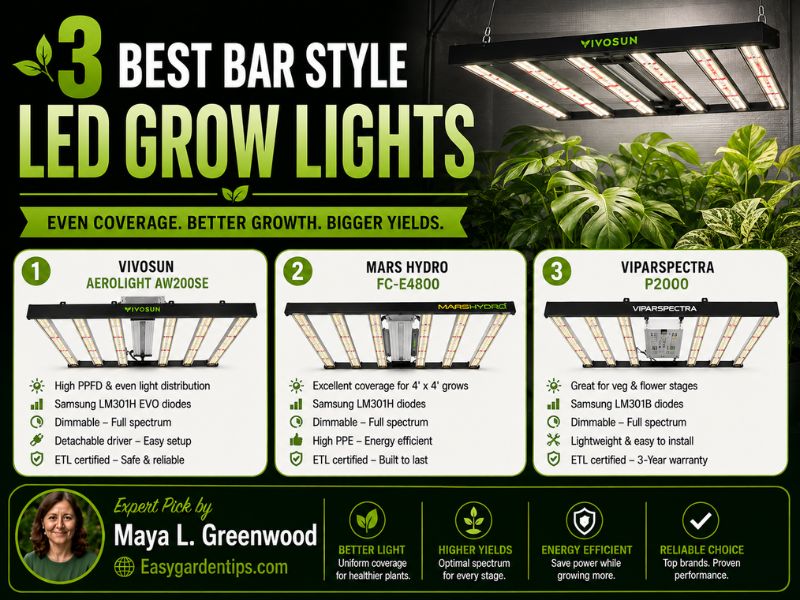
My primary recommendation is the Spider Farmer Glow80 Full Spectrum LED Grow Light Bars. Its two 40-watt bars, published 2.0 µmol/J efficacy, full spectrum with deep red, and IP65-rated construction make it the strongest option for a serious shelf, propagation area, or compact vertical garden.
For buyers who need several shorter high-output fixtures, I would choose the Barrina T8 2-Foot Full Spectrum LED Grow Lights, 6-Pack. The six 24-watt bars provide 144 watts of total connected power and flexible coverage across multiple shelves.
The VIVOSUN T5 2-Foot Full Spectrum LED Grow Lights, 8-Pack is more suitable when a larger number of moderate-output bars is useful. Eight 15-watt fixtures can be distributed across several low-clearance shelves, seed trays, or propagation levels.
These products are not simply stronger and weaker versions of the same light. Spider Farmer uses two long, more powerful bars; Barrina supplies six brighter short bars; and VIVOSUN provides eight moderate-output T5 bars. Choosing by shelf shape and plant requirements is more useful than choosing by total package wattage alone.
Recommended Product by Setup
| Growing setup | Recommended product | Reason |
| One wide, high-output shelf | Spider Farmer Glow80 | Two long 40W bars provide concentrated coverage |
| Humid propagation area | Spider Farmer Glow80 | IP65-rated bar construction |
| Three two-foot shelves | Barrina T8 | Two 24W bars can be placed on each level |
| Six narrow growing areas | Barrina T8 | Bars can be distributed independently |
| Four low-clearance shelves | VIVOSUN T5 | Two 15W bars per shelf provide even coverage |
| Eight small propagation rows | VIVOSUN T5 | One bar can be allocated to each row |
| High-light succulents | Spider Farmer or multiple Barrina bars | Greater intensity is easier to achieve |
| Low- to medium-light foliage | VIVOSUN T5 | Moderate output is easier to manage |
The table provides setup examples rather than fixed installation rules. Shelf height, bar spacing, plant size, natural daylight, and daily operating time change the amount of useful light each leaf receives.
Best Bar Style LED Grow Lights Reviewed
| Image | Product Name | Check Price |
|---|---|---|
Best Choice | Spider Farmer Glow80 Full Spectrum LED Grow Light Bars | Check Price |
Second Best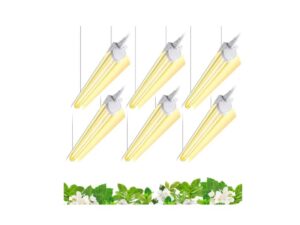 | Barrina T8 2-Foot Full Spectrum LED Grow Lights, 6-Pack | Check Price |
Third Choice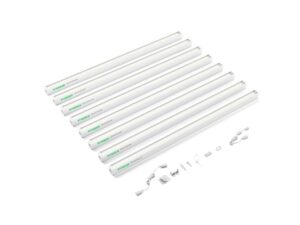 | VIVOSUN T5 2-Foot Full Spectrum LED Grow Lights, 8-Pack | Check Price |
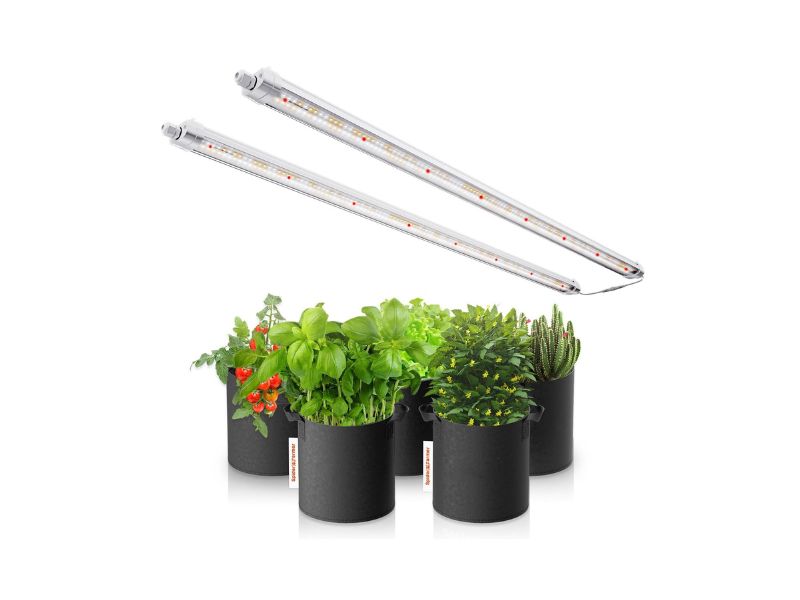
1. Spider Farmer Glow80 Full Spectrum LED Grow Light Bars
Key Features
- Two approximately 3.6-foot LED bars
- 80-watt combined power draw
- Approximately 40 watts per bar
- Published efficacy of about 2.0 µmol/J
- 476 diodes across the two-bar system
- Full spectrum with warm white, cool white, and 660–665nm red
- Approximately 10,400 lumens
- IP65-rated bar construction
- Linkable system
- Passive, fanless cooling
The Spider Farmer Glow80 earns the first position because it offers a better-documented performance profile than typical low-cost shelf bars. Two long fixtures provide 80 watts of combined power, making the system relevant as a primary light for a shelf rather than merely a decorative supplement.
Its spectrum combines warm-white, cool-white, and deep-red diodes. The white channels support general vegetative growth and comfortable visual inspection, while the 660–665nm red output adds photons in a range commonly used by photosynthesis.
The two-bar design provides flexibility. The bars can be mounted parallel over a wide shelf, placed closer together for a narrower high-intensity canopy, or used as supplemental side lighting in an enclosed growing area.
An IP65 rating means the rated bar enclosure offers meaningful protection against dust and water jets under defined test conditions. It does not make electrical connections, plugs, timers, or wall outlets safe for immersion. Those components must remain dry.
At 80 watts, the Glow80 may be excessive for a low-light foliage plant mounted only a few inches away. Distance, bar spacing, or operating duration should be adjusted to the crop. Higher-light houseplants, dense propagation trays, herbs, and succulents are more likely to use its output effectively.
The system has no reason to run around the clock. An external timer and consistent dark period are still required. Users should also confirm the exact linking limit for the voltage and version purchased.
My verdict: Glow80 is the most capable overall option for buyers who want two durable, relatively high-output bars with published efficacy and moisture-resistant construction. Its main limitation is that two long bars offer less multi-shelf flexibility than six or eight shorter fixtures.
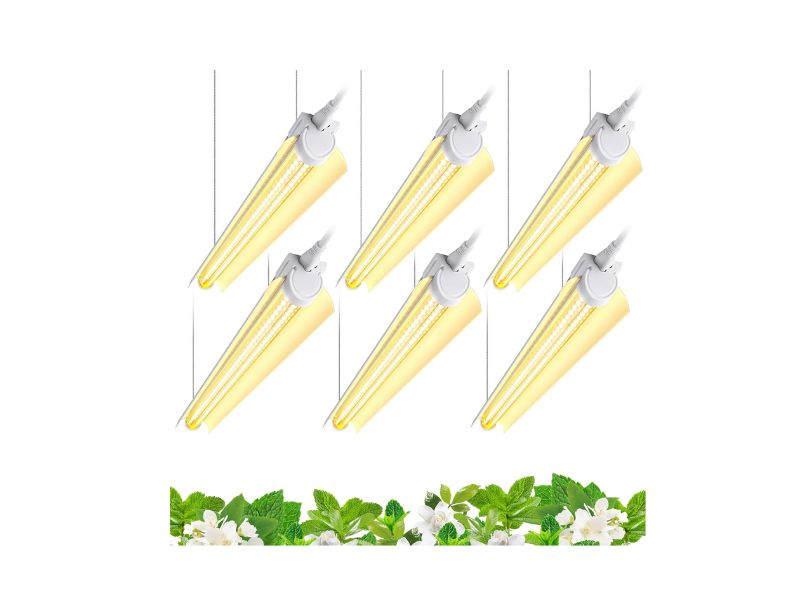
2. Barrina T8 2-Foot Full Spectrum LED Grow Lights, 6-Pack
Key Features
- Six 2-foot LED bars
- 24 watts per bar
- 144 watts total
- Yellow-white full-spectrum output
- Linkable design
- Individual switching
- Reflector-style housing
- Plug-and-play installation
- Mounting and connecting accessories
- No programmable timer
Barrina’s T8 package takes the second position because six 24-watt bars can be arranged across several shelves while retaining more output per short fixture than a typical T5 bar.
The reflector-shaped housing directs light downward and reduces some sideways spill. This is useful on open shelves where bare LEDs might otherwise create glare without contributing much light to the canopy.
Six fixtures make several layouts possible. A user might install two bars on each of three shelves, one bar over six low-light shelves, or three bars over each of two high-light growing levels. The correct arrangement depends on canopy width, mounting height, and plant demand.
The 144-watt figure represents all six bars operating together. It does not mean that one shelf receives 144 watts when the fixtures are divided across several levels. Each level should be evaluated according to the number of bars installed above it.
These lights are suitable for seedlings, foliage plants, herbs, propagation trays, and compact succulents when arranged appropriately. High-light plants may require closer mounting or multiple parallel bars to avoid weak edge growth.
The package lacks an integrated programmable timer. A properly rated external timer can control the system, but the number of connected bars must stay within the manufacturer’s stated limit.
My verdict: Barrina T8 is the most adaptable option for buyers needing several bright two-foot bars. It offers excellent layout flexibility, although the system’s total energy use and visible brightness increase quickly when all six fixtures operate together.
3. VIVOSUN T5 2-Foot Full Spectrum LED Grow Lights, 8-Pack
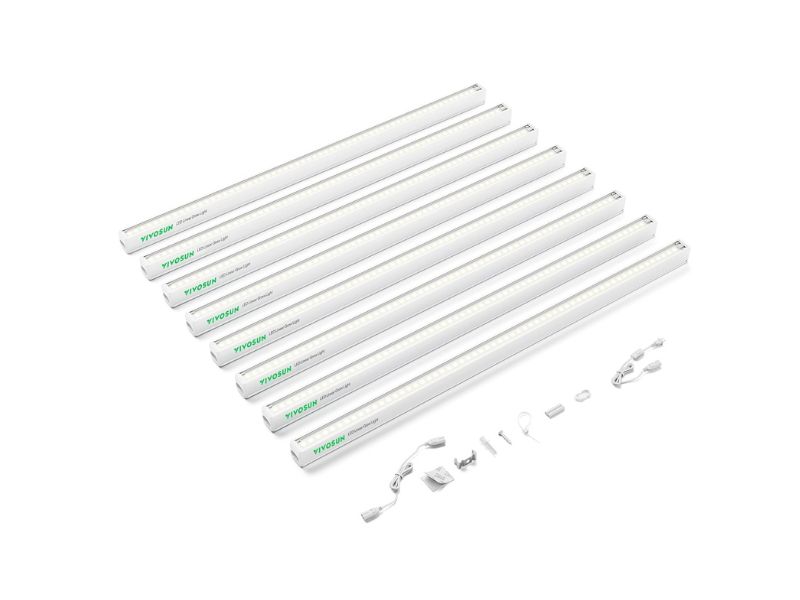
Key Features
- Eight 2-foot LED bars
- 15 watts per bar
- 120 watts combined
- Approximately 5000K white full spectrum
- Linkable configuration
- Low-profile T5 format
- Compatible modular design
- Plug-and-play installation
- Suitable for seed starting and shelves
- No built-in programmable schedule in this version
The VIVOSUN T5 set is the best choice among the three when fixture count matters more than maximum output per bar. Eight 15-watt lights can be spread across a multi-level rack, giving the user more independent coverage zones.
The 5000K appearance is cool white rather than purple. This helps the growing area feel more like a workbench or daylight shelf and makes it easier to inspect natural leaf color, pests, mold, and nutrient symptoms.
At 15 watts per bar, these fixtures are better suited to low-clearance mounting and moderate-light crops than Spider Farmer’s 40-watt bars. One T5 bar may be enough for a narrow row of seedlings or low-light cuttings, while two or more can be combined for broader or more demanding plants.
The eight-pack can support four shelves with two bars each, assuming the shelf dimensions and plant needs are appropriate. It can also serve an uneven arrangement in which higher-light plants receive extra bars and shade-tolerant foliage receives fewer.
VIVOSUN describes the bars as linkable, but linking should follow the instructions for the exact version. Power cords and connectors must be routed away from watering areas and protected from mechanical strain.
My verdict: VIVOSUN T5 is most useful for a multi-tier rack where many moderate-output bars provide better control than two powerful fixtures. It ranks third because its per-bar intensity is lower, not because it is unsuitable for its intended shelf-lighting role.
Bar-Light Comparison Table
| Product | Bars | Length per bar | Power per bar | Total power | Spectrum | Moisture protection | Strongest use case | Main limitation |
| Spider Farmer Glow80 | 2 | About 3.6 ft | 40W | 80W | White plus deep red | IP65-rated bars | One wide, higher-output growing area | Only two independent bars |
| Barrina T8 | 6 | 2 ft | 24W | 144W | Yellow-white full spectrum | No equivalent verified rating | Several moderately high-output shelves | Highest total package power |
| VIVOSUN T5 | 8 | 2 ft | 15W | 120W | 5000K white full spectrum | No equivalent verified rating | Multi-tier shelves and seedlings | Lower intensity from each bar |
Spider Farmer provides the most detailed combination of power, spectrum, efficacy, and environmental protection. Barrina supplies the strongest individual two-foot bars in this comparison, while VIVOSUN supplies the largest number of fixtures.
Total wattage should be interpreted carefully. A 144-watt six-pack spread across six shelves does not produce the same canopy intensity as 80 watts concentrated over one shelf.
Why Choose Bar Lights Instead of Bulbs or Panels?
More Even Shelf Coverage
A point-source bulb produces a high-intensity center and rapidly weakening edges. This pattern can work for one plant but often leaves a row of pots unevenly lit.
A bar follows the shape of a shelf. Multiple parallel bars can distribute photons from front to back as well as from side to side.
Better Use of Vertical Space
Panels and large reflectors require more overhead clearance. Slim bars fit beneath shelves and inside compact propagation racks.
This is particularly helpful in apartments, basements, workshops, and indoor seed-starting stations where every inch between shelves matters.
Modular Expansion
Linkable bars can be added or rearranged as the collection changes. Low-light plants may use one bar, while seedlings or succulents may use two or three.
The modular format also makes it easier to dedicate separate shelves to plants with different lighting needs.
Easier Heat Distribution
Several bars spread electrical power and heat along a longer surface. That does not mean they remain cold, but they are less likely to create one concentrated hot housing in the middle of a shelf.
Adequate airflow is still necessary. Do not cover the bars or press them against heat-sensitive material unless the mounting instructions approve it.
T5 Versus T8 Grow-Light Bars
The labels T5 and T8 originally described tubular lamp diameters, with each number representing eighths of an inch. Traditional T5 fluorescent tubes were approximately five-eighths of an inch wide, while T8 tubes were approximately one inch wide.
Integrated LED grow bars do not always follow fluorescent dimensions precisely, but the names still indicate general product families.
T5-Style LED Bars
T5 bars are usually:
- Slimmer
- Lower in power per fixture
- Easier to fit in low-clearance spaces
- Useful for seedlings and foliage
- Convenient for multi-level racks
VIVOSUN’s 15-watt bars illustrate this approach.
T8-Style LED Bars
T8 bars are generally:
- Wider
- More powerful per fixture
- Equipped with larger reflectors or housings
- Better suited to higher-light shelves
- More likely to need extra vertical clearance
Barrina’s 24-watt bars fit this role.
The designation alone does not determine performance. Compare actual wattage, published photon output, coverage, spectrum, and mounting distance for the exact model.
Understanding Plant-Light Measurements
PPFD
Photosynthetic photon flux density, or PPFD, measures the photosynthetically active photons reaching one square meter every second. Its unit is µmol/m²/s.
PPFD changes with distance and position. A bar may produce a strong reading directly below its center and weaker readings between widely spaced fixtures.
For this reason, PPFD maps are more useful than a single maximum value.
PPF
Photosynthetic photon flux, or PPF, measures the total photosynthetically active photon output of a fixture in µmol/s.
PPF helps compare total output but does not explain how evenly that output reaches the shelf. Optical design and bar spacing control distribution.
PPE or Efficacy
Photosynthetic photon efficacy, sometimes written PPE, expresses how many plant-usable photons a fixture produces per joule of electrical energy:
µmol/J
The Glow80’s published 2.0 µmol/J figure helps describe electrical efficiency. A higher value generally means more photosynthetically active output per watt, but spectrum and coverage remain important.
Daily Light Integral
Daily light integral, or DLI, measures the total photosynthetic light a plant receives during one day.
A simplified formula is:
DLI = PPFD × daily operating seconds ÷ 1,000,000
If average canopy PPFD is 150 µmol/m²/s for 14 hours:
150 × 50,400 ÷ 1,000,000 = 7.56 mol/m²/day
DLI explains why both intensity and duration matter. A strong light operated briefly and a moderate light operated longer can sometimes deliver similar daily totals.
Choosing the Right Bar Length
Measure the Plant Canopy
Measure the actual width occupied by leaves. Pots do not define the illuminated area because foliage frequently extends beyond them.
A four-foot shelf containing only two small pots may not need four feet of bars. Conversely, dense leaves can fill the full shelf even when containers occupy less space.
Leave Space at the Ends
A bar’s effective plant-growing coverage may not extend uniformly to its physical endpoints. Diode spacing, housing design, and reflectors affect edge output.
For an evenly filled shelf, bars should cover most of the canopy length without leaving large unlit end zones.
Consider Future Growth
Seedlings become larger plants. Cuttings develop leaves that overlap. Choose a system that allows another bar to be added or the shelf spacing to be changed.
Two Short Bars Versus One Long Bar
Two independently mounted short bars provide flexible positioning and easier replacement. One long bar reduces connections and may create a cleaner installation.
Spider Farmer uses longer bars for a wide concentrated area, while Barrina and VIVOSUN favor multiple short fixtures.
Calculating How Many Bars a Shelf Needs
There is no universal “one bar per shelf” rule. Consider:
- Shelf width and depth
- Distance between light and canopy
- Plant light requirement
- Natural window light
- Reflective walls
- Daily operating time
- Output per bar
- Front-to-back spacing
A narrow 10-inch-deep shelf with Pothos cuttings may perform under one moderate T5 bar. A 20-inch-deep shelf holding compact succulents may need several parallel bars.
Place bars from front to back so their coverage overlaps without concentrating all output in one center strip.
Choosing Spectrum for Indoor Plants
White Full Spectrum
White full-spectrum bars combine several wavelengths into light that appears white to people. They work well in living areas and allow accurate inspection of plants.
A 5000K fixture such as the VIVOSUN appears cooler than a warm household lamp. Barrina’s yellow-white output appears warmer.
Deep Red
Deep-red light around 660nm contributes efficiently to photosynthesis and can support flowering responses in certain plants. Spider Farmer includes 660–665nm diodes alongside white light.
Deep red is useful, but it does not compensate for poor coverage or insufficient total output.
Blue Light
Blue wavelengths contribute to compact vegetative growth, leaf development, and normal plant form. White LEDs generally contain a meaningful blue component even when separate blue diodes are not visible.
Ultraviolet and Far Red
Most houseplant and seedling setups do not require dedicated ultraviolet output. Far-red light can influence plant form and flowering responses, but it should be used intentionally rather than assumed necessary.
A balanced white-and-red bar is adequate for most household applications.
Appropriate Light Levels by Plant Type
Seedlings
Seedlings need sufficient light to remain compact. Weak light produces elongated, fragile stems.
Bars should be positioned evenly above the tray and raised as plants grow. The light must cover tray edges, not only the center cells.
Propagation Cuttings
Fresh cuttings generally need enough light for photosynthesis without excessive intensity that increases water stress before roots develop.
VIVOSUN T5 bars are easy to distribute over propagation shelves. More intense fixtures should initially be mounted higher or spaced farther apart.
Tropical Foliage
Pothos, Philodendron, Hoya, Peperomia, and similar plants can use moderate shelf lighting. Their exact requirements differ, especially among variegated cultivars.
One or two bars per shelf may be appropriate depending on output and distance.
Succulents and Cacti
Succulents often require stronger light to maintain compact form and coloration. Multiple Barrina T8 bars or the Spider Farmer system are more relevant than one moderate T5 bar.
Watch for stretching, flattening rosettes, or pale new growth as evidence of insufficient light.
Herbs and Leafy Greens
Herbs and greens benefit from even coverage because uneven lighting creates inconsistent growth across a tray.
Spider Farmer or multiple Barrina bars can provide greater intensity for dense herbs. Air circulation also matters because tightly packed foliage can retain moisture.
Flowering Plants
Flowering plants need adequate daily light and, for some species, an appropriate photoperiod. Red-enriched output may be useful, but plant maturity, temperature, and day length can also control flowering.
Mounting Height and Bar Spacing
Start with Product-Specific Guidance
Do not apply one distance to every bar. A 15-watt T5, a 24-watt T8, and a 40-watt long bar produce different intensities.
Begin with the exact model’s instructions, then evaluate leaf response.
Keep the Canopy Level
Use risers beneath short plants so their leaves sit closer to the taller plants’ canopy height. This produces more even exposure and reduces the temptation to lower the entire fixture dangerously close to the tallest leaves.
Space Parallel Bars Evenly
For deep shelves, mount several bars from front to back. Equal spacing is a reasonable starting point, but edge output and plant density may justify placing bars slightly closer to the shelf boundaries.
Recheck as Plants Grow
Growing tips can enter a high-intensity zone quickly. Measure clearance at least monthly and more frequently for seedlings or rapidly growing vines.
Setting the Daily Photoperiod
A consistent schedule is more useful than manually switching lights at different times.
General starting points include:
- Foliage plants: approximately 12–14 hours
- Seedlings and many herbs: approximately 14–16 hours
- Flowering plants: species-dependent
- Supplemental window lighting: adjust for natural daylight
These periods are starting ranges, not universal prescriptions. Plants require darkness, so 24-hour lighting should be avoided unless a specialized crop protocol explicitly calls for it.
None of the three reviewed products should be assumed to include a complete programmable schedule. A compatible external timer is the simplest solution.
Energy-Use Calculations
Monthly energy consumption can be estimated using:
Watts ÷ 1,000 × daily hours × 30
Spider Farmer Glow80
At 80 watts for 14 hours daily:
0.080 × 14 × 30 = 33.6 kWh per month
Barrina T8 Six-Pack
At 144 watts for 14 hours daily:
0.144 × 14 × 30 = 60.48 kWh per month
VIVOSUN T5 Eight-Pack
At 120 watts for 14 hours daily:
0.120 × 14 × 30 = 50.4 kWh per month
These calculations assume every included bar operates. Using fewer bars reduces total consumption proportionally.
Multiply monthly kWh by the local electricity rate to estimate operating cost.
Installation and Electrical Safety
Confirm Shelf Strength
Fixtures, cables, mounting hardware, and timers add weight. Thin particleboard or lightweight wire shelves may need reinforcement.
Do not mount lights directly above valuable plants until the attachment has been tested.
Use the Supplied Mounting System
Use the manufacturer’s clips, brackets, magnets, ties, or suspension cables according to instructions. Improvised adhesive can weaken with heat and humidity.
Never hang a bar by its power cord.
Keep Connections Dry
Position plugs, link cables, timers, and power strips away from misting systems and drainage areas. Form a drip loop in each cord so water falls before reaching an electrical connection.
Even when a bar carries an IP rating, the entire electrical system is not necessarily waterproof.
Respect the Linking Limit
Every linkable system specifies how many fixtures can be connected safely. Exceeding that limit can overheat connectors or overload switching components.
Check the limit for the exact voltage and product version.
Avoid Damaged Extension Cords
Use grounded, appropriately rated equipment. Replace cracked cables, loose plugs, scorched connectors, or power strips that become unusually warm.
Provide Airflow
Fanless LED bars still generate heat. Leave ventilation space around the housings and power components.
Do not cover fixtures with reflective film or allow leaves to press against the LEDs.
Recognizing Incorrect Light Levels
Light Is Too Weak
Common indicators include:
- Tall, thin seedlings
- Large spaces between leaves
- Plants leaning toward another source
- Pale or undersized new foliage
- Succulent rosettes opening or stretching
- Slow growth
- Lower leaves declining
- Soil remaining wet for unusually long periods
Possible solutions include lowering the bars, adding another fixture, increasing daily duration within a reasonable range, or grouping plants more efficiently.
Light Is Too Strong
Possible warning signs include:
- Bleached upper leaves
- Tan patches facing the LEDs
- Leaf edges curling upward
- Fading pigmentation
- Rapid moisture loss
- Warm leaf surfaces
- New growth remaining unusually compact or stressed
Raise the fixture, reduce the number of bars, shorten the schedule, or move sensitive plants toward the shelf edge.
Change one variable at a time so the response can be interpreted.
Maintenance
Clean the Light Surfaces
Dust and mineral residue reduce transmitted light. Unplug the bars, let them cool, and wipe them according to the care instructions.
Do not spray cleaner directly onto LEDs or connectors.
Inspect Mounts Monthly
Heat cycles, shelf movement, and humidity can loosen clips or adhesive supports. Check every mounting point and cable strain relief.
Watch for Flicker
Visible flickering, delayed startup, intermittent operation, buzzing, or unusual heat can signal a connection or driver problem. Stop using damaged equipment until it has been inspected or replaced.
Rotate Plants Only When Necessary
Good bar placement should minimize rotation. If edge plants consistently lean inward, coverage needs improvement rather than indefinite rotation.
Record the Setup
Write down:
- Number of bars
- Mounting height
- Bar spacing
- Daily schedule
- Plant arrangement
- Light measurements when available
A record makes seasonal adjustments more predictable.
Common Bar-Light Buying Mistakes
- Comparing only total package wattage
- Ignoring power per individual bar
- Choosing a bar shorter than the canopy
- Mounting one bar over a deep shelf
- Assuming T8 is always better than T5
- Using “equivalent watts” as a plant-light measurement
- Expecting full spectrum to compensate for low intensity
- Buying more bars than the electrical circuit can support
- Ignoring the manufacturer’s linking limit
- Mounting lights with unapproved adhesive
- Leaving connectors beneath watering areas
- Running lights continuously for 24 hours
- Placing low- and high-light plants on the same level
- Failing to raise lights as seedlings grow
- Treating an IP-rated bar as a fully waterproof electrical system
- Forgetting to include operating cost
- Using one center reading to represent the shelf edges
Frequently Asked Questions
What are the best bar style LED grow lights?
Spider Farmer Glow80 provides the strongest overall specification balance in this comparison. Its two 40-watt bars, 2.0 µmol/J published efficacy, broad spectrum, and IP65-rated construction suit a serious shelf or propagation area. Barrina and VIVOSUN offer greater multi-shelf flexibility.
Are LED grow-light bars good for houseplants?
Yes, bars provide even coverage for plants arranged across shelves or benches. Their linear shape reduces the bright-center, weak-edge pattern created by a single bulb. Output and distance must still match the plant species.
Are T5 or T8 grow lights better?
T5 bars suit lower-clearance shelves, while T8 bars often provide more output. The label does not guarantee performance, so compare actual wattage, photon data, spectrum, housing design, and mounting distance for the exact model.
How many LED bars do I need per shelf?
One to three bars per shelf is a common starting range, not a fixed rule. Narrow low-light shelves may need one, while deep shelves holding succulents may need several parallel bars. Evaluate coverage at the edges.
How far should bar grow lights be from plants?
Use the exact fixture’s guidance because output varies considerably between models. Begin conservatively, monitor the newest leaves, and change the distance gradually. A 40-watt bar usually requires different spacing from a 15-watt T5.
How long should grow-light bars run daily?
Approximately 12–16 hours is a practical range for many indoor growing setups. Foliage plants often need less duration than seedlings or dense herbs. Include natural daylight and provide a consistent dark period.
Can bar lights grow succulents?
Yes, sufficiently intense bars can maintain compact succulent growth. Multiple Barrina T8 bars or the Spider Farmer Glow80 are more suitable than one moderate T5. Watch for stretching as evidence that intensity is insufficient.
Can bar lights start vegetable seedlings?
Yes, even coverage makes LED bars particularly useful for seedling trays. Position the fixtures so tray edges receive useful light, raise them as seedlings grow, and provide airflow to reduce weak stems and excess surface moisture.
Is an IP65 grow light completely waterproof?
No, IP65 does not mean the entire electrical installation can be submerged. The rated enclosure resists dust and water jets under test conditions. Plugs, timers, connectors, and outlets must still remain dry.
Can I connect all the lights to one timer?
Yes, if the timer supports the combined load and switching characteristics. Add the actual wattage of all connected bars and remain below the timer’s rating. Follow the fixture’s linking limit as well.
Do bar grow lights need reflectors?
Reflectors can reduce sideways spill and direct more light toward the canopy. They are helpful on open shelves but do not create additional photons. Proper bar spacing and mounting distance remain essential.
Is 5000K suitable for plant growth?
Yes, 5000K white light can support seedlings and vegetative houseplant growth. Color temperature describes visual appearance rather than the complete spectrum. Useful intensity and coverage remain more important.
Do flowering plants need red LEDs?
Red wavelengths are useful, but flowering depends on more than spectrum alone. Total daily light, photoperiod, plant maturity, temperature, and genetics also matter. White full-spectrum fixtures already contain useful red light.
Will grow-light bars raise shelf temperature?
Yes, LEDs produce heat even without cooling fans. Several bars in a confined rack can raise leaf and air temperatures. Provide airflow and monitor heat near the canopy and power connections.
Can bar lights be mounted vertically?
Yes, vertical mounting can provide side lighting when the product supports secure installation. Side bars are useful for tall plants or dense lower foliage but should supplement—not necessarily replace—adequate top lighting.
Can I use ordinary LED shop lights for plants?
Bright shop lights can support some foliage and seedlings when output and placement are adequate. Purpose-built grow bars may provide more relevant spectrum data, linking accessories, moisture protection, and mounting guidance.
Why are seedlings leaning under bar lights?
Uneven coverage or excessive distance is usually responsible. Center the tray, add another parallel bar, reduce the distance appropriately, and verify that another window or lamp is not creating a stronger directional source.
Should plants be rotated beneath bar lights?
Well-positioned bars should minimize the need for frequent rotation. Occasional rotation may correct minor edge differences, but persistent leaning indicates that coverage or spacing should be improved.
Conclusion
The best bar style led grow lights are determined by the dimensions of the growing area and the intensity required at the canopy. Total package wattage is less informative than output per bar, bar length, spacing, efficacy, spectrum, and mounting height.
Spider Farmer Glow80 remains my primary recommendation. Its two long 40-watt bars, published 2.0 µmol/J efficacy, mixed white-and-red spectrum, and IP65-rated construction make it the strongest choice for one wide shelf, propagation bench, or compact vertical garden.
Barrina T8 is the better alternative for several shorter shelves that require more output from each individual fixture. Six 24-watt bars can be divided among multiple levels or grouped over high-light plants.
VIVOSUN T5 offers the most fixtures and is therefore well suited to multi-tier racks, low-clearance shelves, cuttings, and seedlings. Its 15-watt bars provide more arrangement flexibility, although demanding plants may require two or more bars per level.
Measure the canopy before purchasing, leave room for plant growth, and keep every electrical connection away from water. Use a timer, respect the linking limit, and adjust the bars according to new leaf growth rather than apparent room brightness.
For a single higher-output growing area, I would choose Spider Farmer Glow80. For a larger rack, I would choose between Barrina and VIVOSUN according to the number and depth of the shelves.

I’m Maya L. Greenwood, a lifelong plant lover who believes anyone can grow something beautiful with the right guidance. After years of testing soil mixes, pruning methods, irrigation tricks, and pest-safe solutions, I started EasyGardenTips.com to turn hard-won lessons into step-by-step advice. From seed starting and container gardens to composting and seasonal checklists, my goal is to make gardening simple, sustainable, and fun.