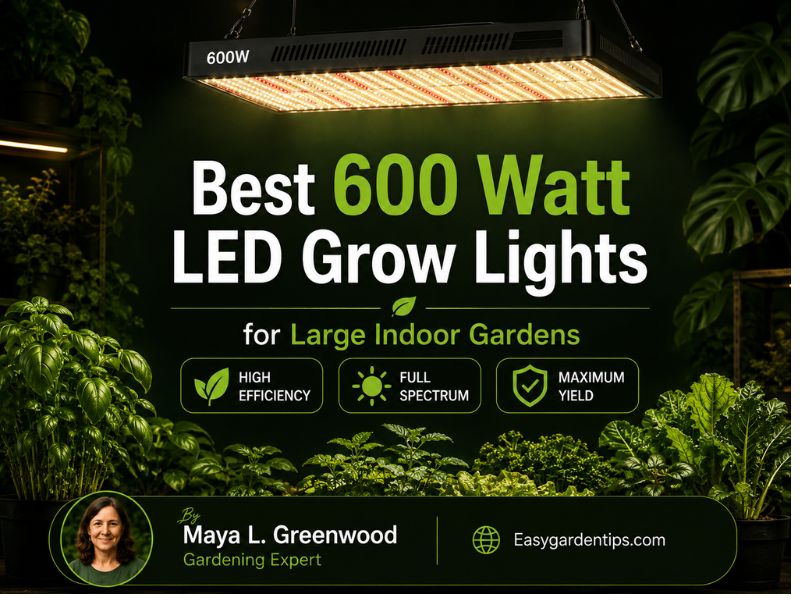
3 Best 600 Watt LED Grow Lights for Large Indoor Gardens
A 600W LED grow light moves well beyond basic seed-starting equipment. This power class is better suited to large indoor canopies, mature vegetables, 4×4 and 5×5 grow tents, and growers who want substantial photon output from one fixture.
The best 600 watt LED grow lights should not be chosen by wattage alone. I would compare actual wall draw, PPF, PPE, PPFD uniformity, dimming, fixture geometry, thermal management, spectrum, and realistic canopy coverage before deciding which model fits a larger indoor garden.
My primary recommendation is the Spider Farmer SF7000 650W LED Grow Light. I would choose it for growers who want a powerful 600W-class fixture with a long Amazon rating history because the current listing specifies 650W actual power, Samsung LM301B diodes, 2.8 µmol/J photon efficiency, approximately 1,786 µmol/s PPF, dimming, and 5×5-foot commercial coverage.
I would choose the HLG 600 Rspec FR 600W LED Grow Light when I specifically want a true 600W fixture with strong published third-party photon numbers. Its current Amazon listing specifies 600W power, approximately 1,529 µmol/s PPF, 2.60 µmol/J efficacy, four quantum boards, deep-red 660nm supplementation, dimming, and 4×4-focused coverage.
For buyers who prefer a true 600W foldable bar fixture, I would choose the AGLEX M600 600W LED Grow Light. Its current listing specifies 600W±5% actual draw, 2,040 LEDs, 0–100% dimming, daisy-chain control, 3000K/5000K white plus blue, 660nm red, 730nm IR, 405nm UV, and 5×5-foot coverage.
3 Best 600 Watt LED Grow Lights Reviewed
| Image | Product Name | Check Price |
|---|---|---|
Best Choice | Spider Farmer SF7000 650W LED Grow Light | Check Price |
Second Best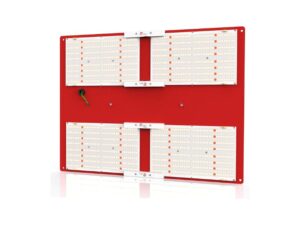 | HLG 600 Rspec FR 600W LED Grow Light | Check Price |
Third Choice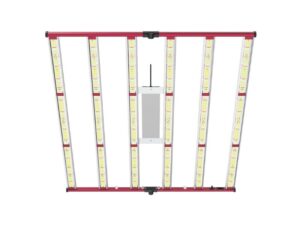 | AGLEX M600 600W LED Grow Light | Check Price |
1. Spider Farmer SF7000 650W LED Grow Light
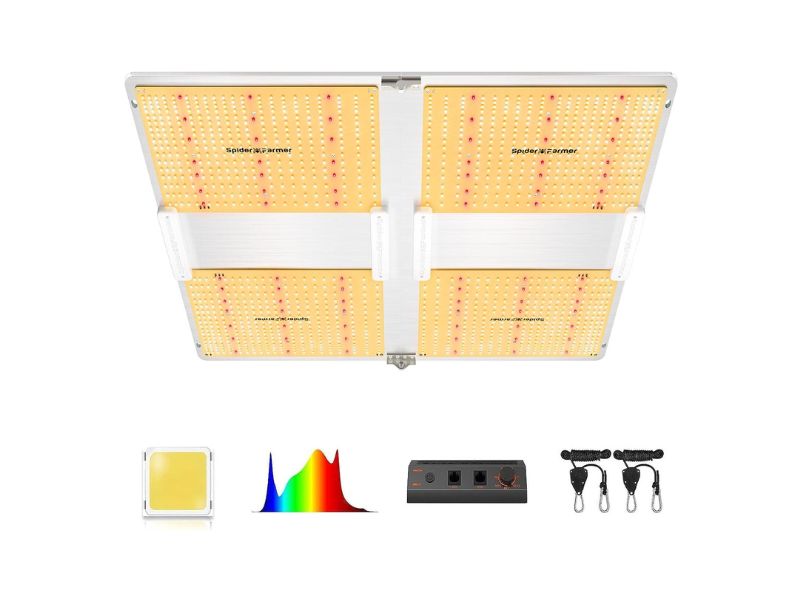
Key Features
- 650W actual power draw
- Samsung LM301B diodes
- 2.8 µmol/J photon efficiency
- Approx. 1,786 µmol/s PPF
- Full-spectrum output
- Dimmable control
- Uniform-PPFD design
- Commercial 5×5-foot coverage
- Passive thermal management
The Spider Farmer SF7000 is my primary recommendation even though it draws 650W rather than exactly 600W.
A 50-watt difference represents only about an eight-percent increase from 600W, so it competes directly in the same large-fixture class. More importantly, its current Amazon listing has a much larger body of customer feedback than the exact-600W alternatives considered here.
The current listing specifies 650W input power, Samsung LM301B diodes, 2.8 µmol/J photon efficiency, and approximately 1,786 µmol/s PPF.
Those numbers deserve attention.
PPE, or photosynthetic photon efficacy, describes how efficiently electricity becomes plant-usable photons.
PPF, or photosynthetic photon flux, describes the total volume of those photons the fixture emits every second.
A high-power grow light should produce substantial PPF, but wattage by itself does not guarantee efficiency.
The SF7000’s published 2.8 µmol/J specification places it in a strong efficiency range for this type of fixture.
Its 5×5-foot commercial coverage is another major reason to consider it.
A 5×5 grow area contains 25 square feet, so fixture geometry matters enormously.
The SF7000 spreads LEDs across a broad light-emitting area rather than concentrating all output into one compact source. That helps improve uniformity from the center toward the edges of the canopy.
This is useful for:
- Mature tomato plants
- Pepper plants
- Eggplants
- Large indoor vegetables
- Herbs grown at scale
- Dense leafy-green canopies
- Large houseplant collections
- 5×5 grow tents
The term uniform PPFD matters here.
PPFD measures the photon density actually reaching the plant canopy.
At this wattage, poor distribution can create an intense hotspot directly beneath the fixture while wasting the outer sections of the tent.
A well-distributed fixture helps make more of the grow area productive.
Dimming is essential.
I would never treat a 650W fixture as something that must operate at maximum output every day.
For young plants, maximum intensity can be excessive.
A sensible progression might involve lower settings during early growth and higher intensity only as the canopy becomes larger and more light-demanding.
Fixture height also matters.
The correct distance varies with:
- Growth stage
- Target PPFD
- Dimmer level
- Canopy density
- Tent reflectivity
Follow Spider Farmer’s model-specific recommendations first rather than relying on a generic hanging-height rule.
Thermal management is another important consideration.
At 650W, this fixture introduces a substantial amount of energy into the room.
Even efficient LEDs ultimately contribute heat to the surrounding environment.
A serious 5×5 setup may need:
- Exhaust ventilation
- Fresh-air intake
- Circulation fans
- Temperature monitoring
- Humidity control
The SF7000 is therefore not a good match for someone who only wants to illuminate a small seedling shelf.
Its strength is large-scale indoor growing.
What I Like
- Strong 2.8 µmol/J published efficiency
- Approx. 1,786 µmol/s PPF
- Large 5×5 coverage
- Samsung LM301B diode platform
- Dimmable operation
- Strong marketplace history
- Good center-to-edge coverage potential
What I Do Not Like
- Actual power is 650W rather than exactly 600W
- Excessive for small grow areas
- Higher heat load than true 600W options
- Requires substantial environmental management
The SF7000 is the model I would choose when I want the strongest all-around 600W-class option for a large 5×5 canopy and do not mind moving slightly above the exact 600W mark.
2. HLG 600 Rspec FR 600W LED Grow Light
Key Features
- 600W actual power
- Approx. 1,529 µmol/s PPF
- 2.60 µmol/J efficacy
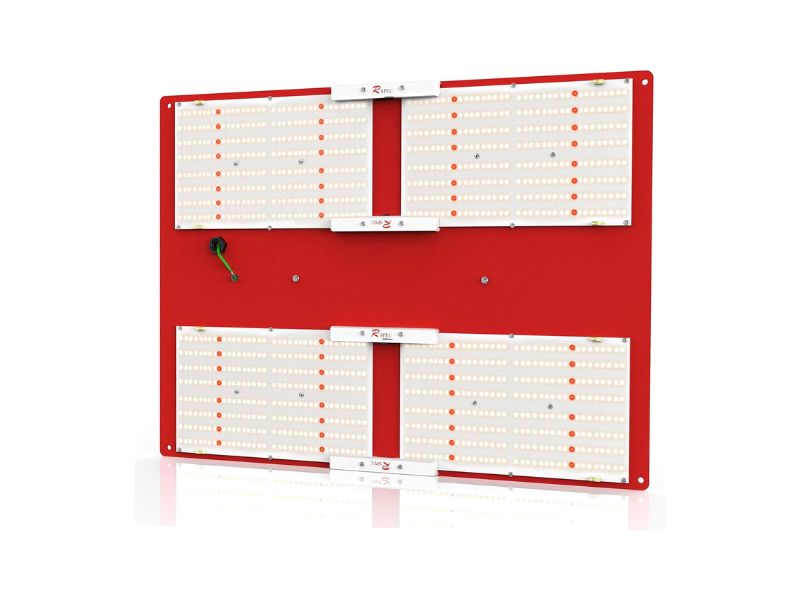
- Four quantum-board architecture
- Full-spectrum white output
- 660nm deep red
- Dimmable
- Designed around a 4×4 grow tent
- Published third-party efficiency data
The HLG 600 Rspec FR is my choice when the requirement is specifically a true 600-watt fixture.
Its current Amazon listing identifies it as a 600W full-spectrum dimmable quantum-board grow light and publishes approximately 1,529 µmol/s PPF at 2.60 µmol/J.
HLG also states that those figures are supported by independent lab testing on the listing.
That makes the published photon data easier to evaluate than vague “equivalent wattage” claims.
The fixture uses four high-efficiency quantum boards with full-spectrum white LEDs and deep-red 660nm supplementation.
The quantum-board design differs from an open bar fixture.
Instead of long narrow bars spread across a large frame, the diodes are concentrated onto several larger boards.
That has some advantages:
- Compact overall architecture
- High diode density
- Straightforward hanging
- Strong central and mid-canopy output
The tradeoff is that bar fixtures can sometimes distribute LEDs farther toward the outer edges.
The correct choice depends on the growing footprint.
HLG specifically positions the 600 Rspec around a 4×4-foot grow tent.
That makes sense.
A 4×4 area contains 16 square feet.
At 600W, the nominal power density is:
600 ÷ 16 = 37.5 watts per square foot.
Watts per square foot is not a replacement for PPFD, but it provides useful context.
An efficient 600W system in a 4×4 footprint has considerably more intensity potential than the same power spread over a 5×5.
That makes the HLG especially attractive for demanding plants in a concentrated canopy.
I would consider it for:
- Mature tomatoes
- Large pepper plants
- Fruiting vegetables
- Dense indoor herbs
- High-light ornamental plants
- 4×4 tents
The deep-red supplementation is useful across later plant development, but I would not choose the light solely because it includes 660nm LEDs.
Overall photon quantity and canopy distribution remain more important.
Dimming also adds versatility.
At full power, 600W can be far too intense for young seedlings.
If I were using the HLG from early growth onward, I would reduce power substantially at first.
As plants fill the 4×4 canopy, output can increase.
That gives the fixture useful stage-to-stage flexibility.
Heat remains significant.
Six hundred watts of electrical input is a serious load in a small enclosed tent.
A 4×4 setup may require robust exhaust airflow depending on room temperature and climate.
The quantum boards themselves do not need noisy active cooling, but the room still needs to remove the heat produced by the system.
What I Like
- True 600W actual draw
- Approx. 1,529 µmol/s PPF
- Published 2.60 µmol/J efficacy
- Third-party test emphasis
- Full-spectrum plus 660nm deep red
- Strong fit for 4×4 tents
- Dimmable
What I Do Not Like
- Quantum-board format is less physically distributed than wide bars
- Overpowered for small propagation setups
- Large heat load at full output
- 4×4 focus may be less ideal for broad 5×5 use
The HLG 600 Rspec FR is the product I would choose when I specifically want a true 600W LED grow light with established photon-output specifications for a concentrated 4×4 canopy.
3. AGLEX M600 600W LED Grow Light
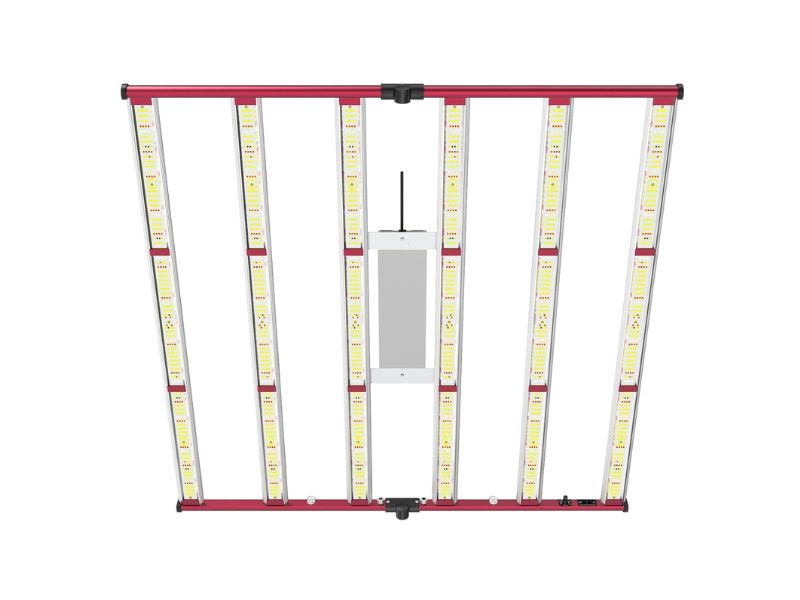
Key Features
- 600W±5% actual draw
- 2,040 LEDs
- Full-spectrum bar design
- 0–100% dimming
- Daisy-chain control
- 3000K warm white
- 5000K cool white
- 460nm blue
- 660nm red
- 730nm IR
- 405nm UV
- 5×5-foot listed coverage
- Foldable fixture
The AGLEX M600 is the more feature-heavy true-600W option.
Its current Amazon listing specifies 600W±5% average power draw and describes the product as a foldable full-spectrum bar fixture designed for a 5×5-foot growing area.
The listing also states that the fixture uses 2,040 LEDs and provides 0–100% dimming.
The spectrum includes:
- 3000K warm white
- 5000K cool white
- 460nm blue
- 660nm red
- 730nm IR
- 405nm UV
That is one of the broadest spectral mixes among these three products.
I would not assume that more wavelength labels automatically mean better plant growth.
For most growers, the hierarchy should still be:
PPFD first, coverage second, photoperiod third, spectral extras after that.
If canopy intensity is inadequate, adding UV or IR does not fix the fundamental lighting problem.
The AGLEX bar-style frame is particularly useful for a 5×5 footprint.
Distributed bars allow LEDs to cover more of the physical growing area.
This can improve:
- Edge illumination
- Corner consistency
- Heat spreading
- Air circulation
- Canopy uniformity
The current listing specifies 5×5 coverage at around 16 inches under its stated setup and publishes a center-style PPFD figure of approximately 1,442 µmol/m²/s.
That PPFD number needs context.
PPFD measurements only make sense when you know:
- Hanging distance
- Measurement point
- Dimmer setting
- Tent conditions
A single maximum number should never be interpreted as the average intensity across the entire 5×5 canopy.
The 0–100% dimming range is one of AGLEX’s strongest practical features.
A wide dimming range lets one fixture work with:
- Seedlings
- Vegetative plants
- Mature plants
- Lower-light crops
- High-light crops
without forcing maximum output.
The listing also supports daisy-chain control, allowing multiple compatible fixtures to be adjusted together.
That feature is more useful for commercial or large-room growers than for a single home tent, but it provides expansion potential.
Foldability helps with storage.
A 5×5-class bar fixture is large.
Being able to fold the frame makes seasonal storage and transport easier than with some permanently rigid designs.
The biggest concern is marketplace history and rating quality.
The exact current Amazon listing has fewer ratings than HLG and dramatically fewer than the Spider Farmer SF7000, and its current star average is also lower.
That does not invalidate the technical specifications, but it is something I would weigh when comparing long-term confidence.
What I Like
- True 600W±5% input
- Broad 5×5 bar coverage
- 0–100% dimming
- Foldable architecture
- Daisy-chain capability
- Wide full-spectrum mix
- Good option for large canopies
What I Do Not Like
- Lower current Amazon rating average
- Much smaller rating history than SF7000
- UV/IR additions can distract from more important PPFD considerations
- Large 5×5 fixture requires substantial installation space
The AGLEX M600 is the option I would choose when I specifically want a true 600W foldable bar fixture with 5×5 coverage and a very wide dimming range.
600 Watt LED Grow Light Comparison
| Product | Actual Power | Fixture Style | Published Photon Metric | Dimming | Coverage Focus | Main Strength |
| Spider Farmer SF7000 | 650W | Distributed LED platform | 2.8 µmol/J, ~1,786 µmol/s | Yes | 5×5 | High output + strong rating history |
| HLG 600 Rspec FR | 600W | Quantum board | 2.60 µmol/J, ~1,529 µmol/s | Yes | 4×4 | True 600W + tested photon data |
| AGLEX M600 | 600W±5% | Foldable bars | PPFD up to ~1,442 µmol/m²/s under listed setup | 0–100% | 5×5 | Foldability + broad spectrum |
The Spider Farmer provides the strongest combination of current Amazon rating history and large-canopy output, HLG is the cleaner exact-600W choice for 4×4 growing, and AGLEX offers a true 600W foldable bar design focused on 5×5 coverage.
How to Choose the Best 600 Watt LED Grow Lights
Verify Actual Wattage
This is the first step.
Grow-light model numbers frequently do not equal real wall draw.
The Spider Farmer SF7000 reviewed here is a 650W fixture, not 7000 watts.
The HLG 600 Rspec is an actual 600W-class fixture, while AGLEX specifies 600W±5%.
Always use real electrical input when calculating:
- Electricity use
- Timer load
- Heat output
- Circuit requirements
600W vs 650W Grow Light
A 650W fixture consumes about 8.3% more power than a 600W fixture.
That difference is relatively small compared with differences in:
- PPE
- PPF
- PPFD distribution
- Fixture shape
This is why I consider the SF7000 a legitimate 600W-class option.
Its published 1,786 µmol/s PPF is also considerably higher than the HLG’s 1,529 µmol/s figure, though the fixtures use different architectures and coverage targets.
Is 600W Enough for a 4×4 Grow Tent?
Yes, a quality 600W LED provides substantial intensity potential in a 4×4 tent.
HLG specifically positions the 600 Rspec for a 4×4 grow tent.
At full output, many crops may not require the fixture to operate at 100%.
Use dimming and canopy-level PPFD rather than assuming more light is always better.
Is 600W Enough for a 5×5 Grow Tent?
Yes for many applications, especially with a well-distributed fixture.
Spider Farmer lists the 650W SF7000 for 5×5 commercial coverage, while AGLEX lists its M600 around a 5×5 footprint.
A 5×5 canopy spreads light over 25 square feet, so distribution matters greatly.
600W for a 3×3 Tent
A full 600W fixture can be excessive in a 3×3.
Nine square feet at 600W equals about:
66.7 watts per square foot.
With efficient modern LEDs, that represents very high potential intensity.
A dimmer makes it possible, but a 300W-class fixture is often more proportionate for a typical 3×3 setup.
600W vs 500W Grow Light
Six hundred watts provides 20% more nominal input power than 500W.
That can provide:
- Higher PPF
- More 5×5 headroom
- Greater mature-plant intensity
- Better ability to cover demanding canopies
It also produces more heat and uses more electricity.
For 4×4 growing, a 500W fixture may already be sufficient.
For 5×5 use, 600–650W becomes more attractive.
600W vs 730W Grow Light
A 730W fixture consumes roughly 22% more power than 600W.
That extra capacity is often targeted toward larger 5×5 canopies.
For example, current larger Spider Farmer SE7000 and MARS HYDRO FC-E6500 generations are around 730W rather than the older 600–650W class.
That does not mean every 5×5 grow requires 730W.
The actual requirement depends on desired PPFD and crop.
Why PPE Matters
PPE measures photon output per joule of electricity.
Spider Farmer publishes approximately 2.8 µmol/J for the SF7000, while HLG publishes 2.60 µmol/J for the 600 Rspec.
Higher PPE means more photosynthetically active photons from the same amount of electrical energy, assuming the figures are measured on a comparable system basis.
Why PPF Matters
PPF is total photosynthetically active photon output.
Spider Farmer lists approximately 1,786 µmol/s.
HLG lists approximately 1,529 µmol/s.
PPF is useful for total fixture output.
It does not tell you how evenly those photons reach the plants.
PPFD Determines What Reaches the Canopy
PPFD measures photon density at a specific point.
It changes when you change:
- Hanging height
- Dimmer level
- Measurement location
- Tent reflectivity
- Fixture geometry
This is why you should always evaluate a PPFD map rather than relying only on the highest listed reading.
Bar Lights vs Quantum Boards
Bar Fixtures
Benefits can include:
- Better edge distribution
- Wider diode spacing
- Improved airflow
- Reduced center hotspots
Spider Farmer SF7000 and AGLEX M600 use broadly distributed architectures.
Quantum Boards
Benefits can include:
- Compact design
- High diode density
- Strong output from a relatively simple fixture
The HLG 600 Rspec uses four quantum boards.
Neither architecture is automatically superior.
Match it to the canopy.
Dimming Is Essential at 600W
A high-power fixture becomes much more versatile when dimmable.
Seedlings require far less intensity than mature high-light plants.
A useful progression might be:
Lower power for seedlings → moderate output for vegetative growth → higher output for a mature canopy.
AGLEX’s 0–100% dimming gives particularly broad adjustment.
Best 600W Grow Light for Seedlings
For seedlings alone, I would not buy a 600W grow light.
A smaller 100–200W fixture is usually more proportionate.
A 600W light becomes sensible when seedlings are only the first stage and you plan to continue using the same fixture over a much larger mature canopy.
If that is the plan, use substantial dimming initially.
Best 600W Grow Light for Vegetable Seedlings
For several large nursery flats, broad bar-style coverage can be useful.
The SF7000 or AGLEX M600 can distribute light across multiple trays, but both should be dimmed considerably while plants are young.
This power class becomes most valuable later as tomatoes and peppers become much larger.
Best 600W Grow Light for Tomatoes
Large tomato plants are one of the strongest use cases for this class.
For a 5×5 canopy of multiple mature tomato plants, I would favor the Spider Farmer SF7000 because of its strong total output and 5×5 positioning.
For a dense 4×4 tomato canopy, the HLG 600 Rspec is particularly attractive.
Best 600W Grow Light for Peppers
Several mature pepper plants can benefit from a strong large-area fixture.
Again, start young plants dimmed and increase intensity as the canopy fills.
A wide fixture helps keep perimeter plants from leaning toward the brightest center region.
Best 600W Grow Light for Lettuce
For normal home lettuce growing, 600W is excessive.
For a large 5×5 commercial-style lettuce canopy, dimmed broad lighting can make sense.
Lettuce generally benefits more from uniform moderate PPFD than extreme peak intensity.
Best 600W Grow Light for Herbs
A few herb pots do not justify 600 watts.
This class is more appropriate for a substantial indoor herb operation occupying much of a 4×4 or 5×5 space.
Use dimming to match actual crop demand.
How Long Should a 600W Grow Light Run?
Wattage does not determine photoperiod.
The correct duration depends on:
- Plant species
- Growth stage
- PPFD
- Natural light
- Desired DLI
A stronger fixture can reach a target Daily Light Integral in fewer hours than a weaker fixture, but plants also have biological photoperiod requirements.
Do not simply shorten or lengthen the day based on watts.
Electricity Use of a 600W LED Grow Light
At maximum output:
600W = 0.6 kW
At 16 hours per day:
0.6 × 16 = 9.6 kWh per day
Over 30 days:
9.6 × 30 = 288 kWh per month
For the 650W Spider Farmer:
0.65 × 16 = 10.4 kWh per day
Over 30 days:
312 kWh per month
Actual consumption will be lower when dimmed.
Heat From a 600W Grow Light
A 600W fixture creates a substantial indoor heat load.
Efficient LEDs produce more photons per watt, but the energy still ultimately becomes heat inside the growing environment.
For a 4×4 or 5×5 tent, consider:
- Exhaust airflow
- Fresh-air intake
- Oscillating or circulation fans
- Temperature monitoring
- Humidity management
Do not size your ventilation as if the light were a small 100W panel.
Timer and Circuit Capacity
A 600W grow light should be connected through appropriately rated electrical equipment.
Check:
- Timer rating
- Outlet condition
- Extension cord rating
- Circuit capacity
- Total load from all grow equipment
Remember that the grow light is only part of the circuit.
Your system may also include:
- Fans
- Dehumidifier
- Heater
- Pumps
- Humidifier
Use actual input watts.
Common 600W Grow Light Buying Mistakes
Choosing by Model Number
Always confirm actual wall draw.
Assuming Exact Wattage Matters Most
A high-quality 650W fixture can be more relevant than a mediocre exact-600W product.
Ignoring PPF
Total photon output matters.
Ignoring PPFD Uniformity
Large tents need strong edge performance.
Running Full Power Over Seedlings
Use the dimmer.
Buying 600W for a Small Tent
Match the fixture to your canopy.
Ignoring Heat Management
Six hundred watts requires ventilation planning.
Treating UV and IR as Essential
They are secondary to adequate PAR intensity and coverage.
Frequently Asked Questions
What are the best 600 watt LED grow lights?
Spider Farmer SF7000 is my primary 600W-class recommendation, followed by HLG 600 Rspec and AGLEX M600.
The SF7000 is technically 650W, while HLG and AGLEX provide true 600W-class input.
Is 650W close enough to 600W?
Yes, 650W is only about eight percent above a 600W electrical load.
For grow-light comparison, efficiency, PPF, PPFD distribution, and canopy size often matter more than that difference.
Which product here is exactly 600 watts?
The HLG 600 Rspec is a true 600W fixture.
AGLEX also specifies approximately 600W±5% actual input.
Is 600W enough for a 4×4 grow tent?
Yes, 600W provides substantial intensity potential for a 4×4 canopy.
HLG specifically positions the 600 Rspec around a 4×4 tent.
Is 600W enough for a 5×5 grow tent?
Yes for many applications when light distribution is sufficiently broad and efficient.
Spider Farmer SF7000 and AGLEX M600 are both positioned around 5×5 use.
Is 600W too much for a 3×3 tent?
At full output, it can be excessive for many typical 3×3 setups.
Dimming makes it manageable, but a 300W-class fixture is often more proportionate.
Is 600W too much for seedlings?
Yes at full power; seedlings generally need substantial dimming under a fixture this large.
A 600W light makes sense for seedlings mainly when the same fixture will later support mature plants.
Which 600W-class light has the highest published PPF here?
Spider Farmer lists approximately 1,786 µmol/s PPF for the 650W SF7000.
The HLG 600 Rspec lists approximately 1,529 µmol/s.
Which has the highest published PPE here?
Spider Farmer publishes approximately 2.8 µmol/J for the SF7000.
HLG lists 2.60 µmol/J for the 600 Rspec.
Which is best for a 4×4 tent?
I would choose the HLG 600 Rspec for a concentrated true-600W 4×4 setup.
Its current listing is specifically engineered around that footprint.
Which is best for a 5×5 tent?
I would choose the Spider Farmer SF7000 for most 5×5 applications.
Its 650W draw, 2.8 µmol/J efficiency, and approximately 1,786 µmol/s PPF provide strong headroom.
Which 600W light has UV and IR?
The AGLEX M600 includes listed 405nm UV and 730nm IR components.
It also includes 3000K, 5000K, 460nm blue, and 660nm red output.
Which 600W grow light folds for storage?
The AGLEX M600 uses a foldable bar-style architecture.
That makes storage easier than some rigid large-frame fixtures.
Is 600W good for tomatoes?
Yes, this power class is well suited to several mature tomato plants in a large canopy.
Use lower output during the seedling stage and increase intensity as plants mature.
Is 600W good for peppers?
Yes, particularly when several mature pepper plants share a 4×4 or 5×5 area.
Dimming lets the same fixture serve younger plants first.
Can I grow lettuce under 600 watts?
Yes, but most home lettuce setups will not require maximum 600W output.
Use dimming and broad distribution to achieve moderate uniform PPFD.
Can I grow herbs under 600 watts?
Yes, but the fixture only makes sense for a relatively large herb-growing area.
For a few pots, a much smaller grow light is more appropriate.
What does 2.8 µmol/J mean?
It describes photosynthetic photon output produced per joule of electrical energy.
Spider Farmer publishes this efficiency figure for the SF7000.
What does 1,529 µmol/s PPF mean?
It is the total photosynthetically active photon output produced each second.
HLG publishes approximately 1,529 µmol/s for the 600 Rspec.
How much electricity does a 600W grow light use?
At full power for 16 hours daily, it consumes about 9.6 kWh per day.
That equals approximately 288 kWh over a 30-day month.
Do 600W LED grow lights create a lot of heat?
Yes, a 600W fixture creates a substantial heat load in an enclosed room or tent.
Adequate exhaust airflow and canopy circulation are important even with efficient LEDs.
Do I need a timer for a 600W grow light?
Yes, a properly rated timer or integrated controller makes consistent photoperiods much easier.
Always size the timer and electrical circuit according to actual input wattage.
Conclusion
The best 600 watt LED grow lights should provide more than a large electrical number. At this power level, I would prioritize system efficiency, total PPF, uniform PPFD, dimming, fixture geometry, thermal management, and realistic 4×4 or 5×5 coverage.
The Spider Farmer SF7000 remains my primary recommendation in the 600W class. Although its actual draw is 650W, its Samsung LM301B diodes, 2.8 µmol/J efficiency, approximately 1,786 µmol/s PPF, dimming, and 5×5 coverage make it a compelling large-canopy option.
If I specifically wanted an exact 600W fixture, I would choose the HLG 600 Rspec FR. Its 600W draw, approximately 1,529 µmol/s PPF, 2.60 µmol/J efficacy, four-board architecture, deep-red supplementation, and 4×4 positioning provide a strong specification set.
The AGLEX M600 is the more flexible true-600W alternative. Its 600W±5% input, foldable bar frame, 0–100% dimming, full-spectrum output with UV and IR, daisy-chain control, and 5×5 positioning give it plenty of versatility for larger gardens.
For a large 5×5 canopy, I would start with Spider Farmer SF7000. For a concentrated true-600W 4×4 setup, I would choose HLG 600 Rspec FR. For a foldable 5×5-oriented system with broad spectral options, I would consider AGLEX M600.

I’m Maya L. Greenwood, a lifelong plant lover who believes anyone can grow something beautiful with the right guidance. After years of testing soil mixes, pruning methods, irrigation tricks, and pest-safe solutions, I started EasyGardenTips.com to turn hard-won lessons into step-by-step advice. From seed starting and container gardens to composting and seasonal checklists, my goal is to make gardening simple, sustainable, and fun.