What Lives in Topsoil? Organisms, Soil Life, and Their Roles
Topsoil is home to billions of microscopic organisms, including bacteria, fungi, and protists, along with earthworms, nematodes, mites, springtails, insects, and living plant roots. These organisms help decompose organic matter, recycle nutrients, improve soil structure, and support plant growth. Together, they form a complex underground ecosystem called the soil food web.
Although topsoil may look like ordinary dirt, it contains a mixture of mineral particles, organic matter, water, air, and living organisms. Some soil creatures are large enough to see, such as earthworms and beetle larvae. Others are so small that they require a microscope.
Not every organism is beneficial. Some fungi cause plant diseases, certain nematodes feed on roots, and insect larvae can damage vegetables or lawns. However, many soil organisms are harmless or perform essential ecological functions.
The number and diversity of organisms depend on soil moisture, temperature, organic matter, plant roots, and management practices.
In this article, I explain what lives in topsoil, how different organisms interact, and why they matter for soil fertility and plant health. I also cover beneficial and harmful soil creatures, the soil food web, signs of biologically active soil, and practical ways to protect soil life in gardens, lawns, and raised beds.
What Lives in Topsoil? The Main Types of Organisms
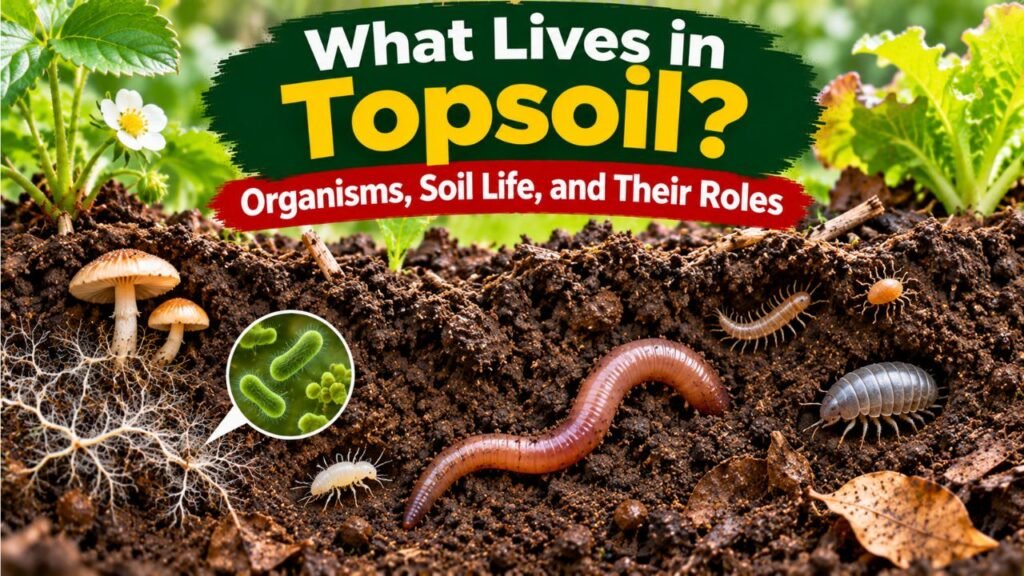
Topsoil contains microscopic organisms, small invertebrates, larger soil animals, and living plant roots. These groups interact to form a biological community that helps maintain soil functions.
The USDA Natural Resources Conservation Service’s Soil Biology Primer identifies bacteria, fungi, protozoa, nematodes, arthropods, and earthworms as important members of the soil food web.
Organisms Commonly Found in Topsoil
| Organism | Typical Size or Visibility | Main Role in Soil |
| Bacteria | Microscopic | Decompose organic matter and cycle nutrients |
| Archaea | Microscopic | Participate in nutrient cycling and other biochemical processes |
| Fungi | Mostly microscopic threads | Decompose organic matter and interact with roots |
| Actinomycetes | Microscopic bacteria | Break down organic residues and contribute to earthy soil odors |
| Protozoa and other protists | Mostly microscopic | Feed on microbes and release nutrients |
| Nematodes | Usually microscopic | Feed on bacteria, fungi, other animals, or plant roots |
| Earthworms | Visible | Mix organic matter and create soil channels |
| Springtails | Tiny, sometimes visible | Feed on fungi and decaying material |
| Soil mites | Tiny | Feed on fungi, organic residues, or other soil organisms |
| Millipedes and pill bugs | Visible | Break down dead plant material |
| Centipedes and predatory beetles | Visible | Feed on other invertebrates |
| Ants and insect larvae | Visible | Burrow, decompose material, hunt, or feed on roots |
| Plant roots | Visible to microscopic | Absorb nutrients, support soil structure, and feed microbes |
| Small burrowing mammals | Visible, usually uncommon in a small sample | Create tunnels and affect soil structure |
Different soils contain different communities.
A forest, vegetable garden, lawn, and agricultural field may have very different populations of soil organisms.
Key Takeaway: Topsoil is a living ecosystem containing organisms that decompose material, recycle nutrients, create soil pores, interact with plants, and regulate other soil populations.
What Is Topsoil, and Why Does It Contain So Much Life?
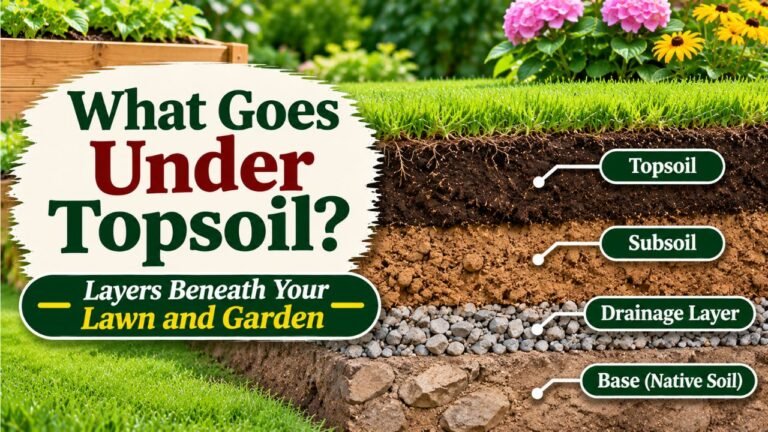
Topsoil is the upper, biologically active mineral layer of natural soil.
Soil scientists commonly identify it as the A horizon.
It generally contains more organic matter and greater biological activity than the mineral subsoil beneath it.
Why Is Topsoil Different From Subsoil?
The Colorado State University Extension’s Introduction to Soils explains that the A horizon commonly contains high biological activity, substantial organic matter, and many plant roots.
Below it lies the B horizon, or subsoil, which generally contains less organic matter and different soil characteristics.
| Characteristic | Topsoil | Subsoil |
| Position | Near the surface | Below topsoil |
| Organic matter | Usually higher | Usually lower |
| Biological activity | Often greater | Generally lower, but still present |
| Plant roots | Often concentrated here | May extend into deeper layers |
| Color | Frequently darker | Often lighter or differently colored |
| Nutrient cycling | Often highly active | Continues at variable rates |
These are general differences.
Actual soil horizons vary with geology, climate, vegetation, and land management.
Topsoil does not have one universal thickness.
Why Do Microorganisms Concentrate Near the Surface?
Several conditions make topsoil favorable for living organisms.
These include:
- Dead leaves and other organic residues
- Living plant roots
- Moisture
- Oxygen in soil pores
- Suitable temperatures
- Available nutrients
- Food from other organisms
Plants also release organic compounds from their roots.
These substances provide food for many soil microorganisms.
What Is the Rhizosphere?
The rhizosphere is the narrow zone of soil immediately surrounding living plant roots.
It is often an area of especially intense microbial activity.
Roots release sugars and other compounds that support microorganisms living nearby.
Some of these microbes help plants obtain nutrients or resist certain diseases.
According to NC State Extension’s Soil Biological Health guide, microbial abundance and activity are often greatest near the soil surface and around plant roots.
The guide identifies the upper 10 centimeters, or approximately 4 inches, as an especially active microbial zone in many soils.
However, organisms also live deeper underground.
Key Takeaway: Topsoil supports abundant life because it contains organic matter, living roots, moisture, and oxygen. The soil immediately around roots is particularly biologically active.
1. Bacteria: The Most Abundant Soil Microorganisms
Bacteria are among the most numerous organisms living in topsoil.
They are microscopic, single-celled organisms found on soil particles, around roots, and within small water-filled pores.
What Do Soil Bacteria Do?
Different bacterial groups perform different functions.
Some bacteria:
- Break down dead plant and animal material
- Help recycle nitrogen and other nutrients
- Convert nitrogen compounds between different forms
- Form beneficial relationships with plant roots
- Contribute to soil aggregation
- Compete with certain disease-causing microorganisms
For example, some bacteria decompose readily available organic compounds from dead leaves and plant roots.
The nutrients released through decomposition and microbial activity can eventually become available to plants.
Do Bacteria Help Plants Get Nitrogen?
Yes, some do.
Certain bacteria, including compatible rhizobia, form relationships with legumes such as peas and beans.
These bacteria can convert atmospheric nitrogen into forms used within the plant.
Other bacteria participate in processes such as nitrification, which transforms nitrogen into different chemical forms.
However, not every soil bacterium performs nitrogen fixation.
Are All Soil Bacteria Beneficial?
No.
Soil bacteria include beneficial, neutral, and disease-causing species.
Some pathogens can cause plant diseases.
Others primarily interact with organic residues or other microorganisms without directly affecting garden plants.
How Many Bacteria Live in Topsoil?
The Washington State University Extension’s Soil Science chapter reports approximate bacterial populations of 100 million to 1 billion cells per gram of agricultural topsoil.
These are illustrative ranges, not fixed counts for every soil.
Microbial populations vary considerably with environmental conditions.
Key Takeaway: Bacteria are major participants in decomposition and nutrient cycling. Their populations can be enormous, but different species have different effects on plants.
2. Fungi: Decomposers and Partners of Plant Roots
Fungi are another important group of organisms found in topsoil.
Many soil fungi grow as thin, branching threads called hyphae.
Networks of these threads are called mycelium.
Fungi can occupy spaces between soil particles and extend through organic residues and plant roots.
What Do Soil Fungi Do?
Many fungi break down complex organic materials.
Examples include:
- Dead leaves
- Wood fragments
- Roots
- Plant stems
- Other organic residues
Some fungi can decompose materials that are relatively difficult for other organisms to break down.
This contributes to nutrient cycling and soil organic matter formation.
What Are Mycorrhizal Fungi?
Mycorrhizal fungi form mutually beneficial relationships with the roots of many plant species.
Their hyphae extend into the surrounding soil.
Through these relationships, fungi can help plants acquire nutrients, particularly phosphorus, and sometimes water.
In exchange, the fungi receive carbon compounds from the plants.
Not every plant forms the same type of mycorrhizal relationship.
Do Fungi Improve Soil Structure?
Some fungal hyphae help bind soil particles together.
This can support the formation and stability of soil aggregates.
Aggregates influence how water and air move through the soil.
Are Mushrooms a Sign of Soil Fungi?
Yes.
A mushroom is the visible reproductive structure of certain fungi.
Much of the fungal organism may exist underground as hyphae.
However, most soil fungi do not produce conspicuous mushrooms.
A lack of mushrooms does not mean that fungi are absent.
Can Soil Fungi Harm Plants?
Yes.
Some fungi cause diseases involving roots, crowns, stems, and leaves.
For example, certain fungal pathogens cause root rots and wilts.
Other plant diseases commonly described as fungal are caused by fungus-like organisms.
Proper drainage, crop selection, sanitation, and disease identification are important.
The Oregon State University Extension’s soil biota guide explains the important roles of fungi in decomposition, root associations, and soil structure.
Key Takeaway: Soil fungi break down organic matter, support soil structure, and sometimes form beneficial partnerships with roots. Other species can cause plant disease.
3. Actinomycetes and Archaea: Less Visible Soil Microbes
Not all important soil microorganisms belong to the familiar groups of ordinary bacteria and fungi.
Two additional groups are worth understanding.
Actinomycetes
Actinomycetes are filamentous bacteria.
They often grow in branching forms that resemble fungal threads.
Many help decompose organic materials.
Certain actinomycetes produce geosmin, a compound associated with the characteristic earthy smell of soil.
However, an earthy smell is not a complete measure of soil health.
Archaea
Archaea are microorganisms that are biologically distinct from bacteria.
Some archaea participate in nitrogen cycling, including the oxidation of ammonia.
Others are associated with different environmental processes.
These organisms are part of the soil microbiome even though they are invisible without specialized equipment.
Can Gardeners Identify Them?
Not through ordinary visual inspection.
Identifying specific bacteria or archaea generally requires laboratory methods.
A home gardener can manage conditions that support microbial communities without identifying every species.
Key Takeaway: Actinomycetes and archaea contribute to soil processes, but their presence and activity cannot be reliably measured by appearance alone.
4. Protozoa and Other Protists: Microscopic Soil Grazers
Protozoa are commonly discussed as a group of microscopic soil organisms.
In modern biological classification, many belong to the broader category of protists.
They live in thin films of water around soil particles and plant roots.
What Do Protozoa Eat?
Many consume bacteria.
Others feed on microorganisms or organic particles.
Some soil protists also have different feeding strategies.
How Do They Help Soil?
When protozoa consume bacteria, nutrients contained in bacterial cells move through the food web.
Some nutrients are released in forms that plants and other organisms can use.
This is an important part of nutrient cycling.
Can You See Protozoa in Soil?
Most cannot be seen without a microscope.
A soil sample that appears completely ordinary may contain many different protists.
Their abundance varies with moisture and food availability.
Are Protozoa Always Beneficial?
No.
Like other soil organisms, protists have diverse ecological roles.
Many participate in microbial grazing and nutrient cycling.
Some can be parasitic or pathogenic.
Key Takeaway: Protozoa and other protists regulate microbial populations and help move nutrients through the soil food web.
5. Nematodes: Tiny Worms Living Between Soil Particles
Nematodes are small, round-bodied worms found in many soils.
Most are too small to identify without magnification.
They live within water films and spaces between soil particles.
Are Nematodes Harmful?
Not all nematodes are plant pests.
Different types feed on different things.
| Nematode Type | Main Food Source | General Role |
| Bacteria-feeding | Soil bacteria | Nutrient cycling |
| Fungi-feeding | Soil fungi | Regulates fungal populations |
| Predatory | Other nematodes and small animals | Predator |
| Plant-feeding | Living plant tissue | May damage crops |
| Insect-parasitic | Certain insects | Can contribute to pest control |
What Are Root-Knot Nematodes?
Root-knot nematodes are plant-parasitic nematodes.
They can cause characteristic swellings or galls on the roots of susceptible crops.
Affected plants may show:
- Stunted growth
- Reduced vigor
- Yellowing
- Wilting
- Poor nutrient and water uptake
However, these symptoms can also have other causes.
Proper identification is important.
Are Most Soil Nematodes Beneficial?
Many nematodes feed on microorganisms or other soil animals rather than plant roots.
They contribute to decomposition and nutrient cycling.
The University of Nevada, Reno Extension’s soil biology guide explains that soil nematodes include numerous non-plant-feeding species.
Key Takeaway: Nematodes are not automatically harmful. Many support soil food-web functions, while some plant-parasitic species damage roots.
6. Earthworms: Visible Animals That Mix and Aerate Soil
Earthworms are among the most recognizable organisms found in topsoil.
Many species consume organic residues and microorganisms while moving through soil.
What Do Earthworms Do?
Earthworms can:
- Create tunnels
- Move organic material into the soil
- Mix soil particles
- Produce nutrient-containing castings
- Improve soil aeration
- Create pathways for water
- Support the decomposition process
Earthworm castings are the material excreted after food passes through a worm’s digestive system.
They often contain organic matter, nutrients, and active microorganisms.
Do All Earthworms Live in Topsoil?
No.
Earthworms occupy different habitats.
Some live mainly in surface litter.
Others live in mineral topsoil.
Deep-burrowing species create tunnels that extend into lower soil layers.
Are Earthworms Always Good for Soil?
Earthworms often benefit agricultural and garden soils.
However, they are not beneficial in every ecosystem.
Some nonnative earthworm species can disrupt native forest soils in parts of North America.
Also, the absence of visible earthworms does not prove that soil is unhealthy.
Some naturally sandy or dry soils contain relatively few earthworms.
Should You Add Earthworms to Your Garden?
Usually, it is better to create suitable conditions for the organisms already present.
Maintain organic matter, appropriate moisture, and minimal unnecessary disturbance.
Avoid introducing unidentified earthworms into natural ecosystems.
Key Takeaway: Earthworms can improve soil structure, nutrient cycling, and water movement, but they are only one part of a healthy soil ecosystem.
7. Springtails and Soil Mites: Small Arthropods in Topsoil
Springtails and mites are small soil arthropods.
They are especially common in moist areas containing organic material.
What Are Springtails?
Springtails are tiny, wingless arthropods.
Many species can jump using a specialized structure beneath their bodies.
They may appear as small moving dots in soil, leaf litter, or compost.
What Do Springtails Eat?
Many feed on:
- Fungi
- Decaying plant material
- Microorganisms
- Organic residues
Their feeding helps move organic material through the soil food web.
What Are Soil Mites?
Soil mites are tiny relatives of spiders and ticks.
They have diverse feeding habits.
Some eat fungi or decomposing material.
Others prey on nematodes, smaller mites, or insect eggs.
Are Springtails and Mites Bad for Plants?
Many are harmless or useful.
However, some soil-dwelling arthropods can feed on roots or tender seedlings.
Identification matters more than assuming that every small moving creature is a pest.
Key Takeaway: Springtails and mites are common components of living topsoil. Many help process organic matter or regulate other soil organisms.
8. Millipedes, Pill Bugs, and Other Decomposers
Larger decomposers often live near the topsoil surface, under leaves, or within damp organic material.
These include millipedes and pill bugs.
Millipedes
Millipedes have elongated, segmented bodies with many legs.
They generally feed on decaying organic matter.
Their activity helps break large plant residues into smaller pieces.
Those smaller pieces become more accessible to fungi and bacteria.
Pill Bugs and Sowbugs
Pill bugs and sowbugs are terrestrial crustaceans.
They are commonly found beneath:
- Mulch
- Rocks
- Fallen leaves
- Logs
- Damp garden debris
They feed mainly on decaying organic materials.
Can These Animals Damage Seedlings?
Sometimes.
Although many prefer decomposing material, some species may feed on tender seedlings or soft plant tissues under certain conditions.
This is more likely to become a concern when large populations are concentrated around vulnerable plants.
Do not automatically use pesticides simply because these animals appear in a garden.
Key Takeaway: Millipedes and pill bugs usually help break down organic residues, although they can occasionally damage vulnerable plants.
9. Centipedes, Beetles, Ants, and Other Soil Insects
Many insects and other invertebrates spend part or all of their lives in topsoil.
Some are predators.
Others feed on roots or decomposing material.
Centipedes
Centipedes are predators.
They feed on smaller soil animals, including certain insects and worms.
They are different from millipedes, which mainly consume decaying material.
Ground Beetles
Many ground beetles hunt other invertebrates.
Depending on the species, they may consume insect larvae, slugs, or other small animals.
Some ground beetles also eat weed seeds.
Ants
Ants can move soil particles while building nests.
Their tunnels influence soil structure and water movement.
However, some ant species may protect sap-feeding pests such as aphids in exchange for honeydew.
Ant activity can therefore have mixed effects in a garden.
Beetle and Fly Larvae
Many insects spend their juvenile stages underground.
Examples include:
- Beetle grubs
- Fly larvae
- Ground beetle larvae
- Other soil-dwelling insect larvae
Some feed on dead material.
Others hunt smaller animals.
Certain larvae, including some white grubs and root maggots, can damage roots.
What About Slugs and Snails?
Slugs and snails commonly shelter in moist topsoil, mulch, and surface debris.
They are mollusks, not insects.
Some feed on decaying matter, while others damage tender leaves and seedlings.
The Colorado State University Extension’s Living Soil guide explains that soil arthropods can act as decomposers, predators, fungus-feeders, or plant-feeding pests.
Key Takeaway: Soil insects and related animals have diverse roles. Some control other pests, while others feed on living plants.
10. Plant Roots and Small Burrowing Animals
Topsoil also contains living plant roots and may contain animals larger than insects.
Plant Roots
Roots are a major living component of topsoil.
They perform several important functions:
- Absorb water
- Take up nutrients
- Stabilize soil
- Create pathways through the ground
- Release organic compounds
- Support microbial communities
Root hairs and fine roots create extensive contact with soil particles.
As roots die and decompose, they also contribute organic matter.
Small Burrowing Mammals
Some animals create tunnels or nests partly within topsoil.
Examples include:
- Moles
- Voles
- Certain mice
- Other locally occurring burrowing mammals
Their effects vary.
Moles primarily feed on soil animals, such as earthworms and insects.
Voles may feed on roots, bulbs, and other plant material.
Burrowing can move soil and create channels, but it may also disturb lawns and garden beds.
Do All These Animals Live Permanently Underground?
No.
Some spend only part of their life cycles in soil.
Others use the ground for nesting, shelter, overwintering, or food.
Topsoil is both a permanent habitat and a temporary shelter for different organisms.
Key Takeaway: Living roots are central to soil biology, while some larger animals use topsoil for feeding, shelter, or burrowing.
How Many Organisms Live in a Handful of Topsoil?
Topsoil can contain extraordinarily large populations of microorganisms.
However, there is no single correct count for every handful of soil.
The number depends on:
- Soil type
- Organic matter
- Moisture
- Temperature
- Plant cover
- Soil pH
- Land management
- Sampling depth
How Many Microbes Can Live in One Gram?
Washington State University Extension reports that one gram of agricultural topsoil can contain as many as a billion microorganisms.
Its approximate population estimates include:
| Microorganism | Approximate Number per Gram of Agricultural Topsoil |
| Bacteria | 100 million–1 billion |
| Actinomycetes | 10 million–100 million |
| Fungal counts reported by the source | 100,000–1 million |
| Algae | 10,000–100,000 |
| Protozoa | 10,000–100,000 |
| Nematodes | 10–100 |
These are illustrative estimates from particular agricultural soil contexts.
They are not guaranteed measurements for garden soil, forest soil, or bagged topsoil.
Also, counting fungi is more complicated than counting individual bacterial cells because fungal organisms often grow as interconnected networks.
Why Can’t You See Most Soil Life?
Most microorganisms are much smaller than the smallest particles visible to the naked eye.
Even when soil appears to contain no moving animals, it may contain numerous bacteria, fungi, protists, and nematodes.
A microscope or laboratory method is needed to observe many of them.
Key Takeaway: A tiny quantity of topsoil can contain millions or billions of microorganisms. Visible earthworms and insects represent only a small portion of soil biodiversity.
How Does the Soil Food Web Work?
The soil food web describes the feeding relationships among organisms living in and around soil.
It includes producers, decomposers, organisms that graze on microbes, and predators.
Step 1: Plants Supply Organic Material
Plants capture energy through photosynthesis.
They contribute organic material through:
- Dead leaves
- Fallen stems
- Dead roots
- Root secretions
- Other plant residues
This material supplies energy to many soil organisms.
Step 2: Bacteria and Fungi Decompose Residues
Microorganisms break down organic materials.
Some nutrients become incorporated into microbial cells.
Other nutrients are released into the surrounding soil.
Step 3: Smaller Animals Feed on Microbes
Protozoa, nematodes, and certain arthropods consume bacteria and fungi.
Their feeding transfers energy and nutrients through the food web.
Step 4: Predators Consume Other Organisms
Predatory mites, centipedes, beetles, and other animals feed on smaller soil organisms.
This helps regulate populations.
Step 5: Nutrients Return to the Soil
As organisms consume food, excrete waste, and die, nutrients continue cycling.
Plants can take up suitable nutrient forms through their roots.
Simplified Soil Food Web
| Food-Web Level | Examples | Main Function |
| Producers | Living plants | Supply organic carbon |
| Decomposers | Bacteria and fungi | Break down organic material |
| Microbial grazers | Protozoa and some nematodes | Consume microbes |
| Shredders | Earthworms, springtails, millipedes | Process organic residues |
| Predators | Centipedes, predatory mites, some beetles | Consume other soil animals |
| Higher consumers | Birds and certain small mammals | Feed on soil organisms |
This is a simplified model.
Many organisms eat more than one type of food and occupy several ecological roles.
Key Takeaway: Soil life forms an interconnected food web. Decomposition, grazing, predation, and plant growth move nutrients and energy throughout the system.
Why Are Living Organisms Important for Topsoil Health?
Soil organisms influence several processes that support plants and ecosystems.
1. Nutrient Recycling
Decomposers process organic residues.
Nutrients contained in dead plants and animals move into microbial cells and eventually into forms available for plant uptake.
This process supports soil fertility.
2. Organic Matter Formation
Microorganisms transform plant residues.
Their remains and byproducts contribute to soil organic matter.
Some of this material becomes protected within soil aggregates or associated with mineral particles.
3. Soil Structure
Fungal threads, microbial secretions, roots, and soil animals contribute to aggregate formation.
Aggregates help create a soil structure that supports roots and water movement.
4. Water Infiltration
Earthworms and other burrowing organisms create channels.
These spaces may allow water to move into and through soil more easily.
However, excessive compaction and poor drainage can still interfere with water movement.
5. Plant Nutrition
Mycorrhizal fungi and certain bacteria form relationships with roots.
These associations can improve access to specific nutrients under suitable conditions.
6. Biological Regulation
Some soil organisms compete with or consume others.
This can influence populations of certain plant pathogens and pests.
However, a biologically active soil does not guarantee that crops will be disease-free.
7. Soil Carbon Cycling
Soil organisms regulate the breakdown and transformation of organic carbon.
These processes influence carbon storage and carbon dioxide release.
Key Takeaway: Topsoil organisms contribute to nutrient cycling, root health, soil structure, water movement, and the regulation of other organisms.
Which Topsoil Organisms Are Beneficial and Which Are Harmful?
Not every organism has the same effect.
Some are beneficial in certain situations but problematic in others.
| Organism | Often Beneficial Role | Possible Concern |
| Bacteria | Nutrient cycling and decomposition | Some cause plant disease |
| Fungi | Decomposition and root partnerships | Some cause root or crown disease |
| Nematodes | Microbial grazing and predation | Some feed on living roots |
| Earthworms | Soil mixing and porosity | Certain nonnative species disrupt some ecosystems |
| Springtails | Fungal feeding and decomposition | Usually minor concerns in ordinary garden soil |
| Millipedes | Decomposing organic matter | May occasionally injure seedlings |
| Ground beetles | Feeding on pests and weed seeds | Effects vary by species |
| White grubs | Part of the soil food web | Some species damage turf roots |
| Slugs | Consume organic residues | Can damage vegetables |
| Ants | Soil movement and ecological interactions | Some protect aphids or disturb plants |
| Plant roots | Stabilize soil and support microbes | Weeds may compete with crops |
Should You Kill Every Bug in Topsoil?
No.
Many soil animals are harmless or useful.
Unnecessary broad-spectrum pesticide applications can affect organisms other than the intended pest.
Identify the animal and the damage before choosing a treatment.
Does Healthy Topsoil Contain Pathogens?
It can.
Healthy soil is not necessarily free of disease-causing organisms.
Instead, it contains a biological community whose members interact with one another and the environment.
Disease occurs when a susceptible plant, a suitable pathogen, and favorable environmental conditions coincide.
Key Takeaway: Soil organisms can be beneficial, neutral, or harmful. Accurate identification is more useful than treating every insect or worm as a pest.
How Can You Tell Whether Topsoil Is Alive and Healthy?
You cannot see most soil organisms directly.
However, certain field observations can provide clues about biological activity.
Signs of Biologically Active Topsoil
Look for:
- A crumbly, well-aggregated structure
- Visible roots
- Gradual decomposition of organic residues
- Earthworm channels or castings where earthworms naturally occur
- Small arthropods beneath mulch
- Adequate moisture without persistent saturation
- An earthy smell
- Healthy plant growth under suitable conditions
The USDA Soil Health Assessment guide explains that soil health should be evaluated through a combination of physical, chemical, and biological indicators.
No single observation proves that soil is healthy.
A Simple Home Soil-Life Check
You can examine the soil using a few basic tools.
What you need:
- Small garden trowel
- White tray or shallow container
- Magnifying glass
- Gloves
- Small amount of moist garden soil
Steps:
- Choose a day when the soil is moist but not waterlogged.
- Remove a small sample from the upper few inches.
- Place the sample on a white tray.
- Gently break apart large clumps.
- Look for earthworms, mites, springtails, and insect larvae.
- Examine root fragments and decomposing organic matter.
- Return the soil and organisms to the sampling location when practical.
This activity can reveal visible soil life.
However, it cannot measure the number of bacteria, fungi, or other microscopic organisms accurately.
Does Dark Topsoil Mean It Is Healthy?
Not necessarily.
Dark color may be associated with organic matter, but soil color also depends on minerals, moisture, and other factors.
A dark soil may still have poor drainage, compaction, or nutrient problems.
What if There Are No Earthworms?
That does not automatically mean the soil is dead.
Earthworm populations vary with climate, soil texture, season, and local ecology.
Many microorganisms may remain active even when no worms are visible.
Key Takeaway: Healthy topsoil often has good structure, roots, organic matter, and biological activity. A complete assessment should also consider pH, nutrients, drainage, and plant performance.
What Conditions Help Topsoil Organisms Survive?
Different organisms have different environmental requirements.
However, several general conditions support a diverse soil ecosystem.
Organic Matter
Dead leaves, plant residues, and appropriate compost supply food for decomposers.
Without sufficient organic inputs, some soil organisms may have fewer resources.
Adequate Moisture
Microorganisms require water for metabolic activity.
Nematodes and many protists move through thin water films.
However, excessive water can displace air from soil pores.
Oxygen
Many soil organisms require oxygen.
Well-structured soil has pore spaces that allow air and water to move.
Severely compacted or saturated soil may restrict aerobic biological activity.
Suitable Temperature
Biological activity often increases under suitable warm, moist conditions.
Cold, dry, or excessively hot conditions can reduce activity.
Some organisms become dormant during unfavorable periods.
Living Roots
Roots supply organic compounds to microorganisms.
Continuous living roots can help maintain food sources for the rhizosphere community.
Limited Unnecessary Disturbance
Repeated excessive tillage can disrupt soil aggregates, roots, fungal networks, and the habitats of soil animals.
Occasional cultivation may be necessary, but disturbance should serve a clear purpose.
Key Takeaway: Food, moisture, oxygen, appropriate temperatures, and living roots influence which organisms survive and how actively they function.
How to Encourage Beneficial Organisms in Garden Topsoil
You can support soil biology without purchasing specialized microbial products.
Start by maintaining conditions that favor existing soil organisms.
1. Add Finished Compost When Needed
Finished compost can supply organic matter and contribute to soil biological activity.
Apply suitable amounts according to soil condition and plant needs.
Avoid excessive applications, particularly when soil already contains high nutrient levels.
2. Keep the Soil Covered
Suitable organic mulch can:
- Reduce evaporation
- Moderate soil temperature
- Protect against erosion
- Supply decomposing organic material
- Provide habitat near the surface
Examples include shredded leaves, weed-free straw, and other suitable organic materials.
Keep mulch away from sensitive plant crowns and stems.
3. Avoid Walking on Growing Soil
Foot traffic compresses soil particles and reduces pore space.
This can interfere with root growth, drainage, and the habitats of soil organisms.
In raised beds, use paths rather than stepping onto the planting surface.
4. Reduce Unnecessary Tilling
Avoid repeatedly turning the soil when it already has a suitable structure.
Minimizing disturbance can help preserve soil aggregates, roots, and biological habitats.
5. Maintain Suitable Moisture
Water according to plant and soil needs.
Avoid prolonged drought and unnecessary saturation.
Check moisture below the surface.
6. Grow Different Types of Plants
Different plant species contribute different root structures and organic inputs.
Crop rotations and cover crops can help maintain living roots and supply residues.
7. Use Fertilizers and Pesticides Appropriately
Apply fertilizer according to soil testing and crop requirements.
Avoid unnecessary pesticide treatments.
Use products according to their labels and target the identified problem.
8. Leave Suitable Organic Residues
Healthy leaves, roots, and other plant residues can provide resources for soil organisms as they decompose.
However, remove diseased material when necessary to reduce the risk of carrying plant pathogens into the next season.
The USDA Soil Health Management guidance emphasizes maintaining soil cover, increasing plant diversity, reducing disturbance, and keeping living roots in the soil.
Key Takeaway: Supporting soil life usually involves protecting existing habitats, supplying organic material, and avoiding unnecessary disturbance rather than adding large amounts of purchased microorganisms.
Do Bagged Topsoil and Raised-Bed Soil Contain Living Organisms?
Yes, they can.
However, the amount and diversity of living organisms vary.
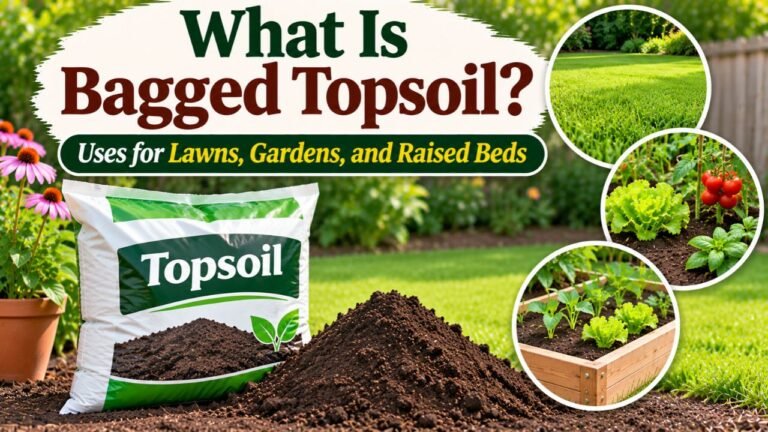
Bagged Topsoil
Commercial bagged topsoil may contain microorganisms, but its biological composition depends on:
- Soil source
- Processing
- Storage conditions
- Moisture
- Temperature
- Organic matter
- Time since packaging
Some products contain blended mineral soil and organic amendments rather than an intact natural soil horizon.
Do not assume every bag contains the same biological community as undisturbed garden topsoil.
Raised-Bed Soil
Raised-bed soil can develop active biological communities.
Living roots, organic residues, moisture, and contact with native soil all influence biological activity.
An open-bottom raised bed may allow earthworms and other organisms to move between the growing medium and the underlying soil.
A bottomed planter has less direct connection to the surrounding ground, but it can still contain microorganisms and small soil animals.
Potting Mix
Potting mix is not necessarily the same as natural topsoil.
Many mixes contain peat, coir, bark, perlite, compost, or other ingredients.
They can support microorganisms and plant roots but may differ greatly from natural soil.
Should You Buy Microbial Inoculants?
Not automatically.
Many garden soils already contain diverse microbial communities.
Some specialized inoculants may be useful for specific crops or situations, but results depend on the product and soil conditions.
For most home gardens, improving moisture, organic matter management, and growing conditions is a sensible starting point.
Key Takeaway: Bagged topsoil, raised-bed soil, and potting mix can all contain living organisms, but their biological communities are not necessarily identical.
Are Soil Organisms Dangerous to Humans?
Most organisms encountered in ordinary garden soil are not a serious threat during normal gardening activities.
However, soil can contain microorganisms capable of causing infections under certain circumstances.
It may also contain contaminants unrelated to biological activity.
Basic Soil-Handling Precautions
Use practical hygiene:
- Wear gloves when appropriate, especially when hands have cuts.
- Wash hands with soap and water after handling soil.
- Avoid rubbing your eyes while gardening.
- Clean gardening tools as needed.
- Avoid breathing large amounts of soil or potting-mix dust.
- Wash harvested produce appropriately.
- Keep soil away from food-preparation surfaces.
People with weakened immune systems or particular health risks may need additional precautions.
Is Soil From an Urban Garden Safe?
Biological activity does not prove that soil is free from harmful chemical contaminants.
In urban locations, soil may require testing for lead or other contaminants based on the site’s history.
A healthy-looking soil sample can still contain undesirable substances.
Should You Sterilize All Garden Topsoil?
Usually not.
Sterilizing ordinary outdoor garden soil would also remove or damage many organisms involved in natural soil processes.
Soil sterilization has specialized uses, but it is not a routine requirement for healthy vegetable gardening.
Key Takeaway: Ordinary garden soil contains many harmless organisms, but basic hygiene and site-appropriate contamination precautions are still important.
Conclusion
Topsoil contains a complex community of living organisms, including bacteria, fungi, protozoa, nematodes, earthworms, springtails, mites, insects, and plant roots. Many are too small to see, but they perform essential functions beneath the soil surface.
Bacteria and fungi break down organic material. Protozoa and nematodes help move nutrients through the soil food web. Earthworms and other soil animals create channels, process organic residues, and influence soil structure.
Some organisms are harmful to plants, including root-feeding nematodes, certain insect larvae, and disease-causing microorganisms. However, the presence of an unfamiliar creature does not automatically mean there is a problem.
Soil life is particularly active near living roots, where microorganisms have access to organic compounds released by plants.
For home gardens and raised beds, I recommend protecting the existing soil community by maintaining suitable moisture, adding organic matter when needed, keeping soil covered, and avoiding unnecessary compaction or tillage.
Healthy topsoil is not simply a growing medium. It is a living ecosystem that supports plant nutrition, soil structure, decomposition, and long-term soil productivity.
FAQs About What Lives in Topsoil
What are the most common living organisms in topsoil?
Bacteria are among the most numerous organisms in topsoil. Other common groups include fungi, archaea, protozoa, nematodes, earthworms, springtails, mites, and insect larvae. Living plant roots also form an important part of the topsoil ecosystem.
What animals live in topsoil?
Earthworms, ants, beetles, insect larvae, millipedes, centipedes, pill bugs, springtails, mites, and nematodes are common examples. Some larger animals, including moles and voles, also use soil for feeding and burrowing. Their presence varies with location and environmental conditions.
How many microorganisms are in one gram of topsoil?
The number varies widely. Washington State University Extension reports that one gram of agricultural topsoil can contain approximately 100 million to 1 billion bacterial cells, along with fungi, protozoa, algae, and other microorganisms. Actual counts depend on soil conditions.
Are earthworms a sign of healthy topsoil?
Earthworms can indicate favorable soil conditions because they need suitable moisture, organic matter, and habitat. Their tunnels and castings can also improve soil structure. However, healthy soils do not always contain large earthworm populations, particularly in naturally dry or sandy environments.
What do bacteria and fungi do in topsoil?
Bacteria and fungi help decompose organic matter and cycle nutrients. Some bacteria participate in nitrogen transformations, while certain fungi form beneficial relationships with plant roots. Other species can cause plant diseases, so their roles vary.
Do harmful organisms live in topsoil?
Yes. Topsoil may contain plant-parasitic nematodes, root-feeding insect larvae, and disease-causing microorganisms. However, many soil organisms are beneficial or neutral. Identify the organism and any associated damage before attempting pest control.
How can you increase beneficial organisms in topsoil?
Maintain suitable soil moisture, apply finished compost when needed, keep the soil covered with appropriate mulch, grow a diversity of plants, and avoid unnecessary compaction and excessive tilling. These practices help support the existing soil food web.

I’m Maya L. Greenwood, a lifelong plant lover who believes anyone can grow something beautiful with the right guidance. After years of testing soil mixes, pruning methods, irrigation tricks, and pest-safe solutions, I started EasyGardenTips.com to turn hard-won lessons into step-by-step advice. From seed starting and container gardens to composting and seasonal checklists, my goal is to make gardening simple, sustainable, and fun.