What Is Under Topsoil? Subsoil, Parent Material, and Bedrock
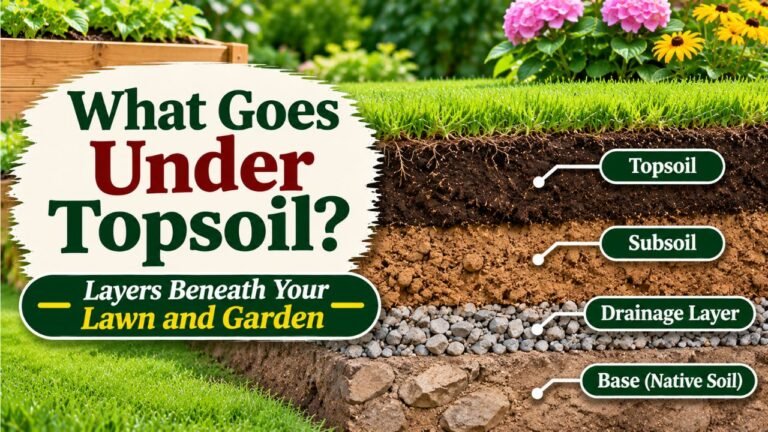
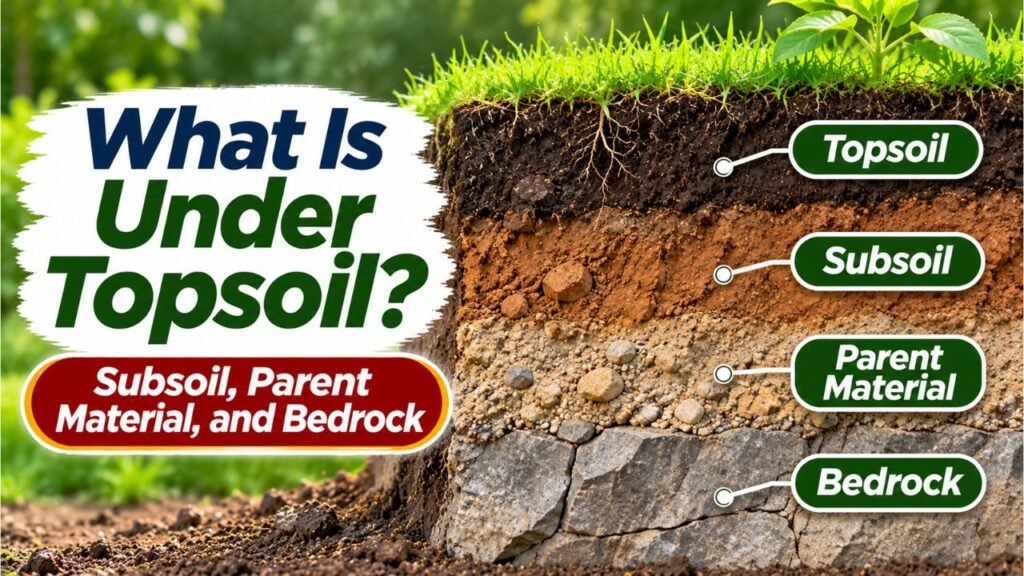
Under topsoil is usually a layer called subsoil, also known as the B horizon. This layer generally contains less organic matter than topsoil and may have more clay, iron minerals, and compact soil structures. Below subsoil, you may find weathered rock or other geological deposits called parent material, followed by solid bedrock at greater depth.
However, soil layers don’t always follow the same pattern. Some soils contain a pale, mineral-depleted E horizon between topsoil and subsoil. Others have shallow bedrock, sandy deposits, compacted clay, or construction fill immediately beneath the surface.
These differences matter for gardening because lower soil layers influence drainage, root growth, water storage, and nutrient availability. A garden with deep, well-structured soil may support extensive roots, while a hard or poorly drained layer can restrict plant growth.
In this article, I explain what lies beneath topsoil, how the different soil horizons form, and how to identify them. I also cover typical soil depth, subsoil characteristics, drainage problems, and what gardeners should do when they discover clay, rock, or compacted soil below their garden beds.
What Is Under Topsoil? Understanding the Soil Layers
In most naturally developed mineral soils, the layer beneath topsoil is called subsoil.
Scientists divide soil into layers known as soil horizons.
These horizons develop through weathering, biological activity, water movement, and changes in minerals and organic matter.
The complete vertical arrangement is known as a soil profile.
According to the USDA Natural Resources Conservation Service’s soil profile guide, most soils have three major mineral horizons:
- A horizon: Topsoil.
- B horizon: Subsoil.
- C horizon: Substratum or relatively unaltered parent material.
Some soils also contain an organic O horizon or a leached E horizon.
Hard bedrock is designated with the letter R.
Soil Layers From Top to Bottom
| Soil horizon | Common name | Main characteristics |
| O horizon | Organic layer | Leaves, plant litter, and decomposing organic materials |
| A horizon | Topsoil | Mineral soil mixed with organic matter, usually rich in biological activity |
| E horizon | Leached layer | Often pale soil depleted of certain minerals or clay |
| B horizon | Subsoil | Altered mineral soil, sometimes enriched with clay, iron, or other materials |
| C horizon | Parent material or substratum | Weathered rock or relatively unaltered mineral deposits |
| R horizon | Bedrock | Hard, consolidated rock |
This is a generalized sequence.
Not every soil contains all six horizons. Some have only a few recognizable layers, while others contain several subdivisions of the same horizon.
For example, one location may have topsoil directly above clay-rich subsoil.
Another may have a pale E horizon between those layers.
In a shallow rocky landscape, weathered material or bedrock may occur close to the surface.
1. Subsoil (B Horizon): The Layer Usually Beneath Topsoil
Subsoil is the mineral soil layer commonly located beneath topsoil.
It often differs from surface soil in color, texture, organic matter content, and structure.
What Is Subsoil Made Of?
Subsoil contains various proportions of:
- Sand.
- Silt.
- Clay.
- Iron minerals.
- Aluminum compounds.
- Other mineral particles.
- Water and air.
- Smaller amounts of organic matter.
Some subsoils also accumulate calcium carbonate, soluble salts, or other materials, depending on the soil-forming environment.
The Colorado State University Extension’s introduction to soils explains that B horizons often accumulate materials transported downward from the upper horizons.
These materials can include clay, iron oxides, aluminum, and dissolved organic compounds.
However, not every B horizon is a zone of clay accumulation. Some develop their characteristics through weathering and changes in soil structure.
What Does Subsoil Look Like?
Subsoil is often lighter than topsoil because it generally contains less organic matter.
Common colors include:
- Reddish brown.
- Yellowish brown.
- Light brown.
- Grayish brown.
- Red.
- Yellow.
- Gray.
Color depends on mineral composition, drainage, and other soil conditions.
For example, iron oxides can contribute red or yellow colors.
Poorly drained subsoil may appear gray or contain gray areas mixed with orange or reddish mottles.
However, color alone isn’t enough to identify a soil horizon accurately.
Soil texture, structure, and other properties must also be considered.
Is Subsoil Harder Than Topsoil?
Sometimes.
Subsoil may contain more clay or have a denser structure than the topsoil above it.
This can make it more difficult to dig.
However, subsoil isn’t always compacted.
Some B horizons have well-developed structures that allow roots, air, and water to move through them.
A naturally clay-rich subsoil and a mechanically compacted soil layer are not the same thing.
Key Takeaway: Subsoil is generally the first major layer beneath topsoil. It contains mineral materials, often has less organic matter, and can strongly influence plant rooting and drainage.
2. E Horizon: The Layer Sometimes Found Between Topsoil and Subsoil
Not every soil has subsoil immediately beneath the topsoil.
Some contain an E horizon between the A and B horizons.
What Is an E Horizon?
The E horizon is a mineral soil layer that has lost certain materials through a process called eluviation.
Eluviation occurs when water moving through the soil carries away materials such as:
- Clay particles.
- Iron compounds.
- Aluminum compounds.
- Some organic substances.
This movement can leave the E horizon relatively pale or light colored.
Why Is the E Horizon Often White or Gray?
The loss of certain pigments and materials can make this layer appear lighter than the soil above or below it.
For example, some E horizons look sandy, pale gray, or almost whitish.
According to the University of Georgia’s soil profile guide, E horizons are often light colored and may have a sandy texture.
However, their appearance varies.
Where Are E Horizons Common?
E horizons can develop in several soil environments.
They are particularly noticeable in some forest soils where water movement has removed minerals and clay from an upper subsurface layer.
They aren’t present in every garden, lawn, or agricultural field.
If your soil profile contains no E horizon, that doesn’t necessarily indicate a problem.
Does an E Horizon Affect Gardening?
It can.
An E horizon may have different nutrient-holding, moisture-retention, and root-growth properties from the layers above and below it.
For example, a sandy E horizon may drain differently from the clay-rich B horizon underneath.
The practical effect depends on the entire soil profile rather than the presence of the E horizon alone.
3. Parent Material (C Horizon): What Lies Below Subsoil?
Beneath the subsoil, many soil profiles contain a C horizon.
This layer is commonly called the substratum or parent material.
What Is Parent Material?
Parent material is the mineral or organic material from which soil develops.
It may consist of:
- Weathered rock.
- Sand.
- Gravel.
- Silt.
- Clay-rich geological deposits.
- Glacial deposits.
- River sediments.
- Wind-deposited material.
The C horizon is generally less affected by soil-forming processes than the A and B horizons.
It often contains less organic matter and has lower biological activity.
However, its specific characteristics depend on the location.
Is Parent Material Always Broken Bedrock?
No.
This is an important distinction.
Some soil develops from rock weathering in place.
Other soils form from sediments transported by rivers, wind, glaciers, or gravity.
For example, a soil profile may develop in wind-deposited silt.
In that case, the material directly beneath the subsoil isn’t necessarily weathered rock from the bedrock underneath.
The Colorado State University Extension’s soil science guidance explains that parent materials can be transported from distant locations before soil formation begins.
Can Plant Roots Grow Into the C Horizon?
Sometimes.
Root penetration depends on:
- Compaction.
- Texture.
- Moisture.
- Available oxygen.
- Rock fragments.
- Soil structure.
- Chemical conditions.
Some roots can extend into weathered parent material through pores and cracks.
Other C horizons may be too dense, dry, wet, or rocky to support substantial root growth.
The C horizon shouldn’t automatically be considered an impenetrable boundary.
4. Bedrock (R Horizon): The Solid Rock Beneath Soil
Beneath weathered geological materials, hard bedrock may eventually be encountered.
In soil classification, consolidated hard bedrock is designated as the R layer.
What Is Bedrock?
Bedrock is solid rock that hasn’t been completely broken down into loose soil particles.
Depending on the region, it may include:
- Granite.
- Limestone.
- Sandstone.
- Shale.
- Basalt.
- Other consolidated rock types.
Bedrock can occur close to the ground surface in some locations.
In other areas, it may be many feet or much deeper below the surface.
Does Every Backyard Have Bedrock Immediately Below Subsoil?
No.
Some locations contain thick sequences of sediment or weathered material.
You may encounter gravel, sand, clay, or other geological deposits long before reaching hard rock.
The depth to bedrock varies substantially with local geology.
Can Plant Roots Grow Through Bedrock?
Most plant roots cannot penetrate intact, solid bedrock directly.
However, roots can sometimes grow into existing fractures and cracks.
Trees and other deeply rooted plants may exploit these openings to access moisture.
The ability to do so depends on the rock and the size and connectivity of fractures.
Key Takeaway: Bedrock is the hard geological foundation beneath many soil profiles, but it may occur at very different depths. The material above it isn’t always the rock from which the upper soil directly formed.
Topsoil vs. Subsoil: What Is the Difference?
Topsoil and subsoil are both important parts of the natural soil profile.
However, they often differ significantly in organic matter, structure, biological activity, and root distribution.
| Feature | Topsoil (A horizon) | Subsoil (B horizon) |
| Position | Near the surface | Usually below topsoil or E horizon |
| Color | Often darker | Often lighter, reddish, yellowish, or gray |
| Organic matter | Generally higher | Generally lower |
| Biological activity | Usually higher | Often lower |
| Plant roots | Often abundant | May contain substantial roots |
| Clay content | Varies | Sometimes higher |
| Nutrient availability | Often relatively favorable | Depends on soil chemistry and minerals |
| Soil structure | Often granular | May be blocky, prismatic, or another structure |
| Water movement | Depends on texture and structure | Can store water or restrict drainage |
| Gardening suitability | Commonly preferred for cultivation | May support roots but can be less suitable as surface soil |
Why Is Topsoil Usually Darker?
Topsoil commonly contains more organic matter.
Decomposed plant residues, microbial activity, and other organic materials contribute to its darker appearance.
However, not all topsoil is dark.
Some naturally sandy or low-organic-matter topsoils are light colored.
Similarly, certain subsoils may appear relatively dark.
Color provides a clue, not a definitive identification.
Is Topsoil More Fertile Than Subsoil?
Topsoil is generally more favorable for many plants because of its organic matter, nutrient cycling, and biological activity.
However, subsoil can contain important nutrient reserves.
Plant roots may obtain water and nutrients from deeper layers.
The Washington State University Extension’s soil science handbook describes subsoil as an important source of water and nutrients, even though it often has less biological activity than topsoil.
Is Subsoil Always Clay?
No.
Subsoil may contain substantial clay, but some B horizons are sandy, silty, or loamy.
Soil properties depend on the parent material and the processes that formed the profile.
You cannot accurately identify all subsoil as clay.
How Deep Is Topsoil Before You Reach Subsoil?
There is no universal topsoil depth.
The thickness of the A horizon depends on the soil’s history and environment.
Some naturally developed soils have only a few inches of recognizable topsoil.
Others have much thicker dark surface horizons.
What Affects Topsoil Depth?
Important factors include:
- Climate.
- Vegetation.
- Erosion.
- Soil-forming parent material.
- Landscape position.
- Agricultural management.
- Construction activity.
- Time.
The University of Minnesota Extension’s soil formation guide explains that soil-forming factors create different horizon characteristics and depths.
Prairie soils, forest soils, wetland soils, and desert soils can have markedly different profiles.
Example of a Soil Profile
The University of Georgia provides an illustrative profile with these depths:
| Depth below surface | Example soil material |
| 0–1 inch | Leaves and organic litter |
| 1–6 inches | Brown sandy loam topsoil |
| 6–10 inches | Lighter-colored sandy loam |
| 10–36 inches | Reddish-brown clay-rich subsoil |
| 36–45 inches | Weathered mineral material |
| Below 45 inches | Hard rock |
This is an educational example, not a standard measurement for all U.S. soils.
Your backyard may have a completely different sequence.
Can Topsoil Be 12 Inches Deep?
Yes.
Some soils have A horizons 12 inches deep or thicker.
However, a 12-inch layer of purchased topsoil spread over construction fill is not necessarily the same as a naturally developed A horizon.
The term topsoil is also used commercially to describe soil products intended for landscaping.
Commercial topsoil may not correspond to a natural soil horizon.
Why Are There Different Layers Below Topsoil?
Soil horizons form through a combination of physical, chemical, and biological processes.
Scientists generally recognize five major soil-forming factors.
1. Parent Material
Minerals and geological deposits provide the starting material for soil formation.
Different parent materials produce different textures and mineral compositions.
For example, a soil formed in sandy sediment may differ greatly from one formed in clay-rich glacial deposits.
2. Climate
Rainfall and temperature influence weathering and the movement of materials through soil.
Water can transport dissolved substances and fine particles downward.
This contributes to the development of E and B horizons in certain conditions.
3. Organisms
Plants, microorganisms, fungi, and soil animals contribute to organic matter cycling and soil development.
Plant roots also influence soil structure.
Earthworms and other organisms may create channels that affect water movement and aeration.
4. Landscape Position
Soil development differs across hilltops, slopes, valleys, and low-lying areas.
Erosion can remove surface material from slopes.
Sediment deposition may add material in lower landscape positions.
Water movement also varies with topography.
5. Time
Soil horizons develop gradually.
Their formation can involve processes operating over hundreds to thousands of years or longer, depending on conditions.
However, some changes caused by erosion, flooding, cultivation, or construction can occur much more quickly.
Key Takeaway: Soil layers develop because minerals, water, organisms, climate, and landscape processes affect different depths in different ways.
What Is Under Topsoil in a Backyard?
The soil beneath a residential lawn or garden may differ from the naturally developed soil profile in the surrounding region.
Construction and landscaping can significantly alter the soil layers.
Compacted Construction Soil
During home construction, heavy equipment may compact the ground.
Topsoil may be removed and stored separately.
After construction, a layer of topsoil may be spread over compacted subsoil.
The resulting soil profile may have a sharp boundary between the two materials.
This can affect drainage and root growth.
The Colorado State University Extension’s urban soil guidance explains that construction activities often remove natural topsoil, mix soil horizons, and reduce pore space.
Clay Beneath Purchased Topsoil
Some yards have a relatively thin layer of purchased topsoil over clay-rich native soil.
This arrangement isn’t automatically harmful.
However, if the underlying clay is heavily compacted or poorly structured, water may move through it slowly.
Water can temporarily accumulate above the restrictive layer after heavy rainfall.
The actual drainage behavior depends on the texture and structure of both layers.
Fill Dirt Beneath Topsoil
Residential properties may contain artificial fill.
Fill may include mixtures of:
- Sand.
- Clay.
- Gravel.
- Excavated soil.
- Rock fragments.
- Other construction-related materials.
The fill may not resemble natural subsoil.
It may also vary considerably across the property.
Gravel or Rock Beneath Topsoil
Some yards contain naturally gravelly soil.
Others contain imported crushed stone or gravel from previous landscaping.
Gravel beneath topsoil doesn’t necessarily mean bedrock is nearby.
It may be part of a geological deposit or an artificial drainage or construction layer.
What Is Under Topsoil in a Raised Garden Bed?
Raised beds are different from naturally developed soil profiles.
The material beneath the raised bed depends on where and how it was installed.
Raised Bed Over Native Ground
An open-bottom raised bed may contain purchased growing mix above native topsoil or subsoil.
Roots can potentially extend into the ground beneath the frame.
This is useful when the underlying soil is suitable for rooting.
If the native soil is heavily compacted, gentle initial loosening may help.
However, established raised beds don’t automatically require annual deep tilling.
Raised Bed Over Grass
A raised bed constructed over a lawn may initially have grass, roots, and native soil beneath its growing mix.
Some gardeners remove the sod.
Others suppress the vegetation with an appropriate no-dig method.
The best approach depends on the grass species, weeds, bed depth, and long-term planting plans.
Persistent perennial weeds may require additional control.
Raised Bed Over Concrete
A raised bed placed over concrete has an impermeable surface underneath.
There is no deeper native soil available to the roots.
The bed must provide sufficient growing depth and appropriate drainage.
Don’t assume a thin layer of soil over concrete will support large vegetables.
Raised Bed With Landscape Fabric
Some raised beds use a permeable barrier or mesh underneath.
The barrier may help manage certain weeds or burrowing animals.
However, its effect on roots and drainage depends on the material.
A fine or restrictive barrier can interfere with root penetration.
Avoid adding unnecessary barriers beneath an open-bottom bed when roots are intended to grow into the underlying soil.
Can Plant Roots Grow Below Topsoil?
Yes.
Many plant roots extend beyond the A horizon into subsoil.
The depth depends on the plant species and local soil conditions.
How Roots Use Subsoil
Roots may grow into the B horizon to obtain:
- Water.
- Mineral nutrients.
- Physical anchorage.
- Additional growing space.
Some roots follow existing cracks, pores, and biological channels.
Others are restricted by dense layers.
What Stops Roots From Growing Deeper?
Common barriers include:
- Severe compaction.
- Continuous hard rock.
- Waterlogged soil with inadequate oxygen.
- Very dry layers.
- Unfavorable soil chemistry.
- Dense or cemented horizons.
A clay-rich subsoil isn’t necessarily impenetrable.
Its physical structure and moisture conditions determine how easily roots can grow.
Do Vegetables Need Deep Topsoil?
Vegetables need sufficient rooting volume and favorable soil conditions.
Some crops, such as leafy greens and radishes, may grow successfully in relatively shallow managed soil.
Others, including tomatoes and large squash plants, benefit from greater available rooting volume.
A shallow A horizon isn’t automatically a problem if the roots can grow into suitable subsoil.
However, where a restrictive layer is present, plants may experience greater water and nutrient stress.
How Does Subsoil Affect Garden Drainage?
The properties of the soil beneath topsoil can strongly influence how water moves through a garden.
Even high-quality surface soil may drain poorly if an underlying layer restricts water movement.
Clay-Rich Subsoil
Some clay-rich subsoils have relatively small pores and slow water movement.
If water enters the upper soil faster than it can move through the lower layer, temporary saturation may occur.
However, well-structured clay can contain cracks and larger pores that allow substantial water movement.
Clay content alone doesn’t determine drainage.
Compacted Subsoil
Compaction reduces pore space and may limit the movement of water and air.
This can contribute to:
- Slow infiltration.
- Surface puddling.
- Poor root growth.
- Water accumulation after rainfall.
- Reduced oxygen availability.
Correcting compaction may require appropriate soil management.
However, aggressive tilling when soil is wet can make the condition worse.
Sandy Subsoil
Sandy layers often allow water to move relatively quickly.
However, very sandy material may have limited water-holding capacity.
A garden with sandy subsoil may require different irrigation management from one with dense clay.
Gray or Mottled Subsoil
Gray coloring and reddish or yellowish mottles can indicate prolonged wetness or fluctuating drainage conditions.
However, these features require interpretation in the context of the overall soil profile.
They don’t establish the current groundwater level by themselves.
A professional soil evaluation may be appropriate when drainage or construction decisions depend on these conditions.
How to Identify What Is Under Your Topsoil
You can learn a great deal about your backyard soil by examining a small, safely excavated sample.
Avoid digging deep, unsupported pits.
For deeper excavation or work near utilities, use appropriate professional guidance and local utility-location procedures.
Step 1: Choose an Undisturbed Area
Select a small location away from obvious utility lines, foundations, and buried irrigation.
If possible, compare more than one area of the yard.
Soil conditions can vary considerably over short distances.
Step 2: Remove a Small Soil Sample
Use a hand trowel or shovel to expose a manageable soil cross-section.
Keep the soil from each depth separate.
Avoid mixing the layers before examining them.
Step 3: Look for Color Changes
Observe whether the soil changes from dark brown to lighter brown, red, yellow, or gray.
A darker upper layer followed by lighter mineral soil may suggest a transition from A to another horizon.
However, color alone isn’t definitive.
Step 4: Check Soil Texture
Moisten a small amount of soil and feel it between your fingers.
General observations include:
- Sandy soil feels gritty.
- Silty soil often feels smooth or floury when dry.
- Clay-rich soil can feel sticky and form a ribbon when moist.
- Loamy soil contains a mixture of particle sizes.
A simple hand-texture test provides an estimate, not a complete laboratory classification.
Step 5: Examine Soil Structure
Look at how the soil naturally breaks apart.
Topsoil often has relatively small, crumbly aggregates.
Subsoil may have larger blocks or other structural patterns.
A compacted layer may appear dense and difficult to break.
Step 6: Check Root Distribution
Look for visible roots at different depths.
Roots may be abundant near the surface and become less common deeper down.
However, some roots can extend well into the subsoil.
Root distribution helps reveal whether plants can use the lower soil layers.
Step 7: Use a Soil Test When Needed
If you’re planning a vegetable garden, laboratory testing can identify important soil characteristics.
Common tests may include:
- Soil pH.
- Phosphorus.
- Potassium.
- Organic matter.
- Other nutrients, depending on the laboratory.
If you’re concerned about contamination, request specific tests for the suspected contaminants.
A standard fertility test doesn’t automatically screen for lead or other pollutants.
Key Takeaway: Color, texture, structure, and root distribution can help identify soil layers, but a formal horizon determination may require professional observation.
Is Subsoil Good for Gardening?
Subsoil can support plant roots, but it often isn’t as favorable as healthy topsoil for direct cultivation.
The difference depends on the specific soil.
Benefits of Subsoil
Subsoil can provide:
- Additional rooting volume.
- Water storage.
- Mineral nutrients.
- Structural support for plants.
- Access to deeper moisture.
A healthy garden can benefit from roots extending into suitable subsoil.
Limitations of Subsoil
Some subsoils have:
- Low organic matter.
- Dense structure.
- Poor aeration.
- Slow drainage.
- Unfavorable pH.
- High concentrations of certain salts.
- Restricted root penetration.
These conditions may reduce plant performance.
Can You Mix Subsoil With Topsoil?
Sometimes, but indiscriminate mixing isn’t recommended.
Bringing large quantities of poor subsoil to the surface can dilute the organic-rich topsoil.
It may also expose material with different pH, texture, or nutrient conditions.
If you must excavate, keep topsoil and subsoil separate when practical.
Return or reuse them appropriately.
For a garden requiring major regrading or soil replacement, test the materials before combining them.
Can Compost Improve Subsoil?
Finished compost may help improve the structure and biological activity of certain poor mineral soils.
However, results depend on the starting soil and application method.
For new gardens with compacted soil, targeted loosening and appropriate organic amendments may help establish a better root zone.
Avoid adding excessive compost without considering nutrient levels.
Organic matter alone won’t remove bedrock or every chemical limitation.
What Should You Do if You Find Hard Clay Under Topsoil?
Finding clay beneath topsoil is common in some regions.
It doesn’t automatically mean the soil is unsuitable for gardening.
The important questions are whether the clay is compacted, how water moves through it, and whether roots can penetrate it.
Check Drainage First
Observe what happens after substantial rain.
Does water soak into the soil within a reasonable period?
Does the area remain waterlogged?
Does water accumulate above the lower layer?
These observations help identify potential drainage limitations.
However, one rainfall event isn’t enough to diagnose every problem.
Avoid Working Wet Clay
Clay can become severely compacted when worked while wet.
Wait until the soil is moist enough to crumble rather than forming sticky clods.
Loosen Compacted Areas Gently
If the clay is physically compacted and you are preparing a new garden, a garden fork or broadfork may help loosen it.
Avoid turning every layer completely upside down.
Keep suitable topsoil near the surface.
Improve the Root Zone Gradually
When appropriate, use finished compost, mulch, suitable plant roots, and careful watering to support soil structure.
Avoid adding small amounts of sand to clay without a soil-specific plan.
Poorly balanced mixtures may not improve drainage and can create a difficult growing medium.
Consider a Raised Bed
A raised bed can provide a better managed root zone above difficult native soil.
However, raising the growing area doesn’t automatically solve severe drainage problems below it.
Make sure water has an appropriate path out of the growing area.
An open-bottom design may be useful where native soil permits downward root growth and drainage.
Why Does Topsoil Sometimes Sit Directly on Rock or Gravel?
Some landscapes don’t have thick, well-developed soil profiles.
The reasons vary.
Shallow Rocky Landscapes
On some hillsides or rocky areas, weathering and erosion leave only a thin layer of soil over fractured rock or bedrock.
The recognizable B and C horizons may be thin or absent.
Erosion
Severe erosion can remove the upper horizons.
This may expose subsoil, parent material, or rock.
A new layer of soil may later accumulate through deposition or human activity.
Construction and Landscaping
Imported topsoil may be spread over gravel, crushed stone, or compacted fill.
This creates an artificial sequence rather than a natural soil profile.
River and Glacial Deposits
Some areas have layers of sand, gravel, or other sediments deposited by rivers or glaciers.
These materials may appear beneath topsoil even when bedrock is much deeper.
Key Takeaway: The material directly beneath topsoil reflects both natural geology and land-use history. It isn’t always a complete sequence of natural horizons.
Common Misconceptions About What Lies Beneath Topsoil
All Soil Has the Same Layers
Not true.
Soil profiles vary with geology, climate, vegetation, and disturbance.
Some horizons may be absent or difficult to distinguish.
Subsoil Is Always Red Clay
Not true.
Subsoil can be sandy, silty, loamy, or clay-rich.
Its color and structure vary by location.
Nothing Can Grow in Subsoil
Not true.
Plant roots can extend into suitable subsoil and obtain water and nutrients.
However, some subsoils have conditions that restrict root growth.
Bedrock Is Always a Few Feet Below Topsoil
Not true.
Bedrock may be close to the surface or far below it.
Its depth depends on local geological conditions.
Dark Soil Is Always Good Topsoil
Not necessarily.
Dark color often indicates organic matter, but it doesn’t guarantee good drainage, suitable pH, or balanced nutrients.
Soil testing and physical evaluation provide more useful information.
Adding More Topsoil Always Fixes Drainage
Not necessarily.
If the underlying material is severely compacted or water cannot drain away, a new surface layer may not resolve the problem.
The complete soil profile should be considered.
Conclusion
Understanding what is under topsoil helps explain how soil supports plants and manages water.
In a typical natural soil profile, topsoil is followed by subsoil, which may contain more clay, iron minerals, and less organic matter. Beneath subsoil is the C horizon, consisting of relatively unaltered geological materials, while hard bedrock may occur farther down.
Some soils also contain a pale E horizon between topsoil and subsoil.
However, the depth and characteristics of these layers vary considerably, and disturbed residential soils may not have a recognizable natural profile.
For gardening, I recommend paying particular attention to root penetration, moisture retention, and drainage rather than assuming every lower soil layer is unsuitable.
Healthy plants can use water and nutrients from subsoil, but compacted or poorly drained layers may restrict their growth.
If you’re preparing a new garden, inspect the soil beneath the surface before adding amendments or building raised beds.
Knowing what lies below the topsoil makes it easier to choose the right planting method, improve soil conditions, and avoid unnecessary digging or soil disturbance.
FAQs About What Is Under Topsoil
What Is the Layer Directly Beneath Topsoil Called?
The layer directly beneath topsoil is usually called subsoil, or the B horizon.
However, some soils contain a pale E horizon between the topsoil and subsoil.
Other soils may have missing or disturbed horizons.
Is There Always Clay Under Topsoil?
No. Subsoil may contain clay, sand, silt, or a mixture of mineral particles.
Some regions have sandy subsoil, while others have dense clay-rich layers.
The texture depends on how the soil formed.
How Far Down Is Subsoil?
Subsoil begins where the A horizon ends, or below an E horizon if one is present.
The depth varies widely.
In some soils, the transition occurs only a few inches below the surface. In others, the upper horizons are much thicker.
What Comes After Subsoil?
Beneath subsoil is commonly the C horizon, also called the substratum or parent material.
It may consist of weathered rock or geological deposits.
Hard bedrock may occur beneath it, although its depth varies.
Can Plants Grow in Subsoil?
Yes. Many plant roots extend into subsoil and obtain moisture and nutrients.
However, dense, waterlogged, rocky, or chemically unfavorable subsoil can restrict rooting.
The ability of roots to grow depends on the soil’s physical and chemical properties.
Is Subsoil the Same as Bedrock?
No. Subsoil is mineral soil that has developed recognizable soil characteristics.
Bedrock is hard, consolidated rock.
Weathered geological material or other sediments may occur between the subsoil and bedrock.
What Is Under Topsoil in a Raised Garden Bed?
It depends on the installation.
An open-bottom raised bed may sit above native topsoil or subsoil, while a bed over concrete has a hard surface beneath the growing mix.
Some raised beds also contain mesh or other barriers.
The underlying material affects drainage and available rooting depth.

I’m Maya L. Greenwood, a lifelong plant lover who believes anyone can grow something beautiful with the right guidance. After years of testing soil mixes, pruning methods, irrigation tricks, and pest-safe solutions, I started EasyGardenTips.com to turn hard-won lessons into step-by-step advice. From seed starting and container gardens to composting and seasonal checklists, my goal is to make gardening simple, sustainable, and fun.