Can I Grow Pumpkins in a Raised Bed? A Complete Growing Guide
Yes, you can grow pumpkins in a raised bed, including in a 4-by-8-foot bed, as long as the plants have enough root space and room for their vines. Compact bush varieties are the easiest choice for smaller gardens. Trailing pumpkins can also thrive when you guide their vines over the bed’s edge into an open area or train small-fruited varieties onto a strong trellis.
The main challenge is space. A pumpkin seedling occupies only a few inches at planting, but a mature plant can spread across several feet of garden. Pumpkins also need abundant sunlight, fertile soil, consistent moisture, and pollinating insects to develop fruit. Planting too many vines in one raised bed can reduce airflow and crowd out other vegetables.
Raised beds offer useful drainage and make soil preparation easier, but they may dry more quickly during hot weather. If the bed sits on concrete, its limited soil depth becomes especially important.
In this article, I explain which pumpkin varieties work best, how many plants fit in a 4-by-8-foot bed, and how to sow seeds or transplant seedlings. I also cover soil depth, watering, trellising, pollination, common problems, and harvest timing.
Can I Grow Pumpkins in a Raised Bed Successfully?
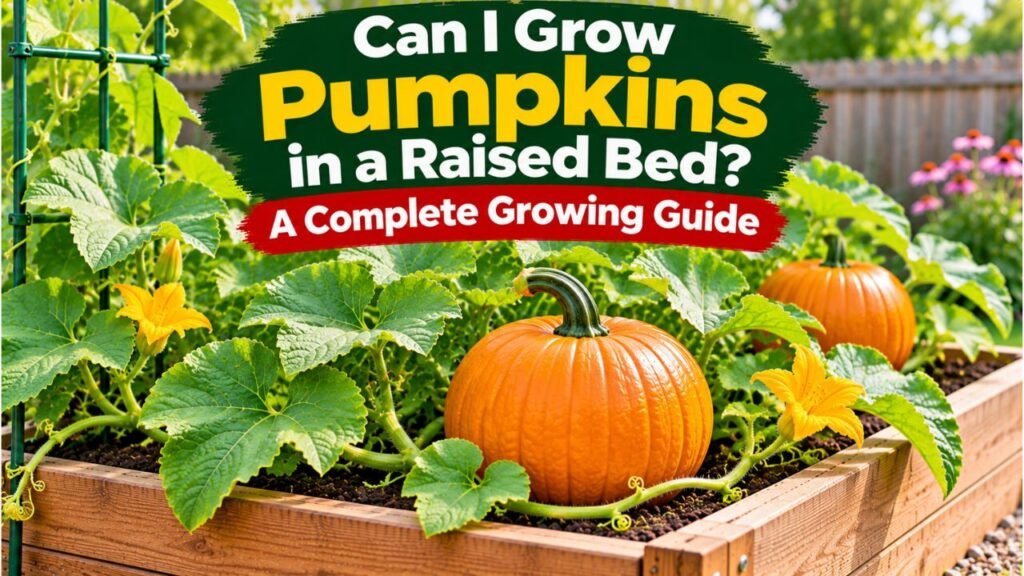
Yes. Pumpkins can grow successfully in raised garden beds when their roots have adequate soil and their vines have sufficient room to spread.
A raised bed does not need to contain the entire pumpkin plant.
In fact, one of the most effective methods is to establish the pumpkin’s roots inside the raised bed and allow its vines to grow outward into a nearby garden area.
This provides the plant with nutrient-rich soil while preventing the vines from overwhelming the raised bed.
Why Raised Beds Work for Pumpkins
Raised beds can provide several growing advantages:
- Improved drainage: Helps prevent water from accumulating around pumpkin roots.
- Better soil control: Allows gardeners to improve fertility and soil structure.
- Earlier soil warming: Raised bed soil often warms faster in spring.
- Convenient maintenance: Makes weeding, watering, and checking plants easier.
- Flexible vine management: Vines can trail outside the bed or grow on suitable supports.
However, raised beds also require careful watering.
Elevated soil may lose moisture faster than surrounding ground, particularly during summer.
Pumpkin plants have large leaves that can lose considerable moisture in hot conditions.
What Is the Biggest Challenge?
Space is the biggest limitation.
Standard vining pumpkins can spread 10 feet or more, depending on the variety and growing conditions.
Some vigorous plants extend considerably farther.
A pumpkin’s root system may fit within the raised bed, but its leaves and vines can cover surrounding paths and plants.
For that reason, the best raised bed setup provides enough room for the vines to grow outside the planting area.
Key Takeaway: A raised bed can provide an excellent rooting environment for pumpkins, but the vine-growing area matters just as much as the bed’s dimensions.
Best Pumpkin Varieties for Raised Garden Beds
The best pumpkin varieties for raised beds are those with manageable growth habits.
Pumpkins vary in fruit size, vine length, days to maturity, and intended use.
Choose a variety based on the space you actually have.
1. Bush Pumpkin Varieties
Bush varieties have a more compact growth habit than traditional long-vining pumpkins.
They are among the easiest types to manage in smaller raised beds.
Bush pumpkins are useful when you want to limit how far the plant spreads.
However, bush does not mean the plant stays as small as a lettuce plant.
Many compact pumpkins still require several feet of growing room.
Choose a seed variety specifically described as bush or compact.
Check its mature width and recommended plant spacing before purchasing.
Best for: Small raised beds, limited gardens, and gardeners who prefer less vine management.
2. Semi-Bush Pumpkin Varieties
Semi-bush pumpkins fall between compact bush plants and vigorous trailing varieties.
They produce shorter or less extensive vines than many traditional pumpkins.
However, their mature size varies considerably.
Some semi-bush varieties still need room beyond a 4-by-4-foot planting area.
They can work well when the pumpkin plant grows in a raised bed and has a nearby area for additional spreading.
Best for: Medium-size raised beds with some surrounding open space.
3. Miniature Pumpkins
Miniature pumpkins produce small fruits commonly used for decoration.
Examples include:
- Jack Be Little
- Baby Boo
- Wee-B-Little
- Baby Bear
These varieties differ in fruit size and growth habit.
Important: A miniature pumpkin does not necessarily have a compact vine.
Some small-fruited pumpkins produce vigorous trailing vines.
This means fruit size alone should not determine whether a variety is suitable for a small raised bed.
Look at the vine-length information on the seed packet.
Miniature pumpkins are useful for trellis growing because their smaller fruits are generally easier to support.
Best for: Decorative pumpkins, small-fruit harvests, and suitable vertical growing systems.
4. Small Pie Pumpkins
Pie pumpkins are often smaller than large carving pumpkins.
Some produce fruits suitable for cooking, baking, and making puree.
For example, Small Sugar is a traditional pie pumpkin variety.
However, many pie pumpkins grow on spreading vines.
A small pie pumpkin may still need substantial space outside a raised bed.
Choose the variety based on its mature vine size rather than assuming a smaller fruit requires a smaller plant.
Best for: Gardeners who want edible pumpkins and have room for trailing vines.
5. Large Carving Pumpkins
Medium and large carving pumpkins can grow in raised beds, but their vines generally need more space.
They may be suitable when the raised bed sits beside a lawn, open garden area, or other usable growing space.
Allow the vines to spread outside the bed.
Avoid planting several vigorous pumpkin plants together in a small raised bed.
Best for: Raised beds with substantial surrounding growing space.
6. Giant Pumpkin Varieties
Giant pumpkin varieties such as Atlantic Giant are not practical choices for most small raised bed gardens.
These plants require extensive growing space, nutrient management, irrigation, and substantial room for large fruits.
Although a giant pumpkin plant could be established in a raised growing area, a conventional 4-by-8-foot bed by itself does not provide enough overall growing space.
For giant pumpkin production, a much larger planting site is preferable.
Which Pumpkin Type Should You Choose?
| Pumpkin Type | Growth Habit | Raised Bed Suitability |
| True bush pumpkin | Compact | Very suitable |
| Semi-bush pumpkin | Moderately spreading | Suitable with room |
| Miniature pumpkin | Varies from compact to long-vining | Good when vine habit is appropriate |
| Small pie pumpkin | Often vining | Good with outside space |
| Large carving pumpkin | Usually vigorous vines | Needs substantial surrounding area |
| Giant pumpkin | Very vigorous | Not practical for a small bed |
For beginners, I recommend choosing a true bush or semi-bush variety with a clearly stated mature size.
How Big Should a Raised Bed Be for Pumpkins?
The ideal bed size depends on the pumpkin variety and whether the vines can grow outside the bed.
You do not necessarily need a huge raised bed.
However, a small bed must be paired with adequate surrounding growing space.
Growing Pumpkins in a 4×4 Raised Bed
A 4-by-4-foot raised bed contains 16 square feet of planting area.
This may be sufficient for establishing one suitable compact pumpkin plant.
However, its mature leaves may cover much of the bed.
A trailing variety would need room for vines to extend beyond the edges.
Avoid growing multiple vigorous pumpkin plants in such a small space.
Practical recommendation: Grow one compact pumpkin plant or one vining plant with ample surrounding space.
Growing Pumpkins in a 4×8 Raised Bed
A 4-by-8-foot bed contains 32 square feet.
This is a practical option for growing pumpkins at home.
Depending on the variety, you could grow:
- One standard vining pumpkin plant with vines directed outside the bed
- One or two genuinely compact bush plants, if their specified spacing permits
- A small-fruited vining variety trained onto a sufficiently strong trellis
The actual number depends on the mature plant size.
Planting additional pumpkins simply because the seedlings fit can cause crowding later.
Growing Pumpkins in a 3×6 Raised Bed
A 3-by-6-foot raised bed can work for one compact pumpkin plant.
It can also support the roots of a trailing variety if the vines have plenty of room outside the bed.
However, the narrower bed provides less flexibility for arranging additional crops.
Place the pumpkin near an appropriate edge and guide the vines outward as they develop.
Growing Pumpkins in a 2×4 Raised Bed
A 2-by-4-foot raised bed is relatively small for pumpkins.
A carefully chosen compact variety may work if the bed provides sufficient soil depth and the plant has additional space beyond its borders.
However, this is not an ideal size for a vigorous vining pumpkin.
For a small, fully enclosed raised planter, choosing a different vegetable may be more practical.
Raised Bed Size Comparison
| Raised Bed Size | Practical Pumpkin Planting Approach |
| 2×4 feet | One specially selected compact plant, with extra space |
| 3×6 feet | One compact plant or a trailing plant extending outside |
| 4×4 feet | One compact plant or one outward-growing vine |
| 4×8 feet | One standard vine or one to two true bush plants |
| 4×12 feet | More flexible, depending on variety and spacing |
| Larger raised bed | Multiple plants if full mature spacing is provided |
These are practical planning suggestions rather than universal plant counts.
Always follow the mature spacing requirements for the specific variety.
How Deep Should a Raised Bed Be for Pumpkins?
Pumpkins need enough soil volume to support their roots, provide nutrients, and retain moisture.
For an ordinary open-bottom raised bed, approximately 12–18 inches of improved soil is a useful starting depth.
However, pumpkins can develop roots into the underlying ground if the soil below the bed is suitable.
A shallow raised frame over healthy garden soil may therefore provide more effective rooting depth than its wall height suggests.
Pumpkins in Open-Bottom Raised Beds
An open-bottom raised bed allows roots to extend below the raised portion.
This can be useful for large pumpkin plants.
Make sure the underlying soil is not severely compacted or waterlogged.
If the bed is placed over heavy clay, improving drainage and soil structure may be necessary.
Pumpkins in Raised Beds on Concrete
A raised bed on concrete or pavement requires additional consideration.
The roots cannot grow into the soil below.
According to the University of Maryland Extension’s raised bed gardening guidance, raised beds on hard surfaces should generally provide approximately 12–24 inches of growing depth for larger crops such as squash.
For pumpkins on a solid surface, a depth toward the higher end of that range can provide more soil volume and moisture buffering.
Adequate drainage openings are essential.
A raised bed sitting directly on an impermeable surface without a drainage path can develop waterlogging problems.
Is a 6-Inch Raised Bed Deep Enough?
A 6-inch raised bed may work when it is open-bottomed and placed over suitable garden soil.
The pumpkin roots can extend below the raised layer.
However, a 6-inch solid-bottom planter provides very limited root space for a large pumpkin plant.
It may dry rapidly and restrict growth.
For solid-bottom pumpkin beds, use a deeper container or raised planter.
Key Takeaway: Pumpkin root space depends on the total available soil, not just the raised bed’s visible height. Open-bottom beds provide greater flexibility than shallow solid-bottom planters.
How to Grow Pumpkins in a Raised Bed Step by Step
Pumpkins can be grown from seeds or transplants.
Direct sowing is often convenient because pumpkin seedlings develop quickly in warm soil and can be sensitive to root disturbance.
Step 1: Choose a Sunny Growing Location
Pumpkins need substantial direct sunlight.
Aim for at least 6–8 hours per day.
For strong growth and fruit development, 8–10 hours is preferable when conditions allow.
Avoid placing the bed beside tall fences, buildings, or trees that block much of the sun.
Also consider where the vines will grow.
A raised bed may receive full sun, but vines extending into a shaded pathway may not develop as well.
Plan the entire growing area before planting.
Step 2: Prepare the Raised Bed Soil
Pumpkins prefer fertile, well-drained soil.
Before planting:
- Remove weeds and old crop debris.
- Check drainage.
- Loosen compacted surface soil.
- Add finished compost when needed.
- Test soil fertility and pH if possible.
- Apply appropriate fertilizer based on soil conditions.
Pumpkins generally grow well in soil with a pH around 6.0–6.8.
However, the exact suitable range varies with the source and growing conditions.
A soil test is more reliable than adding amendments without knowing the current pH.
Avoid filling the bed with pure compost.
Use a suitable complete growing medium that balances drainage, aeration, moisture retention, and nutrients.
Step 3: Wait Until the Soil Is Warm
Pumpkins are warm-season vegetables.
They are vulnerable to frost.
Plant seeds outdoors after the danger of frost has passed and the soil has warmed sufficiently.
A soil temperature of approximately 65–70°F (18–21°C) or warmer is a useful starting point for planting.
Cool, wet soil can delay germination and contribute to seed decay.
Raised bed soil may warm earlier than surrounding ground, but that does not mean planting before the last frost is automatically safe.
Use a soil thermometer when uncertain.
Step 4: Sow the Pumpkin Seeds
Choose the number of planting positions according to the variety’s spacing requirements.
For one standard trailing pumpkin plant in a 4-by-8-foot bed, choose a location near an edge where the vine can grow outward.
Make a planting hole approximately ½–1 inch deep, or follow the depth specified on the seed packet.
Plant two or three seeds at the position if desired.
Cover the seeds with loose soil.
Water gently.
Once the seedlings establish, select the healthiest plant and thin the others if your planting plan calls for one plant.
Cutting unwanted seedlings at soil level avoids disturbing the roots of the selected plant.
Step 5: Transplant Pumpkin Seedlings if Preferred
Pumpkin transplants can be useful in regions with shorter growing seasons.
However, they dislike significant root disturbance.
Start seeds indoors only a few weeks before the expected outdoor planting date.
Use suitable individual containers.
Transplant before the roots become excessively crowded.
To transplant:
- Prepare a hole large enough for the root ball.
- Remove the plant carefully from its container.
- Keep the root ball intact.
- Set the plant at approximately its original soil depth.
- Fill around the roots gently.
- Water thoroughly.
Avoid damaging the stem or burying it deeply without a crop-specific reason.
Step 6: Water After Planting
Water the soil thoroughly after sowing or transplanting.
Keep the upper soil moist while seeds germinate.
After seedlings establish, gradually transition to deeper watering that reaches the growing root system.
Avoid constantly saturating the soil.
Pumpkins need oxygen around their roots as well as adequate water.
Step 7: Add Mulch After the Soil Warms
Organic mulch can help conserve moisture and reduce weeds.
Suitable options include:
- Clean straw
- Shredded leaves
- Untreated, herbicide-free dried grass clippings
- Other appropriate garden mulch
Apply a moderate layer around established plants.
Keep mulch away from stems.
Avoid placing thick, cool organic mulch over the soil before it warms sufficiently in spring.
Step 8: Guide the Vines
As the pumpkin plant grows, begin directing its vines toward the planned space.
Do this while the vines are still flexible.
Avoid sharply bending mature vines because they can crack.
If allowing the vines to grow outside the bed, guide them toward open ground or a suitable pathway that does not need regular foot traffic.
For vertical growing, introduce the vines to their support early.
Step 9: Monitor Flowers and Pollination
Pumpkins produce separate male and female flowers.
Male flowers commonly appear first.
Female flowers develop later and have a small swollen structure beneath the blossom that resembles a miniature pumpkin.
For fruit to develop normally, pollen must reach the female flower.
Bees and other insects commonly perform this work.
Avoid unnecessary pesticide applications during flowering.
Step 10: Care for the Developing Fruit
Once pumpkins begin developing, maintain consistent soil moisture.
Check the vines and leaves for pests and disease.
If the fruit rests on bare ground, consider placing clean straw or a suitable support beneath it to reduce prolonged soil contact.
If the pumpkin is growing on a trellis, make sure the fruit has adequate support.
Do not allow a large pumpkin to hang from a weak vine or unsupported trellis.
How Much Space Do Pumpkin Vines Need?
Vine space is often more important than raised bed size.
Even one vigorous pumpkin plant can spread far beyond the area where it was planted.
According to the University of Maryland Extension’s pumpkin-growing guide, pumpkins are warm-season crops requiring substantial space, with traditional planting systems using several feet between planting positions and much wider spacing between rows.
The exact spacing depends on the variety.
Compact Bush Pumpkins
True bush varieties may fit into a relatively limited area.
However, their mature spread can still reach several feet.
Allow enough space for healthy foliage and airflow.
Do not assume the plant will remain within a small square simply because it is labeled compact.
Semi-Bush Pumpkins
Semi-bush varieties may produce shorter vines.
They can work well when the raised bed has a few feet of additional surrounding space.
Check the cultivar’s stated vine length.
Long-Vining Pumpkins
Long-vining varieties require much more space.
Some develop vines 10 feet or longer.
Others may extend well beyond that.
Growing them in a raised bed is practical when the vines can spread onto surrounding ground.
Can Pumpkin Vines Grow Outside the Raised Bed?
Yes.
This is one of the easiest ways to grow pumpkins in a smaller raised bed.
The main plant remains rooted in the bed while the vines extend over the edge.
Allow them to grow into an open area.
However, keep the vines away from places where people regularly walk.
Pumpkin vines are easily damaged when stepped on or repeatedly moved.
If the vines grow onto suitable garden soil, some nodes may develop additional roots.
Avoid damaging these rooted sections during maintenance.
Can You Grow Pumpkins Vertically in a Raised Bed?
Yes. Certain pumpkin varieties can be grown vertically with a properly constructed trellis.
This approach is particularly useful for miniature and small-fruited pumpkins.
However, growing pumpkins vertically requires stronger support than growing lightweight climbing vegetables.
Which Pumpkins Are Best for Trellising?
Small-fruited pumpkins are generally the most practical choice.
Examples include some miniature decorative varieties and compact-fruited pumpkins.
However, even a small-fruited variety may produce long vines.
Choose one with a suitable growth habit and train it gradually.
Large carving pumpkins and giant pumpkin varieties are not appropriate for ordinary lightweight garden trellises.
What Type of Trellis Should You Use?
A suitable pumpkin trellis may use:
- Strong metal cattle panels
- Securely anchored welded-wire panels
- Robust wooden framing
- Appropriate steel supports
- A properly engineered garden arch
The support must resist both the growing vine weight and the weight of mature fruit.
Wind can also place considerable force on a trellis covered with large leaves.
Secure the structure independently where necessary.
Do not attach a heavy trellis to thin or weakened raised bed walls.
How to Train Pumpkin Vines
Start guiding the vines when they are young and flexible.
Position them near the trellis.
Use soft garden ties if necessary.
Avoid tying the stems tightly because they expand during growth.
Check the vines regularly and guide new growth along the support.
Do not force mature vines around sharp bends.
Do Hanging Pumpkins Need Support?
Some very small fruits may be supported by their vines, but this depends on the variety and growing conditions.
For larger fruits, use a suitable sling or hammock attached to the trellis.
The support should carry the fruit’s weight independently rather than pulling on the stem.
Inspect the sling as the pumpkin grows.
If the fruit becomes too heavy for the structure, it should not remain suspended.
Key Takeaway: Vertical growing is most practical for small-fruited pumpkins with strong support. Large pumpkins are generally better grown on the ground.
How Many Pumpkin Plants Can You Grow in One Raised Bed?
The correct number depends on the pumpkin’s mature size and the surrounding space.
It is better to grow one healthy pumpkin plant than several overcrowded plants.
One Standard Pumpkin in a 4×8 Bed
For many traditional vining varieties, one plant is a practical starting point.
Place it near one end or edge of the bed.
Allow the vine to extend into an open growing area.
This gives the plant access to the bed’s soil resources without forcing the entire vine to stay inside the frame.
Two Compact Pumpkin Plants in a 4×8 Bed
Two genuinely compact bush varieties may work if the seed packet’s spacing recommendations permit them.
Provide adequate separation.
Allow room for both plants to expand.
If the plants become too crowded, competition can reduce their growth and fruit production.
Can You Grow Four Pumpkin Plants in a 4×8 Bed?
Four typical pumpkin plants are usually too many for a conventional 4-by-8-foot raised bed when the vines must remain within or close to the bed.
Certain specially bred compact varieties or carefully managed systems may allow closer spacing.
However, the resulting growth depends on the cultivar and available outside space.
For ordinary home gardening, one or two appropriately chosen plants is a more practical approach.
What About One Pumpkin Plant per Square Foot?
Square-foot gardening methods do not mean every vegetable can be grown at one mature plant per square foot.
Pumpkins have extensive foliage and root systems.
A single pumpkin plant generally needs considerably more growing space.
Use the mature spacing recommendation rather than the number of square-foot sections available.
How Often Should You Water Pumpkins in Raised Beds?
Pumpkins need consistent moisture, especially during flowering and fruit development.
Raised beds can dry faster than in-ground soil during warm weather.
This makes watering particularly important.
Weekly Water Requirements
A general starting point is approximately 1–2 inches of water per week, including rainfall.
However, actual water needs vary according to:
- Temperature
- Wind
- Rainfall
- Soil texture
- Bed depth
- Plant size
- Mulch coverage
- Fruit development stage
Do not apply water automatically simply because a certain number of days has passed.
Check the soil moisture first.
How to Water Pumpkins Properly
Water deeply enough to moisten the root zone.
Apply water around the base of the plant rather than repeatedly wetting the entire canopy.
Drip irrigation or a soaker hose can be convenient.
Avoid allowing the soil to become waterlogged.
A deep watering followed by appropriate drying is generally better than frequent shallow watering that never reaches the deeper roots.
Should You Water Pumpkins Every Day?
Not necessarily.
Daily watering may be appropriate during very hot weather in a shallow raised planter.
However, a deeper bed with moisture-retentive soil may need water less frequently.
Check the soil below the surface.
If it is still moist throughout the root zone, additional water may not be necessary.
What Happens if Pumpkins Do Not Get Enough Water?
Insufficient moisture can cause:
- Wilting
- Slower vine growth
- Reduced fruit development
- Increased plant stress
- Poor fruit quality
Large pumpkin leaves may wilt temporarily during the hottest part of the day even when soil moisture is adequate.
Check the root zone before assuming more water is needed.
If the plant remains wilted into the evening or the soil is dry, watering may be necessary.
How to Fertilize Pumpkins in a Raised Bed
Pumpkins require adequate nutrients to support large leaves, long vines, flowers, and fruit.
However, excessive fertilizer can create problems.
Prepare Fertile Soil Before Planting
Start with suitable raised bed soil.
Finished compost can improve soil structure and contribute nutrients.
If possible, use a soil test to determine which nutrients are needed.
Apply fertilizer according to the test results and product instructions.
Nitrogen During Early Growth
Nitrogen supports leaf and stem growth.
Pumpkin plants need sufficient nitrogen during establishment.
However, applying too much nitrogen can encourage vigorous vines and excessive foliage.
This may reduce the balance between vegetative growth and fruit development.
Do not use high-nitrogen fertilizer repeatedly without considering soil fertility.
Nutrition During Flowering and Fruiting
Potassium and other nutrients contribute to plant growth and fruit development.
However, adding extra potassium or phosphorus is not automatically beneficial if the soil already contains adequate amounts.
Use a balanced fertilization plan based on actual soil needs.
Avoid applying fertilizer directly against the pumpkin stem.
Water appropriately after applying granular fertilizer according to its label.
Can You Use Compost Alone?
Compost may provide sufficient nutrients in some soils, but not all.
Its nutrient concentration varies depending on the materials and composting process.
If the soil is deficient in important nutrients, compost alone may not meet the plant’s needs.
A soil test helps determine whether additional fertilizer is appropriate.
Do Pumpkins Need Pollination in Raised Beds?
Yes.
Most pumpkins require pollen transfer between male and female flowers to develop normal fruit.
Bees and other pollinating insects usually perform this work.
Raised bed growing does not eliminate that requirement.
Identifying Male Pumpkin Flowers
Male flowers usually grow on relatively slender stems.
They do not have a miniature fruit beneath the flower.
Male flowers often appear before female flowers.
This is a normal part of pumpkin growth.
If a young pumpkin plant produces only male flowers for a while, it does not necessarily indicate a problem.
Identifying Female Pumpkin Flowers
Female flowers have a swollen structure directly behind the blossom.
It resembles a tiny pumpkin.
If pollination is successful, the small fruit begins to develop.
If pollination is inadequate, the young fruit may turn yellow, stop growing, and fall off.
How Bees Pollinate Pumpkins
Bees visit pumpkin flowers to collect nectar and pollen.
As they move between flowers, pollen can be transferred from male flowers to female flowers.
Pumpkin flowers are often most active during the morning.
Avoid spraying insecticides while bees are visiting flowers.
Choose pest-management methods that reduce risks to pollinators.
How to Hand-Pollinate Pumpkins
Hand pollination may help when pollinating insects are scarce or fruit set is poor.
The process is simple.
- Find a newly opened male flower.
- Identify a newly opened female flower.
- Carefully remove the male flower’s petals or use a small clean brush.
- Transfer pollen from the male flower’s anther to the female flower’s stigma.
- Repeat gently to provide adequate pollen coverage.
Perform the process during the morning when flowers are open and receptive.
Hand pollination does not guarantee fruit development if temperatures or plant conditions are unsuitable.
Can One Pumpkin Plant Produce Fruit?
Yes.
Most pumpkin varieties produce both male and female flowers on the same plant.
One healthy pumpkin plant can produce fruit when pollen moves between its flowers.
You do not normally need separate male and female pumpkin plants.
How to Protect Raised Bed Pumpkins From Pests and Diseases
Pumpkins are susceptible to several insects and diseases.
Raised beds may improve drainage and accessibility, but they do not eliminate these problems.
Squash Bugs
Squash bugs feed on leaves and stems.
Heavy infestations can cause wilting and plant damage.
Inspect the undersides of leaves for egg clusters.
Remove eggs and insects when practical.
Keep the growing area free of unnecessary debris.
Follow local extension recommendations for severe infestations.
Squash Vine Borers
Squash vine borer larvae can damage susceptible pumpkin stems.
The larvae feed inside the vine and may cause sudden wilting.
Some pumpkin species and varieties are more vulnerable than others.
Early-season protection and regular inspection can be useful.
However, row covers must be removed or opened during flowering to allow insect pollination unless hand pollination is being used.
Cucumber Beetles
Cucumber beetles can damage leaves and flowers.
Some species can also transmit bacterial wilt pathogens to susceptible cucurbits.
Monitoring and suitable pest-management methods are important.
Choose treatments based on the pest and crop rather than applying insecticides unnecessarily.
Powdery Mildew
Powdery mildew appears as a whitish, powdery growth on leaves.
It commonly becomes noticeable later in the growing season.
The disease can reduce leaf function when severe.
To limit problems:
- Provide adequate plant spacing.
- Avoid overcrowding.
- Choose resistant varieties when available.
- Monitor foliage regularly.
- Follow suitable disease-management recommendations.
Do not assume that ordinary white markings naturally present on some pumpkin leaves are always powdery mildew.
Inspect the pattern and appearance carefully.
Fruit Rot
Pumpkins resting on constantly wet soil may develop fruit rot.
To reduce prolonged contact with damp ground, place clean straw or a suitable support beneath developing fruit when practical.
Keep the soil well drained.
Avoid excessive irrigation.
Inspect fruit regularly for soft or damaged areas.
Why Is My Pumpkin Plant Growing Leaves but No Pumpkins?
A pumpkin plant may produce healthy vines and leaves without developing mature fruit.
Several causes are possible.
The Plant Is Still Young
Pumpkin plants often produce male flowers before female flowers.
It may take additional time for fruit-bearing flowers to appear.
Check the expected days to maturity.
Do not assume a young plant is failing because it has not produced fruit immediately.
Poor Pollination
Inadequate pollen transfer can prevent proper fruit development.
This may occur during extended rainy periods or when pollinator activity is low.
Hand pollination can sometimes help.
Excessive Nitrogen
Too much nitrogen may encourage foliage growth at the expense of reproductive development.
Review the fertilizer program.
Avoid unnecessary high-nitrogen applications.
Temperature Stress
Very high temperatures can affect flowering and fruit set.
Unusually cold weather can also slow pumpkin growth.
Raised beds may warm quickly, but they do not protect plants from every temperature extreme.
Overcrowding
Plants competing for sunlight, water, and nutrients may produce fewer or smaller fruits.
Reduce crowding and provide sufficient room for vines.
Can You Plant Other Vegetables With Pumpkins in a Raised Bed?
Yes, but pumpkin vines may eventually cover much of the bed and surrounding area.
Companion plants should be selected carefully.
Lettuce and Radishes
Quick-growing lettuce or radishes can be planted near young pumpkins during suitable weather.
Harvest them before the pumpkin canopy spreads.
However, lettuce and radishes prefer cooler conditions than mature pumpkins.
They are most practical as temporary early-season crops.
Bush Beans
Bush beans may grow near pumpkin plants when sufficient space remains.
However, beans also require sunlight and root space.
Do not crowd them directly beneath expanding pumpkin leaves.
Planting beans does not guarantee that they will supply large amounts of usable nitrogen to the pumpkins during the same growing season.
Nasturtiums
Nasturtiums produce colorful flowers and may attract pollinators.
However, trailing varieties can also spread extensively.
Place them near the outside edge rather than crowding the pumpkin’s main growing area.
Marigolds
Compact marigolds may add color and attract certain beneficial insects.
However, they do not reliably repel all pumpkin pests.
Plant them where they will not interfere with pumpkin vines.
What Should You Avoid Planting Nearby?
Large vegetables such as other sprawling squash, melons, and vigorous tomatoes can compete heavily for space.
They are not necessarily biologically incompatible with pumpkins.
The main issue is overcrowding.
For a 4-by-8-foot bed, keeping the pumpkin as the main crop is generally the easiest approach.
How Long Do Pumpkins Take to Grow in Raised Beds?
Pumpkin maturity depends on variety, temperature, planting date, and growing conditions.
Many pumpkins require approximately 90–120 days from planting to mature fruit.
Some miniature or early varieties mature faster.
Large pumpkins often require longer.
Raised beds may help soil warm earlier, but this does not guarantee that pumpkins will mature faster.
Pumpkin Growth Timeline
| Growth Stage | Approximate Timing |
| Seed germination | Often 5–10 days in warm soil |
| Early seedling growth | First 2–3 weeks |
| Rapid vine development | Following several weeks |
| Flowering | Varies with variety and conditions |
| Fruit development | After successful pollination |
| Mature pumpkin harvest | Often 90–120 days after sowing |
These are broad estimates.
Check the seed packet for the specific cultivar’s days to maturity.
Also allow enough warm growing time before the first expected fall frost.
When Should You Plant Pumpkins for Fall Harvest?
Work backward from the expected harvest period.
If a variety requires 110 days to mature, it needs approximately that many suitable growing days.
In many regions, pumpkins are planted during late spring or early summer.
However, planting dates vary greatly across the United States.
Follow local frost dates and regional extension guidance.
How to Tell When Pumpkins Are Ready to Harvest
Pumpkins should be harvested when they are sufficiently mature for their intended use.
The exact indicators depend on variety.
Check the Mature Color
Many orange pumpkin varieties develop their characteristic color as they ripen.
However, not all pumpkins turn orange.
Some varieties mature white, green, gray, or other colors.
Check the expected mature appearance of the variety you planted.
Test the Rind
A mature pumpkin generally develops a firm rind.
A rind that resists light pressure from a fingernail is often an indication of maturity.
Do not puncture or damage the fruit while testing.
Inspect the Stem
As pumpkins mature, the stem may become harder and more corky.
This can be another useful indicator.
However, maturity should be judged using several signs rather than stem appearance alone.
Harvest Before Damaging Freezes
Pumpkin vines are frost-sensitive.
Mature fruit can sometimes tolerate a light frost, but hard freezing may damage the pumpkins and reduce storage quality.
Harvest mature pumpkins before severe freezing weather.
How to Cut Pumpkins From the Vine
Use clean, sharp pruning shears or a suitable knife.
Cut the stem several inches above the pumpkin.
Leaving approximately 3–4 inches of stem helps preserve the fruit’s handling and storage quality.
Do not lift pumpkins by their stems.
The stems can break, creating an opening for decay.
How to Store Pumpkins After Harvesting
Properly matured pumpkins can often be stored for weeks or months, depending on the variety and conditions.
However, damaged or immature fruit generally stores less successfully.
Cure Suitable Pumpkins
Many mature winter squash and pumpkin varieties benefit from a curing period before long-term storage.
Curing helps the rind harden and allows minor surface injuries to heal.
The appropriate curing method varies by variety.
Follow crop-specific guidance.
Do not cure severely damaged or rotting pumpkins for storage.
Choose a Suitable Storage Area
Many mature pumpkins store best in a cool, dry, well-ventilated area.
Temperatures around 50–55°F are suitable for many storage pumpkins.
Avoid freezing.
Also avoid extremely damp conditions that encourage decay.
Check stored pumpkins periodically and remove any fruit developing soft spots or rot.
Keep Pumpkins Off Damp Surfaces
Place stored pumpkins on shelves, pallets, or another suitable dry surface.
Allow air circulation.
Avoid stacking heavy pumpkins directly on one another unless the arrangement is appropriate and will not cause bruising.
Common Mistakes When Growing Pumpkins in Raised Beds
Even a healthy-looking pumpkin plant may struggle if the raised bed is poorly planned.
Planting Too Many Pumpkin Plants
Pumpkin seedlings are small, but mature vines are large.
Overcrowding can reduce airflow and cause competition.
Grow fewer plants with adequate space.
Choosing a Large Variety for a Tiny Bed
Large pumpkins often require substantial vine space.
Choose compact varieties when the surrounding growing area is limited.
Ignoring Vine Direction
Pumpkin vines may spread across pathways and neighboring beds.
Decide where they will grow before planting.
Guide young vines while they are flexible.
Using a Bed With Poor Drainage
Pumpkin roots need oxygen.
Waterlogged soil can contribute to root problems.
Provide suitable drainage and avoid excessive irrigation.
Forgetting to Water During Fruiting
Pumpkins need consistent moisture when fruits are developing.
Raised beds may dry quickly in hot weather.
Monitor the root zone regularly.
Overusing Nitrogen Fertilizer
Excess nitrogen can encourage excessive vine and leaf growth.
Use fertilizer according to soil needs.
Planting Before the Soil Warms
Cold soil delays germination and may damage seedlings.
Wait until conditions are suitable for this frost-sensitive crop.
Using a Weak Trellis
Heavy pumpkins can overload lightweight supports.
Use appropriate structural materials and support developing fruits.
Ignoring Pollination
Pumpkins need successful pollen transfer for normal fruit development.
Encourage pollinators and avoid unnecessary insecticide applications during flowering.
Harvesting Too Early
Immature pumpkins may have poor flavor and reduced storage life.
Wait until the fruit reaches appropriate maturity indicators for its variety.
Conclusion
So, can I grow pumpkins in a raised bed? Yes. Pumpkins can grow very successfully in raised garden beds when the soil is fertile, drainage is suitable, and the vines have enough room to develop.
For a typical 4-by-8-foot raised bed, I recommend starting with one standard trailing pumpkin plant or one to two genuinely compact bush varieties, depending on their mature spacing requirements.
If you choose a vining pumpkin, let the vines grow beyond the bed rather than forcing the entire plant into a small area. Small-fruited varieties may also be trained onto a sturdy trellis when their weight can be supported safely.
Use a sufficiently deep growing medium, provide abundant sunlight, and maintain consistent moisture throughout flowering and fruit development.
Pay particular attention to pollination, pests, and the amount of space the vines occupy.
With the right variety and a practical layout, you can harvest pumpkins from a raised bed without needing a large traditional pumpkin patch.
FAQs About Can I Grow Pumpkins in a Raised Bed
Can You Grow Pumpkins in a 4×4 Raised Bed?
Yes. A 4-by-4-foot raised bed can support one appropriately selected compact pumpkin plant.
A trailing variety may also grow there if its vines can extend into a larger surrounding area.
Avoid planting several vigorous pumpkin plants in the limited space.
How Many Pumpkin Plants Can Grow in a 4×8 Raised Bed?
One standard vining pumpkin plant is a practical choice when its vines can spread outside the bed.
One or two genuinely compact bush varieties may also work if their mature spacing requirements permit.
The best number depends on the cultivar, soil volume, and available surrounding space.
How Deep Should a Raised Bed Be for Pumpkins?
Approximately 12–18 inches of suitable growing soil is a useful starting point for open-bottom raised beds.
If the bed sits on concrete or another hard surface, approximately 12–24 inches of soil depth is generally recommended for larger crops such as squash, with greater depth providing additional root volume.
Good drainage remains essential.
Can Pumpkin Vines Hang Over the Side of a Raised Bed?
Yes. Pumpkin vines can grow over the edges of a raised bed and spread across surrounding ground.
This is a practical way to grow pumpkins in a smaller raised bed.
Guide the vines carefully while they are flexible and keep them away from heavily used pathways.
Can You Grow Pumpkins on a Trellis in a Raised Bed?
Yes. Small-fruited pumpkin varieties can be trained onto a strong trellis.
Choose a support capable of carrying the mature vines and fruit.
Larger pumpkins may need individual fruit slings, and very large varieties are generally better grown on the ground.
Do Pumpkins Need Full Sun in Raised Beds?
Yes. Pumpkins grow best in full sun.
At least 6–8 hours of direct sunlight is useful, with approximately 8–10 hours preferred for strong growth and fruit production.
Shaded plants may develop weak vines and produce fewer fruits.
Can You Grow Pumpkins in Raised Beds Every Year?
You can grow pumpkins in raised beds each year, but planting them repeatedly in the same soil may increase the risk of certain pests and diseases.
Pumpkins belong to the cucurbit family, along with squash, zucchini, cucumbers, and melons.
Rotate these crops with unrelated vegetables when possible, maintain soil fertility, and remove diseased plant material.

I’m Maya L. Greenwood, a lifelong plant lover who believes anyone can grow something beautiful with the right guidance. After years of testing soil mixes, pruning methods, irrigation tricks, and pest-safe solutions, I started EasyGardenTips.com to turn hard-won lessons into step-by-step advice. From seed starting and container gardens to composting and seasonal checklists, my goal is to make gardening simple, sustainable, and fun.