How to Trellis Cucumbers in a Raised Bed: Height and Spacing
To trellis cucumbers in a raised bed, install a sturdy support approximately 4–6 feet tall, plant vining cucumbers about 12–18 inches apart, and gently guide their young stems and tendrils onto the trellis as they grow. Secure the structure against wind, provide adequate sunlight, and keep the soil consistently moist.
Growing cucumbers vertically saves ground space, keeps developing fruit away from wet soil, and makes harvesting easier. It can also improve airflow around the vines, although trellising alone doesn’t prevent every fungal disease or guarantee higher yields.
A wire-mesh panel is one of the simplest options for beginners. An A-frame, string trellis, or cattle-panel arch can also work when the structure is properly anchored.
The best setup depends on the cucumber variety, raised bed dimensions, and growing conditions. Long-vining cucumbers benefit most from vertical support, while compact bush varieties may not require it.
In this article, I explain how to trellis cucumbers in a raised bed step by step, including materials, support height, plant spacing, and vine training. I also cover different DIY trellis designs, watering, pruning, pollination, and harvesting so you can grow healthy cucumbers without overcrowding your garden.
Why Trellis Cucumbers in a Raised Bed?
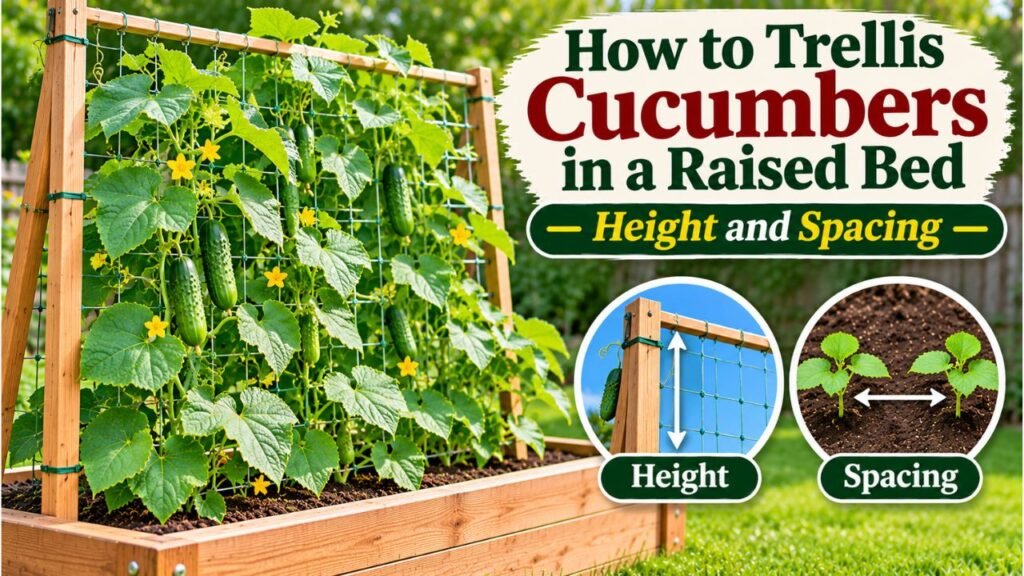
Cucumbers naturally produce climbing tendrils that attach to nearby structures.
When a sturdy support is available, many vining cucumber varieties can grow upward instead of spreading across the soil.
This is especially useful in raised beds, where the planting area may be limited to 16–32 square feet.
According to the University of Minnesota Extension’s vegetable trellis guidance, climbing supports help keep cucumbers and other suitable vine crops cleaner and straighter.
Saves Growing Space
An unsupported cucumber vine may spread several feet across a garden bed.
It can cover nearby lettuce, beans, peppers, or other vegetables.
A trellis redirects much of that growth upward.
This allows more of the raised bed surface to remain accessible for planting and maintenance.
However, trellising doesn’t eliminate the plant’s root-space requirements.
The cucumbers still need adequate spacing, water, and nutrients.
Keeps Cucumbers Away From the Soil
Fruits growing directly on the ground may contact wet soil, mulch, and garden debris.
This can increase exposure to certain fruit-rotting conditions.
Trellising keeps most developing cucumbers suspended above the soil surface.
The fruit is also easier to see when harvesting.
Improves Air Circulation
Vertical training can prevent cucumber foliage from becoming a dense layer directly against the ground.
Better airflow may help leaves dry faster after rain or irrigation.
However, overcrowded trellises can still develop serious disease problems.
Plant spacing remains important.
Makes Harvesting Easier
Cucumbers can hide beneath large leaves when grown on the ground.
On a trellis, hanging fruit is often easier to find.
This makes it simpler to harvest regularly before cucumbers become oversized.
Helps Produce Straighter Fruit
Cucumbers suspended vertically often develop straighter shapes because they aren’t resting against uneven soil.
However, fruit shape also depends on variety, pollination, and growing conditions.
Trellising doesn’t correct every cause of misshapen cucumbers.
Key Takeaway: Trellising is particularly useful for vining cucumbers in small raised beds because it improves space efficiency, harvesting access, and fruit cleanliness.
How to Trellis Cucumbers in a Raised Bed Step by Step
A basic upright mesh trellis is usually the simplest design for beginners.
It requires a supporting frame, suitable mesh, and enough anchoring to prevent the structure from tipping over as vines grow.
Step 1: Choose a Vining Cucumber Variety
Before installing a trellis, identify the cucumber’s growth habit.
There are two broad categories.
Vining cucumbers: Produce longer stems that climb supports using tendrils.
Bush cucumbers: Have more compact growth and generally don’t require tall trellises.
Vining types are usually the best choice when your goal is to grow cucumbers vertically.
Suitable options include many slicing and pickling varieties.
Examples worth considering include:
- Marketmore-type slicing cucumbers.
- Straight Eight-type slicing cucumbers.
- National Pickling-type cucumbers.
- Boston Pickling-type cucumbers.
- Other varieties labeled as vining or suitable for trellises.
Check the specific seed packet because varieties differ in mature vine length, growth habit, and disease resistance.
A compact bush cucumber can still receive support, but a large trellis may provide little additional benefit.
Step 2: Choose the Best Trellis Location
Place the trellis where the cucumbers receive sufficient sunlight without unnecessarily shading other vegetables.
Cucumbers generally grow best with at least 6–8 hours of direct sunlight daily.
In the Northern Hemisphere, positioning a vertical trellis along the north side of a raised bed can help reduce shading over shorter plants to its south.
This is particularly useful in a 4-by-8-foot raised bed containing several vegetable types.
However, surrounding trees, fences, and buildings may affect the best location.
Check the sunlight pattern before installing the structure.
Also consider access.
You should be able to inspect vines, harvest cucumbers, and maintain the trellis without stepping into the raised bed.
Step 3: Gather the Trellis Materials
For a basic mesh trellis, prepare:
- Two sturdy wooden or metal support posts.
- A suitable wire panel or garden trellis netting.
- Outdoor-rated fasteners or appropriate wire ties.
- Measuring tape.
- Level.
- Post driver or suitable installation tools.
- Work gloves.
- Optional additional center support.
- Soft plant ties or garden clips.
For an approximately 8-foot-long trellis, a third support post may improve stability.
Choose corrosion-resistant materials suitable for outdoor use.
Avoid thin, weak supports that could bend under wind pressure and the weight of mature vines.
Step 4: Decide the Trellis Height
A trellis approximately 4–6 feet tall is practical for many home raised bed cucumber gardens.
The appropriate height depends on the variety and how easily you can reach the upper vines.
The University of Minnesota Extension describes cucumber trellises around 3–4 feet tall as a workable option.
For longer-vining varieties, a 5–6-foot support may provide more climbing space.
| Trellis height | Suitable application |
| 3–4 feet | Shorter vines and compact setups |
| 4–5 feet | Small raised beds and manageable harvesting height |
| 5–6 feet | Vigorous vining cucumbers |
| Over 6 feet | Taller structures with suitable access and anchoring |
Taller isn’t automatically better.
An excessively tall trellis may become difficult to harvest and more vulnerable to wind if the frame isn’t properly reinforced.
Step 5: Install the Support Posts Securely
Measure the intended trellis location.
Install the posts before planting cucumbers.
This avoids disturbing established roots later.
For an ordinary ground-supported trellis, place the posts sufficiently deep to resist movement.
The University of Minnesota Extension gives an example of a 6-foot post driven approximately 1 foot into the soil, leaving around 5 feet of exposed support.
However, one foot is an example, not a universal anchoring requirement.
Post depth and bracing depend on soil stability, support height, wind exposure, and the weight of mature vines.
For long or exposed trellises, deeper anchoring or additional bracing may be necessary.
What if the Raised Bed Is Shallow?
Don’t assume a post inserted into only 8–12 inches of loose raised bed mix will remain stable.
Where possible, anchor posts into firm native ground outside the bed.
Another option is a properly reinforced frame attached to structural supports designed to carry the load.
Thin bed walls alone may not withstand the force from a tall, wind-loaded trellis.
If you’re driving posts into the ground, check for underground utilities and irrigation before installation.
Step 6: Attach the Trellis Mesh
Secure the climbing material between the support posts.
Suitable materials include:
- Galvanized welded-wire panels.
- Sturdy garden trellis netting.
- Appropriate livestock fencing.
- Strong outdoor-rated trellis mesh.
A mesh with openings approximately 4–6 inches across can be convenient because cucumber tendrils can grip the structure and fruit is easier to inspect.
Smaller openings can also work.
However, check regularly that growing cucumbers don’t become trapped between wires.
Attach the mesh firmly at the top, bottom, and supporting posts.
It should remain stable when lightly pushed or shaken.
For an 8-foot span, a center post may reduce sagging.
Cover sharp cut-wire ends and keep exposed fasteners away from walkways.
Step 7: Prepare the Soil
Cucumbers prefer fertile, well-drained soil with adequate moisture retention.
Before planting:
- Remove weeds and large debris.
- Check whether the soil is loose enough for root development.
- Add finished compost only if needed.
- Check soil nutrients and pH when appropriate.
- Rake the planting surface level.
- Water lightly if the soil is excessively dry.
Avoid heavily tilling an established raised bed without a specific reason.
The University of Maryland Extension’s raised bed guide recommends at least 8 inches of growing medium for cucumbers in raised beds installed over hard surfaces.
Open-bottom beds over suitable native soil may allow roots to grow below the frame.
Deeper growing media can also provide more water storage, which is useful during hot weather.
Step 8: Plant Cucumbers Near the Trellis
Cucumbers are warm-season vegetables.
Plant them after the danger of frost has passed and the soil has warmed sufficiently.
The University of Minnesota Extension’s cucumber growing guide recommends direct sowing after the soil reaches approximately 70°F at a depth of 1 inch.
Sow cucumber seeds about ½ inch deep, following the variety’s packet instructions.
Place the planting row close enough that young vines can easily reach the trellis.
A distance of approximately 4–8 inches from the mesh may be practical, depending on the support design.
Avoid planting directly against a large structural post.
Leave enough room for roots and stems to develop.
Step 9: Thin Plants to Proper Spacing
After the seedlings emerge and begin growing, thin them according to the variety and training system.
Approximately 12–18 inches between plants is a practical starting range for many trellised cucumber varieties.
However, spacing recommendations differ.
The University of Minnesota Extension describes thinning plants to 8–12 inches in certain home garden systems.
The University of Maryland Extension suggests 18-inch spacing for an intensive vertical planting example.
Closer spacing can work under favorable conditions, but it increases competition and may reduce airflow.
For most beginners, 12–18 inches offers a reasonable balance between productivity and maintenance.
Step 10: Train the Young Vines
When cucumber vines begin developing tendrils, gently guide them toward the mesh.
The tendrils will often attach naturally.
If necessary, use soft plant ties or clips to hold the stem near the support.
Don’t tie stems tightly.
Leave room for growth.
Inspect the plants every few days and redirect stems that begin spreading across the soil.
Avoid forcefully pulling mature vines from existing supports.
Older stems and tendrils can break when handled roughly.
Step 11: Maintain the Growing Vines
Continue checking the trellis as the cucumber plants grow.
Look for:
- Loose ties.
- Branches growing away from the support.
- Leaves blocking airflow.
- Fruit trapped in mesh openings.
- Signs of disease.
- Damaged support materials.
- Loose posts or fasteners.
Guide new growth toward available spaces.
Remove damaged or diseased plant material when appropriate.
Don’t automatically remove every lateral branch.
Many ordinary slicing and pickling cucumbers produce fruit on lateral growth.
Excessive pruning can reduce production.
Step 12: Harvest Cucumbers Regularly
Begin harvesting when cucumbers reach the recommended size for their variety.
Many pickling cucumbers are harvested relatively small, while slicing varieties are usually allowed to grow larger.
Use clean garden shears or carefully detach the fruit without tearing the vine.
Check plants frequently during peak production.
A cucumber hidden behind leaves can become oversized quickly.
Regular harvesting encourages continued production in many varieties.
Key Takeaway: Install the trellis before planting, use suitable spacing, train young vines gently, and check the structure throughout the growing season.
What Is the Best Trellis for Cucumbers in a Raised Bed?
Several trellis designs work well.
The best choice depends on bed size, cucumber variety, available materials, and how much room you have around the garden.
| Trellis type | Best for | Main consideration |
| Vertical mesh panel | Most beginner raised beds | Needs secure posts |
| A-frame trellis | Wider beds with adequate space | Occupies more horizontal room |
| Cattle-panel arch | Two beds separated by a walkway | Requires strong anchoring |
| String trellis | Closely managed vertical vines | Needs regular training |
| Wooden lattice | Decorative small gardens | Openings and strength vary |
| Existing wire fence | Beds beside a suitable fence | Must be accessible and sturdy |
| Freestanding metal trellis | Small installations | Check height and wind stability |
Vertical Mesh Trellis
A vertical mesh trellis is often the easiest choice.
It consists of two or more posts supporting wire mesh or netting.
The cucumbers climb upward while the bed remains accessible.
It works well along one side of a 4-by-4-foot or 4-by-8-foot raised bed.
Advantages include straightforward installation, accessible fruit, and relatively efficient use of space.
Choose sturdy mesh rather than lightweight material that could sag as the vines mature.
A-Frame Trellis
An A-frame consists of two angled climbing surfaces joined near the top.
Cucumber vines can climb one or both sides.
This design can provide support without requiring one tall vertical wall.
However, an A-frame occupies more horizontal space.
It may shade plants underneath or beside it.
Make sure its legs and upper connection are secured so the structure cannot spread or collapse.
Cattle-Panel Arch
A cattle-panel arch can connect two raised beds across a garden walkway.
Cucumber vines grow up the sides and across the overhead curve.
The fruits may hang downward, making them easier to see.
This arrangement can also create an attractive garden entrance.
However, large metal panels are springy and can be difficult to bend safely.
Use appropriate gloves, a helper when needed, suitable post anchors, and secure fasteners.
The structure must remain stable when loaded with foliage and exposed to wind.
For most small single-bed gardens, a vertical panel is simpler than building an arch.
String Trellis
A string trellis uses strong vertical cords attached to an overhead support.
The cucumber stems are trained upward along the cords.
Soft clips may be used to hold the stems in position.
This approach is common in controlled growing systems.
According to Penn State Extension’s cucumber training guide, single-string systems are commonly used with certain greenhouse and high-tunnel cucumber types.
They often require regular training and pruning.
A string trellis can work outdoors, but it needs a secure frame and durable cord.
Wooden Lattice Trellis
Wooden lattice can provide a decorative climbing surface.
However, narrow openings may make it difficult to remove mature cucumbers without damage.
Use a structure with enough space for tendrils and fruit.
Choose wood and fasteners appropriate for outdoor conditions.
Avoid treated materials that are unsuitable for the intended garden use.
How to Build a Simple DIY Cucumber Trellis for a 4-by-8-Foot Raised Bed
A 4-by-8-foot raised bed is large enough to support a useful row of climbing cucumbers.
For most beginners, I recommend an upright mesh panel running along the longer edge.
Materials
For an approximately 8-foot-long trellis, you will need:
- Two or three sturdy posts.
- Approximately 8 feet of suitable trellis mesh.
- Appropriate post anchors or ground installation equipment.
- Outdoor-rated fasteners.
- Measuring tape.
- Level.
- Work gloves.
- Optional top rail for extra rigidity.
Choose the support height before buying the posts.
If you want a 5-foot trellis above the planting surface, the posts must be long enough to include the required anchoring or attachment length.
Construction Instructions
1. Position the trellis.
Place it along the north side of the bed where practical.
Leave enough room behind it for maintenance.
2. Mark post locations.
Use end posts at the boundaries of the intended support.
Add a center support when the span or materials require additional reinforcement.
3. Install the posts.
Anchor them securely into suitable ground or an appropriately reinforced structure.
Don’t rely on loose soil alone.
4. Attach the mesh.
Secure the mesh to the posts and frame.
Keep it properly tensioned to prevent sagging.
5. Inspect the frame.
Check for loose fasteners, sharp edges, and excessive movement.
6. Prepare the planting row.
Loosen only compacted soil and apply necessary amendments.
7. Plant cucumbers.
Space plants according to the variety and planned training system.
8. Train vines as they grow.
Guide tendrils onto the mesh and check the structure regularly.
This design can remain in place for multiple growing seasons when built with durable materials and maintained properly.
How Many Cucumber Plants Fit on a Raised Bed Trellis?
Plant count depends on the length of the trellis, recommended spacing, variety vigor, and how much room is available for roots.
For planning purposes, approximately 18 inches between plants is a conservative starting point for many home raised bed gardens.
Cucumber Plant Count by Bed Size
| Raised bed size | Trellis length along one edge | Approximate plant count at roomy spacing |
| 2 × 4 ft | 4 ft | 2–3 plants |
| 3 × 6 ft | 6 ft | 3–4 plants |
| 4 × 4 ft | 4 ft | 2–3 plants |
| 4 × 6 ft | 6 ft | 3–4 plants |
| 4 × 8 ft | 8 ft | 4–5 plants |
| 4 × 10 ft | 10 ft | 5–6 plants |
These are illustrative layouts, not maximum plant capacities.
They assume a single trellised row and adequate room for mature vines.
Some varieties or intensive systems allow closer spacing.
However, planting more cucumbers doesn’t guarantee a larger harvest.
The University of Maryland Extension’s intensive planting guidance warns that closer spacing can increase competition for water, nutrients, and light while reducing airflow.
Is One Cucumber Plant Per Square Foot Too Many?
One cucumber plant per square foot is a common recommendation in intensive gardening systems.
However, it isn’t suitable for every cucumber variety or raised bed.
Some compact or carefully trained varieties may tolerate close spacing.
Vigorous vining types often benefit from additional room.
For beginners, follow the seed packet and consider a spacing of approximately 12–18 inches rather than automatically planting one cucumber in every square foot.
Can You Grow Cucumbers on Both Sides of a Trellis?
Yes, if the structure provides climbing space on both sides and the root zones have adequate room.
An A-frame or arch can support vines planted on opposing sides.
However, avoid overcrowding the canopy.
Both sides need sunlight, airflow, and access for harvesting.
How to Train Cucumber Vines to Climb a Trellis
Cucumber vines don’t always begin climbing immediately.
Young stems may initially grow along the soil before their tendrils find a support.
A little early training can help establish the desired direction.
Start Training While the Vines Are Young
Begin checking the plants when they develop several true leaves and start producing tendrils.
Gently move the growing tip toward the mesh.
Avoid bending the stem sharply.
Let Tendrils Attach Naturally
Cucumber tendrils wrap around nearby objects.
Once they contact a suitable support, they may attach without assistance.
Give them time to establish a grip.
Check whether the growing tip is moving in the intended direction.
Use Soft Plant Ties When Necessary
For vines that won’t stay against the support, use a loose tie.
Suitable materials include soft garden tape, flexible plant ties, or clips intended for supporting vegetable stems.
Don’t use thin wire directly against tender stems.
Tight ties may damage the plant as it grows.
Guide New Growth Regularly
Check the trellis every few days during active growth.
Move young stems toward open sections of mesh.
This helps distribute the vines more evenly.
Avoid allowing every vine to become tangled in the same small area.
What if the Vine Reaches the Top?
When a cucumber vine reaches the top of the trellis, several options may be appropriate.
You can allow a flexible stem to grow along the upper support or gently redirect it.
Some growing systems allow vines to extend over the top and grow downward.
More intensive systems may pinch or prune the growing tip.
However, pruning practices should match the cultivar and training method.
Don’t automatically cut the main stem simply because it has reached a certain height.
Should You Prune Trellised Cucumber Plants?
Pruning is optional for many ordinary outdoor cucumber varieties.
Some gardeners allow vines to grow naturally across a mesh panel.
Others remove selected branches to manage crowding.
The best approach depends on whether you’re growing standard garden cucumbers or varieties intended for intensive single-stem training.
Pruning Outdoor Slicing Cucumbers
For common outdoor slicing cucumbers, heavy pruning is usually unnecessary.
These plants may produce fruit on both the main stem and lateral vines.
Removing too many side branches can reduce potential production.
Focus on:
- Training vines onto the support.
- Removing severely damaged plant material.
- Managing excessive crowding.
- Maintaining access for harvesting.
Use clean pruning tools when cutting stems.
Pruning Greenhouse-Style Cucumbers
Certain greenhouse and high-tunnel varieties are trained to a single stem.
These systems may involve removing lateral shoots and managing fruit numbers at individual nodes.
Penn State Extension describes this approach for Beit Alpha and European greenhouse-type cucumbers.
However, it isn’t a universal method for ordinary raised bed cucumbers.
Should You Remove Lower Cucumber Leaves?
Don’t automatically remove all lower leaves.
Healthy leaves contribute to photosynthesis.
Removing a few severely damaged or diseased leaves may be appropriate.
However, removing too much foliage can stress the plant and expose fruit to additional sunlight.
Avoid pruning plants when the foliage is wet if disease transmission is a concern.
Key Takeaway: Train outdoor cucumbers first and prune only when needed. Intensive single-stem pruning is more appropriate for certain specialized production systems.
Do Cucumbers Need Support Slings on a Trellis?
Most ordinary slicing and pickling cucumbers don’t require individual fruit slings.
Their stems normally support the fruit as it develops.
The University of Minnesota Extension explains that cucumbers don’t slip from their vines in the same way certain melons do.
Therefore, standard cucumbers usually don’t need slings.
However, check the fruit’s position regularly.
When Fruit Support May Help
Additional support may be appropriate for unusual, oversized, or heavy-fruited varieties.
Use a suitable sling without constricting the growing fruit or stem.
Make sure the sling is attached to a sturdy part of the trellis.
Prevent Cucumbers From Getting Stuck in Mesh
Fruit can begin developing inside a mesh opening.
As it enlarges, it may become wedged between wires.
Check frequently and gently reposition young cucumbers when necessary.
Don’t pull a large trapped fruit forcefully through a narrow opening.
This can damage the vine or fruit.
When to Plant Cucumbers for Trellis Growing
Cucumbers prefer warm soil and frost-free conditions.
They are sensitive to cold temperatures.
Planting Temperature
The University of Minnesota Extension recommends waiting until the soil is approximately 70°F at a depth of 1 inch before direct sowing.
Seeds planted in cold soil may germinate slowly or rot.
Local planting dates vary across the United States.
Use your area’s last expected spring frost date as a starting reference.
Direct Seeding vs. Transplants
Direct seeding often works well for cucumbers.
Sow seeds approximately ½ inch deep, following the packet directions.
You can also use young transplants.
However, cucumber roots are sensitive to disturbance.
Handle transplants carefully.
Avoid allowing seedlings to become excessively root-bound before moving them into the bed.
Do Cucumbers Need Full Sun?
Cucumbers generally prefer at least 6 hours of direct sunlight, with 8 or more hours often beneficial.
Insufficient sunlight can reduce growth and fruit production.
Choose the trellis location carefully so the structure and nearby plants don’t create unnecessary shade.
How to Water Trellised Cucumbers in Raised Beds
Vertical cucumbers need consistent soil moisture.
Trellising doesn’t reduce their water requirements.
In fact, trellised plants may require more frequent moisture checks because exposed foliage can increase water demand under some conditions.
How Much Water Do Cucumbers Need?
The University of Minnesota Extension recommends approximately 1 inch of water per week from rainfall and irrigation as a starting point.
However, needs can rise during hot, dry weather and active fruit development.
For a 4-by-8-foot raised bed:
4 × 8 = 32 square feet
One inch of water over 32 square feet equals approximately 20 gallons.
This is a full-bed water-depth equivalent, not a fixed amount to apply regardless of rainfall or existing soil moisture.
Check the actual root zone before watering.
Use Drip Irrigation or Soaker Hoses
Drip irrigation and soaker hoses are useful for raised bed cucumbers.
They deliver water near the roots while limiting unnecessary leaf wetness.
This can help reduce conditions favorable to some foliage diseases.
Position the irrigation lines before vines become dense.
Water Thoroughly Rather Than Only Wetting the Surface
Check moisture several inches below the surface.
Water slowly enough to moisten the active root zone.
Avoid allowing the soil to alternate between extremely dry and saturated conditions.
Apply Mulch
Suitable organic mulch can reduce evaporation and help control weeds.
Clean straw is a common choice.
Wait until the soil has warmed sufficiently before applying thick organic mulch, especially in cool spring conditions.
Keep mulch away from the base of young stems.
Avoid Overwatering
Cucumbers need moisture, but roots also need oxygen.
Persistently waterlogged soil can contribute to root problems.
Make sure the raised bed drains properly.
How to Fertilize Cucumbers Growing on a Trellis
Cucumbers need sufficient nutrients for vine growth and fruit development.
However, excessive fertilizer isn’t beneficial.
Start With Soil Testing
A soil test can identify nutrient levels and pH.
Use the results to determine whether fertilizer or amendments are needed.
Avoid adding large amounts of compost or manure without considering existing soil nutrients.
Avoid Excessive Nitrogen
Too much nitrogen can encourage vigorous leaf and vine growth without a corresponding increase in fruit production.
Follow fertilizer label instructions and local extension recommendations.
Use the appropriate amount for the growing area.
Side-Dress When Necessary
Some cucumber production recommendations include additional fertilizer after flowering begins.
However, this depends on soil fertility and the fertilizer already applied.
Don’t automatically side-dress if the soil test indicates adequate nutrients.
Watch for Nutrient Stress
Possible signs include poor growth, pale leaves, or weak fruit production.
However, these symptoms can also result from inadequate sunlight, root damage, overwatering, disease, or unsuitable temperatures.
Confirm the likely cause before applying additional fertilizer.
Do Trellised Cucumbers Need Pollination?
Most traditional outdoor cucumber varieties require pollination to develop normal fruit.
They usually produce separate male and female flowers on the same plant.
Pollinators transfer pollen between them.
Male vs. Female Cucumber Flowers
Male flowers grow on stems without a miniature cucumber directly behind the blossom.
Female flowers have a small immature fruit behind the flower.
After successful pollination, that immature fruit can develop into a cucumber.
Attract Pollinators
Bees and other pollinating insects play an important role in many cucumber gardens.
Flowering plants nearby can provide additional resources for beneficial insects.
Avoid applying insecticides when pollinators are actively visiting flowers.
Remove Row Covers When Necessary
Floating row covers can protect young plants from some insect pests.
However, they can also prevent pollinators from reaching the flowers.
For varieties requiring insect pollination, remove or appropriately open the covers when flowering begins.
Certain parthenocarpic cucumber varieties can produce fruit without pollination.
Follow the seed packet’s guidance for those types.
Why Are Cucumbers Misshapen?
Incomplete pollination can contribute to misshapen fruit.
However, other possible causes include:
- Moisture stress.
- Temperature extremes.
- Pest damage.
- Variety characteristics.
- Other growing stresses.
Trellising may help fruit hang straighter, but it doesn’t eliminate pollination problems.
Common Problems With Trellised Cucumbers
A trellis helps organize cucumber vines, but plants still require regular monitoring.
Cucumber Vines Won’t Climb
Possible causes include:
- Bush-type variety.
- Lack of contact with the mesh.
- Young plants not yet producing tendrils.
- Smooth or widely spaced supports.
- Poor growing conditions.
Gently guide young vines toward the mesh.
Use loose ties when needed.
Don’t force older stems into position.
Trellis Is Leaning or Falling
A leaning trellis may have inadequate anchors or supports.
Wind can exert substantial pressure on a wall of cucumber foliage.
If the structure becomes unstable, support it carefully before attempting repairs.
Add appropriate bracing or replace inadequate posts.
Avoid working beneath an unstable overhead trellis.
Leaves Are Turning Yellow
Yellowing can result from several factors, including:
- Excess or insufficient water.
- Nutrient problems.
- Natural aging.
- Pest activity.
- Root damage.
- Disease.
Check the soil moisture and inspect both sides of the leaves.
Don’t assume yellow leaves always mean the plant needs fertilizer.
White Powder Appears on Leaves
White powdery patches may indicate powdery mildew.
This disease can affect cucumber plants during the growing season.
Trellising may improve airflow, but it doesn’t guarantee prevention.
Avoid overcrowding.
Select disease-resistant varieties where appropriate.
Remove severely affected plant material when recommended by local extension guidance.
Cucumber Beetles Appear
Cucumber beetles can damage leaves and flowers.
Some species can also transmit bacterial wilt.
Monitor plants regularly.
Use appropriate pest-management methods based on the specific pest and local recommendations.
Row covers may help protect young plants but must be managed around flowering and pollination.
Cucumbers Aren’t Producing Fruit
Possible causes include:
- Poor pollination.
- Excessive heat.
- Insufficient sunlight.
- Water stress.
- Excess nitrogen.
- Immature plants.
- Pest or disease problems.
Male flowers often appear before female flowers on traditional cucumber varieties.
A short delay in fruit development isn’t necessarily a problem.
How to Harvest Cucumbers From a Raised Bed Trellis
Trellised cucumbers are generally easier to inspect than sprawling plants.
However, regular harvesting is still important.
Harvest at the Recommended Size
Harvest size depends on the variety.
Common pickling cucumbers may be harvested around 2–4 inches long.
Many slicing cucumbers are harvested around 5–8 inches, although some varieties grow considerably longer.
Use the seed packet’s mature harvest size as the primary guide.
Don’t wait until every cucumber becomes oversized.
Check Plants Frequently
During peak production, inspect the vines every day or two.
Fruit can develop quickly during warm weather.
Frequent harvesting helps prevent overmature cucumbers from remaining on the plant.
Avoid Pulling Hard on Vines
Use clean shears or carefully detach cucumbers without tearing stems.
Pulling aggressively may damage the plant or dislodge its tendrils.
Inspect Both Sides of the Trellis
Cucumbers may grow behind leaves or through mesh openings.
Look on both sides when possible.
Remove fruit before it becomes trapped between wires.
Best Raised Bed Layouts for Trellised Cucumbers
The most practical arrangement depends on the bed’s dimensions.
4-by-4-Foot Raised Bed
Install a 4-foot-wide trellis along the north edge where practical.
Grow approximately two or three suitable vining cucumber plants, depending on the variety and spacing recommendations.
Leave the remaining bed space available for root development and compatible smaller plants.
Don’t overcrowd the center with large, competing vegetables.
4-by-8-Foot Raised Bed
Install an 8-foot-long vertical trellis along the northern long side.
For a roomy planting arrangement, consider approximately four or five cucumber plants spaced around 18 inches apart.
The open area toward the southern side may support suitable compact vegetables if soil resources and sunlight are adequate.
However, plan for the mature cucumber root system and canopy.
Two Raised Beds With a Walkway
An arch trellis can connect two beds.
Anchor both sides securely.
Make sure the walkway remains wide enough for safe access.
Choose cucumber varieties suitable for climbing.
Check the arch regularly as plants grow and fruit develops.
Narrow 2-by-4-Foot Raised Bed
A single upright panel is generally simpler than a large A-frame.
Choose one or two suitable cucumber plants, or a compact variety according to its mature dimensions.
A narrow bed may dry quickly, so monitor soil moisture carefully.
Key Takeaway: A vertical panel along the long edge of a raised bed is usually the most space-efficient beginner layout. Use arches and A-frames when there is enough room for secure installation and harvesting access.
Common Mistakes When Trellising Cucumbers
Installing the Trellis After Vines Are Large
Adding posts late can damage roots and stems.
Install the support before planting whenever possible.
Using Weak Supports
A mature cucumber vine can become heavy with foliage and fruit.
Wind also increases the load on the trellis.
Use sturdy posts and appropriate anchors.
Choosing a Trellis That Is Too Short
Very short supports may become overwhelmed by vigorous vining varieties.
Choose a practical height based on the cultivar and available space.
Planting Cucumbers Too Close Together
Overcrowding can reduce airflow and increase competition.
Follow variety-specific spacing recommendations.
Tying the Vines Too Tightly
Tight ties can cut into growing stems.
Use soft, loose supports and inspect them periodically.
Pruning Every Side Shoot
Many ordinary outdoor slicing cucumbers produce fruit on lateral growth.
Excessive pruning may reduce production.
Prune according to the cultivar and growing system.
Forgetting to Check the Fruit
Cucumbers may become stuck inside mesh openings as they enlarge.
Inspect developing fruit regularly.
Allowing Soil to Dry Completely
Raised beds often lose moisture quickly in warm weather.
Monitor soil conditions, especially during fruit development.
Expecting Trellising to Prevent Every Disease
Vertical growth can improve airflow, but disease prevention still depends on plant spacing, resistant varieties, watering methods, sanitation, and local conditions.
Ignoring Pollination
Traditional cucumber varieties rely on pollinating insects.
A trellis doesn’t remove that requirement.
Make sure pollinators can reach the flowers.
How to Keep a Cucumber Trellis Productive All Season
Once the vines begin climbing, maintenance is usually straightforward.
A simple routine can help prevent problems.
Check the Trellis Every Few Days
Inspect posts, mesh, and fasteners.
Look for vines growing away from the support.
Guide young stems into open climbing areas.
Maintain Consistent Moisture
Check the raised bed regularly.
Water according to actual soil moisture, rainfall, and temperature.
Don’t allow severe wet-dry cycles during fruit development.
Keep the Root Zone Protected
Use suitable mulch to help maintain moisture and suppress weeds.
Avoid deep cultivation near cucumber roots.
Monitor for Insects and Disease
Inspect leaves, stems, and flowers.
Pay attention to the undersides of leaves and areas where foliage overlaps.
Early identification makes management easier.
Harvest Regularly
Remove cucumbers at the appropriate size.
Avoid leaving oversized fruit on the vine.
Check behind leaves and near the top of the trellis.
Clean the Trellis After the Season
At the end of the growing season:
- Remove spent cucumber vines.
- Detach old ties and plant clips.
- Remove plant debris from the mesh.
- Check the frame for damage.
- Repair or replace loose fasteners.
- Clean and store removable materials according to their instructions.
Remove diseased plant material appropriately.
Avoid leaving heavily infected cucumber debris in the bed when doing so could contribute to future disease problems.
Conclusion
Learning how to trellis cucumbers in a raised bed is an effective way to grow vining varieties in a limited space.
Start with a sturdy support approximately 4–6 feet tall, install it before planting, and position it where cucumbers receive sufficient sunlight without shading nearby vegetables.
Plant suitable vining varieties at an appropriate spacing, commonly around 12–18 inches depending on the cultivar and training system. Guide young vines onto the mesh, then maintain consistent moisture and monitor the plants as they develop.
For most home gardeners, I recommend a vertical wire-mesh trellis along the north edge of a raised bed. It is relatively simple to construct, makes harvesting convenient, and leaves more space available for other crops.
An A-frame or cattle-panel arch may be useful for larger gardens, provided the structure is properly reinforced and anchored.
Remember that trellising doesn’t replace regular care. Cucumbers still need suitable soil, sunlight, moisture, pollination, and disease monitoring.
With proper support and maintenance, a raised bed can produce healthy climbing cucumber vines and accessible fruit throughout the growing season.
FAQs About How to Trellis Cucumbers in a Raised Bed
How Tall Should a Cucumber Trellis Be in a Raised Bed?
A trellis approximately 4–6 feet tall works well for many vining cucumber varieties.
Shorter 3–4-foot supports can also work, while taller frames may provide more climbing space for vigorous plants.
Choose a height that can be anchored securely and reached safely for harvesting.
How Far Apart Should Trellised Cucumbers Be Planted?
Approximately 12–18 inches between plants is a practical starting range for many home raised bed setups.
Some extension systems use closer spacing, while vigorous cultivars may benefit from more room.
Follow the seed packet and avoid overcrowding.
How Many Cucumber Plants Can Grow on a 4-by-8-Foot Trellis?
Approximately four or five plants can be a reasonable starting arrangement when spaced around 18 inches apart along an 8-foot trellis.
The ideal number depends on cucumber variety, training method, airflow, and growing conditions.
Do Cucumbers Climb a Trellis on Their Own?
Vining cucumbers produce tendrils that naturally attach to suitable supports.
However, young plants may need help finding the trellis.
Gently guide the stems toward the mesh and use loose ties when necessary.
Can You Trellis Bush Cucumbers?
Yes, but bush cucumbers generally have a more compact growth habit.
They may benefit from a small support, but many don’t require a tall trellis.
Vining varieties are usually the better choice for vertical cucumber gardening.
Should You Prune Cucumbers Growing on a Trellis?
Not necessarily.
Many ordinary outdoor cucumbers grow successfully on mesh without intensive pruning.
Remove damaged growth when appropriate and control excessive crowding.
Specialized greenhouse cucumbers may require different pruning methods.
Is an Arch Trellis Better Than a Straight Trellis for Cucumbers?
An arch can be useful between two raised beds and may provide attractive overhead growth.
However, a straight vertical trellis is generally simpler for a single small raised bed.
Choose based on available space, anchoring, accessibility, and the cucumber variety.

I’m Maya L. Greenwood, a lifelong plant lover who believes anyone can grow something beautiful with the right guidance. After years of testing soil mixes, pruning methods, irrigation tricks, and pest-safe solutions, I started EasyGardenTips.com to turn hard-won lessons into step-by-step advice. From seed starting and container gardens to composting and seasonal checklists, my goal is to make gardening simple, sustainable, and fun.