How to Build a Corrugated Metal Raised Garden Bed: DIY Steps
To build a corrugated metal raised garden bed, construct a sturdy wood or metal frame, attach galvanized corrugated steel panels to the supports, cover sharp edges, and fill the completed structure with suitable raised-bed soil. For a typical DIY project, a 4-by-8-foot bed with reinforced corners and intermediate supports provides a practical growing area for vegetables and herbs.
Corrugated metal is a popular raised-bed material because galvanized steel resists rust, holds garden soil inside a defined planting area, and provides a different appearance from traditional wooden beds. However, thin metal sheets cannot always support the pressure of wet soil without proper framing.
Choosing suitable panel thickness, installing secure connections, and preventing exposed sharp edges are important parts of construction. The site must also provide adequate drainage and enough sunlight for the intended crops.
A properly constructed metal raised bed can remain useful for many growing seasons, but poor support or unsuitable materials can shorten its service life.
In this article, I cover the tools and materials needed, frame dimensions, panel cutting and fastening, safe edge finishing, drainage, soil filling, and maintenance. You’ll also learn how to avoid common construction problems and decide whether galvanized steel is suitable for a vegetable garden.
What Do You Need to Build a Corrugated Metal Raised Garden Bed?
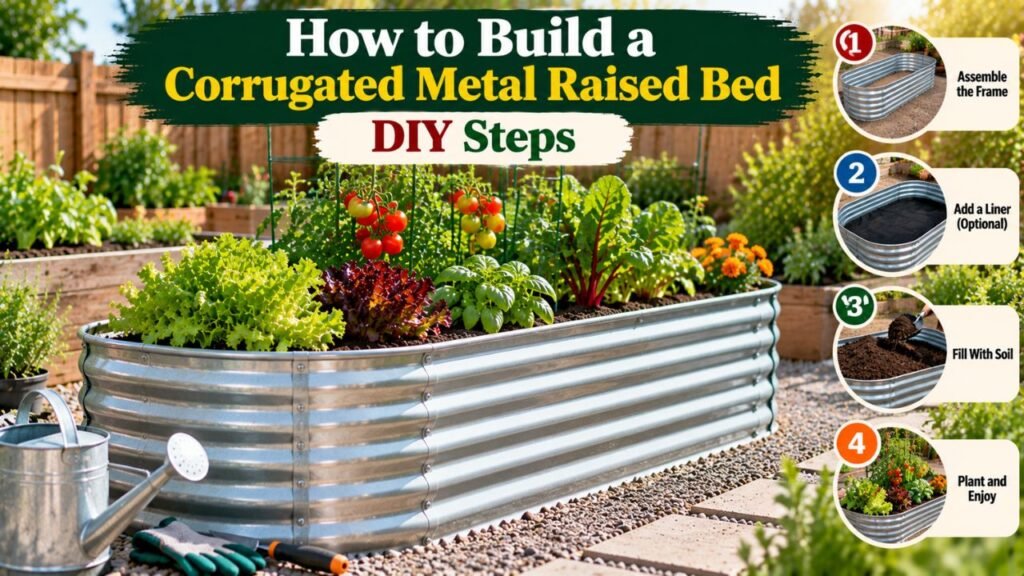
A typical corrugated metal raised bed consists of galvanized steel panels attached to a supporting frame.
The metal forms the walls that hold the growing medium, while wood or metal supports keep those walls from bending outward.
For most home DIY projects, a wooden frame with corrugated metal panels is relatively straightforward to assemble.
Materials for a 4×8 Corrugated Metal Raised Bed
The following materials are suitable for planning a conventional freestanding bed approximately 4 feet wide, 8 feet long, and around 2 feet tall.
| Material | Suggested Quantity | Purpose |
| Corrugated galvanized steel panels, approximately 26–27 inches wide and 8 feet long | 3 sheets | Side and end walls |
| Nominal 2×4 lumber | Approximately 11–12 eight-foot boards, depending on cuts | Top rails, bottom rails, and vertical supports |
| Exterior-rated wood screws | As required | Connecting the wooden frame |
| Suitable galvanized or corrosion-resistant fasteners with washers | As required | Attaching steel panels |
| Corner and intermediate supports | Included in framing lumber | Preventing wall movement |
| Top-edge trim or wood cap | Enough for the perimeter | Covering sharp edges |
| Optional galvanized hardware cloth | Enough for the bottom | Protecting against burrowing pests |
| Raised-bed growing mix | Based on finished dimensions | Filling the bed |
These are planning quantities, not a universal cutting list. The exact number of boards depends on the height, joint design, support spacing, and material purchased.
The Washington State University Extension’s corrugated galvanized raised-bed construction instructions describe both an anchored-post design and a freestanding wooden-frame design.
Its freestanding 4×8 design uses top and bottom 2×4 frames, vertical supports, and galvanized steel panels.
The guide also recommends vertical wall support at intervals no greater than approximately 4 feet for the light-gauge panels described in its design.
Tools Needed for Construction
Common tools include:
- Tape measure.
- Carpenter’s square.
- Level.
- Circular saw or miter saw for wood.
- Drill and driver.
- Metal-cutting shears or aviation snips.
- Drill bits suitable for the selected materials.
- Clamps.
- Metal file or deburring tool.
- Shovel and garden rake.
- Work gloves.
- Safety glasses.
- Appropriate hearing protection.
Cut-resistant gloves are especially important when handling sheet metal.
Freshly cut steel can have extremely sharp edges capable of causing serious cuts.
When using power tools, follow the equipment manufacturer’s instructions and keep the workpieces properly supported.
How to Choose Corrugated Metal Panels for a Raised Bed
The type of metal panel affects durability, construction methods, and long-term maintenance.
Not every corrugated roofing sheet is equally suitable for direct contact with garden soil.
Galvanized Steel Panels
Galvanized steel is one of the most practical materials for corrugated metal raised beds.
It consists of steel protected by a zinc-based coating that helps resist corrosion.
The coating protects the underlying steel from exposure to moisture and oxygen.
Corrugated galvanized panels are commonly available from roofing suppliers, hardware stores, and building-material retailers.
For a raised bed, choose new, undamaged panels with a clearly identified coating.
Avoid heavily rusted sheets or reclaimed industrial panels with unknown coatings or contamination.
What Gauge Metal Is Best for Raised Garden Beds?
Sheet metal gauge describes thickness.
For steel, lower gauge numbers generally indicate thicker material.
Common options include:
| Steel Gauge | General Characteristics | Raised Bed Considerations |
| 22 gauge | Relatively thick and rigid | Useful for stronger designs but heavier and harder to cut |
| 24 gauge | Sturdy sheet metal | Suitable for many reinforced structures |
| 26 gauge | Moderate thickness | Common option for DIY raised-bed walls |
| 28 gauge | Lightweight | Requires appropriate structural support |
| 30 gauge | Thin and flexible | Needs frequent supports and suitable framing |
The appropriate thickness depends on the panel profile, wall height, and distance between supports.
A well-braced thinner sheet may perform adequately, while a thicker unsupported sheet may still deform under substantial soil pressure.
Washington State University Extension’s construction guide discusses 30-gauge panels with vertical supports spaced no more than approximately 4 feet apart.
That recommendation applies to its described construction, not every sheet profile or raised-bed design.
For a DIY project, choose the panel gauge together with the frame design rather than selecting thickness alone.
Corrugated Steel vs. Flat Metal Sheets
Corrugated panels have repeating ridges or grooves formed into the metal.
These corrugations help stiffen the sheet compared with flat steel of similar thickness, although the amount of stiffness depends on the profile and direction of loading.
Flat metal sheets may require additional reinforcement.
Corrugated steel is often easier to incorporate into a lightweight raised-bed frame because the formed profile adds rigidity.
However, corrugation does not eliminate the need for strong corners, rails, and intermediate supports.
Are Galvanized Metal Panels Safe for Vegetables?
Modern galvanized steel is generally considered suitable for raised vegetable beds when the materials are appropriate and the growing conditions are managed properly.
The University of Minnesota Extension’s raised-bed gardening guidance explains that galvanized steel is commonly used for raised beds.
It also notes that zinc from the coating may enter soil more readily under highly acidic conditions, particularly when soil pH is below 5.
For ordinary vegetable-growing soil, galvanized steel is generally considered a reasonable material choice.
However, material quality matters.
The same university guidance warns that some prefabricated metal raised beds have been found to contain lead.
Choose products from reliable suppliers that can provide information about the metal and coating.
Avoid using unknown painted, contaminated, or badly deteriorated metal sheets for food-growing beds.
What Size Should a Corrugated Metal Raised Garden Bed Be?
The best dimensions depend on available space, gardening access, plant requirements, and the amount of soil you’re prepared to purchase.
A bed that is too wide can be difficult to maintain without stepping on the soil.
A bed that is too tall may require additional framing and a considerable amount of growing medium.
Recommended Raised Bed Dimensions
| Bed Size | Suitable Application |
| 3×3 feet | Small vegetable or herb garden |
| 3×6 feet | Compact backyard garden |
| 4×4 feet | Square planting layout |
| 4×8 feet | General-purpose vegetable garden |
| 4×10 feet | Larger garden with proper wall reinforcement |
| 4×12 feet | Long planting area requiring additional supports |
These dimensions describe typical layouts rather than fixed construction standards.
For many gardeners, a width of approximately 3–4 feet is practical when both sides are accessible.
If the bed can only be reached from one side, a narrower structure may be more comfortable.
How Tall Should a Corrugated Metal Raised Bed Be?
Corrugated metal raised beds can be constructed at different heights.
Common options include:
- 12 inches: Useful for a relatively shallow bed over suitable native soil.
- 16–18 inches: A practical compromise between soil depth and material cost.
- 24 inches: Provides a taller planting area and requires stronger support.
- 26–27 inches: May allow the use of certain full-width corrugated panels without trimming their height.
A taller bed can reduce bending during garden work.
However, it also increases the volume and weight of the soil.
For an open-bottom bed, plant roots may extend into the native soil below.
A raised bed with a solid bottom must provide adequate growing depth within the container itself.
How to Build a Corrugated Metal Raised Garden Bed Step by Step
The following process describes a reinforced wood-frame construction using galvanized corrugated panels.
It is suitable as a general approach for a 4×8 raised garden bed installed on reasonably level ground.
Exact framing dimensions and fastener specifications should be adapted to the selected panel system and construction plan.
Step 1: Select and Prepare the Garden Location
Choose a location that receives adequate sunlight for the vegetables you want to grow.
Tomatoes, peppers, cucumbers, and many other fruiting vegetables generally perform best with at least 6–8 hours of direct sunlight each day.
The site should also have:
- Good drainage.
- Convenient access to water.
- Space for walking around the bed.
- Stable ground.
- Limited competition from nearby tree roots.
- Enough clearance for tools and garden maintenance.
Mark the bed’s outline using stakes and string.
Check the ground with a level.
Remove large rocks, unwanted vegetation, and debris from the immediate construction area.
If the ground slopes, prepare a stable, properly leveled foundation rather than forcing the frame into an uneven position.
Avoid installing a heavy raised bed over buried utility lines or areas that require underground maintenance access.
Step 2: Decide Between an Anchored and Freestanding Frame
There are two common ways to support a corrugated metal raised bed.
Anchored-post construction uses vertical posts installed into the ground, with the steel panels fastened to the posts.
This approach can be useful for larger or taller beds where the posts provide structural support.
Freestanding construction uses a complete rectangular frame with upper and lower rails connected by vertical members.
The structure rests on the prepared ground without relying on deeply embedded corner posts.
For a typical level backyard, a properly reinforced freestanding frame may be convenient because it can be assembled before positioning.
However, tall walls and difficult ground conditions may require additional anchoring or a more substantial design.
Step 3: Cut the Wooden Frame Components
For a common 4×8 freestanding design, the frame consists of:
- Two long upper and lower side rails.
- Two shorter upper and lower end rails.
- Vertical corner supports.
- Intermediate sidewall supports.
- Additional supports where required by the design.
Using nominal 2×4 lumber is one practical approach.
Remember that a standard surfaced 2×4 actually measures approximately 1½ inches by 3½ inches.
If the frame must have an outside width of exactly 48 inches and the shorter end rails fit between two full-length side rails, the end rails may need to be cut to approximately 45 inches.
However, other corner-joint arrangements produce different cutting lengths.
Determine the connection method before cutting.
Use a carpenter’s square to mark straight cuts and inspect the wood for cracks or other structural defects.
Step 4: Assemble the Bottom Frame
Arrange the bottom rails into a rectangle on a level working surface.
Connect the corners using appropriate exterior-rated fasteners.
Check that the frame is square.
One useful method is to measure diagonally from one corner to the opposite corner.
For a correctly sized rectangle, the two diagonal measurements should be equal.
If the measurements differ, adjust the frame before tightening the connections completely.
A square bottom frame makes it easier to position the vertical supports and upper rails accurately.
Step 5: Install Corner and Intermediate Supports
Attach vertical framing members to the bottom rectangle.
Place supports at the corners and along the long sides.
For the light-gauge corrugated steel construction described earlier, supports at intervals of no more than approximately 4 feet provide a useful starting point.
For an 8-foot side, this commonly means supports at both ends and near the middle.
Additional vertical members may be useful depending on the height and frame design.
Secure the supports using suitable structural connections.
Do not rely on thin metal panels to keep a poorly connected wooden frame upright.
Important: A tall raised bed filled with moist soil creates substantial outward pressure on the walls. Frame strength must account for that pressure.
Step 6: Attach the Upper Frame
Build an upper rectangular frame using the same basic outside dimensions as the bottom frame.
Place it over the vertical supports.
Check alignment and level before securing it.
The upper frame connects the vertical members and helps distribute loads around the structure.
Use suitable exterior-rated fasteners to connect the rails to the supports.
Once assembled, the wood frame should remain rigid without depending on the metal sheets for its basic stability.
Inspect the corners for movement and correct any loose connections.
Step 7: Measure and Cut the Corrugated Metal Panels
Measure the openings inside the completed frame.
Do not rely only on the original bed dimensions because the wood framing occupies some space.
For a common 4×8 design using approximately 8-foot corrugated panels:
- Two full-length panels may form the long sidewalls.
- A third panel may be cut into shorter sections for the end walls.
The actual cuts depend on the framing arrangement and panel overlap.
If the available panels are wider than the desired wall height, they can be trimmed to fit the selected design.
How to Cut Corrugated Metal Safely
Place the sheet on stable supports.
Mark the cutting line with a straightedge or suitable marking tool.
Use aviation snips or metal shears rated for the panel material and thickness.
For longer or heavier cuts, use a suitable manufacturer-recommended cutting tool.
Wear eye protection and cut-resistant gloves.
Avoid using cutting methods that produce excessive heat or damage protective coatings when the panel manufacturer advises against them.
After cutting, remove sharp burrs using an appropriate deburring tool or file.
Never leave freshly cut sheet-metal edges exposed where people may touch them.
Step 8: Attach the Metal Panels to the Frame
Position the cut steel panels against the designated mounting surfaces.
For a design with metal panels inside the wood frame, place the sheets against the interior supports.
This arrangement allows the wood frame to support the panels from outside as soil pushes against them.
Begin by fastening one long side.
Use the mounting hardware specified for the selected design, such as appropriate galvanized screws or lag screws with suitable washers.
Depending on the hardware, pilot holes may be required.
Keep fasteners properly aligned and use washers that distribute the clamping force across the thin metal.
Avoid overtightening screws because excessive pressure can distort the sheet or damage sealing washers.
Continue attaching the remaining panels.
Check for large gaps, loose edges, or areas that lack support.
If a wall requires multiple pieces of metal, use an appropriate overlap or joint detail consistent with the design.
Step 9: Reinforce the Long Sidewalls
Once the metal panels are installed, inspect the long walls.
A large volume of moist soil can push outward against the steel.
Intermediate supports help reduce unsupported spans, but some taller or longer designs may also require cross ties.
A cross tie connects opposing sides and helps resist outward movement.
The correct bracing arrangement depends on wall height, panel thickness, and frame construction.
Do not add an arbitrary thin wire or weak strip of wood and assume it will restrain the walls.
Use suitable structural connections and materials.
For unusually tall beds or complex designs, obtain a proven construction plan or qualified structural guidance.
Step 10: Cover the Sharp Metal Edges
A protective top edge is one of the most important finishing details.
Corrugated steel can have sharp edges even when the sheets have been deburred.
Suitable protection may include:
- A properly fitted wood cap.
- Metal edge trim designed for the panel profile.
- Suitable manufactured protective edging.
- A top rail that completely covers the steel edge.
For a wood-framed bed, a top cap can also provide a convenient place to rest small gardening tools.
Make sure the cap is securely attached.
Avoid relying on loose trim that could detach when someone leans on the bed or works nearby.
The finished top edge should not expose sharp corners or protruding fasteners.
Step 11: Prepare the Bottom of the Bed
For a traditional raised bed installed directly on garden ground, an open bottom is usually appropriate.
This allows water to move into suitable underlying soil and gives plant roots access to additional growing depth.
Remove persistent weeds and consider loosening compacted soil beneath the frame.
A single layer of plain, uncoated cardboard can be used for temporary weed suppression when appropriate.
Avoid creating a thick, impermeable barrier.
If burrowing animals are a concern, a suitable galvanized hardware-cloth barrier may be installed across the bottom.
Use mesh rather than a solid sheet so water and roots can pass through.
For a raised bed installed on concrete, drainage and root depth require a different design.
A bottomless frame placed directly on pavement needs a planned drainage pathway that prevents prolonged water accumulation.
Step 12: Fill the Metal Raised Bed With Soil
After confirming that the frame is stable, begin filling the bed.
Choose a quality growing medium that provides suitable drainage, structure, and nutrients.
For many open-bottom raised vegetable beds, a mixture of suitable topsoil and finished compost is practical.
Avoid filling the entire structure with pure compost or compacted clay soil.
Add the growing medium gradually and distribute it evenly across the bed.
Check the walls during filling for signs of bowing or movement.
Stop and correct structural problems if the frame begins to deform.
Leave approximately 1–2 inches below the upper rim when practical to provide space for watering and mulch.
Water the soil to settle it naturally, then add more growing medium if necessary.
Step 13: Install Irrigation and Begin Planting
Once the soil has settled, prepare the planting area.
Drip irrigation or soaker hoses can be useful for delivering water near the roots.
Choose crops according to the available sunlight and growing depth.
Possible vegetables include:
- Lettuce.
- Spinach.
- Radishes.
- Carrots.
- Peppers.
- Tomatoes.
- Bush beans.
- Herbs.
Larger plants may require additional rooting space, trellises, or supports.
Avoid attaching heavy trellises directly to thin steel walls unless the frame is designed to carry the additional loads.
How Much Soil Does a Corrugated Metal Raised Bed Need?
The amount of soil depends on the bed’s actual interior dimensions and planned filling depth.
A taller metal bed can require considerably more growing medium than a low wooden bed.
Raised Bed Soil Calculation
Use the formula:
Length × Width × Soil Depth = Soil Volume
Convert all measurements to feet before calculating cubic feet.
For a rectangular bed with a full 4-by-8-foot interior planting area:
4 × 8 = 32 square feet
Multiply that area by the intended soil depth.
Soil Volume for a 4×8 Metal Raised Bed
| Soil Depth | Cubic Feet | Cubic Yards |
| 8 inches | 21.3 | 0.79 |
| 12 inches | 32 | 1.19 |
| 16 inches | 42.7 | 1.58 |
| 18 inches | 48 | 1.78 |
| 24 inches | 64 | 2.37 |
These calculations assume a full 4×8 interior area.
Actual soil requirements may be slightly lower when the frame, corner posts, and other components reduce the usable interior dimensions.
For example, a 4×8 bed filled 12 inches deep requires approximately 32 cubic feet of soil.
That equals sixteen 2-cubic-foot bags before accounting for settling.
Can You Fill the Bottom With Organic Materials?
For a tall, open-bottom bed, some gardeners use clean organic materials below the primary planting layer to reduce purchased soil volume.
Possible materials include:
- Untreated logs.
- Clean branches.
- Shredded leaves.
- Partially decomposed organic matter.
However, these materials gradually break down and may cause settling.
Keep sufficient finished growing medium above the coarse materials to support vegetable roots.
For shallow raised beds, preserving usable rooting depth is usually more important than saving a small amount of soil.
How to Prevent Corrugated Metal Raised Beds From Bowing
One of the most common construction problems is outward wall movement after the bed is filled.
Corrugated sheets are relatively thin compared with solid wooden or concrete walls.
Their ability to resist soil pressure depends heavily on the supporting structure.
Use Intermediate Vertical Supports
Long unsupported metal panels are more likely to deform.
Place suitable supports along the walls according to the panel thickness and construction design.
For many common DIY configurations, an intermediate support near the center of an 8-foot wall is a practical starting point.
Taller beds may require additional reinforcement.
Secure the Corners Properly
Corners transfer loads between adjoining walls.
If the connections are weak, the frame may begin separating as the soil presses outward.
Use appropriate corner supports and structural fasteners.
Check that every wall is attached securely to the adjoining frame members.
Add Cross Bracing When Required
Some raised-bed designs benefit from a cross tie connecting opposite long walls.
This helps resist the outward pressure of the growing medium.
The tie must be strong enough for the intended load and properly connected to the structure.
Cross bracing should be planned before filling the bed whenever possible.
Avoid Overfilling Weak Frames
Do not fill a lightly constructed frame beyond its intended design height.
A deeper soil layer produces more pressure against the lower walls.
Adding more soil can also increase settlement and expose weaknesses in the connections.
If the walls begin to bow noticeably, stop filling and correct the support system.
Do Corrugated Metal Raised Beds Need a Liner?
A liner is optional for many properly constructed galvanized metal raised beds.
However, certain designs may benefit from a suitable barrier between the soil and supporting materials.
When a Sidewall Liner May Help
A sidewall liner can help keep soil from contacting wood framing or leaking through small gaps.
It may also provide some separation between the growing medium and metal surfaces.
Possible materials include suitable heavy-duty liners or landscape fabrics designed for the intended use.
However, a liner should not be treated as a guaranteed solution to contaminated or unsuitable metal.
If the steel has an unknown coating or potentially hazardous history, choose a different material.
Should You Line the Bottom With Plastic?
An impermeable plastic bottom is generally inappropriate for an ordinary open-bottom raised bed on garden ground.
It can prevent water from draining and restrict roots from entering the underlying soil.
If a liner is needed for a particular construction design, it must work with the intended drainage system.
A raised bed built as an enclosed planter requires appropriately designed drainage openings.
Do not confuse a moisture barrier along the sidewalls with a waterproof container bottom.
How to Prevent Rust on Corrugated Metal Raised Beds
Galvanized steel resists corrosion because its zinc-based coating protects the underlying metal.
However, that protection can deteriorate over time.
Protect Exposed Cut Edges
Cutting corrugated steel may expose uncoated portions of the underlying steel.
After cutting, remove burrs and inspect the edges.
Use suitable corrosion protection where recommended by the metal manufacturer.
The correct treatment depends on the panel’s original coating.
Avoid applying unknown paints or industrial coatings to surfaces that will contact vegetable-growing soil.
Use Compatible Fasteners
Fasteners exposed to outdoor moisture should provide suitable corrosion resistance.
Galvanized or appropriately selected stainless steel fasteners may be used when compatible with the panel and support materials.
However, dissimilar metals can sometimes contribute to galvanic corrosion when moisture is present.
Follow the panel and fastener manufacturers’ compatibility recommendations.
Avoid ordinary unprotected steel screws that may deteriorate quickly outdoors.
Prevent Water From Remaining Trapped
Inspect areas where panels overlap or contact the frame.
Trapped moisture and debris may accelerate corrosion.
Allow water to drain from the construction where appropriate.
Avoid designs that create constantly wet pockets around the metal and fasteners.
Avoid Severely Acidic Soil
Highly acidic soil can increase zinc coating deterioration.
Most common vegetable crops do not require extremely acidic growing conditions.
If the intended crops require unusually low soil pH, choose materials appropriate for those conditions.
Blueberries, for example, generally require more acidic soil than many common vegetables, so a different raised-bed wall material may be preferable.
Will Corrugated Metal Raised Beds Get Too Hot?
Corrugated metal can become hot when exposed to direct sunlight, especially during summer.
However, metal surface temperature and the temperature of the entire soil mass are not the same.
How Metal Affects Soil Temperature
Steel transfers heat efficiently.
During direct sunlight, the exposed metal surface can warm quickly.
Some of that heat may transfer into the soil near the sidewalls.
However, moisture content, soil volume, mulch, and surrounding air temperature all affect how much the main root zone warms.
A large raised bed containing substantial moist soil does not necessarily reach the same temperature as its metal surface.
How to Reduce Excess Heat
In hot climates, consider:
- Keeping soil evenly moist.
- Applying appropriate organic mulch.
- Using drip irrigation.
- Avoiding extremely narrow raised beds that expose more soil to heated sidewalls.
- Choosing a location that provides suitable conditions for the intended crops.
- Monitoring young plants near sun-exposed metal walls.
Light-colored exterior finishes may reduce solar absorption in some designs, but coating suitability and manufacturer instructions must be considered.
Do not apply unknown coatings to surfaces contacting edible-crop soil.
Do Metal Raised Beds Need More Water?
They may need more frequent watering under some conditions.
However, watering demand depends on the bed’s height, soil composition, weather, crop type, and drainage.
Raised beds generally have less access to surrounding soil moisture than unrestricted in-ground gardens, especially when they are tall or enclosed.
Check moisture below the surface before watering.
Do not assume that all corrugated metal beds require daily irrigation.
Corrugated Metal vs. Wood Raised Garden Beds
Both metal and wooden raised beds can support productive gardens.
The better material depends on cost, durability, design preferences, and construction requirements.
| Feature | Corrugated Metal Raised Bed | Wooden Raised Bed |
| Main wall material | Galvanized steel sheets | Lumber or timber |
| Structural support | Often needs frame or braces | Boards and corner supports |
| Resistance to rot | Steel does not rot like wood | Wood may decay |
| Corrosion concerns | Possible if coating deteriorates | Fasteners may corrode |
| Cutting | Requires metal-cutting tools | Usually easier with woodworking tools |
| Sharp edges | Require careful protection | Splinters and sharp corners possible |
| Heat transfer | Metal conducts heat efficiently | Wood conducts heat less readily |
| Appearance | Industrial or modern | Natural or traditional |
| Repairs | Panel or fastener replacement | Board or post replacement |
| Initial cost | Depends on steel and framing | Depends on lumber species and quality |
Is Corrugated Metal More Durable Than Wood?
Galvanized steel can last longer than some untreated wood products under suitable conditions.
However, its actual durability depends on coating quality, corrosion exposure, and construction.
A poorly supported metal bed may fail structurally even when the panels remain free from serious rust.
Likewise, a well-constructed cedar bed may provide many years of service.
The entire raised-bed assembly determines durability, not just the wall material.
Is Corrugated Metal Cheaper Than Wood?
Not necessarily.
Corrugated metal panels can be relatively economical, but the project may still require substantial lumber for framing.
Other expenses include:
- Metal fasteners.
- Wood screws.
- Edge protection.
- Bracing.
- Cutting equipment.
- Growing medium.
- Delivery charges.
Compare complete project costs rather than only the price of the panels.
A metal bed that requires a large wooden frame may cost more than a simple low wooden raised bed.
Common Mistakes When Building Corrugated Metal Raised Beds
Several construction errors can reduce the bed’s safety or service life.
Using Metal Sheets Without Adequate Support
Thin roofing panels are not automatically strong enough to hold substantial amounts of soil independently.
Without framing or bracing, the walls may bow or separate.
Use a proven support arrangement appropriate for the wall height and panel thickness.
Leaving Sharp Metal Edges Exposed
Cut corrugated steel can cause serious injuries.
A sharp upper rim is particularly hazardous because gardeners frequently lean over the bed while planting and harvesting.
Deburr cut edges and install secure protective trim.
Choosing Reclaimed Metal With Unknown Coatings
Old roofing materials may contain paint, chemical residues, or coatings that are difficult to identify.
Avoid questionable reclaimed metal for vegetable-growing structures.
New, properly identified galvanized panels from a reputable supplier are generally easier to assess.
Making the Bed Too Wide
A bed wider than your comfortable reach may require stepping on the planting surface.
Repeated foot traffic can compact the growing medium.
For many home gardens, a width of approximately 3–4 feet allows convenient access from both sides.
Failing to Level the Frame
A frame installed on uneven ground may develop gaps, twisting, or uneven soil pressure.
Level the supporting area before filling.
On slopes, use an appropriate anchored or terraced design.
Do not rely on loose blocks or unstable shims to support a heavy raised bed.
Ignoring Soil Weight
Moist soil is heavy.
A 4×8 raised bed filled deeply with soil can place substantial loads on its walls and supporting ground.
If the bed is installed on a deck, rooftop, or elevated structure, verify the structural load capacity before construction.
Do not assume that a surface suitable for walking can safely support a large filled garden bed.
Forgetting Drainage
Corrugated metal walls do not eliminate the need for drainage.
A bed placed over impermeable pavement or poorly draining ground can still experience excessive moisture.
Plan the drainage pathway before building.
Avoid sealing the entire bottom of an ordinary raised bed with solid plastic unless it is part of a specifically designed drainage system.
How to Maintain a Corrugated Metal Raised Garden Bed
Regular inspection can help identify problems before they affect the growing area.
Inspect the Metal Panels
Check the sheets for corrosion, deformation, loose edges, or significant damage.
Pay particular attention to:
- Cut edges.
- Fastener holes.
- Panel overlaps.
- Corners.
- Areas where water collects.
Correct minor problems promptly when an appropriate repair is possible.
Replace badly deteriorated panels rather than relying on temporary patches that may not support soil pressure.
Check Fasteners and Supports
Inspect the wood frame and mechanical connections periodically.
Look for:
- Loose screws.
- Cracked framing lumber.
- Rotting corner posts.
- Bowing walls.
- Detached trim.
- Damaged cross braces.
Replace or repair components using suitable materials.
If significant structural movement occurs, remove enough soil to make the structure safe before attempting repairs.
Maintain the Growing Medium
Raised-bed soil may settle as organic matter decomposes.
Add suitable soil or finished compost when needed.
Avoid repeatedly adding large amounts of compost without considering soil nutrient levels.
A periodic soil test can help determine whether fertilizer or pH adjustments are necessary.
Monitor Moisture During Hot Weather
Check soil moisture during dry periods, particularly when the bed is exposed to strong sunlight.
Use mulch when appropriate to reduce surface moisture loss.
Avoid allowing the soil to remain continuously saturated.
The goal is to maintain suitable moisture throughout the root zone rather than following a rigid watering schedule.
Conclusion
Learning how to build a corrugated metal raised garden bed begins with selecting suitable galvanized steel panels and designing a frame strong enough to support the growing medium.
For a typical DIY vegetable garden, a 4×8 structure with a reinforced wooden frame, properly attached corrugated panels, and protected top edges provides a practical starting point.
Pay particular attention to frame stability, fastener compatibility, sharp-edge protection, and drainage.
New galvanized steel is generally suitable for ordinary vegetable-growing conditions, but product quality and soil acidity still matter.
Once the structure is assembled, fill it with appropriate raised-bed soil and monitor the walls as the material settles.
A carefully built and maintained corrugated metal raised bed can provide an attractive, durable growing area while avoiding many of the decay problems associated with untreated wooden walls.
FAQs About How to Build a Corrugated Metal Raised Garden Bed
Can You Build a Corrugated Metal Raised Bed Without Wood?
Yes. Corrugated metal raised beds can be constructed without wood when the design uses suitable metal corner connectors, braces, and structural supports.
However, thin metal panels still need adequate reinforcement.
A purpose-built metal raised-bed kit may be more practical than attempting to create an unsupported structure from ordinary roofing sheets.
What Gauge Corrugated Metal Is Best for Raised Beds?
The best gauge depends on the wall height, panel profile, and support spacing.
Galvanized steel in approximately the 24–30-gauge range may be used in different supported designs.
Thinner panels generally need more structural support, while thicker panels may be heavier and more difficult to cut.
Follow a construction plan appropriate for the selected material.
Do Corrugated Metal Raised Beds Need a Bottom?
Traditional corrugated metal raised beds installed directly on garden ground usually do not need a solid bottom.
An open-bottom design allows drainage into suitable underlying soil and permits roots to grow below the frame.
For beds installed on concrete or elevated platforms, use an appropriate container design with planned drainage.
How Long Do Corrugated Metal Raised Beds Last?
Their lifespan depends on the galvanized coating, panel thickness, moisture conditions, soil chemistry, and structural design.
Quality galvanized steel can remain serviceable for many years, but corrosion, damaged fasteners, and weak framing can shorten the useful life.
Regular inspection and maintenance help prevent premature deterioration.
Can You Use Corrugated Roofing Metal for Vegetable Beds?
Yes, new corrugated galvanized roofing panels can be suitable for vegetable raised beds when their coating and construction are appropriate.
Avoid old or reclaimed roofing sheets with unknown paint, chemical treatments, or contamination.
Choose a reputable supplier and protect all exposed cut edges.
Should Corrugated Metal Go Inside or Outside the Wood Frame?
Either arrangement may be possible depending on the design.
Installing the panels inside the supporting frame allows the wood structure to resist outward soil pressure, which is a common approach in reinforced raised-bed construction.
If the metal is installed outside the frame, the connection and support details must be designed appropriately.
Follow the selected construction plan rather than treating the two arrangements as structurally identical.
Do You Need to Paint Corrugated Metal Raised Beds?
No. New galvanized steel already has a protective coating intended to resist corrosion.
Painting may be optional for appearance, but any additional coating should be compatible with the metal and appropriate for the intended application.
Avoid using unknown paints on surfaces that may contact vegetable-growing soil.
Can You Build a Corrugated Metal Raised Bed on Concrete?
Yes, but the bed must have adequate drainage and enough growing-medium depth for the intended crops.
Because roots cannot extend into the ground beneath the structure, the design behaves more like a large planter.
Make sure water can leave the growing area without damaging surrounding surfaces, and verify structural capacity if the concrete is elevated.

I’m Maya L. Greenwood, a lifelong plant lover who believes anyone can grow something beautiful with the right guidance. After years of testing soil mixes, pruning methods, irrigation tricks, and pest-safe solutions, I started EasyGardenTips.com to turn hard-won lessons into step-by-step advice. From seed starting and container gardens to composting and seasonal checklists, my goal is to make gardening simple, sustainable, and fun.