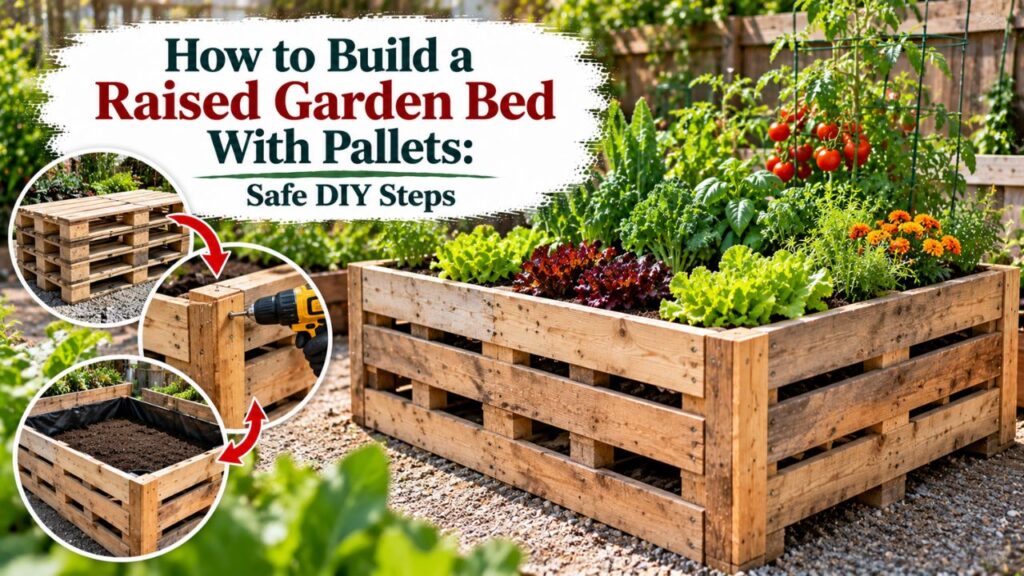
How to Build a Raised Garden Bed With Pallets: Safe DIY Steps
To build a raised garden bed with pallets, select clean, heat-treated wooden pallets, remove the usable boards, cut them to size, and assemble a rectangular frame with reinforced corners. Position the frame on prepared ground, fill it with suitable topsoil and compost, and water the soil before planting vegetables, herbs, or flowers.
Reusing pallet wood can reduce the cost of building a raised bed, especially when suitable pallets are available at little or no cost. However, shipping pallets are not manufactured specifically for gardening. Some may have been chemically treated, exposed to spills, or weakened during transportation.
Choosing the right pallets is therefore just as important as assembling a sturdy frame. The boards also need enough support to resist pressure from the soil, particularly when building a taller bed.
A simple pallet raised bed can be a manageable DIY project with basic woodworking tools.
In this article, I explain how to identify suitable pallets, gather materials, dismantle and cut the boards, assemble a stable raised bed, and prepare the soil for planting. I also cover alternative pallet designs, soil quantities, durability, and mistakes that can affect safety and long-term performance.
How to Choose Safe Pallets for a Raised Garden Bed
Not every wooden pallet is suitable for a vegetable garden.
Pallets are primarily designed to transport and store products, so their treatment and previous use must be considered before bringing them into contact with garden soil.
Look for Heat-Treated Pallets Marked HT
For an edible garden, the preferred option is a clean wooden pallet with a verifiable HT marking and a known, suitable history.
HT stands for heat-treated. It indicates that the wood received heat treatment for pest control rather than methyl bromide fumigation under the relevant pallet treatment system.
The University of California Agriculture and Natural Resources guidance on choosing pallets for raised beds recommends prioritizing heat-treated pallets and avoiding pallets with uncertain treatment or contamination histories.
Pallet markings may include the International Plant Protection Convention (IPPC) symbol, a country code, a manufacturer identification number, and a treatment designation.
Common markings include:
| Pallet Marking | Meaning | Gardening Recommendation |
| HT | Heat treated | Preferred if clean and its history is suitable |
| MB | Methyl bromide fumigation | Avoid for edible gardens |
| DB | Debarked | Does not establish chemical-treatment safety |
| KD | Kiln dried | Does not alone prove the pallet is chemically untreated |
| Unmarked | Treatment information unavailable | Avoid unless its origin and treatment are verified |
A pallet can display more than one marking.
For example, a pallet marked HT and DB has been heat-treated and debarked.
Important: An HT stamp describes a pest-control treatment. It does not guarantee that the pallet was never exposed to chemicals, spills, or contaminated products during transportation.
Avoid Pallets With Unknown Cargo Histories
Even a heat-treated pallet may be unsuitable if it previously transported chemicals or hazardous products.
Before using pallet wood, inspect it for:
- Oil or chemical stains
- Unusual odors
- Sticky residues
- Unknown powders
- Strongly colored coatings
- Signs of chemical spills
- Rotten or heavily damaged wood
Avoid painted pallets when the coating composition is unknown.
Pallets used for transporting food products may be easier to evaluate when their storage and handling history is documented, but the type of cargo alone is not proof of cleanliness.
Do not use an unidentified pallet simply because it looks new.
If its treatment or previous use cannot be verified, purchase suitable untreated lumber instead.
Inspect Pallet Boards for Structural Damage
Safety also depends on the condition of the wood.
Check each pallet for cracked boards, loose nails, rot, and insect damage.
Choose boards that are reasonably straight and strong enough to hold soil inside a frame.
Small surface imperfections may be acceptable, but severely split or weakened boards should be discarded.
Pallet wood is often thinner than standard construction lumber, so additional bracing may be necessary to prevent the sides from bowing outward.
Materials and Tools Needed to Build a Pallet Raised Bed
The materials depend on the size and height of the raised garden bed.
For a beginner-friendly project, consider a rectangular bed with an approximate outside footprint of 3 feet by 4 feet and walls around 10–12 inches high.
The exact height will depend on the width of the salvaged boards.
Materials for a 3×4 Pallet Raised Bed
| Material | Approximate Quantity | Purpose |
| Suitable wooden pallets | 2–4, depending on usable boards | Side walls |
| Sturdy corner posts | 4 | Connect and support the corners |
| Additional support posts | 2 or more | Reinforce longer sides |
| Exterior-rated wood screws | As required | Secure boards and braces |
| Permeable landscape fabric | Optional | Retain soil through wider side gaps |
| Quality topsoil | Based on bed volume | Main growing medium |
| Finished compost | Based on bed volume | Organic matter and nutrients |
The number of pallets depends on their dimensions, the number of usable boards, and how many boards survive dismantling.
For the posts, sound untreated lumber with a cross section around 2×2 inches or larger can provide useful support. Select stronger material if the salvaged boards are particularly thin or the bed is taller.
Tools Required
Gather the following tools before beginning:
- Measuring tape
- Carpenter’s square
- Hand saw or suitable power saw
- Drill and driver
- Drill bits for pilot holes
- Pry bar or pallet dismantling tool
- Hammer and nail puller
- Clamps
- Spirit level
- Sandpaper or sanding block
- Work gloves
- Safety glasses
- Hearing protection when using power tools
- Appropriate dust protection when cutting or sanding wood
A reciprocating saw with a suitable metal-cutting blade can help separate pallet boards by cutting through some of the existing nails.
However, all remaining metal must still be located and removed or made safe before cutting and assembling the wood.
How to Build a Raised Garden Bed With Pallets: Step-by-Step
The following method uses dismantled pallet boards to create a conventional open-bottom raised garden bed.
This design is generally more practical for growing vegetables than standing four intact shipping pallets upright and filling the enclosure with soil.
Step 1: Choose the Location and Mark the Raised Bed
Select a location that receives enough sunlight for the plants you intend to grow.
Most fruiting vegetables, including tomatoes and peppers, prefer approximately 6–8 hours of direct sunlight per day.
The site should also have reasonable drainage and easy access to water.
For a 3×4 raised bed:
- Measure a rectangular area approximately 36 inches wide and 48 inches long.
- Mark the corners using stakes or a garden hose.
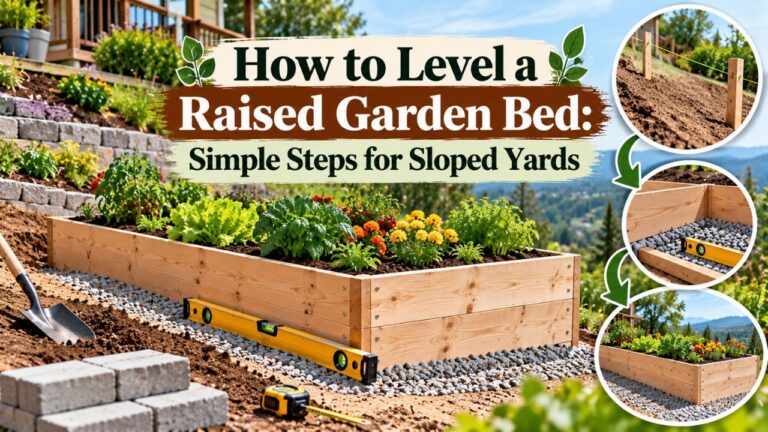
- Check that the ground is reasonably level.
- Leave enough room around the bed for planting and harvesting.
- Confirm that nearby trees, fences, or buildings will not block necessary sunlight.
For comfortable maintenance, approximately 24–36 inches of walkway space is useful where the layout permits.
Build the bed near its final position because moving it becomes more difficult after filling.
Step 2: Dismantle the Wooden Pallets
Place each approved pallet on a stable working surface.
Use a pallet dismantling tool or pry bar to separate the deck boards from the supporting blocks or stringers.
Work gradually to avoid splitting the wood.
If nails are difficult to remove, a suitable reciprocating saw may help cut the fasteners between the boards and supports.
After dismantling:
- Remove exposed nails and screws.
- Inspect both sides of every board.
- Discard boards that split excessively.
- Separate the straightest boards for the side walls.
- Save suitable thicker pieces for reinforcement.
Safety Note: Never run a saw blade through pallet wood until you have checked for hidden nails and other metal fasteners. Wear eye protection and secure the workpiece before cutting.
Step 3: Measure and Cut the Pallet Boards
Decide on the final outside dimensions of the frame.
For an example bed measuring 48 inches long by 36 inches wide, arrange the boards into two long walls and two short walls.
If the long boards overlap the ends of the shorter boards, the shorter pieces must account for the thickness of the long wall boards.
For example, when using boards approximately ¾ inch thick:
36 − (0.75 × 2) = 34.5 inches
In that arrangement, each long board measures 48 inches, while each short board measures approximately 34.5 inches.
Adjust these measurements according to your actual material thickness and corner construction.
The number of boards required depends on their widths.
For example, three courses of boards each measuring approximately 3.5 inches wide create a wall around 10.5 inches high before accounting for any gaps.
If the available boards are narrower, additional courses may be necessary.
After cutting, sand rough edges and remove splinters.
Step 4: Prepare the Corner Posts and Braces
The corner posts connect the walls and help prevent the boards from separating under soil pressure.
Cut four sturdy posts to match the intended wall height.
These posts will sit against the inside corners of the raised bed.
For longer walls, prepare additional vertical supports.
A center brace on each 48-inch wall can reduce outward bowing, particularly when using thinner pallet slats.
Use sound, straight lumber for the supports.
Pre-drill holes where appropriate to reduce splitting, especially near the ends of older boards.
Step 5: Assemble the Two Long Side Panels
Lay the pallet boards for the first long wall on a flat work surface.
Arrange them horizontally, with their ends aligned.
Position the corner posts behind the boards.
Fasten each board to the posts using suitable exterior-rated screws.
Use enough fasteners to secure every board firmly. Two screws near each supported board end are often practical when board width and post dimensions allow.
Repeat the process to build the opposite long wall.
Add a central support post to each long wall when needed.
Avoid leaving large gaps that allow growing soil to escape.
Small gaps are generally manageable, particularly if the inside walls will later be lined with suitable permeable fabric.
Step 6: Attach the Short Walls and Reinforce the Corners
Stand the two long side panels upright.
Connect them using the shorter pallet boards.
Position the boards against the corner posts and secure them with exterior-rated screws.
Check that the walls meet at approximately right angles.
For a rectangular frame measuring 3 feet by 4 feet on the outside, the corner-to-corner diagonals should both measure approximately 5 feet when the frame is square.
Confirm that the two diagonal measurements match before fully tightening the connections.
If the frame shifts or twists, add suitable brackets or braces.
The completed structure should remain stable without noticeable movement at the corners.
Key Takeaway: Pallet boards are often thinner and less uniform than new construction lumber. Reinforcing the corners and longer walls helps prevent the frame from spreading after it is filled with moist soil.
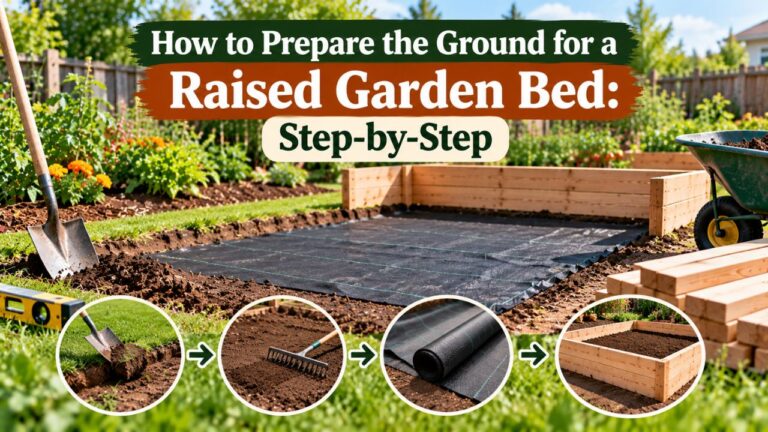
Step 7: Prepare the Ground Beneath the Raised Bed
Move the assembled frame into its intended position.
Clear large stones, debris, and persistent weeds from the area.
If the bed will sit over grass, remove the sod or smother the vegetation using an appropriate method.
Plain, uncoated cardboard can be used temporarily to suppress grass, but remove plastic tape and other nonbiodegradable materials first.
Where the underlying soil is compacted, loosen it carefully with a garden fork.
Most open-bottom raised beds do not need a solid bottom.
Allowing roots to extend into suitable natural soil provides additional growing space.
If the ground is potentially contaminated, have it assessed before constructing a food garden. Do not assume a raised frame alone eliminates contamination concerns.
Step 8: Line Gaps and Fill the Bed With Soil
Check the pallet frame for openings between boards.
If the gaps are large enough for soil to escape, attach permeable landscape fabric to the interior sides.
Use staples or another suitable fastening method to keep it in place.
The fabric should retain loose material without trapping water.
Do not install an impermeable plastic sheet across the bottom of an ordinary open-bottom raised bed. Water needs a path into the underlying ground.
For many vegetable gardens, a mixture of quality topsoil and finished compost provides a practical growing medium.
One starting mixture is:
- Two parts loamy topsoil
- One part finished plant-based compost
The University of Maryland Extension’s raised-bed gardening recommendations describe using compost and purchased topsoil in proportions ranging from one part compost to two parts topsoil through equal parts compost and topsoil, depending on the existing conditions.
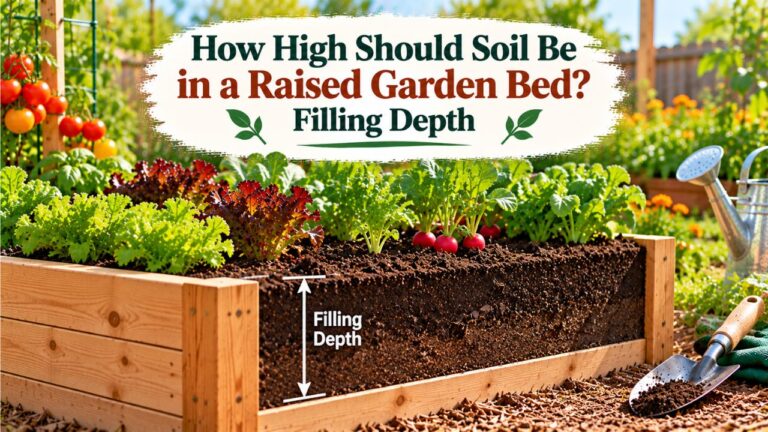
Spread the prepared mixture evenly inside the frame.
Avoid pressing it down heavily or walking on the growing surface.
Leave approximately 1–2 inches below the upper edge when practical to provide room for watering and mulch.
Step 9: Water the Soil and Start Planting
After filling the raised bed, water the growing medium gradually.
Allow moisture to penetrate below the surface and observe whether the soil settles.
If the soil level drops noticeably, add more prepared material.
Before planting, check that the soil is moist but not waterlogged.
Choose vegetables or herbs appropriate for the season, available sunlight, and rooting depth.
Follow crop-specific spacing recommendations rather than planting too many large vegetables in the small growing area.
Once planted, monitor moisture regularly and apply appropriate mulch when needed.
How Much Soil Do You Need for a Pallet Raised Garden Bed?
The amount of soil depends on the interior dimensions and the planned fill depth.
Pallets come in different sizes, and the final frame may be smaller than the original shipping pallet.
Measure the completed enclosure rather than assuming every pallet bed requires the same quantity.
Calculate the Soil Volume
Use this formula:
Soil Volume (Cubic Feet) = Length (Feet) × Width (Feet) × Fill Depth (Feet)
For a bed with interior dimensions of exactly 4 feet by 3 feet and a 12-inch fill depth:
4 × 3 × 1 = 12 cubic feet
This equals approximately 0.44 cubic yards.
If purchasing 2-cubic-foot bags, six bags provide the calculated amount.
A bed measuring 4×3 feet on the outside will have slightly smaller interior dimensions, so its actual soil requirement will be lower.
Soil Requirements for Different Bed Depths
The following table assumes a usable interior growing area measuring 4 feet by 3 feet.
| Soil Depth | Cubic Feet | 2 Cu. Ft. Bags |
| 6 inches | 6 | 3 |
| 8 inches | 8 | 4 |
| 10 inches | 10 | 5 |
| 12 inches | 12 | 6 |
| 16 inches | 16 | 8 |
These calculations exclude additional soil for settling.
For a 12-inch-deep bed requiring 12 cubic feet, a two-to-one topsoil-and-compost mixture would contain:
- Topsoil: 8 cubic feet
- Finished compost: 4 cubic feet
You may need less material when leaving space below the rim.
How Deep Should a Pallet Raised Bed Be?
For a ground-based vegetable bed with an open bottom, approximately 8–12 inches of prepared growing soil is useful for many crops.
The roots can continue into the underlying soil when it has suitable structure and drainage.
A shallow frame can work for lettuce, radishes, and some herbs, provided the plants have adequate rooting space.
Larger crops such as tomatoes need sufficient root development and may benefit from a deeper growing layer or access to suitable soil beneath the bed.
Do not sacrifice most of the available root space by filling a shallow pallet bed with large logs or rocks.
Can You Build a Raised Garden Bed From Whole Pallets?
Yes, but using entire pallets creates a different structure from building a low frame with dismantled boards.
Two common approaches are an upright pallet enclosure and a shallow pallet planter.
Each has different construction requirements.
Building a Raised Bed With Upright Pallets
Some gardeners stand complete pallets vertically to create the walls of a large raised bed.
The pallets are connected at the corners and reinforced with posts or other structural members.
However, full-size pallets can create unusually tall walls.
This introduces several challenges:
- Large gaps between pallet boards
- Significant pressure from the soil inside
- Heavy material requirements
- Additional bracing needs
- Difficulty keeping the structure square
- Faster deterioration of wood in contact with damp soil
An upright pallet enclosure must be designed to withstand the pressure of the contained soil.
Simply attaching four tall pallets at their corners may not provide sufficient stability.
For beginners, dismantling pallets and constructing a lower frame is generally easier to manage.
Using a Whole Pallet as a Shallow Planter
Another approach is to lay one pallet horizontally and turn its spaces into shallow planting areas.
A suitable pallet can be fitted with secure sides and a bottom that retains growing medium while allowing drainage.
This creates a planter rather than a conventional deep, open-bottom raised bed.
It may be useful for herbs, small flowers, and compact leafy vegetables.
However, the planting depth is limited.
A standard pallet laid flat is not automatically deep enough for large vegetables or root crops.
A shallow pallet planter should use a growing medium appropriate for container-style conditions.
Using a Pallet as a Vertical Garden
A pallet can also support a vertical growing arrangement.
In this design, suitable fabric or planter pockets retain a lightweight growing medium between the slats.
The pallet must be securely fastened to a structure capable of supporting its weight when wet.
Vertical pallet gardens are particularly useful for compact herbs and ornamental plants.
However, their limited soil volume makes them less suitable for larger vegetables.
They also dry out relatively quickly and may require frequent moisture checks.
How to Make a Pallet Raised Garden Bed Last Longer
Reclaimed pallet boards are often made from relatively inexpensive softwood.
Even when the wood is clean and suitable for gardening, continuous exposure to moisture can eventually cause deterioration.
Construction quality and maintenance influence how long the bed remains usable.
Keep the Frame Away From Standing Water
Choose a reasonably well-drained location.
Wood left in constant contact with standing water is more likely to deteriorate.
Avoid positioning the frame where roof runoff or irrigation water continually collects against the boards.
Do not block the normal drainage of the growing soil.
Use Rust-Resistant Fasteners
Ordinary indoor screws may corrode when exposed to moisture.
Choose exterior-rated fasteners compatible with the wood and expected conditions.
Check that screws are long enough to hold the boards securely without protruding through the supporting posts.
Where possible, position fasteners away from severely split or damaged sections of reclaimed wood.
Avoid Overloading Thin Pallet Boards
The pressure on the side walls increases as the contained soil becomes deeper.
Moist soil also adds substantial weight to the structure.
For a relatively tall raised bed, thin pallet slats may require more reinforcement than ordinary low garden borders.
Use additional supports where necessary.
If you want a bed 24 inches high or taller, stronger purpose-built structural lumber may be more appropriate than relying on thin salvaged boards.
Inspect the Wood Each Growing Season
Check for:
- Rotten sections
- Splitting boards
- Loose screws
- Bowing side walls
- Unstable corners
- Insect damage
- Exposed nails or sharp edges
Replace weakened boards before the frame loses its ability to hold the soil safely.
Do not assume all pallet beds last the same number of years. Wood species, climate, drainage, and maintenance can produce very different results.
Should You Paint or Seal Pallet Wood?
Painting or sealing can sometimes reduce moisture exposure, but the product must be appropriate for the intended use.
For edible gardens, avoid unknown coatings and products not suitable for the application.
If applying a finish, select one whose manufacturer permits the intended outdoor use and follow all preparation and curing instructions.
Applying a coating does not make a contaminated pallet suitable for vegetable gardening.
For unknown or suspicious wood, replacement with verified suitable material is the safer approach.
What Can You Grow in a Raised Bed Made From Pallets?
A properly constructed pallet raised bed can support many of the same crops as a conventional wooden raised bed.
The important factors are soil depth, sunlight, plant spacing, and growing conditions.
Vegetables for a Small Pallet Raised Bed
Common options include:
- Lettuce
- Spinach
- Radishes
- Bush beans
- Beets
- Compact peppers
- Kale
- Small tomato varieties with proper support
For a small 3×4 bed, avoid overcrowding the planting area.
A few well-spaced vegetables can be easier to maintain than many plants competing for the same soil volume.
Tomatoes and other larger crops need sufficient soil, nutrients, water, and support.
Herbs for Pallet Raised Beds
Herbs are useful choices because many remain relatively compact.
Consider:
- Basil
- Parsley
- Chives
- Cilantro
- Thyme
- Oregano
Group plants according to their watering requirements.
For example, basil generally benefits from more consistent moisture than drought-tolerant thyme.
Check the mature size of each herb before deciding on planting positions.
Flowers for Pallet Raised Beds
A pallet raised bed can also be used for ornamental flowers.
Marigolds, calendula, zinnias, and other suitable annuals can provide seasonal color.
Choose plants according to available sunlight and local growing temperatures.
For edible flowers, the same pallet safety precautions used for vegetable gardens should apply.
How Much Does It Cost to Build a Raised Garden Bed With Pallets?
A pallet raised bed can be economical, but the final cost depends on the materials already available.
Free pallets reduce the cost of the frame, although they do not eliminate the expense of fasteners, reinforcements, and growing soil.
Materials That May Be Available at Little Cost
Potentially reusable materials include:
- Verified suitable pallet boards
- Sound pallet stringers for reinforcement
- Leftover exterior-rated screws in good condition
- Suitable untreated wood for corner posts
- Existing gardening tools
Only collect pallets with the owner’s permission.
A pallet placed near a commercial building is not necessarily discarded or free to take.
Materials You May Still Need to Purchase
Common expenses include:
| Material | Cost Consideration |
| Pallet wood | May be free or low-cost |
| Exterior-rated screws | Needed for secure assembly |
| Corner posts | Can sometimes be made from suitable salvaged wood |
| Saw blades and tools | Additional expense if not already owned |
| Topsoil | Depends on bed volume and local prices |
| Finished compost | Depends on quantity and supplier |
| Landscape fabric | Optional for retaining soil through gaps |
For deeper raised beds, growing soil can become a major part of the total expense.
Compare bagged soil prices with bulk suppliers when purchasing larger quantities.
A low-cost frame is only worthwhile if the reclaimed wood is safe and sufficiently strong for the intended structure.
Common Pallet Raised Bed Construction Mistakes to Avoid
Several mistakes can make a pallet raised bed unsafe, unstable, or difficult to maintain.
Using Pallets Without Checking Their Treatment
Do not assume every wooden pallet is suitable for gardening.
Look for verifiable heat-treatment information and a clean usage history.
Avoid pallets marked MB or showing signs of unknown chemical exposure.
An unidentified pallet is not worth using in an edible garden simply to save money.
Leaving Old Nails in the Boards
Pallets may contain hidden nails, broken fasteners, and sharp metal fragments.
These can cause injuries or damage saw blades during cutting.
Inspect every reclaimed board carefully before assembly.
Remove protruding metal and dispose of unusable pieces safely.
Building Walls Without Enough Support
Thin pallet boards can bow outward when loaded with soil.
Secure the corners properly and add intermediate supports where necessary.
For taller designs, use stronger materials and more substantial bracing.
Filling a Shallow Bed With Rocks or Logs
Large stones and logs occupy space that plants could otherwise use for root growth.
A gravel layer does not automatically improve drainage.
For a shallow pallet bed, provide as much suitable growing soil as practical.
Blocking Drainage With Plastic
A waterproof bottom can trap excess water in an ordinary raised bed.
If landscape fabric is used to contain soil through side gaps, keep the drainage route open.
For enclosed pallet planters, provide a suitable supporting bottom and drainage outlets.
Filling the Bed Before Checking Stability
A raised bed becomes difficult to reposition after it contains soil.
Before filling, confirm that the frame is level, the joints are secure, and no boards move excessively.
Correct structural problems while the bed is still empty.
Conclusion
Learning how to build a raised garden bed with pallets starts with choosing suitable reclaimed wood and constructing a frame strong enough to support the growing soil.
For most beginners, dismantling clean, heat-treated pallets and reassembling the boards into a low rectangular frame is more manageable than using entire pallets as tall walls.
Reinforce the corners, check for hidden nails, and keep the bottom open when building directly over suitable garden ground.
A properly prepared mixture of topsoil and finished compost can then provide the growing environment needed for vegetables, herbs, and flowers.
Pallet wood can reduce construction expenses, but safety and structural condition should always come before cost savings. If the treatment or history of the pallet is uncertain, use verified suitable lumber instead.
FAQs About How to Build a Raised Garden Bed With Pallets
How Many Pallets Do You Need to Build a Raised Garden Bed?
A small raised garden bed may require approximately two to four pallets, depending on their size, the number of usable boards, and the desired wall height. Damaged boards and differences in pallet construction can increase the quantity needed. Measure the salvaged boards before finalizing the design.
Are Wooden Pallets Safe for Growing Vegetables?
Some wooden pallets are suitable for vegetable gardens, but not all. Clean, verified heat-treated pallets with a suitable usage history are generally preferred. Avoid methyl bromide-treated pallets, suspicious stains, and materials with unknown treatment or cargo histories.
Can You Build a Raised Bed Without Taking Pallets Apart?
Yes, but using entire pallets creates a different structural design. Upright pallets require substantial reinforcement to contain soil safely. A whole pallet can also be adapted into a shallow or vertical planter, although its rooting depth will be more limited than a conventional raised bed.
Do You Need Landscape Fabric Inside a Pallet Raised Bed?
Not always. Landscape fabric is useful when gaps between pallet boards are large enough for soil to escape. Choose a permeable material and attach it to the inner walls. It should not block drainage through the bottom of an ordinary open-bottom raised bed.
How Long Will a Pallet Raised Garden Bed Last?
The lifespan varies according to wood species, moisture exposure, construction quality, and maintenance. Pallet wood is often less durable than lumber selected specifically for outdoor garden structures. Inspect boards and connections regularly and replace damaged sections as needed.
Can You Build a Pallet Raised Bed on Concrete?
Yes, but a bed on concrete needs a design that provides suitable drainage and sufficient rooting depth. Because roots cannot grow into natural soil below the frame, the internal growing space becomes more important. A contained planter may also need a suitable supporting base, and its weight must be considered.
What Is the Best Soil for a Pallet Raised Garden Bed?
For an ordinary open-bottom bed, quality loamy topsoil mixed with finished plant-based compost is a practical starting point. A mixture of approximately two parts topsoil and one part compost may work well, depending on the materials and soil conditions. An enclosed pallet planter may require a lighter container-style growing medium.

I’m Maya L. Greenwood, a lifelong plant lover who believes anyone can grow something beautiful with the right guidance. After years of testing soil mixes, pruning methods, irrigation tricks, and pest-safe solutions, I started EasyGardenTips.com to turn hard-won lessons into step-by-step advice. From seed starting and container gardens to composting and seasonal checklists, my goal is to make gardening simple, sustainable, and fun.