Treated vs Untreated Wood for Raised Beds: Safety and Lifespan
Pressure-treated wood generally lasts longer in raised garden beds because preservatives protect it against fungal decay and wood-damaging insects. Untreated wood avoids added chemical preservatives, but its durability depends heavily on the wood species. Both can be suitable for vegetable and flower gardens when the materials are selected carefully.
The biggest concern for many gardeners is whether pressure-treated lumber can release chemicals into the surrounding soil. Older wood treatments contained arsenic, while modern residential pressure-treated lumber commonly uses copper-based preservatives. Understanding that difference is important before deciding which material to use.
Cost also matters. Untreated pine may be inexpensive initially but require replacement sooner. Naturally decay-resistant cedar and redwood offer another option, although they generally cost more than ordinary construction lumber.
The right choice depends on whether you’re growing edible crops, how much maintenance you want, local moisture conditions, and your construction budget.
Comparing wood treatments, food-growing safety, decay resistance, and long-term costs can help you choose suitable lumber without unnecessarily replacing a garden bed later.
Treated vs Untreated Wood for Raised Beds: Main Differences
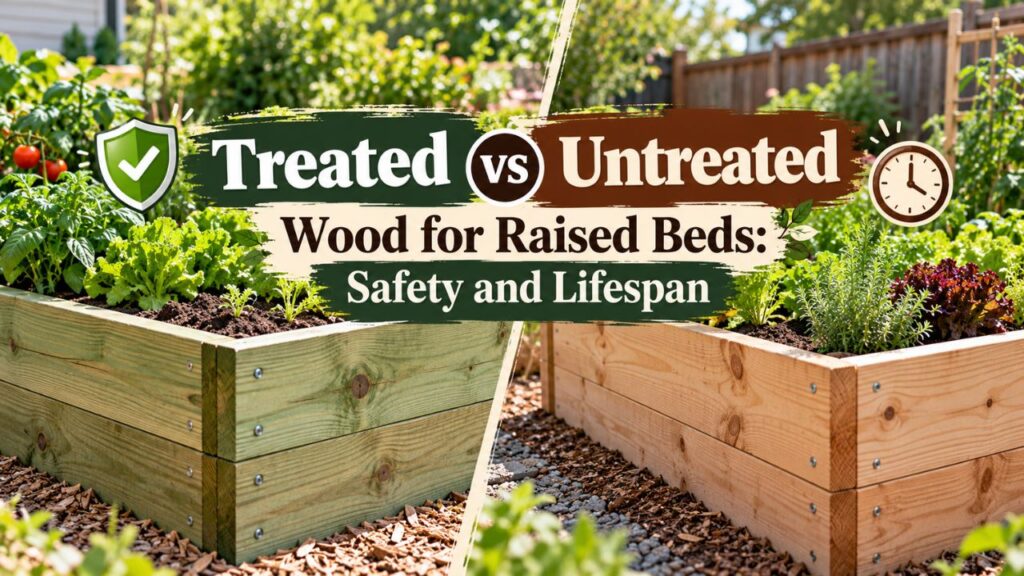
The main difference is how each material resists moisture, fungi, insects, and long-term outdoor exposure.
Pressure-treated lumber contains chemical preservatives that help protect the wood against biological deterioration.
Untreated lumber has no added pressure-treatment preservatives. Its resistance to decay comes primarily from the wood’s natural properties.
| Feature | Treated wood | Untreated wood |
| Wood preservatives | Contains chemical preservatives | No added pressure-treatment preservatives |
| Decay resistance | Generally high when properly rated | Depends on wood species |
| Moisture exposure | Designed to resist decay in suitable outdoor applications | More susceptible, especially untreated pine |
| Insect resistance | Treatment helps resist wood-damaging insects | Varies by species and conditions |
| Food gardening | Modern residential treatments may be suitable when properly selected | No pressure-treatment chemicals to consider |
| Upfront cost | Often more than untreated pine | Pine is usually affordable; cedar and redwood cost more |
| Expected lifespan | Generally longer than comparable untreated softwood | Highly variable |
| Maintenance | Inspect damaged boards and fasteners | May need more frequent board replacement |
| Appearance | May have treatment-related coloration or markings | Natural wood appearance |
| Best application | Long-lasting beds where approved treatment is acceptable | Gardens prioritizing untreated materials or natural durability |
The comparison changes depending on the actual lumber.
For example, untreated cedar and untreated pine shouldn’t be treated as equivalent materials simply because neither has been pressure-treated.
Likewise, different chemical preservatives and treatment ratings affect how treated lumber performs.
What Is Pressure-Treated Wood for Raised Garden Beds?
Pressure-treated wood is lumber that has undergone a preservation process intended to extend its outdoor service life.
During treatment, specialized equipment uses pressure and vacuum to introduce preservatives into the wood.
These substances help protect the lumber from organisms that cause decay and structural damage.
Modern Pressure-Treated Wood Preservatives
Several preservatives are used for residential lumber in the United States.
Common examples include:
- Alkaline copper quaternary (ACQ): A copper-based preservative that helps protect wood against fungal decay and insects.
- Copper azole (CA): A preservative combining copper with other active ingredients for decay and insect resistance.
- Micronized copper azole (MCA): A treatment that uses micronized copper compounds and additional preservative ingredients.
According to the U.S. Environmental Protection Agency’s overview of wood preservative chemicals, ACQ and copper azole are among the registered preservatives used for residential lumber.
These modern formulations differ from older treatments containing arsenic.
However, the fact that a preservative is registered for residential lumber doesn’t mean every treated product is suitable for every garden application.
Always check the treatment label, intended use, and manufacturer guidance.
Older CCA-Treated Lumber
Before 2004, chromated copper arsenate (CCA) was widely used to protect outdoor wood.
CCA contains copper, chromium, and arsenic.
The EPA reports that manufacturers voluntarily discontinued virtually all residential uses of CCA at the end of 2003.
Certain industrial and other permitted uses remain.
This distinction matters when considering reclaimed lumber.
Old deck boards, fence posts, landscaping timbers, and salvaged construction materials may have treatments that are difficult to identify.
Avoid using unidentified older pressure-treated lumber for new vegetable garden beds.
Railroad ties treated with creosote are also unsuitable for this application.
Ground-Contact vs. Above-Ground Treated Lumber
Not every pressure-treated board has the same level of preservative protection.
Some lumber is intended primarily for above-ground outdoor use.
Other products are specifically treated for ground contact, where wood is regularly exposed to moisture and soil.
Raised bed walls usually remain in contact with damp growing soil, so choosing lumber rated for ground contact is important.
Look for an end tag indicating the intended application.
Ground-contact products may carry an AWPA use-category marking such as UC4A, although treatment systems and labeling can vary.
If the label is unclear, ask the lumber supplier to identify the preservative and confirm that the product is appropriate for the intended use.
What Is Untreated Wood for Raised Garden Beds?
Untreated wood is lumber that hasn’t received pressure-applied chemical preservatives.
It may be sold as construction lumber, dimensional boards, or naturally durable outdoor wood.
However, untreated doesn’t automatically mean decay-resistant.
Different species contain different amounts of naturally occurring compounds that can slow fungal deterioration.
Untreated Pine for Raised Beds
Pine is widely available and commonly used for inexpensive garden bed construction.
Its main advantages are affordability, availability, and ease of cutting and fastening.
However, ordinary untreated pine has limited natural resistance to prolonged moisture exposure.
When used as raised bed walls, it may develop fungal decay near the soil line or along constantly wet surfaces.
Board thickness, climate, drainage, and lumber quality affect how quickly this occurs.
Pine is a reasonable choice for temporary or budget-focused raised beds when future board replacement is acceptable.
Untreated Cedar for Raised Beds
Cedar is a popular choice for gardeners who want naturally decay-resistant lumber without added preservatives.
Certain cedar species contain natural compounds that help protect their heartwood against decay.
However, cedar quality varies.
Heartwood generally has greater natural durability than the lighter-colored sapwood of many decay-resistant species.
A cedar board containing substantial sapwood may not last as long as one made primarily from durable heartwood.
Cedar generally costs more than untreated pine but can provide better service life in suitable conditions.
Untreated Redwood and Black Locust
Redwood and black locust are other naturally durable options.
Redwood heartwood is known for its decay resistance, although availability and price vary by region.
Black locust contains naturally durable heartwood and can perform well in demanding outdoor environments.
However, black locust lumber isn’t always easy to find in standard board sizes.
Both materials can be suitable when locally available at a reasonable price.
Other Untreated Lumber
Spruce, fir, and other common softwoods are sometimes used for raised beds.
They can be practical for short-term construction but generally don’t offer the same natural decay resistance as suitable cedar, redwood, or black locust heartwood.
Avoid assuming every hardwood is highly decay-resistant.
Natural durability depends on the species and the specific part of the tree used.
Is Treated Wood Safe for Vegetable Raised Beds?
Modern pressure-treated wood containing residentially approved copper-based preservatives can be a reasonable choice for vegetable raised beds, but chemical movement into nearby soil is possible.
The type of treatment, soil conditions, and intended use determine whether a particular product is appropriate.
The distinction between modern residential treatments and older arsenic-containing lumber is especially important.
What Research Shows About Copper Leaching
Oregon State University has investigated copper movement from pressure-treated lumber into raised bed soil and vegetables.
Researchers compared raised beds constructed with untreated Douglas-fir and beds made from Douglas-fir treated with copper azole.
According to Oregon State University’s research on pressure-treated wood for raised beds, results from four growing seasons showed that:
- Copper concentrations increased slightly in soil directly beside the treated boards.
- The increase was limited to approximately the first inch of soil next to the wood.
- Soil farther from the boards did not show the same increase.
- Vegetables and herbs grown in the treated beds did not show increased copper concentrations compared with those grown in untreated beds.
The study involved vegetables and herbs including carrots, lettuce, tomatoes, peppers, kale, and basil.
Researchers concluded that copper azole-treated lumber rated for ground contact was a reasonable option under the conditions examined in Oregon’s Willamette Valley.
However, these findings don’t establish that every wood preservative performs identically in every soil.
Soil chemistry, environmental conditions, and treatment formulations can affect how preservatives behave.
Does Copper in Treated Wood Harm Plants?
Copper is an essential plant micronutrient.
Plants need small amounts for normal growth and development.
However, excessive copper concentrations can harm plants and soil organisms.
The amount available to plants depends partly on soil pH, organic matter, and mineral composition.
A small increase in copper near a treated board doesn’t necessarily mean plants will absorb harmful amounts.
Nevertheless, gardeners should avoid adding copper-containing products unnecessarily and use lumber treatments appropriate for residential garden construction.
Is Untreated Wood Safer for Growing Food?
Untreated wood removes the concern about added pressure-treatment preservatives entering the soil.
That makes it attractive to gardeners who prefer to minimize contact between growing soil and manufactured preservatives.
However, untreated lumber isn’t automatically free from every potential contaminant.
Reclaimed boards may have old paint, stains, industrial residues, or unknown previous treatments.
Fresh, untreated lumber from a reliable supplier is generally preferable to unidentified salvaged material.
For gardeners who want to avoid pressure-treatment chemicals entirely, suitable untreated cedar or redwood is a practical choice.
Which Lasts Longer: Treated or Untreated Wood?
Pressure-treated wood generally lasts longer than untreated lumber of the same species and similar construction quality when exposed to damp soil.
The preservatives help protect the wood against fungal decay and insect damage.
However, comparing treated pine with naturally durable cedar or redwood is less straightforward.
How Long Does Pressure-Treated Wood Last in Raised Beds?
Properly treated ground-contact lumber can remain serviceable for many years, sometimes decades, depending on conditions.
Its actual lifespan depends on:
- Preservative type and treatment retention.
- Wood species and board thickness.
- Ground-contact rating.
- Moisture exposure.
- Climate and soil conditions.
- Quality of cuts and fasteners.
- Drainage around the structure.
No single lifespan applies to every pressure-treated raised bed.
Water collecting against the bottom boards can shorten service life, even when the lumber has been treated.
How Long Does Untreated Wood Last?
Untreated wood lifespan varies considerably.
Ordinary pine and Douglas-fir may deteriorate relatively quickly in constantly damp conditions.
Naturally decay-resistant heartwood generally lasts longer.
The Oregon State University study provides a useful real-world comparison.
By the beginning of the sixth growing season, the untreated Douglas-fir beds showed substantial decay near the lower portions of their boards. The copper azole-treated beds remained mostly intact with comparatively minor deterioration.
These findings were reported in the university’s linked raised bed lumber study.
They demonstrate the benefit of treatment under those specific conditions, not a guaranteed replacement schedule for all untreated wood species.
Does Wood Thickness Affect Lifespan?
Yes. Thicker boards can maintain structural integrity longer as surface deterioration develops.
For example, nominal 2-inch lumber provides more material than nominal 1-inch boards.
However, increased thickness doesn’t make susceptible wood immune to fungal decay.
The structural design also matters.
Long raised bed walls may bow outward under soil pressure, especially when boards are thin or poorly supported.
Use suitable board thickness, corner connections, and intermediate supports for the intended bed dimensions.
Treated vs Untreated Wood for Raised Beds: Which Costs Less?
Untreated pine often has the lowest initial lumber cost.
Pressure-treated construction lumber commonly costs more than comparable untreated pine because of the preservation process.
Naturally decay-resistant cedar and redwood may cost considerably more, depending on local availability.
However, prices vary with lumber grade, dimensions, region, and market conditions.
Initial Construction Cost
For a fair comparison, calculate the cost of building the same-sized raised bed from each material.
Include:
- Lumber.
- Screws and brackets.
- Corner supports.
- Any required protective materials.
- Cutting and delivery costs.
- Replacement or maintenance materials.
Don’t compare a thin untreated pine frame with a much thicker premium cedar frame.
Different board thicknesses and construction styles can change costs substantially.
Long-Term Cost and Replacement
A low-cost untreated bed may require rebuilding sooner than a properly constructed treated lumber bed.
Replacing the boards also involves labor and potential disturbance to established soil and plants.
Pressure-treated lumber may provide better long-term value when minimizing reconstruction is a priority.
Cedar can offer a balance between natural decay resistance and avoiding added chemical preservatives.
A useful way to compare costs is:
Average annual frame cost = Total frame construction cost ÷ Years of usable service
For example, if a frame costs $120 and remains usable for eight years, the average initial construction cost is $15 per year.
This is an illustrative calculation, not a prediction of any particular lumber’s lifespan.
Actual service life should be evaluated according to the wood and growing conditions.
Should You Use a Liner With Treated Wood Raised Beds?
A liner can reduce direct contact between growing soil and treated wood.
However, a liner isn’t universally required, and its benefits depend on the material and installation.
When a Liner May Be Useful
Some gardeners choose a sidewall liner because they want an additional barrier between the soil and chemical-treated lumber.
This can be a reasonable preference when using modern pressure-treated boards.
Select a durable material appropriate for contact with growing soil.
A physical barrier may reduce direct soil-to-wood contact, but it shouldn’t be presented as a guarantee against all chemical movement.
How to Install a Raised Bed Liner
For a traditional open-bottom raised bed:
- Assemble the wooden frame securely.
- Select an appropriate, durable sidewall liner.
- Attach the material along the inside walls.
- Avoid blocking the open bottom or drainage pathways.
- Keep loose liner edges away from planting and cultivation tools.
- Inspect the material during routine bed maintenance.
Avoid creating pockets where water can become trapped between the wood and liner.
A fully waterproof liner can sometimes change the moisture conditions around the boards.
Does Untreated Wood Need a Liner?
No. Untreated lumber doesn’t automatically require a liner.
Some gardeners use liners to reduce direct exposure to wet soil, but moisture can still reach the wood through rain, joints, and exposed surfaces.
A liner also won’t prevent all forms of deterioration.
For many cedar or redwood raised beds, proper construction and drainage are more useful than installing a complicated sidewall barrier.
How to Choose Treated or Untreated Lumber for a Raised Bed
The best lumber choice depends on the gardener’s priorities and the intended construction.
Choose Treated Wood for Longer Service Life
Consider pressure-treated lumber when:
- The bed will remain permanently in one location.
- The local climate is frequently wet.
- Minimizing future board replacement is important.
- Suitable ground-contact-rated lumber is available.
- Modern residential preservatives are acceptable for the intended application.
Check the end tag before purchasing.
Use only lumber identified as suitable for the planned outdoor application.
Choose Untreated Wood to Avoid Added Preservatives
Untreated lumber is a good choice when:
- Avoiding added wood preservatives is a priority.
- Naturally durable cedar or redwood is available.
- The bed is temporary or easy to rebuild.
- A traditional natural wood appearance is preferred.
- Budget-friendly untreated pine meets the expected service needs.
For a permanent vegetable bed, naturally durable heartwood is generally preferable to untreated pine when the budget permits.
Avoid Unidentified Reclaimed Lumber
Reusing old materials may appear economical, but unknown treatments create uncertainty.
Avoid:
- Old railroad ties.
- Utility poles.
- Lumber with unknown industrial treatments.
- Painted boards with uncertain coating history.
- Previously treated wood that cannot be identified.
- Lumber contaminated by oil, solvents, or other hazardous materials.
Don’t assume weathered wood is untreated merely because it has lost its original color.
Whenever possible, use identifiable new lumber or reclaimed wood with a reliable history.
How to Build a Durable Wooden Raised Garden Bed
Correct construction improves the service life of both treated and untreated beds.
Even durable lumber can fail early if the frame traps moisture or lacks structural support.
Step 1: Select the Appropriate Boards
Choose lumber based on the bed’s dimensions and expected soil pressure.
For many small to medium raised beds, nominal 2-inch-thick boards offer useful rigidity.
Actual dimensions of nominal lumber are smaller than their stated sizes.
For example, a typical nominal 2 × 12 board measures approximately 1.5 inches thick and 11.25 inches wide.
Inspect boards for serious cracks, large defects, or excessive warping.
When using pressure-treated wood, confirm the ground-contact rating and preservative information.
Step 2: Prepare the Installation Site
Choose a location with adequate sunlight for the intended crops and reasonable drainage.
Remove large rocks and unwanted vegetation.
Level the ground so the frame rests evenly.
Avoid placing wood directly in an area where water regularly collects.
Poor drainage increases moisture exposure and can accelerate deterioration.
Step 3: Assemble the Frame With Suitable Fasteners
Fasteners must be compatible with the lumber and outdoor environment.
Copper-based wood treatments can accelerate corrosion in unsuitable metals.
Use manufacturer-approved corrosion-resistant hardware, such as appropriately rated hot-dip galvanized or stainless steel fasteners where specified.
Don’t assume ordinary indoor screws are suitable for pressure-treated lumber.
For larger beds, add structural bracing where needed to prevent the sidewalls from bowing.
Step 4: Protect Exposed Cut Ends
Cutting pressure-treated boards can expose wood that received less preservative penetration.
Follow the lumber manufacturer’s instructions for treating exposed cuts with a suitable end-cut preservative.
Use only products permitted for the intended application, and follow the label.
Avoid applying unidentified preservatives to surfaces contacting vegetable garden soil.
For untreated lumber, carefully finished cuts and good drainage are important, although surface coatings alone won’t make ordinary pine permanently decay-resistant.
Step 5: Fill the Bed Without Damaging the Frame
Fill the raised bed with a suitable growing medium, generally containing quality mineral soil and finished compost.
Spread the soil evenly.
Avoid dumping large quantities against unsupported walls or allowing equipment to strike the boards.
Do not press the soil down heavily.
Ensure water can move through the growing medium and into suitable soil beneath an open-bottom bed.
How to Maintain Treated and Untreated Raised Beds
Maintenance requirements differ, but both types benefit from regular inspection.
Maintaining Pressure-Treated Wood
Check the lower boards, corners, and fasteners periodically.
Look for:
- Soft or deteriorating wood.
- Loose structural connections.
- Cracks that affect strength.
- Damaged cut ends.
- Hardware corrosion.
- Bowing sidewalls.
Replace structurally damaged components before they fail.
Do not burn pressure-treated lumber or use its ash in garden soil.
Dispose of unwanted treated wood according to applicable local waste-management rules.
Maintaining Untreated Wood
Inspect untreated wood more closely in wet climates.
Pay particular attention to sections touching damp soil.
If boards become soft, crumbly, or unable to support the growing medium, plan for replacement.
Avoid letting mulch or debris accumulate unnecessarily against the outside frame.
Keep nearby drainage pathways clear.
Cedar and redwood may weather to a gray color without necessarily losing their structural strength.
Color changes alone don’t prove the wood has failed.
Can You Seal Untreated Wood to Make It Last Longer?
Exterior coatings may reduce water absorption and weathering, depending on the product.
However, they don’t provide the same long-term biological protection as properly applied pressure-treatment preservatives.
If using a finish, confirm that it is suitable for the intended garden application.
Keep products with uncertain ingredients away from surfaces directly contacting edible crops or growing soil.
Don’t assume that a finish described as natural, waterproof, or eco-friendly is automatically appropriate for food gardening.
Which Wood Is Best for Different Raised Garden Beds?
Different garden projects call for different construction priorities.
| Gardening situation | Practical material choice | Main reason |
| Budget vegetable bed | Untreated pine | Low initial cost |
| Permanent raised vegetable bed | Properly rated modern treated lumber or durable untreated wood | Longer service life |
| Garden avoiding added preservatives | Untreated cedar or redwood | Natural decay resistance |
| Wet or humid location | Ground-contact-rated treated lumber | Improved resistance to moisture-related decay |
| Temporary seasonal raised bed | Untreated softwood | Affordable and easy to replace |
| Decorative flower bed | Cedar, redwood, or other suitable untreated wood | Natural appearance |
| Custom deep raised bed | Structurally adequate treated lumber or thick durable untreated boards | Strength and durability |
| Reclaimed-material project | Verified untreated, uncontaminated lumber | Avoids unknown preservatives |
These recommendations assume the wood is structurally suitable and the bed is properly assembled.
For a garden where construction materials must meet specific local rules, product labeling and applicable building requirements should take priority.
Conclusion
Choosing between treated vs untreated wood for raised beds comes down to balancing durability, cost, chemical exposure preferences, and expected maintenance.
Modern pressure-treated lumber offers strong resistance to fungal decay and wood-damaging insects. Properly rated products can provide good long-term value, and research on copper azole-treated beds has found limited copper movement under the conditions studied.
Untreated wood avoids added pressure-treatment preservatives. Cedar, redwood, and other naturally durable species are attractive options for gardeners who prefer this approach.
Ordinary untreated pine is usually more affordable but may require earlier replacement.
For a permanent raised bed where avoiding preservatives isn’t a priority, properly identified ground-contact-rated lumber is a practical option. For gardeners who prefer untreated materials, quality cedar or redwood is often worth considering.
Whichever material you choose, start with identifiable lumber, use compatible fasteners, and build a frame that handles moisture and soil pressure without unnecessary deterioration.
FAQs About Treated vs Untreated Wood for Raised Beds
Can You Use Pressure-Treated Wood for Organic Vegetable Gardening?
Pressure-treated lumber is not automatically acceptable under every organic gardening standard.
For certified organic production, materials must comply with the applicable certification requirements, and prohibited preservatives may rule out certain lumber.
Home gardeners who follow organic practices without certification may make different choices, but untreated naturally durable wood avoids this particular concern.
Is Pressure-Treated Pine Better Than Untreated Cedar?
Pressure-treated pine generally provides strong resistance to decay at a potentially lower price than cedar.
Untreated cedar offers natural durability without added pressure-treatment chemicals.
The better choice depends on the specific products, cost, moisture conditions, and whether avoiding preservatives is a priority.
Can Treated Wood Chemicals Enter Raised Bed Soil?
Yes. Certain preservatives can move from treated wood into nearby soil.
Research involving copper azole-treated raised beds found small increases in copper immediately beside the lumber, without increased copper concentrations in the vegetables tested.
The results may differ with other treatments and soil conditions.
How Can You Tell if Old Wood Is Pressure-Treated?
Look for an original end tag, treatment stamp, or reliable purchase information.
Color alone isn’t dependable because both treated and untreated wood change appearance as they weather.
If the treatment history cannot be established, avoid using the lumber for a new edible garden bed.
Does Untreated Cedar Rot in Raised Garden Beds?
Yes. Cedar can eventually decay, especially under prolonged wet conditions.
Its natural resistance generally makes it more durable than ordinary untreated pine, but durability varies by species and heartwood content.
No untreated wood is completely immune to deterioration.
Should You Put Plastic Between Treated Wood and Soil?
A suitable sidewall liner can reduce direct contact between treated wood and growing soil.
However, lining isn’t universally required, and a barrier shouldn’t obstruct drainage or trap water against the frame.
Choose durable material appropriate for the application and install it carefully.
Is It Safe to Cut Pressure-Treated Wood When Building Raised Beds?
Pressure-treated lumber can be cut using appropriate woodworking tools and safety precautions.
Work in a well-ventilated area, preferably outdoors, and use suitable eye and respiratory protection when creating sawdust.
Do not burn treated wood. Follow the manufacturer’s guidance for handling sawdust, treating cut ends, and disposing of scraps.

I’m Maya L. Greenwood, a lifelong plant lover who believes anyone can grow something beautiful with the right guidance. After years of testing soil mixes, pruning methods, irrigation tricks, and pest-safe solutions, I started EasyGardenTips.com to turn hard-won lessons into step-by-step advice. From seed starting and container gardens to composting and seasonal checklists, my goal is to make gardening simple, sustainable, and fun.