Hugelkultur vs Raised Beds: Which Is Better for Your Garden?
Traditional raised beds are generally the better choice for gardeners who want predictable soil conditions, easier planting, and straightforward maintenance. Hugelkultur is an alternative worth considering when you have untreated logs, branches, and other organic materials to reuse. Both methods elevate the growing area, but the materials beneath the planting surface differ significantly.
A traditional raised bed is usually filled with a prepared mixture of topsoil and finished compost. Hugelkultur uses buried woody materials that gradually decompose beneath the growing soil. That difference affects soil stability, nutrient availability, water movement, and long-term maintenance.
One important distinction is that hugelkultur is technically a type of raised-bed gardening. It can be built as a freestanding mound or adapted to a wooden or metal frame.
The question is whether burying logs provides enough practical benefit to justify the additional complexity. Wood may reduce initial soil purchases and help recycle garden debris, but decomposition can cause settling and temporary nitrogen availability problems.
The following comparison explains how each method works, where the differences matter, and which is more suitable for specific garden conditions.
Hugelkultur vs Raised Beds: Main Differences
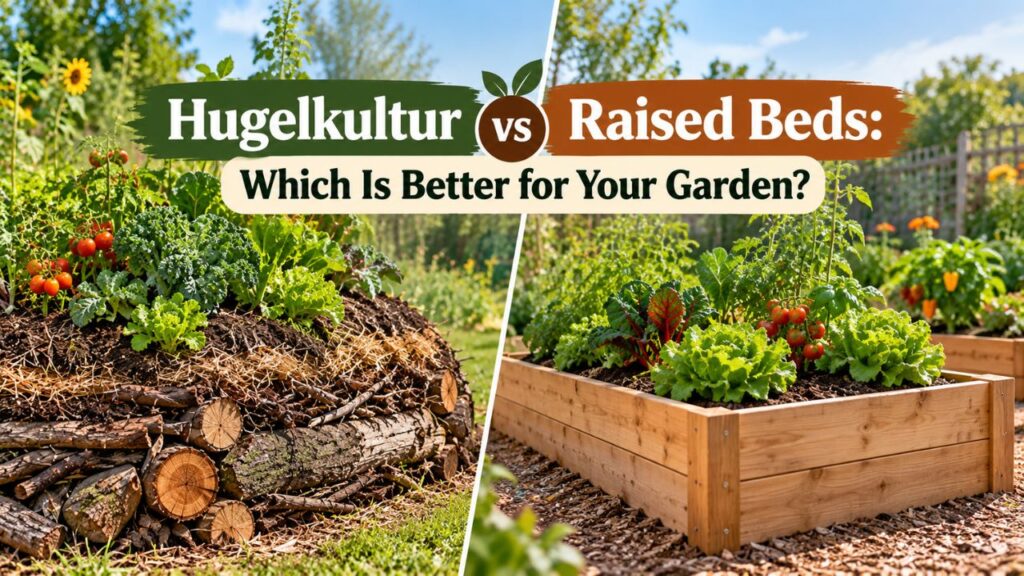
The biggest difference between hugelkultur and conventional raised beds is how the growing area is constructed.
Traditional raised beds primarily use prepared soil and compost. Hugelkultur beds contain substantial woody material beneath a layer of growing soil.
| Feature | Hugelkultur | Traditional Raised Beds |
| Basic structure | Mound or frame containing buried wood | Elevated soil, often inside a frame |
| Main materials | Logs, branches, organic matter, soil | Topsoil, finished compost |
| Soil stability | Settles as wood decomposes | Generally more stable |
| Water retention | Potential benefit, but variable | Depends on soil mixture and watering |
| Nutrient availability | May fluctuate during decomposition | Easier to manage through soil testing |
| Initial material cost | Can be lower with free wood | Usually requires more purchased soil |
| Construction | More layering and material handling | More straightforward filling |
| Long-term maintenance | Requires topping up and possible reshaping | Usually needs routine soil replenishment |
| Growing surface | Flat or sloped, depending on design | Usually level |
| Best suited for | Organic-material reuse and experimental gardening | Predictable vegetable production and accessibility |
Neither approach eliminates the need for healthy growing soil, adequate sunlight, proper watering, or occasional nutrient management.
What Is Hugelkultur Gardening?
Hugelkultur, sometimes written hügelkultur, is a gardening method that uses buried wood and other organic materials to create a raised growing area.
The German term refers to mound cultivation.
A conventional hugelkultur mound generally contains larger logs near the bottom, followed by smaller branches, organic material, compost, and soil.
As the buried materials decompose, their physical structure changes and nutrients gradually become available.
The mound also settles because decomposing wood occupies less space over time.
Some gardeners use hugelkultur to recycle woody yard debris and reduce the amount of purchased growing material.
However, claims that hugelkultur automatically produces better yields, eliminates watering, or creates superior soil conditions are not firmly established by comparative research.
What Is a Traditional Raised Garden Bed?
A traditional raised garden bed is a growing area elevated above the surrounding ground.
Many have frames made from wood, galvanized metal, stone, or other suitable materials.
The growing medium usually consists of topsoil, finished compost, or a prepared raised-bed mixture.
Unlike hugelkultur, a conventional bed does not depend on a large buried wood core.
Its relatively uniform growing medium provides more predictable conditions for root development, drainage, and nutrient management.
Raised beds can also be built without frames, although framed designs are common in residential vegetable gardens.
How Hugelkultur and Raised Beds Are Constructed
Construction methods influence initial expenses, labor requirements, and the condition of the growing soil.
Both approaches require suitable site preparation, but hugelkultur involves additional material selection and layering.
How a Hugelkultur Bed Is Built
A typical hugelkultur bed starts with a layer of untreated woody materials.
The general construction process involves:
- Select a sunny garden location with suitable drainage.
- Remove grass, persistent weeds, and unwanted debris.
- Arrange appropriate logs and larger branches along the intended growing area.
- Fill spaces with smaller branches and suitable organic materials.
- Add finished compost and growing soil to cover the woody core.
- Shape the mound or level the surface if using a frame.
- Water the growing area and monitor settling.
- Add more suitable soil as the buried materials decompose.
Some designs begin with a shallow trench, while others place the wood directly on the existing ground.
The required soil cover depends on the crops and the depth of the buried materials.
The main growing roots should have adequate suitable soil rather than being forced to develop primarily within loosely stacked logs.
A freestanding mound can be relatively tall, but steep sides are more difficult to plant and may be vulnerable to erosion.
How a Traditional Raised Bed Is Built
Traditional raised beds follow a simpler process.
- Choose a level site receiving appropriate sunlight.
- Remove weeds and prepare the ground beneath the bed.
- Assemble the frame if one is being used.
- Loosen compacted native soil where necessary.
- Fill the bed with suitable topsoil and finished compost.
- Spread the mixture evenly without compacting it.
- Water the soil and add more material if settling occurs.
The University of Minnesota Extension’s raised-bed gardening guidance recommends a mixture containing approximately one-half to two-thirds topsoil and one-third to one-half plant-based compost.
This mixture provides a practical starting point for ordinary open-bottom raised beds.
Because the growing medium is relatively uniform, gardeners can more easily assess moisture, nutrient levels, and root-zone conditions.
Hugelkultur vs Raised Beds for Soil Quality and Root Growth
The quality of the growing medium is more important than simply raising the planting surface.
Hugelkultur and traditional raised beds handle organic matter differently, which can affect plant roots and nutrient availability.
How Buried Wood Affects Hugelkultur Soil
Wood contains large amounts of carbon-rich structural material.
As microorganisms break down that material, the wood gradually changes into smaller organic components.
Decomposition can contribute organic matter over time, but the process does not guarantee that nutrients will become available when nearby vegetables need them.
Fresh wood and other carbon-rich materials may also temporarily affect nitrogen availability in the surrounding soil.
This is known as nitrogen immobilization.
Microorganisms require nitrogen as they decompose carbon-rich materials. When available nitrogen is limited, they may use nitrogen that would otherwise be accessible to nearby plant roots.
The effect depends on the wood type, its degree of decomposition, contact with the soil, and surrounding nutrient conditions.
Large intact logs do not behave exactly like fine sawdust mixed throughout the growing soil. The risk is generally more significant where substantial undecomposed woody material comes into close contact with the active root zone.
How Traditional Raised Beds Support Root Development
Conventional raised beds provide growing soil throughout most or all of the intended rooting area.
When the mixture contains suitable mineral soil and finished compost, roots can grow through a reasonably consistent medium.
This makes it easier to manage:
- Soil compaction
- Moisture availability
- Fertilizer applications
- Soil pH
- Rooting depth
- Organic matter content
Plant roots also have fewer large voids or buried obstacles to navigate.
For an open-bottom raised bed, roots may continue growing into suitable native soil beneath the frame.
This is particularly useful for vegetables with deeper root systems.
Which Method Provides Better Soil Fertility?
Traditional raised beds generally allow more predictable nutrient management.
A soil test can identify deficiencies, and amendments can be incorporated into a known growing medium.
Hugelkultur soil changes as its buried materials decompose.
Those changes may affect nutrient availability, soil level, and physical structure.
However, neither system automatically provides all the nutrients vegetables need.
Hugelkultur may require supplemental nitrogen in some circumstances, while traditional raised beds may require fertilizer as crops remove nutrients through harvesting.
Which Retains More Water: Hugelkultur or Raised Beds?
Water retention is one of the most frequently discussed potential benefits of hugelkultur.
Buried woody materials may absorb and hold moisture as they become increasingly decomposed.
However, this does not mean every hugelkultur bed requires less watering than a conventional raised bed.
Water Retention in Hugelkultur Beds
Decomposing wood can hold moisture, especially when it remains in contact with damp surrounding soil.
This may help a properly designed mound retain water during some dry periods.
The actual effect depends on several conditions:
- Wood species and degree of decomposition
- Amount of wood within the mound
- Rainfall and irrigation
- Surrounding soil texture
- Mound height and shape
- Local climate and temperature
- Whether the bed receives surface runoff
Fresh or relatively dry buried wood may not provide the same moisture behavior as partially decomposed wood.
Newly constructed mounds can still require regular watering while plants become established.
The taller or more exposed a mound is, the more its upper and side surfaces may experience drying.
Water Retention in Traditional Raised Beds
Conventional raised beds retain water according to their soil mixture, depth, and environment.
Loamy soil containing suitable organic matter can provide a useful balance between drainage and moisture retention.
However, raised beds may dry faster than surrounding ground-level soil.
This is especially noticeable in tall framed beds, hot climates, and locations exposed to wind.
Mulch and drip irrigation can help reduce unnecessary moisture loss.
A conventional raised bed with appropriate soil and irrigation may require less effort to keep consistently moist than a poorly constructed hugelkultur mound.
Does Research Show Hugelkultur Saves More Water?
There is not enough strong comparative evidence to conclude that hugelkultur consistently requires less irrigation than conventional raised beds.
Washington State University Extension’s review of hugelkultur gardening examines the scientific support for the method and questions several widely repeated performance claims.
Although moisture storage in decomposing organic materials is physically plausible, that alone does not establish how much irrigation a completed garden mound will save.
For dependable moisture management, soil quality, mulch, site conditions, and irrigation practices matter more than choosing a gardening method based on unverified water-saving promises.
Hugelkultur vs Raised Beds: Which Costs Less?
Initial material cost is one area where hugelkultur may offer a practical advantage.
However, the final expense depends on the materials already available, construction requirements, and maintenance needs.
Cost of Building a Hugelkultur Bed
A hugelkultur mound can be inexpensive when the gardener already has suitable untreated logs, branches, and other organic material.
Some designs also avoid the need for a purchased frame.
Potential expenses include:
- Additional topsoil
- Finished compost
- Tools and equipment
- Transporting woody materials
- Irrigation supplies
- Replacement soil as the mound settles
Large logs can be difficult to move, and arranging them into a stable mound requires physical effort.
If suitable wood must be purchased or transported from elsewhere, the cost advantage may disappear.
Cost of Building a Traditional Raised Bed
A conventional framed raised bed often requires purchasing both the frame and growing soil.
The cost depends on:
- Frame material
- Bed dimensions
- Soil depth
- Local topsoil prices
- Compost prices
- Delivery charges
A simple low-sided wooden bed may be relatively inexpensive.
A tall metal raised bed containing several cubic yards of prepared soil can cost considerably more.
Bulk soil purchases are often more economical than purchasing many individual bags, particularly for larger beds.
Can Hugelkultur Reduce Soil Costs in a Deep Raised Bed?
Yes, logs can occupy space that would otherwise need purchased soil.
Consider a rectangular raised bed measuring 4 feet wide, 8 feet long, and 24 inches deep.
Its full internal volume is:
4 × 8 × 2 = 64 cubic feet
A conventional bed filled to the full 24-inch depth requires 64 cubic feet of growing material.
If logs occupy part of the lower area, the initial quantity of purchased soil may be smaller.
However, the savings are not equal to simply subtracting the height of the wood layer.
Soil must fill the gaps around the logs, and additional material may be needed as the wood decomposes.
The actual cost benefit depends on how much space the wood occupies, how the bed is constructed, and the price of suitable growing soil.
Which Gardening Method Requires Less Maintenance?
Traditional raised beds usually provide more predictable maintenance needs.
Hugelkultur adds an ongoing decomposition process that can change the growing surface.
Settling in Hugelkultur Beds
One of the defining characteristics of hugelkultur is long-term settling.
As logs, branches, and other organic materials decompose, they lose their original structure and volume.
The soil above them gradually moves downward.
This can create:
- Uneven soil surfaces
- Depressions around decomposed wood
- Changes in mound height
- Exposed roots in some locations
- A need for additional soil and compost
Settling is a normal part of the method, not necessarily a construction failure.
However, it becomes inconvenient if a gardener expects the bed to maintain the same dimensions for many years.
Maintenance of Traditional Raised Beds
Conventional raised beds also settle, particularly when their soil contains substantial organic matter.
However, mineral topsoil does not break down like buried logs.
As a result, the bed’s main growing structure is usually more stable.
Routine maintenance may include adding finished compost when needed, replacing lost soil, controlling weeds, and monitoring moisture.
Framed beds also require occasional inspection for rotting wood, corrosion, loose connections, or other structural problems.
Do Hugelkultur Beds Last Longer Than Raised Beds?
The answer depends on what is meant by lasting longer.
A hugelkultur mound can remain a useful garden area after its buried wood has substantially decomposed, but its original shape may change or require rebuilding.
A traditional raised bed can also remain productive for many years with suitable soil maintenance.
Its frame may eventually need replacement, but the growing soil does not have to be discarded simply because the enclosure deteriorates.
Neither method has a universal lifespan.
Wood species, climate, moisture, construction quality, and maintenance influence durability.
Hugelkultur vs Raised Beds for Growing Vegetables
Most common vegetables can grow in either system when the available growing soil, sunlight, drainage, and fertility are suitable.
The more useful question is which method provides conditions that are easier to manage for a particular crop.
Tomatoes, Peppers, and Other Fruiting Vegetables
Tomatoes and peppers generally benefit from a substantial, stable rooting area and balanced nutrition.
Traditional raised beds allow the gardener to prepare a consistent soil depth and place supports securely.
Hugelkultur can also support these crops, but the bed should contain sufficient growing soil above the woody core.
Settling may affect stakes or support structures over time.
For gardeners growing tomatoes and peppers intensively, a conventional raised bed is usually the simpler choice.
Carrots, Radishes, and Other Root Vegetables
Root vegetables benefit from loose, relatively uniform soil with few physical obstructions.
Carrots are particularly sensitive to compacted soil and large obstacles that interfere with straight root development.
Traditional raised beds filled with suitable growing soil provide more predictable conditions.
A hugelkultur mound may also grow root vegetables successfully if the planting layer is deep enough and free of large woody pieces.
However, placing seeds directly above a shallow layer of logs or branches can reduce the available uninterrupted rooting space.
Lettuce, Spinach, and Leafy Greens
Leafy greens can grow in either system when moisture and nitrogen availability are appropriate.
A conventional raised bed may be easier to manage because the soil surface is level and growing conditions are relatively consistent.
Steep hugelkultur mounds can develop different moisture conditions near the top and sides.
Young seedlings may require additional attention to watering during establishment.
Squash, Pumpkins, and Spreading Crops
Squash and pumpkins can use substantial growing space.
A gently sloping hugelkultur mound may be suitable where vines can spread beyond the mound without obstructing paths.
However, these crops still need adequate nutrients and moisture.
Do not assume the buried wood eliminates irrigation or fertilizer requirements.
Traditional raised beds can support these plants as well, although the vines may extend beyond the frame.
Can You Combine Hugelkultur With Traditional Raised Beds?
Yes. Hugelkultur methods can be adapted to framed raised beds.
This hybrid approach uses a conventional wooden or metal frame while placing some woody materials in the lower portion.
The upper section contains growing soil.
The main purpose is usually to reuse suitable organic materials and reduce the initial amount of soil needed to fill a tall structure.
How a Hugelkultur-Style Raised Bed Works
A hybrid bed may contain the following materials, from bottom to top:
- Prepared ground beneath the frame
- Suitable untreated logs or branches in the lower section
- Soil filling the gaps around the woody material
- An upper growing layer containing appropriate soil and finished compost
- Organic mulch on the surface when suitable
The exact arrangement depends on bed depth and crop requirements.
The woody material should not replace most of the usable rooting space in a shallow bed.
When a Hybrid Bed Makes Sense
A hybrid design may be worth considering when:
- The raised bed is unusually deep.
- Suitable untreated wood is already available.
- The gardener wants to reduce initial soil purchases.
- The bed has enough space above the wood for plant roots.
- Future settling and soil replenishment are acceptable.
The method becomes less attractive when a bed is relatively shallow or the crops need the entire available soil depth.
When You Should Avoid Buried Wood Fillers
Avoid using large wood fillers when the bed already has limited rooting space.
They are also a poor choice when soil stability is especially important, such as in a carefully designed accessible planter.
Do not bury pressure-treated lumber, painted wood, railroad ties, or wood of unknown chemical history.
Black walnut wood and other materials with potentially harmful plant compounds are best avoided unless their suitability is established.
When gardening near buildings, consider whether buried woody material could create unwanted pest habitat or drainage concerns.
For ordinary raised beds, keeping woody materials on the soil surface as mulch is often a more predictable way to use them.
Which Is Better for Beginners: Hugelkultur or Raised Beds?
Traditional raised beds are generally easier for beginners because they involve fewer variables.
A new gardener can focus on choosing suitable soil, learning proper watering, planting vegetables, and managing nutrients.
Hugelkultur introduces additional considerations involving wood selection, layering, settling, and decomposition.
Choose Traditional Raised Beds If You Want:
- A relatively level planting surface
- Easier soil preparation
- Predictable rooting depth
- Simple planting and harvesting
- Straightforward irrigation
- Easier soil testing and fertilizer management
- Less settling caused by buried woody material
This approach is particularly practical for small vegetable gardens, square-foot gardening, and gardeners prioritizing accessibility.
Consider Hugelkultur If You Want:
- To reuse untreated logs and branches already available
- To experiment with mound gardening
- To build an unframed growing area
- To reduce initial purchased soil in certain deep beds
- To incorporate woody organic materials into a long-term garden project
- To maintain a changing mound as materials decompose
Hugelkultur may be appealing to gardeners interested in experimenting with different growing systems.
However, its potential advantages should not be treated as guaranteed improvements over traditional raised beds.
How to Choose Between Hugelkultur and Raised Beds for Your Yard
The best option depends on site conditions, available materials, and how you intend to maintain the garden.
For a Small Backyard Vegetable Garden
A conventional raised bed is usually the practical choice.
It provides a defined growing area and makes spacing, watering, weeding, and harvesting easier to organize.
Beds around 3–4 feet wide often allow gardeners to reach the center without stepping on the soil, although the ideal width depends on individual reach.
For a Yard With Large Amounts of Woody Debris
Hugelkultur may provide an opportunity to reuse suitable logs and branches.
However, burial is not the only option.
Wood chips and other appropriately processed woody materials can also be used as surface mulch.
If the primary goal is soil improvement rather than experimenting with a mound, compost and surface mulch may offer a simpler approach.
For a Hot, Dry Growing Area
Choose the method based on actual water availability and soil conditions.
Hugelkultur is sometimes promoted as a water-saving system, but its performance is not consistent enough to assume irrigation will be unnecessary.
A conventional raised bed containing suitable soil, covered with mulch, and supplied by drip irrigation may offer more predictable water management.
Monitor moisture directly rather than relying on the construction method alone.
For a Wet or Poorly Drained Yard
A properly constructed raised bed can elevate the root zone above surrounding wet ground.
However, severe site drainage problems may still require correction.
A hugelkultur mound can also elevate roots, but buried wood does not automatically solve standing-water conditions.
Avoid installing either system in an area where contaminated runoff or persistent flooding creates unsuitable growing conditions.
For an Accessible Garden
A stable, framed raised bed is usually preferable.
It can be designed to provide comfortable reach and a consistent working height.
A freestanding hugelkultur mound may have sloped surfaces and change shape as buried materials decompose.
These characteristics generally make it less suitable for gardeners needing predictable access.
Conclusion
When comparing hugelkultur vs raised beds, traditional raised beds offer more predictable soil conditions, easier vegetable production, and simpler long-term maintenance.
Hugelkultur provides an alternative method for using untreated woody materials and building elevated growing areas. However, the buried wood gradually decomposes, which can cause settling and changes in nutrient availability.
Claims about consistently higher yields or reduced irrigation should be treated cautiously because strong comparative evidence remains limited.
For most home vegetable gardens, a conventional raised bed filled with suitable topsoil and finished compost is the more dependable option.
Hugelkultur is worth considering when recycling woody debris is an important goal and the gardener is comfortable managing a changing growing medium. The choice should depend on available materials, crop requirements, site conditions, and the amount of maintenance you are willing to perform.
FAQs About Hugelkultur vs Raised Beds
Is Hugelkultur the Same as a Raised Bed?
Hugelkultur is a type of raised-bed gardening that uses buried wood and organic materials. Traditional raised beds usually contain prepared soil and compost without a substantial woody core. Hugelkultur can be built as an unframed mound or adapted to a framed raised bed.
Does Hugelkultur Produce More Vegetables Than Raised Beds?
There is insufficient strong comparative research to establish that hugelkultur consistently produces higher vegetable yields than conventional raised beds. Productivity depends on growing soil, crop selection, sunlight, water, nutrients, and maintenance. A well-managed traditional raised bed can be highly productive without buried logs.
Does Hugelkultur Need Less Water Than Raised Beds?
Not necessarily. Decomposing wood may store moisture, but the benefit depends on the material, site, climate, and construction. Newly built mounds may still need regular watering. Neither method should be considered irrigation-free.
Can You Use Fresh Logs in a Hugelkultur Bed?
Fresh untreated logs can be used in some designs, but they may introduce additional challenges. Decomposing carbon-rich material can affect nitrogen availability near the wood, and the mound will settle as its contents break down. Older, partially decomposed wood may be easier to manage, provided it is clean and suitable for garden use.
Is Hugelkultur Cheaper Than a Traditional Raised Bed?
Hugelkultur can have lower initial material costs when suitable logs and branches are available for free. It may reduce the amount of purchased soil needed in some deep beds. However, transporting wood, construction labor, future soil replenishment, and maintenance can reduce those savings.
Can You Grow Tomatoes in a Hugelkultur Bed?
Yes. Tomatoes can grow in a hugelkultur bed when they have sufficient suitable rooting soil, adequate nutrients, proper moisture, and enough sunlight. The main considerations are avoiding root-zone nitrogen shortages and accounting for settling that may affect plant supports.
Should You Put Logs in the Bottom of Every Raised Bed?
No. Large logs are not necessary for ordinary raised-bed gardening. In shallow beds, they can occupy valuable rooting space and create uneven settling as they decay. Suitable topsoil and finished compost are generally the better choice when the goal is a stable, productive vegetable-growing area.

I’m Maya L. Greenwood, a lifelong plant lover who believes anyone can grow something beautiful with the right guidance. After years of testing soil mixes, pruning methods, irrigation tricks, and pest-safe solutions, I started EasyGardenTips.com to turn hard-won lessons into step-by-step advice. From seed starting and container gardens to composting and seasonal checklists, my goal is to make gardening simple, sustainable, and fun.