Birdies vs Vego Raised Beds: Materials, Sizes, and Best Value
Birdies and Vego both make durable, modular metal raised garden beds, but Birdies is a strong choice for Australian-made construction and longer advertised warranty coverage, while Vego offers more height options, flexible configurations, and a wider selection of compatible accessories. Neither brand is automatically better for every garden.
Birdies uses Australian BlueScope steel with a zinc-aluminum-magnesium protective coating. Vego uses its VZ 2.0 coated-steel system in its Classic raised beds. Both designs aim to resist corrosion, support substantial soil weight, and provide years of outdoor use.
The biggest differences become apparent when comparing individual models. Birdies offers popular 15-inch and 29-inch heights, while Vego’s Classic range includes options from 11 to 32 inches, depending on the kit.
Pricing also requires careful comparison. A lower-priced frame may have less growing depth, fewer configuration options, or different included hardware.
For gardeners planning a permanent vegetable garden, the decision should account for steel construction, soil capacity, assembly, warranty limitations, and total installation cost.
This comparison examines those differences and explains which brand makes more sense for specific gardening needs.
Birdies vs Vego Raised Beds: Main Differences
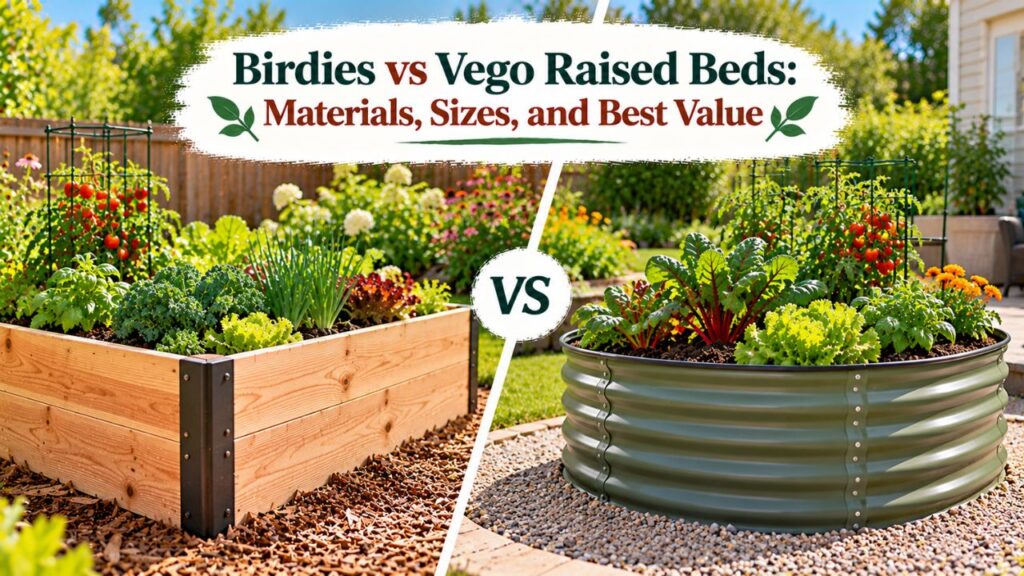
Both brands specialize in modular metal garden beds made from corrosion-resistant coated steel.
Their products share several design features, including removable panels, rounded corners, protective top edging, and open-bottom construction on standard ground-based models.
However, their available sizes, manufacturing details, accessories, and warranty terms differ.
| Feature | Birdies Raised Beds | Vego Raised Beds |
| Brand origin | Australia | United States-based brand |
| Steel | Australian BlueScope coated steel | VZ 2.0 coated steel in Classic models |
| Published panel thickness | 0.50 mm base metal thickness | 0.6 mm panels on selected Classic kits |
| Protective coating | Zinc, aluminum, and magnesium | Zinc, aluminum, magnesium, and protective paint |
| Common bed heights | 15 and 29 inches | 11, 17, 26, and 32 inches, depending on model |
| Modular configurations | Up to 6 on many current kits | Up to 10 on selected Classic kits |
| Protective edging | Rolled edge with safety trim | Rolled edge with protective trim |
| Construction | Bolt-together panels with internal bracing on modular models | Bolt-together panels with bracing according to model |
| Advertised lifespan | Long-term outdoor use | Up to 20+ years claimed for certain models |
| Published US warranty | Limited lifetime, subject to conditions | 2-year limited warranty against manufacturing defects |
| Accessories | Selected bed accessories | Extensive range of compatible garden systems |
These specifications reflect published manufacturer information. They do not represent independent measurements or a hands-on durability test.
The practical distinction: Birdies places more emphasis on Australian manufacturing, reinforced construction, and extended warranty coverage. Vego provides more choices for gardeners who want particular heights, configurations, colors, and integrated accessories.
Birdies vs Vego Raised Beds: Steel Quality and Construction
Steel quality is one of the most important considerations when buying a metal raised bed.
The panels must resist outward pressure from the soil, remain stable through seasonal temperature changes, and tolerate prolonged exposure to moisture.
Both brands use coated steel rather than ordinary untreated sheet metal.
Birdies Raised Bed Steel and Protective Coating
Birdies manufactures its raised garden beds in Australia using BlueScope steel.
Its current product specifications identify 24-gauge steel with a 0.50 mm base metal thickness (BMT).
Base metal thickness refers to the steel itself before the protective coating is included.
Birdies uses a zinc-aluminum-magnesium coating identified as ZAM 100.
The manufacturer describes this coating as providing corrosion protection for long-term outdoor use.
Structural details include:
- Corrugated steel panels
- Stainless steel fastening hardware
- Reinforced modular construction
- Internal bracing on applicable models
- Rolled upper edges
- Protective edge trim
For example, the Birdies Jumbo 15-inch raised bed specifications identify coated steel, internal bracing, stainless steel hardware, and five available configurations.
The combination of panel shape and structural bracing matters because the soil pushes against the sides of the bed.
A larger raised bed needs enough support to resist outward movement, particularly when the growing medium becomes wet.
Vego Raised Bed Steel and VZ 2.0 Coating
Vego Garden uses a proprietary material system called VZ 2.0 in its Classic raised garden beds.
This system combines zinc-magnesium-aluminum-coated steel with protective paint developed by AkzoNobel.
Vego identifies 0.6 mm steel panels on its standard 17-inch modular kits.
Its construction typically includes:
- Corrugated coated-steel panels
- Stainless steel fastening hardware
- Rounded corner panels
- Protective edge trim
- Bracing components where required
- Modular panels that can be rearranged into different configurations
The VZ 2.0 coating is designed to resist corrosion and outdoor weather exposure.
Vego also markets its Classic beds as having a potential service life exceeding 20 years under suitable conditions.
However, that is a manufacturer lifespan claim, not a guarantee that every garden bed will remain corrosion-free for two decades.
Is Vego Steel Thicker Than Birdies Steel?
Based on the published figures for the compared models, Vego lists a higher nominal panel thickness.
Birdies publishes 0.50 mm base metal thickness, while selected Vego Classic kits specify 0.6 mm panels.
However, these measurements may not represent identical measurement conventions.
A thicker steel panel does not automatically mean a stronger or longer-lasting complete raised bed.
Structural performance also depends on:
- Panel corrugation
- Steel grade
- Number and placement of braces
- Fastener strength
- Panel height and length
- Protective coating quality
- Assembly accuracy
Birdies includes structural reinforcement on its modular designs, while Vego also uses bracing systems on applicable kits.
Without controlled testing of comparable assembled beds, the published thickness figures alone cannot establish which brand is structurally superior.
Birdies vs Vego Raised Bed Sizes and Heights
Raised bed dimensions influence gardening comfort, soil costs, and the amount of available growing space.
Both manufacturers sell beds with several possible footprints.
The biggest difference is the selection of available heights.
Birdies Raised Bed Height Options
Birdies currently offers two primary heights in its US raised bed collection.
15-inch raised beds
These models suit gardeners who want a conventional raised vegetable bed without filling an unnecessarily tall frame.
A 15-inch bed can provide sufficient contained growing depth for many common vegetables, particularly when installed over suitable natural ground.
29-inch raised beds
These models elevate the planting surface substantially higher.
They can reduce the distance required to bend while planting, weeding, and harvesting.
However, taller beds require more growing material if filled completely.
Birdies offers rectangular modular kits and round raised beds in these height categories.
Vego Raised Bed Height Options
Vego offers a broader selection of heights across its Classic raised bed collection.
| Height | Typical Gardening Application |
| 11 inches | Compact, lower-profile beds |
| 17 inches | General vegetable and herb gardening |
| 26 inches | Taller growing areas with reduced bending |
| 32 inches | Standing-height gardening for some adults |
Availability depends on the specific model and configuration.
The 17-inch series is a popular general-purpose design, while the taller 26-inch and 32-inch options provide additional working height.
For gardeners who want an intermediate height between Birdies’ two standard options, Vego may be more suitable.
Which Brand Is Better for Waist-High Gardening?
Vego has a slight advantage in height selection because its Classic range includes a 32-inch option.
Birdies’ 29-inch beds may also work well for standing gardeners.
However, comfortable working height depends on the person’s height, arm length, and preferred gardening position.
A 32-inch bed is not automatically more comfortable than a 29-inch bed.
Before purchasing, measure a comfortable hand position while standing and compare it with the planned soil surface.
Remember that the soil surface may sit below the upper edge of the metal frame.
Birdies vs Vego Modular Garden Bed Configurations
Both brands use modular construction, which allows the same kit to be assembled into different shapes.
This flexibility helps gardeners adapt a raised bed to available backyard space.
Birdies Modular Design
Birdies offers several configurations depending on the selected kit.
Its current US collection includes Medium, Large, and Jumbo modular systems.
The Large modular kits provide six configurations, while the Jumbo kits provide five.
For example, Birdies’ Jumbo 15-inch kit can be arranged into these published dimensions:
- 8 × 2 feet
- 10 × 2 feet
- 6 × 4 feet
- 8 × 4 feet
- 6 × 6 feet
These options cover narrow beds, conventional rectangular beds, and larger square planting areas.
A 2-foot-wide configuration is especially useful when access is limited to one side or when the garden has narrow pathways.
Vego Modular Design
Vego’s Classic modular kits offer different numbers of configurations according to their size.
Available options include 4-in-1, 6-in-1, 9-in-1, and 10-in-1 systems.
For example, Vego’s 17-inch 9-in-1 kit supports nine configurations, including:
- 3.5 × 6.5 feet
- 2 × 8 feet
- 5 × 5 feet
- 2 × 6.5 feet
- 3.5 × 5 feet
- 3.5 × 3.5 feet
- 2 × 5 feet
- 2 × 3.5 feet
- 2 × 2 feet
Vego’s larger 10-in-1 model also offers configurations such as 4 × 8 feet and 6 × 6 feet.
The Vego 10-in-1 modular raised bed specifications provide the available layouts and their stated soil capacities.
Which Modular System Offers More Flexibility?
Vego generally offers more configuration choices within its larger modular kits.
This can be useful when designing a garden around fences, pathways, existing trees, or other landscaping features.
However, the number of possible configurations is not the only consideration.
A Birdies kit with five available layouts may already include the exact dimensions needed.
Choose the configuration you actually intend to build rather than paying extra solely for a larger number of possible arrangements.
Birdies vs Vego Raised Beds: Price and Overall Value
Pricing varies by bed height, footprint, model, color, and promotional offers.
Comparing a smaller Birdies kit against a larger Vego kit can produce misleading conclusions.
A more useful approach is to compare beds with the same planting footprint.
Comparing Similar 4-by-8-Foot Raised Beds
Two comparable options are the Birdies 15-inch Jumbo modular bed and the Vego 17-inch 10-in-1 modular bed.
Both offer a 4-by-8-foot configuration.
| Feature | Birdies Jumbo | Vego 10-in-1 |
| Selected footprint | 4 × 8 feet | 4 × 8 feet |
| Height | 15 inches | 17 inches |
| Growing area | 32 sq. ft. | 32 sq. ft. |
| Published soil capacity | 38.4 cu. ft. | 45 cu. ft. |
| Available kit configurations | 5 | 10 |
| Published US list price checked in October 2026 | $159 | $199.95 |
These are manufacturer-listed prices observed during research, not guaranteed checkout totals. Promotions, taxes, and shipping terms can change.
At these listed prices, Birdies costs approximately $40.95 less for the selected footprint.
However, Vego provides an additional 2 inches of frame height and more configuration choices.
The soil capacities are the manufacturers’ published figures and may reflect rounded dimensions or the particular shape of their frames.
Calculate Price Per Square Foot
Both beds provide 32 square feet of nominal planting area.
Using the listed frame prices:
Birdies: $159 ÷ 32 = approximately $4.97 per square foot.
Vego: $199.95 ÷ 32 = approximately $6.25 per square foot.
In this example, Birdies has the lower frame cost per square foot.
However, this calculation does not include soil, mulch, accessories, shipping, or applicable taxes.
It also does not account for differences in height or total growing volume.
Which Brand Has the Lower Total Installation Cost?
For a permanent raised garden bed, the metal frame is only part of the total cost.
Additional expenses may include:
- Topsoil and compost
- Delivery of growing material
- Mulch
- Protective hardware cloth
- Irrigation equipment
- Garden bed covers
- Optional trellises and support systems
A less expensive frame may not produce the lowest total project cost if it requires additional accessories or does not fit the intended garden layout.
Compare the complete setup before deciding which product offers better value.
Birdies vs Vego Soil Capacity and Filling Costs
Soil capacity is especially important when choosing taller raised beds.
Increasing the bed height increases the amount of material required if the entire frame is filled.
How Much Soil Does a Birdies Raised Bed Need?
For Birdies’ 15-inch Jumbo model in its 4-by-8-foot configuration, the manufacturer lists approximately 38.4 cubic feet of soil capacity.
That equals approximately 1.42 cubic yards.
A taller 29-inch version with the same nominal footprint requires substantially more material when completely filled.
The additional volume can increase both delivery costs and the amount of physical work required to establish the bed.
How Much Soil Does a Vego Raised Bed Need?
Vego lists approximately 45 cubic feet of soil capacity for the 17-inch 10-in-1 model configured at 4 by 8 feet.
That equals approximately 1.67 cubic yards.
Compared with the Birdies 15-inch example, the Vego bed has roughly 6.6 additional cubic feet of stated capacity.
That is equivalent to approximately five extra 1.5-cubic-foot bags when rounded up to whole bags.
The additional depth may be useful, but it also increases filling costs.
Can You Save Soil in Taller Metal Raised Beds?
Yes, depending on the bed’s design and the plants being grown.
In a deep, open-bottom bed, a suitable lower layer of organic material may reduce the amount of purchased soil needed.
However, unfinished organic material can settle substantially as it decomposes.
Plants still require sufficient growing soil in the upper root zone.
For tall beds, follow the manufacturer’s filling guidance and account for long-term settling.
Vego also offers soil-saving accessories for selected taller models, but compatibility must be verified before purchase.
An accessory that changes the location of the growing medium must provide appropriate structural support and drainage.
Birdies vs Vego Raised Beds: Rust Resistance and Durability
Both manufacturers use protective steel coatings intended to slow corrosion.
However, no coated steel garden bed is completely immune to environmental damage.
Service life depends on the coating, drainage, soil chemistry, installation, and local conditions.
Will Birdies Raised Beds Rust?
Birdies steel contains protective zinc, aluminum, and magnesium coating components that help resist corrosion.
However, rust can eventually develop if protective surfaces are damaged or exposed to unfavorable conditions for long periods.
Possible problems include:
- Deep scratches reaching exposed steel
- Persistent contact with excessively wet material
- Aggressive soil chemistry
- Corrosive salts
- Damaged panel edges
- Improper installation
Birdies’ Australian manufacturing history and published material specifications are relevant when evaluating long-term product quality.
However, manufacturing origin alone does not establish how long an individual bed will last.
Will Vego Raised Beds Rust?
Vego’s VZ 2.0 system also uses protective metal coatings and paint.
These coatings are designed for prolonged outdoor exposure.
The manufacturer advertises a potential lifespan exceeding 20 years for certain Classic models.
Actual longevity still depends on the environment and how well the protective finish remains intact.
Inspect scratches, damaged edges, and fastener connections periodically.
Avoid using harsh cleaning methods that could damage the protective coating.
Which Brand Lasts Longer?
There is not enough directly comparable independent long-term testing to conclude that one brand consistently lasts longer than the other.
Birdies has a longer-established manufacturing history, while Vego publishes specific claims about its VZ 2.0 corrosion-resistant materials.
Neither factor alone proves superior real-world service life.
For durability, consider the complete construction, coating protection, warranty terms, and expected local conditions rather than comparing steel thickness alone.
Birdies vs Vego Warranty Coverage
Warranty protection is an important difference between the brands.
However, warranty duration should not be confused with expected product lifespan.
Birdies Limited Lifetime Warranty
Birdies currently advertises a limited lifetime warranty on its US raised garden beds.
This is a meaningful consideration for shoppers who want longer-term manufacturer backing.
However, limited lifetime coverage does not necessarily mean unrestricted free replacement for the entire life of the product.
Eligibility, exclusions, claim procedures, and potential customer contributions can apply.
Review the complete written warranty before purchasing.
Vego Two-Year Limited Warranty
Vego Garden’s published US warranty terms currently specify a two-year limited warranty against manufacturing defects in materials and workmanship for its garden bed categories.
The policy includes conditions regarding proper installation, maintenance, proof of purchase, and eligible claims.
Normal cosmetic wear and certain forms of misuse or environmental damage are not automatically covered.
Vego’s advertised potential lifespan of 20 years or more is separate from the written warranty period.
Which Warranty Is Better?
Birdies offers the longer advertised coverage period.
That may be an important reason to choose Birdies for a permanent garden installation.
However, compare what each warranty actually covers rather than assuming the longer period guarantees a better replacement outcome.
Both warranties have conditions and exclusions, and their terms may change.
Birdies vs Vego Assembly and Installation
Both brands use bolt-together modular panels that must be assembled before filling.
Neither requires advanced construction skills for a standard installation, but larger beds involve more panels, connections, and handling.
Installing Birdies Raised Beds
Birdies modular beds use steel panels joined with stainless steel fasteners.
The manufacturer includes protective edge components and structural reinforcement on applicable models.
A practical assembly sequence is:
- Select the desired configuration.
- Lay the panels out on a level surface.
- Connect adjacent panels using the supplied hardware.
- Install the required structural braces.
- Check the frame alignment.
- Secure the fasteners according to the instructions.
- Fit the protective edging.
- Position the frame and fill it with soil.
Larger beds are easier to assemble and move with assistance.
Avoid dragging assembled panels across rough pavement because this can damage the protective finish.
Installing Vego Raised Beds
Vego uses a similar panel-and-fastener approach.
The manufacturer advertises assembly times around 40 minutes for certain modular kits.
Actual assembly time depends on the selected layout, experience, tools, and installation conditions.
The process involves arranging the panels, fastening them together, installing required braces, and applying the protective top trim.
Check whether the selected kit includes everything needed for the intended configuration.
Which Brand Is Easier to Assemble?
Neither brand has a clear universal advantage based on published assembly information.
Both use manageable modular construction.
Vego provides detailed configuration options and supporting instructions, while Birdies uses a relatively straightforward reinforced panel system.
The number of fasteners, included braces, and overall dimensions are more useful comparisons than manufacturer assembly-time estimates.
Birdies vs Vego Raised Beds for Hot Weather
Metal raised beds can become warm when exposed to direct sunlight.
However, the temperature of the outer steel surface is not necessarily the same as the temperature throughout the soil.
Both brands use coated steel finishes that can reflect some incoming sunlight.
Do Birdies Metal Raised Beds Get Too Hot?
Birdies states that its raised beds are suitable for hot Australian conditions.
The soil inside a raised bed provides thermal mass and can moderate rapid temperature changes away from the sidewalls.
However, the metal surface can still become warm in direct sunlight.
Soil temperature depends on sunlight, bed color, moisture, mulch, and the surrounding climate.
Do Vego Metal Raised Beds Get Too Hot?
Vego also emphasizes the reflective properties of its coated-steel system.
However, no metal raised bed can guarantee ideal root temperatures during extreme heat.
The upper soil layer and the area close to sun-exposed sidewalls may become warmer than the center.
Mulch, consistent watering, and appropriate shade can help protect plants during hot weather.
Which Brand Is Better for Hot Climates?
Neither brand can be declared the winner without comparable temperature measurements under the same conditions.
For hot regions, consider choosing a lighter-colored finish.
Also pay attention to soil depth, irrigation, and moisture retention.
A well-maintained bed with suitable soil and mulch may perform better than a poorly watered bed regardless of brand.
Birdies vs Vego Raised Beds for Vegetable Gardening
Both brands can support common vegetables when the bed provides adequate rooting space, soil quality, drainage, and sunlight.
The metal frame itself does not guarantee better harvests.
Growing Tomatoes and Peppers
Tomatoes and peppers need adequate root volume, consistent moisture, and suitable nutrients.
Both Birdies and Vego offer depths that can support these crops.
For an open-bottom bed installed over healthy natural soil, roots may continue growing beneath the frame.
A taller bed may be useful where greater contained growing depth is needed.
However, a taller metal frame does not automatically increase yields.
Growing Lettuce, Spinach, and Herbs
Leafy greens and many culinary herbs can grow well in either brand’s standard-height beds.
A 15-inch Birdies bed or 17-inch Vego bed provides a practical growing depth for these crops.
The main considerations are comfortable access, adequate watering, and avoiding unnecessary soil expenses.
Growing Carrots and Root Vegetables
Carrots, beets, and other root vegetables benefit from a loose growing medium without restrictive layers.
Both brands can provide suitable growing conditions.
For long carrot varieties, the depth of workable soil matters more than the brand printed on the frame.
A shorter open-bottom bed may still provide adequate rooting space if the underlying soil is suitable.
Vego vs Birdies Raised Bed Accessories and Expansion
Accessories can affect the value of a raised bed system, particularly when a gardener wants to add irrigation or protective structures.
Birdies Accessories and Customization
Birdies focuses primarily on durable modular steel garden bed systems.
Its raised beds offer flexible layouts, and gardeners can use suitable third-party supports, irrigation equipment, and protective covers.
However, not every accessory is designed specifically for every Birdies configuration.
Measure the bed carefully before purchasing hoops, trellises, or fitted covers.
Vego Garden Accessories
Vego offers a larger integrated product ecosystem.
Depending on the selected bed series, compatible accessories can include:
- Trellis and plant support systems
- Mesh garden covers
- Greenhouse-style frost covers
- Irrigation products
- Soil-saving accessories
- Garden bed extensions
- Planting and organizing accessories
This can be useful for gardeners who want a coordinated installation.
However, compatibility varies among Vego’s Classic, Modern, and other product lines.
Do not assume that every Vego accessory fits every Vego raised bed.
Which Brand Is Better for a Complete Garden Setup?
Vego has an advantage for gardeners who want to purchase matching accessories from the same manufacturer.
Birdies remains a practical choice when the main priority is a durable steel frame and conventional gardening equipment will be purchased separately.
Which Is Better: Birdies or Vego Raised Beds?
The better choice depends on how the raised bed will be used.
Neither manufacturer’s marketing claims should replace an assessment of the actual dimensions, price, construction, and warranty.
Choose Birdies Raised Beds If You Want
- Australian-made steel garden beds
- BlueScope steel with published coating specifications
- Reinforced modular construction
- A 15-inch or 29-inch frame
- A longer advertised limited warranty
- A relatively simple selection of modular and round beds
- Competitive pricing on certain comparable footprints
Birdies is particularly appealing when the selected model already provides the desired size and height.
Choose Vego Raised Beds If You Want
- More height options across the Classic collection
- Multiple modular configurations
- A wider range of colors and design choices
- Matching irrigation and garden cover accessories
- Extra-tall standing-height options
- Flexible layouts for unusual garden spaces
- An integrated system that can be expanded with compatible products
Vego is a strong choice for gardeners who prioritize design flexibility and coordinated accessories.
My Recommendation for Different Gardeners
| Gardening Priority | More Suitable Choice | Main Reason |
| Value in the compared 4 × 8 ft models | Birdies | Lower observed frame price |
| Longer advertised warranty | Birdies | Limited lifetime coverage |
| Australian manufacturing | Birdies | Manufacturer identifies Australian production |
| Wider height selection | Vego | More published height options |
| Maximum modular flexibility | Vego | Up to 10 layouts on selected kits |
| Matching accessories | Vego | Larger integrated accessory range |
| Standing-height gardening | Either | Depends on comfortable working height |
| Basic vegetable gardening | Either | Both support appropriate growing conditions |
For a straightforward permanent vegetable garden, Birdies deserves serious consideration because of its construction details, price positioning, and extended warranty.
For a customized garden with taller beds, matching accessories, and several possible layouts, Vego may justify its additional cost.
Conclusion
The Birdies vs Vego raised beds comparison comes down to construction preferences, garden layout, budget, and warranty expectations.
Both manufacturers offer corrosion-resistant steel beds that can support vegetables, herbs, and flowers for many growing seasons.
Birdies stands out for its Australian manufacturing, reinforced modular designs, and longer advertised limited warranty. It also offers competitive pricing on certain comparable models.
Vego stands out for its broader height selection, flexible modular configurations, and extensive range of compatible gardening accessories.
Neither brand has been conclusively shown to outperform the other in long-term durability under identical real-world conditions.
For a conventional backyard vegetable garden where the chosen dimensions fit, Birdies is a strong value option. For a more customized system requiring particular heights and accessories, Vego offers greater flexibility.
Before making the final purchase, compare matching footprints, calculate soil requirements, and confirm the current price and written warranty terms.
FAQs About Birdies vs Vego Raised Beds
Are Birdies raised beds better quality than Vego?
Not necessarily. Both brands use corrosion-resistant coated steel and reinforced modular construction. Birdies emphasizes Australian BlueScope steel and its manufacturing history, while Vego uses its VZ 2.0 material system. There is insufficient directly comparable independent testing to establish one brand as universally higher quality.
Are Vego raised beds thicker than Birdies?
Selected Vego Classic kits list 0.6 mm steel panels, while Birdies publishes 0.50 mm base metal thickness for its current modular beds. However, the measurement conventions differ, and thickness alone does not determine structural strength or durability.
Which raised garden bed brand lasts longer?
There is no verified universal winner. Both brands design their metal raised beds for long-term outdoor use. Actual lifespan depends on protective coating condition, soil chemistry, drainage, local climate, and proper installation.
Are Birdies and Vego raised beds safe for growing vegetables?
Both manufacturers market their coated-steel beds as suitable for edible gardening. Their standard metal raised beds are intended for growing vegetables, fruits, and herbs. Proper soil selection, avoiding contaminated fill, and maintaining the protective finish remain important.
Is Birdies cheaper than Vego Garden?
Birdies can be less expensive for certain comparable configurations. For example, its 15-inch Jumbo 4-by-8-foot option had a lower listed frame price than Vego’s 17-inch 10-in-1 option in the checked manufacturer listings. Actual value depends on the selected model, discounts, and included features.
Do Birdies and Vego raised beds have bottoms?
Their standard ground-based modular beds generally have open bottoms. This permits drainage and allows roots to grow into suitable native soil. Elevated planter models and specialty systems may use different bottom designs.
Which is better for a small backyard, Birdies or Vego?
Both brands offer compact configurations. Birdies may be preferable when a simple rectangular or round bed fits the available space. Vego may be more useful when several modular layouts or a particular height are needed to work around existing garden features.

I’m Maya L. Greenwood, a lifelong plant lover who believes anyone can grow something beautiful with the right guidance. After years of testing soil mixes, pruning methods, irrigation tricks, and pest-safe solutions, I started EasyGardenTips.com to turn hard-won lessons into step-by-step advice. From seed starting and container gardens to composting and seasonal checklists, my goal is to make gardening simple, sustainable, and fun.