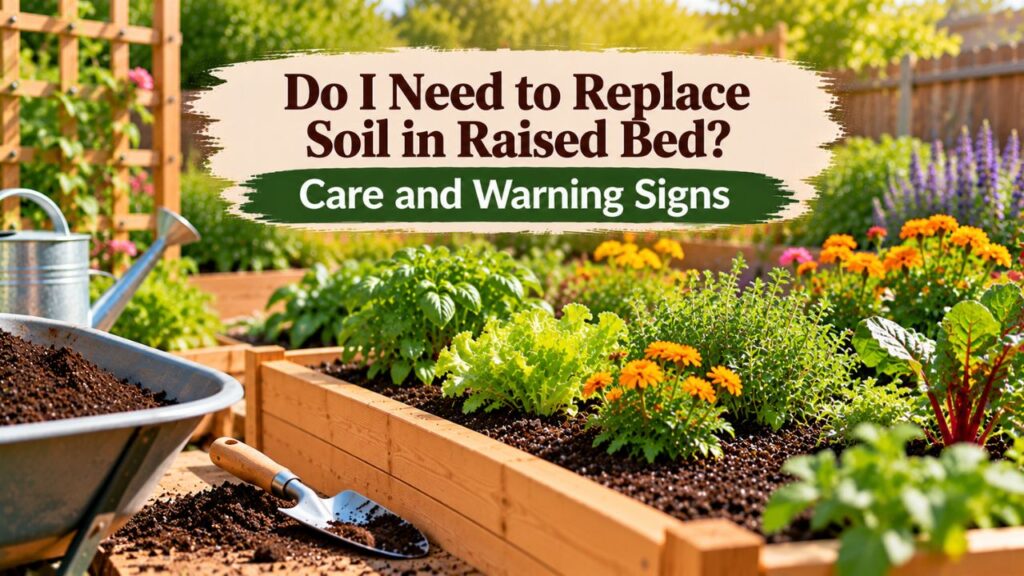
Do I Need to Replace Soil in Raised Bed? Care and Warning Signs
No, you generally do not need to replace the soil in your raised bed every year. Healthy raised bed soil can remain productive for many years when you maintain its organic matter, nutrient levels, drainage, and overall structure. In most cases, adding compost or fresh soil when needed is enough to prepare the bed for another growing season.
However, raised bed soil changes over time. Organic materials slowly decompose, nutrients are removed through harvesting, and the soil level may drop as the mixture settles. These changes are normal and don’t automatically mean the existing soil is unusable.
The situation becomes different when soil contains harmful contaminants, develops persistent disease problems, or suffers from severe physical conditions that cannot be corrected easily.
Understanding the difference between soil that needs refreshing and soil that genuinely requires replacement can save money and prevent unnecessary work.
Before removing your existing growing medium, examine its condition, consider how your plants performed, and identify the actual problem. Most established raised beds benefit more from targeted improvements than from a complete soil change.
Do I Need to Replace Soil in Raised Bed Every Year?
No. Annual soil replacement is unnecessary for most established raised garden beds.
Good garden soil contains mineral particles, organic matter, microorganisms, and pore spaces that help support plant roots. These basic components don’t disappear after one growing season.
Plants remove nutrients as they grow, but nutrients can often be replenished through appropriate compost or fertilizer applications.
Likewise, organic matter gradually breaks down, but it can be maintained without removing the existing mineral soil.
The University of Minnesota Extension’s raised bed gardening guidance treats established raised beds as permanent growing areas and recommends soil testing every two to three years, followed by amendments based on the results.
That approach is more practical than emptying and refilling a healthy bed each spring.
How Long Does Raised Bed Soil Last?
Well-maintained mineral-based raised bed soil can remain useful indefinitely. There is no fixed expiration date.
However, the lifespan of individual ingredients varies.
- Mineral topsoil: Sand, silt, and clay remain part of the growing medium rather than disappearing through normal decomposition.
- Finished compost: Organic matter continues breaking down and needs periodic replenishment.
- Bark-based materials: Gradually decompose, sometimes causing noticeable settling.
- Peat and coconut coir: Can change their physical structure as they age, particularly in heavily organic growing mixes.
A permanent open-bottom raised bed filled with good mineral soil and compost often needs less major renewal than a contained planter filled mostly with decomposable organic materials.
The condition of the growing medium matters more than its age.
What Happens If You Never Refresh Raised Bed Soil?
Raised bed soil may gradually become less productive if its condition is ignored.
Common changes include:
- Declining availability of certain nutrients
- Lower organic matter content
- Surface crusting or compaction
- Changes in soil pH
- Reduced soil volume from settling
- Poor moisture management
However, these problems do not all require replacement.
A soil test, suitable amendments, or improved watering practices can often restore acceptable growing conditions.
When Should You Actually Replace Raised Bed Soil?
Complete replacement is usually a last resort rather than a routine gardening task.
Some problems are easier to correct than others. The following comparison helps distinguish situations where refreshing is appropriate from those requiring further investigation.
| Soil Condition | Best Initial Action | Full Replacement Needed? |
| Soil level has dropped | Add suitable growing medium | Usually no |
| Nutrients are depleted | Test and amend soil | Usually no |
| Soil is compacted | Loosen and improve structure | Usually no |
| Soil dries too quickly | Improve organic matter and watering | Usually no |
| Drainage is poor | Check soil and bed drainage | Sometimes |
| Repeated plant diseases | Identify the disease and manage it | Sometimes |
| Harmful contamination | Test and obtain remediation guidance | May be necessary |
| Organic potting mix has severely degraded | Evaluate and renew the growing medium | Sometimes |
When Soil Contains Harmful Contaminants
Contamination is one of the strongest reasons to consider replacing or isolating raised bed soil.
Possible sources include:
- Lead-based paint from older buildings
- Chemical spills
- Industrial waste
- Certain persistent herbicides
- Unknown construction fill
- Contaminated imported topsoil
These substances may remain in the soil even after compost or fertilizer is added.
The University of Maryland Extension’s guidance on lead in garden soils explains the risks associated with lead contamination and provides recommendations for gardening in affected locations.
Important: If contamination is suspected, don’t assume adding fresh soil on top makes the bed safe for vegetables. Arrange appropriate testing and seek guidance on isolation, remediation, or replacement.
Contaminated soil should also be handled and disposed of according to the relevant local requirements.
When Raised Bed Soil Has Persistent Plant Diseases
Some soilborne pathogens can remain in garden soil between growing seasons.
Examples include pathogens associated with Fusarium wilt, Verticillium wilt, and certain root diseases.
However, a diseased plant doesn’t automatically mean the soil must be replaced.
Yellow leaves, wilting, and poor growth can also result from underwatering, excess moisture, nutrient problems, or heat stress.
Before considering replacement:
- Identify the affected plants and symptoms.
- Check watering and drainage conditions.
- Obtain a diagnosis when a soilborne disease is suspected.
- Remove infected plant material appropriately.
- Consider crop rotation, resistant varieties, or other disease-specific management methods.
Replacing the upper layer of soil may not eliminate a pathogen that survives in deeper soil or the underlying ground.
For severe, confirmed problems in contained raised beds, replacing the growing medium may form part of a broader disease-management plan.
When Soil Drainage Cannot Be Corrected Easily
Poor drainage can affect root health, but it doesn’t always require new soil.
First, determine why the bed remains wet.
Possible causes include:
- Dense, compacted soil
- A clogged drainage outlet
- Impermeable material beneath the growing medium
- Poorly drained native ground
- A soil mixture with insufficient air space
Loosening compacted areas and correcting drainage restrictions may resolve the problem.
If the raised bed contains an unsuitable, heavily compacted growing medium that cannot be improved effectively, partial or complete replacement may be reasonable.
Correct the underlying drainage problem before adding fresh soil. Otherwise, the same issue may return.
How to Refresh Raised Bed Soil Without Replacing It
Refreshing the existing growing medium is usually the most practical way to maintain raised beds between planting seasons.
The process involves assessing the soil, removing unwanted debris, restoring organic matter when needed, and correcting any identified nutrient or drainage issues.
Step 1: Remove Old Plants and Unwanted Debris
After harvesting, clear away spent annual plants and troublesome weeds.
Remove:
- Dead vegetable stems
- Persistent weed roots
- Diseased plant material
- Plastic ties and garden debris
- Large undecomposed materials that interfere with planting
Healthy plant material can often be composted, depending on the composting system.
Avoid putting diseased material into a home compost pile if the composting process cannot reliably manage the associated pathogen.
You don’t need to remove every fine root from healthy harvested plants. Many small roots naturally decompose in the soil.
Step 2: Check the Existing Soil Condition
Examine the soil before adding amendments.
Take a handful of slightly moist soil and squeeze it.
Healthy, workable soil should contain small aggregates and break apart under gentle pressure.
Pay attention to whether it:
- Feels excessively hard or compacted
- Remains saturated for long periods
- Dries out unusually quickly
- Contains large, dense clods
- Has developed a hard surface crust
These observations help identify physical problems.
However, soil appearance alone cannot confirm nutrient deficiencies or chemical contamination.
Step 3: Add Finished Compost When Needed
Compost helps maintain soil organic matter and can improve soil structure.
For many established vegetable beds, a modest surface application is sufficient when additional organic matter is needed.
Approximately ½–1 inch of finished compost can be a practical maintenance amount, but it is not necessary every season for every bed.
Apply less or skip the amendment if your soil already has high organic matter or excessive nutrient levels.
Spread the compost evenly rather than piling it around plant stems.
Avoid automatically adding large amounts of compost every year. Heavy, repeated applications can lead to excessive phosphorus or soluble salt levels, especially when using manure-based compost.
Step 4: Loosen Compacted Soil Gently
If the soil is compacted, use a garden fork to loosen it without unnecessary deep turning.
Insert the fork into the soil and gently rock it backward.
Avoid repeatedly flipping the entire growing layer.
Excessive digging can disrupt established soil aggregates and bring buried weed seeds to the surface.
Don’t work the soil when it is saturated, particularly if it contains substantial clay.
Step 5: Correct Nutrient Problems Based on Soil Testing
If plants have grown poorly or the bed has received repeated fertilizer applications, consider laboratory testing.
A standard soil test can help evaluate:
- Soil pH
- Phosphorus levels
- Potassium levels
- Other nutrients included in the laboratory’s test
- Relevant amendment recommendations
Follow the recommendations instead of applying a general fertilizer without knowing what is missing.
A soil test is especially helpful when the same bed has been used for intensive vegetable production over several seasons.
Step 6: Water and Prepare the Bed for Planting
After making the necessary improvements, water the soil gently.
Allow the surface to settle before sowing seeds or transplanting.
If the soil is already loose and in good condition, avoid disturbing it more than necessary.
A suitable mulch can help protect the surface after planting.
How Much Compost Should You Add to Old Raised Bed Soil?
The amount depends on the bed’s surface area and the condition of the existing soil.
For a maintenance application, a thin layer is often more appropriate than repeating the large compost quantities used when initially filling the bed.
Compost Volume for Common Raised Bed Sizes
The following table shows the volume needed to spread compost at depths of ½ inch and 1 inch.
| Raised Bed Size | ½-Inch Layer | 1-Inch Layer |
| 3 × 3 feet | 0.38 cu. ft. | 0.75 cu. ft. |
| 3 × 6 feet | 0.75 cu. ft. | 1.50 cu. ft. |
| 4 × 4 feet | 0.67 cu. ft. | 1.33 cu. ft. |
| 4 × 8 feet | 1.33 cu. ft. | 2.67 cu. ft. |
| 4 × 10 feet | 1.67 cu. ft. | 3.33 cu. ft. |
These are volume calculations, not mandatory annual compost recommendations.
For example, a 4 × 8-foot raised bed needs approximately 2.67 cubic feet of compost to cover the surface with a 1-inch layer.
If the bed already has nutrient-rich soil, adding that much compost may be unnecessary.
Should You Mix Compost Into the Old Soil?
Not always.
For an established raised bed with good structure, compost can be spread over the surface and allowed to integrate gradually.
Shallow incorporation may be useful when preparing a new planting area, but deep digging is usually unnecessary.
Avoid disturbing established perennial roots.
For vegetable beds, apply compost before planting or carefully around growing plants when needed.
Why Does Raised Bed Soil Sink Every Year?
Soil settling is common, especially in new raised beds.
A noticeable drop in soil level doesn’t necessarily indicate that the soil has become unusable.
Several processes contribute to settling.
Organic Materials Break Down
Compost, bark, leaves, and other organic ingredients continue decomposing after being added to the bed.
As these materials break down, they can occupy less space.
Raised beds containing large amounts of loosely packed organic material may experience more noticeable settling than beds containing substantial mineral topsoil.
Loose Soil Consolidates After Watering
When a new bed is filled, larger air spaces may remain between soil particles and aggregates.
Watering and natural settling reduce some of these spaces.
This can lower the soil level without indicating any serious problem.
Some Soil Is Lost Through Erosion or Removal
Heavy rain can carry small amounts of soil away from poorly protected beds.
Soil may also be removed unintentionally with harvested roots, weeds, and garden debris.
Over several growing seasons, these losses may become noticeable.
How to Top Up a Raised Bed That Has Settled
Measure how much additional soil is needed before purchasing materials.
For a rectangular raised bed:
Additional Soil (cubic feet) = Length (feet) × Width (feet) × Missing Depth (feet)
For example, a 4 × 8-foot bed that has settled by 2 inches requires:
4 × 8 × (2 ÷ 12) = 5.33 cubic feet
Use suitable mineral topsoil, a balanced raised bed mix, or compost according to what the existing soil needs.
If the soil is already high in organic matter, adding more mineral topsoil may be more appropriate than repeatedly topping it up with pure compost.
How Often Should You Test Raised Bed Soil?
For an established, productive vegetable raised bed, testing approximately every two to three years is a reasonable maintenance schedule.
Testing may be needed sooner when plants show unexplained symptoms or when repeated amendments have been added.
Soil tests are particularly useful before adding lime, sulfur, phosphorus, or large amounts of fertilizer.
Signs That a Soil Test May Be Helpful
Consider testing when:
- Several crops show unexplained poor growth
- Soil pH may be outside the preferred range
- Heavy fertilizer applications have been used
- Large amounts of manure compost were added previously
- You are unsure whether the soil needs additional nutrients
Keep in mind that a standard fertility test does not necessarily detect pesticides, heavy metals, or plant pathogens.
Those problems may require specialized testing.
Should You Replace Raised Bed Soil Before Planting Each Spring?
Usually not.
Spring preparation should focus on restoring suitable growing conditions rather than removing the previous year’s soil.
A simple preparation routine can include:
- Remove remaining weeds and unwanted plant debris.
- Examine the soil structure and moisture condition.
- Review recent soil test results or arrange testing if needed.
- Add compost or fertilizer only when appropriate.
- Replenish any significant loss of soil volume.
- Gently level the bed and prepare planting areas.
Avoid working wet soil, especially in early spring when clay-containing mixtures may still be saturated.
If the soil remains loose, fertile, and well-drained, minimal preparation may be enough.
Is Fall Better Than Spring for Refreshing Soil?
Both seasons can work.
Fall offers an opportunity to clear finished crops, apply appropriate organic matter, and protect the bed with mulch.
Spring is a useful time to inspect winter damage, check drainage, and make final adjustments before planting.
The better choice depends on local weather, soil moisture, and planting schedules.
There’s no need to repeat the same full amendment process in both seasons unless the soil genuinely requires it.
Can Old Raised Bed Soil Be Reused for Different Plants?
Yes, healthy raised bed soil can generally be reused for different vegetables, herbs, and flowers.
Changing crops doesn’t require replacing the growing medium.
However, crops vary in their nutrient requirements, rooting habits, and susceptibility to soilborne diseases.
Reusing Soil After Growing Tomatoes
Soil used for tomatoes can support another crop if its drainage, fertility, and health remain suitable.
Tomatoes are susceptible to several diseases, but their presence alone doesn’t mean the soil is contaminated.
If the plants were healthy, remove the spent stems and prepare the bed for the next crop.
If they developed a confirmed soilborne disease, choose the next crop with that disease in mind.
Crop rotation and disease-resistant varieties may be more effective than replacing a small amount of surface soil.
Reusing Soil After Growing Leafy Greens
Soil used for lettuce, spinach, and other leafy greens can generally be reused.
Check whether additional nutrients are needed before starting a new crop.
Avoid adding high-nitrogen fertilizer automatically, especially if a recent soil test indicates adequate fertility.
Reusing Soil for Flowers and Herbs
Existing raised bed soil can also support flowers and herbs when the conditions match their needs.
Some herbs prefer relatively lean, well-drained soil, while certain flowers benefit from greater moisture and nutrient availability.
Adjust the growing conditions for the selected plants rather than replacing all the soil.
How to Keep Raised Bed Soil Healthy for Years
Maintaining soil structure and balanced fertility helps reduce the need for major renovation.
A few consistent practices are usually more effective than frequent replacement.
Avoid Walking on the Growing Area
Foot traffic compresses soil and reduces pore spaces.
Design beds so the center can be reached from surrounding paths.
Use garden forks and hand tools gently rather than repeatedly disturbing deeper layers.
Maintain a Protective Mulch Layer
Organic mulch reduces direct exposure to heavy rainfall, temperature changes, and drying conditions.
Clean straw and shredded leaves are common choices for vegetable beds.
Keep mulch away from direct contact with plant stems to reduce moisture-related problems around their bases.
Manage Watering Carefully
Raised beds often dry faster than surrounding ground-level soil.
Check moisture below the surface rather than watering solely according to the appearance of the top layer.
Overwatering can reduce oxygen availability around roots, while repeated severe drying can stress plants and affect the behavior of some organic growing materials.
Rotate Crops When Practical
Changing where related crops grow can help manage certain pests and diseases.
For small raised beds, full rotation may be difficult, but planting different crop families or resistant varieties can still be useful.
Rotation isn’t a substitute for diagnosing a serious disease problem.
Use Fertilizer According to Plant Needs
Don’t assume that older soil always needs more fertilizer.
Excess nutrients can create problems just as deficiencies can.
A soil test and the requirements of the intended crop should guide amendment decisions.
Conclusion
If you’re asking do i need to replace soil in raised bed, the answer is generally no. Healthy mineral-based raised bed soil can support plants for many years without complete replacement.
Most established beds need occasional compost, suitable nutrient management, and small amounts of additional soil to compensate for settling.
Poor plant growth, compaction, and reduced fertility often have manageable causes that don’t justify emptying the entire bed.
Replacement becomes more appropriate when the growing medium contains harmful contaminants, has severely deteriorated, or requires a disease-specific corrective plan.
Before buying new soil, check the condition of what you already have. Refreshing suitable soil is usually less expensive, less labor-intensive, and better for preserving established soil structure.
FAQs About Do I Need to Replace Soil in Raised Bed
How Many Years Can You Use the Same Soil in a Raised Bed?
You can use suitable mineral-based raised bed soil for many years, potentially indefinitely, with proper maintenance. Add amendments when needed, monitor drainage, and test fertility periodically instead of replacing everything on a fixed schedule.
Should I Remove Old Soil Before Adding Compost?
No. You normally don’t need to remove old soil before adding compost. Spread mature compost over the surface or incorporate it lightly when appropriate. Remove soil only when there is a specific reason, such as confirmed contamination or an unsuitable growing medium.
Can I Add New Soil on Top of Old Raised Bed Soil?
Yes. Adding suitable new soil is a practical way to restore the fill level after settling. Choose a material compatible with the existing soil, and avoid creating a sharp layer of dense soil that interferes with drainage or root growth.
Does Raised Bed Soil Lose Nutrients Every Year?
Plants remove nutrients during growth, and some nutrients can be lost through leaching. However, nutrient loss does not mean the soil itself needs replacement. A soil test can identify which nutrients need replenishment.
Should I Replace Raised Bed Soil After Growing Tomatoes?
Not automatically. If the tomato plants were healthy, the soil can usually be reused. If they suffered from a confirmed soilborne disease, select appropriate disease-management measures before planting another susceptible crop.
What Should I Do if My Raised Bed Soil Is Hard and Compacted?
First, check the soil’s moisture condition and drainage. When it’s workable, gently loosen compacted areas with a garden fork. Add mature compost if additional organic matter is needed, and prevent further compaction by keeping foot traffic outside the bed.
Is It Better to Replace Raised Bed Soil or Add Compost?
For healthy established raised beds, adding compost when needed is generally preferable to replacing all the soil. Complete replacement is more appropriate when a serious problem cannot be corrected through ordinary soil management.

I’m Maya L. Greenwood, a lifelong plant lover who believes anyone can grow something beautiful with the right guidance. After years of testing soil mixes, pruning methods, irrigation tricks, and pest-safe solutions, I started EasyGardenTips.com to turn hard-won lessons into step-by-step advice. From seed starting and container gardens to composting and seasonal checklists, my goal is to make gardening simple, sustainable, and fun.