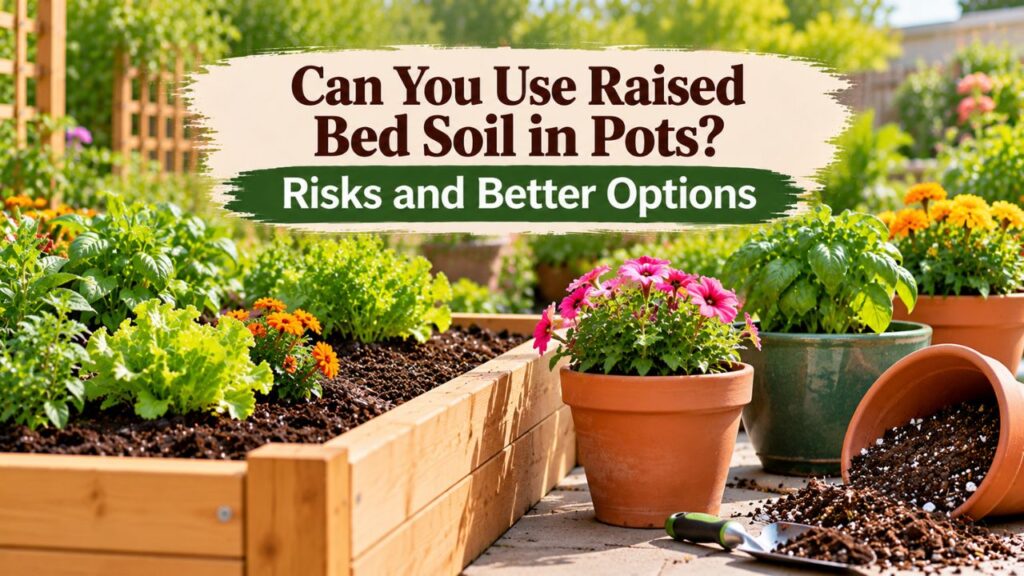
Can You Use Raised Bed Soil in Pots? Risks and Better Options
Yes, you can use raised bed soil in pots if the mixture is lightweight, well-aerated, and drains properly. However, many raised-bed soil products contain mineral topsoil and compost, making them too dense for smaller containers. A quality potting mix is generally the more reliable choice for plants grown in pots.
Raised beds and plant pots may look similar, but their growing conditions are different. Most traditional raised beds allow excess water to move into the ground beneath them. Pots have limited soil volume, enclosed sides, and drainage openings that must handle excess water.
Using the wrong growing medium can lead to compacted soil, poor root aeration, and prolonged wetness around plant roots.
Still, you don’t necessarily have to discard leftover raised-bed soil. Some commercial mixtures work in containers, while others may be usable in limited amounts when combined with appropriate potting materials.
The key is understanding what’s inside the bag, how the mixture handles water, and whether it provides suitable conditions for your particular plants.
When Can You Use Raised Bed Soil in Pots?
Raised bed soil can work in pots when its ingredients and physical structure are suitable for container growing.
The product name alone doesn’t determine whether it will perform well. Some raised-bed mixes contain mostly lightweight organic materials, while others include substantial amounts of natural topsoil.
When Raised Bed Soil Is Suitable for Containers
A raised-bed mix may be suitable for pots when it has the following characteristics:
- Contains lightweight ingredients such as coconut coir, peat, perlite, or composted bark.
- Has a loose texture that allows air to reach plant roots.
- Drains excess water without remaining saturated for long periods.
- Does not become hard or densely compacted after watering.
- Is specifically labeled as suitable for pots, planters, or container gardening.
A product marketed for both raised beds and containers is a reasonable option when its ingredients match the needs of the plants being grown.
However, proper watering and drainage are still necessary.
When Raised Bed Soil Should Not Be Used in Pots
Avoid filling ordinary plant pots with raised-bed soil that contains large amounts of heavy mineral topsoil.
These mixtures may perform well in open-bottom garden beds but behave differently inside enclosed containers.
Potential problems include:
- Water remaining trapped in fine soil pores.
- Reduced oxygen availability around roots.
- Compaction after repeated watering.
- Excessive container weight.
- Poor root development.
- Increased risk of root damage from prolonged saturation.
According to the University of Maryland Extension’s container gardening guidance, garden soil is generally too dense for container growing because its small pore spaces restrict water movement and root aeration.
The guidance favors lightweight soilless media for most container applications.
Raised Bed Soil vs. Potting Mix: What’s the Difference?
The primary difference between raised-bed soil and potting mix is how they are designed to support plants in different growing environments.
Raised-bed soil often contains mineral soil and compost. Potting mix usually contains lightweight materials that maintain air spaces inside containers.
Raised Bed Soil and Potting Mix Comparison
| Feature | Raised Bed Soil | Potting Mix |
| Primary use | Raised garden beds | Pots and containers |
| Common ingredients | Topsoil, compost, organic matter | Coir, peat, perlite, bark, compost |
| Weight | Often heavier | Usually lighter |
| Drainage | Depends on soil composition | Formulated for container drainage |
| Compaction | Greater risk in soil-heavy mixes | Generally more resistant |
| Root aeration | Varies with soil structure | Designed to maintain air spaces |
| Small pots | Often unsuitable | Usually preferred |
| Large outdoor planters | Sometimes suitable | Generally suitable |
Actual performance varies by manufacturer and product formulation.
Why Raised Bed Soil Often Contains Topsoil
Traditional raised garden beds are designed to provide a larger area of productive garden soil above the surrounding ground.
Many raised-bed mixtures combine natural topsoil with finished compost.
The University of Minnesota Extension’s raised-bed gardening guide describes raised-bed soil mixtures containing roughly one-half to two-thirds topsoil, with the remainder consisting of plant-based compost.
That composition can be suitable for open-bottom garden beds.
However, a mixture containing that much mineral soil is generally not appropriate for ordinary plant pots.
The fine particles can pack together inside a container, reducing the movement of water and air.
Why Potting Mix Works Better in Containers
Potting mixes are formulated to maintain a balance between moisture retention and drainage.
Common ingredients include:
- Coconut coir: Holds moisture while contributing to the growing medium’s structure.
- Sphagnum peat moss: Retains water and helps create a lightweight mixture.
- Perlite: Creates air spaces and improves the physical structure of many mixes.
- Vermiculite: Holds water and nutrients.
- Composted bark: Adds coarse particles that help maintain porosity.
- Finished compost: Contributes organic matter and nutrients.
Not every potting mix contains all these ingredients.
The important characteristic is porosity, which refers to the spaces between particles where water and air can move.
Healthy roots require both moisture and oxygen. A container medium must retain enough water without keeping the root zone continuously saturated.
How to Check Whether Raised Bed Soil Is Safe for Pots
Before transferring leftover raised-bed soil into containers, inspect its ingredients, texture, and drainage behavior.
A few simple checks can help identify whether the product is likely to work.
Check the Ingredients on the Soil Bag
Start with the manufacturer’s ingredient list and recommended uses.
Look for ingredients commonly found in potting mixes, such as:
- Coconut coir or peat moss.
- Perlite or vermiculite.
- Composted pine bark.
- Well-processed organic growing materials.
If the product contains mostly topsoil, screened earth, clay-rich soil, or fine mineral particles, it is less suitable for ordinary containers.
Products labeled for raised beds and planters may be appropriate, but confirm that the manufacturer actually recommends container use.
Examine the Texture and Compaction
Take a handful of slightly moist growing medium and gently squeeze it.
A suitable container medium should generally feel loose and maintain a somewhat open structure.
If the material forms a dense, sticky mass and stays tightly packed, it may contain too many fine mineral particles.
However, this hand test is only a rough screening method. It cannot establish the precise drainage or air-holding properties of a growing medium.
A lightweight appearance also doesn’t guarantee good performance, particularly if the material contains a large proportion of very fine compost.
Observe How Water Moves Through the Mix
Fill a small test pot with the material and confirm that the container has unobstructed drainage holes.
Water thoroughly and observe how the medium behaves afterward.
Look for these warning signs:
- Water remains pooled on the surface.
- The mixture becomes muddy or unusually compact.
- The medium stays saturated long after watering.
- Water runs down gaps near the pot walls while the central mix remains dry.
Some materials initially resist water when very dry, so moisten the medium evenly before judging its behavior.
Important: Water exiting the drainage holes does not automatically mean the entire root zone has sufficient air. The medium must also drain and maintain usable pore spaces after watering.
How to Use Raised Bed Soil in Pots When the Mix Is Suitable
If the product is lightweight, properly formulated, and recommended for containers, it can be used much like a regular potting mix.
Follow these steps to prepare the container.
Step 1: Choose a Pot With Drainage Holes
Select a container with functional drainage openings at the bottom.
These openings allow excess irrigation water to leave the pot.
Avoid using a sealed decorative container without an inner draining pot or another suitable drainage system.
Drainage holes are necessary, but they cannot fully compensate for an excessively dense growing medium.
Step 2: Prepare the Raised Bed Soil
Inspect the soil for large debris, compacted clumps, and unwanted plant material.
If the product is suitable for pots, loosen it gently before filling.
Moisten unusually dry material gradually so water can spread throughout the growing medium.
Avoid pressing the mix into a dense mass.
Step 3: Fill the Container Properly
Add the prepared growing medium directly to the pot.
Leave approximately 1 inch of space beneath the rim for watering, adjusting slightly for the container’s size.
Do not place a layer of rocks or gravel at the bottom simply to improve drainage.
Gravel occupies space that plant roots could otherwise use and does not correct poor drainage in fine growing media.
Step 4: Plant at the Appropriate Depth
Remove the plant carefully from its nursery container.
Loosen tightly circling roots when appropriate and position the plant at the recommended planting depth.
Most established plants should be placed at approximately the same depth they occupied in their previous containers.
Some plants, such as tomatoes, can tolerate deeper planting, but this does not apply to every species.
Fill around the roots without heavily compacting the medium.
Step 5: Water and Monitor the Growing Medium
Water until the growing medium is evenly moist and excess water begins leaving the drainage holes.
Allow the pot to drain completely.
Over the following days, check moisture below the surface rather than watering on a fixed schedule.
The container size, weather, plant species, and composition of the growing medium all influence watering frequency.
Can You Mix Raised Bed Soil With Potting Mix?
Yes, some raised-bed materials can be incorporated into a potting mix, but the amount should depend on their composition.
Mixing heavy raised-bed soil with potting mix does not automatically make it suitable for containers.
A soil-heavy mixture may remain too dense even after additional lightweight material is added.
Mixing Lightweight Raised Bed Soil With Potting Mix
If a commercial raised-bed product already consists mainly of coir, bark, perlite, and other lightweight materials, it may be possible to combine it with standard potting mix.
Check the ingredients and manufacturer’s recommendations before blending.
The final mixture should remain loose, drain properly, and provide adequate moisture retention.
There is no universal mixing ratio because raised-bed soil products vary significantly.
Mixing Mineral Topsoil Into Potting Mix
Natural topsoil requires greater caution.
University of Maryland Extension advises that topsoil should only be included in very large containers and should generally remain below about 10% of the total growing-medium volume.
For ordinary household pots and smaller outdoor planters, using a suitable commercial potting mix without additional mineral soil is usually the simpler choice.
If the raised-bed product already contains a substantial amount of topsoil, adding more potting mix may not be enough to achieve an appropriate container medium.
Can Perlite Improve Raised Bed Soil for Pots?
Perlite can improve the physical properties of some growing mixtures by increasing the proportion of coarse particles.
However, adding a small amount of perlite to heavy soil does not necessarily prevent compaction or waterlogging.
The final result depends on the particle sizes, ingredient proportions, and overall composition.
For strongly soil-based raised-bed mixtures, replacing the growing medium with a proper potting mix is generally more reliable than attempting to correct it with perlite alone.
Which Potted Plants Can Grow in Raised Bed Soil?
The suitability of raised-bed soil depends more on the mixture’s physical properties than the plant category alone.
Even plants considered tolerant of different soil types can struggle when their roots remain wet and poorly aerated.
Vegetables in Outdoor Pots
Tomatoes, peppers, lettuce, and other vegetables can grow successfully in containers when provided with appropriate growing media.
A lightweight raised-bed mix labeled for container use may work for these crops.
However, a heavy mixture containing substantial mineral topsoil is not a good substitute for standard potting mix.
Larger vegetables also need containers with sufficient volume to support their mature root systems.
Herbs in Containers
Basil, parsley, cilantro, and similar herbs can grow in a suitable lightweight container mixture.
A raised-bed product may work if it provides sufficient drainage and doesn’t become compacted.
Herbs that prefer relatively dry root conditions, such as rosemary and thyme, require particular attention to drainage.
For these plants, a specially formulated container mix may be preferable.
Flowers in Outdoor Planters
Many annual flowers grow well in commercial potting mixes.
Lightweight raised-bed blends may also be suitable if the manufacturer identifies them for container use.
However, dense mineral soil can become problematic in smaller decorative planters, particularly when watering is frequent.
Choose the growing medium according to the plant’s moisture needs and the container’s drainage characteristics.
Indoor Houseplants
Most indoor houseplants are better grown in a potting mix selected for their specific root requirements.
Indoor containers often dry more slowly than outdoor pots because they experience less sunlight, wind, and evaporation.
Adding dense raised-bed soil may increase the risk of prolonged wetness.
For indoor foliage plants, use an appropriate houseplant potting mix instead of ordinary garden-bed soil.
Succulents and Cacti
Succulents and cacti generally require a growing medium that provides good aeration and avoids prolonged saturation.
Typical topsoil-based raised-bed mixtures are usually inappropriate for these plants.
A cactus or succulent potting mix formulated for the plant’s needs is a more dependable option.
Seedlings and Small Nursery Pots
Young seedlings benefit from a fine-textured, uniform growing medium that retains moisture while allowing air to reach developing roots.
Raised-bed soil containing large pieces of bark, coarse compost, or mineral soil may not provide those conditions consistently.
A seed-starting mix is generally preferable for germinating seeds in small trays.
What Happens if You Use Heavy Raised Bed Soil in Pots?
Using an unsuitable raised-bed mixture doesn’t necessarily cause immediate plant damage.
Problems can develop gradually as repeated watering changes the soil’s structure and moisture conditions.
Soil Compaction and Restricted Root Growth
Fine mineral particles can settle close together after watering.
As the spaces between particles become smaller, root growth and air exchange may become restricted.
The growing medium may eventually develop a hard or compact surface.
Roots can have difficulty expanding through the material, especially in small pots.
Excess Moisture Around Plant Roots
Heavy mixtures can retain water in small pore spaces.
Even if some water exits the pot, the remaining growing medium may stay excessively wet.
Roots need oxygen to function normally.
Prolonged saturation can damage roots and increase the likelihood of diseases associated with poorly aerated conditions.
Nutrient and Fertilizer Problems
Raised-bed soil products vary in nutrient content.
Some contain substantial compost, while others have relatively little available fertilizer.
Adding fertilizer without checking the existing nutrient supply can cause unnecessary salt buildup in containers.
Read the product label before applying additional fertilizer, and follow the needs of the plant rather than assuming all raised-bed soils have the same fertility.
Excessive Pot Weight
Mineral soil is generally heavier than a lightweight soilless potting mix.
This can make containers more difficult to lift, rotate, or relocate.
Large soil-filled pots may be especially inconvenient on balconies, shelves, or lightweight plant stands.
Check the load-bearing capacity of elevated surfaces before placing large, saturated containers on them.
What to Do if You Already Used Raised Bed Soil in a Pot
If a plant is already growing in raised-bed soil, there is no need to replace the material automatically.
First, determine whether the plant and growing medium are performing adequately.
Check for Signs of Poor Drainage
Inspect the pot after normal watering.
Potential warning signs include:
- Soil remaining unusually wet for extended periods.
- Persistent surface pooling.
- Yellowing leaves alongside consistently wet growing medium.
- Stunted growth.
- A sour smell developing from saturated material.
- Soft or damaged roots.
These symptoms can have several causes, so they should not be considered proof that the raised-bed soil is responsible.
Check drainage holes, watering habits, light exposure, and the condition of the roots before deciding what to change.
Repot Plants That Are Struggling
If the growing medium is clearly too dense or remains waterlogged, replacing it may be the most effective solution.
Choose a clean pot with drainage holes and use a suitable commercial potting mix.
Remove the plant carefully and inspect the root system.
Trim clearly dead or rotting roots with clean tools when necessary, preserving healthy roots.
Repot without compressing the new mixture excessively.
After repotting, water according to the plant’s needs and avoid unnecessary fertilizer applications while the plant is recovering.
Keep Healthy Plants Under Observation
If the plant is growing normally and the raised-bed mixture drains adequately, immediate repotting may not be necessary.
Continue checking moisture and plant growth.
Avoid watering simply because the upper surface looks dry.
Testing moisture below the surface provides a better indication of conditions around the roots.
How to Choose the Right Growing Medium for Pots
When buying a new growing medium, select a product intended for the growing environment rather than relying only on the word “soil” printed on the bag.
For ordinary pots, look for:
- A product labeled for container gardening.
- A lightweight, loose structure.
- Good drainage and moisture retention.
- Ingredients appropriate for the plant species.
- Clear information about any included fertilizer.
For vegetables in containers, a general-purpose potting mix is usually a good starting point.
Specialty plants may need a more specific formulation. Orchids, for example, often require much coarser media than ordinary houseplants.
Avoid buying an overly dense product simply because it is inexpensive or contains a large amount of compost.
The best container medium is not necessarily the one with the most nutrients. It is the one that maintains the right balance of air, water, structure, and nutrient availability around the roots.
Conclusion
So, can you use raised bed soil in pots? Yes, but only when the product’s composition and drainage characteristics make it suitable for container growing.
A lightweight raised-bed mix containing coir, bark, perlite, or similar materials may work in outdoor pots, particularly if the manufacturer recommends it for container use.
However, traditional raised-bed soil containing substantial mineral topsoil is usually too dense for smaller pots and indoor containers.
If you already have leftover raised-bed soil, check the ingredient list and texture before deciding whether to reuse it.
For new container plantings, a properly formulated potting mix remains the more reliable choice because it is designed to support root growth within the limited space of a pot.
FAQs About Can You Use Raised Bed Soil in Pots
Can I Use Raised Bed Soil in 5-Gallon Buckets?
Yes, a lightweight raised-bed mix may work in a 5-gallon bucket if the product is suitable for containers and the bucket has adequate drainage holes.
However, soil-heavy mixtures can still become compacted in large buckets.
A quality potting mix is generally the safer choice for container vegetables.
Can I Use Raised Bed Soil for Indoor Plants?
Raised-bed soil is not usually the best choice for indoor plants, especially when it contains substantial natural topsoil.
Indoor plants often need a lightweight growing medium that provides sufficient aeration and controlled moisture retention.
Use a houseplant potting mix appropriate for the species.
Can I Mix Raised Bed Soil and Potting Soil Together?
Yes, but the outcome depends on the ingredients of both products.
Lightweight raised-bed mixtures may be compatible with potting mix.
If the raised-bed product contains a large proportion of mineral topsoil, combining the two in equal amounts may still produce an overly dense growing medium.
Can I Put Gravel at the Bottom of Pots Filled With Raised Bed Soil?
Gravel is not a reliable way to improve drainage in a pot filled with dense raised-bed soil.
It reduces the volume available for root growth and can leave a saturated zone above the gravel layer.
Use a suitable growing medium and a container with effective drainage holes instead.
Is Raised Bed Soil Good for Tomatoes in Pots?
Raised-bed soil may work for tomatoes in pots if it is lightweight, well-draining, and suitable for container growing.
However, tomato plants grown in containers generally perform more reliably in a formulated potting mix.
Choose a container large enough for the tomato variety and maintain appropriate watering and fertilization.
Can I Reuse Raised Bed Soil From an Old Pot?
You may be able to reuse it if the mixture remains loose, drains adequately, and was not associated with serious root disease.
Remove old roots and plant debris, and check whether the growing medium has become compacted.
If the material is predominantly mineral soil or no longer provides suitable drainage, replace it with a fresh container-growing mix rather than continuing to use it unchanged.

I’m Maya L. Greenwood, a lifelong plant lover who believes anyone can grow something beautiful with the right guidance. After years of testing soil mixes, pruning methods, irrigation tricks, and pest-safe solutions, I started EasyGardenTips.com to turn hard-won lessons into step-by-step advice. From seed starting and container gardens to composting and seasonal checklists, my goal is to make gardening simple, sustainable, and fun.