3 Best LED Grow Lights for Houseplants for Healthy Indoor Growth
Indoor plants can survive in surprisingly modest light, but surviving and growing well are not the same thing. The best LED grow lights for houseplants should provide useful intensity without overwhelming a living space, while offering practical positioning, reasonable coverage, and a spectrum that lets you see your plants naturally.
For most homes, I would prioritize fixture placement, dimming, coverage, timer convenience, and plant type ahead of simply buying the highest-wattage lamp. A compact pothos beside a window does not need the same lighting system as a large fiddle-leaf fig in a dark room.
My primary recommendation is the GooingTop 6000K Full Spectrum Grow Light. I would choose it for most houseplant owners because its current Amazon listing combines 6000K white/red LEDs, five brightness levels, a flexible gooseneck, clamp mounting, and repeating 4/8/12-hour timing in a compact design.
I would choose the GE PAR38 Balanced Spectrum Grow Bulb when one larger or more light-demanding houseplant needs stronger directional illumination. The current listing identifies it as a balanced-spectrum PAR38 grow bulb with 50 µmol/s PPF and a rated 25,000-hour lifespan, making it much more output-focused than a small decorative clip lamp.
For one small houseplant where space is extremely limited, I would choose the SANSI 10W Pot Clip Grow Light. Its current Amazon listing specifies 10W power, 4000K full-spectrum output, four dimming levels, and 3/6/12-hour timing, all in a light that clips directly to the pot.
3 Best LED Grow Lights for Houseplants Reviewed
| Image | Product Name | Check Price |
|---|---|---|
Best Choice | GooingTop 6000K Full Spectrum Grow Light | Check Price |
Second Best | GE PAR38 Balanced Spectrum Grow Bulb | Check Price |
Third Choice | SANSI 10W Pot Clip Grow Light | Check Price |
1. GooingTop 6000K Full Spectrum Grow Light
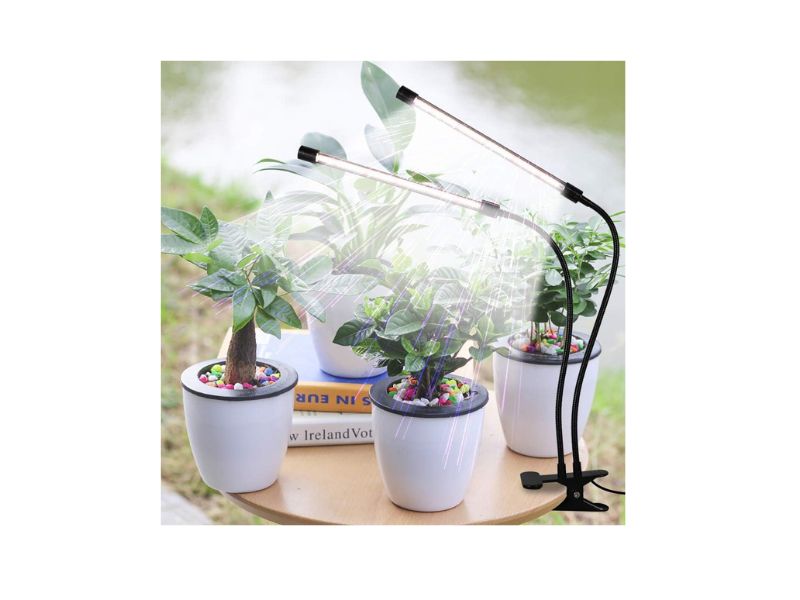
Key Features
- 6000K full-spectrum-style light
- White and red LEDs
- Five brightness levels
- 4/8/12-hour automatic timer
- Flexible gooseneck
- Clamp mounting
- Compact footprint
- Designed for indoor plants
The GooingTop is my primary recommendation because it solves a problem that matters enormously with houseplants: getting the light close enough to the leaves without installing a permanent fixture.
The current Amazon listing describes a 6000K full-spectrum grow lamp with white and red LEDs, five dimming levels, flexible gooseneck positioning, and repeating 4-, 8-, and 12-hour timer settings. It currently shows 21,990 ratings.
The clamp can attach to a:
- Desk
- Shelf
- Plant stand
- Table
- Counter edge
That makes it particularly useful in apartments or rooms where drilling holes for hanging hardware is undesirable.
I would use it for houseplants such as:
- Pothos
- Philodendron
- Monstera seedlings
- Peperomia
- Tradescantia
- Small palms
- Herbs
- Compact succulents
The flexible neck gives you much more control over distance than a fixed overhead fixture.
That matters because usable light decreases rapidly as the lamp moves farther from the leaves.
A modest grow light placed correctly can therefore be more effective than a much larger fixture positioned inconveniently.
The five brightness levels are another strong feature.
Houseplants have very different light requirements.
A snake plant or pothos tolerates lower light better than many succulents or herbs.
Instead of treating one output level as universally correct, you can adjust the GooingTop according to:
- Plant species
- Distance
- Available window light
- Season
The built-in timer is also useful in a home environment.
Houseplant lighting should be consistent, and a repeating timer removes the need to remember the lamp every morning and evening.
The current unit provides 4-, 8-, and 12-hour cycles.
For plants already receiving daylight from a window, those settings can work well as supplemental lighting.
If artificial light is doing almost all the work, however, a 12-hour built-in maximum may not always provide the daily light you want from a modest fixture.
That is one of the limitations.
The other is coverage.
This is not a room-wide light.
It works best when plants are grouped relatively close together.
If you try to illuminate a six-foot plant shelf with one GooingTop, plants toward the ends will receive much less intensity.
A useful sign is leaning.
If the outer plants consistently turn toward the center of the fixture, your illuminated footprint is probably too wide.
The 6000K white appearance is another advantage in a living space.
It looks more like cool daylight than traditional purple horticultural lighting, making it easier to assess natural leaf color.
That can help you notice:
- Yellow leaves
- Brown margins
- Chlorosis
- Pest damage
- Bleaching
without switching on another lamp.
What I Like
- Easy clamp installation
- Flexible gooseneck
- Five brightness levels
- Automatic timer
- White-looking light
- Excellent for a few nearby houseplants
- Very strong Amazon rating history
What I Do Not Like
- Limited coverage
- Timer tops out at 12 hours
- Not powerful enough for a broad high-light collection
The GooingTop is the houseplant light I would choose for the widest range of everyday indoor setups. Its strengths are flexibility and convenience rather than extreme output, which is exactly what many living-room and desk plants need.
2. GE PAR38 Balanced Spectrum Grow Bulb
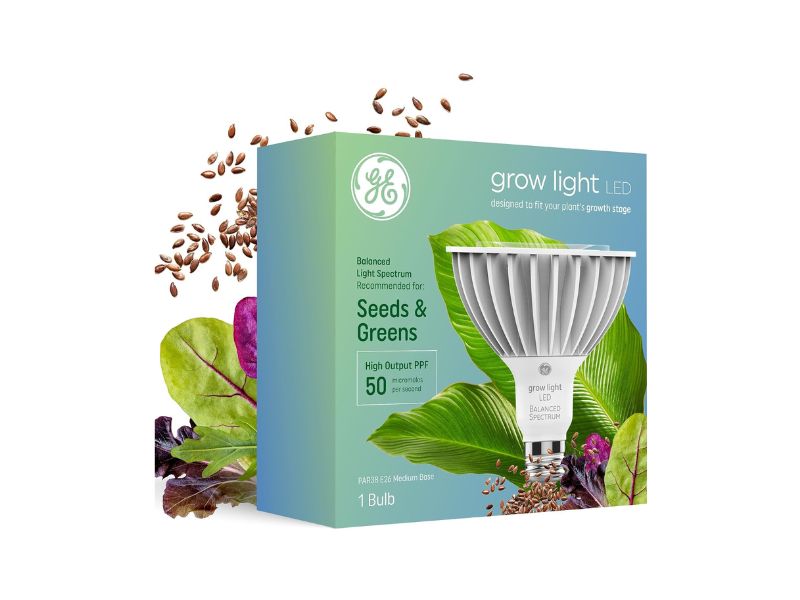
Key Features
- PAR38 directional grow bulb
- 50 µmol/s PPF
- Balanced-spectrum output
- White-looking light
- Standard household-style bulb format
- Rated 25,000-hour lifespan
- Focused coverage
- Suitable for a larger individual plant or compact group
The GE PAR38 is the option I would choose when a houseplant needs more concentrated artificial light than a small clip lamp provides.
Its current Amazon listing identifies the bulb as a balanced-spectrum indoor grow light with 50 PPF and a rated 25,000-hour lifespan.
The 50 µmol/s PPF figure is important.
PPF, or photosynthetic photon flux, measures the total quantity of photosynthetically active photons emitted by the lamp each second.
That is more plant-relevant than simply saying a bulb is “bright.”
Lumens are useful for describing human-visible brightness.
Plants respond more directly to photons in the photosynthetically active range.
The PAR38 format gives the GE bulb a relatively directional beam.
I would consider that useful for:
- A large Monstera
- Rubber plant
- Fiddle-leaf fig
- Citrus kept indoors
- Tall Dracaena
- A concentrated succulent group
- One large tropical plant in a dim corner
The directional nature is both an advantage and a limitation.
It means more light can be aimed at one plant instead of illuminating half the room.
But it also means the useful growing footprint is narrower than a long linear fixture.
The bulb format can also blend more naturally into a home.
Instead of hanging an industrial-looking grow panel, you can use an appropriate sturdy lamp fixture and direct the PAR38 toward the canopy.
That makes it attractive for:
- Living rooms
- Offices
- Bedrooms
- Dining areas
where appearance matters.
The balanced white spectrum is useful for plant inspection too.
You can see whether a leaf is:
- Deep green
- Pale
- Yellowing
- Bleached
- Developing brown edges
without the strong color distortion created by purple LED systems.
One thing I particularly like about the GE is that it publishes a PPF value.
Many inexpensive houseplant lights provide only vague brightness claims.
A photon specification gives you a more meaningful indication of total plant-light output.
However, PPF alone does not tell you what the plant actually receives.
For that, PPFD matters.
PPFD is affected by:
- Distance
- Beam angle
- Plant position
- Fixture orientation
A strong bulb mounted several feet away may provide less useful intensity at the leaves than expected.
This is why placement still matters.
The GE PAR38 also lacks the integrated timer and multi-level dimmer convenience of the GooingTop or SANSI.
That means scheduling is best handled with an appropriately rated external timer.
Intensity may need to be adjusted primarily through distance and fixture position.
What I Like
- Published 50 µmol/s PPF
- Strong focused output
- Balanced white spectrum
- Long rated service life
- Good for larger individual plants
- Fits naturally into home-style lighting setups
What I Do Not Like
- No built-in timer
- Less convenient intensity adjustment
- Directional beam is not ideal for long shelves
- Requires a separate suitable lamp fixture
The GE PAR38 is the model I would choose when one larger or more light-demanding houseplant needs a meaningful step up in focused illumination without installing a full grow-tent fixture.
3. SANSI 10W Pot Clip Grow Light
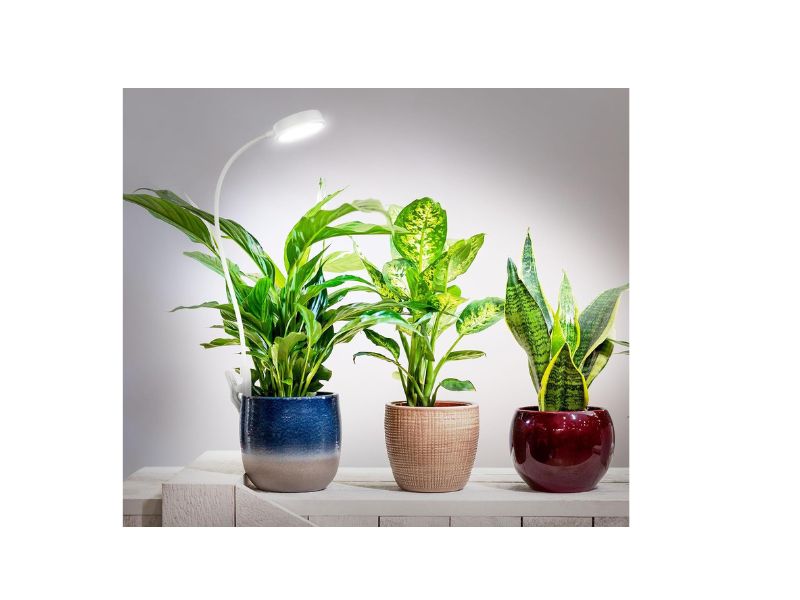
Key Features
- 10W actual power
- 4000K full-spectrum output
- Pot-mounted clip
- Four brightness levels
- 3/6/12-hour timer
- Compact adjustable design
- Minimal independent footprint
- Designed specifically for indoor plants
The SANSI 10W Pot Clip is the most compact solution in this comparison.
Its current Amazon listing identifies it as a 10W full-spectrum indoor plant light with 4000K output, four-level dimming, and 3-, 6-, and 12-hour timer settings. The current listing shows 882 ratings.
Unlike GooingTop, it does not need a shelf or desk edge.
The fixture clips directly to the pot.
That is particularly useful when your houseplant sits:
- On a crowded desk
- On a narrow windowsill
- Beside a computer monitor
- On a bedside table
- On a small plant pedestal
The light and plant effectively become one compact unit.
I would consider it for:
- Small pothos
- Peperomia
- African violets
- Small philodendrons
- Bonsai
- Compact herbs
- Young houseplants
- Single succulents
The 10W output is appropriate for that scale.
It would be misleading to treat 10W as enough for a large room or a mature tree-sized houseplant.
But when a fixture illuminates one small canopy from close range, relatively modest electrical power can still be useful.
This illustrates an important houseplant-light principle:
Match the illuminated area to the fixture.
Light spilling onto walls, floors, and empty shelf space does nothing for the plant.
A targeted small fixture can therefore be very efficient for one pot.
The 4000K white spectrum is another advantage.
It appears more neutral than the cooler 6000K GooingTop.
That may make it more pleasant in:
- Bedrooms
- Offices
- Living rooms
where the light remains visible for many hours.
Four brightness settings provide useful control.
This is particularly important because the fixture is attached directly to the pot and naturally sits close to the leaves.
If a plant begins showing possible light stress, reducing brightness is easier than rebuilding the whole setup.
The built-in 3/6/12-hour timer makes the SANSI particularly convenient for supplemental lighting.
For example, a plant near an east-facing window might receive natural morning light and then several hours of supplemental LED lighting later.
The main limitation is coverage.
This light is intentionally designed around one plant.
If you have:
- Six pothos
- Four philodendrons
- A shelf of herbs
buying a separate pot light for every plant creates unnecessary cables and controls.
At that point, one larger clip lamp or shelf fixture becomes cleaner.
What I Like
- Clips directly to the pot
- Very small footprint
- 10W actual power
- Four dimming levels
- Built-in timer
- Neutral 4000K appearance
- Excellent for a single houseplant
What I Do Not Like
- Very limited coverage
- Not appropriate for large plants
- Multiple units can create cable clutter
The SANSI 10W Pot Clip is my choice when the goal is giving one houseplant dedicated supplemental light without sacrificing additional desk or shelf space.
LED Grow Lights for Houseplants Comparison
| Product | Format | Power/Photon Class | Dimming | Timer | Coverage | Best Use |
| GooingTop 6000K | Clamp/gooseneck | Compact | 5 levels | 4/8/12 hr | Small group | Everyday houseplants |
| GE PAR38 | Directional bulb | 50 µmol/s PPF | Position based | External | Focused | Larger individual plant |
| SANSI Pot Clip | Pot-mounted | 10W | 4 levels | 3/6/12 hr | Very small | One compact plant |
GooingTop gives the best all-around flexibility, GE PAR38 provides stronger focused output, and SANSI minimizes the physical footprint for one individual pot.
How to Choose the Best LED Grow Lights for Houseplants
Start With the Plant, Not the Light
Different houseplants tolerate dramatically different light levels.
A snake plant that grows acceptably several feet from a window should not automatically receive the same artificial intensity as:
- Citrus
- Succulents
- Herbs
- High-light flowering plants
Choose the fixture according to the plant’s actual needs.
Consider Available Window Light
Grow lights can be either:
Supplemental light
or
Primary light.
That distinction matters.
A plant beside a bright window may need only a few extra hours.
A plant in a windowless room may depend on the grow light for nearly its entire daily light supply.
The second situation generally requires stronger output or longer operating time.
Best Houseplant Grow Light for a Few Plants
I would choose GooingTop.
Its flexible gooseneck can be aimed at a small cluster, and five brightness levels provide enough control for several common tropical houseplants.
Best Houseplant Grow Light for One Plant
For a compact plant, I would choose SANSI Pot Clip.
For a larger or more light-demanding individual plant, I would move to the GE PAR38.
Best Grow Light for Pothos
Pothos tolerates moderate indoor light relatively well.
A GooingTop or SANSI fixture is usually the more proportionate choice.
A powerful PAR38 bulb may be unnecessary unless the plant is large or kept in a particularly dark location.
Best Grow Light for Monstera
Young Monsteras can work well under GooingTop.
As a Monstera becomes larger, the canopy can outgrow a small clip lamp.
At that stage, the GE PAR38’s stronger directional output becomes more attractive.
Best Grow Light for Philodendrons
Compact philodendrons are well suited to GooingTop or SANSI.
Larger climbing types need a fixture capable of illuminating more than the top few leaves.
Make sure the useful light actually reaches the active canopy.
Best Grow Light for Snake Plants
Snake plants generally tolerate lower light than many houseplants.
That does not mean they need no light.
A small SANSI or GooingTop used as supplemental lighting is usually more appropriate than a high-output grow panel.
Best Grow Light for Fiddle-Leaf Fig
Fiddle-leaf figs can become large and need substantial bright light.
Of these three products, I would choose GE PAR38 because it gives you stronger directional output that can be aimed over a larger individual canopy.
One small pot light would be unrealistic for a mature plant.
Best Grow Light for Rubber Plants
For a young rubber plant, GooingTop may be sufficient.
For a larger specimen in a dim room, I would favor GE PAR38.
As always, size the illuminated footprint to the actual canopy.
Best Grow Light for African Violets
A compact dimmable light works well.
SANSI’s pot-mounted format is particularly convenient because African violets remain relatively compact and do not require a large overhead fixture.
Best Grow Light for Houseplant Shelves
None of these is my first choice for a long multi-level shelf.
For a full shelf, I generally prefer linear LED bars because they distribute light along the shelf length more evenly.
These three products are better for individual plants or small groups.
Full Spectrum Is Practical for Living Spaces
Broad white-spectrum grow lights are useful because they provide plant-usable wavelengths without making the room intensely purple.
They also allow more natural evaluation of plant color.
That is particularly useful when diagnosing:
- Chlorosis
- Nutrient symptoms
- Pest damage
- Light stress
- Watering problems
4000K vs 6000K for Houseplants
SANSI uses 4000K, while GooingTop uses a cooler 6000K white/red configuration.
Both can support houseplants.
The difference is partly visual:
4000K looks more neutral.
6000K looks cooler and more daylight-like.
I would choose based primarily on useful intensity, fixture placement, and how comfortable the light looks in the room.
Does Wattage Matter?
Yes, but wattage measures electricity consumption rather than plant light directly.
A 10W fixture may be perfectly suitable for one tiny plant.
It would be inadequate for a large room full of plants.
Similarly, buying a 300W grow panel for one pothos would be unnecessary.
PPF Is More Useful Than Lumens
GE publishes 50 µmol/s PPF for the selected PAR38.
PPF describes total photosynthetic photon output.
That is more directly relevant to plants than lumens, which are weighted around human visual sensitivity.
PPFD Matters at the Leaves
PPFD describes the density of photosynthetic photons reaching the plant at a particular location.
This is why distance matters so much.
The same fixture can produce very different PPFD when moved:
- 6 inches away
- 12 inches away
- 24 inches away
from the canopy.
How Close Should a Grow Light Be to Houseplants?
There is no universal distance.
Use the manufacturer’s recommendations as your starting point.
Then monitor plant response.
Possible signs of insufficient light include:
- Stretching
- Leaning toward the lamp
- Long internodes
- Small pale new leaves
Possible signs of excessive intensity include:
- Bleaching
- Curling
- Pale upper foliage
- Localized stress near the lamp
Make changes gradually.
How Long Should Grow Lights Stay On?
The correct photoperiod depends on:
- Fixture intensity
- Natural daylight
- Plant type
- Growth stage
A plant receiving several hours of bright window light may need only supplemental artificial lighting.
A plant relying almost completely on LEDs may need a longer artificial day.
Do not assume every houseplant requires the same timer setting.
Do Houseplants Need Darkness?
Yes.
A regular dark period is appropriate for ordinary houseplant growing.
Running a weak grow light 24 hours per day is not a good substitute for providing adequate intensity during a normal daily photoperiod.
Dimming Is Especially Useful Indoors
Houseplants are often placed wherever furniture allows.
Sometimes the fixture has to sit close.
Dimming gives you a second way to control intensity when you cannot increase distance.
GooingTop provides five brightness levels, while SANSI provides four.
Timers Make Houseplant Lighting Easier
Consistency is more valuable than manually switching a lamp on and off whenever you remember.
Both GooingTop and SANSI include automatic timing.
GE PAR38 can be paired with an external timer.
Grow Lights in Living Rooms
Appearance matters.
For a living-room setup, I prefer:
- White spectrum
- Minimal hardware
- Compact mounting
- Low noise
All three selected products can fit into a normal home more naturally than a large commercial grow-tent panel.
Grow Lights in Offices
SANSI is particularly useful on an office desk because it clips directly to the pot.
GooingTop makes sense when several plants sit along one desk or shelf.
The GE PAR38 is better suited to a larger floor plant.
Electricity Use
A 10W SANSI operating 12 hours per day uses:
0.01 kW × 12 = 0.12 kWh/day
Over 30 days:
3.6 kWh/month
That makes low-power pot lights relatively modest electrical loads.
Actual running cost depends on your local electricity rate.
Do LED Grow Lights Heat the Room?
Yes, although these small houseplant lights add far less total heat than large 300–800W grow fixtures.
Keep the fixture and power electronics ventilated.
Do not bury adapters behind:
- Cushions
- Curtains
- Bedding
- Clutter
and keep electrical connections away from standing water.
Common Houseplant Grow-Light Mistakes
Buying Too Weak a Light for a Large Plant
Match output to canopy size.
Hanging the Light Too Far Away
Usable intensity drops significantly with distance.
Covering Too Many Plants With One Small Lamp
Stay within the useful illuminated footprint.
Running Lights Continuously
Give plants a regular dark period.
Ignoring Window Light
Artificial and natural light work together.
Choosing by Lumens Alone
Plant photon output matters more.
Assuming “Low-Light Plant” Means “No-Light Plant”
Low-light tolerance is not the same as zero light requirement.
Focusing Only on Spectrum
Intensity and placement are usually more important first.
Frequently Asked Questions
What are the best LED grow lights for houseplants?
GooingTop, GE PAR38, and SANSI are my three choices for different houseplant setups.
GooingTop works well for small groups, GE PAR38 suits larger individual plants, and SANSI is ideal for a compact single pot.
Which houseplant grow light is my primary recommendation?
GooingTop 6000K is my primary recommendation for most everyday indoor plant setups.
Its clamp, flexible gooseneck, five brightness levels, and repeating timer make it highly adaptable.
Which grow light is best for one small houseplant?
SANSI 10W Pot Clip is my preferred choice for one compact plant.
It clips directly to the pot and provides four dimming levels plus automatic timing.
Which grow light is best for a larger houseplant?
GE PAR38 is the strongest focused option among these three selections.
Its current listing publishes 50 µmol/s PPF, providing more meaningful directional photon output than a typical small pot lamp.
Are LED grow lights good for houseplants?
Yes, properly sized LED grow lights can supplement or replace inadequate natural window light.
The important factors are usable intensity, coverage, distance, photoperiod, and plant requirements.
Do houseplants need full-spectrum grow lights?
Full-spectrum white LEDs are practical, but adequate intensity matters more than the label alone.
A weak full-spectrum lamp can still provide inadequate light if it is mounted too far away.
Is 4000K good for houseplants?
Yes, 4000K white light works well for many indoor plant applications.
The selected SANSI model uses 4000K full-spectrum output.
Is 6000K good for houseplants?
Yes, 6000K cool-white lighting can work well for vegetative and supplemental growth.
GooingTop uses a 6000K white/red configuration.
Is 10W enough for a houseplant?
It can be enough for one small plant when positioned close and used appropriately.
It is not enough to illuminate a large collection or mature floor plant.
What is the best grow light for pothos?
I would choose GooingTop or SANSI depending on the size and number of plants.
Both provide convenient white-spectrum supplemental lighting without requiring a large fixture.
What is the best grow light for Monstera?
GooingTop suits smaller Monsteras, while GE PAR38 better matches a larger individual canopy.
As the plant grows, make sure the illuminated footprint expands with it.
What is the best grow light for snake plants?
A modest GooingTop or SANSI setup is usually more proportionate than a high-power fixture.
Snake plants tolerate moderate indoor light but still benefit from useful illumination.
What is the best grow light for fiddle-leaf figs?
GE PAR38 is my preferred option here for a larger fiddle-leaf fig.
Its directional format can aim stronger photon output at one substantial canopy.
How many hours should grow lights stay on for houseplants?
The correct duration depends on artificial-light intensity and the natural daylight the plant already receives.
Use a consistent schedule and adjust according to plant response rather than copying one universal number.
Can grow lights stay on for 24 hours?
I would not use continuous lighting as the default for ordinary houseplants.
Provide a regular dark period and improve light intensity or positioning if the plant is stretching.
How close should grow lights be to houseplants?
Distance depends on fixture output, beam spread, plant sensitivity, and dimmer setting.
Start with manufacturer guidance and adjust gradually based on plant response.
Can LED grow lights burn houseplants?
Yes, excessive intensity at close range can stress or bleach leaves.
Plants moved from weak light should be acclimated gradually to stronger illumination.
Why is my houseplant leaning toward the grow light?
Leaning often indicates uneven or insufficient illumination across the plant canopy.
Move the fixture more directly overhead or improve coverage.
What is PPF?
PPF measures the total photosynthetically active photons emitted by a light each second.
GE publishes 50 µmol/s PPF for its selected PAR38 grow bulb.
What is PPFD?
PPFD measures photosynthetic photon density reaching a specific part of the plant canopy.
It changes substantially with distance and fixture positioning.
Do houseplant grow lights use much electricity?
Small 10W-class lights use relatively little electricity compared with large grow-tent fixtures.
Actual cost depends on daily runtime, dimmer setting, wattage, and local utility rates.
Conclusion
The best LED grow lights for houseplants should fit naturally into your living space while delivering enough usable light for the actual plant canopy. For most homes, I would prioritize fixture placement, dimming, coverage, timer convenience, white-spectrum output, and realistic plant requirements rather than buying the highest wattage available.
The GooingTop 6000K remains my primary recommendation for most houseplant owners. Its flexible clamp and gooseneck, five brightness settings, white/red output, and repeating timer make it particularly adaptable to a few pothos, philodendrons, herbs, or other compact plants.
The GE PAR38 Balanced Spectrum Grow Bulb is the stronger choice for one larger or more light-demanding plant. Its focused PAR38 format and published 50 µmol/s PPF provide a meaningful step up in directional photon output.
The SANSI 10W Pot Clip is my preferred minimalist option. Its 10W power, 4000K full-spectrum output, four brightness levels, and 3/6/12-hour timer work particularly well for one compact houseplant where available space is limited.
For most small houseplant groups, I would choose GooingTop. For a larger individual plant, I would choose GE PAR38. For one compact pot on a desk or windowsill, I would choose SANSI 10W Pot Clip.

I’m Maya L. Greenwood, a lifelong plant lover who believes anyone can grow something beautiful with the right guidance. After years of testing soil mixes, pruning methods, irrigation tricks, and pest-safe solutions, I started EasyGardenTips.com to turn hard-won lessons into step-by-step advice. From seed starting and container gardens to composting and seasonal checklists, my goal is to make gardening simple, sustainable, and fun.