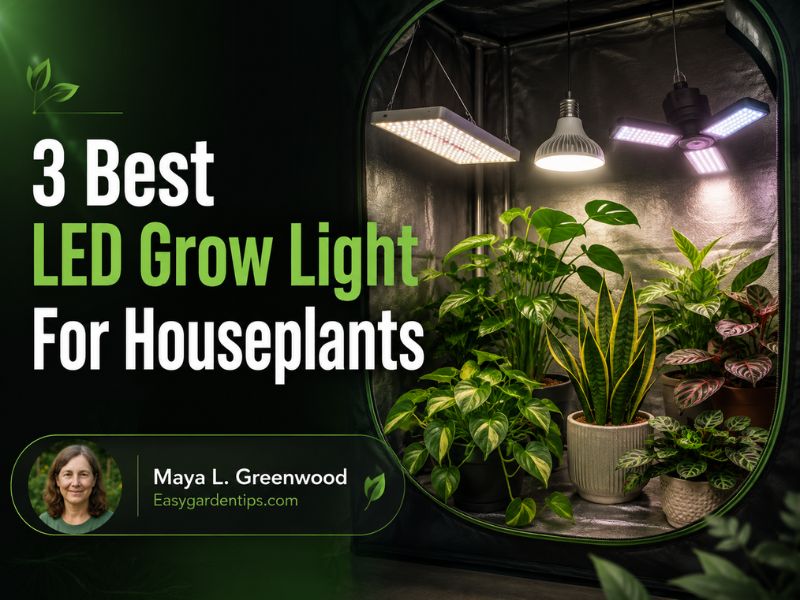
3 Best LED Grow Light for Houseplants: Practical Indoor Picks
A dark corner, a north-facing window, or a long winter can leave even adaptable houseplants struggling to produce healthy new growth. The solution is not necessarily the largest or most powerful fixture. The best led grow light for houseplants is the one that delivers useful light across the plant canopy without creating excessive heat, glare, or installation difficulty.
Different plant arrangements require different light shapes. A screw-in bulb works well over one large plant or a compact group. Linear bars distribute light more evenly across shelves. A lower-output flood bulb is easier to manage around a single low- or medium-light plant.
My primary recommendation is the SANSI 36W Full Spectrum LED Grow Light Bulb. Its 65.6 µmol/s published photosynthetic photon flux, concentrated optical design, and standard E26 base make it the strongest all-around option for one medium-to-large houseplant or a closely arranged plant group.
For shelving, propagation stations, or several small plants arranged in rows, I would choose the Barrina T5 2-Foot Full Spectrum Grow Lights, 8-Pack. Eight linkable 10-watt bars provide better coverage across long rectangular spaces than a single point-source bulb.
The GE Balanced Spectrum BR30 LED Grow Light, 2-Pack is more suitable when simplicity and comfortable indoor appearance matter most. Each bulb has a published PPF of 16 µmol/s, so it is less powerful than the SANSI, but it is easier to use around one small plant at close range.
These three products serve deliberately different setups. The SANSI provides concentrated output, Barrina provides distributed shelf coverage, and GE provides accessible supplemental lighting for smaller areas. Product number one remains my primary recommendation because it offers the strongest balance of usable output, ordinary-lamp compatibility, and flexibility for common houseplants.
Match the Light Format to Your Plant Setup
| Plant arrangement | Most suitable product | Why it fits |
| One medium or large floor plant | SANSI 36W | Strong directional output from one bulb |
| Two or three closely grouped plants | SANSI 36W | Concentrated beam can cover a compact canopy |
| Long plant shelf | Barrina T5 | Linear bars distribute light along the shelf |
| Propagation or seedling rack | Barrina T5 | Multiple bars can cover several levels |
| One small desk or table plant | GE BR30 | Lower output is easier to manage at close range |
| Decorative lamp with an E26 socket | GE BR30 or SANSI | Both use a conventional screw-in format |
| Mixed plants with very different light needs | Separate fixtures | One intensity rarely suits every plant |
Before choosing, measure the actual leaf canopy rather than the room or shelf. A six-foot shelf holding two small plants does not require six feet of illuminated coverage, while a broad Monstera canopy may extend far beyond its pot.
Best LED Grow Lights for Houseplants Reviewed
| Image | Product Name | Check Price |
|---|---|---|
Best Choice | SANSI 36W Full Spectrum LED Grow Light Bulb | Check Price |
Second Best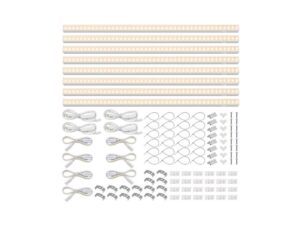 | Barrina T5 2-Foot Full Spectrum Grow Lights, 8-Pack | Check Price |
Third Choice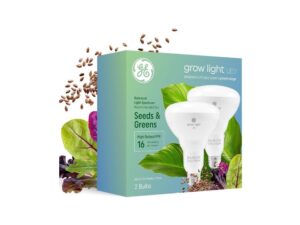 | GE Balanced Spectrum BR30 LED Grow Light, 2-Pack | Check Price |
1. SANSI 36W Full Spectrum LED Grow Light Bulb
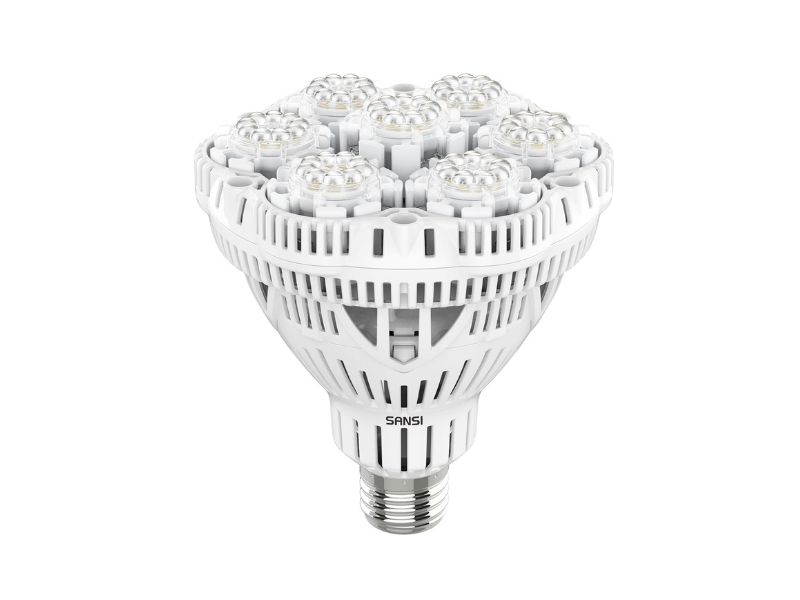
Key Features
- 36-watt actual power draw
- Published PPF of 65.6 µmol/s
- Approximately 4000K white full-spectrum output
- Standard E26 screw base
- Directional optical-lens design
- BR30-style bulb format
- Passive ceramic heat-dissipation structure
- ETL-listed product
- No built-in timer or dimmer
- Fixture must be supplied separately
The SANSI 36W bulb earns the first position because it combines a familiar screw-in format with substantially stronger published plant-light output than a typical decorative grow bulb. Its 65.6 µmol/s PPF gives it enough capacity to supplement one demanding foliage plant or illuminate a compact group when positioned correctly.
The white 4000K appearance is more comfortable in a living space than the strongly purple light associated with older red-and-blue fixtures. Its spectrum can support foliage and general houseplant growth without dramatically changing how plant colors appear in the room.
An optical lens directs the photons toward the canopy instead of scattering them in every direction. This improves useful intensity below the bulb but also creates a defined beam. Plants outside that beam may receive much less light than the center plant.
The bulb uses a standard E26 base, but the fixture must safely support its size, weight, and 36-watt draw. An open, adjustable lamp is preferable to a small enclosed shade because the bulb needs airflow for heat dissipation. It should not be placed in an enclosed fixture unless that use is explicitly approved.
SANSI uses a ceramic heat-dissipation design rather than an exposed cooling fan. This avoids fan noise and moving parts, although the bulb and nearby fixture can still become warm. Leaves should not touch the light.
There is no built-in timer or dimmer. An external plug-in timer solves the scheduling issue, but dimming should be attempted only when the bulb and dimmer are confirmed compatible. Otherwise, intensity should be controlled by changing the hanging distance.
This option is most suitable for Monstera, Fiddle Leaf Fig, Bird of Paradise, citrus, succulents, or a compact tropical collection that cannot receive sufficient window light. The precise distance depends on the plant, canopy size, daily operating time, and amount of natural light already available.
Its limitations are narrow-beam coverage and visual brightness. It may feel intense in a bedroom or seated living area when the bulb remains visible. A shade can control glare, but it must not trap heat or block useful light.
My verdict: I recommend the SANSI 36W for buyers who need meaningful output from a conventional lamp socket. It is the strongest general-purpose option here, provided the fixture is open, securely positioned, and close enough to the canopy to deliver useful light.
2. Barrina T5 2-Foot Full Spectrum Grow Lights, 8-Pack
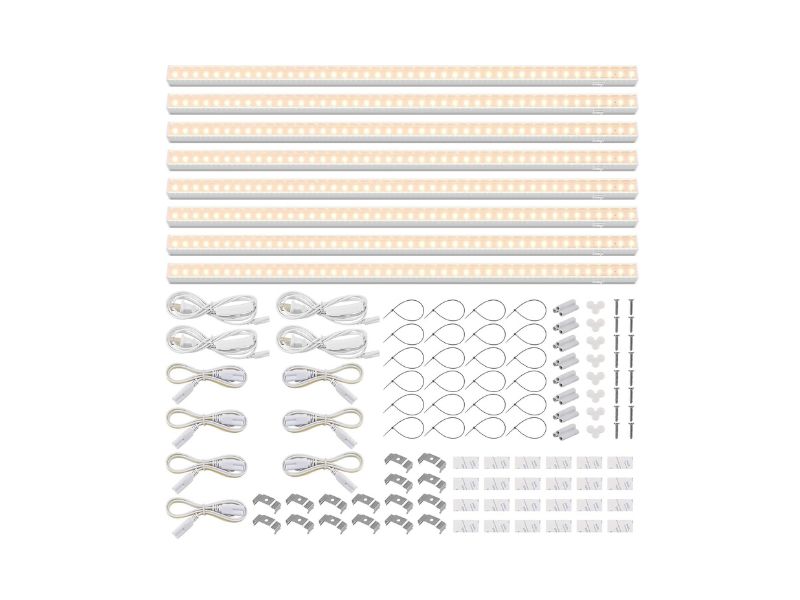
Key Features
- Eight 2-foot LED bars
- 10 watts per bar
- 80 watts total when all bars operate
- Full-spectrum yellow-white appearance
- Linkable configuration
- Plug-and-play installation
- Separate switches on the light bars
- Mounting hardware and connecting accessories
- Linear coverage for shelves and racks
- No integrated programmable timer
The Barrina T5 system ranks second because its geometry solves a different problem from a grow bulb. Instead of producing one bright circular center, the eight linear bars spread light along shelves, propagation trays, or rows of compact plants.
Each bar draws approximately 10 watts, and all eight together draw about 80 watts. The modular arrangement lets users install one or more bars per shelf according to shelf width, plant height, and light demand.
This flexibility works particularly well for Pothos cuttings, African violets, Peperomia, small Philodendrons, herbs, seedlings, and compact succulents. Higher-light plants may need multiple bars positioned closer together, while shade-tolerant foliage may need fewer bars or greater distance.
The bars can be linked, reducing the number of wall outlets needed. Installation accessories allow them to be attached beneath shelves or to a rack. Every connection should remain dry, strain-free, and securely seated.
The system’s main limitation is the absence of a published, comprehensive PPFD map for every possible bar arrangement. Eight bars can be configured in many ways, so total wattage does not reveal how much light reaches a particular leaf.
The bright yellow-white output may also be visually noticeable in an open living room. Under a dedicated plant shelf, however, the linear shape is generally easier to conceal than a large exposed bulb.
No programmable timer is built into the reviewed set. A properly rated external timer can create a consistent daily schedule. When several linked bars are used, confirm that the timer and electrical circuit can support the total connected load.
My verdict: I would choose Barrina for a shelf or rack rather than for one tall floor plant. It delivers the best coverage flexibility in this comparison, but mounting distance and the number of bars per level must be tailored to the plants.
3. GE Balanced Spectrum BR30 LED Grow Light, 2-Pack
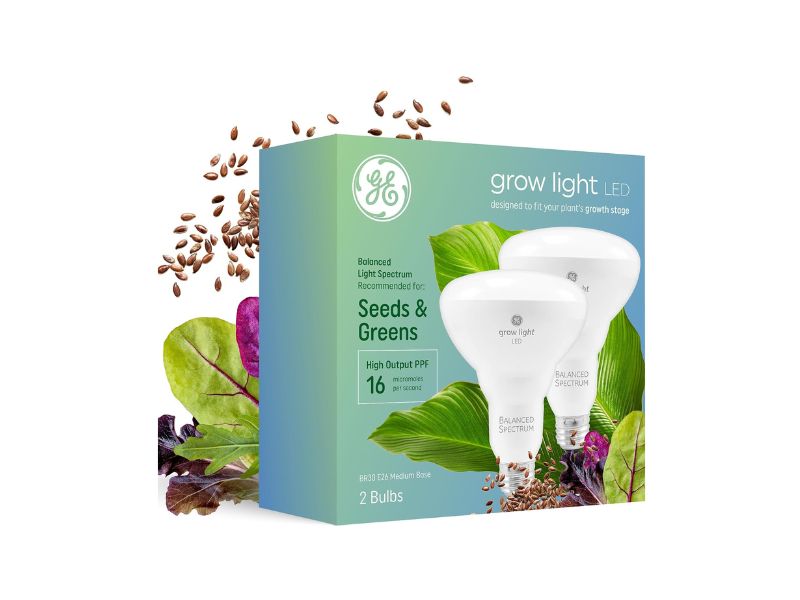
Key Features
- Two BR30 grow-light bulbs
- Published PPF of 16 µmol/s per bulb
- Balanced white spectrum
- Standard E26 base
- Floodlight beam shape
- Suitable for seeds, greens, and foliage
- Published rated life of up to 25,000 hours
- No built-in timer
- No integrated dimmer
- Best used at relatively close range
The GE Balanced Spectrum BR30 is the easiest option to integrate into ordinary home lighting. It produces balanced white light and fits a standard E26 socket, making it practical for an adjustable desk lamp, pendant, or clamp fixture.
Each bulb has a published PPF of 16 µmol/s. That is considerably lower than the SANSI’s 65.6 µmol/s, so the GE bulb should not be treated as an equal-output alternative. Its strength is manageable supplemental light for a small canopy at close range.
The BR30 flood shape creates a broader beam than a narrow spotlight. This is helpful for one small plant or two compact pots, although intensity falls rapidly as the bulb is moved away.
A recommended placement in the general range of approximately 6–9 inches may be appropriate for the reviewed bulb and certain plants, but the final distance should account for leaf response, natural daylight, and operating duration. A stronger bulb’s distance should not be copied to this model.
The package contains two bulbs. They can illuminate two separate plants or be placed in a two-socket fixture to cover a wider grouping. If both are directed toward the same canopy, overlapping beams can create a brighter center.
The bulbs do not include timers or dimming controls. An external timer is the simplest way to maintain a stable photoperiod. As with the SANSI, use an open fixture that allows heat to escape.
My verdict: The GE BR30 is best for a small plant, desktop arrangement, or modest supplemental-light requirement. I would not choose it over the SANSI for a large, light-hungry plant, but its softer output and two-bulb package are convenient for simple household setups.
Full Product Comparison
| Product | Format | Actual power | Published output | Coverage shape | Spectrum appearance | Mounting requirement | Timer | Ideal use |
| SANSI 36W | Screw-in directional bulb | 36W | 65.6 µmol/s PPF | Concentrated circular beam | 4000K white | Open E26 fixture | External | One medium-to-large plant |
| Barrina T5 | Eight linear bars | 80W total | Arrangement-dependent | Long rectangular coverage | Yellow-white full spectrum | Shelf or rack mounting | External | Multiple plants on shelves |
| GE BR30 | Two screw-in flood bulbs | Model-specific draw | 16 µmol/s PPF per bulb | Broad compact flood | Balanced white | E26 fixture | External | One or two small plants |
The SANSI produces the highest published PPF per single light among these products. Its focused beam is useful when the canopy fits underneath it, but it is less efficient for a long shelf.
Barrina’s strength is not a single headline output figure. Its advantage is distributing eight sources across a rectangular area. A well-arranged shelf system can give edge plants more consistent exposure than a single bulb placed in the center.
GE offers the least intense individual light. That limitation can become an advantage for a small low- or medium-light plant because it is easier to place close without overwhelming a large room.
What Grow-Light Specifications Actually Matter?
PPFD: Light Reaching the Leaves
Photosynthetic photon flux density, abbreviated PPFD, measures the number of photosynthetically active photons arriving at a surface each second. It is commonly expressed in micromoles per square meter per second:
µmol/m²/s
PPFD is a location-specific measurement. A light does not have one universal PPFD because the reading changes with:
- Distance from the fixture
- Position within the beam
- Lens or reflector design
- Number of lights
- Nearby reflective surfaces
- Canopy shape
A center reading directly below a fixture may be much higher than readings near the edges. A PPFD map is therefore more useful than one maximum number.
PPF: Total Plant-Usable Output
Photosynthetic photon flux, or PPF, measures the total plant-usable photons emitted each second. Its unit is:
µmol/s
PPF helps compare overall output. The SANSI’s 65.6 µmol/s figure is more informative than a “400-watt equivalent” statement because it describes plant-relevant photon production.
However, PPF does not describe coverage. A powerful bulb can concentrate most of its output in a small area, while several lower-output bars can distribute light more evenly.
DLI: Light Accumulated During the Day
Daily light integral, abbreviated DLI, describes the total photosynthetically active light received over an entire day.
A simplified calculation is:
DLI = PPFD × operating seconds per day ÷ 1,000,000
For example, a plant receiving an average PPFD of 100 µmol/m²/s for 12 hours receives:
100 × 43,200 ÷ 1,000,000 = 4.32 mol/m²/day
This illustrates why duration matters. A plant can receive similar daily light from a moderately strong fixture operated longer or a stronger fixture operated for fewer hours. Nevertheless, an extremely weak light cannot always be rescued by leaving it on all day.
Watts: Electricity Consumed
Watts measure electrical power consumption, not plant-light output. Two 36-watt fixtures can produce different PPF values because their LED efficiency, optics, spectrum, and power electronics differ.
Use actual wattage to estimate energy cost:
Monthly kWh = watts ÷ 1,000 × daily hours × 30
For the 36-watt SANSI operated 12 hours per day:
0.036 × 12 × 30 = 12.96 kWh per month
For all eight Barrina bars at 80 watts for 12 hours:
0.080 × 12 × 30 = 28.8 kWh per month
Multiply the result by the local electricity rate to estimate operating cost.
Lumens and Lux
Lumens describe visible light output as weighted to human vision. Lux describes lumens received per square meter.
These measures can help a homeowner compare the same location over time, but they do not describe plant-usable photons as accurately as PPFD. A spectrum that appears bright to people may not produce an equivalent photosynthetic response.
Color Temperature
Correlated color temperature, or CCT, describes the visual appearance of white light:
- Around 2700K appears warmer and more yellow.
- Around 4000K appears neutral white.
- Around 5000–6500K appears cooler or more daylight-like.
Color temperature is not a complete spectrum measurement. Two 4000K bulbs can distribute energy differently across wavelengths.
For living areas, neutral white full-spectrum fixtures are generally easier on the eyes and preserve natural-looking leaf colors better than purple fixtures.
How Much Light Do Common Houseplants Need?
Houseplants can be grouped broadly by their practical light requirements, but individual species and growing conditions still matter.
Lower-Light Foliage Plants
Examples include:
- Snake Plant
- ZZ Plant
- Cast Iron Plant
- Heartleaf Philodendron
- Pothos
- Chinese Evergreen
“Low light” means these plants tolerate lower intensity; it does not mean they need no light. Under very weak conditions, growth may slow, internodes may lengthen, and the potting mix may remain wet longer.
A GE BR30 can supplement one small lower-light plant when positioned close enough. A SANSI 36W may be unnecessarily intense at the same distance unless moved higher.
Medium-Light Tropical Plants
Examples include:
- Monstera
- Peace Lily
- Rubber Plant
- Calathea
- Anthurium
- Most non-succulent Peperomia
- Many Philodendrons
These plants often benefit from a balanced white grow light when window exposure is inconsistent. SANSI can cover one medium specimen, while Barrina bars work well for smaller tropical plants arranged on shelves.
Higher-Light Houseplants
Examples include:
- Succulents
- Cacti
- Citrus
- Bird of Paradise
- Croton
- Fiddle Leaf Fig
- Flowering indoor plants
- Many culinary herbs
Higher-light plants usually require greater intensity, longer duration, or both. A decorative low-output bulb placed several feet away is unlikely to maintain compact growth.
SANSI is the most relevant choice among the three for one higher-light specimen. Barrina can support high-light shelf plants when enough bars are mounted at a suitable distance. GE is better viewed as supplemental rather than sole lighting for these plants.
Choosing the Correct Coverage
Measure the Canopy
Measure the width and depth of the leaves, not the diameter of the pot. A plant in a 10-inch pot may have a 30-inch canopy.
For several plants, arrange them before measuring. Closely grouped pots may form one manageable canopy, while widely separated plants need independent lights.
Consider the Beam Shape
A bulb produces a roughly circular or oval illuminated area. A bar produces a long rectangular area.
Choose SANSI or GE when the canopy is compact and can be centered below the bulb. Choose Barrina when the plants form a row or occupy a shelf.
Account for Plant Height
Tall and short plants placed together create an uneven canopy. The tallest leaves can receive excessive intensity while short plants remain shaded.
Use risers to bring smaller plants closer to the same height, or separate them under different fixtures.
Plan for Growth
A Monstera or Bird of Paradise may quickly grow toward a fixed light. Ensure the fixture can be raised or repositioned.
Shelf lights also need sufficient clearance. A bar mounted too close to growing tips can bleach new leaves or leave no room for healthy expansion.
Setting the Hanging Distance
There is no universal grow-light distance. “Twelve inches above the plant” is not meaningful unless the fixture, output, beam angle, plant, and operating time are known.
Use this process:
- Begin with the manufacturer’s distance guidance.
- Account for natural light from nearby windows.
- Run the light on a consistent schedule.
- Observe the newest growth for two or three weeks.
- Move the fixture gradually rather than making large changes.
- Check edge plants as well as the center plant.
- Raise the light as the canopy grows.
The SANSI’s stronger concentrated output generally permits a greater distance than the GE bulb for the same target intensity. Barrina bars are commonly mounted relatively close to shelves because their output is distributed along each tube.
Establishing a Daily Schedule
Most foliage houseplants respond well to a consistent total light period of roughly 12–14 hours, including meaningful natural and artificial light. Flowering plants or seedlings may sometimes receive a longer photoperiod, depending on the species and growth goal.
A timer is strongly recommended because manually operated lights tend to follow inconsistent schedules.
Plants also need darkness. Running a grow light continuously for 24 hours is not a good default strategy. A dark period supports normal plant physiology and reduces unnecessary energy use.
A practical starting schedule might be:
- Light on at 7:00 a.m.
- Light off at 8:00 p.m.
- Total artificial-light period: 13 hours
If the plant already receives several hours of strong window light, the supplemental period may be shortened. Evaluate the combined exposure rather than treating the grow light as the only source.
Signs the Light Is Too Weak
Look for patterns in new growth:
- Long spaces between leaves
- Thin stems
- Growth leaning toward a window
- Smaller new leaves
- Loss of variegation
- Slow or stalled growth
- A succulent opening or stretching
- Soil staying wet longer than expected
- Lower leaves declining without another clear cause
Move the light closer, increase duration within a reasonable range, improve coverage, or use a higher-output fixture. Do not simultaneously overwater or overfertilize in an attempt to force growth.
Signs the Light Is Too Strong
Possible symptoms include:
- Pale or bleached areas facing the fixture
- Dry tan patches
- Upward leaf curling
- Leaves turning away from the beam
- Fading color
- Warm leaves
- Rapid drying near the center of the canopy
- Damage appearing soon after the light was moved closer
Raise or dim the fixture gradually. Previously damaged tissue will not return to normal, so judge the change by the condition of new leaves.
Installation and Electrical Safety
Use the Correct Socket
SANSI and GE bulbs require a compatible E26 socket. Confirm that the lamp is rated for at least the bulb’s actual wattage and can physically support its dimensions and weight.
A small clip lamp may tip when fitted with a heavy bulb. Secure the fixture independently rather than relying on a weak clip above valuable plants or furniture.
Avoid Enclosed Fixtures
Grow bulbs release less heat than many older lamp technologies, but their LEDs and electronics still produce heat. An enclosed shade can trap that heat and shorten component life.
Use an open fixture unless the product is explicitly rated for enclosed operation.
Keep Electricity Away from Water
Position cords, connectors, timers, and power strips where irrigation water cannot reach them. Create a drip loop so water running down a cord falls before reaching an outlet.
The Barrina connectors should remain dry and mechanically supported. Do not place a connection directly beneath a drainage hole.
Secure Bar Lights Properly
Mount Barrina bars with appropriate clips, ties, or magnetic hardware where compatible. Check the attachment periodically, especially if heat, humidity, or shelf movement could loosen it.
Do not suspend a bar by its electrical cord.
Avoid Overloading Linked Systems
Follow the manufacturer’s limit for how many bars can be connected in one chain. The external timer, extension cord, power strip, and wall circuit must support the combined load.
Control Glare
An exposed grow light can be uncomfortable even when it is safe for the plant. Aim bulbs downward and away from seated eye level. Use an open reflector that controls glare without trapping heat or blocking the beam.
Maintenance
Keep the Light Surface Clean
Dust reduces transmitted light and can interfere with heat dissipation. Unplug the fixture, let it cool, and wipe it with a dry or slightly damp soft cloth as permitted by the instructions.
Do not spray cleaning liquid directly onto LEDs, vents, sockets, or connectors.
Check the Distance Monthly
Plants grow closer to the light over time. Recheck the gap between the fixture and the tallest leaves at least monthly during active growth.
Inspect Cords and Mounts
Look for:
- Loose sockets
- Frayed insulation
- Discolored connectors
- Excessive heat
- Flickering
- Cracked housings
- Loose mounting clips
- Strain on linked cables
Stop using a fixture that develops electrical damage, unusual odor, visible arcing, or excessive heat.
Monitor Output Consistency
LEDs usually dim gradually rather than failing all at once. If plant response declines while watering, nutrition, temperature, and distance remain stable, compare light readings at the same location or test another fixture.
Common Grow-Light Buying Mistakes
Selecting by “Equivalent Wattage”
A phrase such as “400-watt equivalent” does not describe actual electricity consumption or useful photon delivery. Compare actual watts, PPF, PPFD, distance, and coverage instead.
Hanging a Small Bulb from the Ceiling
A bulb may appear bright across the room while delivering very little useful intensity to a plant several feet below. Most compact grow bulbs need close, intentional placement.
Using One Spotlight for a Long Shelf
The center plants receive most of the light while the ends remain weak. Linear bars such as Barrina better match rectangular shelves.
Assuming Full Spectrum Guarantees Performance
Spectrum matters, but insufficient output remains insufficient. A low-output full-spectrum bulb placed too far away cannot maintain a high-light plant.
Running the Light Around the Clock
Long duration wastes electricity and removes the dark period. Use a timer and an appropriate photoperiod.
Ignoring Natural Window Light
A plant near a sunny window may need only modest supplementation. The same species in an interior hallway may require a stronger fixture and longer schedule.
Mixing Low- and High-Light Plants
A succulent and a ZZ Plant may not respond well to identical intensity at identical distances. Group plants by light requirement.
Changing Light and Watering Simultaneously
Stronger light can increase water use, but immediately increasing watering on a fixed schedule may cause root problems. Check the potting mix and plant response before watering.
Frequently Asked Questions
What is the best LED grow light for houseplants?
The SANSI 36W is the strongest all-around option for a compact canopy. Its 65.6 µmol/s published PPF and standard E26 base suit one medium-to-large plant. Barrina is better for shelves, while GE is more manageable for one small plant.
Do LED grow lights work for houseplants?
Yes, correctly sized LED fixtures can supplement or replace inadequate window light. Success depends on plant-usable output at the leaves, coverage, distance, and operating duration. A powerful fixture placed badly can be less useful than a modest light positioned correctly.
How many hours should a grow light run?
About 12–14 hours is a practical starting point for many foliage houseplants. Consider natural daylight as part of the total exposure. Flowering plants and seedlings may have different needs. Use a timer and provide a consistent dark period.
How far should LED grow lights be from plants?
Distance must be based on the exact fixture and the plant’s response. A 36-watt directional bulb, a 10-watt bar, and a 16-PPF flood bulb produce different intensities. Begin with model-specific guidance and adjust gradually.
Is the SANSI 36W too strong for houseplants?
It can be too intense for sensitive plants when positioned very close. Low-light foliage may need greater distance than succulents or citrus. Watch the newest leaves for bleaching, curling, or fixture-facing damage and raise the bulb when necessary.
Can Barrina T5 lights support succulents?
Yes, but high-light succulents may require multiple bars mounted relatively close. One widely spaced bar may not maintain compact growth across a deep shelf. Monitor stretching and rotate plants if edge coverage is weaker than the center.
Is the GE BR30 enough for a Monstera?
It can supplement a small Monstera but may be insufficient for a large canopy. Each bulb publishes 16 µmol/s PPF, so close placement and possibly two bulbs may be needed. The SANSI is more appropriate when stronger output is required.
Are white grow lights better than purple lights?
White grow lights are generally more comfortable in living spaces. Both can support photosynthesis when their spectra and output are appropriate. White fixtures make it easier to inspect natural leaf color, pests, and nutrient symptoms.
Does a grow light need ultraviolet radiation?
No, ordinary houseplants do not require a UV-emitting fixture for healthy indoor growth. Photosynthetically useful visible light is the primary concern. Unnecessary UV exposure can add eye, skin, and plant-damage risks.
Can I use a regular lamp for a grow bulb?
Yes, if the socket, wattage rating, airflow, and physical support are suitable. Use an open E26 fixture for the SANSI or GE bulb. Avoid unstable lamps and enclosed shades that trap heat.
Do grow lights increase electricity bills significantly?
Operating cost depends on actual wattage, daily hours, and the electricity rate. A 36-watt bulb used 12 hours daily consumes about 12.96 kWh monthly. Eight 10-watt bars under the same schedule consume about 28.8 kWh.
Can grow lights burn houseplant leaves?
Yes, excessive intensity or close placement can bleach or scorch leaves. Heat is not the only cause; high photon intensity can damage sensitive foliage even when the fixture feels relatively cool. Increase exposure gradually.
Should variegated plants receive more light?
Variegated plants often benefit from brighter conditions but can still scorch. Their pale tissue contains less chlorophyll, so sufficient light helps maintain growth. Increase intensity gradually and evaluate the newest leaves.
Can a grow light replace sunlight completely?
Yes, if it supplies sufficient spectrum, intensity, coverage, and daily duration. Many decorative household grow bulbs are better suited to supplementation because their output or coverage is limited. A light meter and consistent plant response help verify adequacy.
Do I need a timer?
A timer is strongly recommended for consistent daily lighting. None of the three reviewed products includes a complete programmable timer. A compatible external timer prevents missed days, excessive operation, and irregular photoperiods.
Should I leave grow lights on overnight?
No, schedule them during the day or evening and provide darkness afterward. Running a light overnight is possible if the plant still receives a consistent dark period, but daytime operation is usually easier for household routines and visual comfort.
Why is my plant leaning under a grow light?
The beam may be off-center or weaker than another nearby light source. Center the canopy, improve edge coverage, or rotate the plant periodically. A plant leaning toward a window may still receive more usable light there than from the fixture.
Conclusion
The best led grow light for houseplants should match the shape and light requirement of the plant collection. Output alone does not determine success; coverage, distance, operating time, fixture safety, and natural window light are equally important.
The SANSI 36W Full Spectrum LED Grow Light Bulb remains my primary recommendation. Its 65.6 µmol/s published PPF provides the strongest single-source output in this comparison, while the E26 base makes it adaptable to many open, adjustable fixtures. I would choose it for one medium-to-large plant or a compact group requiring meaningful supplemental light.
Barrina T5 2-Foot Full Spectrum Grow Lights are the better option for shelves, propagation stations, or rows of small plants. Their linear format distributes light more evenly than a central bulb, and the eight-bar package allows several mounting arrangements.
The GE Balanced Spectrum BR30 is most appropriate for a small plant or modest supplemental-light setup. Its lower output makes close-range placement important, but the familiar white floodlight format fits naturally into a home.
Whichever option you choose, use an external timer, keep electrical connections dry, and check the distance as plants grow. Start with the manufacturer’s guidance, then adjust gradually according to new leaf size, color, spacing, and direction.
For the broadest houseplant use, I would begin with the SANSI 36W and position it over a measured, compact canopy.

I’m Maya L. Greenwood, a lifelong plant lover who believes anyone can grow something beautiful with the right guidance. After years of testing soil mixes, pruning methods, irrigation tricks, and pest-safe solutions, I started EasyGardenTips.com to turn hard-won lessons into step-by-step advice. From seed starting and container gardens to composting and seasonal checklists, my goal is to make gardening simple, sustainable, and fun.