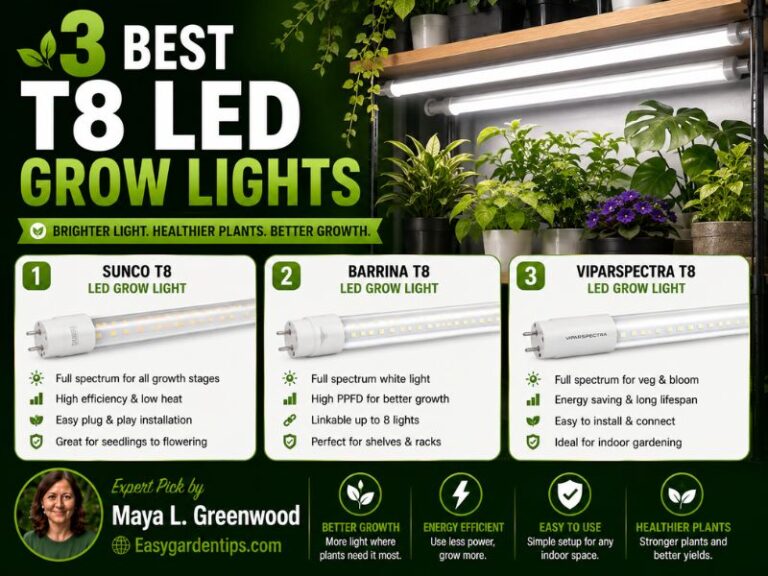
3 Best LED Tube Grow Lights: Shelves and Seedlings Compared
The long, narrow shape of a tube light is particularly effective for seedlings, houseplant shelves, propagation trays, and indoor growing racks. Instead of concentrating output beneath one bulb or in the center of a square panel, a tube-style fixture distributes light along an extended row.
The best led tube grow lights should match the length and depth of the growing surface. A single four-foot tube can follow the length of a long shelf, while several two-foot fixtures offer more flexibility across compact racks. Tube power, reflector design, color temperature, dimming, mounting clearance, and linkability determine how useful the system will be.
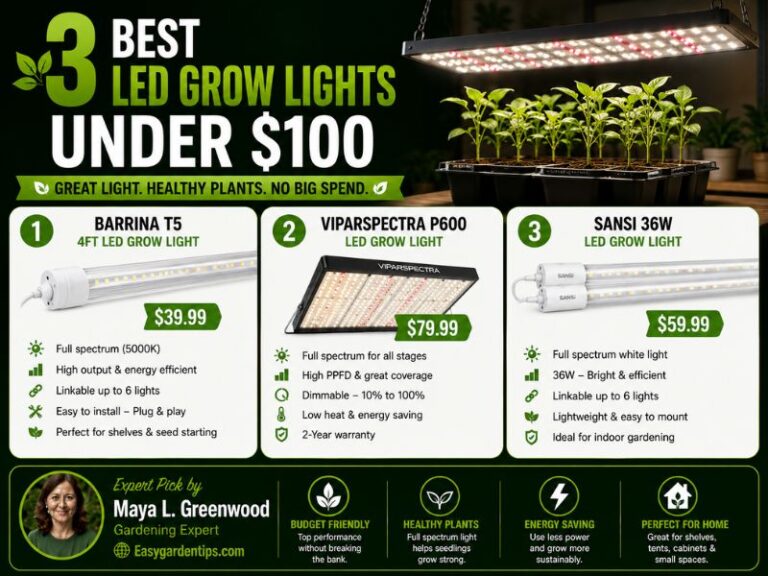
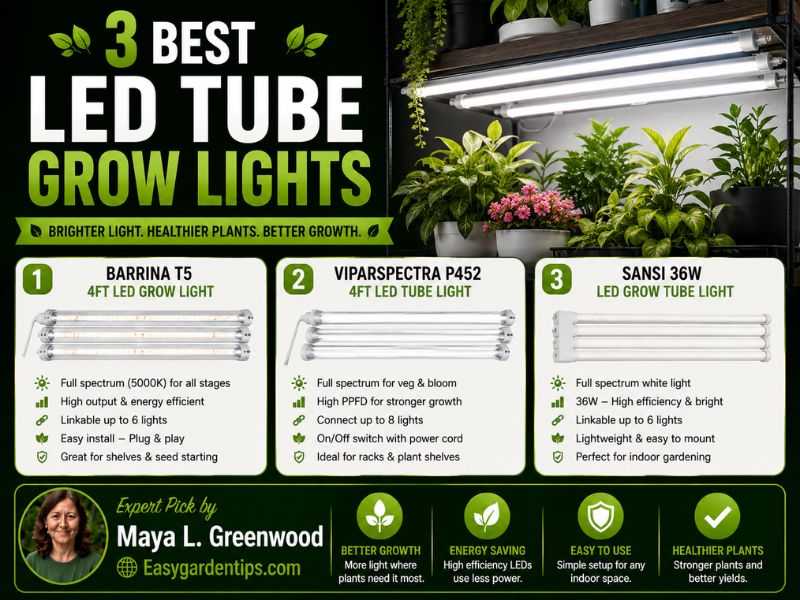
My primary recommendation is the Barrina T5 4-Foot Full Spectrum LED Grow Lights, 8-Pack. Its eight 20-watt fixtures provide 160 watts of combined power, and the long 5000K tubes are well suited to four-foot shelves, seed-starting tables, or multi-tier racks.
For stronger output from shorter fixtures, I would choose the Monios-L T8 2-Foot Full Spectrum LED Grow Lights, 6-Pack. Each tube draws approximately 24 watts and uses a reflector-style housing, making it useful for compact shelves containing seedlings, herbs, or higher-light plants.
The VIVOSUN T5 2-Foot Full Spectrum LED Grow Lights With Timer and Dimming Controller is more appropriate when automated scheduling and brightness adjustment matter. Its eight 15-watt tubes provide modular coverage, while the controller offers timer and output settings that the simpler plug-and-play sets lack.
These products have been selected for three different buyers: Barrina for long shelves, Monios-L for stronger two-foot coverage, and VIVOSUN for multi-tier control. Barrina remains my primary recommendation because its four-foot format offers the most natural coverage for standard racks and long plant benches.
Which LED Tube System Fits Your Setup?
| Growing space | Recommended system | Suggested starting arrangement |
| One 4-foot foliage shelf | Barrina T5 | One or two tubes |
| Four 4-foot growing levels | Barrina T5 | Two tubes per level |
| A 2-foot seedling shelf | Monios-L T8 | One or two tubes |
| Three 2-foot higher-light shelves | Monios-L T8 | Two tubes per level |
| Four controlled propagation shelves | VIVOSUN T5 | Two tubes per level |
| Mixed low- and medium-light plants | VIVOSUN T5 | Adjust brightness by supported group |
| Wide shelf over 18 inches deep | Multiple parallel tubes | Space tubes from front to back |
| One large floor plant | A bulb or panel may fit better | Tube geometry may be inefficient |
These are layout examples, not universal prescriptions. The number of tubes required depends on plant type, distance from the canopy, shelf depth, natural daylight, and daily operating time.
Best LED Tube Grow Lights Reviewed
| Image | Product Name | Check Price |
|---|---|---|
Best Choice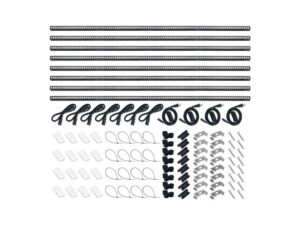 | Barrina T5 4-Foot Full Spectrum LED Grow Lights, 8-Pack | Check Price |
Second Best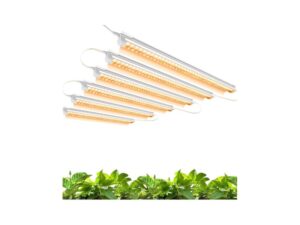 | Monios-L T8 2-Foot Full Spectrum LED Grow Lights, 6-Pack | Check Price |
Third Choice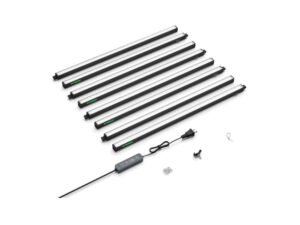 | VIVOSUN T5 2-Foot Full Spectrum LED Grow Lights With Controller | Check Price |
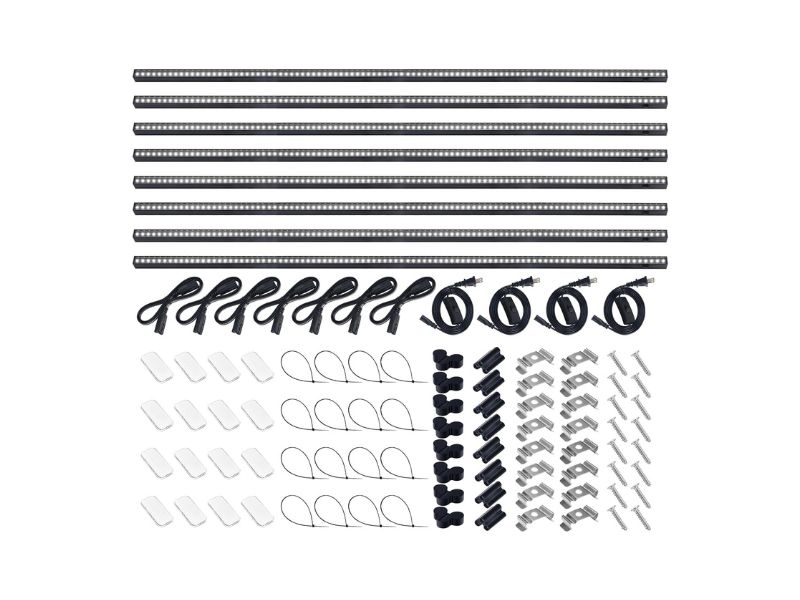
1. Barrina T5 4-Foot Full Spectrum LED Grow Lights, 8-Pack
Key Features
- Eight integrated LED tube fixtures
- Four-foot length
- 20 watts per tube
- 160 watts total
- Approximately 5000K white spectrum
- Black low-profile housing
- Magnetic mounting components
- Linkable design
- Individual switching
- Plug-and-play installation
The Barrina set ranks first because its four-foot fixtures match the length of many common wire racks, utility shelves, and seed-starting benches. Fewer gaps between short fixtures mean cleaner installation and more continuous end-to-end coverage.
Each tube draws approximately 20 watts. One fixture can supplement low-light foliage on a shallow shelf, while two or more parallel tubes can improve front-to-back coverage for seedlings, herbs, or dense tropical plants.
The 5000K white appearance is cooler than ordinary warm household lighting. It provides a daylight-like workspace and makes it easier to inspect leaves for discoloration, pests, mildew, and nutrient symptoms.
Magnetic mounting is convenient on compatible steel shelving. Clips and other included mounting options can be used where a magnetic surface is unavailable. Magnets should not be assumed suitable for every painted, stainless, aluminum, wooden, or plastic shelf.
The tubes can be linked, reducing the number of cords running to the outlet. Users still need to follow the connection limit for the exact version. The combined load also must remain within the external timer and circuit rating.
Barrina does not provide advanced integrated scheduling in this version. A properly rated plug-in timer is therefore useful for maintaining a consistent photoperiod.
My verdict: I recommend the Barrina four-foot T5 system for buyers building a long plant shelf or multi-tier rack. Its main limitation is that four-foot tubes are awkward in compact cabinets and harder to reposition independently than shorter fixtures.
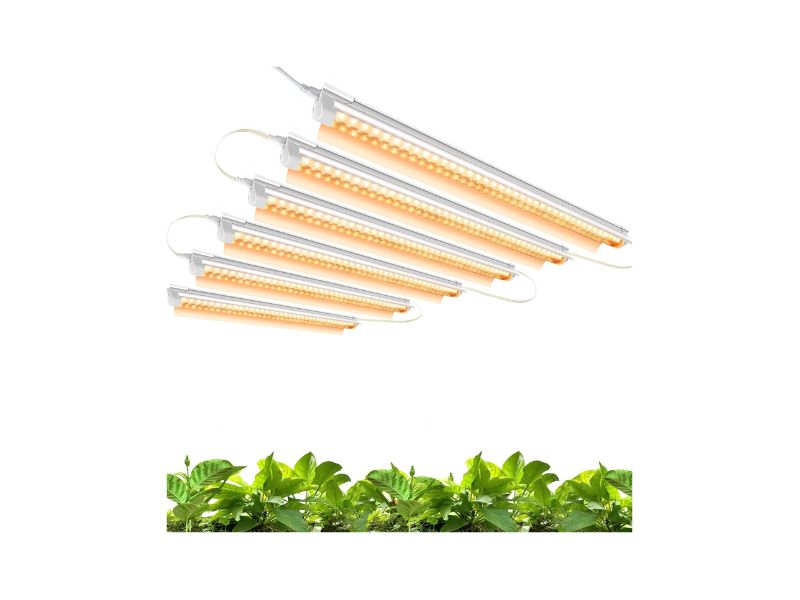
2. Monios-L T8 2-Foot Full Spectrum LED Grow Lights, 6-Pack
Key Features
- Six integrated T8-style LED fixtures
- Two-foot length
- 24 watts per tube
- 144 watts total
- Full-spectrum white output
- Reflector-style housing
- Linkable configuration
- Plug-in operation
- Mounting accessories included
- Appropriate for compact shelves and seed trays
The Monios-L set provides more power per two-foot fixture than either T5 system in this comparison. Each 24-watt tube is suited to compact shelves where a moderate-output 15-watt bar might require additional parallel fixtures.
The reflector helps direct light toward the canopy and reduces some sideways spill. This does not increase the fixture’s total photon production, but it can improve the proportion of light aimed toward the plants.
Six tubes can be arranged in several useful ways. A three-level rack might receive two fixtures per level. A wide two-level shelf could use three per level, while six shallow propagation areas might use one each.
Because the fixtures are only two feet long, their coverage can be adjusted more precisely than a four-foot tube. However, installing two short fixtures end to end creates a center connection and potentially less uniform light at the joint.
The T8-style housing is larger than a slim T5 fixture and may require more clearance. This can be an important limitation in a tightly spaced rack.
No sophisticated dimmer or programmable controller is central to this product. Intensity is managed mainly by changing tube count, spacing, mounting height, or operating duration.
My verdict: Monios-L T8 is the most suitable option for buyers seeking strong output from individual two-foot tubes. It is particularly useful for compact seedling and herb shelves, but low-light houseplants may need greater mounting distance.
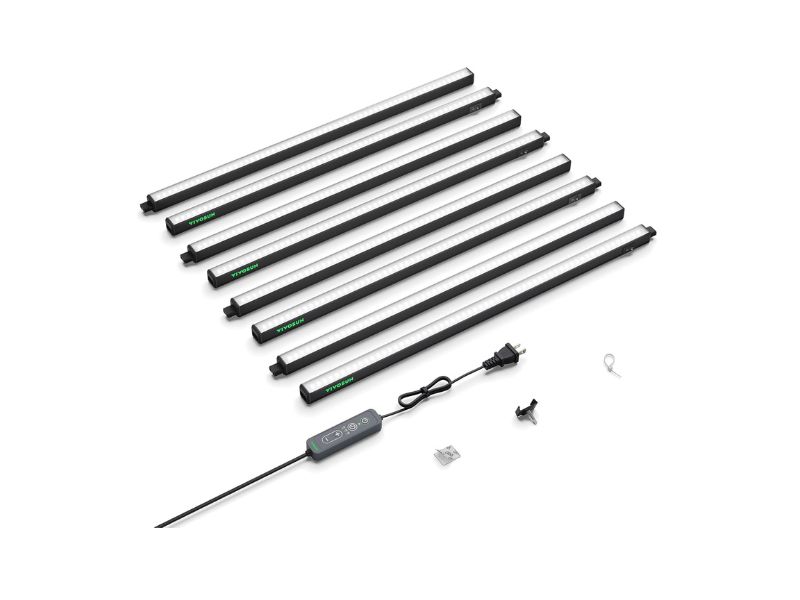
3. VIVOSUN T5 2-Foot Full Spectrum LED Grow Lights With Controller
Key Features
- Eight integrated LED tubes
- Two-foot length
- Approximately 15 watts per tube
- Approximately 120 watts total
- 5000K full-spectrum white output
- Four brightness levels
- 8-, 12-, and 18-hour timer settings
- Linkable construction
- Multiple mounting options
- Optional ecosystem compatibility depending on controller version
The VIVOSUN T5 system takes the third position because its timer and brightness controls solve two common problems: inconsistent manual schedules and excessive intensity on low-clearance shelves.
The eight two-foot tubes can be divided across several growing levels. Two fixtures per shelf create a practical four-level configuration, while demanding shelves can receive more tubes.
Four brightness settings allow the user to reduce output without moving every fixture. This is useful during seedling establishment, propagation, acclimation, or seasonal changes in natural window light.
The timer offers 8-, 12-, and 18-hour cycles. Twelve hours is a useful starting point for many foliage plants, while eighteen hours may be excessive for some mature houseplants. The preset should be selected according to the crop rather than convenience.
The system uses a 5000K white spectrum, providing a daylight-like appearance. It remains visibly bright in a bedroom or living area, so shelves may need a valance or careful orientation to manage glare.
The exact VIVOSUN version should be checked before ordering because similar listings can differ in tube quantity, controller features, individual wattage, and optional smart-system compatibility.
My verdict: VIVOSUN is the most convenient option for users who want integrated scheduling and brightness adjustment. It ranks third because its individual tubes produce less power than the Monios-L T8 fixtures and its controls add model-version complexity.
Product Comparison Table
| Product | Tube type | Tube length | Quantity | Power per tube | Total power | Color appearance | Timer | Brightness control |
| Barrina T5 | Slim integrated LED | 4 ft | 8 | 20W | 160W | 5000K white | External | By tube count or distance |
| Monios-L T8 | Reflector-style integrated LED | 2 ft | 6 | 24W | 144W | Full-spectrum white | External | By tube count or distance |
| VIVOSUN T5 | Slim integrated LED | 2 ft | 8 | 15W | 120W | 5000K white | 8/12/18 hours | Four levels |
Barrina offers the longest continuous coverage. Monios-L provides the most power from each two-foot fixture. VIVOSUN supplies the most convenient controls.
Total package wattage does not describe the intensity on one shelf unless every tube is installed on that level. A 160-watt eight-pack divided across four shelves supplies roughly 40 watts of fixture power per shelf.
Integrated LED Tubes Versus Replaceable Tubes
The selected products are integrated LED fixtures. Their diodes, housing, and electrical components form one assembly.
Integrated Fixtures
Advantages include:
- Slim construction
- Simple plug-and-play installation
- No separate ballast
- Linkable wiring
- Purpose-designed spectrum
- Lower fixture weight
- Easy under-shelf mounting
Limitations include:
- LEDs usually cannot be replaced independently
- Driver failure may require replacing the fixture
- Tubes may not fit ordinary fluorescent sockets
- Similar-looking versions may have different connectors
Replaceable LED Tubes
Some growing setups use replaceable LED tubes installed in compatible housings. These allow the lamp to be replaced without discarding the complete fixture.
However, compatibility can be complicated. Tubes may be:
- Ballast-compatible
- Ballast-bypass
- Single-ended powered
- Double-ended powered
- Designed for a particular fixture only
Incorrect installation can create shock or fire hazards. Electrical conversion of a fluorescent fixture should be performed according to the tube instructions and applicable electrical requirements.
The selected integrated systems avoid ballast confusion, making them more practical for typical household growers.
What T5 and T8 Actually Mean
Traditional fluorescent tubes use “T” followed by a number representing diameter in eighths of an inch:
- T5: approximately 5/8 inch
- T8: approximately 8/8 inch, or 1 inch
Integrated LED products may use the labels more loosely, but they still describe general fixture families.
T5 Characteristics
T5-style LED grow lights tend to be:
- Slim
- Lightweight
- Suitable for low-clearance shelves
- Moderate in power per tube
- Easy to install in multiples
- Appropriate for seedlings and foliage
Barrina and VIVOSUN follow this general approach.
T8 Characteristics
T8-style LED grow lights are often:
- Wider
- Higher in power per fixture
- Equipped with larger reflectors
- More suitable for intensive shelf lighting
- More demanding of vertical clearance
Monios-L represents the T8 format in this comparison.
T8 is not automatically better. A low-clearance propagation shelf may benefit more from dimmable T5 fixtures, while compact succulents may benefit from stronger T8 output.
How to Size Tube Lights for a Shelf
Measure Length and Depth
Length determines whether two-foot or four-foot tubes fit. Depth determines how many parallel rows are needed.
A four-foot-long shelf that is only 10 inches deep might use one or two four-foot T5 fixtures. A 24-inch-deep shelf may require three or four parallel tubes to avoid weak front and back edges.
Measure the Canopy, Not the Shelf
Empty shelf space does not need illumination. Measure the region occupied by leaves rather than the full piece of furniture.
As plants grow, the canopy may expand. Leave room to add another fixture or reposition the tubes.
Account for End Loss
Light output may be weaker near tube ends because of diode spacing and housing design. Avoid placing the most demanding plants completely beyond the illuminated length.
Consider Fixture Connections
Two short tubes installed end to end may leave a small gap where the housings and connectors meet. Overlap their effective coverage where possible rather than assuming perfectly uniform end-to-end output.
How Many Tubes Are Needed?
The answer depends on shelf depth and crop requirements.
One Tube
One tube may be appropriate for:
- A very narrow shelf
- Low-light foliage
- Fresh propagation cuttings
- Supplemental window lighting
- A single row of small plants
Two Tubes
Two parallel tubes are a practical starting point for:
- Standard seed trays
- Medium-light tropical foliage
- Herbs
- African violets
- Compact houseplants
- A 12- to 18-inch-deep shelf
Three or More Tubes
Multiple tubes may be necessary for:
- Deep shelves
- Succulents and cacti
- Dense seedling trays
- Fruiting plants
- High-light herbs
- Shelves with strong edge-to-edge coverage requirements
Adding tubes increases both intensity and heat. Monitor leaf temperature and shelf ventilation.
Spectrum and Color Temperature
5000K White Light
Both Barrina and VIVOSUN use approximately 5000K white output. This cool-white appearance resembles daylight and generally contains a meaningful blue component.
It is well suited to vegetative growth, seedlings, and foliage plants. The visual clarity also helps identify leaf problems.
Full Spectrum
“Full spectrum” does not have one legally universal grow-light definition. It generally indicates a broad mixture of visible wavelengths rather than a narrow red-and-blue output.
A full-spectrum label should not replace actual performance information. Wattage, photon output, coverage, and distance still matter.
Red Light
Red wavelengths contribute efficiently to photosynthesis and flowering responses. White LEDs contain red light, although some grow tubes may add dedicated deep-red diodes.
Blue Light
Blue wavelengths help regulate compact plant form, leaf opening, and vegetative development. Cool-white tubes typically provide more visible blue than warm-white household lighting.
Purple Versus White Fixtures
Purple fixtures can support plants but distort leaf color and create uncomfortable room lighting. White tubes are easier to use in homes, classrooms, offices, and working propagation areas.
Understanding Light Output
Watts
Watts describe electrical consumption. They do not directly measure light delivered to plants.
Higher wattage often supports greater potential output, but LED efficiency, optics, spectrum, and mounting distance affect the result.
PPF
Photosynthetic photon flux describes the total plant-usable photon output from a fixture in µmol/s.
PPF helps compare total fixture capacity but does not describe how evenly light reaches a shelf.
PPFD
Photosynthetic photon flux density describes photons arriving at the canopy in µmol/m²/s.
PPFD changes with:
- Distance
- Tube spacing
- Reflectors
- Shelf walls
- Plant height
- Position below the fixture
Measure at several points across the shelf rather than only at the center.
DLI
Daily light integral represents the total plant-usable light accumulated over one day.
The simplified calculation is:
DLI = PPFD × operating seconds per day ÷ 1,000,000
A shelf receiving an average PPFD of 120 µmol/m²/s for 14 hours receives:
120 × 50,400 ÷ 1,000,000 = 6.05 mol/m²/day
Increasing either PPFD or operating time increases DLI, but a dark period should still be maintained.
Matching Tubes to Plants
Seedlings
Seedlings require enough light to prevent elongated stems. Tubes work well because they follow the shape of rectangular trays.
Keep the canopy relatively level and raise the fixtures as seedlings grow.
Propagation Cuttings
Unrooted cuttings generally need moderate, even light rather than extreme intensity. VIVOSUN’s brightness controls are useful for beginning at a reduced setting.
Tropical Houseplants
Pothos, Philodendron, Peperomia, Hoya, and similar plants can grow well under white tube systems. Variegated forms may need greater intensity than fully green forms, but pale tissue can also scorch.
Succulents
Succulents often need multiple tubes mounted closer to maintain compact form. Monios-L’s higher-output T8 fixtures are more relevant than a single moderate T5 tube.
Herbs and Greens
Basil, parsley, lettuce, and similar plants benefit from even coverage. Dense leaves require airflow as well as light.
Fruiting Plants
Tomatoes, peppers, and other fruiting crops typically need substantially more intensity than foliage houseplants. Several tubes may work for seedlings, but mature fruiting plants may be better served by a high-output panel or bar-style fixture with published PPFD maps.
Hanging Distance
There is no reliable universal distance for every tube.
The correct height depends on:
- Watts per tube
- Number of parallel tubes
- Reflector design
- Plant species
- Growth stage
- Natural daylight
- Daily schedule
- Canopy temperature
Begin with the manufacturer’s instructions. If complete PPFD data is unavailable, start at a conservative distance and observe the newest growth.
Too Far Away
Symptoms can include:
- Seedlings leaning or stretching
- Long internodes
- Small pale leaves
- Weak succulent form
- Plants growing toward another light source
Too Close
Symptoms can include:
- Bleaching
- Tan dry patches
- Upward leaf curl
- Warm leaves
- Faded pigments
- Unusually rapid drying
Adjust height in small increments and wait for new growth before making another large change.
Photoperiod and Timer Settings
A stable schedule makes plant response easier to evaluate.
General starting ranges include:
- Foliage houseplants: 12–14 hours
- Seedlings: 14–16 hours
- Herbs and greens: 14–16 hours
- Flowering plants: species-dependent
- Supplemental window lighting: adjusted for natural exposure
Plants should receive a regular dark period. Continuous 24-hour lighting wastes power and is not a sensible default.
VIVOSUN offers preset timer options. Barrina and Monios-L require an external timer for automatic scheduling.
If power is interrupted, verify whether the controller resumes its previous brightness and whether the timer must be reset.
Estimating Electricity Use
Use this calculation:
Monthly kWh = watts ÷ 1,000 × daily hours × 30
Barrina T5 Eight-Pack
All eight fixtures at 160 watts for 14 hours:
0.160 × 14 × 30 = 67.2 kWh per month
Monios-L T8 Six-Pack
All six fixtures at 144 watts for 14 hours:
0.144 × 14 × 30 = 60.48 kWh per month
VIVOSUN T5 Eight-Pack
All eight fixtures at 120 watts for 14 hours:
0.120 × 14 × 30 = 50.4 kWh per month
These estimates assume full output and every tube operating. Dimming or using fewer tubes reduces consumption.
Multiply kWh by the local electricity rate to estimate cost.
Installation Methods
Magnetic Mounting
Magnets simplify installation on compatible steel shelves. Test the attachment before positioning plants underneath.
Paint thickness, surface shape, vibration, and fixture weight can affect holding strength. Use a secondary restraint where failure could cause injury or water contact.
Mounting Clips
Clips provide a more permanent installation. Fasteners must suit the shelf material and should not split thin wood or particleboard.
Cable Ties
Cable ties are useful on wire racks but should be rated for the temperature and load. Inspect them periodically for brittleness.
Hanging Chains or Cables
Suspended mounting makes height adjustment easier. Ensure all suspension points share the load evenly so the tube remains level.
Adhesive Mounting
Adhesive can weaken because of heat, moisture, dust, or textured surfaces. It should not be the only support above plants unless the manufacturer approves the application.
Linking Multiple Tubes
Linking allows several fixtures to share one power connection, reducing cable clutter.
Before linking:
- Check the maximum number of fixtures per chain.
- Add their actual wattages.
- Verify controller and timer capacity.
- Inspect all connectors.
- Keep connections away from irrigation.
- Avoid tension on link cables.
- Cap unused powered connection points as instructed.
A physical connector fitting into another tube does not prove that an unlimited number can be connected.
Electrical and Water Safety
Create Drip Loops
Every cord should dip below its outlet or controller before rising to the connection. Water running down the cable then falls at the low point.
Keep Power Strips Elevated
Do not place power strips or timers on the floor beneath a plant rack. Mount them above potential drainage areas but away from water and mist.
Unplug Before Watering When Necessary
If watering could splash electrical components, switch off and unplug the system first. Allow wet areas to dry before restoring power.
Inspect for Heat
A warm housing can be normal. Scorched plastic, discoloration, melting, crackling, or unusually hot connectors are not.
Use Indoor Equipment Indoors
Do not expose a dry-rated fixture to rain, direct spray, or greenhouse condensation unless the exact product carries a suitable environmental rating.
Heat and Airflow
LED tubes are more efficient than many older fluorescent systems, but they still add heat.
Several tubes mounted beneath a shelf can warm:
- The shelf above
- The plant canopy
- Propagation domes
- Electrical drivers
- Enclosed cabinets
Provide air circulation without directing a harsh stream at delicate seedlings. Measure temperature at canopy height rather than relying only on the room thermostat.
Maintenance
Remove Dust
Dust on optical surfaces reduces useful output. Unplug the fixtures and wipe them with a dry or slightly damp soft cloth according to the instructions.
Inspect Mounts
Check magnetic bars, clips, ties, chains, and screws monthly. Growing vines and routine watering can place unexpected strain on the fixtures.
Check Connectors
Loose connectors may flicker, heat up, or fail intermittently. Disconnect power before reseating them.
Monitor Light Output
LEDs may gradually lose output. If plants stretch despite an unchanged setup, check distance, tube cleanliness, operating schedule, and measured intensity.
Replace Failed Integrated Fixtures
Do not open or modify an integrated tube unless the manufacturer provides a service procedure. Electrical repair can expose hazardous voltage.
Common Purchasing Mistakes
- Confusing integrated fixtures with replaceable LED tubes
- Buying four-foot lights for a two-foot cabinet
- Comparing only total package wattage
- Ignoring wattage per individual tube
- Mounting one tube over a deep shelf
- Assuming T8 always outperforms T5
- Treating color temperature as a complete spectrum specification
- Believing “full spectrum” guarantees sufficient intensity
- Trusting inflated equivalent-wattage claims
- Ignoring the linking limit
- Using a timer with insufficient capacity
- Mounting fixtures with weak adhesive
- Allowing connectors beneath drainage holes
- Running lights 24 hours per day
- Failing to leave vertical growth space
- Mixing shade plants and succulents on one fixed-intensity shelf
- Forgetting to account for electricity use
- Assuming LEDs produce no heat
Frequently Asked Questions
What are the best LED tube grow lights?
Barrina’s four-foot T5 set offers the strongest overall shelf-coverage balance. Its eight 20-watt fixtures fit long racks effectively. Monios-L is better for powerful two-foot coverage, while VIVOSUN adds timer and brightness controls.
Are LED tube lights good for growing plants?
Yes, their linear shape provides even coverage across shelves and seed trays. Correct intensity, spectrum, distance, and operating duration are still necessary. One weak tube may not support high-light plants on a deep shelf.
What is the difference between T5 and T8 grow lights?
T5 fixtures are slimmer, while T8 fixtures are typically wider and more powerful. Integrated LED products may use the terms loosely, so compare actual dimensions, wattage, output, and housing design.
Are these replacement tubes for fluorescent fixtures?
No, the three reviewed products are complete integrated LED fixtures. They contain their own LEDs, housing, and electronics. Do not attempt to install them in fluorescent sockets.
Can LED tubes replace fluorescent grow lights?
Yes, integrated LED fixtures can replace the complete fluorescent-light setup. They should not be inserted into old fluorescent housings unless specifically designed for that purpose. Remove or safely decommission incompatible equipment.
How many tubes should I install per shelf?
One to three tubes is a practical starting range for many shelves. Narrow foliage shelves may use one, while deep seedling or succulent shelves may need several. Measure intensity at canopy height when possible.
How far should tube grow lights be from seedlings?
Distance depends on individual tube power and the number of fixtures. Start with the manufacturer’s guidance, monitor stretching or bleaching, and adjust in small steps. Raise the tubes as seedlings grow.
Are 5000K LED tubes suitable for plants?
Yes, 5000K white light supports seedlings and vegetative plant growth. Color temperature does not describe the complete spectrum, but cool-white full-spectrum tubes are practical for indoor shelves.
Can tube lights grow succulents?
Yes, but succulents commonly need multiple tubes and relatively close placement. Monios-L T8 fixtures provide stronger individual output. Watch new growth for stretching or loss of compact form.
Can tube grow lights flower plants?
They can support flowering when sufficient intensity and the correct photoperiod are provided. Mature fruiting crops may need more output than lightweight shelf tubes can deliver economically.
How long should tube grow lights remain on?
Approximately 12–16 hours is a useful range for many indoor setups. Mature foliage often needs less duration than seedlings. Use a timer and provide darkness every day.
Do LED grow tubes need reflectors?
Reflectors help direct sideways light toward the plants but do not create more output. Monios-L includes a reflector-style housing. Good tube spacing and mounting height remain equally important.
Can I connect all tubes to one outlet?
Yes, when the linked load stays within every component’s electrical rating. Follow the manufacturer’s maximum chain length and confirm that the timer, power strip, and circuit support the total wattage.
Do LED tubes produce heat?
Yes, all LED fixtures release heat during operation. Several tubes in an enclosed rack can noticeably raise canopy temperature. Provide airflow and keep housings unobstructed.
Are built-in timers better than external timers?
Integrated timers simplify setup, while external timers offer broader replacement choices. VIVOSUN provides preset schedules. Barrina and Monios-L can use properly rated external timers.
Can tube lights be mounted vertically?
Yes, secure vertical mounting can provide side lighting for tall plants. Most plants still benefit from overhead lighting, so vertical tubes are often supplemental rather than the only source.
Why are plants at the shelf ends growing slowly?
The tube may not provide strong output across the entire physical length. Move plants inward, extend the lighting, or overlap coverage from another fixture. Measure the canopy rather than assuming end-to-end uniformity.
Can I leave LED grow tubes on overnight?
Yes, if the plants still receive a consistent dark period at another time. Daytime operation is usually more convenient and reduces nighttime glare. The biological schedule matters more than the clock time.
Conclusion
The best led tube grow lights should match the growing surface rather than simply offering the largest number of fixtures. Tube length determines whether the light follows the shelf, while wattage per tube, reflector design, mounting height, and spacing determine canopy intensity.
Barrina T5 4-Foot Full Spectrum LED Grow Lights remain my primary recommendation. Their four-foot length is well suited to common utility racks and long growing benches, and eight 20-watt fixtures can be divided among several levels.
Monios-L T8 is the stronger compact alternative. Six 24-watt two-foot tubes provide flexible, higher-output coverage for seedlings, herbs, succulents, and short shelves. Their larger reflector-style housings require more clearance than slim T5 fixtures.
VIVOSUN T5 is more suitable when automation matters. Its eight modular tubes, brightness settings, and timer presets make it easier to manage propagation or foliage shelves without adding a separate controller.
Before choosing, measure shelf length, shelf depth, plant height, and available mounting clearance. Keep electrical connections away from water, respect the linking limit, and leave space to raise the fixtures as plants grow.
For a standard four-foot plant rack, I would begin with Barrina T5 and allocate one or two tubes to each shelf according to plant demand.

I’m Maya L. Greenwood, a lifelong plant lover who believes anyone can grow something beautiful with the right guidance. After years of testing soil mixes, pruning methods, irrigation tricks, and pest-safe solutions, I started EasyGardenTips.com to turn hard-won lessons into step-by-step advice. From seed starting and container gardens to composting and seasonal checklists, my goal is to make gardening simple, sustainable, and fun.