Best LED Bulbs for Growing Plants: 5 Reliable Indoor Options
Growing healthy plants indoors requires more than installing the brightest bulb available. Plants respond to usable light intensity, spectrum, coverage, distance, and daily exposure. The best LED bulbs for growing plants combine suitable wavelengths with enough photosynthetic output for the intended plant and growing area.
My primary recommendation is the SANSI 36W Full Spectrum LED Grow Light Bulb because it offers the strongest overall balance of plant-usable output, natural-looking light, focused coverage, standard E26 compatibility, and effective heat management. It is powerful enough for demanding houseplants and compact indoor growing areas while remaining easier to install than a dedicated grow-light panel.
The other bulbs in this guide cover different needs, including larger PAR38 floodlights, multi-socket growing areas, compact A19 fixtures, and automated lighting schedules.
Best LED Bulbs for Growing Plants Reviewed
| Image | Product Name | Check Price |
|---|---|---|
Best Choice | SANSI 36W Full Spectrum LED Grow Light Bulb | Check Price |
Second Best | GE Grow LED PAR38 Balanced Spectrum Light Bulb | Check Price |
Third Choice | SYLVANIA Full Cycle 20W PAR38 LED Grow Light Bulbs, 6-Pack | Check Price |
1. SANSI 36W Full Spectrum LED Grow Light Bulb
Key Features
- 36-watt LED grow bulb
- 65.6 μmol/s photosynthetic photon flux
- 4000K full-spectrum white light
- Standard E26 base
- Ceramic heat-dissipation structure
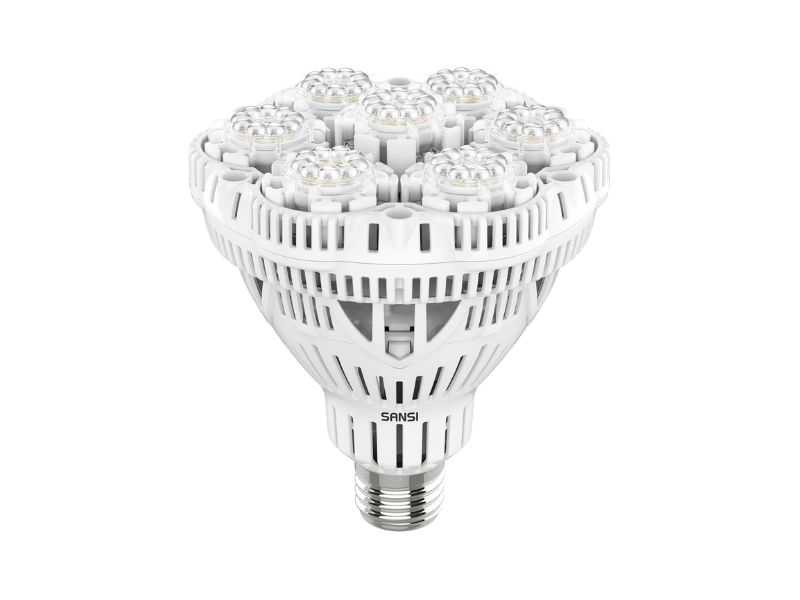
The SANSI 36W is a high-output BR30-style bulb designed for indoor plants that need more light than a conventional household bulb can provide. Its published PPF of 65.6 μmol/s gives it the highest total plant-usable output among the products compared here.
Its 4000K light looks relatively natural in a living space while covering wavelengths across the visible spectrum. That makes it suitable for foliage growth, seedlings, herbs, and plants moving through multiple growth stages. It is also a more comfortable choice for occupied rooms than older red-and-blue grow bulbs that cast a strong purple glow.
SANSI uses a chip-on-ceramic construction instead of a conventional LED board and separate metal heat sink. The ceramic body helps transfer heat away from the LED chips without a cooling fan. The bulb therefore operates silently, although the housing can still become warm during long lighting cycles.
An optical lens concentrates the output toward the plant canopy. This produces stronger intensity directly below the bulb but creates a smaller effective growing area than a wide LED panel. I prefer it for one large plant, a close group of medium plants, or a compact seed-starting area rather than a long shelf.
The bulb fits a standard E26 socket, but its weight and dimensions require a stable fixture. A sturdy pendant, track-light head, or securely mounted clamp fixture is more appropriate than a flexible gooseneck. It should also be used in a fixture that provides adequate airflow instead of trapping heat around the ceramic body.
Placement should be adjusted according to plant response and measured light intensity. Starting approximately 12 to 18 inches above many houseplants is reasonable, but light-sensitive plants may require more distance. High-light plants may benefit from closer positioning after gradual acclimation.
What I Like
- Delivers strong plant-usable output from a single replaceable bulb
- Produces natural-looking white light suitable for living spaces
- Uses focused optics to direct more light toward the plant
- Passive ceramic cooling eliminates fan noise
What I Do Not Like
- Heavier than a normal household bulb
- Focused coverage may not illuminate a wide shelf evenly
- Requires an external timer for automatic scheduling
The SANSI 36W is the bulb I would choose for a serious indoor plant setup that still needs the convenience of an E26 socket. Its output, spectrum, and thermal design make it the strongest all-around option, provided the fixture is stable and the bulb is positioned carefully.
2. GE Grow LED PAR38 Balanced Spectrum Light Bulb
Key Features
- 32-watt PAR38 floodlight design
- 50 μmol/s photosynthetic photon flux
- Balanced red-and-blue spectrum
- Standard E26 base
- Rated operating life of up to 25,000 hours
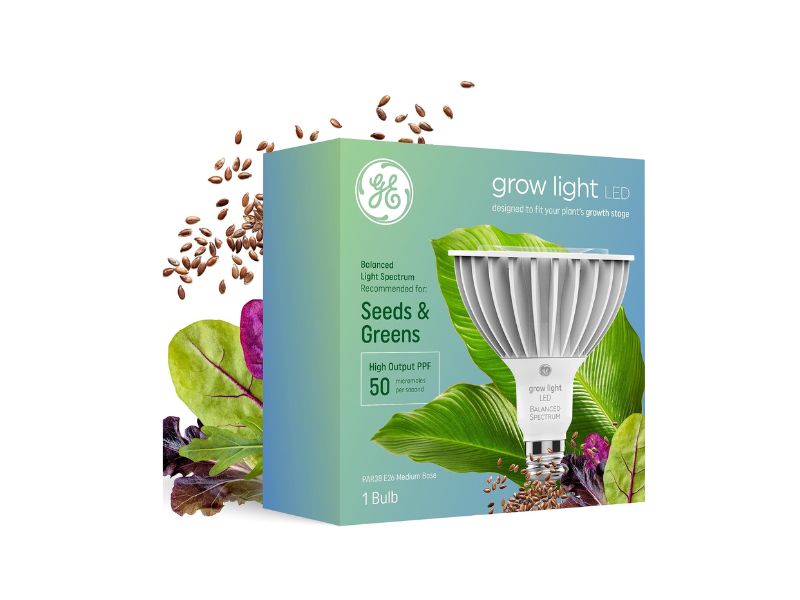
This GE grow bulb combines substantial output with a conventional PAR38 floodlight shape. Its 50 μmol/s PPF places it below the SANSI bulb in total output but well above most compact A19 grow bulbs.
The balanced spectrum is designed for seeds, leafy greens, herbs, and general plant development. Although it provides red and blue wavelengths used in photosynthesis, the emitted light appears white to the eye. This makes it practical for a kitchen garden, living room plant corner, or other visible indoor location.
The PAR38 design creates directed floodlight coverage. It works well above a defined group of plants, but the intensity decreases as the distance or coverage area increases. It is therefore important to aim the fixture directly at the canopy instead of relying on light reflected from a wall or ceiling.
The bulb consumes 32 watts and does not contain a fan, so it runs silently. Heat is substantially lower than that of an older high-wattage incandescent grow lamp, but adequate ventilation is still necessary. It is non-dimmable, so intensity must be controlled by adjusting distance or operating time.
At approximately 1.2 pounds, this is another relatively heavy bulb. A strong fixed socket is preferable to a lightweight desk lamp or flexible arm. Its broad PAR38 body may also extend beyond narrow shades.
I would use this bulb for a medium plant cluster, a productive herb garden, or seedlings that need more intensity than an A19 bulb can provide. The balanced spectrum makes it more versatile across vegetative stages than a specialized red-heavy flowering bulb.
What I Like
- Provides clearly stated plant-usable output
- Balanced spectrum supports several plant types and growth stages
- White appearance is easier to live with than purple grow lighting
- Directed PAR38 beam works well over a defined growing area
What I Do Not Like
- Large and heavy for flexible or lightweight fixtures
- Cannot be dimmed
- Less total output than the first-ranked bulb
The GE PAR38 is a dependable choice when I want substantial output and straightforward specifications in a familiar floodlight design. It is particularly suitable for seedlings, herbs, and leafy plants positioned under a strong, securely mounted fixture.
3. SYLVANIA Full Cycle 20W PAR38 LED Grow Light Bulbs, 6-Pack
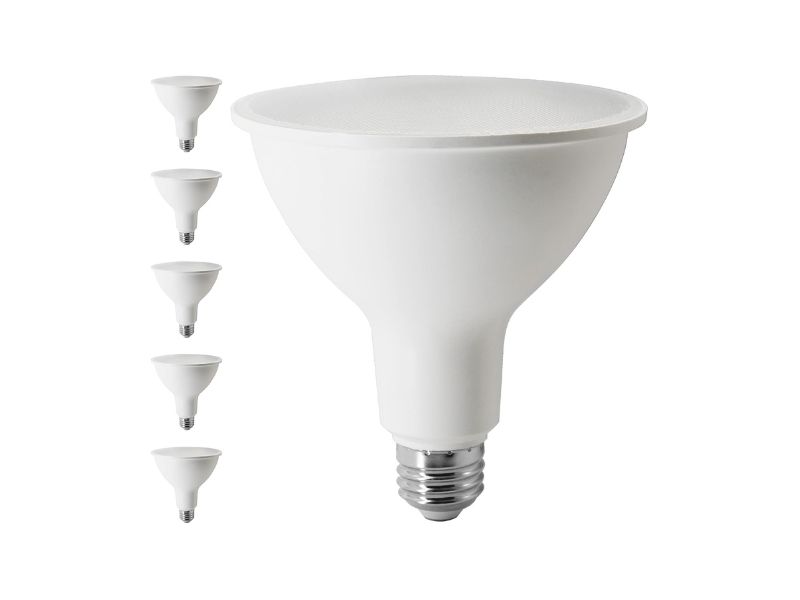
Key Features
- Six 20-watt PAR38 bulbs
- 30 μmol/s PPF per bulb
- Full-cycle plant spectrum
- Standard medium screw base
- Damp-location rating
The SYLVANIA Full Cycle PAR38 is designed for growers who need multiple independent light sources instead of maximum output from one bulb. Each bulb produces 30 μmol/s PPF, allowing the six-pack to cover several plants, shelves, or growing stations when installed in separate fixtures.
Distributing several bulbs can provide better canopy uniformity than aiming one powerful light at a wide group. For example, two or three bulbs can be positioned over a broad plant cluster, while the remaining bulbs can support separate seedling or houseplant areas. This arrangement also reduces the deep shadows that occur when all light comes from one direction.
The full-cycle spectrum is intended for seedlings, vegetative development, and flowering plants. Each bulb uses a standard medium base and has a frosted PAR38 design. The bulbs are non-dimmable, so height, spacing, and operating duration remain the primary controls.
At 20 watts per bulb, electricity use depends heavily on how many are operated. Six bulbs running simultaneously draw 120 watts, which may be unnecessary for a small houseplant collection. The pack makes more sense when the bulbs will be distributed across a larger indoor garden or activated in separate zones.
The bulbs use passive cooling and do not require fans. Their damp-location rating adds useful flexibility around humid indoor growing areas, but it does not make them waterproof. Electrical connections must remain protected from irrigation, condensation, and splashing.
A PAR38 bulb is substantially wider than an A19 bulb, so fixture clearance should be checked before installation. Secure clamp lamps or fixed overhead sockets work better than small decorative shades.
What I Like
- Six bulbs can cover multiple growing locations
- 30 μmol/s output per bulb supports meaningful supplemental lighting
- Full-cycle spectrum works across different plant stages
- Damp-location rating suits appropriately protected humid spaces
What I Do Not Like
- Six bulbs may be excessive for a small collection
- Operating the entire pack increases total power consumption
- Non-dimmable design limits intensity control
I would choose the SYLVANIA pack for a multi-zone indoor garden where even distribution matters more than concentrating all available output on one plant. It offers useful flexibility, but buyers should calculate the number of bulbs they genuinely need before planning the fixtures.
4. Feit Electric 9W A19 Full Spectrum LED Grow Light Bulb
Key Features
- Compact 9-watt A19 design
- 14.2 μmol/s plant-usable output
- 3300K full-spectrum light
- E26 base
- Rated for enclosed fixtures and damp locations
The Feit Electric A19 is a practical choice for a small plant, an enclosed compatible fixture, or a location where a large PAR38 bulb will not fit. Its conventional A19 shape measures approximately 4.3 inches long and 2.4 inches wide, making it easier to use in household lamps.
Its output is listed at 14.2 μmol/s, which is appropriate for supplemental light over a small area but considerably lower than the three bulbs ranked above it. It works best when positioned relatively close to one low- or medium-light plant. Several bulbs may be needed for seedlings, high-light succulents, or plants expected to flower and fruit indoors.
The 3300K light has a warmer appearance than a 4000K or daylight-colored bulb. Its spectrum emphasizes useful blue and red wavelengths, including output around 449 nm and 630 nm. This allows it to support photosynthesis without producing the extreme purple appearance associated with narrow-spectrum grow lights.
The bulb draws only 9 watts and operates without a fan. It is non-dimmable, but its lower output can be useful when a high-powered bulb would be unnecessarily intense. It is also rated for enclosed fixtures and damp locations, giving it broader fixture compatibility than many higher-output grow bulbs.
Its compact form does not eliminate the need for proper placement. A decorative lamp that points light sideways or traps most output behind an opaque shade will perform poorly. The socket should direct the bulb toward the foliage, and the fixture should not block its useful beam.
What I Like
- Fits fixtures that cannot accommodate a large PAR38 bulb
- Low 9-watt power draw suits a small supplemental-light setup
- Enclosed-fixture rating improves installation flexibility
- Warm white appearance integrates well into living areas
What I Do Not Like
- Output is limited to a small growing area
- Non-dimmable
- Not powerful enough for a broad tray or demanding mature plant by itself
The Feit Electric A19 is a sensible compact bulb for keeping a small houseplant or herb supplied with supplemental light. I would not choose it as the sole light source for a large plant, but its fixture compatibility and modest energy use make it useful in tight spaces.
5. Briignite 11W A19 Dimmable Grow Light Bulbs, 2-Pack
Key Features
- Two 11-watt A19 bulbs
- Four spectrum or growth modes
- Dimmable output up to 1,000 lumens
- 3-, 9-, 12-, and 18-hour timing options
- Standard E26 base
The Briignite A19 bulbs prioritize convenience and control. Each bulb combines adjustable output, four growth modes, and several timing durations, reducing the need for a separate plug-in timer or dimmer.
The two-pack is useful for positioning light on opposite sides of a plant or illuminating two separate small growing zones. This can produce more balanced growth than placing one bulb on only one side, especially for upright foliage plants that naturally lean toward the strongest light source.
Each bulb consumes 11 watts and fits an E26 socket. The A19 shape is more compact than a PAR38 floodlight and should fit a wider range of household fixtures. However, fixture orientation still matters. A socket that points away from the canopy wastes much of the available output.
The integrated controls provide more flexibility than the other bulbs in this guide. The 3-hour setting can supplement a bright window, while 9-, 12-, or 18-hour cycles can serve plants receiving less natural light. The longer setting may also suit seed-starting applications when bulb intensity and distance are appropriate.
Dimming helps acclimate sensitive plants and manage light in living areas. Nevertheless, lumens describe human-visible brightness rather than plant-usable photon output. Because a clear PPF specification is not the main strength of this model, I would monitor plant response closely instead of assuming that maximum brightness guarantees adequate intensity.
The bulbs operate without cooling fans, making them suitable for quiet rooms. Their additional electronics create more operational complexity than a basic on/off bulb, so correct control setup is important after a power interruption.
What I Like
- Built-in timing simplifies daily light scheduling
- Dimming provides better intensity control
- Four modes allow adjustment for different growing stages
- Two bulbs can illuminate separate plants or reduce side shadows
What I Do Not Like
- Plant-usable output is less clearly defined than on higher-ranked models
- Controls are more complicated than a basic bulb and timer
- Two compact bulbs may still be insufficient for a large canopy
The Briignite two-pack is best suited to buyers who value automated scheduling and adjustable light more than maximum documented output. I would use it for small houseplants, herbs, or seedlings where convenient control and flexible placement are priorities.
LED Grow Light Bulb Comparison
| Product | Bulb Type | Power | Plant-Output Specification | Spectrum | Base | Controls | Suitable Setup | Main Strength | Main Limitation |
| SANSI 36W Full Spectrum LED Grow Light Bulb | BR30 | 36W | 65.6 μmol/s PPF | 4000K full spectrum | E26 | On/off | One large plant or compact cluster | Highest output in the comparison | Heavy with focused coverage |
| GE Grow LED PAR38 Balanced Spectrum Light Bulb | PAR38 | 32W | 50 μmol/s PPF | Balanced red and blue | E26 | On/off | Medium plant cluster or seedlings | Strong output and clear specifications | Large and non-dimmable |
| SYLVANIA Full Cycle 20W PAR38 LED Grow Light Bulbs | PAR38 | 20W each | 30 μmol/s PPF each | Full cycle | Medium base | On/off | Multiple fixtures or growing zones | Flexible multi-bulb coverage | Six-pack can exceed small setups |
| Feit Electric 9W A19 Full Spectrum LED Grow Light Bulb | A19 | 9W | 14.2 μmol/s | 3300K full spectrum | E26 | On/off | One small plant | Compact and enclosed-fixture rated | Limited growing area |
| Briignite 11W A19 Dimmable Grow Light Bulbs | A19 | 11W each | Not prominently specified | Four growth modes | E26 | Dimming and timer | Small plants or two light zones | Built-in automation | Less transparent plant-output data |
The main difference is usable intensity. The SANSI and GE PAR38 bulbs concentrate substantial output into a defined area, while the Feit and Briignite A19 bulbs prioritize compact installation. The SYLVANIA pack occupies the middle ground by distributing moderate output through several fixtures.
How to Choose the Best LED Bulbs for Growing Plants
Understand PPF, PPFD, and DLI
Photosynthetic photon flux, or PPF, measures the total quantity of photosynthetically useful photons a light produces each second. It is expressed in micromoles per second. PPF helps compare overall light output, but it does not reveal how much of that light reaches a specific leaf.
Photosynthetic photon flux density, or PPFD, measures the photon intensity reaching one square meter of canopy each second. PPFD changes with hanging height, beam angle, fixture direction, and the size of the growing area.
Daily light integral, or DLI, represents the total useful light a plant receives throughout one day. A lower PPFD can sometimes be compensated for with a longer photoperiod, but plants still require a regular dark period. Excessive operating time cannot always correct inadequate intensity or poor coverage.
Match Output to the Plant
Low-light tropical foliage plants generally tolerate modest supplemental intensity. Herbs, seedlings, succulents, vegetables, and fruiting plants usually require more usable light.
A compact 9- or 11-watt A19 grow bulb can help maintain one small houseplant near a window. It is less likely to provide all the light required by a mature tomato, citrus tree, or broad seedling tray.
For higher-light plants, I would start with a bulb that publishes PPF or PPFD information. Published output makes it easier to estimate whether the bulb can support the intended plant instead of relying on vague watt-equivalent claims.
Do Not Judge a Grow Bulb by Lumens Alone
Lumens measure brightness according to human vision. Human eyes are especially sensitive to green-yellow light, while plants use photons across the photosynthetically active radiation range of approximately 400 to 700 nanometers.
A high-lumen household bulb may appear bright without directing enough useful light onto the canopy. Conversely, a horticultural bulb can provide meaningful plant output without having the highest visible lumen rating.
Lumens remain useful for understanding how bright a room may feel, but PPF and PPFD are more relevant for plant growth.
Choose the Correct Spectrum
A full-spectrum white grow light is the most flexible choice for general indoor growing. Blue wavelengths support compact vegetative growth and leaf development, while red wavelengths contribute strongly to photosynthesis and reproductive growth.
Spectrum alone does not determine performance. A perfectly balanced spectrum at very low intensity may produce weaker growth than a sufficiently intense broad-spectrum bulb.
For mixed houseplants, herbs, and seedlings, I prefer a balanced white spectrum. A red-heavy bulb can be useful for flowering or fruiting plants, but it may be less versatile when used as the only light throughout the plant’s life cycle.
Check Bulb Shape and Fixture Compatibility
Most bulbs in this guide use a standard E26 medium screw base, but identical bases do not guarantee identical fixture compatibility.
An A19 bulb is compact and fits many household lamps. BR30 and PAR38 bulbs are wider, longer, and frequently heavier. A large grow bulb may not fit inside a narrow shade, and its weight can pull a flexible lamp arm out of position.
Check the fixture’s maximum electrical rating, physical clearance, socket condition, and ability to support the bulb. Unless a bulb is specifically approved for enclosed fixtures, use it where air can circulate around the housing.
Consider Beam Angle and Coverage
A narrow beam creates stronger intensity in a smaller area. A wide beam covers more leaves but spreads the available photons over a larger surface.
For one large plant, a concentrated bulb directly above the canopy can work well. For a long shelf, multiple bulbs usually create more uniform coverage. Plants at the edge of a beam may stretch sideways even when the center plant receives enough light.
Overlapping two beams can reduce dark areas, but excessive overlap can also create an intense hotspot. Periodically inspect every plant instead of judging the setup only by its center.
Plan for Heat Management
LED grow bulbs are more efficient than old incandescent grow lamps, but they still produce heat. The heat is concentrated around the LED driver and heat sink rather than projected mainly as infrared radiation.
Keep the bulb’s vents or cooling surfaces unobstructed. Do not allow leaves, curtains, paper, or other material to touch the bulb. If foliage curls, bleaches, dries unusually quickly, or develops pale patches directly under the light, increase the distance and reassess intensity.
Use a Reliable Light Schedule
Many houseplants perform well with approximately 10 to 14 hours of supplemental light, while seedlings may receive 14 to 18 hours when intensity is appropriate. These are starting ranges rather than universal rules.
Plants need darkness for normal physiological processes. Leaving a grow bulb on continuously can waste energy and may interfere with growth or flowering responses.
A plug-in timer is often the simplest control for a basic bulb. A timer also creates more consistent results than switching the light on and off manually at different times each day.
Installation and Placement Guidance
Install the bulb only when the fixture is switched off and cool. Confirm that the socket is undamaged and that the fixture supports the bulb’s wattage, dimensions, and weight.
Position the light above the canopy whenever possible. Overhead placement encourages balanced vertical growth, while strong side lighting can make stems and leaves lean toward the fixture.
Start conservatively with the bulb farther from the plant, then reduce the distance gradually. Watch for stretching, small pale leaves, and slow growth as possible signs of inadequate light. Bleaching, crispy patches, upward leaf curling, or unusually fast drying can indicate excessive intensity or heat.
As plants grow taller, raise the fixture to maintain consistent distance. When several plants share one bulb, arrange them so their leaves form a relatively even canopy. Shorter plants can be elevated on stable platforms instead of lowering the light too close to taller plants.
Energy Use and Operating Cost
The monthly electrical consumption of a grow bulb can be estimated with this formula:
Wattage ÷ 1,000 × operating hours per day × 30 = monthly kilowatt-hours
For example, a 36-watt bulb operating 14 hours per day uses:
36 ÷ 1,000 × 14 × 30 = 15.12 kWh per month
Multiply 15.12 by the electricity rate shown on the local utility bill to estimate the monthly operating cost.
Remember to calculate the combined wattage when using several bulbs. Six 20-watt bulbs draw 120 watts in total, even though each individual bulb is relatively efficient.
Maintenance and Long-Term Use
Dust reduces the amount of light reaching the plant. Switch off and unplug the fixture, allow the bulb to cool completely, and wipe the exterior gently with a dry microfiber cloth. Do not spray cleaning liquid onto the bulb or socket.
Inspect clamp mechanisms, hanging hardware, cords, timers, and sockets periodically. A heavy bulb can gradually loosen an unsuitable fixture. Replace equipment that shows discoloration, cracking, exposed wiring, flickering, or excessive heat.
Clean reflective walls and trays when necessary, but avoid reflective materials that create concentrated hotspots or electrical hazards. Rotate plants if the lighting pattern produces noticeably uneven growth.
Keep irrigation water away from electrical connections. A damp-location rating does not mean the bulb can tolerate direct spray or immersion. In a humid growing area, provide airflow and use appropriately protected electrical outlets.
Common Grow-Light Bulb Mistakes
Choosing by Watt Equivalent
A watt-equivalent claim compares visible brightness with an older bulb type. It does not reliably describe horticultural performance. Compare actual wattage, PPF, PPFD, spectrum, and coverage instead.
Placing the Bulb Too Far Away
Light intensity decreases rapidly as distance increases. A powerful grow bulb mounted near the ceiling may contribute little useful light to a plant on the floor.
Trying to Cover Too Much Area
One bulb rarely illuminates a long shelf or several widely spaced plants evenly. Adding strategically positioned bulbs is usually more effective than expecting one beam to cover the entire room.
Ignoring Fixture Weight and Ventilation
Large grow bulbs can overwhelm lightweight fixtures. Enclosing a high-output bulb can also trap heat and shorten its useful life unless the bulb is specifically rated for that installation.
Leaving the Light on Continuously
A longer photoperiod is not automatically better. Provide a consistent dark period and adjust the schedule according to plant type, intensity, growth stage, and natural window light.
Making Sudden Intensity Changes
Plants accustomed to dim conditions can develop light stress when placed immediately under a powerful bulb. Begin at a greater distance or shorter duration and increase exposure gradually.
Frequently Asked Questions
What are the best LED bulbs for growing plants indoors?
The best LED bulbs for growing plants provide documented plant-usable output, a suitable spectrum, safe heat management, and coverage that matches the canopy. The SANSI 36W is my primary recommendation for substantial output over one plant or a compact cluster. A lower-power A19 bulb may be more appropriate for one small houseplant, while multiple PAR38 bulbs are better for several growing zones. Plant type, fixture strength, distance, and operating schedule should determine the final choice.
Can any LED light bulb grow plants?
A normal LED bulb can supplement window light, but it may not provide enough intensity or the most useful spectral distribution for sustained indoor growth. Household bulbs are designed primarily for human visibility, so their lumen rating does not describe plant-usable output. A dedicated grow bulb with published PPF or PPFD information is easier to evaluate. A regular daylight LED may maintain a tolerant foliage plant, but seedlings, herbs, succulents, and flowering plants generally benefit from purpose-built horticultural lighting.
How many LED grow bulbs do I need?
The required number depends on bulb output, beam angle, hanging height, canopy size, plant type, and the amount of natural light available. One high-output bulb may support a large houseplant or compact group, while a long shelf generally needs several evenly spaced bulbs. Begin by mapping the area each beam covers at the intended height. Add another bulb if plants at the edges stretch, lean, or develop weaker growth than plants in the center.
How close should an LED grow bulb be to plants?
There is no universal distance because bulb output and optics differ substantially. Compact A19 bulbs may need to be relatively close, while high-output PAR38 or BR30 bulbs can operate farther from the canopy. Manufacturer guidance provides a starting point, but plant response remains important. Increase the distance if leaves bleach, curl, or develop dry patches. Reduce it gradually if stems stretch, growth remains weak, or plants consistently lean toward the bulb.
How long should grow bulbs stay on each day?
Many indoor plants can begin with 10 to 14 hours of supplemental light, while seedlings commonly receive 14 to 18 hours when intensity is appropriate. Natural window light should be considered part of the daily total. Plants also need a consistent dark period, so continuous 24-hour lighting is generally unnecessary. I prefer using a timer and adjusting the schedule only after observing growth, leaf color, stem spacing, flowering response, and signs of excessive exposure.
Is white or purple light better for plants?
Both can support photosynthesis when their intensity and spectrum are appropriate. Purple grow lights typically combine concentrated red and blue wavelengths, while white full-spectrum lights include a broader range and are more comfortable in living areas. White light also makes it easier to inspect natural leaf color and identify pests or nutrient problems. For a home environment, I generally prefer a balanced white grow bulb unless a specialized crop or growth stage requires a more targeted spectrum.
Can LED grow bulbs burn plant leaves?
Yes, excessive intensity or heat can damage leaves even when the bulb uses efficient LED technology. Light stress may appear as bleaching, pale patches, curled edges, or dry tissue directly below the bulb. Heat can also increase water loss and dry the growing medium more quickly. Start with a conservative distance, provide airflow, and acclimate plants gradually. Never allow foliage to touch the bulb, heat sink, or fixture.
Are grow-light bulbs expensive to operate?
Most individual LED grow bulbs use relatively little electricity, but total cost depends on wattage, quantity, daily operating hours, and the local electricity rate. A 36-watt bulb running 14 hours per day consumes about 15.12 kWh in a 30-day month. Several bulbs can increase that figure quickly. Calculate the combined actual wattage rather than using advertised watt-equivalent numbers, then multiply monthly kilowatt-hours by the rate on the utility bill.
Can I use a grow bulb in a regular lamp?
Yes, if the base, voltage, wattage, physical size, ventilation requirements, and fixture rating are compatible. An E26 grow bulb fits many standard U.S. sockets, but a large BR30 or PAR38 model may be too wide or heavy for a decorative lamp. The fixture must aim light toward the plant and securely hold the bulb. Use an open fixture unless the bulb is specifically rated for enclosed operation, and keep cords and sockets away from irrigation water.
Do indoor plants need grow lights near a window?
Sometimes. A bright south-facing window may provide adequate seasonal light for certain plants, while a north-facing window or shaded room may not. Window glass, short winter days, surrounding buildings, and the plant’s distance from the glass all reduce available light. A grow bulb can extend the photoperiod, raise intensity during dark weather, or illuminate the side of the plant facing away from the window. Monitor growth rather than assuming every window provides sufficient light.
Conclusion
Choosing the best LED bulbs for growing plants starts with matching plant-usable output to the plant, canopy size, and fixture. Spectrum matters, but intensity, beam coverage, placement, ventilation, and daily operating time are equally important.
My first choice remains the SANSI 36W Full Spectrum LED Grow Light Bulb. Its 65.6 μmol/s output, focused optical system, white full-spectrum light, and E26 base create a strong balance for serious indoor plant care.
The GE Grow LED PAR38 Balanced Spectrum Light Bulb is a strong alternative for seedlings, herbs, and medium plant groups. The SYLVANIA Full Cycle 20W PAR38 LED Grow Light Bulbs make more sense when several separate growing zones need coverage. For a compact fixture and one small plant, I would consider the Feit Electric 9W A19 Full Spectrum LED Grow Light Bulb. The Briignite 11W A19 Dimmable Grow Light Bulbs are better when built-in timing and adjustable output are priorities.
Whichever bulb you select, install it in a suitable fixture, begin at a conservative distance, provide a regular dark period, and adjust the setup according to measurable output and plant response.

I’m Maya L. Greenwood, a lifelong plant lover who believes anyone can grow something beautiful with the right guidance. After years of testing soil mixes, pruning methods, irrigation tricks, and pest-safe solutions, I started EasyGardenTips.com to turn hard-won lessons into step-by-step advice. From seed starting and container gardens to composting and seasonal checklists, my goal is to make gardening simple, sustainable, and fun.