Best All-in-One Grow Tent Kits: 3 Complete Indoor Systems
Building an indoor growing space one component at a time provides flexibility, but it also creates compatibility questions. The grow light must match the tent footprint, the exhaust fan must handle the enclosure volume, the carbon filter must fit the ducting, and every controller, hanger, cable, and accessory needs to work together.
The best all-in-one grow tent kit reduces that uncertainty by combining a tent, full-spectrum LED light, ventilation system, filtration equipment, environmental controls, and basic cultivation accessories in one coordinated package. A complete kit does not eliminate the need to understand temperature, humidity, watering, and plant spacing, but it creates a more organized starting point.
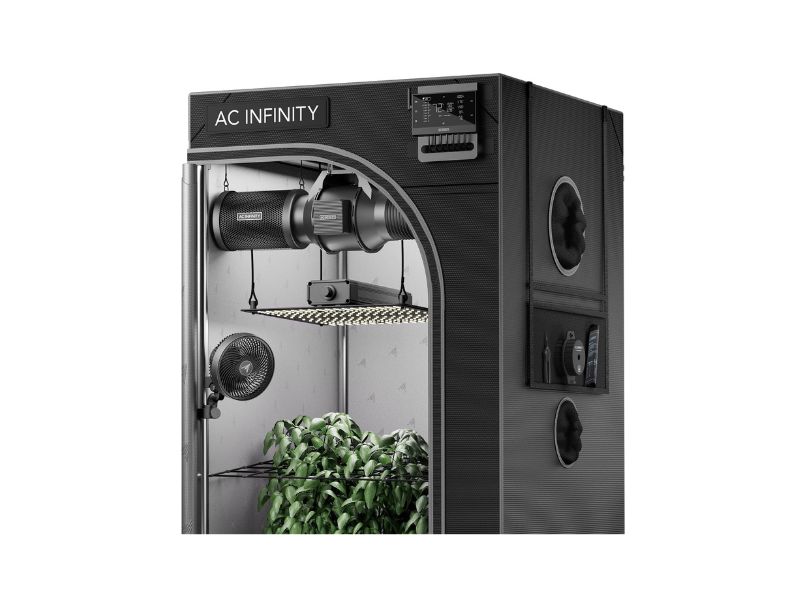
My primary recommendation is the AC Infinity Advance Grow System 2×2. Its thick 2000D tent, smart climate controller, full-spectrum LED fixture, inline exhaust system, circulation fan, carbon filter, and app-based monitoring provide the strongest integrated experience among these three systems.
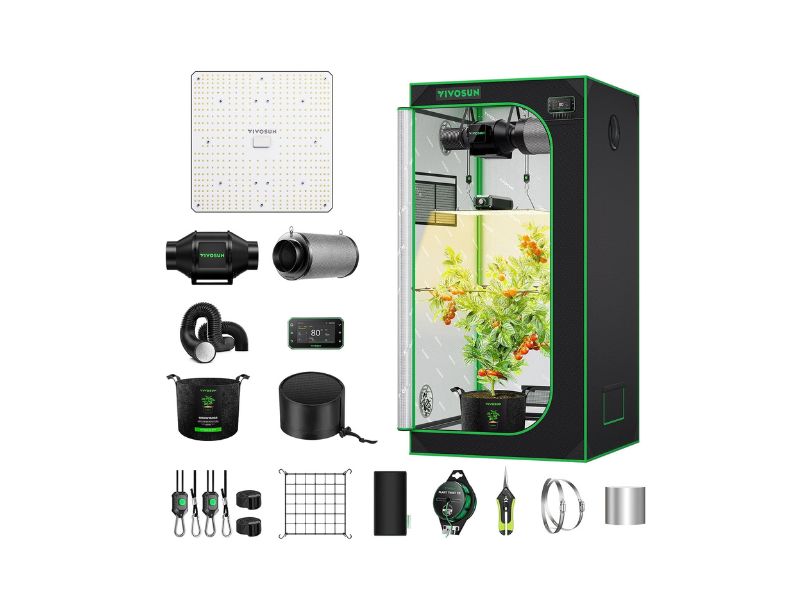
The VIVOSUN GIY Smart Grow Tent System 2.7×2.7 provides a larger canopy with Wi-Fi controls and coordinated ventilation.
The Mars Hydro 2×2 Complete Grow Tent Kit is a more straightforward alternative for growers who prefer basic manual equipment over a connected automation platform.
An all-in-one kit is most valuable when its included components match the intended plant size, room temperature, electrical capacity, and maintenance schedule. Buying the most complex system is unnecessary when a simple timer and fan controller will meet the grower’s needs.
3 Best All-in-One Grow Tent Kits
| Image | Product Name | Check Price |
|---|---|---|
Best Choice | AC Infinity Advance Grow System 2×2 | Check Price |
Second Best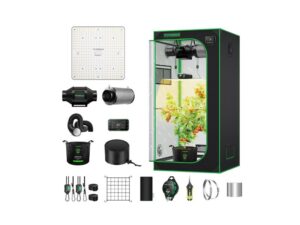 | VIVOSUN GIY Smart Grow Tent System 2.7×2.7 | Check Price |
Third Choice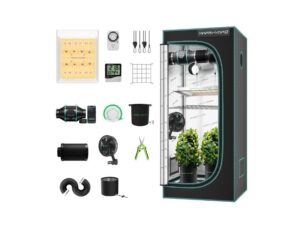 | Mars Hydro 2×2 Complete Grow Tent Kit | Check Price |
1. AC Infinity Advance Grow System 2×2
Key Features
- Approximately 24 × 24-inch grow-tent footprint
- Heavy-duty 2000D Oxford canvas
- Full-spectrum LED grow light
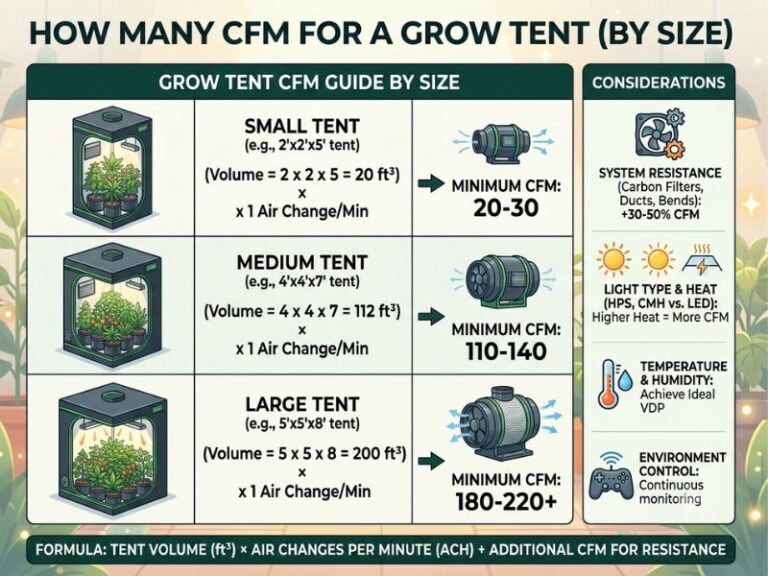
- Four-inch inline exhaust fan
- Activated carbon filter
- Flexible ventilation ducting
- Smart environmental controller
- Bluetooth or app-based monitoring
- Internal circulation fan
- Fabric grow pots
- Trellis netting and cultivation accessories
- Coordinated lighting and airflow controls
The AC Infinity Advance Grow System is designed as an integrated indoor environment rather than a collection of unrelated components. Its tent, LED light, exhaust system, circulation equipment, and controller are intended to operate within the same ecosystem.
The compact 2×2 footprint makes the system practical for a bedroom corner, closet area, office, or small utility room. It is best suited to one medium plant, a few compact plants, seedlings, herbs, or a controlled propagation setup.
The tent uses thick 2000D material and a reflective interior. Heavier canvas can improve light containment, resist tearing, and remain more stable under negative pressure than thinner entry-level material. Strong zippers and reinforced frame components are also important because the support structure must hold the light, filter, fan, and circulation equipment.
The included full-spectrum LED fixture is sized around the compact canopy. Dimming and scheduled operation allow one light to support early development and mature growth without remaining at maximum output throughout the entire cycle.
The four-inch inline exhaust fan removes warm, humid air while the carbon filter helps manage plant and growing-medium odors. The controller can adjust airflow according to environmental triggers rather than forcing the fan to operate at one fixed speed.
Smart climate control is the primary reason this kit ranks first. Temperature and humidity data can be monitored over time, making it easier to identify daytime heat increases or humidity spikes after the light switches off.
The circulation fan moves air within the tent rather than replacing it. This helps reduce stagnant canopy zones and moves warm air away from leaves, but it does not replace the exhaust fan.
The system still requires setup and calibration. Automated equipment cannot determine the correct plant spacing, watering volume, nutrient concentration, light intensity, or environmental target without user input.
Cable management also matters. Controller wires, sensor probes, fan cables, and lighting connections should be secured above runoff areas and kept away from wet growing medium.
What I Like
- Complete coordinated equipment ecosystem
- Thick and durable tent construction
- Smart airflow and lighting schedules
- Historical environmental monitoring
- Strong ventilation and filtration integration
- Internal circulation fan included
- Compact footprint
- Suitable for beginners who want automation
- Components are designed to communicate together
What I Do Not Like
- Higher system complexity
- App features require initial configuration
- Small canopy limits future expansion
- Additional humidification or dehumidification may still be required
- Automation features can be excessive for a simple setup
- Equipment and cables occupy some usable tent space
The AC Infinity Advance Grow System is the strongest choice for growers who want a compact indoor system with integrated monitoring and climate automation. Its main advantage is not one individual component but the way the light, fans, sensors, and controller work together.
2. VIVOSUN GIY Smart Grow Tent System 2.7×2.7
Key Features
- Approximately 32 × 32 × 63-inch tent
- Larger canopy than a standard 2×2 system
- Full-spectrum LED grow light
- Integrated or coordinated circulation airflow
- Four-inch AeroZesh exhaust fan
- Activated carbon filter
- Wi-Fi-enabled GrowHub controller
- Temperature and humidity sensor
- App-based scheduling and monitoring
- Trellis netting
- Fabric grow bags
- Basic trimming and plant-management accessories
The VIVOSUN GIY system offers more floor area than a compact 2×2 kit while remaining manageable in a small room. Its approximately 2.7×2.7-foot footprint provides more flexibility for plant spacing, containers, irrigation equipment, and canopy training.
The square layout works well with a central LED fixture and several containers arranged around the canopy. It can accommodate more growing area than the AC Infinity kit, though the larger footprint also creates higher lighting, airflow, and humidity-management demands.
The included GrowHub controller provides Wi-Fi-based environmental monitoring and scheduling. The light, ventilation fan, and compatible circulation equipment can be managed through coordinated settings rather than separate timers.
This is useful for growers who are away from the tent during part of the day. Remote data can show whether the temperature increased unexpectedly, whether humidity remained elevated after irrigation, or whether fan behavior changed during the light cycle.
The AeroZesh exhaust fan is responsible for exchanging tent air. Its performance is affected by the carbon filter, duct length, bends, and surrounding-room conditions. A fan cannot cool the tent below the temperature of the incoming room air.
The full-spectrum LED light is designed to support multiple plant stages. Intensity should begin conservatively and increase as the canopy develops. App-based scheduling is convenient, but fixture height and plant response still need physical inspection.
The accessory package reduces the number of small purchases required after the main kit arrives. Fabric pots, trellis material, trimming tools, and plant ties can help establish an organized canopy, though growers may replace some accessories as their preferred method develops.
The 63-inch tent height is usable but not generous. After subtracting pot height, fixture thickness, hanging hardware, filter placement, and a safe canopy gap, the remaining plant height can become limited.
What I Like
- Larger canopy than a standard 2×2 kit
- Wi-Fi environmental monitoring
- Coordinated lighting and ventilation
- Useful accessory package
- Square layout supports several plant arrangements
- Full-spectrum lighting
- Temperature and humidity sensing
- Appropriate for growers who want remote access
- Centralized app control reduces separate timers
What I Do Not Like
- Limited vertical height
- More floor space than a compact kit
- Smart setup depends on network configuration
- Some included accessories may be basic
- High humidity may still require separate equipment
- Rear canopy access becomes harder when the tent is full
The VIVOSUN GIY system is well suited to growers who want more canopy area and Wi-Fi control without moving to a large 3×3 or 4×4 installation. Its balance of space, automation, and included accessories makes it a practical intermediate system.
3. Mars Hydro 2×2 Complete Grow Tent Kit
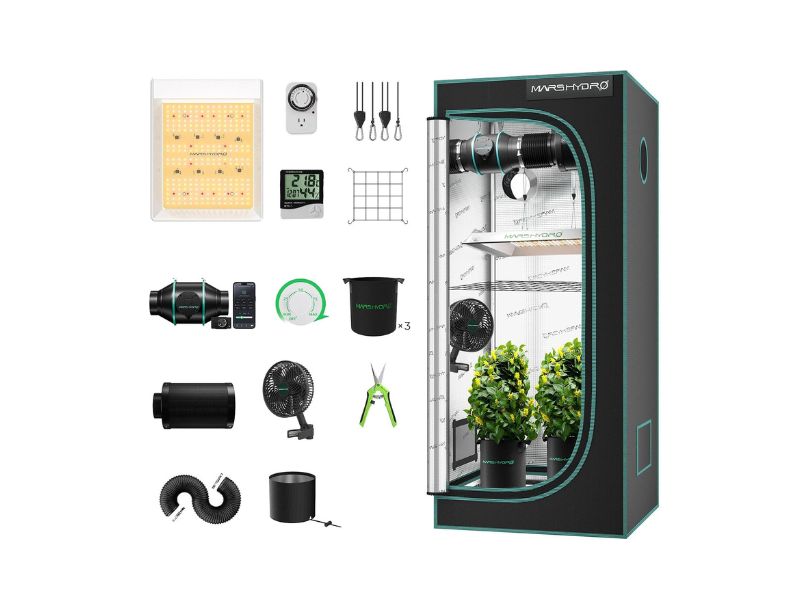
Key Features
- Approximately 24 × 24 × 55-inch tent
- Full-spectrum TS600-style LED grow light
- Four-inch inline ventilation fan
- Fan-speed control
- Activated carbon filter
- Flexible ducting and clamps
- Clip-on circulation fan
- Lighting timer
- Temperature and humidity monitor
- Fabric grow bags
- Rope hangers
- Reflective 1680D-style tent material
The Mars Hydro 2×2 kit follows a more conventional design than the two smart systems above. It includes the essential equipment needed to build a compact indoor environment without requiring the light, fan, and monitor to operate through one app.
This approach can be easier for growers who prefer physical timers and manual controls. The light follows the outlet timer, the inline fan uses its speed controller, and the temperature-humidity monitor provides local readings.
The compact 2×2 tent is suited to a small canopy. Its short footprint makes it easier to fit into limited spaces, but the approximately 55-inch height creates important vertical restrictions.
A grow tent loses usable height to several components:
- Plant container
- Tent support bars
- Carbon filter
- Inline fan
- LED fixture
- Hanging ropes
- Required canopy gap
Low-profile containers and controlled plant training are therefore important. Mounting the exhaust fan or carbon filter outside the tent can preserve internal height when the room layout allows it.
The included LED fixture is appropriate for compact cultivation and uses a full-spectrum output. It is a simpler light than those found in more expensive smart systems, but it can support seedlings, vegetative development, herbs, and a small mature canopy.
The inline fan and carbon filter create a basic exhaust system. The clip fan supplies internal air movement, helping prevent stagnant zones around leaves and containers.
The included timer and temperature-humidity monitor cover two essential functions, but they do not automatically adjust the environment. The grower must read the measurements and change fan speed, room conditions, or equipment settings manually.
This manual design can be an advantage for users who do not want accounts, apps, firmware updates, or wireless connectivity. It also provides a clearer understanding of how each component affects the tent.
What I Like
- Includes the major equipment required to start
- Straightforward manual controls
- No wireless network required
- Compact footprint
- Carbon filter and ventilation equipment included
- Clip fan supports internal air movement
- Timer and thermo-hygrometer included
- Suitable for growers learning basic environmental management
What I Do Not Like
- Shorter tent height
- Limited smart automation
- Environmental settings require manual adjustment
- Compact light provides limited expansion capacity
- Filter and fan can consume valuable overhead room
- Basic accessories may eventually be upgraded
The Mars Hydro kit is the most practical choice for growers who want a conventional all-in-one system without a connected control ecosystem. It provides the central equipment required for a compact indoor setup while keeping operation relatively straightforward.
All-in-One Grow Tent Kit Comparison Table
| Product | Tent Size | Control Type | Grow Light | Ventilation | Circulation Fan | Accessories | Main Strength | Main Limitation |
| AC Infinity Advance Grow System | Approx. 2×2 | Smart controller and app | Full-spectrum compact LED | Four-inch smart exhaust and carbon filter | Included | Pots, netting, tools, ducting | Best integrated automation | Small canopy and higher complexity |
| VIVOSUN GIY Smart System | Approx. 2.7×2.7 | Wi-Fi GrowHub | Full-spectrum LED | AeroZesh fan and carbon filter | Integrated or included | Pots, netting, ties, trimming tools | Larger smart-controlled canopy | Limited vertical clearance |
| Mars Hydro Complete Kit | Approx. 2×2 | Manual timer and fan control | TS600-class full-spectrum LED | Four-inch fan and carbon filter | Included | Pots, monitor, timer, hangers | Simple complete setup | Minimal automation |
The AC Infinity system offers the most coordinated control. VIVOSUN provides more floor area and Wi-Fi management, while Mars Hydro is better for growers who prefer separate manual components.
What Counts as an All-in-One Grow Tent?
A genuine all-in-one system should include most of the equipment required to create a controlled indoor environment.
The core components normally include:
- Grow tent
- Full-spectrum grow light
- Inline exhaust fan
- Activated carbon filter
- Ducting
- Fan-speed controller
- Lighting timer or smart controller
- Internal circulation fan
- Temperature and humidity monitoring
- Light hangers
- Fabric pots
- Basic canopy-management accessories
Some kits use the term “complete” while omitting circulation fans, pots, sensors, or environmental controllers. The product contents should therefore be checked carefully rather than relying only on the kit name.
No kit includes every item required by every grower. Depending on the climate and growing method, additional equipment may include:
- Humidifier
- Dehumidifier
- Heater
- Air conditioner
- Automatic watering system
- Drain tray
- pH meter
- Nutrient meter
- Soil or growing medium
- Irrigation reservoir
- Leak sensor
Smart System vs. Manual Kit
Smart grow-tent system
A smart system links compatible devices through one controller or app.
It can provide:
- Lighting schedules
- Fan-speed programs
- Temperature triggers
- Humidity triggers
- Historical graphs
- Remote alerts
- Coordinated device behavior
- Repeatable environmental settings
Its disadvantages include:
- More complicated setup
- Wireless connectivity requirements
- Additional cables and probes
- Greater dependence on one control ecosystem
- Higher initial cost
- More settings to learn
Manual grow-tent kit
A manual system uses separate timers, dimmers, fan controls, and local monitors.
It provides:
- Straightforward operation
- Fewer software dependencies
- Easier component replacement
- Lower initial complexity
- Direct understanding of each device
Its disadvantages include:
- More frequent inspections
- No automatic environmental response
- Limited historical information
- More separate controls
- No remote alerts
The better option depends on the grower’s schedule. Automation is useful when it replaces repeated monitoring, but it cannot correct poor equipment placement or unsuitable environmental targets.
Choosing the Correct Tent Size
Two-by-two systems
A 2×2 kit is appropriate for:
- One medium plant
- A few compact plants
- Seedlings
- Clones
- Herbs
- Leafy greens
- Limited room space
Its main constraints are canopy area and height.
Two-point-seven-by-two-point-seven systems
An approximately 32-inch-square system offers:
- More container space
- Better access around one central plant
- Room for several smaller plants
- More canopy-training flexibility
- Additional irrigation space
It also requires a stronger light and more environmental management than a 2×2 tent.
Larger systems
A 3×3, 2×4, or 4×4 kit provides more capacity but increases:
- Lighting power
- Heat output
- Fan requirements
- Water use
- Electrical load
- Room-space demand
- Equipment cost
- Maintenance time
Choose the smallest tent that comfortably holds the intended canopy and equipment rather than the smallest tent that can physically contain the pots.
Evaluating the Included Grow Light
The grow light should match the tent’s flowering footprint, not only its vegetative or maximum coverage.
Important specifications include:
- Actual power draw
- Fixture dimensions
- Full-spectrum output
- Dimming range
- Photon efficacy
- PPFD distribution
- Hanging-height requirements
- Driver location
- Heat production
- Controller compatibility
A compact kit may include a 100- to 150-watt LED fixture. This can be appropriate for a 2×2 or similar canopy when the light is efficient and positioned correctly.
The light should remain dimmable or adjustable. Seedlings generally require less intensity than mature plants, and a fixed full-power fixture can be difficult to manage in a short tent.
Understanding the Ventilation Package
The inline fan exchanges air between the tent and the surrounding room.
Its effective airflow is reduced by:
- Carbon filter resistance
- Long ducting
- Sharp bends
- Narrow intake openings
- Dirty prefilters
- Silencers
- Exhaust direction
A fan advertised at a particular CFM does not provide that exact airflow after the complete filtration system is installed.
The carbon filter is most effective when:
- Air is pulled through it
- The prefilter remains clean
- Humidity is controlled
- Duct connections are sealed
- Fan speed is appropriate
- The filter size matches the fan
The circulation fan has a different role. It moves air within the enclosure and helps reduce stagnant areas. It should create gentle movement without blasting one section of the canopy continuously.
Smart Environmental Controllers
A controller normally uses a temperature and humidity probe to monitor the tent.
Depending on the system, it may:
- Increase exhaust speed above a temperature threshold
- Increase airflow above a humidity threshold
- Maintain minimum background ventilation
- Schedule lights
- Record environmental graphs
- Send mobile alerts
- Coordinate circulation fans
- Calculate VPD
A controller cannot directly cool the tent below the intake-room temperature. If the surrounding room is hot, increasing exhaust speed only replaces tent air with hot room air.
Likewise, an exhaust fan may lower humidity only when the incoming room air is drier than the tent air.
Planning Vertical Clearance
Use this formula:
Usable plant height = tent height − container height − fixture depth − hanging hardware − canopy gap − overhead equipment
For example, a 55-inch tent may lose:
- 10 inches to a container
- 4 inches to the light
- 5 inches to hangers
- 16 inches to the canopy gap
- 8 inches to ventilation equipment
That leaves:
55 − 10 − 4 − 5 − 16 − 8 = 12 inches
This demonstrates why a tent that appears tall enough can become restrictive after equipment installation.
Vertical room can be preserved by:
- Using short hangers
- Training plants horizontally
- Mounting the fan outside
- Mounting the carbon filter outside
- Choosing low-profile pots
- Moving a removable LED driver outside
- Avoiding unnecessary overhead accessories
Electrical Load and Safety
A complete grow system may include:
- LED light
- Inline exhaust fan
- Circulation fan
- Humidifier
- Dehumidifier
- Heater
- Water pump
- Controller
- Sensors
- Automatic watering equipment
Calculate the combined load rather than considering the grow light alone.
Use:
- Grounded outlets
- Properly rated timers
- Elevated power strips
- Drip loops
- Dry cable connections
- Secure controller mounts
- Appropriate extension cords
- Circuit protection
- Leak alarms near irrigation equipment
Do not place power connections beneath pots, reservoirs, humidifier hoses, or irrigation lines.
Assembly Order
A logical installation sequence reduces the need to remove equipment later.
Step 1: Assemble the frame
Confirm that all poles, corner connectors, and support bars are fully seated.
Step 2: Install the fabric cover
Align doors, duct ports, windows, and controller openings before closing the zippers.
Step 3: Position the tent
Leave access to the primary door, duct routes, and electrical outlet.
Step 4: Install the light
Center and level the fixture before adding the carbon filter.
Step 5: Install filtration and exhaust
Determine whether the filter and fan will remain inside or outside.
Step 6: Route the ducting
Use the shortest practical route with minimal sharp bends.
Step 7: Install the circulation fan
Position it to create gentle canopy movement rather than direct continuous force.
Step 8: Mount controllers and sensors
Keep the probe near canopy height and the controller away from water.
Step 9: Test every component
Operate the complete system before adding plants.
Step 10: Check heat and humidity
Run the empty tent through a complete light cycle and dark cycle.
What Complete Kits Commonly Leave Out
Even a well-equipped kit may not include:
- Growing medium
- Nutrients
- pH adjustment products
- Water-quality meters
- Irrigation equipment
- Drainage trays
- Humidifier
- Dehumidifier
- Heater
- Air conditioner
- Leak detector
- Extra electrical outlets
- Replacement carbon-filter prefilter
These omissions do not make the kit incomplete. Environmental equipment depends heavily on the climate of the surrounding room.
A humid coastal room may need dehumidification, while a dry heated room may need a humidifier. Buying both before measuring the environment may waste money.
Common All-in-One Grow Tent Mistakes
Assuming every required item is included
Review the complete component list before purchase.
Choosing the smallest possible tent
Pots may fit while working access and vertical clearance remain inadequate.
Installing the filter without measuring height
The ventilation system can consume a large amount of overhead space.
Running the light at maximum immediately
Young plants usually need less intensity.
Depending on automation without learning the environment
A controller follows programmed rules; it does not determine whether those rules are correct.
Ignoring the surrounding room
Tent temperature and humidity depend on the air entering from outside.
Leaving cables unorganized
Loose cables can touch wet surfaces or interfere with doors and hangers.
Blocking passive intake openings
The exhaust fan needs replacement air.
Using excessive negative pressure
High fan speed can pull walls inward and reduce canopy space.
Skipping an empty-tent test
Problems are easier to correct before plants and irrigation equipment are installed.
Maintenance and Long-Term Use
Weekly checks
- Inspect fan operation
- Check filter prefilter
- Confirm light schedule
- Review temperature and humidity trends
- Inspect duct clamps
- Check circulation-fan mounting
- Examine cables and connectors
- Empty runoff trays
- Clean spilled growing medium
Monthly checks
- Clean circulation-fan guards
- Inspect tent seams and zippers
- Remove dust from LED surfaces
- Check carbon-filter resistance
- Verify controller probes
- Examine hanging hardware
- Review app or timer settings
Between cycles
- Remove all pots and equipment
- Vacuum loose debris
- Wipe reflective walls
- Clean the floor tray
- Flush irrigation equipment
- Inspect fabric for damage
- Clean fan blades
- Replace worn prefilters
- Test every device before reloading the tent
Frequently Asked Questions
What is the best all-in-one grow tent?
The AC Infinity Advance Grow System 2×2 is my primary recommendation because it combines a durable tent, coordinated lighting, smart ventilation, filtration, circulation, and environmental monitoring.
VIVOSUN provides more canopy space, while Mars Hydro offers a simpler manual system.
Are all-in-one grow-tent kits worth it?
They are useful for beginners and buyers who want compatible components without researching every item separately.
Experienced growers may prefer choosing individual parts to obtain specific lights, fans, tents, and controllers.
What should a complete grow-tent kit include?
A strong kit should include a tent, full-spectrum LED light, inline fan, carbon filter, ducting, circulation fan, environmental monitor or controller, light hangers, and basic cultivation accessories.
Is a smart grow-tent kit better?
It is better when remote monitoring, automatic fan response, schedules, and historical data are important.
A manual system is adequate when the grower can inspect and adjust the environment regularly.
How many plants fit in a 2×2 kit?
A 2×2 system generally suits one medium plant or several compact plants.
Actual capacity depends on container size, training method, plant species, and canopy spread.
How many plants fit in a 2.7×2.7 kit?
An approximately 32-inch-square tent can support one larger trained plant or several smaller plants.
Access and airflow should determine the final count rather than floor dimensions alone.
Does an all-in-one kit include nutrients?
Most kits do not include a complete nutrient and growing-medium program.
The user normally selects soil, coco, hydroponic media, nutrients, and pH-management products separately.
Does a complete kit need a humidifier?
Only when the tent humidity remains below the intended range.
Measure the environment through complete light and dark cycles before adding humidity equipment.
Does a grow-tent kit need a dehumidifier?
It may need one when plant transpiration and irrigation create persistent high humidity that ventilation cannot control.
A room-level dehumidifier is often more effective than a very small unit inside the tent.
Can a grow-tent controller manage temperature?
It can increase or reduce connected fan operation according to temperature.
It cannot cool the incoming air below the surrounding-room temperature without separate cooling equipment.
Is a carbon filter necessary?
It is useful for controlling odors and filtering exhausted air.
It also creates airflow resistance, so the fan must be appropriately sized.
Should the inline fan stay inside the tent?
It can be installed inside or outside depending on the duct layout and available height.
External installation preserves internal ceiling space but may increase room noise.
Can I replace components later?
Yes. Lights, filters, fans, controllers, and accessories can be upgraded as long as their dimensions, electrical requirements, and control connections remain compatible.
Do all-in-one kits use much electricity?
Consumption depends primarily on the grow light and environmental equipment.
Small kits generally use less power than large systems, but heaters, dehumidifiers, and air conditioners can consume more than the included fans.
Should I test the kit before adding plants?
Yes. Run the complete system through at least one full lighting and dark cycle.
Check heat, humidity, fan behavior, timer operation, airflow, noise, light leaks, and electrical stability.
Conclusion
Choosing the best all-in-one grow tent depends on how much canopy space, automation, and manual involvement the grower wants.
The AC Infinity Advance Grow System 2×2 is the strongest complete option for a compact smart-controlled setup. Its coordinated controller, lighting, exhaust, circulation, and environmental monitoring reduce the need to operate several separate devices.
The VIVOSUN GIY Smart Grow Tent System 2.7×2.7 provides more growing area and Wi-Fi-based control, making it suitable for users who want additional canopy flexibility.
The Mars Hydro 2×2 Complete Grow Tent Kit is the better choice for growers who prefer physical timers and straightforward controls rather than an integrated app ecosystem.
An all-in-one kit simplifies equipment selection, but it does not remove the need for correct setup. Measure the room, calculate vertical clearance, secure electrical connections, test ventilation, and run the empty tent before introducing plants. The most effective system is the one whose size and control method match the user’s actual space and maintenance routine.

I’m Maya L. Greenwood, a lifelong plant lover who believes anyone can grow something beautiful with the right guidance. After years of testing soil mixes, pruning methods, irrigation tricks, and pest-safe solutions, I started EasyGardenTips.com to turn hard-won lessons into step-by-step advice. From seed starting and container gardens to composting and seasonal checklists, my goal is to make gardening simple, sustainable, and fun.