Do You Need Special Soil for Raised Beds? Choosing the Right Mix
No, you do not need special soil for raised beds, but you do need a growing mixture with suitable drainage, moisture retention, and nutrients. Quality garden soil mixed with finished compost works well for many raised beds, especially those with open bottoms that allow plant roots to grow into the ground beneath them.
You also don’t have to purchase expensive bags labeled “raised bed soil.” A homemade blend of loamy topsoil and mature compost can provide the same essential growing conditions when its ingredients are suitable.
However, the type of raised bed makes a difference. A wooden frame installed over healthy garden ground has different soil requirements from an elevated planter or a raised bed placed on concrete.
Using heavy, compacted soil in a shallow container may restrict drainage, while filling a large outdoor bed entirely with lightweight potting mix can create unnecessary expenses and moisture management problems.
Understanding these differences helps you choose an affordable growing medium without sacrificing plant health.
This guide explains when regular garden soil is sufficient, when a specialized mixture makes sense, and how to choose the right soil for vegetables, herbs, and flowers.
When do you need special soil for raised beds?
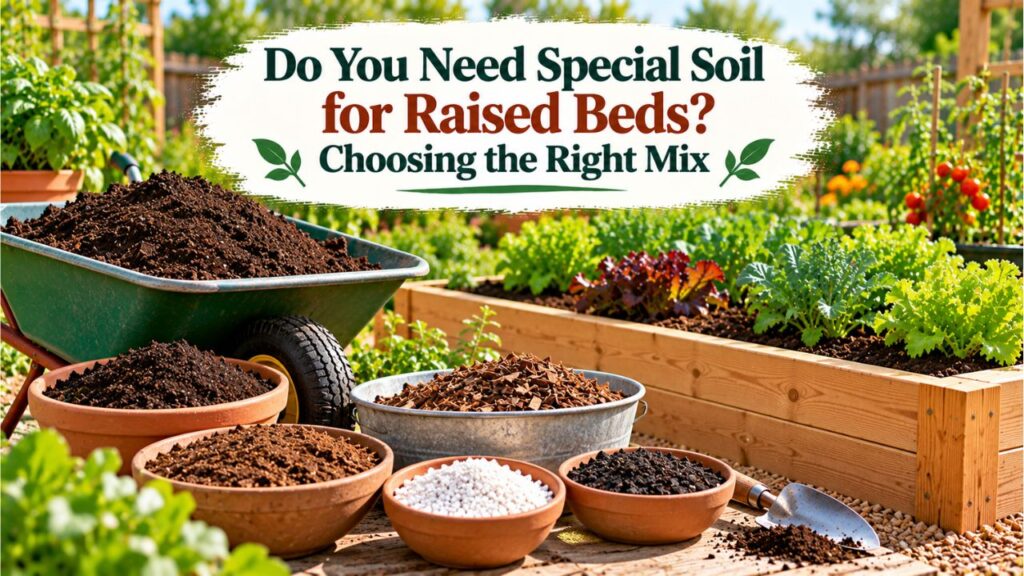
You generally do not need a specially manufactured soil product for a traditional raised bed installed over suitable garden ground.
However, a purpose-formulated growing medium may be useful when the bed has a restricted bottom, sits on pavement, or contains very little usable mineral soil.
The appropriate choice depends on the underlying surface, the growing depth, and the plants you intend to grow.
| Raised Bed Type | Do You Need Special Soil? | Suitable Growing Medium |
| Open-bottom bed over healthy garden soil | No | Existing soil with compost as needed |
| Raised bed over compacted clay | Not necessarily | Quality loamy topsoil and finished compost |
| Raised bed on concrete | A suitable container-style mix is recommended | Compost and soilless growing medium |
| Elevated planter with legs | Usually needs a container-appropriate mix | Lightweight, well-draining growing medium |
| Raised bed over potentially contaminated ground | Needs clean soil and protective design | Verified clean growing medium with suitable separation |
| Large wooden or metal raised bed | No special branded product required | Topsoil and mature compost blend |
Open-Bottom Raised Beds Usually Need Ordinary Garden Soil
An open-bottom raised bed allows plant roots to extend beyond the frame and into the ground.
This means the growing environment includes both the added soil and the existing soil underneath.
If the native soil is loose, fertile, and drains properly, it may already provide much of what vegetables need.
A modest amount of finished compost may improve soil structure and organic matter content.
In this situation, purchasing a completely new soil mixture may be unnecessary.
Elevated Raised Beds Have Different Soil Requirements
An elevated planter supported by legs acts more like a large container.
Its roots cannot grow into the ground beneath the structure.
The growing medium must provide enough moisture, air, nutrients, and root space within the planter itself.
Lightweight potting mixes and container-style growing media are often useful in these beds.
They can also reduce the load compared with filling the entire container with dense mineral topsoil.
The supporting frame must still be strong enough to hold the growing medium when fully watered.
Raised Beds on Concrete Need Careful Soil Selection
Concrete and other hard surfaces prevent roots from entering natural ground.
The bed therefore needs sufficient contained growing depth and reliable drainage.
A mixture suited to container-style growing conditions is often preferable to heavy native soil alone.
The planter must also allow excess water to escape without creating persistent waterlogging.
What Kind of Soil Is Best for Raised Garden Beds?
For most traditional open-bottom raised beds, a mixture of quality loamy topsoil and mature compost is a practical choice.
This blend combines the physical structure of mineral soil with the benefits of decomposed organic matter.
Each component serves a different purpose.
Loamy Topsoil Provides Structure
Topsoil contains mineral particles, including sand, silt, and clay.
These particles affect drainage, water storage, nutrient retention, and how easily roots penetrate the soil.
Loamy soil generally provides a useful balance of these properties.
Look for topsoil that is:
- Loose and crumbly rather than hard and compacted
- Free of construction debris and excessive stones
- Not dominated by coarse sand or dense clay
- Obtained from a reputable supplier
- Suitable for growing edible crops when used for vegetables
Avoid assuming that all products labeled topsoil have the same composition.
Some commercial products contain substantial compost or other organic materials, while others consist primarily of mineral soil.
Finished Compost Adds Organic Matter
Finished compost improves the physical condition of mineral soil and contributes nutrients as organic materials continue to decompose.
It also supports the biological activity involved in nutrient cycling.
Compost can help maintain a workable soil structure and improve water management when added in suitable amounts.
However, more compost is not always better.
Excessive compost can lead to unnecessary nutrient accumulation, changes in moisture behavior, and significant settling as organic materials break down.
Use mature compost rather than unfinished material containing large amounts of fresh plant waste.
Optional Ingredients for Specialized Growing Mixes
Some commercial raised bed mixtures contain additional materials.
Common examples include:
- Coconut coir: Helps retain moisture in lightweight growing media.
- Peat moss: Provides moisture-holding organic material.
- Perlite: Creates air spaces in container growing mixes.
- Pumice: Adds durable mineral particles that help maintain aeration.
- Vermiculite: Helps retain moisture in certain growing mixtures.
- Composted bark: Contributes organic material and affects growing media structure.
These ingredients are not mandatory for every raised bed.
A traditional open-bottom vegetable bed often performs well without purchasing perlite, coir, or vermiculite separately.
Best Soil Mix Ratio for Raised Beds
A useful starting mixture for traditional raised beds is:
2 parts loamy topsoil + 1 part finished plant-based compost
This provides approximately 67% topsoil and 33% compost by volume.
For example, you could combine two buckets of topsoil with one bucket of finished compost.
The University of Minnesota Extension’s raised bed gardening guidance describes an appropriate mixture containing approximately one-half to two-thirds topsoil and one-third to one-half plant-based compost.
This recommendation supports using mineral soil as a substantial component rather than filling a permanent raised bed entirely with compost.
However, the two-to-one ratio is a starting point, not a requirement for every garden.
When to Use Less Compost
If the purchased topsoil already contains significant compost or other organic matter, adding another full portion may be unnecessary.
Existing garden soil that has been amended regularly may also need only a small additional amount.
A soil test can help determine whether further nutrient-rich amendments are appropriate.
When an Equal-Part Mixture May Work
Some raised beds can use equal volumes of topsoil and finished compost.
The suitability depends on the original materials, soil fertility, and intended crops.
An equal-part mixture contains substantially more compost than a two-to-one blend.
If the compost is rich in nutrients or contains manure, check whether the higher proportion is appropriate before filling the bed.
Do You Need to Add Fertilizer to the Mixture?
Not automatically.
Topsoil and compost may already supply sufficient nutrients for initial plant growth.
Adding fertilizer without assessing the soil can create unnecessary nutrient buildup.
A laboratory soil test provides a more reliable basis for fertilizer decisions.
Can You Use Regular Garden Soil Instead of Raised Bed Soil?
Yes. Regular garden soil can be used in raised beds when it has suitable physical properties and is safe for the intended plants.
You do not need to replace healthy soil simply because it came from the ground rather than a bag marketed for raised beds.
The important factors are soil structure, drainage, fertility, and possible contamination.
Using Healthy Backyard Soil
If your backyard contains workable loamy soil, it can provide the foundation for a raised vegetable bed.
You may only need to add compost and improve the planting area.
This approach can reduce soil costs significantly compared with purchasing a complete replacement mixture.
Before using native soil, check whether it:
- Drains without remaining saturated for prolonged periods
- Is reasonably loose and workable
- Contains excessive stones or debris
- Has a suitable pH and nutrient balance
- Comes from an area without known contamination concerns
For food gardens, soil with an uncertain history may require laboratory testing.
Using Clay Soil in Raised Beds
Clay-rich soil is not automatically unsuitable for gardening.
Clay particles help retain water and nutrients, but compacted clay can restrict air and water movement.
If the existing ground is heavily compacted, carefully loosening it before filling the raised bed may improve root penetration.
A raised layer of loamy topsoil and finished compost can provide a more workable planting area.
However, adding loose soil above dense clay does not guarantee that drainage problems beneath the bed will disappear.
Check the underlying conditions rather than treating the frame itself as a drainage solution.
Using Sandy Garden Soil
Sandy soil generally allows water to move through quickly.
It may require more frequent irrigation because it has relatively limited water-holding capacity.
Suitable compost additions can help improve moisture retention.
Organic mulch can also reduce evaporation from the soil surface.
The goal is to create a mixture that holds enough water for plants without remaining saturated.
Raised Bed Soil vs. Potting Mix vs. Garden Soil
The labels on commercial soil products can be confusing.
Some products have overlapping ingredients, but they are designed for different applications.
| Growing Medium | Typical Composition | Most Suitable Use |
| Raised bed soil | Mineral soil and compost, or a formulated growing blend | Outdoor raised beds |
| Garden soil | Mineral soil, sometimes with added compost | Ground-level gardens and open-bottom beds |
| Potting mix | Peat, coir, bark, perlite, or similar materials | Containers and elevated planters |
| Topsoil | Mineral soil with varying organic matter | Soil-based raised bed blends |
| Compost | Decomposed organic materials | Soil improvement and organic matter replenishment |
Can You Fill a Raised Bed With Potting Mix?
Yes, but the type of raised bed matters.
Potting mix can be appropriate in elevated planters and other enclosed growing systems.
However, filling a large permanent open-bottom raised bed entirely with potting mix is often unnecessary.
Some lightweight mixes dry faster than mineral-soil-based blends and may require different watering and fertilization practices.
For large outdoor beds, a topsoil-and-compost mixture may provide a more economical long-term growing medium.
Can You Fill a Raised Bed With Topsoil Only?
Yes, suitable topsoil can support plants when its drainage, structure, fertility, and organic matter content are appropriate.
However, low-quality topsoil may become dense or fail to provide suitable growing conditions.
Adding finished compost can improve the mixture where needed.
If the topsoil is already fertile and well structured, extensive amendments may not be necessary.
Can You Use Pure Compost Instead of Soil?
Filling a traditional raised bed entirely with compost is generally not recommended.
Although compost contains useful organic matter and nutrients, it does not necessarily provide the long-term physical structure of mineral soil.
A compost-only growing medium may also settle considerably and develop nutrient or moisture management problems.
For conventional permanent beds, a suitable soil-and-compost combination is usually a better choice.
What Soil Should You Use for Raised Beds on Concrete?
Raised beds on concrete require a different approach because their roots cannot extend into the underlying ground.
These beds need adequate growing depth and a medium that supports both moisture retention and drainage.
The University of Maryland Extension’s raised bed vegetable gardening guide recommends equal parts finished compost and soilless growing medium for raised beds installed on hard surfaces.
It also explains that up to 20% topsoil by volume can be included when the bed is at least 16 inches deep.
Choose a Suitable Growing Depth
For raised beds on impermeable surfaces, University of Maryland Extension recommends at least 8 inches of growing medium for crops such as leafy greens, beans, and cucumbers.
For peppers, tomatoes, and squash, it recommends approximately 12–24 inches.
These depths are particularly important because the roots cannot access additional soil underneath.
The actual growing space should also accommodate the crop’s mature root system and water requirements.
Provide Drainage Outlets
A container-style raised bed should not trap water in the root zone.
Provide functioning drainage outlets and select a growing medium suited to the planter’s design.
Avoid placing a layer of gravel at the bottom as a substitute for proper drainage.
A gravel layer can reduce the space available for roots without correcting the real drainage problem.
Consider the Weight of the Growing Medium
Mineral soil becomes substantially heavier when wet.
This matters for raised beds installed on decks, balconies, and other elevated structures.
Before filling a large planter, confirm that the supporting structure can handle the expected load.
A lightweight growing mix may reduce weight, but the entire planter must still be safely supported.
How to Tell Whether Your Existing Soil Is Good Enough
Before buying specialized soil, evaluate the material already available.
A few practical checks can reveal whether the soil needs improvement.
Check the Soil Texture
Take a small handful of moderately moist soil and squeeze it gently.
A workable loamy soil often forms a loose clump that breaks apart when disturbed.
Very sandy material may fall apart immediately.
Clay-rich soil may feel sticky and form a dense ribbon between your fingers.
This is only a rough physical assessment, especially when the soil contains substantial compost.
Check Water Movement
Water a small area and observe whether the water enters the soil.
Persistent surface puddling may indicate compaction or another restriction.
However, rapid surface infiltration does not always mean that deeper drainage is adequate.
Check the soil beneath the raised bed if waterlogging is a recurring problem.
Test Soil pH and Nutrients
A laboratory soil test can identify nutrient levels and whether the pH is suitable for the crops being grown.
Many common vegetables prefer slightly acidic to near-neutral growing conditions.
If the soil already contains high nutrient levels, adding more compost or fertilizer may be unnecessary.
Where contamination is a concern, request specialized testing rather than relying only on a standard nutrient analysis.
How to Fill a Raised Bed Without Buying Special Soil
A traditional open-bottom raised bed can often be prepared using quality topsoil and finished compost.
The process does not require an elaborate commercial soil recipe.
Step 1: Prepare the Ground Beneath the Bed
Choose a sunny location with suitable drainage.
Remove unwanted vegetation and inspect the soil for debris or possible contamination concerns.
If the native soil is safe but compacted, gently loosen it with a garden fork.
Avoid working the soil when it is saturated.
Step 2: Prepare the Soil Mixture
Combine approximately two parts quality topsoil with one part mature compost by volume.
Mix the ingredients evenly using a shovel, garden fork, or wheelbarrow.
If the purchased topsoil already contains substantial compost, reduce the additional compost accordingly.
Step 3: Calculate the Required Soil Volume
For a rectangular raised bed, use:
Soil Volume = Length × Width × Soil Fill Depth
Convert all measurements to feet to calculate cubic feet.
For example, a 4-by-8-foot raised bed filled to a depth of 12 inches requires:
4 × 8 × 1 = 32 cubic feet
That equals approximately 1.19 cubic yards of soil.
The calculated quantity may need adjustment for settling and the space left below the frame’s upper edge.
Step 4: Fill the Bed Without Compacting the Soil
Add the growing mixture evenly.
Avoid stepping inside the bed or repeatedly pressing the soil down.
For an open-bottom bed, maintain contact with suitable native ground to allow root growth and water movement.
Do not mix into the underlying soil when contamination concerns require it to remain isolated.
Step 5: Water and Check the Soil Level
Water the soil gently so that the mixture becomes evenly moist.
Allow loose material to settle naturally.
Add more growing medium if needed.
Leave enough space below the bed rim for mulch and watering.
Step 6: Plant and Monitor the Growing Conditions
Once the soil is moist and prepared, plant seeds or transplants according to their individual requirements.
Monitor watering and drainage as plants become established.
There is generally no need to wait several weeks before planting when the growing medium contains fully mature compost.
Is Bagged Raised Bed Soil Worth Buying?
Bagged raised bed soil can be convenient, but it is not required for successful gardening.
The value depends on the product’s composition, quality, quantity, and price.
When Bagged Soil Makes Sense
Bagged mixtures are convenient for smaller beds and situations where transporting bulk soil is difficult.
They may be useful when:
- Filling a compact patio bed
- Preparing a small herb garden
- Purchasing a limited quantity
- Avoiding the need to mix ingredients
- Selecting a product designed for a particular container setup
However, check whether the product contains mineral topsoil or consists mainly of organic materials.
The label “raised bed soil” does not guarantee a particular recipe.
When Bulk Soil Is More Practical
Large raised beds require substantial growing volumes.
Purchasing soil by the cubic yard can be more economical than buying many small bags.
For example, a 4-by-8-foot bed filled to a depth of 12 inches needs approximately 32 cubic feet of material.
That is more than the volume of thirty 1-cubic-foot bags.
A reputable landscape supplier may offer premixed topsoil and compost suitable for raised beds.
Ask about the ingredients, material source, and available soil testing information before ordering.
What to Check Before Buying Raised Bed Soil
Examine the product carefully rather than relying on promotional claims.
Pay particular attention to:
- Whether the blend contains actual mineral soil
- The type and maturity of the compost
- Whether fertilizer has already been included
- Whether the product is intended for vegetables
- Drainage and moisture characteristics
- The origin and cleanliness of the material
A suitable growing medium matters more than a specialized product name.
Problems Caused by Using the Wrong Soil in Raised Beds
Choosing unsuitable material can make a raised bed difficult to maintain even when the frame is properly constructed.
Heavy Soil Can Restrict Root Growth
Dense, compacted soil may contain insufficient air spaces for healthy root development.
Roots can struggle to penetrate hard layers, while excess water may remain trapped.
Choose a workable soil mixture and avoid walking inside the growing area.
Excessively Lightweight Mixes Can Dry Quickly
Some growing media contain large amounts of coarse organic materials or lightweight components.
These materials may dry rapidly under hot, windy conditions.
In elevated planters, limited soil volume can increase the need for frequent watering.
Select a medium with suitable moisture-holding capacity and monitor conditions below the surface.
Too Much Compost Can Create Nutrient Problems
Repeatedly adding compost does not always improve the soil.
Some compost products contain substantial phosphorus or soluble salts.
Excessive applications may contribute to nutrient imbalances over time.
Test established raised bed soil before making large fertilizer or compost additions.
Poor Drainage Can Cause Waterlogging
A raised bed can remain waterlogged when water cannot move out of the root zone.
The restriction may come from compacted underlying ground, unsuitable growing material, or blocked planter outlets.
Identify the drainage problem before purchasing additional amendments.
Unknown Soil Sources Can Create Safety Concerns
Imported soil should come from a reliable source, especially when growing food.
Avoid using material that may contain construction debris or contaminants.
If a garden is installed near an older painted building or on land with a potentially contaminated history, obtain appropriate soil testing and follow qualified guidance.
Conclusion
So, do you need special soil for raised beds? No, not for most traditional open-bottom garden beds. Healthy garden soil or quality loamy topsoil mixed with finished compost can provide an excellent growing environment without a specially branded product.
A two-to-one mixture of topsoil and mature compost is a useful starting point when preparing a new soil-based raised bed.
However, elevated planters and beds installed on concrete may benefit from container-style growing media because they have different drainage, depth, and weight requirements.
Before buying soil, evaluate the existing ground, determine how much growing medium the bed needs, and check the ingredients of any commercial product.
The best choice is not necessarily the most expensive bag. It is the soil mixture that provides suitable root space, moisture, drainage, and nutrients for the plants you intend to grow.
FAQs About Do You Need Special Soil for Raised Beds
Can I use regular dirt from my yard in a raised bed?
Yes, if the soil is suitable for gardening and free from known contamination. Good-quality native soil can support vegetables, especially when combined with an appropriate amount of finished compost.
Do vegetables need special raised bed soil?
No. Most vegetables do not require a proprietary raised bed soil product. They need a suitable growing medium with adequate root space, drainage, moisture, and nutrients.
Is raised bed soil different from potting soil?
Often, yes. Traditional raised bed soil commonly contains mineral topsoil and compost, while potting mixes frequently contain lightweight materials such as coir, peat, bark, and perlite. Their exact compositions vary by product.
Can I use only compost in my raised garden bed?
Filling a permanent raised bed entirely with compost is generally not recommended. Compost can settle substantially and may contain excessive nutrients. A suitable blend of mineral soil and mature compost is usually more appropriate for traditional beds.
Do I need to replace raised bed soil every year?
No. Raised bed soil can remain productive for many years with proper maintenance. Check its condition, replenish settled material when necessary, and use soil test results to guide nutrient management.
Is expensive raised bed soil better than homemade soil?
Not necessarily. A well-prepared homemade mixture can perform as well as a commercial product when its ingredients are appropriate. Compare soil composition, cleanliness, drainage, and nutrient characteristics rather than assuming a higher price means better growing conditions.

I’m Maya L. Greenwood, a lifelong plant lover who believes anyone can grow something beautiful with the right guidance. After years of testing soil mixes, pruning methods, irrigation tricks, and pest-safe solutions, I started EasyGardenTips.com to turn hard-won lessons into step-by-step advice. From seed starting and container gardens to composting and seasonal checklists, my goal is to make gardening simple, sustainable, and fun.