5 Best Self Propelled Walk Behind String Trimmer: Full Guide
Finding the best self propelled walk behind string trimmer starts with matching the machine to the kind of overgrowth you actually manage. These wheeled trimmers are built for tall grass, weeds, field edges, fence lines, and light brush that can overwhelm a conventional lawn mower or make a handheld trimmer tiring to use.
For most homeowners and property owners, the BILT HARD Self-Propelled Walk-Behind String Trimmer is the strongest overall choice because it combines self-propelled operation, a 170cc four-cycle engine, a 22-inch cutting path, and eight height settings. The YARDMAX YL2250 22 In. 170cc Gas Walk is the clearest alternative for users who prioritize fence-line trimming, large-property productivity, and rugged wheels, although its supplied specifications do not identify it as self-propelled.
The five options below were compared by engine capacity, cutting width, line size, wheel design, height adjustment, handling, storage, and the type of terrain or vegetation each machine is designed to address. Because several products are described as walk-behind or push models rather than explicitly self-propelled machines, that distinction is important when setting expectations.
Best Self Propelled Walk Behind String Trimmer: Quick Comparison
| Product | Name | Price |
|---|---|---|
 |
BILT HARD Self-Propelled Walk-Behind String Trimmer | Check Price |
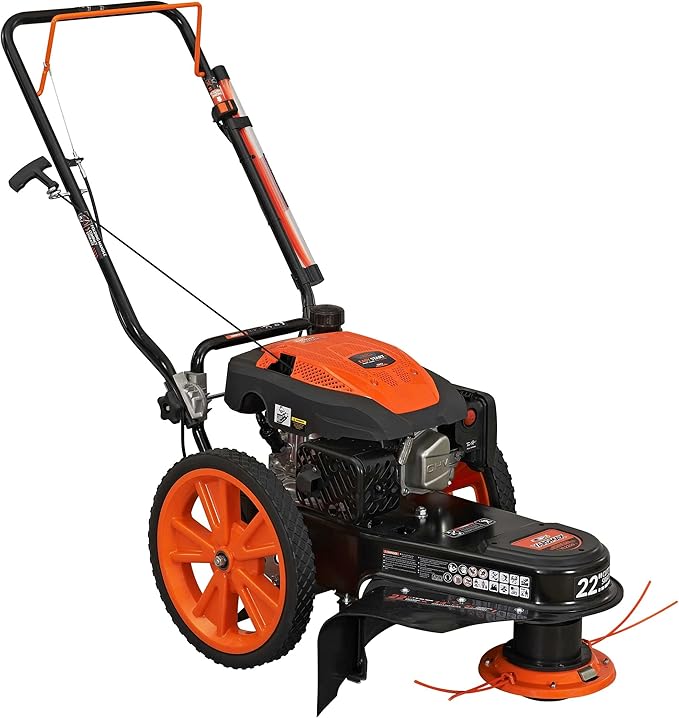 |
YARDMAX YL2250 22 In. 170cc Gas Walk | Check Price |
 |
Powersmart 22-Inch 170cc | Check Price |
 |
PROYAMA 170cc Walk Behind Weed Trimmer String | Check Price |
 |
FORESTWEST 11112 | Check Price |
1. BILT HARD Self-Propelled Walk-Behind String Trimmer
The BILT HARD earns the top position by offering the most complete combination of features for demanding residential and acreage maintenance. Its 170cc OHV four-cycle engine is designed for thick grass, dense weeds, and light brush, while the self-propelled drive travels at a stated 1.9 mph. That steady pace can reduce the physical effort involved in covering slopes, rough ground, or a large lawn, particularly when compared with a machine that must be pushed continuously.
A 22-inch cutting diameter helps clear a broad strip with each pass. The eight-position height adjustment, ranging from 1.6 to 3.7 inches, provides more flexibility than the five-position systems used by several alternatives. Lower settings can suit routine vegetation control, while taller settings are useful when approaching long grass or uneven terrain where scalping would be undesirable.
The one-piece steel deck adds durability and stability, and side discharge moves cut material away from the cutting path. Its 10-inch flat-free wheels are smaller than the 14-inch wheels on some competing models, but they should reduce concerns about punctures and work well where maneuverability and compact storage matter. The folding handle is another practical advantage for a garage or shed with limited room.
This trimmer is a strong fit for users who want powered forward movement and broad adjustment rather than a basic push machine. Its trade-offs are the gas-engine maintenance requirements and the relatively slow 1.9 mph travel speed, which favors controlled trimming over rapid mowing. Before purchase, confirm the assembly and operating instructions, use the recommended fuel and oil procedures, and inspect the nylon line and deck regularly. If you specifically want very large wheels for deeply rutted ground, a competing 14-inch-wheel model may roll more easily.
2. YARDMAX YL2250 22 In. 170cc Gas Walk
The YARDMAX YL2250 takes second place because it is purpose-built for fast, practical clearing across larger areas, with a useful design detail that many owners will appreciate: the offset head position. That layout allows the cutting line to reach more directly along fence lines, barns, landscaping borders, and similar obstacles. Instead of repeatedly moving away from an edge and coming back at a different angle, the operator can work closer to the boundary with less repositioning.
Its 22-inch cutting width matches the leading BILT HARD model and is intended to make short work of broad overgrown sections. The machine includes onboard trimmer-string storage and a cord caddy, so replacement material can remain with the trimmer instead of being misplaced in a garage or shed. Five tool-free height settings cover 1.5 to 3.5 inches, offering quick adjustment without requiring a wrench.
Rugged 14-inch ball-bearing wheels are a notable strength. Their larger diameter should be helpful when rolling across uneven ground, and the ball-bearing construction is intended to support smooth wheel movement. These characteristics make the YARDMAX appealing for field edges, rough lots, and properties where a smaller-wheeled trimmer may catch more easily on bumps.
The main qualification is that the supplied product information describes this as a gas walk-behind string trimmer mower, not explicitly as self-propelled. Buyers who selected this roundup specifically to avoid pushing should verify the drive system and current manual before ordering. It also has only five height settings, and the available data does not specify engine-start features, line diameter, or a folding handle. Choose it when edge access, wheel performance, and onboard line storage matter most. For clearly documented self-propelled operation and broader height adjustment, the BILT HARD is the safer match.
3. Powersmart 22-Inch 170cc
The Powersmart 22-inch model is a balanced option for property owners who want a wide cutting path, a substantial line, and features intended to simplify starting and storage. Its 170cc four-cycle OHV engine includes an easy-start ignition system and auto choke. Those details may be useful for operators who prefer a more straightforward startup routine, especially when the machine has been stored between seasonal jobs.
The 22-inch swath is paired with heavy-duty 0.155-inch trimming line. A thicker line is appropriate for demanding vegetation, and the wide head helps reduce the number of passes across a large section. The trimmer is also equipped with 14-inch wheels and an adjustable cutting height from 1.90 to 3.90 inches. That combination is aimed at deep weeds, tall grass, brush, and uneven surfaces where a compact lawn trimmer would be less appropriate.
Storage is relatively simple because the handle folds after use. The included equipment is helpful for initial ownership: the package lists a funnel, two wrenches, a spark plug wrench, ten pieces of 0.155-inch replacement line, and a user manual. Having replacement line included means the owner can begin planning for line changes without immediately sourcing a compatible size.
Its limitations are worth noting. The product information calls it a walk-behind string trimmer rather than explicitly identifying a self-propelled drive, so it should not automatically be treated as a powered-drive alternative. The supplied data also does not state whether the wheels are flat-free or describe an offset cutting head for edging. This model makes sense for someone comfortable guiding a push-style machine and wanting easy-start features, a tall maximum cutting height, and useful accessories. Keep the line at the recommended diameter, inspect it before each job, and follow the manual for fuel, oil, spark-plug, and storage procedures.
4. PROYAMA 170cc Walk Behind Weed Trimmer String
The PROYAMA places fourth because it delivers a strong specification package for heavy vegetation at a lower level of product-detail confidence than the higher-ranked choices. Its 170cc, 3.5 kW OHV four-cycle engine is listed at 5 horsepower, 3,600 rpm, and 6.64 foot-pounds of torque. Those figures indicate that the machine is intended for dense weeds, tall grass, and thick brush rather than light lawn edging.
A 22-inch cutting path and heavy-gauge 0.155-inch line give it the capacity needed for broad overgrowth. The 14-inch flat-free rear wheels are another practical advantage for rough terrain, since their size can help the trimmer pass over bumps and ruts while the flat-free design avoids ordinary puncture concerns. The handle folds without tools, making the machine easier to store in a shed, garage, or suitable vehicle space.
PROYAMA also includes useful ownership extras. The package lists 0.16-inch nylon trimmer lines, a side bag, and 450 ml of engine oil. The side bag can keep replacement line or small supplies close at hand, although buyers should pay attention to the stated line sizes and use only the size approved for the cutting head. The four-cycle design uses straight fuel rather than a gasoline-and-oil mixture, which simplifies refueling.
This is a push-behind design in the supplied description, not a confirmed self-propelled model. That distinction matters on slopes or when clearing a large field, where the operator may need to supply all forward movement. It also has fewer documented height-adjustment details than the top-ranked BILT HARD; the supplied specifications do not state a height range. Consider PROYAMA when engine output, large wheels, flat-free operation, and included oil are priorities. Confirm assembly, line compatibility, fuel requirements, and starting instructions before the first use, and do not assume the included line can be substituted for the manufacturer-approved diameter.
5. FORESTWEST 11112
The FORESTWEST 11112 is a straightforward option for buyers who want a basic walk-behind string trimmer with a large cutting width and a relatively light stated operating weight. It uses a 175cc four-stroke gasoline engine, the largest engine displacement in this group, and its 22-inch cutting width is consistent with the other full-size machines here. That combination makes it suited to tall grass, weeds, and general overgrowth across areas where a handheld trimmer would be slow or tiring.
At only 31 kg according to the supplied information, it may be easier to control and transport than a heavier brush-cutting machine. The 14-inch wheels are designed for all-terrain operation, giving the trimmer a useful stance for uneven outdoor surfaces. Its cutting height adjusts from 1.5 to 3.5 inches, which covers common vegetation-management needs without adding a complicated adjustment system.
The design is appealing in its simplicity. A four-stroke engine takes gasoline without the fuel-and-oil mixing associated with two-stroke equipment, and the large wheels should help it roll over ordinary bumps. For a homeowner clearing a property perimeter, vacant lot, or overgrown garden area, these basic specifications may be enough.
However, this product has less available supporting information than the other entries. The supplied data does not identify a self-propelled drive, line diameter, wheel construction, starting system, storage arrangement, included accessories, or customer-review information. It should therefore be viewed as a conventional walk-behind choice rather than a confirmed self-propelled machine. Before purchasing, verify whether the handle folds, what replacement line fits, how the height adjustment works, and whether the engine requires any special setup. It is most appropriate for buyers who value the stated 175cc engine, 31 kg weight, 14-inch wheels, and uncomplicated 22-inch format over advanced convenience features.
How to Choose the Right Walk-Behind String Trimmer
A walk-behind string trimmer is not simply a lawn mower with a different blade. It is a vegetation-management tool designed to cut material that is too tall, too coarse, or too scattered for ordinary mowing. The right choice depends on the property, the operator, and how often the machine will be used. Begin with the conditions it must handle, then compare convenience features.
Confirm whether it is actually self-propelled
This is the most important distinction in this category. A self-propelled model uses an integrated drive system to move forward while the operator guides it. A push model rolls on wheels but depends on the operator for all forward motion. Product titles and retailer categories can use “walk-behind,” “brush mower,” “string mower,” and “weed trimmer” broadly, so those words alone do not prove that powered drive is included.
Self-propelled operation is especially valuable on slopes, long passes, and large properties. It can reduce fatigue, but it may also add mechanical complexity and weight. The BILT HARD is the only product in this group whose supplied specifications clearly state a self-propelled system, including a 1.9 mph travel speed. For the YARDMAX, Powersmart, PROYAMA, and FORESTWEST, the available descriptions identify walk-behind or push operation without confirming powered drive. Verify the manual or manufacturer listing if self-propulsion is a requirement rather than a preference.
Match engine size to vegetation
All five machines use four-cycle gasoline engines in the 170cc-to-175cc range. That is a useful size class for tall grass, weeds, and light brush, but displacement alone does not tell the whole story. Cutting-head design, line diameter, wheel layout, terrain, and operating speed also influence how easily a trimmer handles difficult growth.
Four-cycle engines use straight gasoline rather than a premixed gasoline-and-oil fuel, which can make refueling simpler. They still require regular care, including checking engine oil, replacing or inspecting the spark plug as directed, cleaning air-intake areas, and following the correct storage procedure. Never choose fuel or oil solely by appearance; consult the model’s manual for the required grades and quantities.
For occasional seasonal clearing, a 170cc machine may provide ample capacity. If vegetation is routinely woody or includes substantial brush, remember that these products are still string trimmers. They should not be treated as substitutes for a dedicated brush cutter, clearing saw, or heavy-duty mower unless the manufacturer specifically approves that use.
Consider cutting width and line diameter together
A 22-inch cutting path appears on every model in this roundup. That width can reduce the number of passes needed across an open field or large overgrown lawn. It also creates a broad machine footprint, so it may be less convenient around narrow gates, dense landscaping, or small garden beds. Measure access points before buying if the trimmer must pass through a shed door, side gate, or vehicle opening.
Line diameter is equally important. The Powersmart and PROYAMA listings specify heavy-duty line around 0.155 to 0.16 inches. Thicker line can be appropriate for dense vegetation, but only when the cutting head is designed for it. Using oversized line can affect rotation, place stress on the head, or create an unsafe operating condition. The YARDMAX and FORESTWEST data does not specify line diameter, so replacement-line compatibility should be confirmed before ordering supplies.
Keep spare line available, especially when clearing rough ground. Contact with rocks, wire, fencing, concrete, and tree roots can wear or break line quickly. Stop the engine before inspecting or replacing line, and clear debris from the cutting area before starting work.
Choose wheels for the terrain
Wheel diameter affects how a walk-behind trimmer responds to bumps, ruts, roots, and soft ground. Larger wheels generally make it easier to roll over obstacles, while smaller wheels can offer a more compact footprint and tighter maneuverability. The YARDMAX, Powersmart, PROYAMA, and FORESTWEST models list 14-inch wheels. The BILT HARD lists 10-inch flat-free wheels, which may appeal to owners who value puncture resistance and compact handling.
Wheel construction also matters. The YARDMAX specifies ball-bearing wheels, and the PROYAMA identifies its 14-inch rear wheels as flat-free. The other listings do not provide the same level of wheel detail. On a rough acreage, inspect how the wheels attach to the frame and whether the operator can maintain control when one wheel crosses a rut. No wheel design eliminates the need to slow down around holes, slopes, loose rocks, or hidden debris.
Before operating on a slope, confirm that the machine is appropriate for that terrain and follow the manufacturer’s instructions. A self-propelled drive may reduce pushing effort, but it does not remove the risk of slipping or losing control.
Look at height adjustment and cutting conditions
Height adjustment lets the operator adapt the cutting head to vegetation and terrain. Lower settings can produce a closer cut, while higher settings are generally more suitable for tall grass and rough ground. Cutting too low can increase contact with soil, stones, and hidden objects, and it may cause the line to wear faster.
The BILT HARD offers eight positions from 1.6 to 3.7 inches, giving it the broadest stated adjustment range in this group. YARDMAX and FORESTWEST provide five settings spanning 1.5 to 3.5 inches. Powersmart lists a 1.90-to-3.90-inch range, which offers the highest stated maximum. The PROYAMA listing supplied here does not state a height range, so that detail should be checked before purchase.
Tool-free adjustment is convenient when changing conditions during a job. However, a simple lever or pin system is only useful if it locks securely. Inspect the adjustment mechanism before every session, especially after transporting the machine or working across uneven ground.
Evaluate storage, transport, and included equipment
These machines are substantially larger than handheld string trimmers. A folding handle can make a major difference in a crowded garage or shed. BILT HARD, Powersmart, and PROYAMA specifically identify folding handles, while the supplied YARDMAX and FORESTWEST information does not state whether their handles fold.
Weight and access are also practical concerns. The FORESTWEST is listed at 31 kg, but weights are not provided for every model, so do not assume that all five are equally easy to load or move. Measure the storage area and consider how the machine will be transported without spilling fuel or damaging the cutting head. Follow the manual’s instructions for tipping, draining, or preparing the unit for transport.
Included supplies can reduce initial setup time. Powersmart lists replacement line, tools, a funnel, a spark-plug wrench, and a manual. PROYAMA lists line, a side bag, and 450 ml of engine oil. YARDMAX includes onboard string storage and a cord caddy. These details do not necessarily indicate superior cutting performance, but they can improve ownership convenience.
Understand gas-engine maintenance
Every product in this roundup uses a gasoline engine, so routine maintenance is part of ownership. Before use, check the oil level, inspect for loose hardware, examine the line head and guard, and make sure the wheels and handle are secure. Keep cooling areas and the engine exterior reasonably free of grass buildup.
Use fresh, appropriate fuel and follow the manufacturer’s instructions for storage. Fuel left in a small engine for long periods can contribute to starting problems, so seasonal storage may require a specific draining or stabilizing procedure. The manual should also provide guidance for air-filter cleaning, spark-plug service, oil changes, and safe transport.
Do not perform maintenance while the engine is running. Disconnect or secure the ignition system as instructed, wait for hot components to cool, and keep hands away from the cutting head. If the engine cranks but does not start, check the basic items first: fuel condition, oil level, ignition controls, choke or auto-choke operation, and the spark plug. For persistent problems, use the manual’s troubleshooting process rather than repeatedly pulling the starter.
Use protective equipment and clear the work area
String trimmers can throw stones, wire, sticks, and pieces of line at high speed. Wear eye protection, sturdy footwear, long pants, and hearing protection appropriate for gasoline equipment. Keep children, pets, and bystanders away from the cutting zone, and avoid working near vehicles, windows, siding, or other surfaces that could be damaged by thrown debris.
Walk the area before starting. Remove loose branches, stones, cans, wire, and other objects that may become projectiles or wrap around the head. Take extra care around fences, landscape edging, tree trunks, and irrigation components. The YARDMAX’s offset head can help with fence-line access, but it does not eliminate the risk of striking posts or hidden objects.
Operate at a controlled pace and avoid forcing the machine into growth. Let the line and engine do the cutting, and make multiple passes through unusually tall vegetation instead of trying to remove everything at the lowest setting. Stop immediately if the trimmer vibrates unusually, loses power, or collects material around the cutting head.
Frequently Asked Questions
What is the best self-propelled walk-behind string trimmer in this roundup?
The BILT HARD Self-Propelled Walk-Behind String Trimmer is the strongest overall match because its supplied specifications explicitly identify self-propelled operation, a 170cc four-cycle engine, a 22-inch cutting path, eight height settings, and a steel deck. Its 1.9 mph drive speed is intended to reduce pushing effort while maintaining controlled progress.
Are all walk-behind string trimmers self-propelled?
No. “Walk-behind” generally describes the physical format, not necessarily a powered drive system. The BILT HARD listing explicitly states self-propelled operation. The supplied information for the YARDMAX, Powersmart, PROYAMA, and FORESTWEST models describes walk-behind or push use without confirming powered drive, so buyers should verify each product’s current manual and specifications.
What cutting width is useful for large overgrown areas?
A 22-inch cutting path is a practical full-size option for open areas because it clears more ground per pass. Every product in this roundup lists a 22-inch cutting width. The trade-off is a wider machine that may be less convenient in narrow gates, tight landscaping, or small storage spaces.
Do these walk-behind trimmers use mixed fuel?
The listed machines use four-cycle gasoline engines, and the PROYAMA description specifically says it uses straight fuel rather than a gasoline-and-oil mixture. Always follow the individual manual for fuel and oil requirements. Four-cycle engines still require separate engine oil checks and scheduled maintenance.
Which model has the most height-adjustment flexibility?
The BILT HARD offers eight cutting-height positions from 1.6 to 3.7 inches. YARDMAX and FORESTWEST list five settings, while Powersmart gives a 1.90-to-3.90-inch range. The supplied PROYAMA information does not state its height range, so that specification should be confirmed before purchase.
What replacement line should I buy?
Use the diameter approved for the specific cutting head. Powersmart specifies 0.155-inch line, and PROYAMA lists 0.155- and 0.16-inch line in its product information. The YARDMAX, BILT HARD, and FORESTWEST data supplied here does not identify a line diameter. Check the manual or manufacturer before buying replacement line, and never assume that a thicker line is automatically compatible.
Conclusion: Which Walk-Behind String Trimmer Should You Choose?
The BILT HARD Self-Propelled Walk-Behind String Trimmer is the best overall choice when reducing pushing effort, adjusting cutting height precisely, and covering rough or overgrown areas are the priorities. The YARDMAX is a compelling alternative for fence-line work and larger wheels, while the Powersmart, PROYAMA, and FORESTWEST offer useful push-style choices with different combinations of engine, wheel, storage, and accessory features. Confirm the drive system and line compatibility before ordering, then choose the model that matches your terrain, storage space, and maintenance expectations.

I’m Maya L. Greenwood, a lifelong plant lover who believes anyone can grow something beautiful with the right guidance. After years of testing soil mixes, pruning methods, irrigation tricks, and pest-safe solutions, I started EasyGardenTips.com to turn hard-won lessons into step-by-step advice. From seed starting and container gardens to composting and seasonal checklists, my goal is to make gardening simple, sustainable, and fun.