5 Best Battery String Trimmer for the Money: Top Value Picks
Are you looking for the best battery string trimmer for the money without paying for power, battery capacity, or features your yard does not actually need? The best value cordless trimmer should balance cutting swath, brushless motor efficiency, battery runtime, line diameter, weight, feed system, and battery-platform compatibility rather than simply being the cheapest model available.
For most homeowners, the EGO POWER+ ST1511T 56V 15-Inch POWERLOAD String Trimmer offers the strongest overall value. Its 15-inch cutting swath, 0.095-inch dual line, high-efficiency brushless motor, POWERLOAD line-loading system, telescoping shaft, and 2.5Ah battery kit give it enough performance for normal grass as well as heavier weeds. EGO rates the included battery for up to about 45 minutes under suitable conditions.
If your priority is a lower purchase cost and easy residential handling, the Greenworks 40V 13-Inch Cordless String Trimmer/Edger is one of the better value kits. It combines a 13-inch cut path, auto-feed head, telescoping aluminum shaft, seven-position pivoting head, edging wheel, 2.0Ah battery, and roughly 40-minute claimed runtime in a lightweight platform.
For homeowners already using Makita cordless tools, the Makita XRU23Z 18V LXT Brushless 13-Inch String Trimmer can deliver exceptional long-term value. Its brushless motor, 6,000 RPM maximum speed, high/low settings, variable-speed trigger, and Rapid Load bump-feed head make it significantly more capable than many lightweight 18V trimmers.
What Makes a Battery String Trimmer Good for the Money?
Value is not the same as lowest price.
A cheap cordless weed eater can become poor value if its battery runs out quickly, replacement spools are difficult to find, or the motor struggles every time grass gets slightly tall.
On the other hand, buying a professional-grade trimmer for a 2,000-square-foot suburban yard can also waste money.
For this guide, I focused on the features that give homeowners the biggest return for their budget:
brushless motor efficiency, battery capacity, cutting width, trimmer-line diameter, variable-speed control, line-loading convenience, overall weight, edging capability, warranty, and battery ecosystem.
The right tool should have enough reserve power for the vegetation you normally cut without becoming unnecessarily heavy or expensive.
1.EGO POWER+ ST1511T 56V 15-Inch POWERLOAD String Trimmer- Best Overall
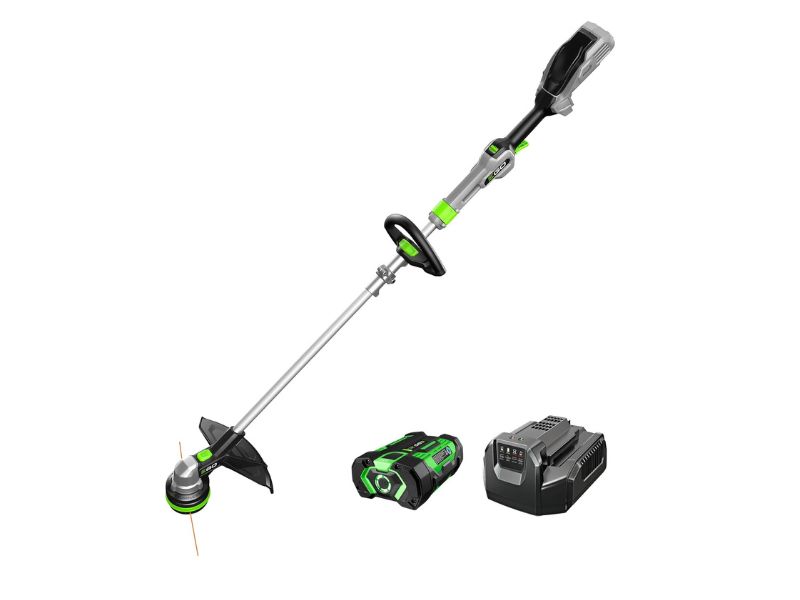
The EGO POWER+ ST1511T is my best overall choice because it sits in one of the most useful performance ranges for residential lawn care.
It is powerful enough for thick grass and common weeds, yet it does not require stepping all the way up to EGO’s more expensive premium carbon-fiber models.
The ST1511T uses a 15-inch cutting swath, professional-style 0.095-inch dual line, high-efficiency brushless motor, telescoping aluminum shaft, and a 56V 2.5Ah ARC Lithium battery.
EGO lists up to approximately 45 minutes of runtime with the supplied battery under suitable operating conditions.
POWERLOAD Is More Useful Than It Sounds
Reloading trimmer line is one of the most annoying parts of owning a traditional string trimmer.
The POWERLOAD system simplifies the process dramatically.
Feed the line through the head, press the loading control, and the trimmer winds the line into the spool automatically.
For someone who trims weekly, this saves far more frustration over several seasons than a small difference in motor speed or voltage.
15-Inch Cutting Swath
A 15-inch string trimmer is a strong compromise for normal residential properties.
It is noticeably more productive than 10- to 12-inch lightweight models but remains easier to control than some 17- or 18-inch professional machines.
That makes it suitable for trimming around:
fence lines, trees, landscaping beds, sheds, mailboxes, retaining walls, sidewalks, and driveway edges.
0.095-Inch Dual Line
Line diameter has a major impact on the type of vegetation a trimmer can comfortably handle.
Thin 0.065-inch line works well on ordinary lawn grass.
EGO’s 0.095-inch spiral-twist line gives you additional durability and cutting capability when you encounter denser weeds or coarse grass.
Consumer testing has also rated the ST1511T strongly for normal trimming, edging, and tall-grass performance.
Brushless Motor
The brushless motor improves the value proposition because it provides strong output while using battery energy efficiently.
Brushless designs also eliminate carbon brushes as a motor wear component.
That does not mean the trimmer requires no maintenance—the head, line, guard, and battery still need normal care—but the motor architecture is well suited to repeated cordless use.
Adjustable Shaft
The telescoping shaft helps users of different heights maintain a more natural trimming position.
Poor trimmer ergonomics can cause shoulder and lower-back fatigue surprisingly quickly.
The adjustable shaft is therefore not simply a comfort feature; it helps make the machine easier to control accurately.
Battery Ecosystem
The 56V ARC Lithium battery platform extends across EGO lawn mowers, blowers, hedge trimmers, chainsaws, and other outdoor equipment.
That makes the ST1511T particularly good value if you plan to build a complete battery-powered lawn-care system.
A battery becomes much easier to justify financially when it powers five tools instead of one.
Where It Falls Short
The ST1511T is heavier than ultra-light 20V trimmers.
Some users may also find a 56V platform excessive if they only trim a few feet around a townhouse lawn.
For tiny yards, Greenworks or another lightweight model may feel easier.
But when balancing power, runtime, line capacity, ease of loading, cutting width, and long-term battery usefulness, EGO offers the strongest overall package.
2.Greenworks 40V 13-Inch Cordless String Trimmer/Edger- Best Budget Value
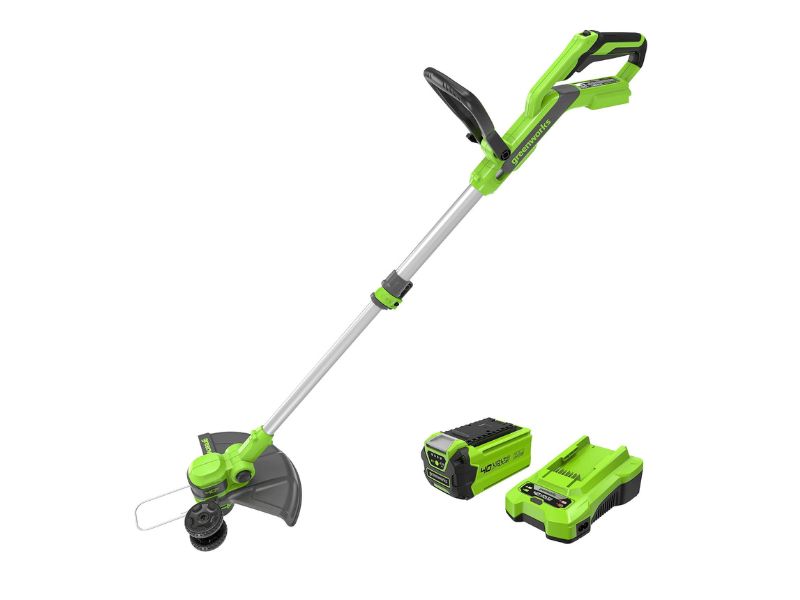
The Greenworks 40V 13-inch String Trimmer/Edger is the option I would choose when value means getting a complete, useful residential trimmer without paying for professional-level cutting capacity.
The kit configuration includes a 40V 2.0Ah lithium-ion battery and charger, while the tool provides a 13-inch cutting path and a lightweight body.
Greenworks lists approximately 40 minutes of runtime, a 60-minute recharge time, and a tool weight around 5.2 pounds without the battery.
Lightweight Handling
Weight can matter more than raw power on a small property.
String trimming requires continuous movement.
You are constantly sweeping the head, turning the shaft, reaching under shrubs, and repositioning around landscaping.
At just over five pounds without the battery, the Greenworks is substantially easier to handle than many heavy-duty machines.
That makes it especially attractive for small and medium yards.
13-Inch Cut Path
The 13-inch cutting swath is large enough for ordinary residential maintenance.
You will make more passes than with a 16-inch trimmer, but the smaller head is easier to maneuver in tight landscaping.
For a homeowner who spends only 10–20 minutes trimming after mowing, the productivity difference is often insignificant.
Trimmer and Edger in One
The Greenworks converts from a string trimmer to an edger by rotating the head.
An integrated edging wheel helps guide the machine along sidewalks and driveways.
This adds real value because many buyers do not need a separate dedicated lawn edger.
Seven-Position Pivoting Head
The head can be positioned through multiple angles.
This helps when trimming:
Under benches.
Below shrubs.
Along slopes.
Around raised beds.
Against retaining walls.
A rigid professional straight-shaft trimmer can provide more reach, but the adjustable Greenworks design is often more convenient around compact residential landscaping.
Auto-Feed Head
The trimmer uses an automatic line-feed system with 0.065-inch line.
This is suitable for normal grass and light weeds.
It is not ideal for thick brush.
That distinction matters.
The Greenworks represents good value precisely because it avoids overbuilding the machine for jobs most homeowners do not perform.
40V Tool Compatibility
Greenworks’ 40V platform supports a broad range of compatible outdoor equipment.
If you later buy a lawn mower, blower, hedge trimmer, chainsaw, or pole tool within the same platform, the original battery investment becomes substantially more valuable.
Where It Falls Short
The 0.065-inch line is noticeably lighter than EGO’s 0.095-inch line.
Dense weeds and neglected vegetation will expose that difference quickly.
This is best viewed as a lawn-maintenance trimmer, not a brush-clearing machine.
For an average maintained lawn, though, that is exactly what many buyers need.
3.Makita XRU23Z 18V LXT Brushless 13-Inch String Trimmer- Best for Existing Tool Owners
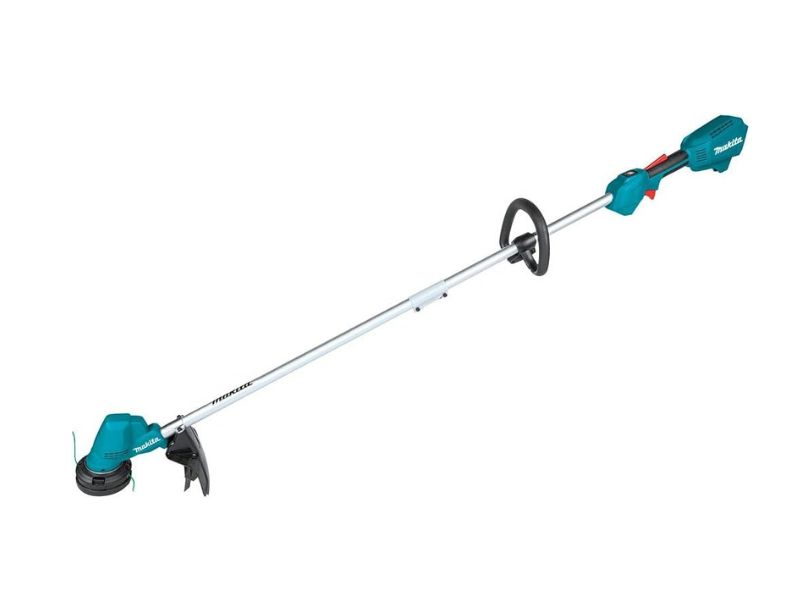
The Makita XRU23Z is a particularly smart value purchase if you already own Makita 18V LXT batteries.
Rather than buying into another high-voltage lawn-tool ecosystem, you can use the same battery platform that powers a huge range of drills, saws, impact drivers, blowers, lights, and other cordless equipment.
The XRU23 uses a 13-inch cutting swath, brushless motor, variable-speed trigger, two speed ranges, and Rapid Load bump-feed head.
Makita rates maximum no-load speed at 6,000 RPM and states that the trimmer can reach up to about an hour of runtime with a 4.0Ah battery under appropriate conditions.
Brushless Performance From an 18V Platform
The XRU23 proves that voltage alone does not determine whether a trimmer performs well.
Makita combines an efficient BL brushless motor with intelligent power management.
For regular grass trimming, the result is considerably more capable than many basic 18V or 20V homeowner machines.
High and Low Speeds
Two speed ranges help you control energy consumption.
The low setting reaches approximately 4,500 RPM, while high reaches approximately 6,000 RPM.
Low is useful for:
Normal lawn grass.
Light edging.
Working close to delicate plants.
Extending battery runtime.
High makes more sense when vegetation becomes thicker.
Variable-Speed Trigger
In addition to the high/low selector, the variable-speed trigger lets you control output within the selected range.
This is particularly useful while trimming around tree bark, siding, fences, and landscaping where maximum line speed is unnecessary.
Rapid Load Head
Makita’s Rapid Load bump-and-feed head uses a simple align, feed, and twist process for loading replacement line.
It does not automatically wind line like EGO’s POWERLOAD system, but it is much easier than dismantling a traditional spool and manually winding line.
Tool-Only Value
The XRU23Z is generally sold as the bare tool.
That is a disadvantage if this is your first Makita product because you still need a compatible battery and charger.
But for someone who already owns multiple 18V LXT packs, the opposite is true.
You avoid paying for another battery you do not need.
That can make the Makita one of the best values in this guide.
Where It Falls Short
The 13-inch cutting swath is smaller than EGO’s 15 inches.
It also does not have the same heavy 0.095-inch line capability as larger high-voltage trimmers.
For weekly residential maintenance, however, its balance of brushless performance, low weight, speed control, and enormous battery-platform compatibility makes it easy to recommend.
4.KIMO 20V Cordless String Trimmer and Blower Combo Kit- Best Combo Value
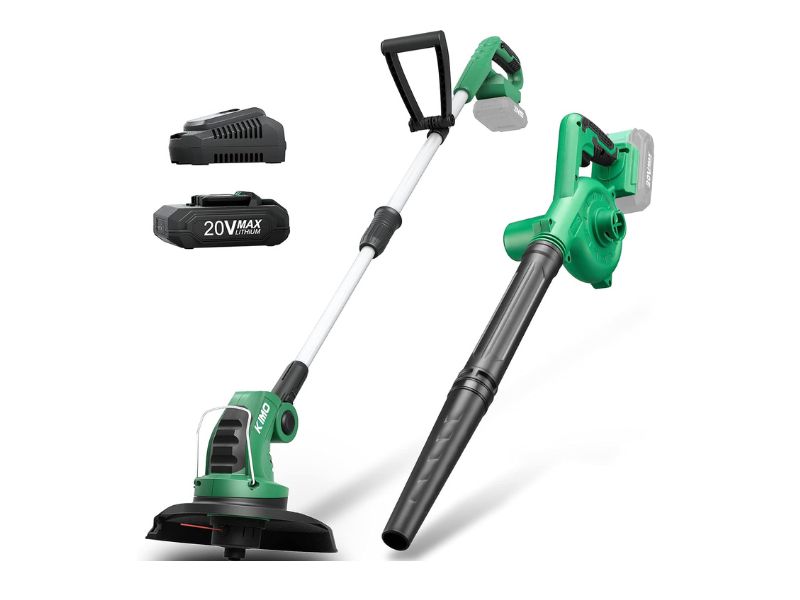
The KIMO 20V String Trimmer and Blower Combo approaches value differently.
Rather than giving you only a string trimmer, the kit includes both a 2-in-1 trimmer/edger and cordless blower, along with two batteries.
That can make it attractive for a new homeowner building a basic yard-tool collection.
The trimmer weighs roughly 3.5 pounds, uses an adjustable shaft, converts for edging, and includes a multi-angle head.
Two Yard Tools in One Purchase
A common lawn-care routine is:
Mow.
Trim.
Edge.
Blow clippings from the driveway and sidewalk.
Buying a trimmer and blower together addresses the complete cleanup process.
For someone starting from zero, this can provide better overall value than purchasing a premium trimmer first and then buying a blower separately.
Very Lightweight Trimmer
The roughly 3.5-pound trimmer weight is one of the biggest reasons to consider this kit.
It is substantially lighter than high-power 40V and 56V machines.
That helps reduce fatigue when trimming a compact yard.
Adjustable Design
The telescoping shaft allows the working length to be changed, while the head can be repositioned for different trimming angles.
The trimmer also converts into an edger by rotating the cutting head.
These features make it suitable for:
small lawns, landscaping borders, sidewalks, patios, raised beds, and light grass around fences.
Two Batteries
The kit includes two lithium-ion batteries.
This can be convenient because one can be used in the trimmer while the other remains charged or powers the blower.
Battery capacity and motor output are still smaller than premium lawn-tool systems, so this should not be confused with a heavy-duty machine.
Who Should Buy It?
The KIMO makes the most sense for a small-yard homeowner who needs both trimming and cleanup tools.
I would not choose it for half-acre properties with thick weeds.
But as a compact starter package, its overall cost-to-function ratio is appealing.
5.LawnMaster CLGT2425S 24V Cordless Grass Trimmer- Best Lightweight Adjustable Pick
The LawnMaster CLGT2425S is another lightweight trimmer aimed at users who prioritize easy handling rather than maximum cutting capacity.
It uses a 24V lithium-ion battery, automatic line feed, telescoping shaft, adjustable front handle, pivoting head, plant guard, and removable edging wheel system.
Its cutting width is approximately 25 centimeters, or just under 10 inches, so it is clearly designed for compact lawn maintenance.
Highly Adjustable
This is one of the biggest advantages of the LawnMaster.
The shaft length can be adjusted.
The front handle can move.
The head pivots through multiple positions.
That lets the operator adapt the tool to different jobs rather than holding one fixed shaft angle everywhere.
Automatic Line Feed
The auto-feed spool eliminates traditional bump feeding.
This is particularly helpful for homeowners who simply want a trimmer that works without learning the technique of striking the head against the ground.
Plant Protection
A retractable guard helps prevent the cutting line from accidentally reaching flowers, tree trunks, and garden plants.
This is valuable on landscaped yards where most trimming takes place very close to vegetation you want to preserve.
Small Cutting Head
The narrow cutting width is both the strength and weakness.
It can navigate tight areas easily.
But covering long fence lines takes more time.
For a tiny garden or townhouse lawn, that tradeoff makes sense.
For a large suburban property, it does not.
Who Should Buy It?
Choose the LawnMaster when low weight, adjustability, and precision around landscaping matter more than maximum productivity.
It is best for small grass areas and routine light trimming.
Best Battery String Trimmer for the Money Comparison
| Product | Voltage | Cutting Swath | Motor | Line/Feed | Best For |
| EGO ST1511T | 56V | 15 in. | Brushless | 0.095 in., POWERLOAD | Best overall value |
| Greenworks 40V | 40V | 13 in. | Electric | 0.065 in., auto feed | Budget residential use |
| Makita XRU23Z | 18V | 13 in. | Brushless | Rapid Load bump feed | Existing LXT owners |
| KIMO Combo Kit | 20V | Compact | Electric | Adjustable trimmer head | Trimmer + blower value |
| LawnMaster CLGT2425S | 24V | ~10 in. | Electric | Auto feed | Lightweight precision |
What Voltage Is Best for a Battery String Trimmer?
There is no universal best voltage.
Battery voltage should match the workload.
18V to 24V
This range works well for:
Small lawns.
Regular edging.
Light grass.
Landscaped properties.
Short trimming sessions.
Tools such as Makita, KIMO, and LawnMaster fit into this category.
40V
A 40V cordless string trimmer is a strong middle ground.
It can provide more sustained power and runtime without becoming as heavy as some larger systems.
Greenworks is a good example.
56V and Higher
Higher-voltage outdoor platforms make sense when you have:
Thick weeds.
Long fence lines.
A larger yard.
Heavy cutting line.
Longer working sessions.
EGO’s 56V platform provides more headroom than most lightweight 20V systems.
Does Higher Voltage Mean More Power?
Not automatically.
Motor design, battery current capability, controller electronics, line diameter, blade-tip speed, and efficiency all affect real cutting performance.
A well-designed 18V brushless trimmer can outperform a poorly designed higher-voltage model.
Instead of buying based on voltage alone, compare:
cutting swath
line diameter
brushless vs. brushed motor
battery watt-hours
maximum RPM
runtime
tool weight
speed control
Those specifications tell you much more about how a trimmer will behave.
What Cutting Swath Gives the Best Value?
For most homeowners, 13 to 15 inches is the sweet spot.
A 10-inch trimmer can be convenient in very tight areas, but it requires more sweeping passes.
A 17-inch trimmer covers ground quickly but generally becomes heavier and more expensive.
A 13- to 15-inch machine provides enough productivity for normal residential use without moving into commercial-style dimensions.
What Line Diameter Is Best?
Light-duty trimmers frequently use 0.065-inch line.
This works well for ordinary grass and light weeds.
Medium-duty machines typically use 0.080-inch line.
More capable residential and professional-style trimmers often use 0.095-inch line.
EGO’s 0.095-inch line is one reason it ranks first for overall value.
It gives the machine considerably more cutting capability without moving into a very large commercial tool.
Brushless vs. Brushed Motor
If the price difference is reasonable, I generally prefer a brushless string trimmer.
Brushless motors offer several potential advantages:
Better energy efficiency.
Less internal wear.
Improved power-to-weight ratio.
Better speed control.
Reduced heat generation.
EGO and Makita both use brushless motors in the models reviewed here.
However, a homeowner trimming for only 10 minutes per week may never see enough practical difference to justify a major price increase.
How Much Battery Runtime Do You Actually Need?
Runtime should match your yard.
If trimming takes 12 minutes after mowing, you do not need an hour of battery capacity.
If your property has several hundred feet of fencing, large landscaping areas, and roadside grass, runtime matters much more.
A practical approach is to estimate how long your current trimming session takes.
Then choose a battery system that provides at least 25–50% additional runtime reserve.
That margin helps compensate for thicker seasonal growth and battery aging.
Battery Ah vs. Voltage
Amp-hours (Ah) measure battery capacity, but comparing Ah across different voltage systems can be misleading.
A 2.5Ah 56V battery stores more energy than a 2.5Ah 20V battery.
A more useful measure is watt-hours:
Voltage × amp-hours = approximate watt-hours.
That still does not tell you everything because motor efficiency and workload matter, but it gives a much better comparison than Ah alone.
Is a Battery String Trimmer Worth It?
For most residential homeowners, yes.
Battery trimmers eliminate several inconveniences associated with gasoline equipment:
No fuel mixing.
No carburetor.
No pull cord.
No exhaust at the tool.
Less noise.
Instant starting.
They are also easier to store because you do not have to worry about gasoline sitting in the machine during winter.
The primary tradeoffs are battery runtime and replacement-battery cost.
For ordinary suburban yards, those disadvantages are increasingly small.
String Trimmer vs. Weed Eater vs. Weed Wacker
These terms generally describe the same category of tool.
String trimmer is the generic equipment term.
Weed eater and weed wacker/weed whacker are common consumer search terms.
You may also see:
battery weed eater
cordless weed trimmer
grass trimmer
lawn trimmer
battery weed wacker
cordless edger
For SEO and buying purposes, they usually refer to variations of the same rotating-line lawn tool.
String Trimmer vs. Dedicated Edger
A convertible string trimmer can produce a clean lawn edge along sidewalks and driveways.
However, a dedicated blade edger cuts a deeper and more defined trench.
If you simply want the lawn to look neat after mowing, a trimmer/edger combination is usually enough.
If you maintain long formal borders or need to establish new edges, a dedicated edger performs better.
Bump Feed vs. Auto Feed vs. POWERLOAD
These terms describe different parts of line management.
Bump Feed
Tap the spinning head against the ground to release additional line.
Makita uses this traditional system but simplifies reloading with its Rapid Load design.
Auto Feed
The mechanism releases line automatically.
Greenworks and LawnMaster use this approach.
It is convenient for beginners but sometimes advances more line than experienced users would choose manually.
POWERLOAD
EGO’s system primarily simplifies loading fresh line into the trimmer head.
Feed line through and let the motor wind it into place.
For many homeowners, this is one of the most useful convenience features available on a cordless trimmer.
How Heavy Should a Battery String Trimmer Be?
Weight affects comfort more than many specifications.
A heavy trimmer may feel perfectly manageable for five minutes and exhausting after half an hour.
Battery location also affects balance.
A well-balanced 10-pound machine may feel easier to operate than a poorly balanced 8-pound one.
For small yards, I favor lightweight machines.
For larger yards, additional weight can be acceptable when it brings more power and battery capacity.
Straight Shaft vs. Adjustable Shaft
A straight shaft is commonly used on higher-performance trimmers because it provides reach and rigidity.
Professional users often prefer this configuration.
A telescoping or adjustable shaft is more useful for residential buyers who share the tool with other family members.
Greenworks, EGO, KIMO, and LawnMaster all offer meaningful adjustment.
Makita uses a more conventional straight-shaft configuration.
How to Get the Most Value From a Battery Platform
Before buying, look at the other tools available for the battery.
If you expect to purchase a:
leaf blower
hedge trimmer
lawn mower
chainsaw
pole saw
cultivator
then battery compatibility becomes extremely important.
Two cordless tools that share batteries can be cheaper to own than two individually cheaper tools using completely different battery systems.
This is one of the biggest hidden factors in determining the best cordless string trimmer for the money.
How to Make Trimmer Line Last Longer
Avoid running the string directly against concrete whenever possible.
The cutting tip should do most of the work.
Repeatedly slamming the full length of line into:
brick, fencing, rocks, concrete walls, and metal edging
causes rapid line wear.
Work gradually around obstacles and maintain the proper line length.
Also use only the diameter approved for the trimmer head.
Oversized line can place additional load on the motor and feed mechanism.
How to Trim Thick Weeds With a Battery Trimmer
Do not bury the complete cutting head into dense vegetation.
Approach heavy weeds gradually.
Let the outer several inches of line cut first.
For very tall grass, consider cutting from the top downward in stages.
This reduces the chance of long grass wrapping around the trimmer shaft.
Use higher speed only when the vegetation requires it.
Lower power can preserve substantial battery capacity during routine grass trimming.
Frequently Asked Questions
What is the best battery string trimmer for the money?
The EGO ST1511T offers the strongest overall balance of power, runtime, cutting width, and convenience.
Its 15-inch swath, 0.095-inch dual line, brushless motor, POWERLOAD head, adjustable shaft, and 56V battery make it capable enough for both everyday lawn care and heavier residential weeds.
What is the best budget battery string trimmer?
The Greenworks 40V 13-inch trimmer is an excellent budget-focused choice for normal residential lawns.
It combines a battery and charger with a lightweight 13-inch trimmer, automatic line feed, adjustable head, and edging capability.
Is a 20V string trimmer powerful enough?
Yes, for small yards and regular grass maintenance.
A 20V trimmer works well around flower beds, fences, sidewalks, and other light-duty areas. Larger properties and thick vegetation justify moving to a stronger platform.
Is 40V better than 20V for a string trimmer?
40V usually provides more performance headroom, but it is not automatically the better purchase.
A small-yard homeowner may benefit more from a lightweight 20V machine, while a larger lawn benefits from additional power and runtime.
What is the best string trimmer for thick weeds?
The EGO ST1511T is the strongest choice among these five for thicker residential weeds.
Its brushless motor and 0.095-inch dual line give it more cutting capability than lightweight trimmers using thin 0.065-inch line.
Is Makita XRU23Z worth it?
Yes, especially if you already own Makita 18V LXT batteries.
Its brushless motor, two speed ranges, variable trigger, and 13-inch cutting swath provide strong residential performance without requiring a separate outdoor-only battery platform.
Is a brushless string trimmer worth the money?
Usually yes if you trim frequently or deal with heavier vegetation.
Brushless motors typically improve efficiency and eliminate carbon brushes as a motor wear component.
What line size is best for a cordless weed eater?
0.065 inch is good for light grass, while 0.080–0.095 inch is better for thicker vegetation.
Always follow the manufacturer’s approved line-diameter specifications.
What size cutting swath is best for a normal yard?
A 13- to 15-inch cutting swath is ideal for many residential properties.
It offers a good combination of productivity, weight, and maneuverability.
How long should a cordless string trimmer run?
For many homeowners, 20–45 minutes of usable runtime is enough.
The correct number depends on yard size, vegetation density, battery capacity, motor efficiency, and speed setting.
Can a battery weed eater replace a gas trimmer?
Yes, for most residential lawn maintenance.
High-quality cordless models now provide enough cutting performance for grass, edging, fence lines, and common weeds without fuel mixing or pull-starting.
Is it cheaper to buy a bare tool?
Yes, if you already own the correct compatible batteries and charger.
That is why the Makita XRU23Z can be such a good value for existing LXT users.
Final Verdict
The EGO POWER+ ST1511T is my top choice for the best battery string trimmer for the money. Its combination of a 15-inch cutting swath, 0.095-inch dual line, high-efficiency brushless motor, POWERLOAD line loading, adjustable shaft, and useful 56V battery capacity provides a strong balance between homeowner convenience and serious cutting performance.
The Greenworks 40V 13-Inch String Trimmer/Edger is the better choice when budget and low weight matter most. It provides the core features most small-yard homeowners need without forcing them to pay for excessive cutting capacity.
The Makita XRU23Z delivers excellent value to anyone already invested in the 18V LXT ecosystem because the tool combines brushless efficiency, two-speed control, variable throttle, and easy line loading without requiring another battery platform.
The KIMO 20V Combo Kit provides the most equipment for the money by bundling both a string trimmer and blower, making it useful for first-time homeowners with compact lawns.
Finally, the LawnMaster CLGT2425S is a lightweight precision option for small gardens where maneuverability and adjustability matter more than raw cutting width.
For most buyers, the smartest purchase is not simply the cheapest trimmer. Look at the complete ownership equation: battery cost, cutting swath, line diameter, motor efficiency, runtime, replacement line, tool weight, and battery compatibility with future lawn equipment. That is what determines whether a battery string trimmer remains good value long after the initial purchase.

I’m Maya L. Greenwood, a lifelong plant lover who believes anyone can grow something beautiful with the right guidance. After years of testing soil mixes, pruning methods, irrigation tricks, and pest-safe solutions, I started EasyGardenTips.com to turn hard-won lessons into step-by-step advice. From seed starting and container gardens to composting and seasonal checklists, my goal is to make gardening simple, sustainable, and fun.