How Deep Should a Raised Bed Be for Potatoes? Soil Depth Guide
A raised garden bed should ideally be 12–18 inches deep for growing potatoes, although a 12-inch bed is usually sufficient when roots can extend into healthy soil underneath. For an enclosed raised planter sitting on concrete or another solid surface, approximately 18–24 inches of growing-medium depth provides more room for roots, moisture storage, and developing tubers.
Potatoes grow underground, but the edible tubers aren’t the same as roots. They develop from specialized underground stems, usually near the original seed potato. Because these tubers must stay covered to prevent greening, the growing method needs enough space for planting and adding soil or mulch as the plants develop.
A shallow raised bed can produce potatoes, but restricted soil volume may increase water stress and make proper hilling difficult. A deeper bed can be easier to manage, although extra depth doesn’t automatically produce a larger harvest.
The right depth also depends on whether the bed has an open bottom, the type of potatoes, and the soil underneath.
In this article, I explain how deep a raised bed should be for potatoes, comparing 6-, 8-, 12-, 18-, and 24-inch beds. You’ll learn the correct seed planting depth, how much soil to leave for hilling, what growing medium to use, and how to manage spacing, drainage, watering, and harvesting.
How Deep Should a Raised Bed Be for Potatoes?
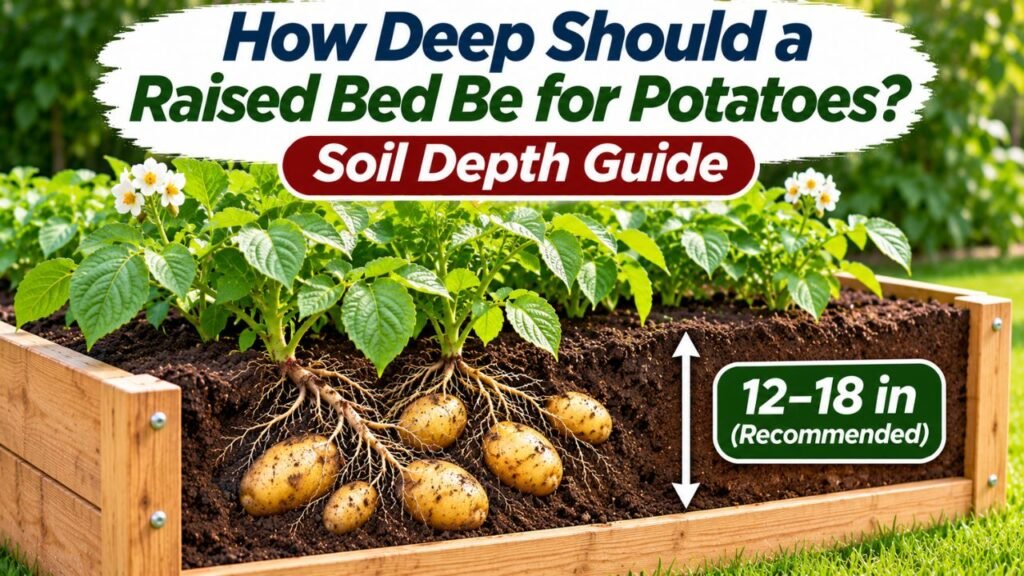
For most home gardens, a raised bed with 12–18-inch sides is a practical choice for potatoes. The important distinction is whether the bed is open to the ground or has a solid bottom.
An open-bottom raised bed allows potato roots to extend into the native soil below. An enclosed planter must provide the entire root zone within its own growing medium.
Recommended Raised-Bed Depths for Potatoes
| Raised-bed depth | Suitable for potatoes? | Practical recommendation |
| 6 inches | Possible under favorable conditions | Only consider if roots can enter suitable soil below |
| 8 inches | Possible in a bottomless bed | Limited room for hilling inside the frame |
| 10 inches | Generally workable over good native soil | More headroom may be useful |
| 12 inches | Yes | Good starting choice for a ground-connected raised bed |
| 15 inches | Yes | Provides additional room for soil and hilling |
| 18 inches | Yes | Convenient for many raised-bed potato gardens |
| 24 inches | Yes | Useful for enclosed planters needing more growing volume |
These are practical guidelines rather than strict biological minimums.
A 6-inch wooden frame over deep, fertile soil can provide more effective rooting space than a 12-inch planter with a solid bottom.
Likewise, a 24-inch raised bed filled with poorly drained material may perform worse than a properly managed 12-inch bed.
What Do University Extensions Recommend?
The UC Master Gardener Program’s potato-growing guidance recommends a container or raised bed at least 12 inches deep, starting with at least 6 inches of suitable growing medium so additional material can be added as the plants grow.
The University of Georgia Extension’s raised-bed dimensions guide also notes that most garden crops need at least 10 inches of soil, but potatoes may need additional depth when the bed sits on a hard surface.
These recommendations reinforce why the soil underneath the bed matters.
Key Takeaway: A 12–18-inch bottomless raised bed is a practical choice for potatoes. For an enclosed planter, prioritize additional usable soil volume and reliable drainage.
Is a 12-Inch Raised Bed Deep Enough for Potatoes?
Yes. A 12-inch raised bed is a popular and generally suitable option for potatoes when properly prepared.
It offers room to plant seed potatoes and add soil or mulch during growth.
However, the actual available depth depends on how the bed is filled.
Growing Potatoes in a 12-Inch Bottomless Bed
If the bed is positioned over healthy native soil, potato roots can grow below the raised section.
This gives plants access to additional water and nutrients.
You can begin with approximately 6–8 inches of growing medium inside the frame.
Leave the remaining space available for hilling.
As the potato stems grow, gradually add loose soil around their bases.
Eventually, the soil level may approach the top of the frame.
This arrangement helps keep developing tubers covered.
What if the 12-Inch Bed Sits on Concrete?
A 12-inch planter with a solid bottom has more limitations.
The roots cannot extend into deeper ground, and the available soil must also accommodate developing tubers and moisture storage.
Potatoes may still grow successfully in a suitably designed container, but additional depth and volume usually make management easier.
For a permanent enclosed bed, I would generally favor approximately 18–24 inches of usable growing-medium depth when space and construction allow.
That is a planning recommendation, not a guaranteed minimum for every potato variety.
Can You Grow Potatoes in an 8-Inch Raised Bed?
Yes, but the bed should preferably be open to suitable soil underneath.
An 8-inch raised frame doesn’t necessarily mean the entire potato root system is restricted to 8 inches.
However, the frame offers less space for adding soil during hilling.
When an 8-Inch Bed Can Work
An 8-inch bed may be suitable when:
- The bottom is open.
- Native soil is loose and reasonably fertile.
- Drainage is adequate.
- Roots can grow into the underlying ground.
- The gardener can maintain sufficient soil or mulch coverage.
You may need to mound soil above the frame or use suitable mulch as the plants develop.
When an 8-Inch Bed Is Too Shallow
An 8-inch enclosed planter may dry out rapidly and restrict root development.
The limited volume can also make moisture and temperature management difficult.
If the planter has a solid bottom, a deeper container is usually preferable.
Is an 18-Inch Raised Bed Better for Potatoes?
An 18-inch raised bed offers useful flexibility.
It provides more room for the initial growing medium, additional soil during hilling, and moisture storage.
That can be particularly helpful where native soil is unsuitable for root growth.
Benefits of an 18-Inch Bed
With an 18-inch frame, you can:
- Begin with sufficient loose soil for planting.
- Leave space for gradual hilling.
- Reduce the need to mound soil above the frame.
- Maintain more growing-medium volume.
- Accommodate a deeper root zone.
- Keep the raised-bed surface accessible.
However, deeper soil also requires more material and a structure capable of supporting its weight.
For an open-bottom bed over healthy soil, 18 inches isn’t always necessary.
Does Deeper Soil Mean More Potatoes?
Not necessarily.
Potato tubers generally develop near the original planted seed piece and along relatively short underground stems.
Simply stacking more soil above the plant doesn’t guarantee additional layers of potatoes.
The University of Maryland Extension’s potato-growing guide specifically notes that potato towers often fail to deliver the results gardeners expect because tubers develop close to the original seed potato.
Good soil conditions, adequate plant spacing, moisture, and nutrition matter more than excessive bed height.
Key Takeaway: An 18-inch raised bed can make hilling and moisture management easier, but it doesn’t automatically yield more potatoes than a properly managed 12-inch bed.
What’s the Difference Between Raised-Bed Depth and Potato Planting Depth?
These measurements describe different things.
Raised-bed depth refers to the vertical growing space available inside the structure.
Potato planting depth refers to how far below the current soil surface the seed potato is placed.
You shouldn’t plant a seed potato at the very bottom of an 18-inch bed simply because the bed is 18 inches tall.
How Deep Should You Plant Seed Potatoes?
A common recommendation is to plant seed potatoes approximately 3–5 inches below the soil surface.
The University of Maryland Extension recommends 3–5 inches for many plantings and 5–6 inches for certain later crops.
The exact depth depends on climate, soil texture, and growing method.
In a raised bed, a 3–4-inch planting depth is a practical starting point when using loose soil and planning to hill the plants.
Example: Planting in a 12-Inch Raised Bed
Consider a raised bed with 12-inch-high sides.
You could:
- Start with approximately 7–8 inches of loose growing medium.
- Place seed potatoes about 3–4 inches beneath the current surface.
- Leave roughly 4–5 inches of space below the top of the frame.
- Add soil gradually around the growing stems.
- Use mulch or additional mounding when needed to keep tubers covered.
This is an example layout, not a universal requirement.
The precise arrangement depends on the potato variety and the underlying soil.
Should You Fill the Raised Bed Completely Before Planting?
Not if you intend to hill potatoes within the frame.
Leaving some space makes it easier to add soil as the plants grow.
However, if you’re using a different cultivation method, such as deep planting or thick straw mulch, the initial filling strategy may differ.
How Much Soil Do You Need for a Potato Raised Bed?
The amount of soil depends on the bed’s length, width, and planned soil depth.
A deeper bed requires more material, especially if you’re filling it completely.
Raised-Bed Soil Volume Formula
For a rectangular bed:
Soil volume (cubic feet) = Length (ft) × Width (ft) × Soil depth (ft)
If the depth is measured in inches:
Soil volume (cubic feet) = Length × Width × Depth in inches ÷ 12
To convert cubic feet to cubic yards, divide by 27.
Soil Volume for Common Potato Raised Beds
| Bed size | Soil depth | Soil volume |
| 4 × 4 feet | 12 inches | 16 cu. ft. |
| 4 × 4 feet | 18 inches | 24 cu. ft. |
| 4 × 8 feet | 12 inches | 32 cu. ft. |
| 4 × 8 feet | 18 inches | 48 cu. ft. |
| 4 × 8 feet | 24 inches | 64 cu. ft. |
| 3 × 6 feet | 12 inches | 18 cu. ft. |
| 3 × 6 feet | 18 inches | 27 cu. ft. |
These quantities assume the growing medium occupies the full listed depth.
If you initially fill the bed only partway to leave space for hilling, you’ll need less soil at planting.
Example: Soil Needed for a 4 × 8 Potato Bed
Suppose you build a bed measuring:
- Length: 8 feet.
- Width: 4 feet.
- Height: 12 inches.
Full soil volume:
8 × 4 × 12 ÷ 12 = 32 cubic feet
If you initially fill it to 8 inches:
8 × 4 × 8 ÷ 12 = 21.33 cubic feet
This leaves approximately 10.67 cubic feet of space for additional material if the bed is eventually filled to the full 12-inch depth.
Actual quantities may vary because of settling.
What Soil Is Best for Growing Potatoes in Raised Beds?
Potatoes perform best in loose, fertile, well-drained soil.
Heavy, waterlogged soil can restrict tuber development and increase rot problems.
Extremely sandy soil may drain rapidly and require frequent watering.
A suitable growing medium should balance moisture retention with drainage.
Ideal Soil Characteristics
Look for soil that:
- Is loose enough for tubers to develop.
- Drains excess water.
- Retains sufficient moisture.
- Contains appropriate organic matter.
- Provides essential nutrients.
- Has a suitable pH.
The University of Maine Cooperative Extension describes approximately pH 5.3–6.0 as typical for potato production.
Potatoes can grow across a broader pH range, but soil acidity influences certain disease risks.
Should You Use Topsoil and Compost?
For a bottomless raised bed, a suitable mineral-soil-based growing medium with finished compost can work well.
The exact mixture depends on the existing soil and local materials.
Avoid using pure compost as the entire growing medium.
Compost decomposes and can contain more nutrients or salts than required when used excessively.
For enclosed planters, choose a container growing mix with appropriate drainage, structure, and moisture retention.
Can You Use Garden Soil?
Yes, if it has suitable texture, drainage, and fertility.
However, dense clay soil may require structural improvements.
Avoid filling an enclosed planter with heavy garden soil that compacts easily or drains poorly.
Test the soil when possible.
Should You Put Gravel at the Bottom?
Generally, no.
A gravel layer beneath the growing medium doesn’t automatically improve drainage.
In an enclosed planter, drainage openings and a suitable growing mix are more important.
A gravel layer can also reduce the soil volume available for potato roots.
For a bottomless raised bed, ensure water can move into the native soil beneath it.
How to Plant Potatoes in a Raised Bed Step by Step
Once the bed has adequate depth and suitable soil, planting is straightforward.
Step 1: Select Certified Seed Potatoes
Use certified seed potatoes from a reputable supplier.
These are potatoes produced specifically for planting under a seed certification program.
Grocery-store potatoes may carry diseases even when they appear healthy.
Certified seed stock helps reduce the risk of introducing disease into the bed.
Step 2: Prepare the Seed Pieces
Small seed potatoes can often be planted whole.
Larger potatoes may be cut into pieces.
A common recommendation is approximately 1½–2 ounces per seed piece, with at least one healthy eye.
Many gardeners prefer two eyes when practical.
If cutting seed potatoes, use a clean knife and follow appropriate handling instructions.
Allow cut surfaces to heal when recommended by the seed supplier or local extension.
Step 3: Prepare the Soil
Remove weeds and debris.
Check soil moisture and drainage.
Add finished compost or fertilizer when needed.
Avoid adding fresh manure directly before planting because it can contribute to common scab and other problems.
Step 4: Mark the Planting Positions
A practical starting distance is approximately 10–12 inches between seed potatoes.
Use wider spacing if growing large storage potatoes or varieties with substantial foliage.
In conventional rows, row spacing is often around 24–36 inches.
Intensive raised-bed layouts may use closer arrangements when soil fertility, irrigation, and growing space allow.
Step 5: Plant the Seed Potatoes
Make holes or furrows approximately 3–5 inches deep.
Place the seed potatoes with healthy eyes positioned to encourage upward shoot growth.
Cover with loose soil.
Avoid pressing the growing medium down excessively.
Step 6: Water the Bed
Water enough to settle the soil around the seed pieces.
Keep the growing medium moderately moist, not saturated.
Cold, waterlogged conditions can increase seed-piece rot.
Step 7: Allow the Plants to Emerge
Potato shoots emerge as soil temperature and moisture permit.
Germination and emergence speed depend on weather, planting depth, and seed condition.
Protect young growth when damaging frost is expected.
Step 8: Begin Hilling as Plants Grow
When the shoots reach approximately 6–8 inches tall, start adding soil around their lower stems.
Keep sufficient foliage exposed to continue photosynthesis.
Repeat when needed to keep developing tubers covered.
Key Takeaway: Plant seed potatoes several inches below the current soil surface and reserve enough space for hilling. Don’t confuse bed height with seed planting depth.
How to Hill Potatoes in a Raised Garden Bed
Hilling means placing additional soil or suitable mulch around the growing potato stems.
Its primary purpose is to keep developing tubers covered and protected from light.
It can also help suppress weeds and maintain a favorable environment around the tubers.
Why Do Potatoes Need Hilling?
Potato tubers can become exposed as they grow or when soil moves away from the plants.
Exposure to sunlight causes greening.
Green potato tissue may contain elevated levels of potentially toxic glycoalkaloids.
Keeping tubers covered reduces this risk.
When Should You Hill Potatoes?
Start when the plants are approximately 6–8 inches tall.
Add loose soil around the stems, leaving a useful portion of the foliage visible.
Repeat as the plants continue growing and tubers require protection.
The University of Vermont Extension’s potato-growing guidance recommends hilling after plants reach approximately 6–8 inches and repeating the process as needed.
How Much Soil Should You Add?
You can add approximately 2–3 inches of loose soil at a time.
The exact amount depends on plant height and how much of the lower stem is exposed.
Avoid burying the entire plant.
Keep enough green leaves above the soil to support growth.
Can You Use Straw Instead of Soil?
Yes, suitable clean straw can help cover developing potatoes.
However, it must be thick enough to block light.
Loose straw also needs monitoring because wind, settling, and decomposition may expose tubers.
Don’t assume a thin straw layer provides complete light protection.
Do You Need to Keep Adding Soil All Season?
Not necessarily.
Stop hilling when the tubers are adequately protected and the plants have reached a suitable stage.
Building a very tall potato tower isn’t a reliable way to multiply the harvest.
Most tubers develop relatively close to the original seed piece.
Key Takeaway: Hilling protects developing potatoes from light. It’s not a guarantee that every additional inch of soil will create another layer of tubers.
How Many Potatoes Can You Plant in a Raised Bed?
Planting density affects the space available for leaves, roots, and tuber development.
Crowding may produce smaller potatoes and increase competition for moisture and nutrients.
Potato Spacing Guide
| Raised bed | Approximate number of planting positions | Notes |
| 2 × 4 feet | 4–6 | Small planting |
| 3 × 6 feet | 9–12 | Allow room for mature foliage |
| 4 × 4 feet | 9–12 | Practical compact layout |
| 4 × 8 feet | 18–24 | More room for staggered planting |
| 4 × 12 feet | 27–36 | Suitable for a larger crop |
These are illustrative planning ranges, not guaranteed capacities.
The exact number depends on spacing, variety, margins, and maintenance access.
For large storage potatoes, wider spacing is often preferable.
How Many Seed Potatoes for a 4 × 4 Bed?
A 4 × 4-foot bed can hold approximately 9–12 planting positions in a moderately spaced arrangement.
This provides more room for tuber development than packing every square foot with multiple seed pieces.
If you prefer larger potatoes, use fewer plants.
If you’re harvesting small new potatoes, slightly closer spacing may be reasonable.
How Many Seed Potatoes for a 4 × 8 Bed?
A 4 × 8-foot bed may hold approximately 18–24 plants with a practical staggered arrangement.
However, high-density planting requires careful watering and nutrition.
Choose spacing based on the specific potato variety rather than maximizing plant count.
Can You Grow Potatoes in a Bed With Only 6 Inches of Soil?
It depends on what lies underneath.
Six inches of prepared soil isn’t necessarily the entire root zone when the bed has an open bottom.
Six Inches Over Good Native Soil
A bottomless bed containing 6 inches of loose growing medium may be workable when the soil below is suitable for root growth.
However, you’ll have limited space inside a short frame for hilling.
You may need to mound additional soil above the frame or use appropriate mulch.
Six Inches Over Concrete
A 6-inch enclosed planter is generally a poor choice for conventional potato production.
It offers limited rooting volume, dries out quickly, and provides little space for hilling.
Choose a deeper container.
Why a Deeper Bed Is Often More Convenient
A deeper bed provides more flexibility for:
- Initial planting depth.
- Additional hilling material.
- Root growth.
- Moisture storage.
- Soil temperature management.
These benefits can make the growing process more forgiving, particularly for beginners.
How Often Should You Water Potatoes in Raised Beds?
Raised-bed soil often dries faster than nearby ground-level soil.
Potatoes need dependable moisture, especially during tuber initiation and enlargement.
However, the soil shouldn’t remain waterlogged.
General Water Requirements
Potatoes often need approximately 1–2 inches of water per week during active growth, depending on rainfall, temperature, and soil conditions.
This is a broad starting range rather than a fixed schedule.
Check moisture in the root zone.
Water when the growing medium is becoming too dry for healthy growth.
When Is Water Most Important?
Consistent moisture is particularly important when developing tubers begin enlarging.
Drought stress during this period may contribute to:
- Reduced tuber growth.
- Uneven tuber sizes.
- Growth cracks.
- Other quality problems.
Large fluctuations between dry and saturated soil can also affect potato quality.
Should You Use Drip Irrigation?
Drip irrigation is useful for raised-bed potatoes.
It can deliver water directly into the root zone.
It also reduces the need to wet the foliage regularly.
This may be helpful where foliar diseases are a concern.
Monitor soil moisture and adjust irrigation as weather conditions change.
Can You Overwater Potatoes?
Yes.
Potatoes can suffer in saturated soil.
Poor drainage increases the risk of tuber rot and other root-zone problems.
If the bed remains wet for long periods, investigate drainage before adding more water.
What Fertilizer Is Best for Raised-Bed Potatoes?
Potatoes need adequate nutrients for healthy foliage and tuber growth.
However, the right fertilizer depends on the existing soil.
What Nutrients Do Potatoes Need?
The major fertilizer nutrients are:
- Nitrogen: Supports leaves and stems.
- Phosphorus: Supports energy transfer and plant development.
- Potassium: Supports water regulation and tuber development.
Potatoes also require other essential nutrients.
A soil test can help determine which amendments are needed.
Should You Use a Balanced Fertilizer?
A balanced fertilizer may be suitable when the soil needs several nutrients.
However, a raised bed with high phosphorus doesn’t necessarily need additional phosphorus.
Use recommendations appropriate for potatoes and your soil-test results.
Can Too Much Nitrogen Affect Potatoes?
Yes.
Excessive nitrogen may encourage abundant foliage while delaying maturity or reducing tuber quality.
Apply fertilizer according to recommendations rather than assuming more produces larger potatoes.
Should You Add Manure?
Avoid using fresh manure directly before growing potatoes.
Manure can increase the risk of common scab under some conditions and may introduce additional concerns.
Finished compost can be useful, but it should be applied in appropriate amounts.
When Should You Plant Potatoes in a Raised Bed?
Potatoes generally prefer relatively cool growing conditions.
In many U.S. regions, they are planted during spring.
However, planting dates vary significantly by climate.
Ideal Soil Temperature
The University of Maine Extension recommends planting once soil temperatures reach approximately 50°F.
Potatoes may emerge in cooler soil, but prolonged cold, wet conditions increase the risk of seed-piece decay.
Can You Plant Potatoes Before the Last Frost?
Yes, in many regions.
Potatoes are commonly planted approximately 2–4 weeks before the expected last spring frost when soil conditions are suitable.
However, emerging foliage can be damaged by freezing temperatures.
Protect young growth when necessary.
Can You Grow Potatoes in Summer?
Potatoes can grow during summer where temperatures remain suitable.
However, excessive soil heat can interfere with tuber development.
University of Maryland Extension notes that soil temperatures above approximately 80°F can inhibit tuber formation.
In hot climates, spring, fall, or winter planting may be more suitable than midsummer planting.
Common Mistakes When Growing Potatoes in Raised Beds
Even a deep raised bed can produce disappointing results when other growing conditions are unsuitable.
Using a Bed That’s Too Shallow
A shallow enclosed planter can restrict roots and reduce moisture storage.
Choose a deeper growing area whenever possible.
Filling the Bed to the Top Before Hilling
If you plan to hill potatoes inside the frame, leave some space for additional soil.
Otherwise, you may need to mound material above the bed.
Planting Seed Potatoes Too Deeply
Excessively deep planting can delay emergence.
Use the recommended planting depth for the variety and growing method.
Overcrowding the Bed
Too many plants compete for nutrients, water, and light.
Maintain suitable spacing.
Using Grocery-Store Potatoes as Seed
Grocery potatoes can carry diseases and may have been treated to reduce sprouting.
Choose certified seed potatoes.
Adding Too Much Compost or Fertilizer
Excess nutrients can contribute to soil imbalances and poor plant performance.
Test the soil when possible.
Letting Developing Tubers Become Exposed
Uncovered tubers may turn green.
Hill the plants or use appropriate light-blocking mulch.
Avoid eating green or bitter potatoes.
Ignoring Crop Rotation
Potatoes belong to the nightshade family, along with tomatoes, peppers, and eggplants.
Growing these crops repeatedly in the same bed can encourage certain pests and diseases.
Where possible, rotate potatoes and other nightshade crops away from the same bed for approximately 3–4 years.
How to Harvest Potatoes From a Raised Bed
Raised beds can make potato harvesting easier because the soil is often loose and accessible.
When Are Potatoes Ready?
Harvest timing depends on the variety and whether you want new potatoes or mature storage potatoes.
Some new potatoes can be harvested approximately 6–8 weeks after planting.
For mature potatoes, wait until the plants have reached maturity and the foliage begins dying back naturally.
The exact timing depends on variety and weather.
How to Harvest Without Damaging Tubers
- Stop excessive watering as harvest approaches, following crop conditions.
- Gently remove mulch.
- Loosen soil around the plant.
- Use your hands or a suitable garden fork to locate tubers.
- Lift potatoes carefully.
- Avoid cutting or puncturing them.
- Keep harvested tubers out of direct sunlight.
Damaged potatoes generally store less successfully.
Use them sooner rather than placing them with undamaged storage potatoes.
How to Store Harvested Potatoes
For mature storage potatoes, follow appropriate curing and storage guidance for the variety.
Store potatoes in a cool, dark, well-ventilated location.
Avoid exposing them to light.
Discard potatoes that are extensively green, bitter, rotten, or otherwise unsafe.
Best Raised-Bed Depth for Potatoes: Final Comparison
If you’re choosing a raised bed specifically for potatoes, the most useful decision is whether the plants will have access to native soil underneath.
| Your growing situation | Recommended approach |
| Bottomless bed over healthy ground | Approximately 12 inches is a good starting height |
| Bottomless bed over compacted ground | Around 12–18 inches, plus improvement of the underlying soil when possible |
| Enclosed planter on concrete | Prefer a large planter with approximately 18–24 inches of usable growing-medium depth |
| Shallow 6–8-inch frame over healthy ground | Possible, with careful hilling and moisture management |
| Small patio or balcony | Use a deep container or suitable grow bag with drainage |
| Beginner growing potatoes for the first time | A 12–18-inch bottomless raised bed is a practical choice |
Remember that soil depth alone doesn’t guarantee yield.
A healthy potato crop also depends on appropriate planting depth, spacing, irrigation, soil fertility, and keeping tubers covered.
Conclusion
So, how deep should a raised bed be for potatoes? For most home gardeners, a 12–18-inch raised bed provides a practical balance of growing space, hilling room, and ease of maintenance.
A 12-inch bottomless bed can work well when potato roots can extend into suitable native soil. An 18-inch bed offers additional flexibility, while an enclosed planter may benefit from approximately 18–24 inches of usable growing-medium depth.
Plant seed potatoes approximately 3–5 inches below the current soil surface, leaving space to add soil or mulch as the stems develop.
Avoid assuming that an extremely tall bed will automatically produce more potatoes. Most tubers develop relatively close to the original planted seed piece.
I recommend choosing a 12–18-inch bottomless raised bed when possible, filling it with loose, well-drained soil, and leaving enough room for hilling. Maintain appropriate spacing and consistent moisture throughout the growing season.
The best potato raised bed is deep enough for healthy roots and tuber protection, but proper soil, drainage, and care matter more than extra height alone.
FAQs About How Deep Should a Raised Bed Be for Potatoes
Is 12 Inches Deep Enough for Potatoes?
Yes. A 12-inch raised bed is generally suitable when it has an open bottom and the roots can grow into healthy soil beneath it.
Leave enough space for hilling, and maintain good drainage.
For a solid-bottom planter, additional depth and soil volume may be preferable.
Can Potatoes Grow in an 8-Inch Raised Bed?
Yes, under suitable conditions.
An 8-inch bottomless raised bed can work when roots have access to deeper soil.
However, the limited frame height makes hilling more difficult.
An enclosed 8-inch planter is generally less suitable for a full potato crop.
Is an 18-Inch Raised Bed Too Deep for Potatoes?
No.
An 18-inch raised bed provides plenty of room for potatoes.
You don’t need to plant the seed pieces at the bottom of the bed.
Start with an appropriate soil depth, plant several inches below the surface, and add more soil as the stems grow.
How Deep Should You Plant Seed Potatoes in a Raised Bed?
Seed potatoes are commonly planted approximately 3–5 inches below the soil surface.
The exact depth depends on soil conditions, planting season, and growing method.
Avoid planting excessively deep or leaving the seed pieces exposed.
How Much Soil Should You Put in a Raised Bed for Potatoes?
The amount depends on the bed size and how much space you want to leave for hilling.
For example, a 4 × 8-foot bed filled to 12 inches requires 32 cubic feet of soil.
If initially filled to 8 inches, it needs approximately 21.3 cubic feet.
Leave room for additional soil if hilling within the frame.
Can You Grow Potatoes in a Raised Bed With a Bottom?
Yes.
However, the enclosed bed needs enough soil volume and drainage for roots and developing tubers.
A deep planter with approximately 18–24 inches of usable growing medium is a practical option, although requirements vary.
Avoid shallow containers that restrict roots and dry rapidly.
Do Potatoes Grow Better in Deep Raised Beds?
Not automatically.
A deeper bed can improve moisture storage and provide more room for roots and hilling.
However, excessive height doesn’t guarantee more tubers.
A well-managed 12-inch bottomless bed may perform better than a poorly drained 24-inch planter.
Do You Have to Hill Potatoes in a Raised Bed?
Hilling is commonly recommended because it helps keep developing tubers covered and prevents light exposure.
You can add loose soil around the stems or use a suitable light-blocking mulch system.
The main goal is to protect the tubers, not create an extremely tall mound.
Can You Grow Potatoes in the Same Raised Bed Every Year?
It’s better to rotate crops when possible.
Potatoes share certain pests and diseases with tomatoes, peppers, and eggplants.
Avoid growing potatoes or other nightshade crops in the same bed repeatedly.
A rotation interval of approximately 3–4 years is commonly recommended where garden space allows.

I’m Maya L. Greenwood, a lifelong plant lover who believes anyone can grow something beautiful with the right guidance. After years of testing soil mixes, pruning methods, irrigation tricks, and pest-safe solutions, I started EasyGardenTips.com to turn hard-won lessons into step-by-step advice. From seed starting and container gardens to composting and seasonal checklists, my goal is to make gardening simple, sustainable, and fun.