Raised Beds vs Pots: Which Is Better for Growing Vegetables?
Raised beds are generally better for growing several vegetables in a permanent garden space, while pots are better for small areas, patios, balconies, and flexible planting arrangements. Both methods can produce healthy vegetables, herbs, and flowers when plants receive enough sunlight, water, nutrients, and rooting space.
The biggest difference is how much growing space plants have available. Traditional raised beds usually have open bottoms, allowing roots to extend into the ground beneath them. Pots contain a limited volume of growing medium, making container size and watering especially important.
Cost, maintenance, and soil requirements also differ. A raised bed may require a larger initial investment, but it can support multiple crops in one organized area. Pots are easier to start with, although growing many plants in separate containers can become expensive and time-consuming.
Choosing between these two gardening methods depends on the space available, the crops you want to grow, and how much maintenance you can manage. Understanding their practical differences makes it easier to select a setup that fits your gardening goals.
Raised Beds vs Pots: Key Differences at a Glance
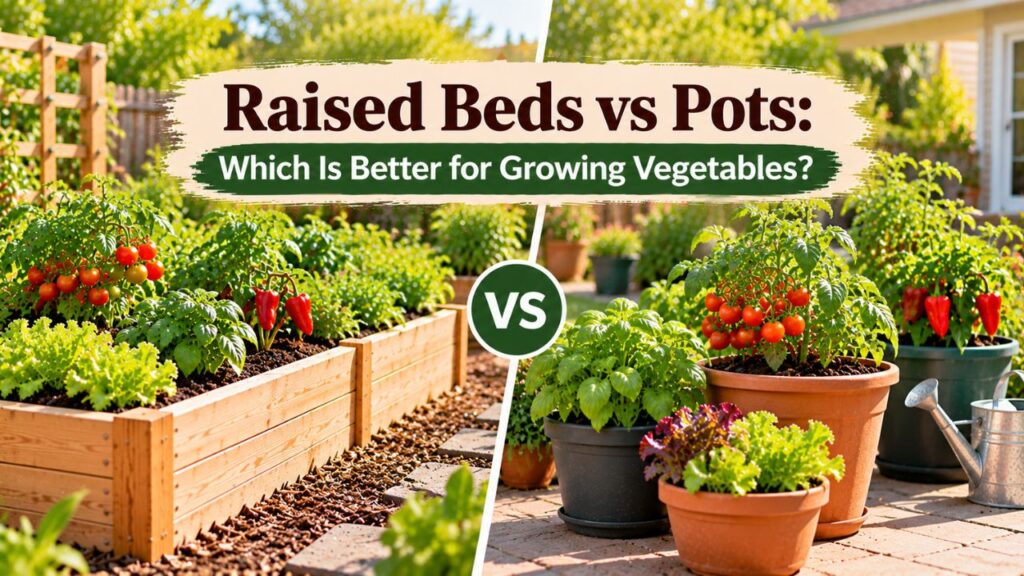
Raised beds and pots both provide controlled growing spaces, but their construction and growing conditions are different.
A traditional raised bed is a planting area elevated above the surrounding ground. It may have wooden, metal, or stone sides, although some raised beds are simply mounds of soil.
A pot is a container that holds growing medium within defined walls and a bottom, usually with drainage holes.
Raised Beds vs Pots Comparison Table
| Feature | Raised Beds | Pots |
| Growing space | Larger, shared planting area | Limited to individual containers |
| Root development | Can extend into native soil if open-bottomed | Usually restricted to the pot |
| Soil type | Mineral soil and compost often suitable | Lightweight potting mix preferred |
| Watering | May retain moisture longer due to greater volume | Small pots often dry faster |
| Drainage | Depends on soil and underlying ground | Requires adequate drainage outlets |
| Mobility | Usually permanent or difficult to move | Smaller pots are portable |
| Initial cost | Often higher for frames and soil | Usually lower for a few plants |
| Fertilizing | Based on soil condition and crop needs | Often requires more frequent feeding |
| Best location | Yards and permanent garden areas | Patios, balconies, decks, and small spaces |
| Planting capacity | Suitable for multiple crops | Depends on individual pot size |
The main distinction is rooting volume and flexibility. Raised beds provide an organized growing area for several plants, while pots allow individual plants to be placed and managed separately.
Neither method guarantees better growth. A well-maintained tomato plant in a large pot may outperform one growing in a poorly maintained raised bed.
How Raised Beds and Pots Affect Root Growth
Root space is one of the most important differences between raised bed gardening and container gardening.
Roots absorb water and nutrients, anchor plants, and respond to conditions within the growing medium.
When the available growing space is restricted, plants may require more frequent watering and closer attention to nutrients.
Root Growth in Open-Bottom Raised Beds
Traditional raised beds built directly over natural ground generally allow roots to grow beneath the raised soil layer.
For example, a raised bed with 10 inches of added soil may provide more than 10 inches of effective rooting depth if the ground beneath is loose, clean, and suitable for plant growth.
This can benefit vegetables with extensive root systems.
According to the University of Maryland Extension’s raised bed gardening guidance, plants in raised beds placed over natural ground can extend their roots into the soil underneath. The added growing layer also helps provide loose soil for root development.
However, roots may struggle to penetrate severely compacted clay, construction fill, or other restrictive materials.
Preparing the underlying ground is therefore important when building a permanent raised bed.
Root Growth in Garden Pots
Pot-grown plants have a defined amount of growing medium available.
A plant in a 3-gallon container has much less rooting volume than the same plant in a 10-gallon container.
As roots grow, they may eventually reach the container walls and bottom.
In rigid pots, roots can begin circling when the container becomes too small.
Severe root restriction can interfere with water and nutrient uptake, making it difficult for the plant to maintain healthy growth.
Choosing a sufficiently large pot helps reduce this problem.
Fabric grow bags can encourage air pruning, where exposed root tips stop growing outward and branch into smaller roots. However, fabric containers can also lose moisture quickly through their sides.
What Happens With Raised Beds on Concrete?
Not all raised beds have access to natural ground.
A raised bed installed on concrete, pavement, or an elevated platform behaves more like a large container.
Roots cannot extend into the ground below, so the growing medium must provide enough depth and volume for the intended crops.
Drainage also needs attention because water cannot simply move into native soil.
Important: When comparing raised beds with pots, distinguish traditional open-bottom raised beds from elevated planters and raised beds with solid bottoms. Their root-space and drainage conditions are not identical.
Soil Requirements for Raised Beds vs Pots
The best growing medium depends on whether the plants are growing in a permanent open-bottom bed or a contained pot.
Using the wrong soil type can lead to poor drainage, compaction, or inadequate moisture retention.
What Soil Works Best in Raised Beds?
For a traditional raised bed on natural ground, good-quality mineral topsoil combined with mature compost is often a suitable choice.
Mineral soil contains sand, silt, and clay particles that provide structure and help retain nutrients.
Finished compost adds organic matter and can improve soil structure and moisture management.
A practical starting mixture for a new bed is:
- Two parts suitable mineral topsoil
- One part finished compost
These proportions are measured by volume.
However, the exact mixture should depend on the existing soil’s condition.
If the native soil is already fertile, loose, and well-drained, additional compost or purchased topsoil may not be necessary.
The goal is to provide a stable growing environment that retains useful moisture while allowing excess water to drain.
What Soil Works Best in Pots?
Pots generally perform better with a lightweight, well-aerated potting mix designed for container growing.
Commercial potting mixes often contain ingredients such as:
- Coconut coir or peat moss
- Composted pine bark
- Perlite
- Vermiculite
- Finished compost
These materials help create air spaces while retaining moisture.
The University of Maryland Extension’s container vegetable gardening guide explains that ordinary mineral garden soil can become too dense for container growing. Lightweight potting media provide better aeration and water movement within the restricted root space.
Avoid filling small pots entirely with dense backyard soil.
Even soil that works well in an open garden bed may compact or drain poorly inside a container.
Can You Use the Same Soil in Raised Beds and Pots?
Not always.
An open-bottom raised bed can use suitable mineral soil because excess water and roots may move into the ground beneath it.
A pot needs a growing medium that maintains adequate air space within a limited volume.
Commercial products labeled “raised bed mix” also vary in composition. Some contain substantial mineral topsoil, while others resemble lightweight potting media.
Check the ingredients rather than assuming all bagged garden soils are interchangeable.
For elevated raised beds with solid bottoms, a lighter container-style mix may be appropriate, depending on the bed’s depth, weight capacity, and drainage design.
Raised Beds vs Pots: Watering and Drainage
Both raised beds and pots require careful watering, but their moisture behavior can differ considerably.
Pot size, growing medium, weather, plant maturity, and container materials all affect how quickly water is lost.
Do Pots Need More Water Than Raised Beds?
Small pots generally need more frequent watering than large, well-prepared raised beds.
A small pot contains less growing medium, so it has less moisture available to support the plant between waterings.
Pots are also exposed to heat and wind around their sides.
During hot summer weather, small containers may need daily moisture checks, while some large raised beds can go longer between waterings.
However, watering frequency is not fixed.
A raised bed filled with a very coarse mixture may dry quickly, while a large self-watering container may retain useful moisture for longer.
The most reliable approach is to check moisture below the surface and water according to the plant’s needs.
How Does Drainage Differ?
Traditional open-bottom raised beds allow water to move through the growing layer into the soil beneath them.
When the underlying ground drains properly, this can provide a suitable environment for vegetable roots.
However, a raised frame does not automatically correct severely waterlogged native soil.
Pots need drainage holes or an appropriate overflow system so excess water can leave the container.
Without drainage, the growing medium may remain saturated and deprive roots of oxygen.
Adding gravel or broken pottery to the bottom of a pot does not solve poor drainage. It can reduce the amount of growing medium available and may worsen water retention near the bottom of the root zone.
Use a suitable potting mix and functional drainage outlets instead.
Which Handles Hot Weather Better?
Large, open-bottom raised beds often provide more buffered root conditions than small exposed pots.
Smaller containers can heat up and cool down more rapidly because their entire root zone is surrounded by the container walls.
Dark-colored pots placed in direct summer sunlight may become particularly warm.
Unglazed terracotta and fabric pots can also lose additional moisture through their sides.
Raised beds are not immune to heat stress. Tall beds, metal-sided beds, and beds on pavement may dry quickly or experience elevated soil temperatures.
Mulching, suitable watering, and adequate growing volume help manage these conditions.
Which Grows Vegetables Better: Raised Beds or Pots?
Both methods can produce productive vegetable plants.
The more useful question is whether each crop has enough rooting volume, sunlight, water, and physical space to grow.
Some crops are convenient in small containers, while others are easier to manage in larger planting areas.
Growing Tomatoes and Peppers
Tomatoes and peppers can grow in raised beds or sufficiently large pots.
Raised beds offer more flexibility for supporting several plants and providing space for expanding root systems.
In pots, the container must be large enough for the selected variety.
A 5-gallon container is a reasonable minimum starting size for many standard tomato and pepper plants, although larger containers can provide better moisture reserves and rooting volume.
Large indeterminate tomatoes may benefit from considerably more space.
Provide sturdy plant supports regardless of the growing method.
For a gardener planning several tomato and pepper plants in one sunny backyard area, a raised bed may be more convenient.
For someone growing one compact pepper or patio tomato, a pot can be sufficient.
Growing Lettuce, Spinach, and Other Leafy Greens
Leafy greens are suitable for both gardening methods.
Their relatively compact growth habits make them practical choices for pots, window boxes, and small raised beds.
Pots offer the flexibility to move cool-season greens away from excessive afternoon heat when necessary.
Raised beds allow multiple varieties to grow together in organized rows or blocks.
For a continuous supply of salad greens, a raised bed can provide convenient planting space for successive sowings.
For occasional harvests, a few containers may be enough.
Growing Carrots, Radishes, and Root Vegetables
Root vegetables need loose growing medium without large obstructions.
Raised beds are useful because the soil can be prepared to an appropriate depth.
Carrots, for example, may develop poorly if their roots encounter compacted layers or large stones.
Pots can also support root vegetables, provided the container is deep enough for the expected root length.
Short carrot varieties are particularly useful for containers.
Radishes are another practical choice for smaller growing spaces because many varieties mature quickly and require relatively little horizontal room.
Growing Cucumbers, Beans, and Squash
Cucumbers, beans, and squash can grow in either system, but their growth habits affect the required space.
Bush varieties are often easier to manage in containers than vigorous trailing varieties.
A sufficiently large pot with a trellis may work well for a compact cucumber plant.
Raised beds are convenient for several plants because support structures can be installed along the bed.
Summer squash typically needs considerable growing space and benefits from a large root zone.
For a small patio, choosing compact varieties is often more important than the gardening method itself.
Growing Herbs
Pots are particularly convenient for many culinary herbs.
Basil, parsley, thyme, chives, and mint can grow successfully in appropriately sized containers.
Keeping mint in a separate pot can help prevent its spreading roots from overtaking nearby plants.
A raised bed is useful when growing a larger collection of herbs with compatible moisture and soil requirements.
However, avoid grouping drought-tolerant herbs with plants that require consistently moist soil unless watering can be managed separately.
Raised Beds vs Pots: Cost and Setup Requirements
The cost difference depends on the size of the garden, the materials selected, and whether suitable soil is already available.
Pots usually require less initial spending when growing only a few plants.
Raised beds may become more practical when the goal is to maintain a larger vegetable garden over several seasons.
Initial Cost of Raised Beds
A typical framed raised bed requires:
- A frame or other edging material
- Suitable growing soil
- Compost or other amendments when needed
- Basic gardening tools
- Watering equipment
The frame may be made from wood, galvanized metal, stone, or other appropriate materials.
Soil can represent a substantial part of the initial cost, particularly in tall raised beds.
For example, a 3 × 3-foot raised bed filled to a depth of 12 inches requires:
3 × 3 × 1 = 9 cubic feet of soil
That is approximately one-third of a cubic yard.
If the bed is placed over suitable existing garden soil, the amount of purchased material may be reduced.
Initial Cost of Pots
For a small container garden, the basic materials include:
- A suitably sized pot with drainage
- Potting mix
- Seeds or seedlings
- Fertilizer when needed
- Basic watering equipment
A 5-gallon container holds approximately 0.67 cubic feet of growing medium.
That is much less than the volume required to fill a 3 × 3-foot raised bed to 12 inches.
However, one 5-gallon pot generally provides growing space for only one large vegetable plant.
If you purchase many large pots and fill each with commercial potting mix, the total cost can become substantial.
Which Is More Economical Over Time?
For one or two plants, pots are often the less expensive option.
For several vegetables grown in a permanent backyard garden, raised beds can be more economical over multiple seasons, depending on frame durability and soil availability.
Mineral-based raised bed soil can remain useful for many years with appropriate maintenance.
Potting mixes can also be reused when healthy, although they may need fresh ingredients and nutrient replenishment as their structure changes.
Costs vary widely, so compare the full setup rather than only the price of a frame or pot.
Which Is Easier to Maintain: Raised Beds or Pots?
Neither gardening method is completely maintenance-free.
However, the type and frequency of work are different.
Maintenance in Raised Beds
Established raised beds generally require:
- Regular moisture checks
- Seasonal weed management
- Mulching when appropriate
- Soil testing and nutrient management
- Occasional compost applications
- Maintenance of the bed frame
A larger growing area may be easier to water consistently using drip irrigation or soaker hoses.
Permanent beds also allow gardeners to maintain the same growing area from season to season without completely rebuilding it.
However, preparing or filling a new raised bed requires more initial physical work than planting in a small pot.
Maintenance in Pots
Potted plants often need closer attention to moisture and nutrients.
Smaller growing volumes mean plants can be affected more quickly by drying, overwatering, and nutrient shortages.
Container care may involve:
- Frequent moisture checks
- Monitoring drainage holes
- Fertilizing according to the growing mix and crop
- Repotting root-restricted plants
- Replenishing degraded potting mix
- Moving containers during unsuitable weather
A few pots are easy to manage.
Maintaining dozens of individual containers, however, can require more frequent attention than a comparably sized raised bed garden.
Raised Beds vs Pots for Small Spaces and Accessibility
The available growing area often determines which method is more practical.
Raised Beds for Backyard Gardens
Raised beds work particularly well in yards where a permanent growing area can be established.
They help define planting spaces and separate garden beds from walking paths.
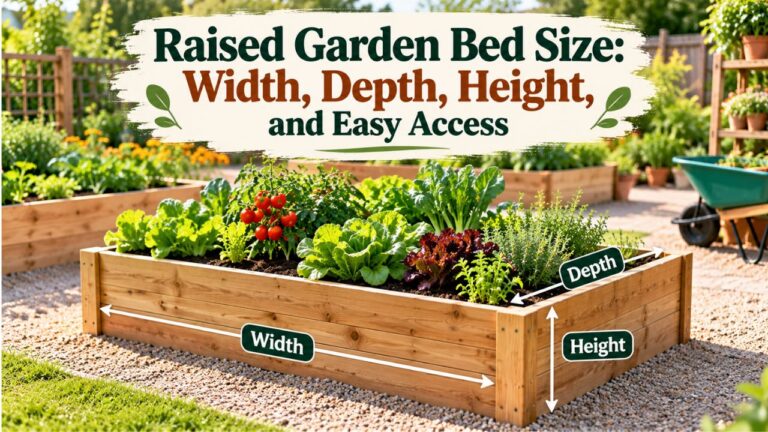
A bed that can be reached from both sides is commonly kept around 3–4 feet wide.
This allows access to plants without stepping on the soil and causing compaction.
Multiple raised beds can also be arranged to accommodate crop rotation, paths, and watering equipment.
Pots for Patios, Balconies, and Apartments
Pots are usually more practical where ground space is limited or unavailable.
They can fit along patio edges, on suitable shelves, or in other areas receiving enough light.
Smaller pots can also be moved when seasonal sunlight changes.
This flexibility is useful for renters or people who expect to relocate.
However, large pots filled with wet growing medium may be difficult to move safely.
Safety Note: Before placing large pots or raised planters on a balcony or elevated deck, confirm that the structure can safely support the combined weight of containers, saturated growing medium, plants, and water.
Which Is Easier for Gardeners With Limited Mobility?
Both methods can be adapted for easier access.
A tall raised bed can reduce the need to bend or kneel.
However, its height, width, and surrounding paths must allow the gardener to reach plants comfortably.
Pots can be placed on sturdy stands or tables to create a convenient working height.
For someone who wants to garden while seated, a properly designed elevated planter or accessible raised bed may provide better working conditions than low ground-level beds.
The most suitable option depends on reach, stability, mobility needs, and available space.
How to Choose Between Raised Beds and Pots
The best option depends on what you intend to grow and how you want to manage the garden.
Choose Raised Beds When You Want a Permanent Vegetable Garden
Raised beds are generally a better fit when:
- You have a suitable backyard or dedicated garden area.
- You want to grow several vegetables together.
- You prefer a larger, shared growing space.
- You want roots to access the native soil beneath an open-bottom bed.
- You plan to maintain the garden for several seasons.
- You can accommodate the initial frame and soil requirements.
They are also useful when the natural ground needs improvement, provided the site’s drainage and soil safety are addressed.
Choose Pots When You Need Flexibility
Pots are generally a better fit when:
- You have only a patio, balcony, or small outdoor space.
- You want to grow a few herbs or vegetables.
- You need to reposition plants for sunlight or weather.
- You rent your home or may move.
- You want to start gardening without constructing a permanent bed.
- You prefer to manage different plants in separate growing media.
Pots also allow you to isolate plants with different soil and watering requirements.
Can You Combine Raised Beds and Pots?
Yes. Using both methods can be more practical than choosing only one.
For example, a backyard gardener might grow lettuce, carrots, beans, and several peppers in a raised bed while keeping mint, basil, and a compact tomato variety in separate containers.
This arrangement gives larger crops additional planting space while keeping plants with different management needs separate.
Pots can also supplement raised beds when the main growing area becomes crowded.
The combination works especially well when sunlight and watering requirements can be managed appropriately.
Conclusion
The choice between raised beds vs pots depends primarily on available space, plant size, watering needs, and how permanent you want the garden to be.
Raised beds are generally better for growing several vegetables in one organized area, especially when they have open bottoms and access to healthy native soil. Their larger growing volume can make moisture and root management easier.
Pots offer greater flexibility, require less initial space, and work well for herbs, compact vegetables, and patio gardening. However, smaller containers often need more frequent watering and nutrient management.
For a permanent backyard vegetable garden, a well-designed raised bed is often the more practical choice. For a balcony, rental home, or small collection of plants, appropriately sized pots are usually easier to start with.
Neither method is universally better. Matching the growing space to the crop’s root requirements and your available time is more important than the type of container or garden structure.
FAQs About Raised Beds vs Pots
Do Vegetables Grow Faster in Raised Beds Than in Pots?
Not necessarily. Growth depends on sunlight, temperature, moisture, nutrients, and available rooting space. A well-maintained pot with sufficient growing medium can support vigorous plants, while poorly maintained raised beds may produce slower growth.
Are Raised Beds Just Large Pots?
Not always. Traditional raised beds usually have open bottoms that connect to the native ground, while pots contain their growing medium within a limited space. Raised planters with solid bottoms function more like large containers.
Can You Use Potting Soil in Raised Beds?
Yes, but it may not be necessary or economical for permanent open-bottom beds. A suitable mineral soil and compost mixture often provides a stable growing medium. Container-style mixtures are more relevant for elevated planters or beds on hard surfaces where drainage and weight need special consideration.
Do Raised Beds Need Drainage Holes Like Pots?
Traditional open-bottom raised beds generally do not need drainage holes because water can move into the ground beneath them. Raised beds with solid bottoms or those placed on impermeable surfaces need an effective drainage arrangement to prevent waterlogging.
Are Pots Better Than Raised Beds for Tomatoes?
Pots are convenient for growing one or two compact tomato plants, especially when outdoor space is limited. Raised beds are often easier for growing several larger tomato plants because they provide shared rooting space and room for support structures. Either method can work when plant needs are met.
Are Raised Beds or Pots Better for Beginners?
Pots are often easier for beginners who want to start with a few plants and avoid building a permanent garden. Raised beds can be easier for managing several vegetables together once the bed has been installed and filled with suitable soil.
Can Plants Stay in Pots Longer Than in Raised Beds?
Many plants can remain in pots for multiple growing seasons when the containers are large enough and the growing medium is maintained. However, expanding roots may eventually require a larger container or root management. In open-bottom raised beds, roots often have more room to grow into the ground beneath the planting area.

I’m Maya L. Greenwood, a lifelong plant lover who believes anyone can grow something beautiful with the right guidance. After years of testing soil mixes, pruning methods, irrigation tricks, and pest-safe solutions, I started EasyGardenTips.com to turn hard-won lessons into step-by-step advice. From seed starting and container gardens to composting and seasonal checklists, my goal is to make gardening simple, sustainable, and fun.