How Much Soil for 3×3 Raised Bed? A Depth and Bag Size Chart
A 3×3 raised bed needs 9 cubic feet of soil at 12 inches deep, 6 cubic feet at 8 inches deep, or 4.5 cubic feet at 6 inches deep. For a standard 12-inch fill, that’s approximately 0.33 cubic yards or 255 liters of soil.
If you’re buying 2-cubic-foot bags, five bags will fill a 3×3 raised garden bed to a 12-inch depth, leaving approximately 1 cubic foot of soil for later use. However, the amount changes depending on the actual fill depth and the size of the soil bags.
The main mistake when calculating soil for a small raised bed is using the bed’s length and width without accounting for its height. A 3×3 bed has 9 square feet of surface area, but it can require anywhere from 4.5 to 18 cubic feet of soil at common growing depths.
You also need to consider the soil mixture, whether the bed sits on natural ground or concrete, and how much space to leave below the rim. The calculations below cover these details so you can purchase the right amount without wasting money.
How Much Soil for 3×3 Raised Bed at Different Depths?
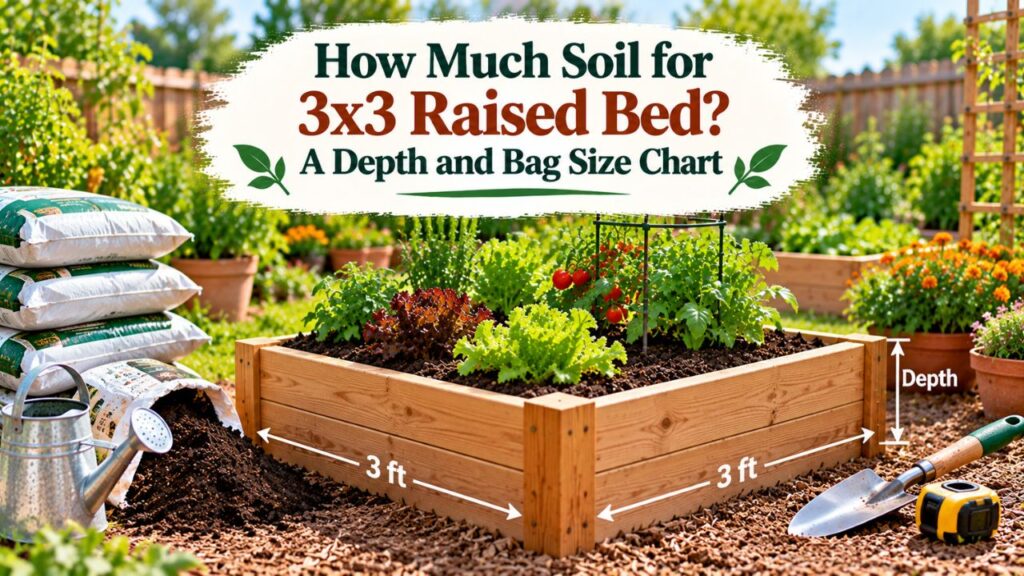
The amount of soil required for a 3×3 raised bed depends on how many inches deep you plan to fill it.
Since the bed measures 3 feet long and 3 feet wide, its total growing area is:
3 × 3 = 9 square feet
Multiplying this area by the soil depth in feet gives the required volume.
3×3 Raised Bed Soil Volume Chart
| Soil Depth | Cubic Feet | Cubic Yards | Liters |
| 6 inches | 4.5 | 0.17 | 127 |
| 8 inches | 6 | 0.22 | 170 |
| 10 inches | 7.5 | 0.28 | 212 |
| 12 inches | 9 | 0.33 | 255 |
| 16 inches | 12 | 0.44 | 340 |
| 18 inches | 13.5 | 0.50 | 382 |
| 24 inches | 18 | 0.67 | 510 |
These measurements assume the interior dimensions are exactly 36 inches by 36 inches and the entire specified depth is filled.
If you leave an inch of space below the top edge, you’ll need slightly less soil.
How Much Soil for a 3×3 Raised Bed 6 Inches Deep?
A 3×3 raised bed filled to a depth of 6 inches needs 4.5 cubic feet of soil, equivalent to approximately 127 liters.
This depth can be suitable for certain shallow-rooted vegetables, particularly when the bed sits directly over healthy garden soil.
An open-bottom raised bed allows roots to extend into the ground beneath it. However, if a solid surface blocks root growth, 6 inches may not provide enough growing space for many crops.
How Much Soil for a 3×3 Raised Bed 8 Inches Deep?
An 8-inch-deep 3×3 raised bed requires 6 cubic feet of soil, approximately 170 liters.
This is enough to fill the bed using three 2-cubic-foot bags.
An 8-inch soil depth can work for lettuce, certain herbs, and other vegetables, especially when roots can grow into the native soil below.
If you’re growing larger plants, a deeper bed may provide more flexibility.
How Much Soil for a 3×3 Raised Bed 12 Inches Deep?
A 12-inch-deep raised bed needs 9 cubic feet of soil, approximately 255 liters.
This is one-third of a cubic yard.
A 12-inch depth is a practical option for many vegetable gardens because it provides a reasonable amount of growing medium without requiring excessive soil.
For a 3×3 bed at this depth, you can purchase:
- Nine 1-cubic-foot bags
- Six 1.5-cubic-foot bags
- Five 2-cubic-foot bags
The last option provides 10 cubic feet, leaving approximately 1 cubic foot unused.
How Much Soil for a 3×3 Raised Bed 18 Inches Deep?
An 18-inch-deep 3×3 bed requires 13.5 cubic feet of soil, equivalent to approximately 382 liters or half a cubic yard.
The extra depth provides more rooting volume, which can be helpful when growing vegetables above compacted ground or in a contained planter.
However, it also increases the amount of growing medium needed.
For this depth, you’ll need seven 2-cubic-foot bags, with half a cubic foot left over.
How Much Soil for a 3×3 Raised Bed 24 Inches Deep?
A 24-inch-deep bed requires 18 cubic feet of soil, approximately 510 liters or two-thirds of a cubic yard.
This is twice the volume of a 12-inch-deep bed.
The additional height may make gardening easier for someone who prefers less bending, but it also increases material costs and the total weight of the filled bed.
If the bed has a raised bottom or stands on legs, check the manufacturer’s load capacity before adding soil.
How to Calculate Soil Volume for a 3×3 Raised Bed
You can calculate the soil requirement yourself using three measurements: length, width, and fill depth.
The formula is:
Soil Volume (cubic feet) = Length (feet) × Width (feet) × Soil Depth (feet)
Because the bed is 3 feet long and 3 feet wide, the calculation becomes:
Soil Volume = 9 × Soil Depth (feet)
Step 1: Measure the Actual Bed Dimensions
Measure the interior length and width of your raised bed.
Some 3×3 raised bed kits advertise outside dimensions, which means the usable interior space may be smaller.
For accurate results, measure from one inside wall to the opposite inside wall.
Step 2: Convert Soil Depth From Inches to Feet
Most raised garden beds list their heights in inches.
To convert inches to feet, divide by 12.
For example:
- 6 inches = 0.5 feet
- 8 inches = 0.667 feet
- 10 inches = 0.833 feet
- 12 inches = 1 foot
- 18 inches = 1.5 feet
Use the actual planned soil depth rather than automatically using the frame’s total height.
Step 3: Multiply the Dimensions
Suppose your bed measures 3 feet by 3 feet and you want to add 10 inches of soil.
First, convert 10 inches into feet:
10 ÷ 12 = 0.833 feet
Then calculate the soil volume:
3 × 3 × (10 ÷ 12) = 7.5 cubic feet
Therefore, a 3×3 raised bed filled to a depth of 10 inches requires 7.5 cubic feet of soil.
Step 4: Convert Cubic Feet Into Cubic Yards or Liters
Bulk garden soil is often sold by the cubic yard, while packaged soil is typically labeled in cubic feet.
To convert:
- Cubic yards: Divide cubic feet by 27.
- Liters: Multiply cubic feet by approximately 28.317.
For a 9-cubic-foot bed:
9 ÷ 27 = 0.333 cubic yards
9 × 28.317 = 254.85 liters
This makes it easier to compare bagged soil with bulk delivery options.
How Many Bags of Soil Do You Need for a 3×3 Raised Bed?
The number of soil bags depends on their individual volume.
Common bag sizes in the United States include 1, 1.5, and 2 cubic feet.
3×3 Raised Bed Soil Bag Calculator Chart
| Soil Depth | 1 Cu. Ft. Bags | 1.5 Cu. Ft. Bags | 2 Cu. Ft. Bags |
| 6 inches | 5 | 3 | 3 |
| 8 inches | 6 | 4 | 3 |
| 10 inches | 8 | 5 | 4 |
| 12 inches | 9 | 6 | 5 |
| 16 inches | 12 | 8 | 6 |
| 18 inches | 14 | 9 | 7 |
| 24 inches | 18 | 12 | 9 |
The table rounds up to whole bags because soil is generally purchased in complete bags.
How to Calculate the Number of Soil Bags
Divide the required total soil volume by the volume of one bag.
Number of Bags = Total Soil Volume ÷ Bag Volume
For example, a 12-inch-deep 3×3 bed requires 9 cubic feet.
If each bag contains 1.5 cubic feet:
9 ÷ 1.5 = 6 bags
If each bag contains 2 cubic feet:
9 ÷ 2 = 4.5 bags
Since you cannot normally purchase half a sealed bag, round up to five bags.
Are Soil Bags Sold by Weight or Volume?
Some garden soil products display both weight and volume, while others prominently display only one measurement.
For soil volume calculations, use cubic feet or another stated volume measurement.
A 40-pound bag of soil does not always contain the same volume as another 40-pound bag because density and moisture content vary.
If a product lists only weight, check the manufacturer’s volume information before deciding how many bags to purchase.
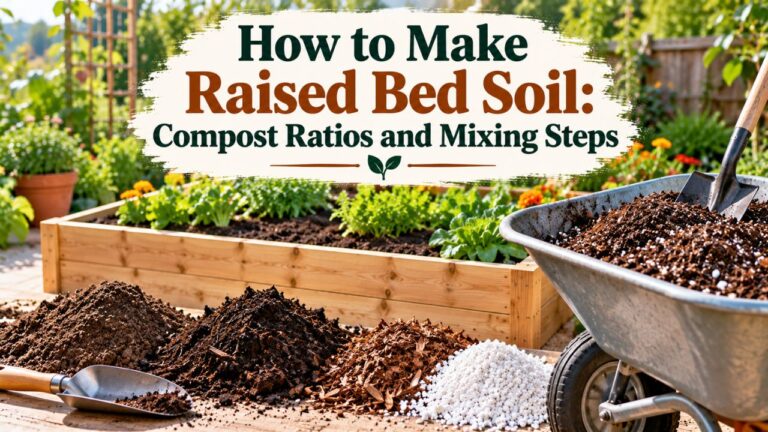
What Is the Best Soil Mix for a 3×3 Raised Bed?
A good raised bed mixture should support plant roots while providing balanced drainage, moisture retention, and nutrients.
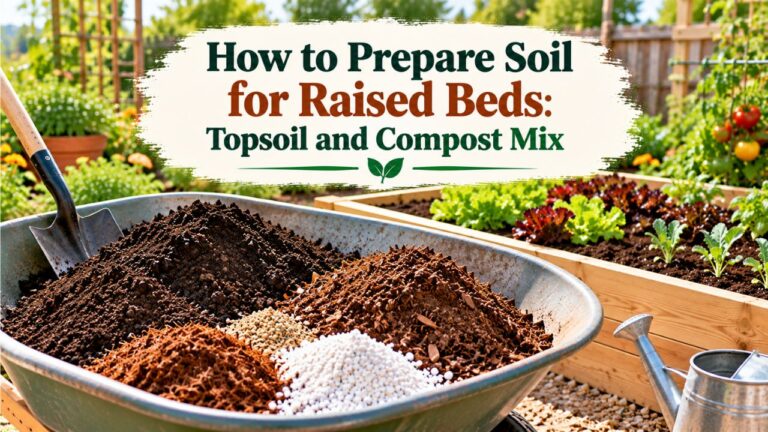
For an open-bottom raised bed on natural ground, a mixture of mineral topsoil and finished compost is often a practical choice.
According to Penn State Extension’s guidance on soil health in raised beds, a recommended starting mixture contains 70% soil and 30% compost.
This ratio provides a mineral soil foundation with added organic matter.
Soil Mix for a 12-Inch-Deep 3×3 Raised Bed
A 12-inch-deep bed requires 9 cubic feet of soil mixture.
Using 70% topsoil and 30% compost:
| Material | Percentage | Volume |
| Topsoil | 70% | 6.3 cubic feet |
| Finished compost | 30% | 2.7 cubic feet |
| Total | 100% | 9 cubic feet |
These amounts are approximate starting quantities.
You may need to adjust the mixture if your existing soil already contains substantial organic matter or has drainage problems.
Soil Mix for an 8-Inch-Deep 3×3 Raised Bed
An 8-inch-deep bed holds 6 cubic feet.
For the same 70/30 mixture, you’ll need:
- 4.2 cubic feet of topsoil
- 1.8 cubic feet of finished compost
You can also use a suitable commercial raised bed soil mix rather than purchasing separate ingredients.
Check the product’s composition and intended use before buying.
Can You Use Regular Garden Soil?
Yes, regular garden soil can be used in a 3×3 raised bed if it is clean, fertile, and well-drained.
However, garden soil that contains excessive clay or is heavily compacted may need improvement.
Mixing in mature compost can improve the soil’s structure and make it easier for roots to develop.
Avoid using contaminated soil, construction fill, or garden soil of uncertain origin for edible crops.
How Deep Should a 3×3 Raised Bed Be for Vegetables?
The best soil depth depends on the vegetables you’re growing and whether the bed has an open or closed bottom.
A bed placed directly over natural ground can allow roots to grow deeper than the height of the frame.
A bed placed over concrete has a fixed rooting depth and needs adequate drainage.
The University of Maryland Extension’s raised bed vegetable gardening guide recommends at least 8 inches of soil for leafy greens, beans, and cucumbers in beds placed on hard surfaces. It recommends 12–24 inches for peppers, tomatoes, and squash.
Choosing Soil Depth for Common Vegetables
| Vegetable | Practical Depth Consideration |
| Lettuce | Can grow in relatively shallow soil |
| Spinach | Usually suitable for modest soil depths |
| Radishes | Need loose soil for root development |
| Carrots | Need depth matching the mature root length |
| Peppers | Benefit from deeper growing medium |
| Tomatoes | Need substantial rooting space and support |
| Cucumbers | Need enough root volume and room for vines |
These are general considerations rather than fixed minimum depths for every variety.
For example, compact tomato varieties may fit into a 3×3 bed more easily than large indeterminate tomatoes.
Similarly, short carrot varieties can work in less soil depth than long-rooted types.
Is a 12-Inch-Deep 3×3 Raised Bed Enough?
A 12-inch soil depth is a reasonable starting choice for many common vegetables.
It provides more rooting volume than a 6- or 8-inch bed while keeping the soil requirement manageable.
If the bed is open at the bottom and rests on suitable native soil, roots may continue growing below the raised layer.
For larger crops in a bed with a solid bottom, a greater depth may be useful.
Should You Fill a 3×3 Raised Bed Completely to the Top?
You do not necessarily need to fill the bed exactly to its upper edge.
Leaving about 1 inch below the rim can provide space for watering and mulch.
For a 3×3 bed, each inch of soil depth represents 0.75 cubic feet.
Therefore, a 12-inch-tall bed filled to only 11 inches needs:
3 × 3 × (11 ÷ 12) = 8.25 cubic feet
Instead of purchasing exactly 9 cubic feet to reach the rim, your actual required volume is approximately 8.25 cubic feet.
This distinction can be useful when calculating how much soil to purchase.
However, leaving space below the rim reduces the effective soil depth. Make sure the remaining depth is still suitable for your crops.
How Much Extra Soil Should You Buy for Settling?
Freshly filled soil can settle after watering.
The amount depends on soil texture, compost content, and how loosely the materials were packed.
Rather than assuming a fixed settling percentage, calculate the required fill volume and consider keeping a small amount of extra soil available.
For a small 3×3 raised bed, a partially unused bag may be enough for later adjustments.
Avoid compacting the soil deliberately to prevent settling. Excessive pressure can reduce the air spaces needed for healthy roots.
How to Fill a 3×3 Raised Bed Without Wasting Soil
A little preparation helps you use the purchased soil effectively.
- Choose the bed location. Select a reasonably level area with enough sunlight for your intended plants.
- Measure the interior. Confirm the usable length, width, and intended soil depth.
- Prepare the ground. Remove persistent weeds and loosen compacted native soil if the bed is open at the bottom.
- Calculate the volume. Multiply the interior length, width, and fill depth using feet.
- Prepare the growing mixture. Use suitable topsoil and mature compost or a ready-made raised bed mix.
- Fill the bed evenly. Add the soil gradually and spread it without excessive compression.
- Water gently. Allow the soil to settle and check that excess water drains properly.
- Adjust the final level. Add more growing medium if necessary, leaving enough space for mulch and watering.
For a 3×3 bed, purchasing a suitable mix and filling the bed directly is usually simpler than trying to save soil with thick layers of logs, branches, or other bulky materials.
These materials may decompose and settle over time, reducing the available rooting depth.
Common Soil Calculation Mistakes for a 3×3 Raised Bed
Small differences in measurement can change how much soil you need.
Confusing Square Feet With Cubic Feet
A 3×3 garden bed covers 9 square feet, but that measurement represents surface area rather than volume.
Soil quantity must account for depth.
For example, a 3×3 bed with a 6-inch fill holds 4.5 cubic feet, while the same bed at 12 inches holds 9 cubic feet.
Using the Outside Dimensions
Some raised bed kits measure 3 feet across the outside edges.
The interior width and length may be smaller.
Measuring the usable interior helps prevent overestimating the soil requirement.
Ignoring Soil Already in the Bed
If you’re topping up an existing bed, calculate only the empty portion.
A 12-inch-tall 3×3 bed that already contains 6 inches of usable soil needs another 4.5 cubic feet to reach the rim.
There’s no need to purchase enough soil for the full 12 inches again.
Buying the Wrong Bag Size
A bag labeled 1 cubic foot contains only half as much volume as a 2-cubic-foot bag.
Compare products based on volume rather than assuming all bags contain the same amount.
Also account for separate bags of compost if you plan to prepare your own mixture.
Conclusion
Calculating how much soil for 3×3 raised bed is straightforward once you know the depth you want to fill.
A 6-inch-deep bed requires 4.5 cubic feet, an 8-inch-deep bed needs 6 cubic feet, and a 12-inch-deep bed requires 9 cubic feet.
For a 12-inch fill, five 2-cubic-foot bags provide enough soil with a small amount left over.
If you’re building a new vegetable bed over suitable natural ground, a balanced mixture of topsoil and finished compost is a practical starting point.
Measure the inside dimensions, choose a soil depth appropriate for your crops, and calculate the actual fill volume before purchasing. This will help you avoid unnecessary soil costs while providing enough growing medium for your plants.
FAQs About How Much Soil for 3×3 Raised Bed
How Many Cubic Feet of Soil Does a 3×3 Raised Bed Hold?
A 3×3 raised bed holds 9 cubic feet of soil at 12 inches deep. At 8 inches deep, it holds 6 cubic feet, and at 6 inches deep, it holds 4.5 cubic feet.
How Many 2-Cubic-Foot Bags Do I Need for a 3×3 Raised Bed?
You need five 2-cubic-foot bags for a 12-inch-deep bed, three bags for an 8-inch-deep bed, or seven bags for an 18-inch-deep bed. These quantities are rounded up to whole bags.
How Much Soil Do I Need for a 3×3 Raised Bed in Liters?
A 3×3 raised bed requires approximately 127 liters at 6 inches deep, 170 liters at 8 inches deep, and 255 liters at 12 inches deep.
How Many Cubic Yards of Soil Fill a 3×3 Garden Bed?
At 12 inches deep, a 3×3 garden bed needs approximately 0.33 cubic yards. At 18 inches deep, it requires 0.50 cubic yards, and at 24 inches deep, it needs approximately 0.67 cubic yards.
Can I Use Only Compost to Fill a 3×3 Raised Bed?
Using only compost is generally not ideal for a permanent open-bottom raised bed. A mixture containing suitable mineral soil and mature compost provides a more stable growing medium. A soil-and-compost ratio of approximately 70/30 is one practical starting option.
Do I Need to Replace the Soil in My 3×3 Raised Bed Every Year?
No. You generally don’t need to replace the entire soil mixture each year. Check its condition, replenish settled material when necessary, and use soil test results to guide compost and fertilizer additions.

I’m Maya L. Greenwood, a lifelong plant lover who believes anyone can grow something beautiful with the right guidance. After years of testing soil mixes, pruning methods, irrigation tricks, and pest-safe solutions, I started EasyGardenTips.com to turn hard-won lessons into step-by-step advice. From seed starting and container gardens to composting and seasonal checklists, my goal is to make gardening simple, sustainable, and fun.