Most Popular Seed Starting Kit with Light and Heat Mat: Guide
As an Amazon Associate, I earn from qualifying purchases. Learn more
Choosing a seed starting kit with light and heat mat can be harder than it looks. Cell count, dome height, light adjustability, heat control, drainage, and cleanup all affect whether a beginner gets sturdy seedlings or a crowded, overly damp tray.
My first choice is Kokopro 36-Cell Seed Starter Tray Kit. Its extra-large cells give roots more room, while the warming mat, adjustable lighting system, humidity dome, and included controller create a balanced setup for seeds, cuttings, and indoor propagation.
My second choice is SOLIGT 60-Cell Seed Starter Tray Kit. The alternative is the SOLIGT 60-Cell Seed Starter Tray Kit with Grow Light and Heat Mat. It ranks second because it offers more planting spaces, a taller 4.3-inch dome, and flexible three-head lighting, making it attractive for gardeners who want higher capacity without giving up adjustable light placement.
This comparison explains what each kit does best, where its limitations may matter, and which type of gardener it suits. The buying guidance also covers capacity, temperature, light placement, humidity, setup, cleaning, safety, and common mistakes.
5 Best Seed Starting Kit with Light and Heat Mat
I selected these products by comparing their relevance to indoor seed starting, the usefulness of their supplied specifications, available customer-feedback evidence, and the practical differences between cell counts, lighting systems, domes, and heat mats. Brand variety was also considered when a different design offered a meaningful alternative.
| # | Image | Product | Price on Amazon |
|---|---|---|---|
| 1 |  |
Kokopro 36-Cell Seed Starter Tray Kit | Check Price |
| 2 |  |
SOLIGT 60-Cell Seed Starter Tray Kit | Check Price |
| 3 |  |
Amazon.com 72-Cell Seed Starter Tray Kit | Check Price |
| 4 |  |
BlumWay 40-Cell Seed Starter Tray | Check Price |
| 5 |  |
MetryGrow 80-Cell Seed Starter Kit | Check Price |
Kokopro 36-Cell Seed Starter Tray Kit
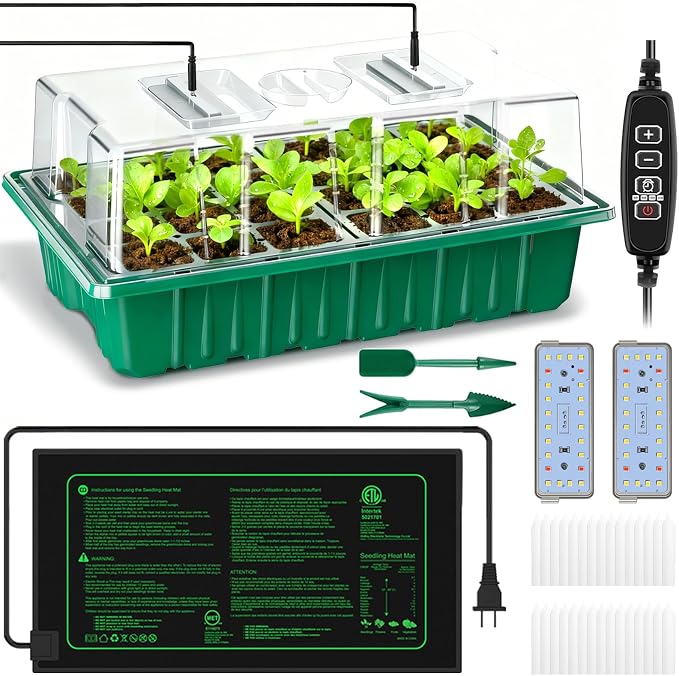
The Kokopro kit earns the top position by combining a manageable 36-cell layout with larger 1.96-inch square cells. That size is more forgiving for beginners than very small cells because seedlings have additional room for early root development and may not need immediate potting up. It is also a practical format for starting a mixed batch of vegetables, flowers, herbs, or cuttings.
Heat is one of this kit’s strongest selling points. The waterproof heating mat is designed to provide steady warmth in the approximate 70°F to 85°F range, which suits many germination and propagation tasks. Its flexible, wipe-clean construction is helpful when water or potting mix spills, while the insulation and IP67 rating offer useful protection in a damp growing environment.
The package includes a grow light, intelligent controller, plant labels, tools, tray, and humidity dome. Four timing settings make it easier to establish a repeatable light schedule instead of relying on memory. The heightened lid also gives developing seedlings more headroom, although the supplied information does not specify the exact dome height or light output, so buyers with demanding light requirements should confirm those details before purchase.
Pros
- Large 36-cell format gives seedlings more individual growing space.
- Heating mat targets a useful 70°F to 85°F germination range.
- Waterproof, flexible mat is easier to wipe clean and reuse.
- Includes lighting, controller, dome, labels, and basic tools.
Cons
- Lower capacity than 60-cell, 72-cell, and 80-cell alternatives.
- Exact grow-light wattage and dome height are not specified.
My Opinion
This is the strongest all-around choice for a beginner who values roomier cells and a complete, organized setup over maximum capacity. It also makes sense for propagation, but gardeners growing many seedlings at once may prefer SOLIGT or MetryGrow.
SOLIGT 60-Cell Seed Starter Tray Kit
SOLIGT is a strong second choice for gardeners who want more planting spaces than the Kokopro provides. Its 60-cell tray uses 1.5-inch square cells that are 2.3 inches deep, so the design favors efficient use of space while still giving roots a reasonably deep growing area. The included bottom tray helps contain water and simplifies moving the setup.
The 4.3-inch humidity dome is a notable advantage. Taller seedlings have more room before they reach the cover, and adjustable vents give the grower a way to gradually reduce trapped humidity as plants develop. That flexibility can be especially useful when starting a mixture of quick-growing herbs and slower vegetable seedlings.
Its 11.5W, 4500K light uses 15 red and 111 white LEDs and offers five brightness levels. The flexible three-head gooseneck can be positioned over the tray, clipped in place, or used on its stand after the dome is removed. Four timer options—4, 8, 12, or 18 hours—make the schedule adaptable, while the waterproof heat mat adds consistent bottom warmth. The trade-off is that the smaller cells leave less room for plants that will remain indoors for a long time.
Pros
- 60 cells provide useful capacity for larger seed batches.
- Tall dome and adjustable vents support staged humidity control.
- Flexible three-head light offers several placement options.
- Five brightness levels and four timer choices aid customization.
Cons
- Smaller cells may require earlier transplanting for vigorous plants.
- More planting capacity can make watering and labeling less simple.
My Opinion
SOLIGT is the better fit for a gardener starting many varieties in a compact footprint. Choose it over Kokopro when capacity and dome height matter more than extra-large cells, especially if the flexible light will be useful beyond the covered tray.
Amazon.com 72-Cell Seed Starter Tray Kit
This 72-cell kit is aimed at gardeners who want to start a substantial number of seedlings in a small mini-greenhouse-style arrangement. The supplied title identifies six sets of six trays with 72 small cells, along with grow lights, a heat mat, humidity domes, and four timing settings. That makes it appealing for spring vegetable planning, flower batches, classroom projects, or anyone who prefers to start many varieties at once.
The main benefit is capacity. More cells allow gardeners to separate cultivars, stagger planting dates, or keep backup seedlings available. The included domes help retain humidity during germination, while the heat mat supports warmth from below and the lighting system addresses the weak indoor light that often causes thin, leaning growth.
There is an important trade-off: the cells are described as small, and the supplied data does not provide the exact cell dimensions, light wattage, temperature range, dome height, or construction details. Small cells can dry out faster and may give roots less room before transplanting. Buyers should therefore plan to monitor moisture closely and be ready to move established seedlings into larger containers rather than leaving them in the starter trays too long.
Pros
- 72-cell capacity suits larger seed-starting projects.
- Multiple trays can help organize different varieties and schedules.
- Includes grow lights, heat mat, domes, and timing controls.
- Useful for gardeners who need many seedlings in one purchase.
Cons
- Small cells may dry quickly and limit root space.
- Key specifications such as light output and heat range are not supplied.
- Higher capacity can increase watering and labeling work.
My Opinion
This option makes sense when the number of seedlings is the deciding factor. It is less appealing for someone who wants roomy cells or detailed temperature and lighting specifications, but it can be a practical production-oriented choice for organized growers.
BlumWay 40-Cell Seed Starter Tray
BlumWay takes a middle-ground approach with 40 cells, a 1.96-inch-deep tray, and a 9-centimeter humidity dome. That combination gives seedlings more vertical room than a low cover and offers a little more root space than many compact starter trays. The clear tray and dome also make it easier to observe soil moisture and plant progress without repeatedly opening the enclosure.
Its heat mat is designed to deliver approximately 104°F warmth directly to the soil. That can help warmth-loving seeds germinate, but the relatively high stated temperature deserves attention: not every seed or seedling benefits from the same amount of heat. Buyers should match the setup to the needs of their selected plants and avoid assuming that maximum warmth is always better.
The lighting system provides 360-degree coverage with 40 lamp beads, three lighting modes, five brightness settings, and 3-, 6-, and 12-hour timer choices. A remote indicator shows the selected timer mode. Adjustable vents support humidity changes as seedlings mature, and the thick ABS plastic is described as reusable, lightweight, and resistant to breakage. The limitation is that the timer range is less flexible than SOLIGT’s, and the product has a lower supplied customer rating than the first two options.
Pros
- 40-cell capacity balances organization and planting space.
- 9-centimeter dome gives seedlings useful vertical clearance.
- Multiple light modes, brightness settings, and timer choices.
- Clear reusable tray and adjustable vents simplify monitoring.
Cons
- Stated 104°F mat temperature may be too warm for some plants.
- Timer choices are limited to 3, 6, and 12 hours.
- Lower customer rating than the two highest-ranked choices.
My Opinion
BlumWay is worth considering for gardeners who want a sturdy, moderately sized kit with strong light adjustment. Its heat specification makes plant-specific temperature planning especially important, so it is better for buyers willing to monitor conditions rather than simply turn everything on and walk away.
MetryGrow 80-Cell Seed Starter Kit
MetryGrow is the highest-capacity system in this group, using two 40-cell trays for a total of 80 cells. Water-reservoir bases and a clear adjustable dome make it suitable for a broad mix of indoor projects, including herbs, vegetables, microgreens, cloning, and propagation. The larger count is useful for gardeners who plan a substantial planting calendar or want separate trays for different crops.
The 48W full-spectrum LED light is the most substantial lighting system listed here. App and remote control, eight dimming levels, and dual spectrum modes provide more ways to adjust coverage and intensity. Its independent 16-inch stand can continue supporting seedlings after the dome is removed, which helps maintain a consistent light position as plants grow taller.
A 30W heating mat offers six temperature levels and an automatic timer, giving this kit more heat adjustment than products with a fixed or less clearly specified setting. Reinforced 1.2mm trays and a leakproof ridge are intended to reduce bending and water reaching the mat or table. MetryGrow also lists a one-year warranty and replacement support for damaged parts or accessories. The drawbacks are its larger footprint, higher system complexity, and lower relevance for someone starting only a few plants.
Pros
- 80 cells provide the highest capacity in this comparison.
- 48W light has eight dimming levels and dual spectrum modes.
- 16-inch stand remains useful after removing the dome.
- Six heat levels, timer, reinforced trays, and one-year warranty.
Cons
- Larger capacity may occupy more space than casual growers need.
- More controls can feel less approachable for first-time gardeners.
- Its supplied rating is below SOLIGT’s and Kokopro’s.
My Opinion
MetryGrow is the best capacity-focused choice and the most adjustable system on paper. It suits serious indoor seed starting, but a small-space beginner may get a simpler experience from Kokopro or SOLIGT.
How I Selected These Seed Starting Kits with Light and Heat Mat
The ranking emphasizes how completely each kit addresses the three conditions that matter during indoor germination: suitable moisture, dependable warmth, and adequate light after emergence. I also considered cell size, dome clearance, light adjustment, heat controls, cleaning practicality, and whether the package appears useful beyond a single round of seeds.
Customer feedback was used only where supplied. Kokopro lists a 4.4 rating from 252 customers, while SOLIGT lists a 4.5 rating without a customer-feedback volume in the provided information. BlumWay, MetryGrow, and the 72-cell kit include supplied ratings but no customer totals, so their positions rely more heavily on the stated design and available specifications.
Selection takeaway: A larger cell count is not automatically better; usable capacity depends on root space, watering effort, and how quickly seedlings will be transplanted.
Rankings also reflect different buyer priorities. Kokopro leads because it offers a balanced, beginner-friendly package with larger cells and a stated moderate heat range. SOLIGT follows closely because its 60 cells, tall dome, and flexible light placement are especially useful for higher-volume indoor growing.
How to Choose a Seed Starting Kit with Light and Heat Mat
The right kit should match the plants, available space, and amount of attention you can give seedlings each day. Before buying, focus less on the number of accessories and more on whether the cells, heat settings, dome, and light can work together without creating excessive moisture or crowding.
Buyer takeaways
- Choose larger cells for plants that will remain in the tray longer; choose smaller cells for high-volume, quick-transplant projects.
- Look for adjustable light height or brightness so the setup can follow seedlings as they grow.
- Use a dome with vents when possible, since humidity needs to decrease after germination.
- Confirm that the heat level suits the crop instead of assuming warmer is always better.
- Measure the shelf, counter, or table before selecting a high-capacity kit.
Cell count and root space
Cell count affects more than how many seeds can be planted. A 36-cell tray with larger compartments may be easier to manage than an 80-cell system when each plant needs more room, while a 72- or 80-cell tray can make sense when many seedlings will be transplanted soon after emergence.
Small cells also require more careful moisture management because their limited soil volume can dry faster. If you often forget to check trays, a moderate-capacity kit with larger cells may be more forgiving than a densely packed high-count design.
Light adjustment and coverage
Seedlings generally need light positioned close enough to prevent weak, stretched growth, but the ideal distance changes as plants develop. Adjustable brightness, flexible arms, or a stand that rises after dome removal are valuable because they extend the useful life of the kit.
Timer controls reduce guesswork and provide a repeatable day-and-night cycle. More timer choices are convenient, but a simple schedule that you use consistently is more useful than advanced controls that remain unexplored.
Heat and temperature suitability
A heat mat warms the growing medium from below, which can encourage faster germination for plants that prefer warm soil. It should not be treated as a universal setting for every seed, particularly when a product lists a high fixed temperature such as BlumWay’s approximately 104°F.
For mixed trays, group plants with similar temperature preferences or use separate settings when the kit allows it. Once most seeds have sprouted, seedlings may need less bottom heat, so a controller or timer can help prevent unnecessary warmth.
Humidity dome design
A clear dome helps slow moisture loss during germination, but a sealed, humid environment is not ideal forever. Adjustable vents are helpful because they let you increase airflow gradually instead of removing the lid all at once.
Dome height matters for fast-growing seedlings. A taller cover such as SOLIGT’s 4.3-inch dome offers more clearance, while a kit with an unspecified height should be checked carefully if you plan to grow tomatoes, peppers, or other seedlings that rise quickly.
Setting Up the Kit for the First Time
Place the tray on a level, water-resistant surface near a dependable electrical outlet. Keep enough room around the kit to adjust the light, inspect the dome, and remove trays without knocking over nearby containers.
- Clean the tray, dome, and tools before filling the cells.
- Add a suitable seed-starting medium without packing it excessively.
- Moisten the medium evenly before sowing, following the needs of the selected seed.
- Label each cell or row immediately so varieties do not become confused.
- Connect the heat mat and light according to the supplied instructions.
- Position the light evenly above the tray and use the dome only while humidity is useful.
Do not bury seeds deeper than their instructions recommend. Some seeds need light or only a thin covering, while others require more depth, so one universal planting method can reduce germination.
Using Light, Heat, and Humidity Together
These components solve different problems. The heat mat warms the root zone, the dome slows evaporation, and the light supports growth after germination; none of them substitutes for the others.
During the first stage, check the medium daily for excessive dryness or standing water. After seedlings appear, begin increasing airflow and keep the light close enough for compact growth without allowing leaves or the dome to touch it.
A useful routine is to inspect the tray at the same time each day. Look for condensation, leaning stems, dry corners, algae-like surface growth, or roots emerging from drainage holes. Small adjustments made early are easier than correcting stressed seedlings later.
Watering and Drainage Tips
Seed-starting cells should remain evenly moist rather than saturated. Overwatering can reduce air around roots, while letting small cells dry completely can damage young roots quickly.
Bottom watering can help distribute moisture through the cell, but excess water should not remain in the reservoir indefinitely. Empty or reduce standing water when the medium is adequately moist, and keep electrical connections away from spills.
Transparent trays and domes make observation easier, but they do not replace checking the growing medium. The surface can look damp while the lower portion remains saturated, so use the tray’s drainage design and the plant’s condition as guides.
Cleaning, Storage, and Long-Term Ownership
After each growing cycle, remove old roots and potting mix before washing the trays and dome. A soft cloth or sponge is preferable to anything that could scratch clear plastic and make future inspection harder.
Heat mats should be unplugged before cleaning and wiped according to the manufacturer’s instructions. Kokopro specifically describes its mat as wipe-clean and waterproof, but moisture should still be kept away from plugs, controllers, and power connections.
Let every component dry completely before storage. Store domes where they will not be crushed, coil cables loosely, and keep small labels or tools together so the next setup does not require replacing accessories.
Compatibility and Space Planning
Most of these kits are designed for indoor seed starting, but the available data also mentions uses such as cuttings, hydroponic projects, microgreens, terrariums, and mushroom growing for certain models. Those uses can require different humidity, heat, and sanitation practices, so do not assume one setting suits every project.
Measure the complete footprint, including the light stand and any controller or power adapters. MetryGrow’s independent 16-inch stand and 80-cell layout offer strong growing capacity but may need more vertical and horizontal room than a compact 36-cell kit.
If the kit will be used in a greenhouse, patio area, or balcony, protect electrical components from weather unless the product specifically provides outdoor electrical guidance. A waterproof mat does not mean every connected component is weatherproof.
Common Mistakes to Avoid
Most beginner problems come from treating the kit as an automatic greenhouse. The controls help create stable conditions, but seedlings still need regular observation and adjustments as they move from germination to active growth.
- Leaving the dome sealed after seedlings emerge and humidity is no longer needed.
- Using the highest heat setting for every crop.
- Placing the light too far away, causing thin and leaning stems.
- Keeping the medium constantly saturated instead of evenly moist.
- Starting more cells than can be transplanted or maintained on schedule.
- Failing to label varieties at sowing time.
- Operating the kit near splashing water or overloaded electrical outlets.
Important caution: Warm, enclosed trays can change quickly. Check moisture, temperature, light position, and airflow regularly rather than relying only on a timer.
Troubleshooting Early Seedling Problems
Seeds are not germinating
Check whether the medium is too dry, too wet, or outside the seed’s preferred temperature range. Confirm that the heat mat is connected and that the tray is making good contact with it, but avoid increasing heat without knowing the crop’s needs.
Seedlings are tall and weak
Leggy growth often indicates insufficient or poorly positioned light. Move the light closer if the product instructions permit, increase brightness gradually, and rotate the tray when coverage is uneven.
The dome is covered in heavy condensation
Some condensation is normal during germination, but excessive moisture can signal poor airflow or overwatering. Open the vents, shorten the time the dome remains sealed, and allow the surface to dry slightly between waterings when appropriate.
Plants outgrow the tray
Transplant seedlings before roots become tightly crowded or stems press against the dome. Water the medium first, lift plants carefully by the leaves rather than fragile stems, and move them into containers suited to their next growth stage.
FAQS About Seed Starting Kit with Light and Heat Mat
What does a seed starting kit with light and heat mat include?
These kits commonly combine starter trays, a humidity dome, a heat mat, and an indoor grow light. Some also include controllers, timers, labels, tools, water reservoirs, or adjustable stands. The exact package varies, so check whether the light wattage, dome height, and temperature controls meet your needs.
Is a heat mat necessary for starting seeds indoors?
Not for every seed, but bottom warmth can help many warmth-loving seeds germinate more consistently. It is most useful when the growing area is cool. Always consider the crop’s preferred temperature and avoid using a high setting indiscriminately.
How long should the grow light run?
The correct schedule depends on the crop and the light system. Timer options in these kits range from short schedules to as much as 18 hours on SOLIGT. Begin with the product instructions and adjust based on seedling color, height, and leaf development.
When should the humidity dome be removed?
Begin venting the dome as seedlings emerge and gradually increase airflow as they strengthen. Removing it entirely may be appropriate once the seedlings no longer need elevated humidity or begin touching the cover.
Can these kits be used for cuttings?
Several products are described as suitable for clone propagation or cuttings. A warm mat and humid dome can support rooting conditions, but cuttings still need clean tools, suitable moisture, and a light level that does not overheat or dry them.
Which kit is best for a small number of plants?
Kokopro’s 36-cell format is the most manageable of the ranked options for a modest batch, especially when larger cells are preferred. A higher-capacity tray can work, but unused cells still take up space and may add watering and labeling work.
Final Thoughts
The seed starting kit with light and heat mat that best balances beginner-friendly capacity, larger cells, heat, and included accessories is the Kokopro 36-Cell Seed Starter Tray Kit with Grow Light and Heat Mat. For more planting spaces, a taller dome, and flexible light positioning, choose the SOLIGT 60-Cell Seed Starter Tray Kit with Grow Light and Heat Mat.

I’m Maya L. Greenwood, a lifelong plant lover who believes anyone can grow something beautiful with the right guidance. After years of testing soil mixes, pruning methods, irrigation tricks, and pest-safe solutions, I started EasyGardenTips.com to turn hard-won lessons into step-by-step advice. From seed starting and container gardens to composting and seasonal checklists, my goal is to make gardening simple, sustainable, and fun.