Which Is the Best Soil Blocker Kit: Top Picks and Buying Guide
As an Amazon Associate, I earn from qualifying purchases. Learn more
Choosing a soil blocker kit can be surprisingly confusing because similar-looking tools may produce very different block sizes, capacities, and planting workflows. The best choice depends on whether you need tiny germination blocks, larger transplant-ready cubes, faster batch production, or a durable system that can grow with your garden.
My first choice is Amazon.com Authentic Ladbrooke 5-Pc Essentials Soil Blocker Set England Mini. It stands at the top of this 5-product list because it offers the strongest overall fit for the buying priorities covered below.
My second choice is KHAMAL 4-Cell 2-Inch Soil Blocker. KHAMAL 4-Cell 2-Inch Soil Blocker is the best alternative for gardeners who want a straightforward, comfortable tool focused on producing four larger blocks at a time. Its spring-assisted handle and three interchangeable seed pins may appeal especially to beginners who expect to make repeated batches of herbs, vegetables, or flowers.
This comparison explains what makes each tool different, where its design is most useful, and which limitations deserve attention before ordering. The buying guidance also covers block sizing, soil moisture, cleaning, storage, common mistakes, and how to match a blocker to your actual seed-starting routine.
5 Best Soil Blocker Kit
I selected these products by comparing their stated block sizes, production capacity, included accessories, construction details, usability features, and available customer-feedback evidence. The list also includes different styles, from a nesting system to compact single-size tools, so gardeners can compare practical alternatives rather than one nearly identical design.
| # | Image | Product | Price on Amazon |
|---|---|---|---|
| 1 |  |
Amazon.com Authentic Ladbrooke 5-Pc Essentials Soil Blocker Set England Mini | Check Price |
| 2 |  |
KHAMAL 4-Cell 2-Inch Soil Blocker | Check Price |
| 3 |  |
Jownupp Large and Small Two-Piece Soil Blocker Set | Check Price |
| 4 |  |
Garlump TILLERMAN Heavy-Duty Small and Large Soil Blocker Bundle | Check Price |
| 5 |  |
BlumWay Eight-Cell 2-Inch Soil Block Maker | Check Price |
Amazon.com Authentic Ladbrooke 5-Pc Essentials Soil Blocker Set England Mini
The Authentic Ladbrooke Essentials Set earns the top position because it is designed as a complete progression system. The Mini 4 produces four 2-inch blocks per press, while the Micro 20 creates twenty 3/4-inch starter blocks. Cubic inserts let the smaller blocks nest directly into the larger ones, so seedlings can move up in size without being pulled from one container and replanted into another.
That arrangement is especially useful for gardeners who start many small seeds but eventually need sturdy blocks for transplanting. The included seed pins create standard planting dimples, while the deeper dowel pins accommodate seeds that need more depth. The built-in seed holes also make repeated sowing more consistent than poking each block by hand.
According to the supplied product information, Ladbrooke tools have been manufactured in England since the 1960s and use premium EP-coated steel intended to resist moisture, corrosion, and soil chemicals. The set is also marked with the Ladbrooke logo and “MADE IN UK,” which helps distinguish it from lookalike products. Its main limitation is that the complete system may be more equipment than a gardener needs if all seeds can go directly into 2-inch blocks.
Pros
- Combines 3/4-inch starter blocks and 2-inch transplant blocks.
- Includes cubic inserts, seed pins, and dowel pins.
- Designed for a continuous no-pot seed-starting workflow.
- EP-coated steel is intended for long-term seasonal use.
Cons
- More involved than a single-size blocker.
- The small starter blocks may be unnecessary for direct-sown or larger seeds.
- Expansion to additional sizes requires separate equipment.
My Opinion
This is the strongest choice for organized seed starters who want one coordinated system rather than a basic mold. Buyers should confirm they want both sizes before purchasing, because the set’s greatest advantage is its nesting progression, not simply its ability to make 2-inch blocks.
KHAMAL 4-Cell 2-Inch Soil Blocker
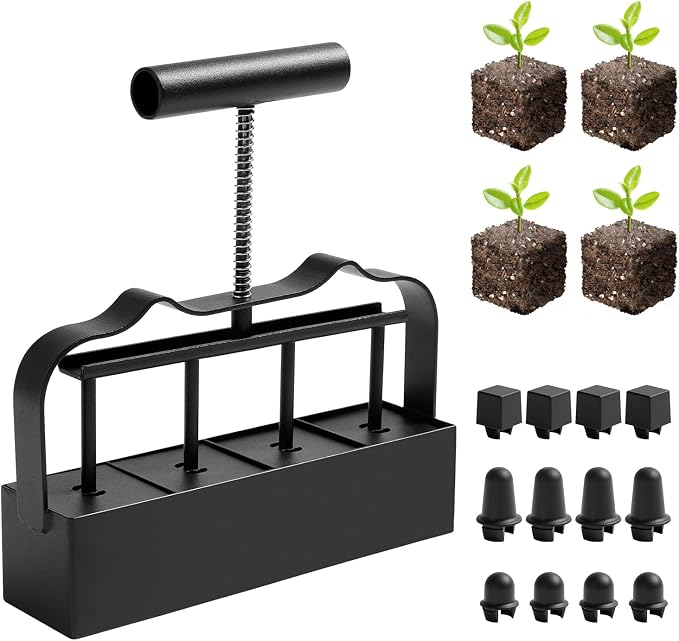
The KHAMAL Soil Blocker focuses on a familiar, manageable format: four 2-inch blocks in one press. That capacity is a good middle ground for home gardeners who want to produce several seedlings at once without handling a large commercial-style mold. Its intended uses include herbs, vegetables, and flowers, making it a practical size for many common garden starts.
The ergonomic spring handle is the most notable usability feature. The supplied information says the updated mechanism reduces pressing force by 50 percent and uses a contoured, non-slip grip. Those details may matter during a long sowing session, particularly for gardeners working with muddy gloves or making several batches in succession. The claim should be understood as a design benefit rather than a guarantee of identical comfort for every hand.
Three interchangeable seed pins provide square, cone, and cylinder-shaped planting holes. That flexibility helps match the opening to different seed types, although beginners should still check the depth recommended on each seed packet. The tool is made from iron steel and stores vertically at an advertised height of 8.7 inches, with detachable pins that can click into side slots. It may be a better fit than the Ladbrooke system for someone who wants one block size and easier storage, but it does not offer the same built-in progression from miniature starter blocks.
Pros
- Produces four 2-inch blocks per press.
- Spring-assisted handle is designed to reduce hand fatigue.
- Three pin shapes provide planting-hole flexibility.
- Vertical storage and side pin slots save workspace.
Cons
- Does not include a smaller nesting starter-block system.
- Iron steel may require attentive drying after cleaning.
- Four-block capacity is slower than an eight-cell or larger batch tool.
My Opinion
KHAMAL is a sensible second choice for gardeners who value handle comfort and straightforward 2-inch production. It suits a modest seed-starting operation, while gardeners planting hundreds of seedlings or starting very small seeds may benefit from a higher-capacity or multi-size alternative.
Jownupp Large and Small Two-Piece Soil Blocker Set

The Jownupp two-piece set stands out for giving gardeners both a 2-inch blocker and a smaller 0.67-inch blocker in one package. The larger tool produces six blocks, while the small tool has 28 compartments. That combination is useful when a garden includes both fine seeds that need an early, compact start and larger seedlings that can move into a roomier block.
Several accessories make this set more approachable for beginners. The package includes a seeding tray, six grow tweezers, square seed pegs, short cylindrical pegs, and long cylindrical pegs. The tweezers could be useful for positioning tiny seeds, while the different peg shapes allow the planting hole to be adjusted for seed size and depth. These extras do not replace good seed-starting technique, but they reduce the need to assemble a separate collection of small tools.
The stated construction is advanced metal designed to resist deformation during long-term use. Its manual ejection process is intended to push the formed blocks out cleanly, which is important because compact blocks can crumble when the mix is too dry or stick when it is too wet. With a 28-cell small mold and a six-cell large mold, this kit is more production-oriented than a basic four-cell tool, but its two sizes also mean more parts to clean and organize after sowing.
Pros
- Includes both 0.67-inch and 2-inch block sizes.
- Small tool makes 28 blocks at once; large tool makes six.
- Includes tweezers, tray, and three seed-peg styles.
- Useful for gardens with varied seed sizes and stages.
Cons
- More accessories and parts require additional organization.
- The very small blocks may dry faster than larger cubes.
- There is less emphasis on handle ergonomics than on the higher-ranked tools.
My Opinion
Jownupp is a strong value-oriented choice for gardeners who want size flexibility and useful accessories in one package. It ranks below the first two because the supplied information gives less detail about long-term corrosion protection and handle design, but its two capacities make it appealing for mixed planting schedules.
Garlump TILLERMAN Heavy-Duty Small and Large Soil Blocker Bundle
The Garlump TILLERMAN bundle is built around two blocker sizes and a handle design intended to address a common annoyance: a loose or slipping spring. Its rubber-sealed handle keeps the spring secured inside the handle area rather than leaving it exposed. That may help maintain a steadier pressing motion and reduce the chance of jamming or wear associated with a spring that shifts during use.
The bundle includes small and large soil blockers along with three types of interchangeable tips, with four pieces of each tip type. The small tip is positioned for herbs and smaller seeds, while the larger format is intended for broader seed-starting needs. This makes the set suitable for a greenhouse bench, a home garden, or a gardener who starts both compact flowers and larger vegetable seedlings.
The zinc-coated stainless-steel construction is described as rust-proof, waterproof, corrosion-resistant, and lightweight, while the rubber handle is intended to provide a secure grip. Those material claims suggest easier ownership in a damp gardening environment, but cleaning and drying are still wise habits for any metal tool. The listing also emphasizes smooth edges, which can make handling more comfortable. Unlike the Ladbrooke set, this bundle does not describe a nesting system, trays, or a dedicated miniature multi-cell progression.
Pros
- Includes small and large blockers for different planting needs.
- Rubber-sealed handle is designed to prevent spring slippage.
- Supplied with three interchangeable tip styles.
- Corrosion-resistant construction is suited to damp garden work.
Cons
- The exact block capacities are not specified in the supplied data.
- It lacks the documented nesting workflow of the top pick.
- Two tools and multiple tips need a dedicated storage spot.
My Opinion
TILLERMAN makes sense for buyers who prioritize a secure handle and two general-purpose block sizes. Because the supplied details do not state the production count for each mold, shoppers who need a precise number of blocks per press should verify that information before ordering.
BlumWay Eight-Cell 2-Inch Soil Block Maker
The BlumWay Soil Blocker is the most appealing option here for gardeners who want to make eight 2-inch blocks at a time. Its higher capacity can reduce the number of presses required for a larger seed-starting session, while the structure is intended to keep the soil cubes separated and easier to eject. That combination favors gardeners who already know that 2-inch blocks fit most of their seedlings.
Three seed-pin styles—square, short cylinder, and long cylinder—provide options for different seed shapes and planting depths. This is useful when one sowing tray contains several crop types, although the correct hole should still be guided by the seed packet rather than by convenience. The handheld format is also described as easy to carry, which may help gardeners move between an indoor work surface, greenhouse, and outdoor potting area.
The tool uses heavy-gauge stainless steel and is promoted as easy to clean. Stainless construction is a practical choice for a tool regularly exposed to wet soil, but leaving any blocker packed with damp mix can still encourage residue buildup. The main trade-off is its single 2-inch format: it offers speed, but no tiny starter blocks or larger finishing blocks. It is therefore less versatile than the Ladbrooke, Jownupp, or TILLERMAN bundles when seedlings need different stages.
Pros
- Produces eight 2-inch blocks per press.
- Includes three seed-pin shapes and lengths.
- Stainless-steel construction is intended for repeated use.
- Higher capacity suits larger home seed-starting batches.
Cons
- Only offers the 2-inch block size.
- Higher capacity may be unnecessary for a small garden.
- Does not include a tray or tiny starter-block mold in the supplied details.
My Opinion
BlumWay is a practical pick when output matters more than size progression. It could be the right fit for a gardener raising many seedlings that can remain in 2-inch blocks, but shoppers wanting miniature germination cubes or a complete multi-stage system should look higher on the list.
How I Selected These Soil Blocker Options
The ranking weighs more than the number of cells in each mold. I considered how clearly each product explains its block sizes, how useful the included pins and accessories are, whether the tool supports a logical seedling workflow, and how easy the design appears to store and handle based on the supplied information.
Product-specific evidence also affected the order. Ladbrooke provides the clearest long-term brand and manufacturing context, while KHAMAL supplies customer-feedback evidence in the provided data along with concrete handle and storage details. The other options remain valuable because they offer different capacities, multiple sizes, or handle and material features that may suit a different gardener.
The central comparison: a multi-size system offers flexibility, while a single-size high-capacity blocker offers speed and simpler setup.
I did not treat a higher stated rating or a larger cell count as automatic proof of superiority. A blocker earns its place by matching a real seed-starting need, because the tool that is fastest for one garden may be unnecessarily complicated for another.
How to Choose a Soil Blocker for Your Garden
Start with the seedlings you actually raise, not the biggest number printed in a product title. A gardener growing a few dozen peppers may prefer a comfortable four-cell mold, while someone sowing trays of lettuce may save time with a 20- or 28-cell starter tool.
Key buyer takeaways
- Choose the block size first: tiny blocks suit early germination, while 2-inch blocks provide more room before transplanting.
- Match capacity to batch size: high-cell tools are efficient for many seedlings but can be cumbersome for small sowings.
- Check pin options: interchangeable pins are useful when seed size and sowing depth vary.
- Consider progression: nesting systems reduce disruption when seedlings move from small to larger blocks.
- Think about storage: multiple molds, pins, and trays need a dry, organized location.
Block size and seedling timing
Very small blocks can conserve mix and provide a focused starting space for fine seeds, but they generally need closer moisture attention because there is less soil around the roots. Two-inch blocks are more forgiving for many vegetable and flower seedlings and can remain useful until outdoor transplanting, depending on the crop and growing conditions.
A kit with both sizes is not automatically better. If every crop in your schedule can start comfortably in a 2-inch cube, a single-size tool may be easier to load, clean, and store.
Capacity versus control
Four or six blocks per press give the user more control over small, mixed sowings. Eight, 20, or 28 cells can make a larger session faster, but a partially filled mold may be less convenient if you are sowing only a few varieties.
Consider labeling as well as speed. When several crops share one large mold, careful tray organization becomes more important because blocks can look alike after ejection.
How to Prepare Soil for Blocking
Soil blocking depends heavily on moisture and texture. The mix should be wet enough to compact and hold its shape, but not so saturated that it becomes muddy and smears across the mold. A properly prepared mixture should compress into a firm mass and release without crumbling at the edges.
Use a mix appropriate for seed starting and remove large pieces that could interfere with the ejector or leave weak spots in a block. Perlite or other aerating ingredients may help create pore space when included in a suitable seed-starting formula, but the supplied products do not specify one universal recipe.
Make a small trial block before filling an entire batch. If it breaks apart immediately, add moisture gradually; if it sticks heavily to the mold or leaves a paste on the tool, the mix may be too wet or too fine.
How to Use a Soil Blocker for the First Time
- Prepare a clean tray or flat surface where finished blocks can be placed without being disturbed.
- Fit the desired seed pins before loading the mold, checking that each pin is seated securely.
- Press the mold firmly into the moistened mix and compact it enough to fill corners and cell walls.
- Scrape away excess mix from the bottom or top as appropriate so the blocks can separate cleanly.
- Position the blocker over the tray and use the handle or ejector mechanism steadily rather than jerking it.
- Inspect the first few blocks for cracks, collapsed sides, or overly deep holes before continuing.
- Place seeds at the depth suited to the crop, then label the tray immediately.
Do not rush the first batch. A few trial blocks can reveal whether the mix, pressure, and pin choice are working before a full tray is committed.
Making Different Block Sizes Work Together
Multi-size tools are most useful when each stage has a clear purpose. A tiny block can support germination, while a larger block provides additional root space before outdoor planting. The Ladbrooke set specifically allows its 3/4-inch blocks to nest into 2-inch blocks through cubic inserts, reducing the need to disturb young roots.
Not every small block should be moved immediately. Wait until the seedling and root structure are developed enough to benefit from the next size, and keep the receiving block prepared so the transfer is quick. A block that is too dry or too loosely formed may not accept a smaller cube cleanly.
For single-size tools, the practical alternative is to start directly in the largest block that suits the seedling. This simplifies the routine but uses more mix at the beginning and may occupy more tray space.
Cleaning and Maintaining the Blocker
Remove soil from the mold, pins, and ejector surfaces soon after use. Dried mix can harden in corners and interfere with clean ejection during the next session, especially around narrow seed pins or small-cell molds.
Rinse away remaining residue, then dry the tool thoroughly before storage. Even products described as corrosion-resistant benefit from being stored free of wet soil and standing water. Avoid forcing a brush or rigid object into a mechanism if it could bend a pin or damage a spring.
Check the moving handle and ejector before each major sowing session. A loose pin, shifting spring, or blocked cell can create uneven cubes and increase the force required to press the tool.
Storage and Ownership Tips
Keep pins with the mold they fit rather than storing every accessory in one loose container. Small pegs are easy to misplace, and a missing pin can limit the planting-hole options that made the kit attractive in the first place.
Vertical storage can save room for a tool such as the KHAMAL model, while a multi-piece kit may need a labeled box or shallow bin. Store trays flat and avoid placing heavy objects on handles or ejector parts that could bend under pressure.
If the tool will sit unused between seasons, clean it at the end of the final session rather than waiting until spring. A short maintenance routine is easier than trying to remove old, compacted soil months later.
Common Mistakes to Avoid with a Soil Blocker Kit
Most disappointing results come from the soil mix, moisture level, or handling technique rather than from the basic idea of soil blocking. Avoid these preventable problems when setting up a new tool.
- Using a dry mix: blocks may crumble when ejected or moved.
- Overwatering the mix: wet paste can stick inside the mold and weaken the block’s shape.
- Skipping a test block: the first full tray may expose an incorrect pin or unsuitable moisture level too late.
- Applying uneven pressure: incomplete corners can create weak blocks and inconsistent planting holes.
- Choosing holes by guesswork: use the seed packet’s depth guidance instead of automatically selecting the longest pin.
- Leaving soil on the tool: dried residue can reduce smooth ejection and complicate cleaning.
- Buying capacity you will not use: a large mold may waste mix and bench space for a small sowing schedule.
Practical caution: if a block will not release, do not immediately increase force. First check moisture, compacted residue, pin alignment, and whether the mold is overfilled.
Troubleshooting Weak or Sticking Blocks
When blocks crumble
Cracking or crumbling usually indicates insufficient moisture, inadequate compression, or a mix with too little structure. Add moisture gradually and test again rather than soaking the whole batch. Make sure the mold is filled fully and pressed evenly.
When blocks stick
Sticking may result from excessive moisture, compacted residue, or a mold that is being twisted during release. Clean the tool, reduce the water slightly, and use a controlled press-and-eject motion. Small cells and narrow pins may need particularly careful cleaning.
When planting holes look uneven
Confirm that all pins are seated and that the mold is resting evenly during pressing. A pin that is not fully inserted can create a shallow or slanted hole. If several seed types are being sown, change pin styles only between clearly labeled batches.
Which Gardeners Benefit Most From Soil Blocking?
Soil blocking is especially attractive to gardeners who want to reduce reliance on disposable plastic pots and who can manage moisture carefully. It also suits people who appreciate compact root systems and the ability to transplant a formed block directly into garden soil or another growing area.
A beginner with a small collection of seeds may prefer a four-cell, 2-inch tool because it is simple to understand and does not create more blocks than needed. A serious seed starter may prefer a nesting system or two-size bundle that supports different crops and growth stages.
Gardeners with limited workspace should consider the entire workflow, including trays, finished blocks, unused mix, and storage for pins. A tool with impressive capacity still needs a suitable place to load and organize the blocks it creates.
FAQS About Soil Blocker Kit
What size soil blocker should a beginner buy?
A 2-inch blocker is a practical starting size for many herbs, vegetables, and flowers because it offers a reasonable balance between seedling room and manageable tray space. A smaller starter mold is useful if you regularly grow fine seeds or want a staged progression.
Are interchangeable seed pins necessary?
They are not essential, but they are helpful when you sow seeds with different shapes or depth requirements. A kit with square, cone, or cylindrical pins gives more control than a single fixed indentation.
Is a high-capacity blocker always better?
No. Eight, 20, or 28 cells can speed up large batches, but a smaller four- or six-cell tool may be easier to fill when growing only a few varieties. Capacity should match the number of seedlings you normally start.
Can small soil blocks be placed inside larger blocks?
Some systems are specifically designed for this. The Authentic Ladbrooke set uses cubic inserts so its 3/4-inch starter blocks can nest into 2-inch blocks. A standard small mold should not be assumed to fit another brand’s larger mold without compatible inserts.
How wet should the blocking mix be?
The mix should be moist enough to compact into a firm shape and hold together after ejection. If it crumbles, it is likely too dry or insufficiently compressed; if it smears and sticks heavily, it may be too wet.
How should a metal blocker be cleaned?
Remove soil soon after use, rinse away residue, and dry the tool completely before storage. Pay special attention to cell corners, pins, handles, and ejector areas where damp mix can harden.
Do soil blocks eliminate the need for trays?
No. The blocks still need a stable surface or tray for handling, watering, and moving seedlings. Some products include trays or are sold as part of a larger system, while others require the gardener to provide a suitable tray separately.
Final Thoughts
The best soil blocker kit depends on whether you value a complete growth-stage system or a simple, efficient mold. Authentic Ladbrooke Mini 4 and Micro 20 Essentials Soil Blocker Set is the strongest overall choice for flexibility and long-term progression, while KHAMAL 4-Cell 2-Inch Soil Blocker is the better alternative for straightforward 2-inch blocks and a comfort-focused handle.
For the final decision, my first two recommendations are Amazon.com Authentic Ladbrooke 5-Pc Essentials Soil Blocker Set England Mini and KHAMAL 4-Cell 2-Inch Soil Blocker. They are the two options I would compare first based on the ranking and buying factors covered above.

I’m Maya L. Greenwood, a lifelong plant lover who believes anyone can grow something beautiful with the right guidance. After years of testing soil mixes, pruning methods, irrigation tricks, and pest-safe solutions, I started EasyGardenTips.com to turn hard-won lessons into step-by-step advice. From seed starting and container gardens to composting and seasonal checklists, my goal is to make gardening simple, sustainable, and fun.