5 Best Electric Start Gas Lawn Mower: Top Picks and Buying Guide
If you are shopping for the best electric start gas lawn mower, the main appeal is straightforward: you get the cutting power and longer runtime associated with a gas engine without relying on a traditional pull cord every time you mow. Among these five options, the 24 In. 201cc Electric Start Select PACE is the primary recommendation because it is the only model in this group whose supplied details specifically confirm electric-start technology.
The 24 In. 201cc Electric Start Select PACE stands out for its push-button starting, automatic choke, six-speed CVT, and included high-airflow blower. The BILT HARD 21″ Self Propelled Gas Lawn is the clear alternative for shoppers who want a more conventional 21-inch self-propelled mower with a 201cc engine, steel deck, and three cutting modes, but do not specifically require a confirmed electric-start system.
The remaining choices bring useful differences rather than simply repeating the same design. PowerSmart emphasizes a familiar 21-inch rear-wheel-drive layout, SENIX provides a wider 22-inch deck and broad height range, and YARDMAX adds CVT speed control, aggressive tread, and a deck cleanout port. I compared them by starting convenience, propulsion control, cutting width, terrain handling, deck versatility, height adjustment, and the ownership trade-offs revealed by the available product information.
Best Electric Start Gas Lawn Mower at a Glance
| Product | Name | Price |
|---|---|---|
 |
24 In. 201cc Electric Start Select PACE | Check Price |
 |
BILT HARD 21″ Self Propelled Gas Lawn | Check Price |
 |
Powersmart 21″ Self-Propelled Gas Lawn Mower | Check Price |
 |
SENIX 201cc 22″ 3-in-1 Variable Speed Self | Check Price |
 |
YARDMAX 22 In. 201cc Select PACE 6 | Check Price |
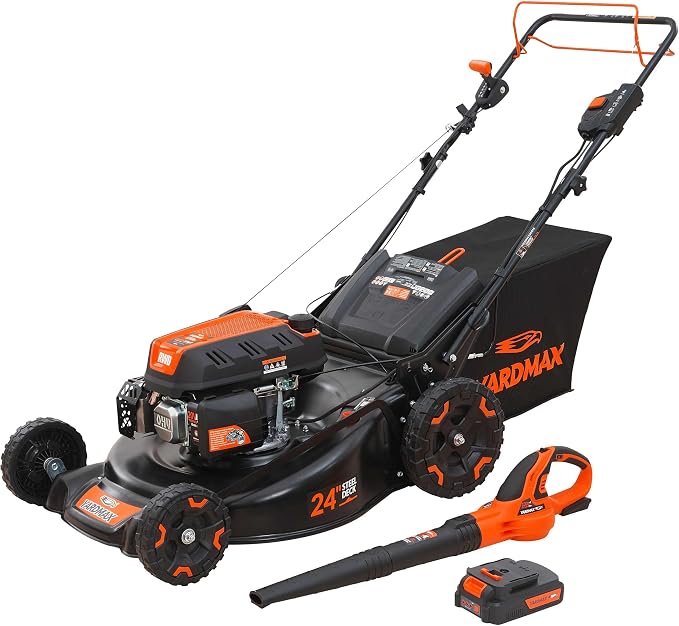
1. 24 In. 201cc Electric Start Select PACE
The 24 In. 201cc Electric Start Select PACE earns the top position because it most directly matches the search intent. Its electric start technology is designed to replace the usual pull-cord procedure with a push of a button, making it the clearest fit for someone who prioritizes starting convenience. The automatic choke adds another practical advantage because the supplied specifications say it starts without manually priming or choking the engine.
This mower is also unusually feature-rich for a walk-behind gas model. Its 201cc engine is paired with an exclusive continuously variable transmission and a six-speed shift lever. That combination lets the operator select a pace that more closely matches walking speed instead of being limited to one fixed self-propelled setting. The 24-inch cutting width can help cover more lawn per pass, while the high-wheel rear-wheel-drive design is intended to make a larger mowing area and uneven sections easier to manage.
A further distinction is the integrated leaf-blower capability. The Advanced Airflow Technology blower is listed at 150 CFM and up to 130 MPH, giving the machine a second cleanup function beyond mowing. That could be useful for clearing clippings from sidewalks or gathering leaves after cutting, although buyers should view it as an added convenience rather than assuming it replaces a dedicated blower for every cleanup job.
The trade-offs are the relatively limited review volume and a reported 3.7 rating in the supplied data, so shoppers should weigh the impressive feature list against the smaller amount of owner feedback. The CVT controls may also require a little familiarization. Check the starting-system instructions and any battery-related requirements before setup, and follow the engine, fuel, and deck-cleaning guidance in the owner documentation. It is the strongest choice for buyers who want the most complete feature package and specifically want confirmed electric starting.
2. BILT HARD 21″ Self Propelled Gas Lawn
The BILT HARD 21″ Self Propelled Gas Lawn is the clearest alternative to the top pick because it combines a familiar 21-inch format with a 201cc four-cycle OHV engine, rear-wheel drive, and single-speed self-propulsion. Its supplied title describes a smooth easy start, while the feature information specifies a no-choke, no-primer design. That should make routine startup less complicated, although the available data does not explicitly identify the mower as electric start. Buyers who require push-button starting should confirm that point before ordering.
Its durable steel deck supports three useful mowing modes: rear bagging, mulching, and side discharge. That flexibility matters because different lawn conditions call for different clipping strategies. Bagging can keep the surface tidy, mulching can return finely cut material to the lawn, and side discharge can move through taller growth without stopping as often to empty a bag. The 21-inch path is a practical middle ground for medium and larger yards without moving to an especially wide deck.
The single-lever system adjusts all four wheels together across eight positions, from 1.2 to 3.75 inches. That is one of the more precise height ranges in this group and gives the owner room to adapt to seasonal grass height or a preferred finished appearance. Rear-wheel drive can also be helpful when the mower needs traction while moving across sloped sections. The angled, foam-wrapped handle is intended to reduce hand fatigue during longer sessions.
The main limitation is speed control: unlike the CVT-equipped models, this mower has a single self-propelled speed. That is simple, but it may not match every walking pace. It also lacks the top-ranked mower’s listed blower function and its cutting deck is narrower at 21 inches. Still, the BILT HARD is a sensible choice for someone who values a steel deck, broad height adjustment, and straightforward three-in-one mowing. Keep the bagging, mulching, and discharge attachments correctly installed for the selected mode, and use the manufacturer’s support channel if setup or starting questions arise.
3. Powersmart 21″ Self-Propelled Gas Lawn Mower
The Powersmart 21″ Self-Propelled Gas Lawn Mower holds third place as a broadly capable, conventional option with a substantial amount of supplied owner feedback. Its 170cc OHV engine is described as offering smooth startup and consistent performance, and the 21-inch steel deck gives it a familiar balance between coverage and maneuverability. The product information does not confirm electric starting, so it should be considered a gas self-propelled alternative rather than a guaranteed push-button mower.
Rear-wheel drive and large 10-inch rear wheels are central to this model’s practical appeal. Those features are intended to improve traction and control on slopes or uneven ground, where a basic push mower can become tiring. The self-propelled system can reduce the effort required to move the mower through a medium or larger yard, especially when the grass is dense or the terrain is not perfectly flat. The layout should still be operated at a controlled pace, since traction hardware does not eliminate the need for careful handling on inclines.
The three-in-one cutting system supports bagging, mulching, and rear discharge. Its listed 1.4-bushel bag provides a defined collection capacity, while the rear-discharge mode can be useful when speed matters more than collecting clippings. A single lever provides six height positions from 1.5 to 3.9 inches. That range covers lower and higher mowing preferences and allows adjustments as the season, grass type, or lawn condition changes.
This mower’s trade-off is that its 170cc engine is smaller than the 201cc engines used by several higher-ranked competitors, and the supplied rating is 3.5 despite a much larger review count. That does not determine every owner’s experience, but it is worth considering alongside the feature set. Choose it when rear-wheel traction, familiar controls, and a large base of feedback matter more than electric-start confirmation or variable speed. Before first use, verify the discharge, bagging, or mulching configuration and set all four wheels consistently through the single height lever.
4. SENIX 201cc 22″ 3-in-1 Variable Speed Self
The SENIX 201cc 22″ 3-in-1 Variable Speed Self ranks fourth because it offers strong mowing fundamentals but does not have a stated electric-start feature in the supplied information. Its 201cc four-cycle OHV engine and 22-inch steel deck make it a capable candidate for medium to large lawns. The wider deck covers more ground than a 21-inch model, which can reduce the number of passes required when the yard is relatively open.
Terrain handling is another strength. The rear-wheel-drive self-propelled system works with large 11-inch rear wheels to provide traction and maneuverability across slopes, uneven areas, and thicker grass. The listing describes the propulsion as variable speed, which gives the operator more control than a fixed-speed system. That can be especially helpful when moving from a level stretch to a tighter section around landscaping, although buyers should consult the controls and operating instructions to understand how the speed adjustment behaves.
The 3-in-1 cutting system switches among bagging, mulching, and side discharge. This is a useful arrangement for owners who do not want to commit to one clipping method. A single lever adjusts six cutting-height positions from 1.25 to 4 inches, giving the widest upper-end range among the listed products. A higher setting can be useful when conditions call for leaving more grass height, while the lower settings support a shorter finished appearance when appropriate for the lawn.
The larger deck and wheels may be an advantage on open, uneven lawns, but they can be less convenient in narrow gates, crowded beds, or compact storage areas than a smaller machine. Also, variable-speed self-propulsion should not be confused with the six-speed CVT systems listed on the PACE models. Confirm the mower’s storage footprint and access route before buying, and keep the blade, deck, and collection system maintained according to the manual. This is a good fit when cutting width, height range, and rear-wheel traction outrank confirmed electric starting.
5. YARDMAX 22 In. 201cc Select PACE 6
The YARDMAX 22 In. 201cc Select PACE 6 is a strong fifth-place option for shoppers who want adjustable travel speed and traction-focused hardware but do not specifically need confirmed electric starting. Its 201cc engine uses an automatic choke system, and the supplied information says there is no need to prime or manually choke the engine. That can simplify startup, although automatic choke convenience is different from an electric starter and should not be interpreted as push-button operation.
The mower’s most notable feature is its six-speed continuously variable transmission. The shift lever lets the operator choose a pace that better suits walking speed, lawn layout, or mowing conditions. That is more adaptable than a single-speed self-propelled system, particularly when the operator prefers to slow down around obstacles or move more quickly across an open section. The high-wheel, front-wheel-drive configuration is paired with rubber tires featuring an aggressive spiked tread pattern, which is intended to improve traction and maneuverability.
For maintenance convenience, the deck includes a cleanout port. The feature can make it easier to rinse or clean the underside of the cutting deck, where packed grass can accumulate and interfere with efficient mowing. A single-lever deck adjustment also makes it quicker to set the mowing height. The supplied data confirms a three-in-one gas walk-behind design, so the owner can use the mower for the preferred clipping approach rather than being locked into one discharge method.
The key limitation is that the product information does not state electric starting, and front-wheel drive may not be the first choice for every sloped or especially uneven yard. The CVT and six-speed selector also introduce more controls than a simple fixed-speed machine. Choose YARDMAX when speed matching, tire tread, and deck-cleanout convenience are especially important. During setup, learn how the drive engagement and speed selector interact, keep the cleanout process consistent with the safety instructions, and make sure the selected height is appropriate before beginning a full mowing pass.
How to Choose the Best Electric Start Gas Lawn Mower
Choosing among gas mowers with self-propulsion and starting conveniences requires more than comparing engine size. The phrase “electric start” describes a specific starting method, while features such as automatic choke, no-primer starting, and smooth easy start describe different forms of convenience. Begin by separating what is explicitly confirmed from what is merely suggested by marketing language.
Confirm the starting system
The top-ranked 24 In. 201cc Electric Start Select PACE is the only mower in this group whose supplied features specifically state electric-start technology. That distinction matters if avoiding a pull cord is the central reason for shopping. A mower may have an automatic choke or no-choke, no-primer operation and still use a recoil starter. The BILT HARD, SENIX, Powersmart, and YARDMAX data provided here does not explicitly confirm electric starting.
Before purchase, read the exact product configuration and owner documentation carefully. Look for clear wording such as electric start, push-button start, starter motor, or a stated battery-operated starting system. If a battery is part of the configuration, confirm whether it is included, how it is charged, and how it should be stored. Do not assume that every listing under an electric-start search automatically includes the same starting hardware.
Starting convenience also includes what happens after the button or handle is used. Automatic choke operation can reduce manual steps, while a no-primer design may make cold starts simpler. These features are valuable, but they do not provide the same experience as electric starting. A buyer who has difficulty with pull cords should give the confirmed starting method more weight than a general phrase such as “easy start.”
Match propulsion to the lawn and your walking pace
Self-propulsion can make a gas mower considerably easier to move, but the best drive arrangement depends on the property. Rear-wheel drive is often appealing for slopes, uneven ground, and situations where traction near the rear of the mower is useful. The Powersmart and SENIX models both emphasize rear-wheel drive, and the BILT HARD also uses rear-wheel drive with a single self-propelled speed.
Front-wheel drive can be convenient when maneuvering around trees, beds, and other obstacles because lifting or redirecting the front of the mower can be more natural. The YARDMAX uses front-wheel drive and adds aggressive tread, but buyers should consider whether that layout suits their slopes and turning habits. The right choice depends on the actual yard rather than a universal rule that one drive type is always superior.
Speed control is equally important. A single-speed mower is mechanically straightforward and can be easy to operate, but its pace may not match every user. BILT HARD uses a single-speed system. SENIX is described as variable speed, while the YARDMAX and top-ranked PACE models use six-speed CVT controls. Adjustable speed is helpful when the operator walks slowly, when the lawn has tight spaces, or when different sections require different pacing.
Remember that self-propulsion is not the same as autonomous mowing. You still guide the mower, manage turns, watch the terrain, and control the drive engagement. On slopes, move according to the owner’s safety directions and avoid treating large wheels or rear-wheel drive as permission to operate carelessly on steep or wet ground.
Choose the cutting width thoughtfully
Cutting width affects both productivity and maneuverability. The 24-inch top pick can cover a broad path in one pass, which may reduce mowing time on a large, open lawn. The 22-inch SENIX and YARDMAX models also provide more coverage than the 21-inch BILT HARD and Powersmart models. A wider deck can be useful when the grass area is spacious and relatively free of obstacles.
However, wider is not automatically better. Measure narrow gates, passages between structures, and the space available in a shed or garage. A wide mower can require more room to turn around landscaping and may be less convenient in a compact yard. Consider how much of the property is open turf versus narrow strips and irregular sections. The time saved on straight passes may not outweigh the extra maneuvering if most of the lawn is divided into small spaces.
Deck material also deserves attention. The BILT HARD, Powersmart, SENIX, and YARDMAX listings identify steel decks or durable steel-deck construction. Steel can provide a substantial cutting platform, but it still benefits from keeping grass buildup under control and storing the mower properly. The supplied data does not provide complete deck thickness, corrosion protection, or warranty details, so those points should be checked in the full listing and manual.
Understand three-in-one mowing modes
Bagging, mulching, and discharge each suit a different mowing priority. Bagging collects clippings for a cleaner-looking surface and can be useful when the grass is long or leaves are present. It requires stopping to empty the bag and adds the task of fitting and removing the collection system. Confirm that the bag is seated correctly before operation and never reach under the deck while the mower is running.
Mulching cuts and redistributes clippings across the lawn. It can reduce the need to handle a full bag, but it works best when mowing conditions and grass height are appropriate. Taking off too much grass in one pass can overload the deck and leave visible clumps. Raising the deck or mowing more frequently may be preferable when growth is heavy.
Discharge is often the quickest approach when collection is not needed. The BILT HARD and SENIX listings specify side discharge, while the Powersmart listing specifies rear discharge. Those are not interchangeable descriptions. Consider where the clippings will go and whether discharge could place material onto walkways, driveways, gardens, or neighboring areas. Change modes only with the mower stopped and following the manufacturer’s instructions.
Use height adjustment to protect the finish
Single-lever height adjustment is convenient because it changes the wheel positions together rather than requiring separate adjustments at each corner. BILT HARD offers eight positions from 1.2 to 3.75 inches. Powersmart lists six positions from 1.5 to 3.9 inches, SENIX lists six from 1.25 to 4 inches, and the supplied YARDMAX information confirms single-lever deck adjustment without listing the full range.
A broad range gives more flexibility across grass types and seasons, but the correct setting is determined by the lawn and current conditions. Avoid removing excessive blade height in a single pass, particularly when the grass is tall or stressed. A higher setting can also reduce the chance of scalping uneven ground. Make height changes before mowing, with the engine stopped and the mower positioned safely.
Check that the lever is fully seated at the chosen position and that the deck appears level. Uneven height can produce a visibly inconsistent cut and may encourage the mower to catch on irregular terrain. If the mower is being shared by several users, make the height position clear before each session rather than relying on memory.
Consider engine size in context
Engine displacement can help indicate the mower’s intended workload, but it is not a complete performance score. The listed models use either a 170cc or 201cc OHV engine. The 201cc engines appear on the top-ranked PACE, BILT HARD, SENIX, and YARDMAX, while Powersmart uses a 170cc OHV engine. The product descriptions characterize these engines as suitable for medium to larger mowing jobs, but the supplied data does not provide a direct, controlled comparison of cutting power.
More displacement may be appealing for thick grass or a larger deck, yet actual results also depend on blade condition, mowing height, grass moisture, terrain, and how much material is being cut at once. A well-maintained smaller engine can be a better ownership choice than a neglected larger one. Avoid using engine size alone to predict fuel consumption, noise, starting behavior, or long-term durability because those details are not established by the supplied specifications.
OHV refers to the engine design described in the listings; it does not eliminate routine care. Follow the manual for oil, fuel, air-filter, spark-plug, blade, and storage requirements. Use only the fuel and lubricants specified by the manufacturer, and never perform maintenance while the engine is hot or able to start unexpectedly.
Think about maintenance and cleanup before buying
Gas mowers require more routine ownership attention than many battery models. Before the first mowing session, complete the assembly steps, add the required fluids, inspect fasteners, and verify that the controls move as described in the manual. The exact fluid quantities and fuel requirements are not included in the supplied data, so use the manufacturer’s instructions rather than guessing.
After mowing, remove accumulated grass from accessible areas once the engine is off and the machine is safely secured. The YARDMAX has a deck cleanout port, which may make underside cleaning more convenient. That feature does not remove the need to follow the stated cleaning procedure or to confirm whether water, a hose, or another method is permitted. Never clean around a moving blade, and disconnect or secure the starting system as directed before working near the deck.
Blade condition affects the cut and the workload placed on the engine. Inspect the blade periodically for damage and have sharpening or replacement performed according to the manual. Keep the discharge opening, bag, and mulch components clear. A blocked passage can reduce collection or discharge performance and may encourage unsafe attempts to clear material while the mower is running.
Seasonal storage deserves equal attention. Gasoline, battery components if equipped, moisture, and debris can all affect the next startup. Follow the manufacturer’s procedure for fuel handling and storage, and keep the mower in a dry, secure location. Since battery details are not provided for the listed electric-start configuration, confirm the proper charging and storage process in its documentation rather than applying assumptions from another mower.
Account for comfort, access, and ownership fit
Handle design and wheel size influence how tiring a mowing session feels. BILT HARD lists an angled, foam-wrapped handle intended to reduce hand fatigue. Powersmart uses 10-inch rear wheels, while SENIX lists 11-inch rear wheels. Larger wheels can help the mower roll across uneven areas, but they may increase the machine’s overall footprint. The best ergonomic choice depends on the operator’s height, grip, strength, and the lawn’s layout.
Storage and transport should be considered before ordering. A 24-inch or 22-inch deck may not fit comfortably through every gate or into every shed. Measure doorways and storage shelves, and allow room to access the controls and cleaning points. If the mower must be lifted into a vehicle, check the product’s actual weight and handling instructions; those details are not supplied here, so do not estimate them from deck width alone.
Owner feedback can provide useful context, but the review counts and ratings vary considerably in the supplied data. The top model has a 3.7 rating from nine reviews, BILT HARD has a 4.2 rating from 117 reviews, Powersmart has a 3.5 rating from 1,876 reviews, SENIX has a 3.9 rating from 1,299 reviews, and YARDMAX has a 4.0 rating from 426 reviews. These figures are not a controlled test and should not be treated as a guarantee. Read recent comments for recurring issues involving setup, starting, drive engagement, bagging, or support.
Use a practical decision sequence
First, decide whether a confirmed electric starter is essential. If yes, begin with the top-ranked PACE and verify the exact configuration. Next, decide whether the lawn needs rear-wheel traction, front-wheel maneuverability, a wide deck, or adjustable travel speed. Then select the clipping method you are most likely to use and confirm that the included accessories support it.
Finally, check the less glamorous details: starting instructions, maintenance schedule, storage dimensions, support availability, and the return or warranty terms shown in the current listing. A mower with the right deck and engine can still be a poor fit if it cannot pass through the gate or if the owner is uncomfortable with its controls. Matching the machine to the property and operator is more useful than chasing one specification in isolation.
Electric Start Gas Lawn Mower FAQ
What is the best electric start gas lawn mower in this group?
The 24 In. 201cc Electric Start Select PACE is the primary choice because its supplied features explicitly confirm electric-start technology. It also combines a 24-inch cutting width, automatic choke, six-speed CVT, rear-wheel drive, and a listed blower function. Those features make it the closest match to the specific electric-start search intent, although its smaller review count means buyers should read the current listing and owner feedback carefully.
Does every mower in this roundup have electric start?
No. Only the top-ranked PACE is explicitly described as having electric-start technology in the supplied data. BILT HARD is described as having a no-choke, no-primer design and smooth easy start; YARDMAX lists an automatic choke; and the Powersmart and SENIX descriptions discuss engine performance without confirming electric starting. Automatic choke and easy-start wording should not be treated as proof of a push-button starter.
Is a self-propelled gas mower better than a push mower?
It can be a better fit for larger lawns, slopes, uneven terrain, or users who would rather not push the mower’s full weight. All five listed products are self-propelled designs. The practical difference is in the drive layout and speed control: BILT HARD uses a single speed, while the PACE and YARDMAX models use six-speed CVT systems, and SENIX is described as variable speed. A smaller, flat lawn may not need that added propulsion complexity.
Which electric-start gas mower is best for slopes?
The available data does not establish a definitive slope winner, and the top PACE is the only model with confirmed electric starting. For terrain considerations, Powersmart and SENIX specifically emphasize rear-wheel drive, traction, and large rear wheels, while BILT HARD also uses rear-wheel drive. The PACE is listed as rear-wheel drive as well. Always follow the operating and slope-safety instructions because wheel size and drive type do not make unsafe terrain safe.
What should I check if an electric-start mower will not start?
Start with the owner’s troubleshooting sequence rather than repeatedly pressing the starter. Confirm that the fuel, oil, safety controls, and starting procedure are correct, and check the starting battery or power source if the model uses one. The exact battery and charging details for the PACE are not included in the supplied information, so use its documentation. If the starter still does not respond, contact the manufacturer or seller instead of bypassing safety features.
Are gas mowers with electric start maintenance-free?
No. Electric starting changes the starting process but does not remove gas-engine maintenance. The mower still requires the care specified for its engine, fuel system, air filter, spark plug, blade, deck, and storage. Keep the cutting deck and discharge path clear, inspect the blade safely, and follow the manufacturer’s seasonal-storage procedure. If the mower has a starting battery, it will also have battery-specific charging and storage requirements.
Should I choose a 21-inch, 22-inch, or 24-inch deck?
Choose based on the balance between coverage and maneuverability. A 24-inch deck can reduce passes across an open lawn, while a 21-inch mower may be easier to guide through tighter areas. The 22-inch SENIX and YARDMAX models sit between those dimensions. Measure gates and storage spaces, and consider how much of the lawn is open versus divided by beds, trees, or narrow passages. Width alone does not determine the best fit.
Conclusion: Which Mower Should You Choose?
The 24 In. 201cc Electric Start Select PACE is the strongest overall match for this search because it is the only option here with explicitly confirmed electric starting, while also offering CVT speed control, a wide deck, automatic choke, and a blower function. Choose the BILT HARD 21″ Self Propelled Gas Lawn when you prefer a straightforward 201cc, steel-deck mower with three cutting modes and no-choke, no-primer starting. The Powersmart, SENIX, and YARDMAX alternatives make sense when traction, deck width, height range, or adjustable travel speed matters more than confirmed electric-start operation.

I’m Maya L. Greenwood, a lifelong plant lover who believes anyone can grow something beautiful with the right guidance. After years of testing soil mixes, pruning methods, irrigation tricks, and pest-safe solutions, I started EasyGardenTips.com to turn hard-won lessons into step-by-step advice. From seed starting and container gardens to composting and seasonal checklists, my goal is to make gardening simple, sustainable, and fun.