3 Best Cordless Lawn Mower Under 300: Smart Battery Mower Picks
Are you looking for the best cordless lawn mower under 300 but do not want to sacrifice cutting width, battery capacity, or everyday usability just to stay within budget? Choosing poorly can leave you with a mower that takes too many passes, struggles in thicker grass, runs out of battery before the lawn is finished, or locks you into an inconvenient battery platform.
I narrowed the field to three complete cordless mower packages that make practical sense for small to medium residential lawns. My primary recommendation is the Greenworks 40V 19-Inch Brushless Cordless Lawn Mower. Its 19-inch steel deck, brushless motor, 40V battery platform, and seven-position cutting-height adjustment give it the strongest overall mowing capability of these three.
I would choose the WORX WG743 40V Power Share 17-Inch Cordless Lawn Mower when maneuverability, battery versatility, bagging, and compact storage matter more than maximum deck width. It includes two 20V 4.0Ah batteries that operate together as a 40V system and adds IntelliCut torque control, seven cutting-height positions, and both mulching and bagging capability.
The Greenworks 40V 16-Inch Cordless Push Lawn Mower is the simpler option I prefer for smaller yards, narrow passages, and buyers who value low mower weight and an established 40V battery ecosystem. Its 16-inch deck, 4.0Ah battery, five height positions, and folding handle keep operation straightforward.
Best Cordless Lawn Mower Under 300
| Image | Product Name | Check Price |
|---|---|---|
Best Choice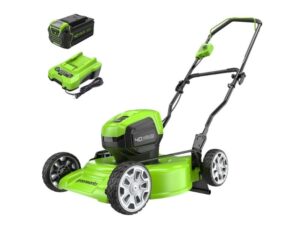 | Greenworks 40V 19-Inch Brushless Cordless Lawn Mower | Check Price |
Second Best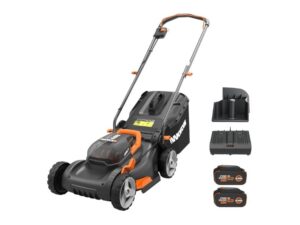 | WORX WG743 40V Power Share 17-Inch Cordless Lawn Mower | Check Price |
Third Choice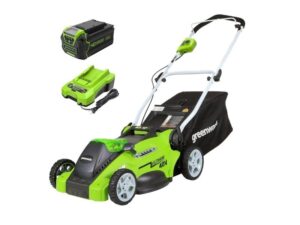 | Greenworks 40V 16-Inch Cordless Push Lawn Mower | Check Price |
Best Cordless Lawn Mower Under 300
1. Greenworks 40V 19-Inch Brushless Cordless Lawn Mower
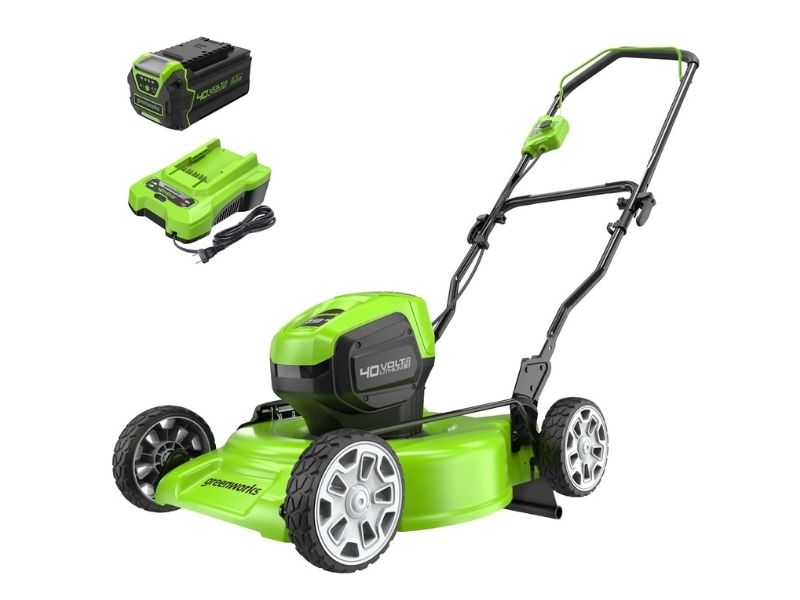
Key Features
- 40V cordless platform
- 19-inch steel cutting deck
- Brushless motor
- Included 4.0Ah lithium-ion battery
- Battery charger included
- Up to approximately 30 minutes of stated runtime
- Seven-position single-lever cutting-height adjustment
- 2-in-1 mulching and side-discharge capability
- Push-button starting
- Folding residential push-mower design
The Greenworks 40V 19-inch mower is my primary recommendation because its specifications line up particularly well with what I want from a sub-$300 cordless mower: a reasonably wide deck, a brushless motor, a full battery-and-charger package, and a mature battery ecosystem.
The 19-inch cutting deck is the first major advantage.
Cutting width has a direct impact on how many passes you make across the yard. A 19-inch mower removes a noticeably wider strip of grass on every pass than a 16-inch model.
That does not sound dramatic when comparing three inches on paper, but the difference accumulates over an entire lawn.
If a lawn contains large open rectangular sections, a wider deck can reduce walking distance and mowing time. It also feels more similar to the cutting width homeowners are accustomed to with conventional walk-behind gas mowers.
Greenworks uses a steel deck on this model. Steel gives the mower a more substantial cutting structure than many lightweight polymer budget mowers.
I would particularly value that construction if the yard has uneven areas, thicker turf, or occasional small debris.
Steel is not automatically superior in every respect. It can eventually corrode if neglected, and it contributes more weight than lightweight composite material. The underside should therefore be kept reasonably clean and dry.
The motor is another reason I rank this model first.
A brushless motor eliminates the carbon brushes used in traditional brushed DC motors. That generally allows a cordless outdoor tool to operate more efficiently while reducing mechanical wear inside the motor.
For a lawn mower, efficiency is important because the motor operates continuously under changing loads.
Thin, dry grass creates relatively modest resistance.
Tall, dense, damp, or fast-growing grass places a much heavier load on the blade.
A well-designed brushless system can respond efficiently to those changes while extracting useful work from a limited battery pack.
This model is supplied around a 40V 4.0Ah battery configuration.
Amp-hours are often misunderstood, so it helps to separate voltage from capacity.
Voltage describes the electrical system’s nominal power platform.
Amp-hours indicate battery charge capacity.
You should not compare two batteries by Ah alone when their voltages are different.
A 4Ah 40V-class battery stores considerably more energy than a 4Ah battery operating at half the voltage.
For this particular mower, the manufacturer-supported runtime figure is around 30 minutes under specified conditions, but actual mowing time will vary substantially with grass height, moisture, cutting height, lawn density, temperature, battery condition, and how aggressively the blade is loaded.
That runtime profile makes the mower a better fit for small and modest medium-size lawns than for very large properties.
A battery mower should ideally finish the lawn without forcing the owner to stop halfway through and recharge.
If your normal mowing session regularly exceeds the capacity of the included battery, adding another compatible battery can solve that problem—but it also changes the overall ownership cost.
That is why battery-platform compatibility deserves consideration before buying the mower.
Greenworks’ 40V battery family is used across numerous lawn and garden tools. If you eventually add a compatible string trimmer, blower, hedge trimmer, chainsaw, or other yard equipment, sharing batteries can be far more convenient than maintaining unrelated chargers and packs. Greenworks states that this 40V family supports dozens of compatible tools.
Cutting-height adjustment is another practical strength.
The mower provides seven height positions controlled by a single lever.
Single-lever adjustment is preferable to designs that require moving each individual wheel.
Grass height should change with species, season, heat, rainfall, and lawn condition.
Cutting too low repeatedly can weaken turf because the plant loses too much photosynthetic leaf area.
During stressful hot or dry weather, leaving grass somewhat taller can help shade the soil and protect the crown.
For healthier mowing, I would generally avoid removing more than roughly one-third of the grass blade in one session whenever practical.
The seven-position mechanism gives you more flexibility to make those adjustments without spending several minutes repositioning wheels.
Clipping management is 2-in-1, focusing on mulching and side discharge.
Mulching works by keeping clippings under the deck long enough for the blade to cut them into smaller pieces before returning them to the lawn.
Those fine clippings break down and return nutrients to the soil.
Side discharge moves clippings away from the cutting chamber quickly. It is often more practical when the grass is long enough that heavy clippings would otherwise accumulate under the deck.
The important limitation is that this particular configuration is not the one I would select if rear bagging is essential.
That is where the WORX WG743 becomes a better fit.
For someone who routinely collects grass because of heavy leaf litter, lawn disease concerns, seed heads, or a preference for an exceptionally clean appearance, the WORX’s bagging system adds meaningful versatility.
The Greenworks mower is a push model rather than self-propelled.
That is normal at this budget level.
Self-propelled systems add motors, controls, drivetrain hardware, battery demand, weight, and cost.
On a relatively flat small lawn, a lightweight push mower can actually be easier to maneuver around trees, landscaping, gates, and garden beds than a larger self-propelled machine.
On a sloped property, however, self-propulsion becomes much more valuable.
I would not recommend buying a push mower simply to save money if the yard contains long or steep inclines that make manual pushing uncomfortable.
One of the conveniences of cordless mowing is the push-button start.
There is no fuel valve, choke position, primer bulb, pull cord, gasoline storage, oil change, or carburetor maintenance.
Insert a charged battery, complete the mower’s safety-start sequence, and begin mowing.
That reduction in routine maintenance is one of the strongest reasons homeowners with smaller lawns move away from gasoline.
Blade care still matters.
A cordless mower with a dull blade will consume battery energy inefficiently while producing a poorer cut.
Rather than slicing grass cleanly, a dull edge tears the tips.
Frayed grass tips can turn brown and make an otherwise healthy lawn look dry shortly after mowing.
Inspect the blade periodically and sharpen or replace it when necessary.
Always remove the battery and follow the mower’s safety procedure before performing work near the blade.
Another benefit of the 19-inch model is storage efficiency.
Cordless push mowers generally require less preparation for seasonal storage because there is no gasoline to stabilize or drain.
A folding handle reduces the footprint further.
Just keep the battery stored under appropriate temperature conditions instead of leaving it exposed to extreme heat or freezing conditions for long periods.
The biggest consideration is still runtime.
A 19-inch deck helps you finish faster, but tall or wet grass can sharply increase load.
If the lawn has become overgrown, do not immediately lower the deck to the final desired height and force the mower through it.
Raise the deck, make the first cut, then lower it gradually on a later pass or mowing session.
That improves cut quality and reduces the chance of repeated bogging.
What I Like
- Brushless motor is well suited to cordless mowing
- 19-inch deck reduces the number of passes on open lawns
- Steel deck feels more substantial than many lightweight budget designs
- Seven cutting-height settings offer useful lawn-care flexibility
- Included 40V battery and charger make it a complete mowing package
- Mulching works well for routine lawn maintenance
- Side discharge helps when clipping volume increases
- Greenworks 40V batteries can support a broader yard-tool system
What I Do Not Like
- Roughly 30-minute stated runtime limits suitability for large properties
- No rear-bagging function on this particular configuration
- Push drive requires more effort on hills
- Steel construction can require more attention to moisture and corrosion than polymer decks
The Greenworks 40V 19-inch mower has the strongest overall balance here because it gives you the widest cutting deck and a brushless motor without abandoning the practical 40V residential battery platform. I would choose it for a relatively flat small-to-medium lawn where mulching or side discharge covers your clipping-management needs.
2. WORX WG743 40V Power Share 17-Inch Cordless Lawn Mower
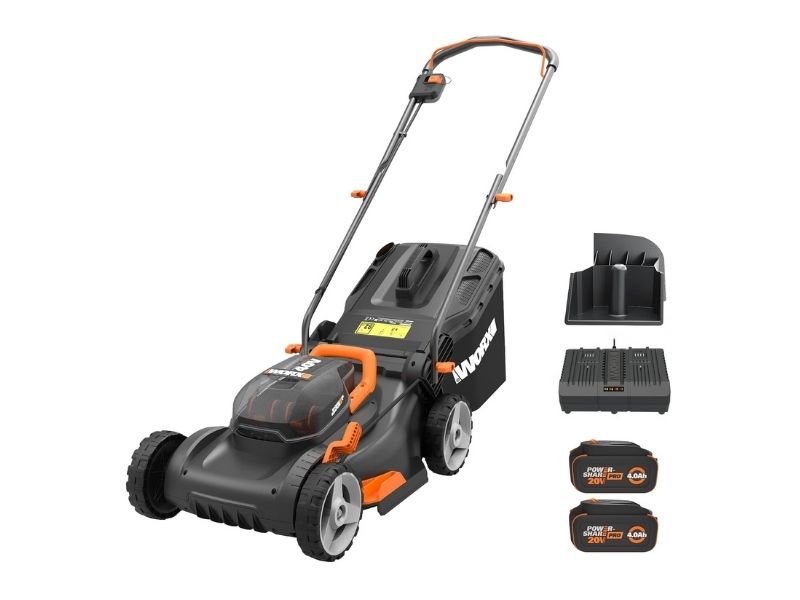
Key Features
- 40V MAX system using two 20V batteries
- Two 4.0Ah Power Share batteries
- Dual-port battery charger
- 17-inch deck
- Approximately 16-inch cutting diameter
- IntelliCut torque control
- Seven-position single-lever height adjustment
- Cutting-height range approximately 1.5 to 3.5 inches on current product information
- 2-in-1 mulching and rear bagging
- Cut-to-edge deck design
- Approximately 38.1-pound machine weight
- Folding handle for compact storage
The WORX WG743 is the mower I would pick if you want something more compact than the Greenworks 19-inch model but do not want to fall all the way to a basic 16-inch configuration.
Its 17-inch deck provides a useful middle ground.
It remains narrow enough to maneuver through gates, around landscaping, and between raised beds while covering more ground than very small mowers.
WORX lists the actual cutting diameter at approximately 16 inches, with the deck itself around 17 inches wide.
That distinction between deck width and cutting width is worth understanding.
Manufacturers may advertise the overall deck dimension, but the blade itself needs clearance inside the housing.
The actual swath removed on each pass is therefore often slightly narrower than the outside deck.
The WG743’s defining feature is its battery configuration.
Instead of one nominal 40V battery, it uses two 20V Power Share 4.0Ah packs simultaneously to operate the 40V mower.
Both batteries must be installed for normal operation. WORX explicitly notes that the 40V Power Share mower is designed to run using two matched battery packs rather than one battery by itself.
This configuration has an important ecosystem advantage.
The individual 20V batteries can be used across compatible WORX Power Share tools.
That means you may use one battery in a compatible drill, blower, string trimmer, reciprocating saw, hedge trimmer, or other tool, then install two packs together when operating certain 40V equipment.
For homeowners who already own WORX tools, that compatibility can matter as much as the mower itself.
Battery ecosystems become expensive when duplicated.
Owning one 40V mower, an unrelated 56V blower, an unrelated 18V trimmer, and yet another battery platform for power tools means maintaining several chargers and replacement packs.
A shared platform reduces that clutter.
The WG743 also includes IntelliCut.
This system lets the mower increase torque when grass becomes more demanding and reduce demand when full output is unnecessary.
The practical goal is simple: use battery energy more intelligently.
Short, dry grass should not require the same motor effort as a thick patch of rapidly growing spring turf.
Being able to access additional torque in tougher areas gives the mower more flexibility without operating at maximum demand continuously. WORX specifically identifies IntelliCut as a feature for increasing torque in denser grass and reducing it to conserve energy in easier conditions.
That does not make it immune to bogging.
Any cordless mower can struggle if asked to remove too much wet or overgrown material in one pass.
Deck size, blade sharpness, battery state of charge, and discharge airflow all influence cutting performance.
If you hear the mower repeatedly slowing in heavy turf, raising the deck is usually a better response than pushing more slowly through a severely overloaded cutting chamber.
The WG743 also stands out because it supports rear bagging and mulching.
Rear bagging is useful when you want to collect clippings directly instead of leaving them on the turf.
There are several situations where I would bag rather than mulch.
If the lawn is badly overgrown, the clipping volume may simply be too heavy to redistribute neatly.
When fallen leaves cover the lawn, bagging after shredding them can provide a cleaner result.
If weeds have mature seed heads, collecting material may reduce how much seed is redistributed.
And some homeowners simply prefer the appearance of a freshly bagged lawn.
The bag has a capacity of roughly 1.1 bushels according to current WORX specifications.
A compact bag fills sooner than the large bag on a full-size 21-inch mower.
That means more frequent emptying if the lawn is long.
The tradeoff is reduced mower size and weight.
At around 38.1 pounds, this is a manageable machine for a battery mower.
Lower weight is especially useful when turning at the end of each pass.
Push mowers often require the operator to press down slightly on the handle, lift weight from the front wheels, pivot, line up the next pass, and lower the deck.
A heavy mower makes that repetitive process more tiring.
Lower weight also makes the machine easier to transport and move into storage.
The Cut-to-Edge deck design is another useful detail.
No rotary mower can cut perfectly flush against every wall or fence because the blade must stay enclosed safely inside the deck.
But reducing the distance between the blade path and deck edge can leave a narrower strip of uncut grass.
That means less follow-up work with a string trimmer.
For yards with long fences, raised borders, retaining walls, or hardscape edges, reducing trim work can save noticeable time.
Cutting height is controlled by one lever with seven positions.
Current WORX product information lists a range around 1.5 to 3.5 inches, while historical manual specifications may show slightly different upper limits depending on revision.
Because product revisions can change, I would follow the adjustment markings on the exact mower received rather than relying on an old manual for the final setting.
The important point is that the range is broad enough for ordinary residential turf.
The dual-port charger is another practical advantage.
Because the mower requires two batteries simultaneously, charging them together is much more convenient than swapping packs through a single-slot charger.
Keeping the battery pair at similar states of charge is sensible because both contribute to the mower’s 40V operating system.
Storage is straightforward because the handle folds down.
That matters more than it sounds.
A lawn mower is used frequently during the growing season but spends most of its life in a garage or shed.
A machine that consumes unnecessary floor space can become annoying quickly, particularly when the same storage area contains bicycles, trash bins, shelving, snow equipment, and other yard tools.
The biggest limitation relative to the Greenworks 19-inch model is productivity.
The narrower cutting path means more passes.
For a compact lawn with landscaping obstacles, that can be an acceptable tradeoff.
For a broad, open lawn, I prefer a wider deck.
The second limitation is the push-only drive system.
At about 38 pounds it remains manageable on level terrain, but the mower does not pull itself uphill.
If your property slopes steeply, consider saving for self-propelled equipment rather than choosing strictly by the under-$300 threshold.
What I Like
- Two included 4.0Ah batteries
- Batteries integrate into the wider WORX Power Share ecosystem
- Dual-port charger handles both mower batteries together
- IntelliCut adds torque when mowing gets more demanding
- Seven-position single-lever height adjustment
- Rear bagging is valuable for cleanup-focused mowing
- Mulching handles routine cuts without collecting clippings
- Relatively lightweight body improves maneuverability
- Cut-to-edge design can reduce follow-up trimming
- Folding handle improves storage
What I Do Not Like
- Narrower cut than the Greenworks 19-inch mower
- Requires both batteries for mower operation
- Small bag needs more frequent emptying in heavy grass
- Push drive is less convenient on slopes
I would choose the WORX WG743 for a small lawn with obstacles, narrow areas, or homeowners who value bagging and a versatile shared battery platform. Its two-battery Power Share system, IntelliCut control, compact chassis, and low weight make it particularly easy to live with even though it does not cover ground as quickly as a 19- or 21-inch mower.
3. Greenworks 40V 16-Inch Cordless Push Lawn Mower
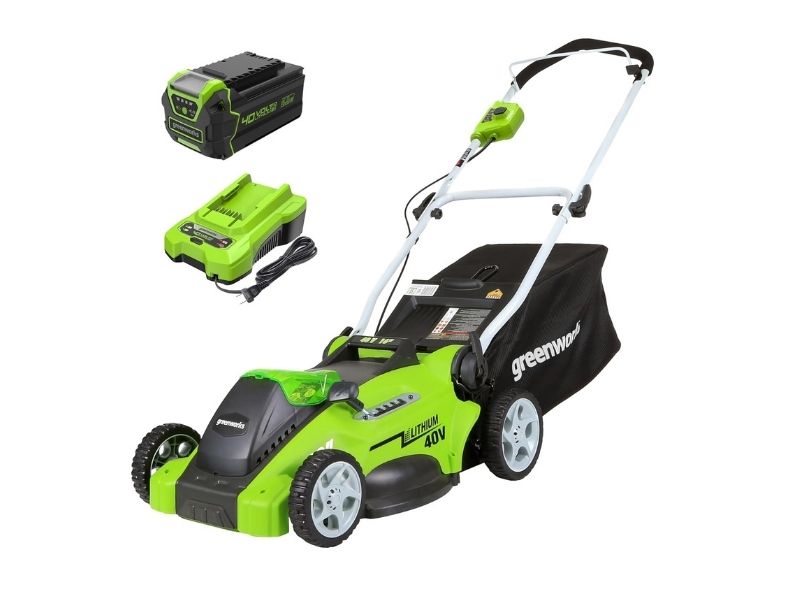
Key Features
- 40V lithium-ion battery system
- Included 4.0Ah battery
- Charger included
- 16-inch deck
- Five cutting-height positions
- Cutting-height range approximately 1.25 to 3.375 inches
- 2-in-1 mulching and rear bagging
- Push-button start
- Folding handle
- Approximately 37.8-pound mower weight
- Manufacturer-stated runtime up to approximately 40 minutes
- Designed primarily for smaller residential lawns
The Greenworks 40V 16-inch mower is the simplest machine of the three, and that simplicity is exactly why I would consider it.
Not every homeowner needs a brushless motor, 19-inch steel deck, sophisticated torque control, or self-propelled drive.
If you have a relatively small lawn and want a cordless mower that is easy to push, easy to store, and uses a common 40V battery system, a 16-inch mower can be more practical than carrying around a larger machine.
Greenworks lists this model at roughly 37.8 pounds with a hardened-plastic deck structure.
That low weight immediately changes how the mower feels.
It is easier to turn.
It is easier to push into a storage location.
It is easier to maneuver around ornamental beds.
It is easier to negotiate narrow side yards.
And if the mower needs to be lifted over a threshold or transported occasionally, every pound matters.
The tradeoff is cutting width.
A 16-inch deck is compact.
Compared with the 19-inch model, each mowing pass covers less grass.
On a tiny urban or suburban lawn, that may make almost no practical difference.
On a larger open property, the extra passes become noticeable.
This is why yard size should guide mower selection rather than simply buying the cheapest or lightest option.
Greenworks targets the mower primarily toward smaller lawns and specifies runtime up to approximately 40 minutes with the included 4.0Ah battery under suitable conditions.
Runtime claims deserve context.
Battery mowers do not consume energy at exactly the same rate every minute.
Consider two mowing sessions.
In the first, the grass was cut five days ago, is completely dry, and only a small amount needs to be removed.
Blade load is low.
In the second, the lawn has grown for two weeks, morning dew is still present, and thick spring grass is being cut down several inches.
The motor works substantially harder.
Runtime will fall.
Battery temperature and age also matter.
Lithium-ion batteries are consumable components. Their usable capacity gradually declines after repeated charge cycles and aging.
Good battery habits can help.
Do not leave the pack sitting for extended periods in extreme heat.
Allow a hot battery to cool before charging when instructed by the manufacturer.
Avoid storing it where moisture can reach electrical contacts.
And if the mower will not be used for a long seasonal period, follow the battery manufacturer’s storage-charge recommendations.
The 16-inch Greenworks provides five-position single-lever height adjustment, with a published cutting range around 1.25 to 3.375 inches.
Five positions are fewer than the seven settings offered by the other two mowers.
For ordinary residential mowing, however, five settings are usually enough.
The more important issue is choosing an appropriate height and mowing regularly enough that the mower is not asked to remove excessive growth at once.
Cutting too low can stress turf.
It exposes more soil to sunlight, encourages moisture loss, and can weaken grass roots.
A healthy lawn often looks better when mowing height is chosen according to grass species rather than trying to create the shortest possible surface.
The mower supports mulching and rear bagging.
This combination is useful for a small-yard machine.
Mulching is what I would use for routine maintenance when the lawn is being cut frequently.
The mower chops clippings finely and returns them to the turf.
Bagging becomes helpful if grass has become longer, autumn leaves are being collected, or a cleaner finish is desired.
This flexibility gives the 16-inch Greenworks an advantage over a mower that only mulches and side discharges.
The deck is polymer rather than steel.
For some buyers that sounds like a downgrade, but polymer decks have legitimate benefits.
They do not rust.
They reduce mower weight.
They can handle ordinary lawn moisture without corrosion.
The downside is that plastic/composite structures may feel less substantial, particularly around rough terrain or repeated impacts.
A residential mower should never be intentionally used to strike stones, exposed roots, or hard objects regardless of deck material.
Walk the lawn first if debris may be present.
The machine uses a traditional brushed motor rather than the brushless design found on the larger Greenworks model.
That is one reason I place this mower third.
Brushless motors are generally preferable when efficiency, motor life, and power delivery are priorities.
But for a small lawn where weekly runtime is limited, the simpler motor can still be entirely adequate.
The 40V battery system is one of the strongest reasons to consider the mower.
Greenworks uses compatible 40V packs across a wide collection of outdoor equipment.
If you already own compatible batteries, the mower becomes more flexible because spare packs can extend mowing time.
If this is your first cordless yard tool, the included 4.0Ah pack becomes the starting point for a broader system.
Battery ecosystem matters particularly with outdoor power equipment because replacement packs can represent a significant percentage of the original tool cost.
Before committing to any cordless brand, I would look beyond the mower itself.
Ask which tools you may buy in the next several years.
String trimmer?
Leaf blower?
Hedge trimmer?
Pole saw?
Chainsaw?
Cultivator?
If several useful tools share the same packs, the battery platform becomes more valuable.
Storage is also excellent.
The handle folds to reduce the footprint substantially. Greenworks states that the folding design can reduce storage space significantly compared with leaving the handle extended.
That makes the mower particularly appropriate for small garages, sheds, townhouses, and other properties where storage is at a premium.
Noise is another benefit compared with gasoline.
There is still blade and motor noise, so hearing protection can remain appropriate, but there is no combustion engine repeatedly firing beside the operator.
You also avoid gasoline fumes during use and storage.
Maintenance becomes mostly mechanical and electrical housekeeping:
Keep the blade sharp.
Keep the deck clean.
Inspect wheels and fasteners.
Check the grass bag.
Store the battery properly.
Inspect the charger and power cable.
There are no spark plugs, carburetor jets, oil filters, fuel stabilizers, or stale gasoline issues.
For the right property, that simplicity is extremely appealing.
Its greatest weakness remains productivity.
I would not recommend a 16-inch push mower to someone with a large open lawn just because it fits the budget.
The mower may technically be able to cut the lawn, but the time required can undermine the convenience of going cordless.
A compact machine makes sense when the lawn itself is compact.
What I Like
- Very manageable mower weight
- 16-inch deck fits narrow spaces
- Included 4.0Ah battery and charger
- Up to roughly 40 minutes of stated runtime in suitable conditions
- Mulching and rear bagging
- Simple five-position height adjustment
- Polymer deck cannot rust like untreated steel
- Folding handle reduces storage footprint
- Compatible Greenworks 40V platform extends beyond the mower
- Straightforward push-button operation
What I Do Not Like
- Narrow deck increases the number of passes
- Brushed motor is less sophisticated than the 19-inch model’s brushless system
- Five height positions provide less fine adjustment
- Small deck is inefficient for larger open lawns
I would choose the Greenworks 16-inch mower for a genuinely small yard where maneuverability and storage matter more than mowing speed. It is also the model I would consider for a homeowner who wants a well-established cordless platform but does not need the additional deck width and brushless performance of the 19-inch Greenworks.
Cordless Lawn Mower Under 300 Comparison
| Product | Voltage | Deck Size | Motor | Included Battery | Height Positions | Clipping Modes | Drive | Approx. Weight | Main Strength |
| Greenworks 40V 19-Inch Brushless | 40V | 19 in. steel | Brushless | 4.0Ah | 7 | Mulch / Side Discharge | Push | ~40 lb class | Wider deck and brushless performance |
| WORX WG743 | 40V via 2x20V | 17 in. deck / ~16 in. cut | Cordless motor with IntelliCut | 2×4.0Ah | 7 | Mulch / Rear Bag | Push | 38.1 lb | Battery flexibility and maneuverability |
| Greenworks 40V 16-Inch | 40V | 16 in. polymer | Brushed | 4.0Ah | 5 | Mulch / Rear Bag | Push | 37.8 lb | Compact size and easy handling |
The Greenworks 19-inch mower gives you the strongest mowing hardware, particularly because of its brushless motor and wider steel deck. The WORX gives up some cutting width but gains a particularly flexible dual-20V battery system, bagging, and compact maneuverability. The Greenworks 16-inch mower is the simplest option and makes the most sense when lawn size and storage space are limited.
How to Choose a Cordless Lawn Mower Under $300
A strict budget makes product selection more difficult because many premium cordless mowers move beyond this range once a battery and charger are added.
The biggest mistake is comparing a complete mower kit against a tool-only listing.
A bare mower may look significantly cheaper, but it is useless until compatible batteries and a charger are added.
When comparing budget cordless mowers, confirm exactly what is included.
For a first-time owner, I generally want:
Mower + sufficient battery capacity + compatible charger
If you already own the battery platform, tool-only models can make excellent financial sense.
Choose Deck Width According to Lawn Size
Deck width affects productivity more directly than almost any other physical specification.
A wider blade cuts more grass per pass.
For very small lawns, a 16- to 17-inch mower is easy to handle and store.
For larger residential areas, a 19- to 21-inch deck reduces walking and turning.
The three-inch difference between 16 and 19 inches may seem small, but consider the number of passes needed across an open rectangular lawn.
If the mower needs 30 passes with a 16-inch cutting path, increasing usable width can eliminate several trips back and forth.
The wider machine may therefore finish sooner even if runtime is similar.
There is a tradeoff.
Wide mowers are less convenient around:
- Narrow gates
- Closely spaced garden beds
- Trees
- Small islands
- Raised beds
- Air-conditioning units
- Tight side yards
Measure the narrowest places the mower must pass before buying.
Brushless vs Brushed Motors
A brushed motor uses carbon brushes to transfer electrical current to the rotating motor assembly.
A brushless motor uses electronic control instead of traditional physical brushes.
For cordless outdoor equipment, I generally prefer brushless technology because it can provide:
- Better efficiency
- Reduced internal wear
- Strong power-to-weight performance
- Better response to changing load
- Lower maintenance requirements
That does not mean every brushed mower is bad.
A homeowner mowing a tiny lawn for 20 minutes per week may get many years of satisfactory use from a simpler brushed motor.
The benefit of brushless design becomes more valuable as mowing load and operating time increase.
That is one reason the Greenworks 19-inch model ranks first.
Battery Voltage
Voltage labels can be confusing because different companies build their battery systems differently.
Greenworks uses dedicated 40V packs in these models.
WORX uses two 20V Power Share batteries together to operate its 40V mower.
Neither strategy is automatically better.
What matters is:
- Available energy
- Motor efficiency
- Battery capacity
- Runtime
- Battery replacement cost
- Compatibility with other tools
Do not judge performance using voltage alone.
A mower labeled 56V is not automatically better than one labeled 40V.
Motor design, battery cells, controller programming, blade design, and deck airflow all matter.
Understanding Amp-Hours
Amp-hours (Ah) describe battery charge capacity.
A larger Ah rating generally means greater stored energy when voltage remains the same.
For example, within the same compatible 40V family:
A 2.0Ah battery stores less energy than a 4.0Ah battery.
A 5.0Ah battery stores more than a 4.0Ah battery.
However, a higher-capacity battery is usually:
- Heavier
- More expensive
- Slower to charge with the same charger
The ideal battery balances runtime with mower weight and ownership cost.
Runtime Claims
Runtime is probably the specification buyers misunderstand most.
Manufacturers normally specify an “up to” runtime measured under certain conditions.
Real-world mowing can differ considerably.
Runtime decreases when:
- Grass is tall
- Grass is wet
- Grass is very dense
- The blade is dull
- The mower is set extremely low
- Mulching requires repeated recutting
- Battery temperature is unfavorable
- The battery has aged
Runtime may improve when grass is dry, mowing is frequent, and only a modest amount is removed.
I would never size a mower with absolutely no runtime margin.
If your lawn normally takes 35 minutes to mow, buying a system that delivers around 35 minutes only under ideal conditions leaves little flexibility.
Push vs Self-Propelled
All three mowers here are primarily push mowers.
That helps keep them within this budget.
A self-propelled mower uses additional motor power to turn the drive wheels.
It can be extremely useful on:
- Slopes
- Large lawns
- Thick turf
- Properties where the mower is physically heavy
On a flat 1/8-acre yard, self-propulsion is much less important.
A lightweight push mower can actually feel quicker around landscaping.
If you have mobility limitations or steep slopes, however, I would prioritize self-propulsion even if it means raising the budget.
Mulching, Bagging, and Side Discharge
These three clipping systems serve different purposes.
Mulching
A mulching mower keeps clippings in the deck longer so the blade can cut them into smaller pieces.
Advantages include:
- No bag emptying
- Nutrients returned to soil
- Faster routine mowing
Mulching works best when you mow frequently and remove only modest grass height.
Rear Bagging
Bagging collects clippings.
It helps when:
- Grass is excessively long
- Leaves are being collected
- You want a very clean finish
- Weed seed heads are present
- Lawn debris needs removal
The tradeoff is frequent stopping to empty the bag.
Side Discharge
Side discharge expels clippings quickly.
It works well in heavier grass where keeping all material under the deck for mulching could overload the mower.
The Greenworks 19-inch model favors mulch/side discharge, while the WORX WG743 and 16-inch Greenworks provide mulch/bag combinations in the configurations reviewed here.
Cutting Height
A good cordless mower should allow enough cutting-height range for seasonal lawn care.
Avoid choosing a mowing height solely by appearance.
Different turfgrasses perform best at different heights.
Cutting too low repeatedly can:
- Weaken root development
- Increase moisture stress
- Expose soil
- Encourage some weeds
- Create scalping on uneven ground
A single-lever adjustment is particularly convenient because all wheels change together.
Seven positions provide finer control than five, although both can be sufficient for normal residential mowing.
Mower Weight
Weight affects the experience more than spec-sheet comparisons suggest.
A lighter mower is easier to:
- Turn
- Push
- Transport
- Lift slightly at obstacles
- Store
- Maneuver around landscaping
Heavier construction can improve stability and may accompany larger steel decks.
Neither extreme is automatically ideal.
For flat small yards, I generally favor lighter machines.
For broad open lawns, I will accept additional weight in exchange for a larger cutting deck.
Battery Ecosystem
Do not buy a cordless mower without thinking about the next cordless yard tool.
Battery packs are expensive enough that platform compatibility matters.
A strong ecosystem can allow the same batteries to support:
- String trimmers
- Blowers
- Hedge trimmers
- Chainsaws
- Pole saws
- Cultivators
- Other lawn equipment
Both Greenworks 40V and WORX Power Share provide broader tool families.
If you already own compatible batteries from either brand, that can legitimately change which mower is the best choice for you.
Storage
Cordless mowers have one major storage advantage over gasoline machines: there is no fuel system to worry about.
Folding handles further reduce space.
Before purchasing, measure the storage area.
Consider:
- Handle length
- Deck width
- Whether vertical storage is permitted
- Battery storage location
- Charger location
Do not assume every mower can safely be stored vertically just because the handle folds.
Follow the manufacturer’s storage orientation instructions.
How to Get More Runtime From a Cordless Mower
You can often improve effective runtime without buying a larger battery.
Keep the Blade Sharp
A sharp blade cuts grass with less resistance.
A dull blade forces the motor to work harder and damages grass tips.
Mow Dry Grass
Wet clippings are heavy and tend to stick inside the deck.
This restricts airflow and increases cutting resistance.
Avoid Removing Too Much at Once
If the lawn is overgrown, raise the mower.
Taking a smaller amount per pass is easier on the battery and produces a better result.
Walk at a Sensible Pace
Pushing too quickly into dense grass can overload the blade chamber.
Let the mower maintain blade speed.
Keep the Deck Clean
Built-up clippings interfere with airflow.
Always remove the battery before inspecting or cleaning underneath the deck.
Cordless Mower Maintenance
Battery mowers require less routine servicing than gasoline mowers, but they are not maintenance-free.
Blade Maintenance
Inspect the blade for:
- Dull cutting edges
- Bends
- Cracks
- Severe chips
A damaged blade should be replaced rather than aggressively reshaped.
Deck Cleaning
Grass buildup can trap moisture and interfere with airflow.
For steel decks, keeping the underside clean and dry also helps reduce corrosion risk.
Never direct water into battery compartments or electrical components unless the manufacturer specifically permits that cleaning method.
Battery Care
Lithium-ion batteries prefer reasonable temperatures.
Avoid leaving packs for prolonged periods:
- In direct summer sun
- In a hot vehicle
- In standing water
- In extreme cold
Inspect the battery housing before use.
Stop using a pack that is swollen, cracked, severely damaged, or behaving abnormally.
Charger Care
Use a compatible charger intended for the battery system.
Keep charger ventilation openings clear.
Charge in a dry location with reasonable airflow.
Common Mistakes When Buying a Cordless Lawn Mower Under 300
Buying a Tool-Only Mower by Accident
Always confirm whether batteries and chargers are included.
A cheap bare tool may cost substantially more once the power system is added.
Choosing Too Narrow a Deck
A 16-inch mower is excellent for a tiny lawn but can become frustrating over a larger open property.
Do not sacrifice mowing productivity unnecessarily.
Expecting Ideal Runtime Every Time
Manufacturer runtime figures are not guarantees for wet, overgrown, dense turf.
Leave some capacity margin.
Ignoring Battery Replacement Cost
The battery is one of the most expensive components of a cordless mower.
Consider the entire battery platform before committing.
Assuming Higher Voltage Means Better Cutting
Voltage is only one part of mower performance.
Motor efficiency, blade speed, deck airflow, and battery capability matter too.
Mowing Wet Grass
Wet mowing increases load, encourages clumping, and can produce a poor cut.
It also creates additional safety concerns.
Wait for the lawn to dry whenever practical.
Cutting the Lawn Too Short
Scalping grass can stress the lawn and make uneven areas look worse.
Choose height based on turf type and conditions.
Buying a Push Mower for a Steep Property
Budget should not override ergonomics.
If hills make pushing difficult, a self-propelled mower may be the smarter purchase.
Frequently Asked Questions
What is the best cordless lawn mower under 300?
The Greenworks 40V 19-inch brushless mower offers the strongest overall balance for most buyers.
Its wider steel deck and brushless motor give it better mowing productivity than the smaller alternatives while retaining a practical 40V battery system. I would choose the WORX WG743 instead when rear bagging, compact handling, or compatibility with WORX 20V Power Share tools matters more.
Is a cordless lawn mower under $300 worth buying?
Yes, especially for small and medium residential lawns where maximum runtime is not required.
This price class can provide lithium-ion batteries, adjustable cutting heights, mulching, bagging or discharge functions, and respectable deck sizes. The main compromises are usually smaller batteries, push drive rather than self-propulsion, and less runtime than premium machines.
What size lawn can a 40V mower handle?
A 40V mower is well suited to many small residential lawns, but battery capacity matters more than voltage alone.
Greenworks targets its 16-inch 40V model toward small-yard use and states up to roughly 40 minutes of runtime under suitable conditions. Grass density, cutting height, moisture, battery age, and mowing frequency all affect how much area can actually be completed.
Is a 16-inch mower too small?
No, a 16-inch mower is a practical choice for small lawns and tight landscaping.
Its narrow deck improves maneuverability through gates and around obstacles. The disadvantage is that you need more passes to cover the same lawn compared with a 19- or 21-inch deck. For a larger open yard, I prefer a wider mower.
Is a 19-inch cordless mower better than a 16-inch mower?
A 19-inch mower is generally more productive, while a 16-inch mower is easier to maneuver and store.
The wider deck removes more grass per pass, making it better suited to open areas. The smaller mower can be more pleasant around garden beds, narrow gates, trees, and compact urban lawns.
Do I need a brushless lawn mower?
You do not strictly need one, but brushless motors are desirable for efficiency and reduced internal wear.
A brushed mower can still work very well for a small lawn with short weekly mowing sessions. I would prioritize brushless technology when the mower will operate longer, cut denser grass, or serve as the primary machine for a larger residential yard.
How long does a cordless lawn mower battery last per charge?
Typical runtime varies widely with battery size, grass conditions, mower efficiency, and cutting load.
The Greenworks models discussed here carry manufacturer runtime estimates of roughly 30–40 minutes depending on configuration. Treat these as planning guidelines rather than guarantees because tall or wet grass can reduce runtime significantly.
Can I mow wet grass with a cordless mower?
It is usually better to wait until the lawn is dry.
Wet grass becomes heavier, clumps under the deck, increases motor load, and can produce an uneven cut. Moist conditions can also increase slipping risk. Follow the mower manufacturer’s safety instructions and avoid exposing battery or electrical components to inappropriate moisture.
Is rear bagging better than mulching?
Neither is universally better; mulching suits routine mowing, while bagging helps with heavy clippings and cleanup.
Mulching eliminates repeated bag emptying and returns finely cut organic material to the turf. Bagging is useful when grass is overgrown, leaves are present, or you want to remove debris from the lawn.
Is a push cordless mower difficult to use?
A lightweight push mower is easy to manage on relatively flat lawns but takes more effort on slopes.
The smaller mowers in this guide weigh around the upper-30-pound range, making them considerably easier to maneuver than many full-size machines. Hills change the equation, and a self-propelled mower may be worth the additional cost for sloped properties.
Can I use a larger Ah battery in my cordless mower?
Usually yes when the battery is explicitly compatible with the same platform, but verify the mower’s requirements first.
A higher-capacity pack can increase runtime but also adds weight and may have physical-fit limitations. For example, Greenworks notes battery-cover fit considerations with some larger 40V packs on certain mower models.
How often should I sharpen a cordless mower blade?
Sharpen when the blade becomes dull rather than relying only on a fixed calendar interval.
Inspect the grass after mowing. Torn, ragged, or brown-looking tips can indicate a dull edge. Usage frequency, soil, sand, small debris, and lawn size all affect wear. Remove the battery before performing any blade inspection or maintenance.
Does a cordless mower need oil?
Battery-powered electric lawn mowers do not require gasoline-engine oil changes.
There is no combustion engine, carburetor, spark plug, or fuel system. You still need to maintain the blade, deck, wheels, handle hardware, battery, charger, and other components according to the owner’s manual.
Can cordless mower batteries be stored in a garage?
Yes, if the garage stays within the battery manufacturer’s permitted storage-temperature range.
Extreme heat and cold can accelerate lithium-ion battery degradation. A climate-controlled or moderate-temperature storage location is preferable, especially during long periods when the mower is not being used.
Which mower is best if I already own WORX batteries?
The WORX WG743 becomes particularly attractive if your existing batteries are compatible Power Share packs.
Its two-battery 40V architecture allows compatible 20V batteries to participate in the wider WORX ecosystem. The mower itself requires two suitable batteries installed together, so confirm battery capacity and compatibility before relying on existing packs.
Conclusion
Choosing the best cordless lawn mower under 300 requires balancing deck width, battery capacity, lawn size, clipping management, and the battery ecosystem you may use for future yard tools.
My primary recommendation is the Greenworks 40V 19-Inch Brushless Cordless Lawn Mower. Its brushless motor and wider steel deck make it the strongest choice of these three for homeowners who want better mowing productivity on a small-to-medium, relatively flat lawn.
The WORX WG743 40V Power Share 17-Inch Cordless Lawn Mower is the alternative I would choose for tighter yards, rear bagging, easy handling, and homeowners who value the flexibility of WORX’s dual-20V Power Share battery platform.
The Greenworks 40V 16-Inch Cordless Push Lawn Mower is better suited to genuinely small lawns where a lightweight deck, narrow cutting width, simple operation, and compact storage are advantages rather than compromises.
Before choosing, measure your actual lawn, identify slopes and narrow passages, estimate normal mowing time, and decide whether you prefer mulching, bagging, or side discharge.
For the broadest combination of cutting capacity and cordless efficiency within this budget category, I would start with the Greenworks 19-inch brushless mower.

I’m Maya L. Greenwood, a lifelong plant lover who believes anyone can grow something beautiful with the right guidance. After years of testing soil mixes, pruning methods, irrigation tricks, and pest-safe solutions, I started EasyGardenTips.com to turn hard-won lessons into step-by-step advice. From seed starting and container gardens to composting and seasonal checklists, my goal is to make gardening simple, sustainable, and fun.