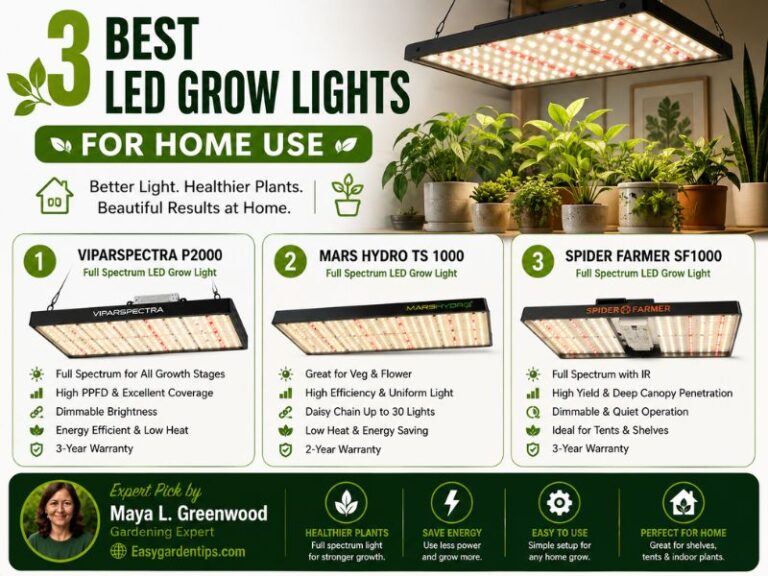
3 Best 1000W LED Grow Lights for Powerful 5×5 Growing
A true 1000W LED grow light is serious equipment for a large, high-light indoor canopy. The best 1000W LED grow lights should combine high photon output with strong system efficiency, even PPFD distribution, effective dimming, reliable thermal management, and enough physical coverage to make the electrical load worthwhile.
I would not buy a 1000W fixture simply because it has the largest number on the box. At this power level, PPF, PPE, canopy uniformity, dimming, bar spacing, heat management, driver design, and 5×5 suitability matter far more than wattage alone.
My primary recommendation is the MARS HYDRO FC-E1000W. I would choose it for most buyers who genuinely need 1000W because its current configuration combines 1000W actual input, approximately 2.8 µmol/J system PPE, roughly 2,800 µmol/s PPF, Bridgelux 2835 diodes, enhanced Osram 660nm red output, a foldable multi-bar architecture, and maximum 5×5 coverage.
I would choose the Spider Farmer G1000W when higher published efficiency and smart control matter. Its 2026 configuration specifies 1000W actual draw, 2.9 µmol/J PPE, approximately 2,940 µmol/s PPF, high-density Bridgelux diodes, upgraded Osram 660nm Hyper Red LEDs, Wi-Fi/Bluetooth app control, and 5×5 coverage.
For growers who want the higher-tier MARS HYDRO diode platform, I would choose the MARS HYDRO FC-1000W. Its current listing uses Bridgelux 3030 diodes, Osram 660nm supplementation, 2.9 µmol/J system PPE, approximately 2,900 µmol/s PPF, a foldable frame, and 5×5 maximum coverage.
3 Best 1000W LED Grow Lights Reviewed
| Image | Product Name | Check Price |
|---|---|---|
Best Choice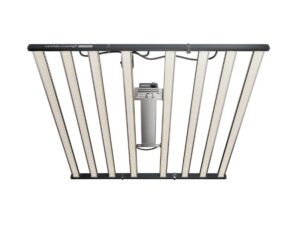 | MARS HYDRO FC-E1000W 1000W LED Grow Light | Check Price |
Second Best | Spider Farmer G1000W 1000W LED Grow Light | Check Price |
Third Choice | MARS HYDRO FC-1000W 1000W LED Grow Light | Check Price |
1. MARS HYDRO FC-E1000W 1000W LED Grow Light
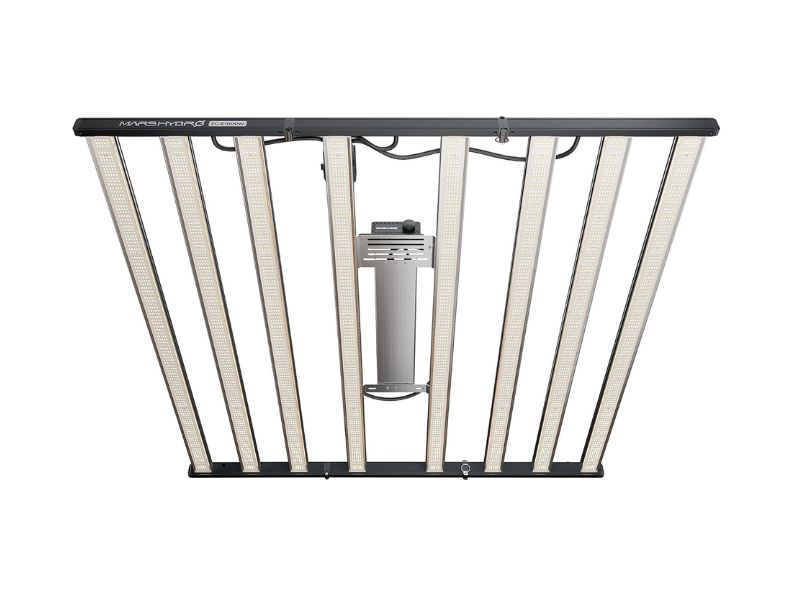
Key Features
- 1000W actual power class
- 2.8 µmol/J system PPE
- Approximately 2,800 µmol/s PPF
- Bridgelux 2835 LEDs
- Enhanced Osram 660nm red LEDs
- Full-spectrum output
- Multi-bar construction
- Foldable frame
- Dimmable
- Maximum 5×5-foot coverage
The MARS HYDRO FC-E1000W is my primary recommendation because it provides the kind of specifications I expect from a genuine 1000W horticultural fixture without relying on misleading “equivalent wattage” language.
The current Amazon listing identifies it as a 5×5 fixture using Bridgelux 2835 diodes, enhanced Osram 660nm red LEDs, 2.8 µmol/J PPE, and approximately 2,800 µmol/s total PPF.
That PPF number is important.
PPF, or Photosynthetic Photon Flux, measures how many photosynthetically active photons the fixture produces each second.
At roughly 2,800 µmol/s, this is an extremely high-output grow light.
That amount of photon capacity makes sense for:
- Large mature canopies
- High-light vegetable production
- 5×5 grow tents
- Commercial-style indoor rooms
- Advanced hydroponic systems
- Dense plant arrangements
It makes far less sense for a seedling tray, small shelf, or one or two houseplants.
The 2.8 µmol/J system PPE provides important efficiency context too.
A 1000W fixture consumes a large amount of electricity.
Therefore, conversion efficiency matters.
Two lights can both draw approximately 1000W while producing meaningfully different photon output.
PPE helps explain how efficiently electrical energy becomes plant-useful light.
The FC-E1000W’s bar design is another major advantage.
At this power level, I strongly prefer a physically distributed architecture.
Imagine concentrating 1000W worth of LED output into one relatively small board.
The center of the canopy could become extremely intense while the outer area receives substantially less.
Multiple bars spread the emitters across a much larger area.
That can improve:
- Edge PPFD
- Corner PPFD
- Center-to-edge uniformity
- Heat distribution
- Air movement through the fixture
Uniformity becomes particularly important in a 5×5 tent.
A 5×5 area contains 25 square feet.
The rough electrical density at 1000W is:
1000W ÷ 25 sq. ft. = 40 watts per square foot.
That is only a rough electrical comparison; PPFD and photon efficiency are much more useful horticultural measurements.
Still, 40 watts per square foot from an efficient modern fixture is serious lighting capacity.
Dimming is therefore essential.
I would rarely recommend switching a 1000W fixture immediately to maximum output over young plants.
A much better strategy is to increase intensity as the canopy develops.
For example:
Early growth → low-to-moderate output
Established vegetative canopy → moderate output
Large mature canopy → increase only as plant demand justifies it
This gives the grower room to use one fixture through several stages without wasting large amounts of electricity early.
The foldable frame is practical as well.
A full-size 5×5 bar fixture can be awkward to move through a doorway or around a tent.
Being able to fold the system makes:
- Transport
- Installation
- Storage
- Fixture replacement
more manageable.
The spectrum includes broad white horticultural output with enhanced deep red.
Osram 660nm red LEDs can complement the white spectrum, particularly in mature growth stages.
However, I would not choose FC-E1000W because it contains a particular red wavelength.
At this level, I would prioritize:
PPFD uniformity → PPF → system PPE → photoperiod → environment → spectral refinements.
An impressive spectrum cannot compensate for poor canopy management.
Heat is one of the main considerations.
A high-efficiency 1000W LED does not magically eliminate thermal load.
At maximum input, approximately 1000 watts of electrical energy enters the growing environment.
Some leaves as photons and is later absorbed by surfaces and plants, but practically, the room still has to deal with a substantial thermal load.
A serious setup may require:
- Proper exhaust
- Fresh-air intake
- Strong circulation
- Air conditioning
- Dehumidification
- Temperature monitoring
depending on the room and crop.
This is why I would not recommend a 1000W light merely because the budget allows it.
You need an environment capable of supporting it.
What I Like
- True 1000W-class output
- Strong ~2,800 µmol/s PPF
- Published 2.8 µmol/J system PPE
- Broad multi-bar distribution
- Osram red supplementation
- Dimmable
- Foldable architecture
- Excellent fit for serious 5×5 growing
What I Do Not Like
- Substantial electrical demand
- Major heat-management requirement
- Excessive for most small home gardens
- 2.8 µmol/J is slightly below the 2.9 µmol/J figures of the other two selections
The FC-E1000W is my primary recommendation because it provides strong 5×5 photon output, efficient full-spectrum performance, distributed bars, and mature-canopy headroom while having considerably more Amazon customer-rating history than the other true-1000W alternatives in this comparison.
2. Spider Farmer G1000W 1000W LED Grow Light
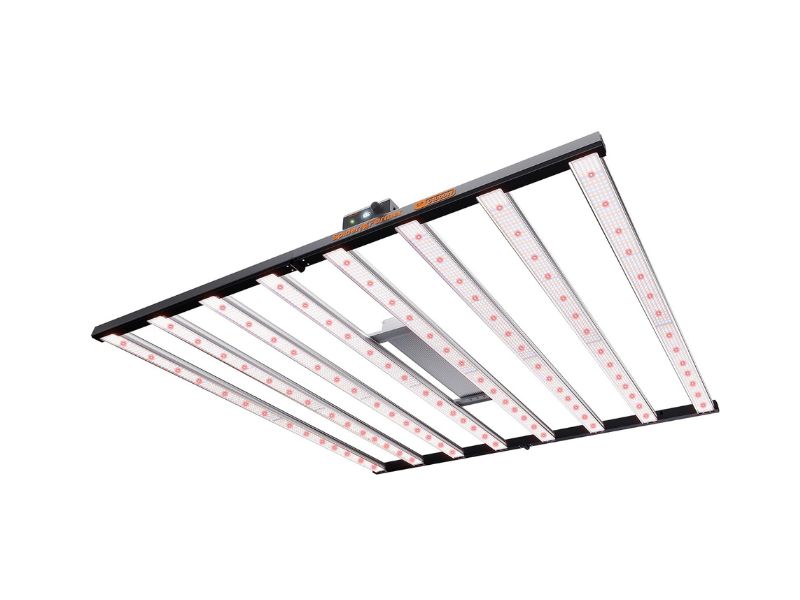
Key Features
- 1000W actual power
- 2.9 µmol/J PPE
- Approximately 2,940 µmol/s PPF
- High-density Bridgelux LED platform
- Upgraded Osram 660nm Hyper Red
- Full-spectrum output
- Bar-style architecture
- Wi-Fi and Bluetooth app control
- Sunrise/sunset simulation
- Programmable scheduling
- 5×5 coverage
- Five-year listed warranty
The Spider Farmer G1000W is the technically compelling alternative when I want a true 1000W fixture with stronger smart-control features.
The current 2026 Spider Farmer specification lists 1000W ±5% actual draw, 2.9 µmol/J PPE, approximately 2,940 µmol/s PPF, 5×5 coverage, app control, and an updated Osram 660nm Hyper Red configuration.
That places it slightly ahead of FC-E1000W on published efficiency.
The difference between:
2.8 µmol/J
and
2.9 µmol/J
may look small.
But at 1000W and thousands of operating hours, small system-efficiency improvements can matter.
Spider Farmer also publishes approximately 2,940 µmol/s PPF for the current G1000W.
That is an enormous photon budget.
Again, it should not automatically be interpreted as “more yield.”
Plants have biological and environmental limits.
Additional photons can only be used effectively when other variables support them.
These include:
- Temperature
- Humidity
- Root health
- Irrigation
- Nutrition
- CO₂ availability
- Genetics
- Leaf area
This is particularly important with 1000W fixtures because growers can easily provide more light than the plants can productively use.
The G1000W’s high-density diode layout is one of its more interesting design features.
Spider Farmer describes the G series as using a large number of Bridgelux diodes so that individual LEDs do not need to be driven as aggressively, while also improving uniform coverage.
That approach has several potential advantages.
More LEDs spread across the fixture can help:
- Smooth out the PPFD map
- Reduce severe hotspots
- Improve thermal distribution
- Increase useful edge illumination
The 2026 version also adds upgraded Osram 660nm Hyper Red output.
Again, that is useful as part of a complete full-spectrum fixture rather than something I would chase in isolation.
The most obvious difference from FC-E1000W is smart control.
The G1000W currently supports Wi-Fi and Bluetooth app control, including programmed schedules and sunrise/sunset-style gradual dimming.
Smart operation does not make plants inherently grow better.
A mechanical timer and manual dimmer can provide an excellent lighting schedule.
The value is convenience and repeatability.
For example, the app can make it easier to maintain:
- Fixed daily start times
- Fixed shutoff times
- Repeatable intensity
- Gradual ramping
- Stage-specific lighting schedules
This becomes much more valuable when several fixtures are involved.
A grower managing a single tent may be perfectly happy with manual controls.
A grower managing several zones benefits more from automation.
The bar architecture is another good fit for 5×5 coverage.
At approximately 44 inches across the current fixture dimensions, Spider Farmer spreads the lighting system over a large portion of the active canopy rather than relying on a compact center-mounted board.
That physical scale helps with uniformity.
For high-output lighting, I would rather see 850–950 µmol/m²/s over a large fraction of a canopy than an enormous center reading combined with weak outer zones.
The exact target depends on the crop and environment, but the principle is the same:
productive square footage matters more than peak marketing numbers.
The G1000W also accepts 100–277V AC input according to Spider Farmer’s technical specifications, which makes it more adaptable to different electrical installations.
For a normal U.S. home grow, the fixture can still operate from common supply voltage, but professional installations may appreciate higher-voltage compatibility.
Heat remains substantial.
At 1000W, even an efficient 2.9 µmol/J fixture adds a serious thermal load to a room.
The high-density diode arrangement may spread that heat more evenly, but it cannot eliminate it.
You still need adequate ventilation or HVAC capacity.
What I Like
- Excellent 2.9 µmol/J PPE
- Very high ~2,940 µmol/s PPF
- High-density Bridgelux architecture
- Updated Osram Hyper Red LEDs
- Broad bar-style distribution
- Wi-Fi/Bluetooth control
- Sunrise/sunset scheduling
- Full 5×5 coverage
- Strong commercial-style feature set
What I Do Not Like
- Smart system adds complexity
- 1000W is excessive for many home growers
- Large fixture needs dedicated mounting space
- High electrical and cooling demand
The G1000W is the model I would choose when published photon efficiency, 5×5 uniformity, and app-based control matter more than keeping the system simple. Its current 2.9 µmol/J and ~2,940 µmol/s specifications make it one of the strongest true-1000W options in this group.
3. MARS HYDRO FC-1000W 1000W LED Grow Light
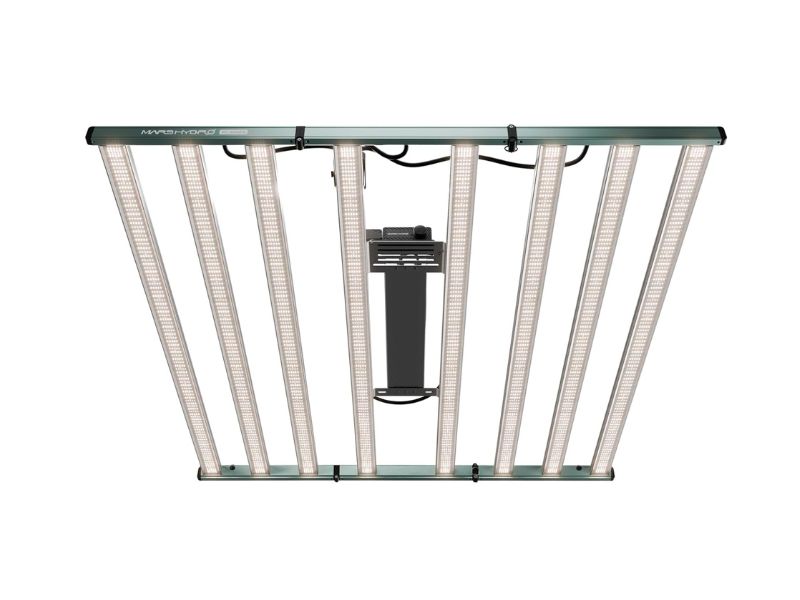
Key Features
- 1000W actual power
- Premium Bridgelux 3030 diodes
- Osram 660nm LEDs
- 2.9 µmol/J system PPE
- Approximately 2,900 µmol/s PPF
- Full-spectrum output
- Foldable multi-bar architecture
- Dimmable
- Maximum 5×5 coverage
The MARS HYDRO FC-1000W is the model I would choose when the upgraded diode platform matters more than Amazon rating history.
The current listing specifies Bridgelux 3030 diodes, Osram 660nm supplementation, 2.9 µmol/J PPE, approximately 2,900 µmol/s PPF, a foldable structure, and 5×5 maximum coverage.
This makes it different from FC-E1000W.
The two products have very similar names, so they are easy to confuse.
The distinction I would keep in mind is:
FC-E1000W: value-oriented Bridgelux 2835 platform, 2.8 µmol/J.
FC-1000W: higher-tier Bridgelux 3030 platform, 2.9 µmol/J.
The FC-1000W therefore provides slightly better published system efficiency.
At a 1000W power draw, the current listing claims approximately 2,900 µmol/s PPF.
That is nearly the same raw photon class as G1000W.
The main reason it ranks third is not performance.
It is marketplace history: its current exact Amazon listing shows only a handful of ratings, whereas FC-E1000W and G1000W have substantially more customer-rating history.
For a buyer who values the technical configuration more than Amazon rating volume, the FC-1000W may actually be more appealing than its position suggests.
The multi-bar design makes sense at this output level.
Several bars spread the 3030 diodes across the growing area.
This can help minimize the difference between the strongest center zone and the outer canopy.
For a mature 5×5 garden, that is exactly what I would want.
A light can produce an impressive PPF figure but still deliver poor real-world results if much of that output misses the useful plant area.
Physical distribution determines where the photons go.
The Osram 660nm supplementation also provides dedicated deep-red output alongside the broader white spectrum.
The fixture is therefore suitable across multiple stages rather than being a narrow-spectrum specialty light.
Dimming remains one of the most important controls.
At full output, the FC-1000W delivers far more light than most seedlings or small vegetative plants require.
Instead of changing fixtures, the grower can reduce intensity early and increase it later.
This is particularly useful when the same 5×5 space is used through an entire production cycle.
The foldable architecture also helps with practical installation.
Once unfolded, a high-power bar fixture occupies a large area.
Being able to transport it in a more compact form reduces some of the inconvenience of large grow-room hardware.
I would consider the FC-1000W primarily for:
- Serious 5×5 indoor gardens
- Commercial-style rooms
- Large mature vegetable canopies
- Hydroponic production
- Growers prioritizing high PPE
- Buyers comfortable managing 1000W of lighting
I would not buy it for:
- 2×2 tents
- Seedling-only setups
- Houseplants
- Small herb shelves
A dimmer makes a powerful light flexible, but it does not always make an oversized light the best-value choice.
What I Like
- Strong 2.9 µmol/J system PPE
- Approximately 2,900 µmol/s PPF
- Bridgelux 3030 diode platform
- Osram 660nm supplementation
- Wide bar-style architecture
- Foldable
- Dimmable
- Genuine 1000W class
What I Do Not Like
- Very limited current Amazon rating history
- Significant electrical demand
- High heat load
- Easy to confuse with FC-E1000W because of similar naming
The FC-1000W is the model I would choose when premium diode configuration and 2.9 µmol/J system efficiency matter more than marketplace track record. It is technically a strong 5×5 fixture even though the exact Amazon listing is much newer or less reviewed than the other selections.
1000W LED Grow Lights Comparison
| Product | Actual Power | Published PPF | System PPE | Fixture Style | Smart Control | Coverage |
| MARS HYDRO FC-E1000W | 1000W class | ~2,800 µmol/s | 2.8 µmol/J | Foldable multi-bar | Controller dependent | 5×5 |
| Spider Farmer G1000W | 1000W ±5% | ~2,940 µmol/s | 2.9 µmol/J | High-density bars | Wi-Fi/Bluetooth app | 5×5 |
| MARS HYDRO FC-1000W | 1000W class | ~2,900 µmol/s | 2.9 µmol/J | Foldable multi-bar | Model controls | 5×5 |
The FC-E1000W offers the strongest combination of proven Amazon history and serious output, G1000W has the highest published PPF and stronger smart controls, and FC-1000W combines premium Bridgelux 3030 hardware with 2.9 µmol/J system PPE.
How to Choose the Best 1000W LED Grow Lights
Make Sure It Is Actually 1000W
This is particularly important.
Grow-light product names have historically used numbers such as:
- 1000
- 2000
- 3000
without those numbers necessarily matching actual electrical draw.
For this guide, I focused on genuine 1000W-input-class fixtures rather than 100W lights with “1000” in the model name.
Always check actual power consumption.
1000W vs “1000W Equivalent”
They are not the same thing.
A fixture marketed as equivalent to an old 1000W lamp may draw:
- 100W
- 150W
- 200W
from the wall.
A true 1000W LED fixture like the products in this guide draws roughly ten times as much electricity as a 100W board.
That difference dramatically changes:
- Photon output
- Heat
- Electrical requirements
- Grow-space size
- Operating cost
Best 1000W LED Grow Light for 5×5
For most buyers, I would choose MARS HYDRO FC-E1000W.
Its 2.8 µmol/J efficiency, roughly 2,800 µmol/s PPF, and broad foldable architecture make it a strong all-around 5×5 option.
For growers prioritizing smart controls and slightly higher published efficiency, G1000W is particularly attractive.
Is 1000W Too Much for a 5×5 Tent?
It can be.
A 5×5 contains only 25 square feet.
A modern 1000W LED producing around 2,800–2,940 µmol/s has enormous photon capacity.
Many growers may not need maximum output all day.
That is why I consider dimming mandatory in practice for this wattage class.
The fixture gives you headroom.
You decide how much of that headroom to use.
Can You Use a 1000W Light in a 4×4?
Technically, a dimmable fixture can be operated over a 4×4.
But I usually would not select a 1000W fixture specifically for a normal 4×4.
A 4×4 contains only 16 square feet.
Unless there is a specialized reason for extreme intensity, a smaller high-efficiency light will usually be easier to manage.
PPF Is More Useful Than Wattage
Wattage tells you how much electricity enters the fixture.
PPF tells you how much total photosynthetic photon output the system creates.
Among these products, published PPF is approximately:
- 2,800 µmol/s — FC-E1000W
- 2,940 µmol/s — G1000W
- 2,900 µmol/s — FC-1000W
That makes the G1000W the highest-output model on paper.
PPE Tells You About Efficiency
PPE is measured in µmol/J.
The higher the comparable complete-system PPE, the more plant-useful photons the fixture produces for each joule of electrical input.
Here:
- FC-E1000W: 2.8 µmol/J
- G1000W: 2.9 µmol/J
- FC-1000W: 2.9 µmol/J
That makes G1000W and FC-1000W particularly strong on published system efficiency.
PPFD Matters at the Canopy
PPF tells you total output.
PPFD tells you how much photosynthetic light reaches a particular point.
This distinction matters enormously.
Two 2900 µmol/s fixtures can produce different canopy results if one has better:
- Bar spacing
- Hanging height
- Diode distribution
- Beam spread
I would always look at the complete PPFD map rather than a single center number.
Uniformity Matters More Than Peak PPFD
Suppose one fixture produces an exceptional reading directly in the center but falls dramatically toward the corners.
That may look impressive in advertising but does not necessarily maximize productive canopy area.
A better 5×5 light should maintain more useful intensity across:
- Center
- Mid-canopy
- Edges
- Corners
That is one reason bar fixtures dominate this 1000W class.
Why Bar Fixtures Make Sense at 1000W
A 1000W fixture needs room to spread its light.
Bars provide:
- Wider LED distribution
- More open airflow
- Reduced central concentration
- Improved edge potential
- Better physical heat spreading
All three selected fixtures use a wide distributed architecture rather than concentrating 1000W into a tiny board.
Bridgelux 2835 vs 3030
The FC-E1000W uses a Bridgelux 2835 platform, while FC-1000W is currently listed with Bridgelux 3030 diodes.
I would not choose based on package number alone.
The final fixture metrics matter more.
Look at:
- Complete-system PPE
- Total PPF
- PPFD distribution
- Thermal design
rather than assuming one diode package automatically guarantees better results.
Is Osram 660nm Important?
All else equal, deep-red supplementation can be useful in a broad horticultural spectrum.
Both MARS HYDRO fixtures and the current G1000W incorporate enhanced red components in their latest configurations.
However, I would not sacrifice uniformity or efficiency merely to obtain more red LEDs.
Fundamental light delivery comes first.
Dimming Is Essential at 1000W
A 1000W light gives you a very large output range.
Dimming allows that capacity to be matched to plant development.
It can help reduce:
- Electricity use
- Excess heat
- Early-stage light stress
- Wasted photons
The goal is not to run maximum power because you paid for maximum power.
The goal is to provide the amount of light the canopy can use.
Smart Control vs Manual Dimming
The Spider Farmer G1000W is the strongest smart-control choice here.
It supports app-based scheduling, brightness control, and sunrise/sunset-style ramping in the current 2026 configuration.
Those features improve convenience.
They are not biologically required.
A reliable timer and manual dimmer can still provide an excellent lighting program.
Sunrise and Sunset Simulation
Gradual ramping may make transitions less abrupt and is convenient for automation.
However, I would not buy a fixture solely for simulated sunrise.
The important variables remain:
- Daily photon total
- Correct intensity
- Correct timing
- Good environmental control
Best 1000W LED Grow Light for High Yield
I would consider the Spider Farmer G1000W particularly attractive when raw output and efficiency are priorities because it publishes approximately 2,940 µmol/s PPF at 2.9 µmol/J.
The actual biological result still depends heavily on the entire grow system.
Best 1000W LED Grow Light for Professional Use
Both G1000W and FC-1000W are strong technical options.
G1000W’s smart controls and wide voltage support make it particularly suitable for more complex installations.
FC-E1000W remains attractive when you want strong output with much more Amazon marketplace history.
Best 1000W LED Grow Light for Hydroponics
Any of these fixtures can work over a large hydroponic canopy.
I would pay special attention to:
- Reservoir temperature
- Room temperature
- Humidity
- Electrical isolation from water
- Canopy uniformity
because a 1000W fixture adds significant thermal and electrical load to a hydroponic environment.
Best 1000W Light for Tomatoes
Large mature tomato plants can use substantial light when all other conditions are suitable.
A broad 5×5 bar system is much more appropriate than a compact panel when several tomato plants share one canopy.
G1000W’s high published output makes it particularly interesting for high-demand mature plants.
Best 1000W Light for Peppers
The same basic principle applies.
A few young peppers do not need 1000W.
A fully developed 5×5 canopy can make much better use of the fixture.
Dimming allows one light to support the transition between those stages.
Best 1000W Light for Seedlings
None of these would be my first purchase for seedling-only use.
They can be heavily dimmed, but a smaller propagation fixture is generally more proportionate.
A 1000W fixture becomes sensible when those seedlings will eventually grow into a large mature canopy under the same light.
How Much Electricity Does a 1000W Grow Light Use?
At full power:
1000W = 1 kilowatt
At 12 hours daily:
1 kW × 12 hours = 12 kWh/day
Over 30 days:
360 kWh/month
At 16 hours daily:
1 × 16 = 16 kWh/day
Over 30 days:
480 kWh/month
Multiply by your local electricity rate to estimate operating cost.
Electricity Cost Can Become Significant
A 1000W light is not like a small 10W houseplant lamp.
It can consume hundreds of kilowatt-hours per month when run at high output.
That makes system efficiency and dimming financially meaningful.
Saving a little power every day can become significant across a long grow cycle.
Heat Load From 1000W LEDs
Expect substantial heat.
Even efficient LEDs eventually add energy to the growing environment.
A fanless or passively cooled fixture may be quiet, but the room can still become warm.
Plan:
- Exhaust
- Intake
- Circulation
- HVAC
- Dehumidification
before installing the light.
Can a 1000W LED Run on a Normal U.S. Outlet?
That depends on the fixture, circuit, voltage, and other equipment using the circuit.
For rough context, 1000W at 120V is around:
1000 ÷ 120 ≈ 8.3 amps
before considering exact operating specifications.
Spider Farmer lists the G1000W at approximately 8.2A on 120V in its technical data.
Do not forget the additional loads from:
- Exhaust fans
- Dehumidifiers
- Pumps
- Heaters
- Air conditioners
- Circulation fans
Circuit planning should consider the complete setup.
Higher Voltage Can Reduce Current
For the same power level, operating at a higher voltage reduces current.
Spider Farmer lists G1000W compatibility across 100–277V in the current specifications.
Professional installations may therefore have more electrical configuration flexibility than basic home setups.
Do Not Daisy-Chain Power Strips
A powerful grow setup should not depend on improvised extension and power-strip chains.
Use properly rated electrical equipment.
When high-wattage lighting, pumps, HVAC, and other equipment share a space, electrical planning deserves the same attention as horticultural planning.
1000W Grow Lights and CO₂
Very high light intensity can increase photosynthetic demand.
In advanced controlled environments, growers sometimes coordinate elevated light with managed CO₂.
That does not mean a 1000W grow light automatically requires CO₂ supplementation.
It means extreme light should be viewed as one component of a complete environment rather than an isolated upgrade.
Higher Light Does Not Automatically Mean Higher Yield
Yield can be limited by:
- Plant genetics
- Temperature
- Root health
- Water availability
- Nutrient balance
- CO₂
- Humidity
- Canopy management
Once another variable becomes limiting, additional light may provide diminishing returns.
A properly managed 700W system can outperform a poorly managed 1000W system.
Daily Light Integral Matters
DLI, or Daily Light Integral, measures the total photosynthetic light received over an entire day.
This means both intensity and runtime matter.
High PPFD for fewer hours can sometimes deliver a similar daily photon total to lower PPFD over a longer period.
Do not optimize photoperiod without considering intensity.
Detachable Drivers Can Help Heat Placement
Some large grow lights allow the driver to be mounted away from the fixture.
This does not eliminate heat, but it can move part of the thermal load away from the immediate canopy.
That may be valuable in compact tents or multi-level grow rooms.
Maintain Good Airflow
A powerful light can support a dense canopy, but dense foliage can trap moisture.
Use gentle circulation to reduce stagnant pockets.
Air should move around:
- Upper leaves
- Lower leaves
- Growing tips
without constantly blasting plants with high-speed airflow.
Common 1000W Grow-Light Buying Mistakes
Confusing Model Number With Actual Wattage
Always verify wall draw.
Buying 1000W for a Tiny Tent
Match power to canopy size.
Running Maximum Power Immediately
Use the dimmer.
Comparing Only Wattage
PPF and PPE are more informative.
Comparing Only Peak PPFD
Check the entire canopy map.
Ignoring Electricity Cost
1000W running for many hours uses substantial energy.
Ignoring Heat
Cooling requirements can become a major part of the setup.
Paying for Smart Features You Will Never Use
Automation should solve a practical problem.
Choosing by Diode Brand Alone
Evaluate the complete fixture.
Assuming More Light Guarantees More Yield
The entire plant environment must support the light level.
Frequently Asked Questions
What are the best 1000W LED grow lights?
FC-E1000W, G1000W, and FC-1000W are my three true-1000W selections.
All three are large 5×5-class bar fixtures with published horticultural photon specifications rather than merely “1000W equivalent” marketing.
What is my primary recommendation?
MARS HYDRO FC-E1000W is my primary choice for most true-1000W buyers.
It combines approximately 2,800 µmol/s PPF, 2.8 µmol/J PPE, a foldable bar frame, and much more current Amazon rating history than the alternatives.
Which 1000W grow light has the highest published PPF?
Spider Farmer G1000W has the highest published figure here at about 2,940 µmol/s.
Its current 2026 specification also lists 2.9 µmol/J PPE.
Which 1000W grow light is most efficient?
G1000W and FC-1000W both publish approximately 2.9 µmol/J system PPE.
FC-E1000W is currently listed at approximately 2.8 µmol/J.
Are these actually 1000W grow lights?
Yes, these selections are approximately 1000W actual-input fixtures, not 1000W-equivalent lamps.
That makes them fundamentally different from products such as 100W fixtures whose model names contain “1000.”
Is a 1000W LED good for a 5×5 tent?
Yes, but it provides extremely high photon capacity and may need significant dimming.
All three selected models are positioned around maximum 5×5 coverage.
Is 1000W too much for a 4×4?
It is more capacity than I would select for most ordinary 4×4 gardens.
A smaller efficient fixture is usually easier to manage unless there is a specialized reason for extreme light levels.
What is PPF?
PPF measures the total photosynthetically active photons a fixture emits every second.
It is typically expressed in µmol/s and is more useful than wattage alone for comparing total horticultural output.
What is PPE?
PPE measures photosynthetic photon output produced per joule of electrical energy consumed.
It helps compare the efficiency of complete grow-light systems.
What is PPFD?
PPFD measures photosynthetic photon density reaching a specific location on the canopy.
It changes with fixture height, dimming, bar spacing, and position beneath the light.
Is 2.9 µmol/J good?
Yes, 2.9 µmol/J is a strong published system-efficiency level for this fixture class.
Both G1000W and FC-1000W currently list approximately 2.9 µmol/J.
Is 2,900 µmol/s PPF a lot?
Yes, that is extremely high total photon output for a home indoor garden.
Such output makes most sense across a large mature canopy where the photons can actually be intercepted and used.
Which 1000W grow light has app control?
Spider Farmer G1000W is the strongest smart-control option in this comparison.
The 2026 model supports Wi-Fi/Bluetooth control, schedules, dimming, and sunrise/sunset simulation.
Which 1000W grow light uses Bridgelux 3030 diodes?
MARS HYDRO FC-1000W uses the Bridgelux 3030 platform in its current configuration.
It also combines those LEDs with Osram 660nm supplementation.
What is the difference between FC-E1000W and FC-1000W?
FC-E1000W is the value-oriented 2835 platform; FC-1000W uses the higher-tier 3030 platform.
Their published system efficiencies are approximately 2.8 and 2.9 µmol/J respectively.
Are bar-style 1000W grow lights better?
Bars are particularly useful at this wattage because they distribute LEDs over a larger area.
That can improve edge uniformity, airflow, and heat distribution compared with a compact central source.
Do I need to run a 1000W grow light at full power?
No, maximum output should only be used when the canopy and environment can use it.
Dimming is one of the most important features on a true 1000W fixture.
How much electricity does a 1000W grow light use in 12 hours?
At full output, approximately 12 kWh per day.
Over 30 days, that is approximately 360 kWh before accounting for dimming.
How much electricity does a 1000W grow light use in 16 hours?
At full output, approximately 16 kWh per day.
That equals roughly 480 kWh over 30 days.
Do 1000W LED grow lights produce a lot of heat?
Yes, a true 1000W fixture creates a substantial heat load despite high LED efficiency.
Plan ventilation, circulation, and potentially HVAC around the full room rather than only the fixture temperature.
Can I use a 1000W grow light for seedlings?
Yes when heavily dimmed, but a dedicated seedling fixture is usually more proportionate.
A 1000W light makes more sense when those plants will eventually fill a large mature canopy.
Which 1000W LED grow light should I buy?
Choose FC-E1000W for balance, G1000W for smart efficiency, or FC-1000W for premium hardware.
The correct choice depends on whether marketplace history, automation, or the higher-tier diode platform matters most.
Conclusion
The best 1000W LED grow lights are serious high-output fixtures intended for large indoor canopies, not oversized versions of ordinary houseplant lamps. At this power level, I would prioritize system PPE, total PPF, PPFD uniformity, dimming, bar geometry, electrical requirements, and thermal management before focusing on secondary features.
The MARS HYDRO FC-E1000W remains my primary recommendation. Its 1000W-class input, approximately 2.8 µmol/J system PPE, roughly 2,800 µmol/s PPF, Bridgelux 2835 platform, enhanced Osram red output, foldable bars, and 5×5 coverage create a strong balance of output and practical design.
The Spider Farmer G1000W is my choice when efficiency and automation are higher priorities. Its current 2026 configuration provides approximately 2.9 µmol/J PPE and 2,940 µmol/s PPF, along with Wi-Fi/Bluetooth app control and upgraded red supplementation.
The MARS HYDRO FC-1000W is the technically attractive premium alternative. Its Bridgelux 3030 diode platform, Osram 660nm supplementation, approximately 2.9 µmol/J PPE, and 2,900 µmol/s PPF give it excellent specifications despite its much smaller current Amazon rating history.
For most buyers genuinely needing this power class, I would choose MARS HYDRO FC-E1000W. For maximum published PPF plus smart control, I would choose Spider Farmer G1000W. For the premium MARS HYDRO diode platform, I would choose FC-1000W.

I’m Maya L. Greenwood, a lifelong plant lover who believes anyone can grow something beautiful with the right guidance. After years of testing soil mixes, pruning methods, irrigation tricks, and pest-safe solutions, I started EasyGardenTips.com to turn hard-won lessons into step-by-step advice. From seed starting and container gardens to composting and seasonal checklists, my goal is to make gardening simple, sustainable, and fun.