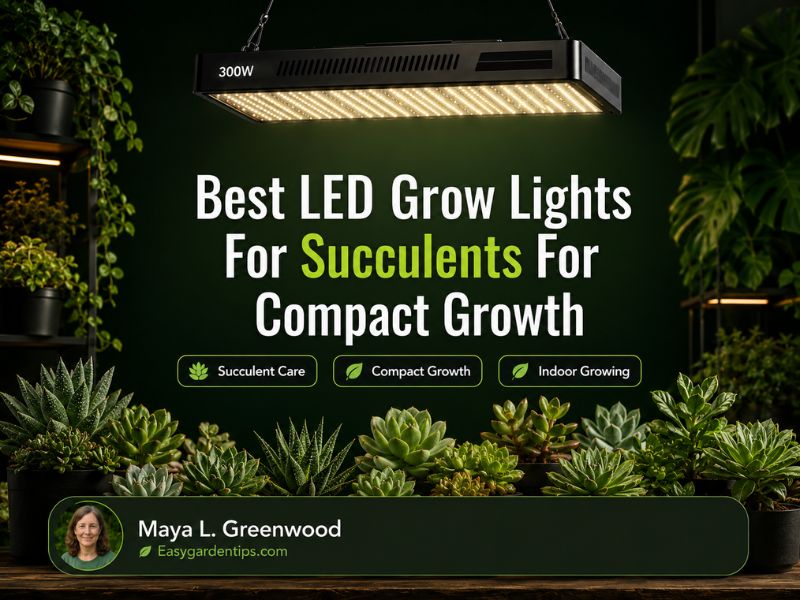
3 Best LED Grow Lights for Succulents for Compact Growth
Succulents often need more usable light than typical low-light houseplants, especially when grown away from a bright window. The best LED grow lights for succulents should provide enough intensity to help plants stay compact while offering practical coverage, sensible positioning, and an easy daily lighting schedule.
My primary recommendation is the GooingTop 6000K Full Spectrum LED Grow Light. I would choose it for a few succulents because its current listing combines 6000K white/red output, five brightness levels, flexible gooseneck positioning, and a repeating 4/8/12-hour timer in a compact clip-on design.
I would choose the Barrina T5 4FT Grow Lights 8-Pack for a larger succulent shelf or collection. The package includes eight 4-foot fixtures at 20W each for 160W total, and the current Amazon listing specifically markets them for succulents, seedlings, and greenhouse growing.
For one small pot or a very compact desk setup, I would choose the SANSI 10W Pot Clip Grow Light. It provides 10W actual power, 4000K full-spectrum output, four dimming levels, and 3/6/12-hour automatic timing while clipping directly to the pot.
3 Best LED Grow Lights for Succulents Reviewed
| Image | Product Name | Check Price |
|---|---|---|
Best Choice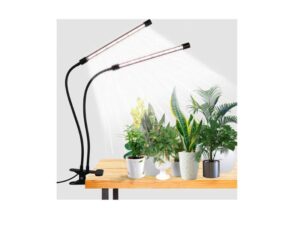 | GooingTop 6000K Full Spectrum LED Grow Light | Check Price |
Second Best | Barrina T5 4FT Grow Lights 8-Pack | Check Price |
Third Choice | SANSI 10W Pot Clip Grow Light | Check Price |
1. GooingTop 6000K Full Spectrum LED Grow Light
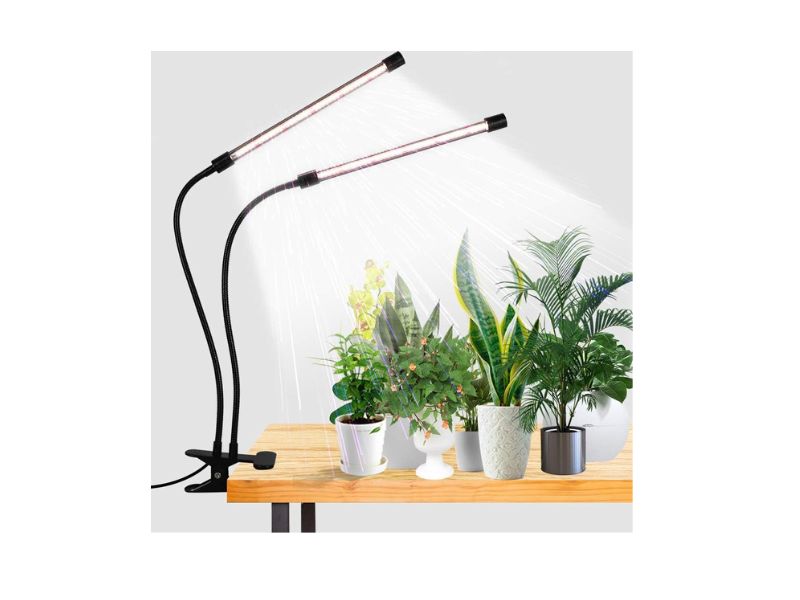
Key Features
- 6000K full-spectrum-style lighting
- White and red LEDs
- Five brightness settings
- 4/8/12-hour repeating timer
- Flexible gooseneck
- Clamp mounting
- Compact footprint
- Good for a few succulent pots
The GooingTop is my primary recommendation for a small succulent setup because it gives you much more control over placement than a fixed overhead lamp.
Its current Amazon listing identifies it as a 6000K full-spectrum clip lamp with five-level dimming and automatic 4-, 8-, and 12-hour timing.
That makes it particularly useful for succulents on:
- A desk
- A windowsill
- A shelf
- A small plant stand
- A kitchen counter
Succulents often become stretched when they receive insufficient usable light.
You may notice:
- Wider spacing between leaves
- Rosettes opening up
- Thin new growth
- Leaning toward a window
- Loss of compact form
A grow light cannot reverse old stretched growth, but better light can help future growth develop more compactly.
The five brightness levels make it easier to acclimate plants gradually.
If a succulent has been sitting in a dim room, I would not immediately place the lamp extremely close at maximum brightness.
Instead, increase exposure progressively.
The flexible gooseneck is especially useful because light intensity depends strongly on distance.
A modest lamp positioned close to a compact succulent canopy can be more useful than a stronger lamp positioned several feet away.
The white 6000K appearance is also convenient for indoor living spaces.
Unlike strongly purple horticultural lights, it allows you to see natural-looking leaf color and check for:
- Sun stress
- Yellowing
- Rot
- Pests
- Damage
- General plant condition
The built-in timer reduces clutter.
That can be valuable in small spaces where adding a separate timer plug makes the setup awkward.
The limitation is coverage.
One GooingTop lamp is better suited to a few closely grouped plants than a full shelf of succulents.
Once the collection becomes wider than the fixture’s useful illumination zone, Barrina makes more sense.
What I Like
- Very easy to position
- Five brightness settings
- Built-in repeating timer
- Natural-looking white light
- Compact clamp design
- Strong current Amazon rating history
What I Do Not Like
- Limited coverage
- Not ideal for a large succulent shelf
- Maximum timer setting is 12 hours
The GooingTop is the model I would choose for a few succulents that need flexible supplemental lighting without a permanent shelf installation.
2. Barrina T5 4FT Grow Lights 8-Pack
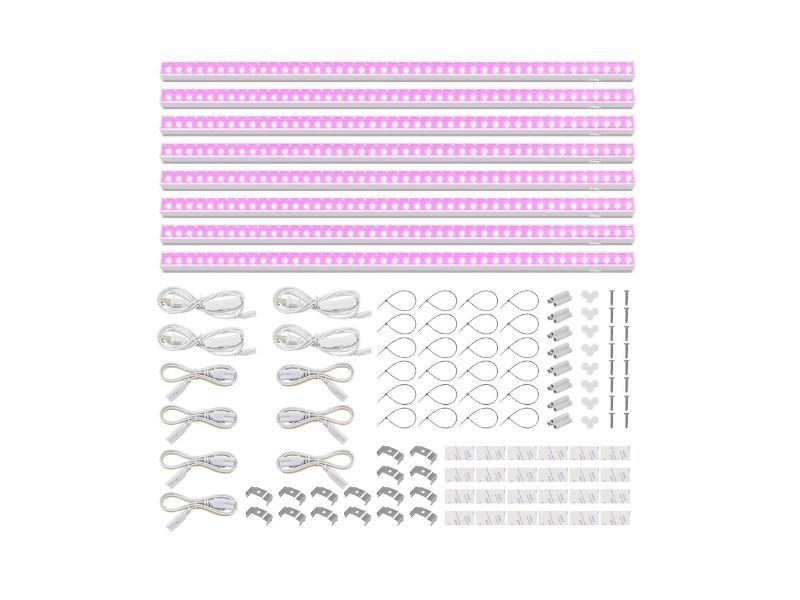
Key Features
- Eight 4-foot LED bars
- 20W per fixture
- 160W total package
- Full-spectrum output
- Separate on/off controls
- Plug-and-play installation
- Flexible mounting
- Specifically marketed for succulents
- Excellent for shelves and collections
The Barrina T5 system is my preferred choice for a substantial succulent collection.
Its current U.S. Amazon listing specifies eight four-foot lights, each using 20W, for 160W total package power and specifically includes succulents among its intended applications.
The major advantage is geometry.
Succulent collections are often arranged across long shelves.
A clip light produces a relatively narrow light zone.
A four-foot linear bar follows the shape of the shelf much more naturally.
Several bars can be mounted in parallel to increase both intensity and front-to-back coverage.
That is useful for:
- Echeveria
- Haworthia
- Aloe
- Crassula
- Sedum
- Graptopetalum
- Mixed succulent collections
You do not need to use all eight fixtures on one shelf.
A practical arrangement might be:
- Two bars per shelf across four levels
- Four bars over two high-light shelves
- Different numbers of bars for different plant groups
That modularity is one of the biggest reasons I like Barrina.
Succulents can vary considerably in light demand.
Some tolerate moderate indoor light better than others, while sun-loving rosette succulents often benefit from stronger illumination.
Adding or removing bars gives you a simple way to change total intensity.
Separate on/off controls also mean unused fixtures can remain off.
This is useful if only part of your rack is occupied.
The T5 format can also help reduce edge stretching.
A single point source over the center of a shelf encourages plants at the ends to lean inward.
Linear lights distribute output more evenly along the shelf.
Installation is the main tradeoff.
You need to think about:
- Mounting height
- Bar spacing
- Cable routing
- Number of bars per level
I would also pair the system with a properly rated external timer for consistent daily operation.
What I Like
- Excellent shelf geometry
- Specifically listed for succulents
- Eight independently usable fixtures
- 160W total available output
- Easy to scale across multiple shelves
- Broad, even coverage
What I Do Not Like
- Requires mounting
- More cables than a clip lamp
- External timer is preferable
- Excessive for one or two plants
The Barrina T5 system is the clear choice when I want broad, repeatable lighting across an entire succulent shelf or collection.
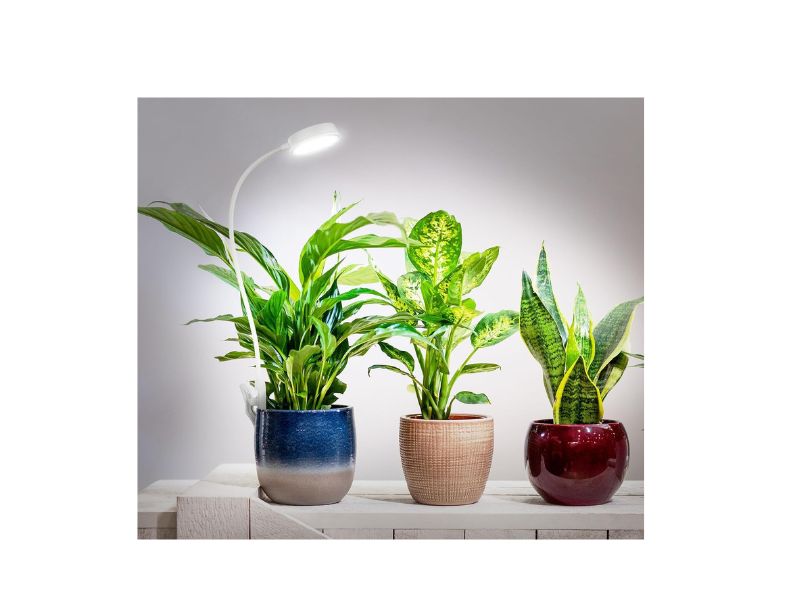
3. SANSI 10W Pot Clip Grow Light
Key Features
- 10W actual power
- 4000K full-spectrum output
- Pot-mounted clip
- Four brightness levels
- 3/6/12-hour timer
- Compact adjustable design
- Minimal independent footprint
- Ideal for one small succulent
The SANSI 10W Pot Clip is the smallest and most targeted option here.
Its current Amazon listing specifies 10W actual power, 4000K full-spectrum light, four dimming levels, and automatic 3-, 6-, and 12-hour timing.
Instead of clipping to a desk or shelf, the light attaches directly to the plant pot.
That makes it especially useful for:
- One Echeveria
- Small Aloe
- Haworthia
- Crassula
- Single desk succulent
- Window plant needing supplemental light
The biggest advantage is space efficiency.
There is no separate lamp base or floor stand.
The plant and light function as one compact unit.
That can be particularly useful in:
- Apartments
- Offices
- Dorm rooms
- Narrow shelves
- Crowded desks
The 4000K appearance is relatively neutral compared with very cool white grow lights.
That can make it more comfortable in a living or working area.
The four brightness levels also help with acclimation.
A shade-tolerant Haworthia may not need the same intensity as a sun-loving rosette succulent.
You can adjust the dimmer and lamp distance rather than treating every plant identically.
The timer provides three choices:
- 3 hours
- 6 hours
- 12 hours
This is convenient for supplemental lighting.
If the succulent relies almost entirely on artificial light, however, the appropriate daily light period depends on intensity, species, and plant response rather than simply choosing the longest timer setting.
The main limitation is obvious: the SANSI is for one small growing zone.
A collection of ten succulents would be better served by one well-designed shelf-light system than ten separate pot lights and power cables.
What I Like
- Clips directly to the pot
- Very small footprint
- 10W actual power
- Four brightness settings
- Integrated timer
- Neutral-looking 4000K output
What I Do Not Like
- Very limited coverage
- Not practical for large collections
- Several units can create cable clutter
The SANSI is the light I would choose when the goal is to give one succulent a dedicated full-spectrum light without using extra shelf or desk space.
LED Grow Lights for Succulents Comparison
| Product | Format | Power | Dimming | Timer | Coverage | Best Use |
| GooingTop 6000K | Clamp/gooseneck | Compact | 5 levels | 4/8/12 hr | Small | A few succulents |
| Barrina T5 8-Pack | Eight 4-ft bars | 160W total | By fixture layout | External recommended | Large | Shelves/collections |
| SANSI Pot Clip | Pot-mounted | 10W | 4 levels | 3/6/12 hr | Very small | One succulent |
The GooingTop is the easiest general-purpose option, Barrina provides the best shelf-wide coverage, and SANSI minimizes space when only one pot needs light.
How to Choose the Best LED Grow Lights for Succulents
Succulents Need Enough Intensity
The word “full spectrum” does not automatically mean a light is strong enough.
A low-output lamp can still produce stretched growth if it is mounted too far away or expected to cover too much area.
For succulents, I would prioritize:
- Useful intensity
- Coverage
- Distance
- Daily light duration
- Spectrum details
Watch for Etiolation
Etiolation is one of the clearest signs of insufficient light.
Depending on the succulent, you may see:
- Long stems
- Widely spaced leaves
- Open rosettes
- Leaning
- Pale new growth
Improved lighting helps future growth, but already stretched sections will not become compact again.
Increase Light Gradually
Do not take a plant from weak indoor light directly into extremely intense artificial light.
Sudden exposure can cause:
- Bleaching
- Discoloration
- Stress marks
Increase intensity or duration gradually.
Best Grow Light for One Succulent
For one pot, I would choose SANSI 10W Pot Clip.
It keeps the lighting system physically attached to the plant and uses almost no independent space.
For one larger or particularly sun-loving succulent, a stronger directional grow bulb may eventually be more appropriate.
Best Grow Light for Several Succulents
For a handful of closely grouped pots, GooingTop is my preferred option.
The flexible head makes it easy to center the light over the group.
Best Grow Light for a Succulent Shelf
Barrina is the strongest fit.
Linear bars align naturally with long shelving and provide much better end-to-end coverage than a central clip lamp.
Best Grow Light for Echeveria
Echeveria often shows insufficient light clearly by opening up and stretching.
For one plant, use a close, appropriately positioned lamp.
For several Echeverias on a shelf, I would choose Barrina and arrange enough bars to provide strong even light.
Best Grow Light for Haworthia
Haworthia generally tolerates less intense light than many sun-loving rosette succulents.
A small dimmable fixture such as SANSI can therefore be particularly useful.
Start conservatively and watch leaf color and growth habit.
Best Grow Light for Aloe
Aloe can become larger than many small desktop succulents.
For one young plant, GooingTop may be sufficient.
For several larger Aloe plants, a broader shelf or panel system may be more appropriate.
Best Grow Light for Jade Plants
Young jade plants can work well under GooingTop or SANSI.
As a jade becomes larger and develops a wider canopy, increase the illuminated area accordingly.
The grow light should cover the whole upper canopy, not only one branch.
Full Spectrum Is Convenient Indoors
Broad white full-spectrum lighting provides plant-usable wavelengths while keeping the room relatively natural-looking.
It also makes it easier to inspect:
- Leaf color
- Pest damage
- Rot
- Edema
- Light stress
than strongly purple lights.
4000K vs 6000K for Succulents
SANSI uses 4000K, while GooingTop uses a cooler 6000K white/red configuration.
Both can work.
Color temperature alone does not determine whether a succulent receives enough light.
Intensity and coverage are more important.
How Close Should a Grow Light Be?
There is no universal distance.
The correct setup depends on:
- Fixture output
- Beam spread
- Dimmer setting
- Plant species
- Natural window light
Follow manufacturer guidance first.
Then watch the plant.
If it stretches, usable intensity may be too low.
If it bleaches or develops stress directly beneath the light, intensity may be too high.
How Long Should Grow Lights Run?
Daily duration depends on the intensity reaching the plant.
A weak light often needs a longer daily photoperiod than a stronger fixture.
Succulents receiving several hours of strong natural sunlight may only need supplemental artificial lighting.
Use plant response rather than copying one universal hour count.
Do Succulents Need Darkness?
Yes.
A normal growing routine should include a regular dark period.
Do not leave grow lights on 24 hours simply because the plant appears to need more light.
PPFD Matters More Than Lumens
PPFD measures the density of photosynthetically active photons reaching the plant canopy.
Lumens measure brightness according to human vision.
For plant performance, PPFD is the more relevant concept.
Unfortunately, many inexpensive consumer grow lights do not provide high-quality PPFD maps.
When reliable data are unavailable, use:
- Fixture distance
- Coverage
- Plant growth
- Dimming
- Actual wattage
as practical guides.
Succulent Shelf Lighting
For shelves, uniformity is especially important.
Plants at the ends should not consistently receive much less light than those at the center.
Mounting several linear bars parallel to each other is often more effective than using one central lamp.
Grow Lights and Succulent Color
Some succulents develop red, pink, or purple stress coloration under strong light.
However, color alone is not always a reliable measure of plant health.
Genetics, temperature, watering, and nutrition can also affect pigmentation.
Do not increase light endlessly just to force coloration.
Grow Lights and Watering
More usable light can increase plant activity and water use.
But succulents still need well-drained media and appropriate dry periods.
Do not assume stronger grow lights justify keeping soil constantly moist.
Airflow Matters
Dense succulent shelves can trap humidity.
Maintain some airflow around:
- Leaves
- Pots
- Soil surface
- Lighting fixtures
This is particularly important when many plants are grouped closely together.
Common Succulent Grow-Light Mistakes
Using One Tiny Light for a Whole Shelf
Match coverage to plant area.
Hanging the Light Too Far Away
Intensity drops rapidly with distance.
Increasing Light Too Quickly
Acclimate gradually.
Running Lights 24 Hours
Maintain a dark period.
Ignoring Edge Plants
Watch for leaning and stretching.
Choosing by Lumens Alone
Human brightness is not the same as plant-useful light.
Expecting Old Stretching to Reverse
Improved lighting affects new growth.
Frequently Asked Questions
What are the best LED grow lights for succulents?
GooingTop, Barrina T5, and SANSI are my three choices for different succulent setups.
GooingTop works well for a few plants, Barrina suits shelves, and SANSI is ideal for one pot.
What is the best LED grow light for a few succulents?
GooingTop is my primary recommendation for several closely grouped small succulents.
Its five brightness settings, flexible gooseneck, and timer make placement and scheduling easy.
What is the best grow light for one succulent?
The SANSI 10W Pot Clip is my preferred option for one small plant.
It attaches directly to the pot and provides four dimming levels plus automatic timing.
What is the best grow light for a succulent shelf?
Barrina T5 is the strongest choice here for long shelves and larger collections.
Its eight four-foot bars provide 160W total available output and flexible mounting.
Are Barrina T5 lights good for succulents?
Yes, the current Amazon listing specifically includes succulents among its intended uses.
The linear format also works particularly well for shelf-wide coverage.
Is 10W enough for a succulent?
It can be enough for one small plant when positioned appropriately.
Coverage and distance matter just as much as the wattage number.
Is 6000K good for succulents?
Yes, 6000K cool-white lighting can work well for succulent growth.
GooingTop combines its 6000K white output with red LEDs.
Is 4000K good for succulents?
Yes, 4000K full-spectrum-style white is practical for many indoor succulents.
SANSI uses this more neutral-looking color temperature in the selected model.
How many hours should a grow light be on for succulents?
Daily duration depends on intensity, species, natural daylight, and fixture distance.
Use a consistent timer but adjust the schedule according to how much usable light actually reaches the plant.
Can succulents get too much grow light?
Yes, especially when they are moved abruptly from low light to high intensity.
Watch for bleaching, discoloration, or stressed growth and acclimate gradually.
Why is my succulent stretching under a grow light?
Stretching usually means the plant is not receiving enough usable light.
Increase intensity gradually, move the lamp closer when appropriate, or improve coverage.
Will grow lights fix a stretched succulent?
They can improve future growth but will not reverse already elongated tissue.
Pruning or propagation may be needed if the old shape is undesirable.
Should a grow light be directly above succulents?
Overhead placement usually encourages more symmetrical and compact growth.
Strong side lighting can make plants lean toward the source.
Do succulents need full-spectrum lights?
Full-spectrum LEDs are convenient, but adequate intensity is more important than the label alone.
A weak full-spectrum light can still produce stretched plants.
Do succulents need darkness?
Yes, give them a normal daily dark period rather than continuous 24-hour lighting.
A timer makes this routine much easier.
Is PPFD important for succulents?
Yes, PPFD describes the plant-useful photon density reaching the succulent canopy.
It changes substantially with distance, dimming, and fixture placement.
Can I use a grow light with natural window light?
Yes, supplemental artificial lighting works very well when window light is insufficient or seasonal.
A compact GooingTop setup is particularly convenient for this use.
Which grow light is best for Echeveria?
Barrina is excellent for several Echeverias, while GooingTop works for a small group.
The goal is enough intensity to maintain compact rosette growth.
Which grow light is best for Haworthia?
A dimmable SANSI or GooingTop light is a practical choice for Haworthia.
These plants often need less intensity than many sun-loving rosette succulents.
Which grow light is best for jade plants?
GooingTop is suitable for a small jade, while larger plants need broader coverage.
As the canopy expands, make sure the entire plant receives useful overhead light.
Do LED grow lights increase watering needs?
Potentially, because stronger light can increase plant activity and moisture use.
Still allow the growing medium to dry appropriately for the succulent species.
Conclusion
The best LED grow lights for succulents should provide enough usable intensity to maintain compact new growth while matching the size and shape of the collection. I would prioritize coverage, fixture distance, dimming, timer control, and full-spectrum white light rather than choosing by wattage or color temperature alone.
The GooingTop 6000K is my primary recommendation for a few succulents. Its flexible clamp, five brightness levels, white/red output, and repeating timer make it especially easy to use on a desk, shelf, or small plant stand.
The Barrina T5 system is my preferred option for a larger succulent collection. Its eight four-foot fixtures provide 160W total available output, and the linear format is much better suited to broad shelf coverage than a single point-source lamp.
The SANSI 10W Pot Clip is the most compact option. Its 10W power, 4000K full-spectrum output, four brightness levels, and 3/6/12-hour timer make it particularly convenient for one plant where available space is limited.
For a few succulents, I would choose GooingTop. For a full shelf or multi-level collection, I would choose Barrina T5. For one small pot with almost no spare space, I would choose SANSI 10W Pot Clip.

I’m Maya L. Greenwood, a lifelong plant lover who believes anyone can grow something beautiful with the right guidance. After years of testing soil mixes, pruning methods, irrigation tricks, and pest-safe solutions, I started EasyGardenTips.com to turn hard-won lessons into step-by-step advice. From seed starting and container gardens to composting and seasonal checklists, my goal is to make gardening simple, sustainable, and fun.