3 Best LED Grow Lights Professional Growers Can Rely On
The best LED grow lights professional growers choose should do more than deliver high wattage. Commercial-quality lighting needs strong photon output, good PPFD uniformity, dependable dimming, efficient thermal management, useful controls, and enough physical coverage to illuminate an entire production canopy rather than only its center.
For a serious indoor grow room, I would pay particular attention to system PPE, PPF, bar spacing, driver placement, 5×5 coverage, control scalability, electrical load, and serviceability. Those factors become increasingly important when a light operates for thousands of hours and may eventually be installed alongside several identical fixtures.
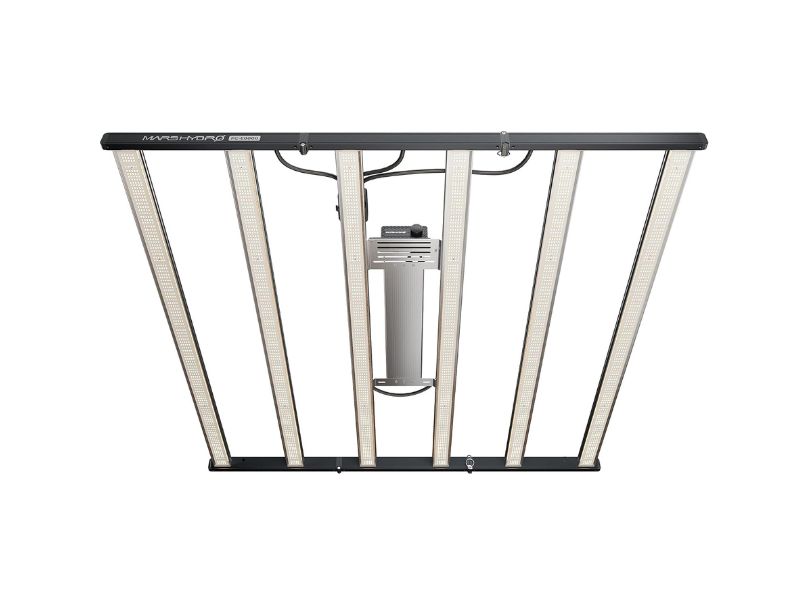
My primary recommendation is the MARS HYDRO FC-E8000 800W LED Grow Light. I would choose it when strong commercial-class photon output is the priority because the current listing specifies 800W actual power, 2.8 µmol/J PPE, approximately 2,240 µmol/s PPF, Bridgelux 2835 diodes, enhanced Osram 660nm red output, a foldable bar architecture, and maximum 5×5 coverage.
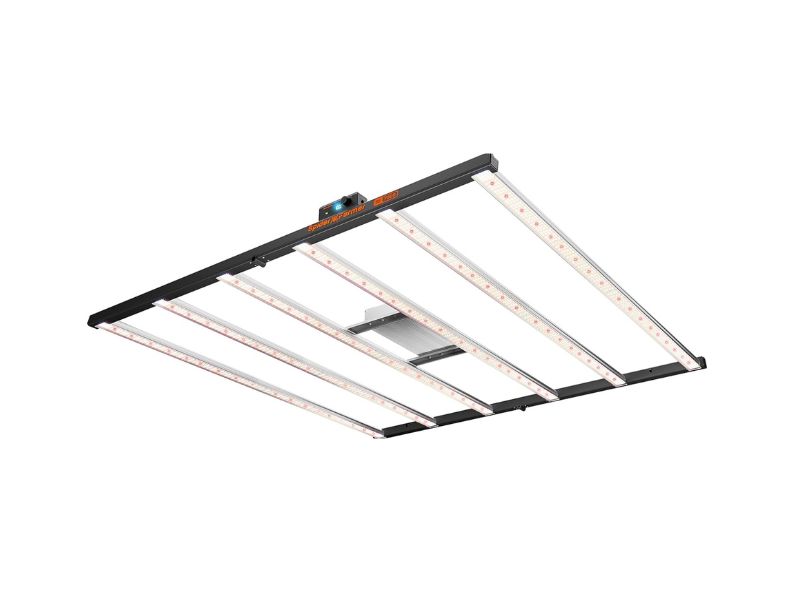
I would choose the Spider Farmer SE7000 730W LED Grow Light for growers who want substantial output with smart operation and multi-fixture scalability. The current 2026 listing specifies 730W input, approximately 2,146 µmol/s photon output, bar-style construction, app control, dimming, daisy chaining, and a detachable driver, with positioning for 5×5 tents and vertical grow racks.
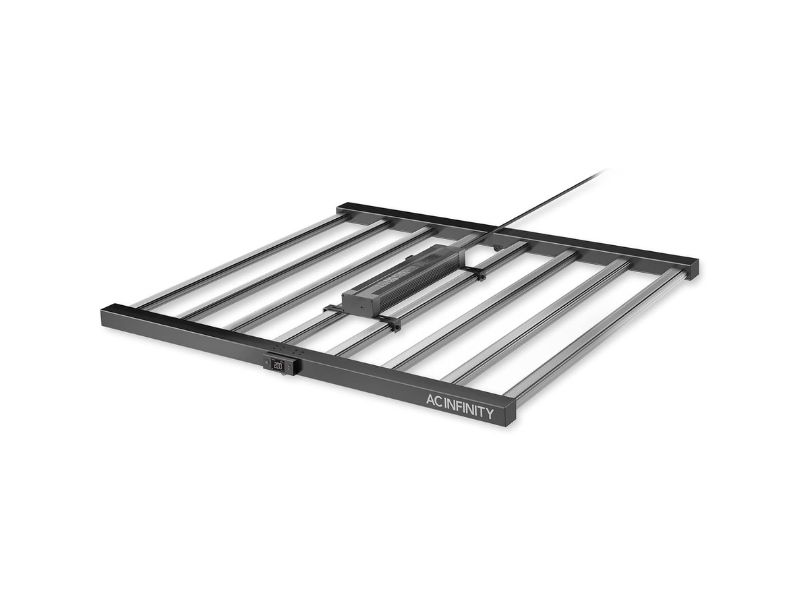
For a professional grow room built around environmental automation, I would choose the AC Infinity IONFRAME EVO8 730W. It uses 2,688 Samsung LM301H EVO diodes, provides ten brightness levels, programmed schedules, sunrise/sunset dimming, removable-driver construction, and UIS-compatible Wi-Fi control.
3 Best Professional LED Grow Lights Reviewed
| Image | Product Name | Check Price |
|---|---|---|
Best Choice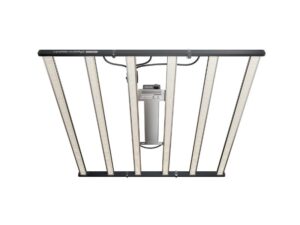 | MARS HYDRO FC-E8000 800W LED Grow Light | Check Price |
Second Best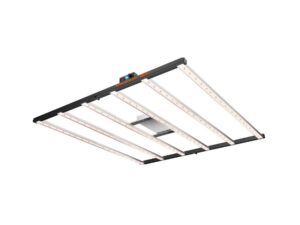 | Spider Farmer SE7000 730W LED Grow Light | Check Price |
Third Choice | AC Infinity IONFRAME EVO8 730W LED Grow Light | Check Price |
1. MARS HYDRO FC-E8000 800W LED Grow Light
Key Features
- 800W actual input
- 2.8 µmol/J system PPE
- Approximately 2,240 µmol/s PPF
- Bridgelux 2835 LEDs
- Osram 660nm deep-red supplementation
- Foldable multi-bar frame
- Full-spectrum output
- Dimmable
- Maximum 5×5-foot coverage
- Commercial-style distributed architecture
The MARS HYDRO FC-E8000 is my primary recommendation because it gives a professional grower a large photon budget without relying on vague equivalent-wattage marketing.
Its current U.S. Amazon listing publishes 800W input, 2.8 µmol/J PPE, and approximately 2,240 µmol/s PPF.
Those are the types of specifications I want to see on professional horticultural lighting.
PPE, or photosynthetic photon efficacy, describes how efficiently the fixture converts electrical energy into photosynthetically active photons.
PPF, or photosynthetic photon flux, describes the total quantity of those photons emitted each second.
Professional comparisons should ideally use those measurements rather than merely asking whether a fixture is 600W, 700W, or 800W.
At approximately 2,240 µmol/s, the FC-E8000 has enough total photon output to support a substantial high-light canopy when the rest of the environment is properly managed.
The current fixture uses Bridgelux 2835 diodes with enhanced Osram 660nm red LEDs.
Diode branding deserves some attention, but I would not choose a professional fixture based on diode manufacturer alone.
The complete system matters.
A professional light needs:
- Good diode efficiency
- Proper current management
- Driver efficiency
- Effective thermal design
- Good physical distribution
- Useful dimming
- Consistent output across the footprint
The FC-E8000’s multi-bar architecture is particularly important.
Professional growers generally care about the usable square footage beneath the fixture, not just the highest center PPFD value.
Spreading LEDs across multiple bars helps distribute light toward:
- Tent edges
- Corners
- Gaps between plants
- Outer canopy zones
That can make more of a 5×5 footprint productive.
A 5×5 area contains 25 square feet.
At 800W, the rough electrical density is:
800 ÷ 25 = 32 watts per square foot.
Watts per square foot is not a substitute for PPFD, but it provides useful context.
The important question is how efficiently those watts become photons and how evenly those photons reach the canopy.
The published 2.8 µmol/J system PPE addresses the first question. A complete PPFD map and correct installation help answer the second.
The FC-E8000 is also foldable.
That sounds like a minor feature until you handle a full-size bar fixture.
Professional lights are physically large, and a foldable frame can simplify:
- Transportation
- Installation
- Storage
- Fixture replacement
The spectrum is designed for use across multiple plant stages, so the light does not need to be replaced when a crop moves from young vegetative growth into mature production.
Dimming is essential for the same reason.
I would not operate an 800W fixture at full intensity over newly established plants simply because the electrical capacity exists.
A professional workflow should increase light according to:
- Plant age
- Canopy development
- Target PPFD
- Crop response
- Daily Light Integral
- Environmental capacity
This is where professional cultivation differs from simply buying the biggest light possible.
More photons only create value while another factor is not limiting growth.
Potential bottlenecks include:
- Temperature
- Humidity
- CO₂ availability
- Irrigation
- Root-zone oxygen
- Nutrition
- Genetics
- Canopy structure
If those systems cannot keep pace, increasing light intensity can create diminishing returns or unnecessary stress.
Thermal management is another consideration.
An efficient 800W LED still consumes 800 watts at maximum output.
The fixture may run without active cooling fans, but the room still has to deal with the energy entering the growing environment.
A professional installation may therefore need:
- Appropriately sized exhaust
- HVAC or room cooling
- Canopy circulation
- Dehumidification
- Intake-air management
- Temperature monitoring
That is why I consider FC-E8000 a serious production fixture rather than a general houseplant lamp.
What I Like
- Very high ~2,240 µmol/s PPF
- Published 2.8 µmol/J system PPE
- Large 5×5-class footprint
- Distributed multi-bar design
- Dimming
- Foldable construction
- Enhanced 660nm red output
- Strong current Amazon rating history for this equipment class
What I Do Not Like
- 800W creates substantial electrical demand
- Significant heat management is required
- Excessive for small grow spaces
- Large frame needs dedicated installation space
The FC-E8000 is the professional fixture I would choose when high total photon output and broad 5×5 coverage are the main objectives. Its published system efficiency and 2,240 µmol/s output give experienced growers substantial lighting capacity without making a single center hotspot the entire design philosophy.
2. Spider Farmer SE7000 730W LED Grow Light
Key Features
- 730W actual input
- Approximately 2,146 µmol/s PPF
- Premium Bridgelux diode system
- Osram Hyper Red supplementation
- Bar-style architecture
- Full-spectrum output
- App control
- Digital dimming
- Daisy-chain functionality
- Detachable driver
- 5×5 grow-tent compatibility
- Suitable for vertical racks
The Spider Farmer SE7000 is my second choice and arguably the more interesting option for professional growers who prioritize control scalability.
The refreshed 2026 Amazon listing specifies 730W actual power and approximately 2,146 µmol/s of photon output.
That combination implies a very strong output-to-power relationship and puts the SE7000 squarely in commercial-style 5×5 territory.
The fixture uses a distributed bar structure rather than one compact board.
Again, that is exactly the architecture I prefer as grow spaces become larger.
Professional production benefits from consistency.
If central plants receive substantially more PPFD than perimeter plants, crop development can become uneven.
That may lead to:
- Different growth rates
- Different watering demand
- Uneven canopy height
- Uneven maturation
- Less predictable production
Broad diode distribution helps reduce that problem.
Spider Farmer positions the current SE7000 for both 5×5 grow tents and vertical commercial-style racks.
That rack compatibility is particularly relevant to the word “professional.”
Vertical cultivation has different priorities from a basic home tent.
Fixture depth, heat distribution, output uniformity, and centralized control all become more important when multiple layers or multiple fixtures operate together.
The SE7000 also provides app control.
For one grow light, an app can seem like a convenience feature.
For several fixtures, centralized control becomes considerably more useful.
A professional grower may want to change intensity across an entire production zone without manually adjusting every fixture.
The current configuration supports dimming and daisy-chain operation as part of its commercial positioning.
That can simplify:
- Batch scheduling
- Stage-based intensity changes
- Multi-fixture rooms
- Repeatable lighting recipes
The detachable driver is another professional-friendly feature.
Drivers generate heat.
Moving the driver away from the fixture allows the grower to decide where some of that localized heat is released.
In a small tent, that can mean mounting it outside the enclosure.
In a larger room, it can simplify thermal planning around racks.
This does not eliminate heat.
The same electrical energy still eventually enters the surrounding environment.
It simply provides more flexibility about where heat is concentrated.
The current listing also highlights enhanced red output using Osram Hyper Red components.
Supplemental deep red can be useful within a horticultural spectrum, but I would still put canopy PPFD and daily photon delivery ahead of spectral marketing.
Professional lighting should be evaluated as a complete system.
The headline numbers here are:
730W + ~2,146 µmol/s + broad bars + dimming + centralized control.
That package is what makes the SE7000 interesting.
Its lower electrical input compared with the 800W FC-E8000 is also relevant.
The difference is:
800W – 730W = 70W.
If both fixtures run for 12 hours:
FC-E8000:
0.8 × 12 = 9.6 kWh/day
SE7000:
0.73 × 12 = 8.76 kWh/day
Difference:
0.84 kWh/day per fixture.
Across many fixtures and months of production, apparently small wattage differences begin to matter.
That does not automatically make SE7000 more economical because photon output and purchase requirements must also be considered.
Professional growers should compare photons delivered per unit of electrical input, not electrical input alone.
What I Like
- Strong ~2,146 µmol/s output
- 730W commercial power class
- Excellent bar-style distribution
- App control
- Dimming
- Daisy chaining
- Detachable driver
- 5×5 and vertical-rack positioning
What I Do Not Like
- Requires meaningful environmental cooling
- App functionality adds setup complexity
- Large footprint
- Current Amazon star average is lower than some competing premium models
The SE7000 is the model I would choose when multiple fixtures, centralized adjustment, rack compatibility, and broad canopy distribution matter as much as raw PPF. Those are precisely the qualities that become more useful as a grow moves from hobby scale toward professional operation.
3. AC Infinity IONFRAME EVO8 730W LED Grow Light
Key Features
- 730W actual power
- 2,688 Samsung LM301H EVO diodes
- Diodes rated at 3.14 µmol/J
- Bar-style fixture
- Algorithmic diode spacing
- Ten brightness levels
- Programmed schedules
- Sunrise/sunset dimming
- UIS-compatible Wi-Fi control
- Removable LED driver
- Daisy-chain support
- 5×5 flowering / 6×6 vegetative positioning
The AC Infinity IONFRAME EVO8 is the option I would choose for a professionally managed grow room where automation and environmental integration are central to the setup.
Its current Amazon listing identifies the selected model as a 730W 5×5 fixture using 2,688 Samsung LM301H EVO diodes.
AC Infinity states that the individual Samsung LEDs are rated at 3.14 µmol/J PPE.
There is an important technical distinction here.
That is a diode-level efficiency figure.
It should not automatically be compared directly with a published whole-fixture system PPE such as the 2.8 µmol/J figure MARS HYDRO lists for FC-E8000.
The complete fixture includes losses through:
- Driver conversion
- Electrical connections
- Operating temperature
- System architecture
Professional buyers should compare system PPE to system PPE whenever possible.
Even so, Samsung LM301H EVO is an attractive diode platform, and AC Infinity distributes 2,688 diodes across the EVO8.
The bar layout is designed around even coverage.
AC Infinity specifically describes its diode spacing as optimized for coverage, canopy penetration, and hotspot reduction.
That addresses one of the most important professional lighting concerns.
A fixture should not be judged by its best PPFD reading.
A more useful question is:
How much of the production canopy falls within the desired PPFD range?
A large uniform zone can be more valuable than an extremely intense center combined with weak corners.
Where the EVO8 really separates itself is control.
The current Amazon configuration provides:
- 10 brightness levels
- Programmed schedules
- Sunrise dimming
- Sunset dimming
- UIS compatibility
- Wi-Fi app control
Professional growers may not biologically need sunrise and sunset simulation.
Plants can perform perfectly well under simpler on/off schedules when other variables are appropriate.
The value lies in operational control.
Digital scheduling makes it easier to establish a repeatable lighting program across production cycles.
That repeatability helps when comparing:
- Crop batches
- Cultivars
- Light intensities
- Production timelines
The UIS platform can also integrate the fixture into a broader AC Infinity environment.
That ecosystem approach may be particularly attractive if your operation already uses compatible:
- Exhaust equipment
- Circulation systems
- Sensors
- Controllers
Instead of maintaining unrelated devices, you can manage more of the growing environment from a common platform.
The EVO8 also uses a removable driver.
Again, this provides thermal flexibility.
It can be useful in tightly controlled rooms where every heat source influences HVAC load.
AC Infinity’s current Amazon page lists the model family with the selected EVO8 variation at 5×5, 730W, while its product information positions the fixture around 5×5 high-intensity use and a broader vegetative footprint.
This stage-dependent coverage concept is important.
Vegetative plants can often be spread over a larger area because their target PPFD may be lower.
For demanding mature production, I would size the fixture based on its more intensive footprint rather than the largest marketing coverage number.
The main reason EVO8 ranks third here is the Amazon rating-count ordering used for this guide, not a lack of professional features.
Its exact listing currently shows 99 Amazon ratings, compared with 297 for SE7000 and 1,461 for FC-E8000.
Technically, it may be the strongest option for a grower who wants deep automation.
What I Like
- 2,688 Samsung LM301H EVO LEDs
- Strong 730W power class
- Excellent automated scheduling
- Ten brightness settings
- Sunrise/sunset control
- Broad bar-style distribution
- Removable driver
- UIS integration
- Daisy-chain scalability
What I Do Not Like
- Published 3.14 µmol/J figure is diode-level, not directly comparable system PPE
- Most valuable when using the wider AC Infinity ecosystem
- Controls may be unnecessarily complex for basic operations
- Large commercial footprint
The EVO8 is the fixture I would choose for an automation-centered professional grow room. Its value comes from combining premium diode hardware with one of the most complete integrated control platforms in this comparison.
Professional LED Grow Lights Comparison
| Product | Actual Power | Published Photon Metric | Fixture Style | Smart Control | Driver | Best Professional Use |
| MARS HYDRO FC-E8000 | 800W | 2.8 µmol/J; ~2,240 µmol/s PPF | Foldable multi-bar | Controller dependent | Thermal-management design | Maximum 5×5 output |
| Spider Farmer SE7000 | 730W | ~2,146 µmol/s PPF | Distributed bars | App + daisy chain | Detachable | Multi-fixture/rack setups |
| AC Infinity IONFRAME EVO8 | 730W | LM301H EVO diodes rated 3.14 µmol/J | Algorithmic bar layout | UIS/Wi-Fi | Removable | Integrated automation |
FC-E8000 provides the largest published total photon output, SE7000 combines high output with commercial-style control scalability, and EVO8 provides the deepest integrated automation package.
How to Choose Professional LED Grow Lights
Look for System-Level Data
Professional equipment should provide meaningful horticultural specifications.
At minimum, I want to see:
- Actual input watts
- PPF
- PPE
- PPFD maps
- Recommended footprint
- Dimming range
Avoid evaluating fixtures solely by model numbers such as “7000” or “8000.”
Those numbers are product names, not electrical wattage.
Understand PPE
PPE describes how efficiently a grow light turns electrical energy into photosynthetically active photons.
The FC-E8000 publishes 2.8 µmol/J system PPE.
Higher comparable system PPE generally means more plant-useful photon output for each unit of electricity.
Diode PPE vs System PPE
This distinction is particularly important with EVO8.
AC Infinity states that its Samsung LM301H EVO diodes are rated at 3.14 µmol/J.
That does not mean every joule pulled from the wall becomes exactly 3.14 µmol of fixture-level output.
Compare equivalent measurement types.
PPF Matters at Commercial Scale
PPF measures total photosynthetic photon production.
FC-E8000 publishes about 2,240 µmol/s.
SE7000 publishes about 2,146 µmol/s.
Those are both serious large-canopy photon budgets.
PPFD Determines What Reaches Plants
PPF tells you what leaves the fixture.
PPFD tells you what reaches a particular location on the canopy.
Professional growers should evaluate a complete PPFD map at realistic hanging heights.
A single peak measurement is not enough.
Uniformity Can Matter More Than Peak PPFD
Suppose a fixture produces exceptional PPFD across only one square foot.
That does not help plants occupying the other 24 square feet of a 5×5 canopy.
Commercial productivity depends on usable area.
This is one reason distributed bars have become so common in high-power horticultural fixtures.
Best Professional LED Grow Light for 5×5
My first choice is MARS HYDRO FC-E8000 when maximum available photon output is the priority.
Its current specification of approximately 2,240 µmol/s PPF gives a well-managed 5×5 room substantial headroom.
For smarter multi-fixture management, I would choose SE7000 or EVO8.
Best Professional Light for Vertical Racks
I would give Spider Farmer SE7000 strong consideration because its current Amazon positioning explicitly includes vertical grow racks.
Rack growing places a premium on distributed output, fixture geometry, and centralized control.
Best Professional Light for Automation
I would choose AC Infinity IONFRAME EVO8.
Its built-in scheduling, ten brightness levels, sunrise/sunset control, and UIS-compatible Wi-Fi platform provide the strongest integrated automation package here.
Best Professional Light for Maximum Output
FC-E8000 wins this comparison on published total PPF.
Approximately 2,240 µmol/s gives it more raw photon output than the SE7000’s approximately 2,146 µmol/s.
That additional output is only useful if the crop and environment can use it.
730W vs 800W Professional Fixtures
A 730W fixture uses about 8.75% less electrical power than an 800W fixture at maximum output.
That difference becomes meaningful across many fixtures.
Ten lights running 12 hours daily would create a 700W difference in instantaneous lighting load between ten 730W units and ten 800W units.
Commercial planning should therefore consider facility-wide electrical demand rather than one fixture in isolation.
Electricity Use at Professional Scale
One 800W fixture running 12 hours daily uses:
0.8 × 12 = 9.6 kWh/day
Over 30 days:
288 kWh/month
Ten fixtures:
2,880 kWh/month
One 730W fixture at 12 hours uses:
0.73 × 12 = 8.76 kWh/day
Over 30 days:
262.8 kWh/month
Ten fixtures:
2,628 kWh/month
Actual use falls when fixtures are dimmed.
Electrical Infrastructure Matters
Professional lighting should be planned as part of the facility.
Lighting is only one load.
A grow room may also operate:
- HVAC
- Dehumidifiers
- Exhaust
- Circulation fans
- Pumps
- Environmental controllers
- Heaters
- Irrigation equipment
Have electrical infrastructure sized appropriately for the total system.
Heat Load Should Be Planned Before Installation
A professional grower should think about heat before hanging the lights.
A room filled with several 730–800W fixtures can create a significant cooling requirement.
Higher photon efficiency helps, but efficient LEDs are not heat-free.
Removable Drivers Can Help Thermal Management
Both SE7000 and EVO8 provide detachable or removable-driver functionality in their current configurations.
Moving drivers can reduce localized canopy heat and provide more flexibility in rack designs.
It does not eliminate total facility heat.
Dimming Is Essential
Professional lighting should rarely operate as a simple full-power/on-off system across every growth stage.
Dimming allows the grower to match output to crop demand.
That can reduce:
- Electricity use
- Excess heat
- Early-stage light stress
while preserving full output for stages that can actually use it.
Smart Controls vs Basic Timers
Plants do not require Wi-Fi.
A simple timer can produce a perfectly consistent photoperiod.
Professional smart controls become valuable when they reduce labor or improve reproducibility.
They can help manage:
- Multiple fixtures
- Separate grow zones
- Stage-specific intensity
- Scheduled changes
The bigger the facility, the more valuable centralized control can become.
Daisy Chaining Matters More in Commercial Rooms
Daisy-chain capability allows compatible fixtures to be controlled together.
That can greatly simplify a room containing many identical lights.
SE7000 and EVO8 both emphasize multi-light scalability in their current listings.
Full Spectrum Is Usually the Practical Baseline
Broad white full-spectrum horticultural LEDs remain the most flexible choice for general professional production.
Supplemental deep red can be useful, but I would prioritize:
PPFD → uniformity → DLI → environmental control → spectral refinements.
DLI Matters as Much as Instantaneous Intensity
Daily Light Integral measures total photosynthetic photons received during the entire day.
A professional lighting strategy therefore combines:
- PPFD
- Photoperiod
instead of optimizing either variable independently.
A crop receiving high PPFD for a shorter period can have a similar DLI to a crop receiving moderate PPFD for longer.
Professional Lighting and CO₂
As photon intensity becomes high, carbon availability may become one of several factors affecting whether plants can make productive use of additional light.
That does not mean every professional grow needs supplemental CO₂.
It means high-intensity lighting should be evaluated within the complete environmental strategy.
Airflow Becomes More Important Under Dense Canopies
High-output lighting supports dense leaf growth when conditions are favorable.
Dense canopies can create localized areas with:
- High humidity
- Weak airflow
- Temperature gradients
Professional installations need circulation below and above the canopy rather than relying only on a large exhaust fan.
Reliability Matters More Than Features
A professional fixture can run thousands of hours.
Features are useful, but long-term operation should remain central to the purchase decision.
I would consider:
- Driver accessibility
- Warranty support
- Replacement availability
- Control-system stability
- Electrical certification
- Fixture construction
alongside efficiency.
Common Professional Grow-Light Buying Mistakes
Choosing by Wattage Alone
Watts measure electricity, not horticultural effectiveness.
Comparing Diode PPE to System PPE
Make sure the measurements are equivalent.
Choosing by Peak PPFD
Uniformity across the production footprint matters more.
Oversizing Every Room
Extra capacity only creates value when plants can use it.
Ignoring Cooling Load
Lighting and HVAC should be planned together.
Adding Smart Controls Without a Reason
Automation should reduce labor or increase consistency.
Ignoring Driver Placement
Remote mounting can improve thermal flexibility.
Forgetting Electrical Expansion
Plan for the number of fixtures the room may eventually operate.
Frequently Asked Questions
What are the best LED grow lights professional growers should consider?
MARS HYDRO FC-E8000, Spider Farmer SE7000, and AC Infinity EVO8 are my three selections.
They offer different professional strengths: maximum photon output, commercial scalability, and sophisticated environmental automation.
Which professional LED grow light is my primary recommendation?
I would choose MARS HYDRO FC-E8000 when strong 5×5 photon output is the priority.
It publishes 800W actual input, 2.8 µmol/J system PPE, and approximately 2,240 µmol/s PPF.
Which professional grow light has the highest PPF here?
MARS HYDRO FC-E8000 has the highest published PPF at approximately 2,240 µmol/s.
Spider Farmer SE7000 follows at approximately 2,146 µmol/s.
Which professional grow light has the best automation?
AC Infinity IONFRAME EVO8 offers the deepest integrated automation package here.
It includes scheduling, ten brightness levels, sunrise/sunset dimming, and UIS-compatible Wi-Fi controls.
Which professional grow light is best for vertical racks?
Spider Farmer SE7000 is particularly relevant because its listing explicitly supports vertical grow racks.
Its bar-style architecture and multi-fixture controls also suit scalable installations.
Is 730W enough for professional growing?
Yes, an efficient 730W fixture provides substantial photon capacity for a 5×5-class canopy.
SE7000 publishes approximately 2,146 µmol/s from its current 730W configuration.
Is 800W too much for a 5×5?
Not necessarily, but full output should match crop demand and environmental capacity.
FC-E8000 provides dimming, so the grower does not need to use all 800W throughout every stage.
Which professional light uses Samsung LM301H EVO?
AC Infinity IONFRAME EVO8 uses 2,688 Samsung LM301H EVO diodes.
AC Infinity rates the individual diodes at 3.14 µmol/J.
What does 3.14 µmol/J mean on EVO8?
It is the published efficiency rating of the individual Samsung LM301H EVO diodes.
It should not automatically be interpreted as complete-fixture system PPE.
What is system PPE?
System PPE measures complete-fixture photon output relative to electrical energy consumed.
It accounts for the functioning fixture rather than describing only the theoretical diode component.
What is PPF?
PPF measures the total photosynthetically active photons emitted by the fixture each second.
Professional fixtures commonly publish this value in µmol/s.
What is PPFD?
PPFD measures photon density actually reaching a particular point on the plant canopy.
It changes with distance, dimming, fixture geometry, and measurement location.
Why is PPFD uniformity important professionally?
Uniform PPFD helps plants across the production area develop under more consistent light conditions.
An extreme center hotspot can waste usable canopy area.
Are bar lights better for professional growers?
Bar fixtures are particularly useful at high wattages because they spread diodes over more area.
That can improve uniformity, airflow, and thermal distribution.
Do professional LED grow lights need dimming?
Yes, dimming greatly improves flexibility across plant stages and production recipes.
It also helps reduce energy consumption when maximum intensity is unnecessary.
Do professional grow rooms need smart controls?
Not necessarily, but centralized controls can reduce labor when many fixtures operate together.
The value increases as the grow room becomes larger and more complex.
Are detachable drivers useful?
Yes, remote driver placement provides additional flexibility for managing localized heat.
Both SE7000 and EVO8 provide removable-driver functionality.
How much electricity does an 800W grow light use?
At full power for 12 hours, one 800W fixture uses about 9.6 kWh daily.
That equals approximately 288 kWh over 30 days.
How much electricity does a 730W grow light use?
At full power for 12 hours, one 730W fixture uses about 8.76 kWh daily.
That equals approximately 262.8 kWh over 30 days.
Do professional LED grow lights create a lot of heat?
Yes, several 700–800W fixtures can create a substantial facility cooling requirement.
Lighting, HVAC, ventilation, and dehumidification should be planned as one system.
Which professional fixture should I choose for a 5×5?
FC-E8000 suits maximum output, SE7000 suits scalable smart control, and EVO8 suits integrated automation.
All three are serious large-canopy fixtures; the best choice depends on the production system rather than wattage alone.
Conclusion
The best LED grow lights professional growers use should deliver more than raw electrical power. I would prioritize system efficiency, total PPF, PPFD uniformity, dimming, distributed bar geometry, driver flexibility, scalable controls, and realistic thermal management.
The MARS HYDRO FC-E8000 remains my primary recommendation. Its current 800W input, 2.8 µmol/J system PPE, approximately 2,240 µmol/s PPF, broad bar architecture, Bridgelux LEDs, enhanced Osram red output, and 5×5 positioning provide a strong foundation for serious indoor production.
The Spider Farmer SE7000 is the option I would choose for a scalable professional installation. Its 730W input, approximately 2,146 µmol/s output, app control, dimming, detachable driver, daisy-chain architecture, and compatibility with 5×5 tents and vertical racks make it particularly useful when several fixtures may need to operate together.
The AC Infinity IONFRAME EVO8 is my choice for automation-focused environments. Its 2,688 Samsung LM301H EVO diodes, ten brightness levels, programmable schedules, sunrise/sunset control, removable driver, and UIS integration provide the most sophisticated control environment of these three.
For maximum professional 5×5 output, I would choose MARS HYDRO FC-E8000. For commercial-style scalability and rack use, I would choose Spider Farmer SE7000. For integrated automation, I would choose AC Infinity IONFRAME EVO8.

I’m Maya L. Greenwood, a lifelong plant lover who believes anyone can grow something beautiful with the right guidance. After years of testing soil mixes, pruning methods, irrigation tricks, and pest-safe solutions, I started EasyGardenTips.com to turn hard-won lessons into step-by-step advice. From seed starting and container gardens to composting and seasonal checklists, my goal is to make gardening simple, sustainable, and fun.