Best Power Strip for Grow Tent: 3 Safer Picks for Indoor Grows
Choosing the best power strip for grow tent equipment requires more caution than selecting a strip for a desk or entertainment center. A grow setup combines high-output LED lights, inline fans, circulation fans, controllers, pumps, humidifiers, cameras, and other electrical equipment in an environment where irrigation water and elevated humidity may also be present.
For that reason, none of the power strips in this guide should be treated as waterproof grow-tent equipment. The safest practical arrangement is usually to keep the strip outside the tent or in another dry, elevated location, then route individual equipment cords through the tent’s cable ports. Belkin specifically identifies its indoor surge protector as unsuitable for water-related applications, while electrical-safety organizations recommend keeping temporary power equipment away from damp conditions and using appropriately protected circuits where water exposure is possible.
My first recommendation is the Belkin 12-Outlet BE112230-08 Surge Protector. It has the strongest customer-feedback history of the three selections and combines 12 grounded outlets, six widely spaced BlockSpace positions, an 8-foot heavy-duty cord, 3,940 joules of surge protection, UL 1449 certification, indicator lights, and a 15A/1875W electrical rating.
The Anker 351 Power Strip is my second choice. It also provides 12 AC outlets but adds USB-C and USB-A charging, widely spaced outer receptacles, mounting slots, and an eight-point safety system. Anker specifies the AC side at 125V, 15A, and 1875W, making it appropriate for organizing several modest grow-tent devices as long as their combined load stays within the strip and household circuit limits.
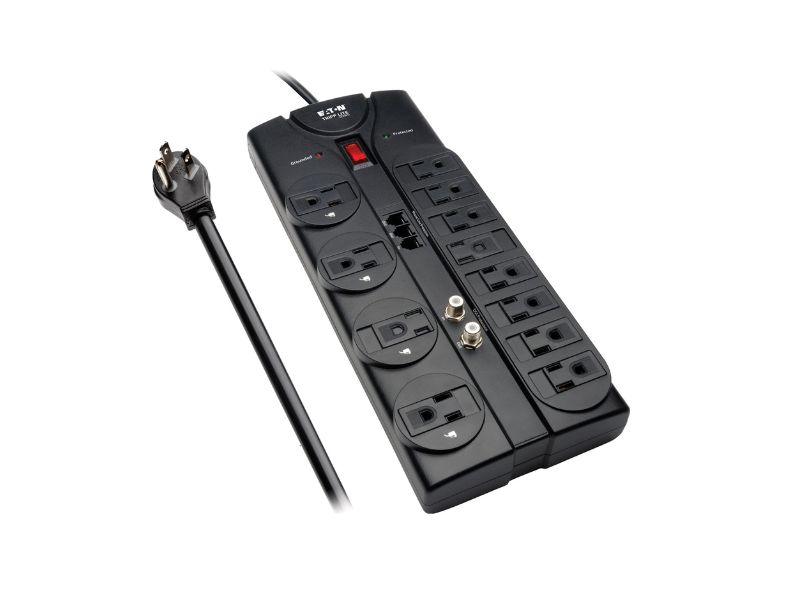
The Eaton Tripp Lite TLP1208TELTV rounds out the list. It offers 12 outlets, an 8-foot cord, transformer-friendly spacing, diagnostic indicators, a 15A resettable circuit breaker, and automatic shutoff when the surge-protection circuit is no longer functional.
3 Power Strips for Grow Tent Equipment
| Image | Product Name | Check Price |
|---|---|---|
Best Choice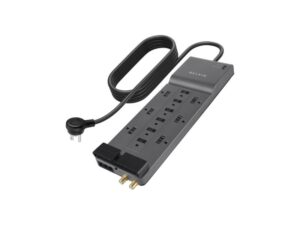 | Belkin BE112230-08 12-Outlet Surge Protector | Check Price |
Second Best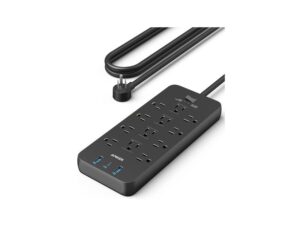 | Anker 351 12-Outlet Power Strip | Check Price |
Third Choice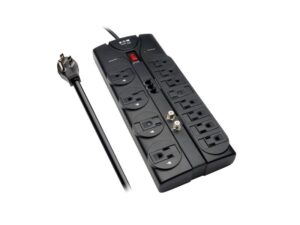 | Eaton Tripp Lite TLP1208TELTV Surge Protector | Check Price |
I ranked these products primarily by customer rating confidence and review volume, then considered the characteristics that matter around an indoor growing setup:
- 15A-class electrical capacity
- Independent safety certification
- Surge protection
- Overload protection
- Grounding indicators
- Outlet spacing for bulky power adapters
- Cord length
- Mounting capability
- Build quality
- Ease of keeping the strip off the floor
These are conventional indoor surge protectors, not waterproof agricultural distribution boxes. Placement and load management are therefore just as important as the product itself.
1. Belkin BE112230-08 12-Outlet Surge Protector
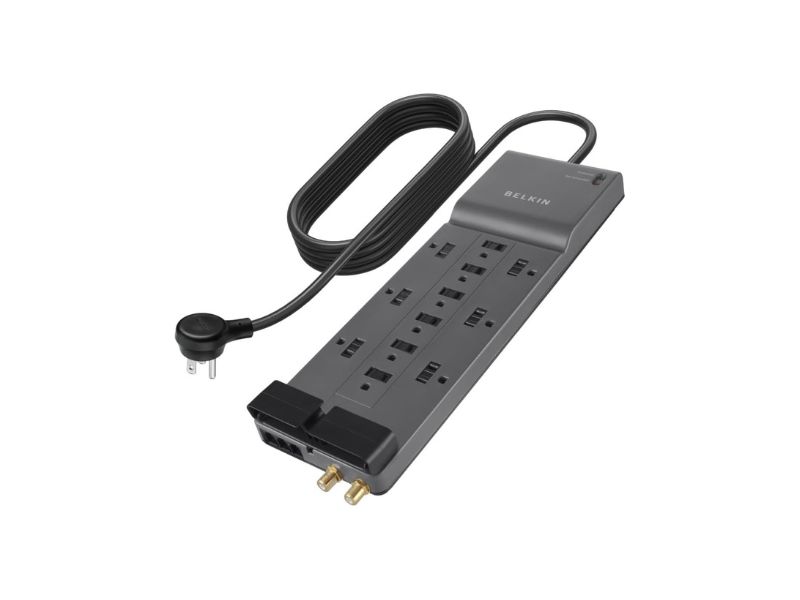
Key Features
- 12 grounded AC outlets
- Six widely spaced outlets
- 3,940-joule surge rating
- 8-foot heavy-duty cord
- 15A / 1875W continuous-duty electrical rating
- UL 1449 certified
- Ground and protection indicators
- Wall-mounting holes
Belkin takes first place because it provides a strong combination of capacity, outlet layout, surge protection, and exceptionally established buyer confidence.
The twelve-outlet design is useful around grow-tent equipment because many devices use bulky AC adapters rather than simple two-prong plugs. Six BlockSpace outlets provide additional room for larger transformers, reducing the chance that one fan or controller adapter blocks two neighboring receptacles.
Belkin rates this model for 125V, 15A, and 1875W, with 3,940 joules of surge protection. It is also UL 1449 certified and provides indicators showing whether surge protection and proper grounding are present.
For a grow setup, I particularly like the mounting holes. Instead of leaving the strip flat on the floor near runoff trays or reservoirs, it can be secured in a suitable dry location outside the enclosure.
What I Like
- Excellent outlet spacing
- Strong surge-protection specification
- Clear grounding/protection indicators
- Heavy-duty 8-foot cord
- Easy to mount away from the floor
What I Do Not Like
- It is specifically an indoor product, not a wet-location power strip
- Coax and telephone protection are unnecessary for most grow-tent setups
The Belkin is the most convincing option when you need to organize several pieces of ordinary 120V grow equipment from one properly grounded receptacle while keeping the strip itself in a dry location.
2. Anker 351 12-Outlet Power Strip
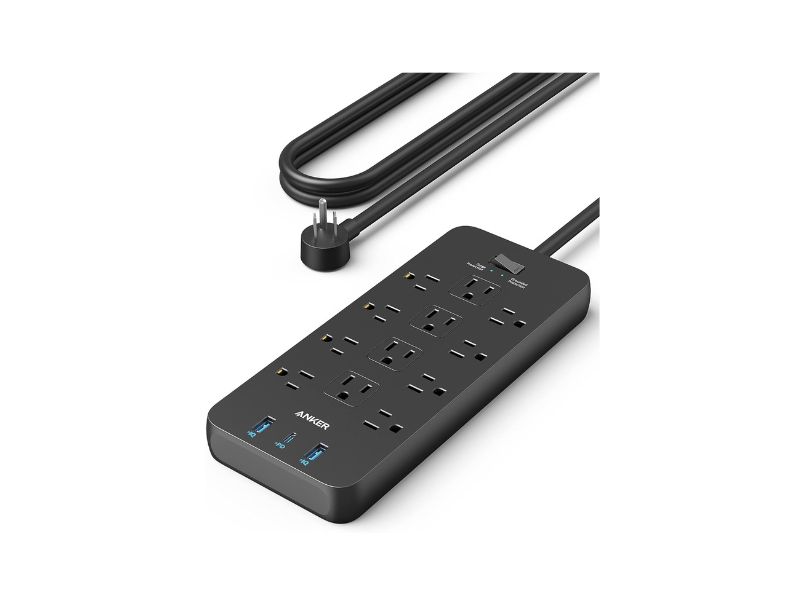
Key Features
- 12 AC outlets
- 1 USB-C port
- 2 USB-A ports
- 2100-joule surge protection
- 15A / 1875W AC rating
- 5-foot power cord
- TUV certification
- Overload and temperature protection
- Rear mounting slots
The Anker 351 ranks second because it combines high outlet capacity with a particularly clean layout.
Anker provides 12 grounded AC receptacles, plus USB-C and USB-A charging for low-power devices. The outside AC outlets are spaced farther apart to accommodate larger adapters, which is useful for environmental controllers, small fans, cameras, and other equipment that often uses wall-wart power supplies.
Its AC specification is 125V × 15A, up to 1875W, and Anker’s safety system includes surge, overload, grounded, fire-resistance, and temperature-related protection features. The product is TUV certified.
The USB ports are not a reason by themselves to buy a grow-tent power strip, but they can be convenient for a monitoring camera, phone, or another low-voltage accessory without consuming an AC receptacle.
What I Like
- 12 outlets in a compact layout
- Widely spaced receptacles for large adapters
- USB-C and USB-A charging
- Strong overload/safety feature set
- Mounting slots help keep it elevated
What I Do Not Like
- Five-foot cord is shorter than the Belkin and Tripp Lite
- USB charging adds little value if every grow device uses AC power
The Anker 351 makes the most sense when outlet density and adapter spacing are priorities and you want one organized distribution point outside the tent.
3. Eaton Tripp Lite TLP1208TELTV Surge Protector
Key Features
- 12 grounded outlets
- Four transformer-friendly positions
- 8-foot cord
- 15A resettable breaker
- Diagnostic LEDs
- Automatic shutoff protection
- Wall/keyhole mounting
- Coax and telephone protection
The Eaton Tripp Lite takes third place because its design emphasizes conventional electrical protection and practical outlet spacing.
The current TLP1208TELTV platform provides 12 outlets and four positions designed to accommodate larger transformers. Eaton also specifies a 15A resettable circuit breaker, grounded/protection diagnostic LEDs, and an automatic shutoff feature that cuts power if the surge-protection circuit becomes incapacitated.
An 8-foot cord makes it easier to keep the power strip away from the tent floor while still reaching the wall receptacle.
The additional coax and telephone protection will not matter for most growers, but those features do not interfere with using the AC receptacles for normal equipment.
What I Like
- 12 grounded outlets
- Long 8-foot cord
- Resettable 15A breaker
- Automatic shutoff if surge protection fails
- Transformer-friendly spacing
What I Do Not Like
- Several features are designed for home-theater equipment rather than grow tents
- Less convenient USB support than the Anker
The Tripp Lite is a good fit when straightforward surge protection, clear diagnostic indicators, and a long cord matter more than smart or USB features.
Grow Tent Power Strip Comparison
| Product | AC Outlets | Electrical Capacity | Surge Protection | Cord | Standout Feature |
| Belkin BE112230-08 | 12 | 15A / 1875W | 3,940 J | 8 ft. | Strong protection and outlet spacing |
| Anker 351 | 12 | 15A / 1875W | 2,100 J | 5 ft. | Compact layout plus USB |
| Eaton Tripp Lite TLP1208TELTV | 12 | 15A breaker | High-capacity surge suppression | 8 ft. | Automatic protection shutoff |
For grow-tent use, I would prioritize electrical rating, certification, overload protection, outlet spacing, and safe mounting over USB count or cosmetic design.
Should a Power Strip Be Inside a Grow Tent?
Keeping it outside the tent is usually the safer arrangement.
Grow tents may contain irrigation water, humidifiers, hydroponic reservoirs, condensation, runoff trays, and elevated relative humidity. The selected Belkin unit is explicitly identified as an indoor device and not intended for water-related applications.
A practical setup is:
Wall receptacle → surge protector mounted outside tent → individual equipment cords routed through cable port
This arrangement keeps the multi-outlet connection point away from the wettest part of the garden.
The power strip can be mounted on:
- A nearby wall
- A dry equipment board
- A sturdy shelf
- The exterior side of a dedicated equipment area
Avoid putting it loose on the floor.
Water and Electricity Need Extra Separation
A grow tent is fundamentally different from a home office because water is intentionally introduced into the environment.
Potential sources include:
- Watering cans
- Automatic irrigation
- Hydroponic buckets
- Reservoirs
- Humidifiers
- Runoff
- Condensation
- Drainage tubing
Electrical Safety Foundation International advises keeping temporary power equipment out of water and using GFCI protection in potentially damp locations. NFPA likewise identifies GFCI protection as an important safeguard against hazardous ground faults.
If the available circuit or receptacle is not appropriate for a damp growing area, have a qualified electrician evaluate the installation.
Why 15 Amps Matters
Most standard power strips in this category are designed around a 15A, 120/125V household circuit connection.
Belkin and Anker both publish 15A/1875W maximum AC specifications for their selected models, while the Eaton Tripp Lite uses a 15A resettable breaker.
The important word is combined.
Twelve outlets do not mean you can connect twelve high-power devices simultaneously.
Every connected device contributes to the same total load.
For example, your system might contain:
- LED grow light
- Inline fan
- Two circulation fans
- Humidifier
- Water pump
- Air pump
- Controller
- Camera
Add their nameplate wattages rather than counting plugs.
More Outlets Do Not Mean More Available Power
A 12-outlet strip is still limited by its electrical rating.
The extra receptacles provide connection convenience, not additional branch-circuit capacity.
This distinction is particularly important in grow tents because some devices use very little electricity while others use much more.
A small circulation fan may draw relatively little power.
A large LED fixture can draw hundreds of watts.
A heater can consume dramatically more.
The strip does not care whether one device or twelve devices create the total load.
Be Careful With Space Heaters
Do not connect a portable space heater to a power strip.
CPSC specifically advises plugging electric space heaters directly into a wall receptacle rather than using an extension cord or power strip because of overheating and fire risk.
This is especially relevant to indoor growers because a heater might seem like an easy way to raise nighttime tent temperatures.
If supplemental heating is necessary, follow the heater manufacturer’s installation requirements and keep it away from combustible tent material, plants, water, and other equipment.
Do not treat a 15A power-strip rating as permission to plug in a 1,500W space heater alongside the rest of the grow equipment.
What About Portable Air Conditioners?
High-draw appliances deserve similar caution.
NFPA recommends that major appliances be connected directly to appropriate wall receptacles rather than extension cords or plug strips.
Always check the appliance manufacturer instructions.
If an air conditioner, dehumidifier, heater, or other high-load appliance requires a dedicated wall connection, do not defeat that requirement just because there is an unused outlet on the strip.
Surge Protector vs Basic Power Strip
A basic power strip mainly expands one receptacle into several.
A surge protector adds components intended to reduce transient voltage spikes before they reach connected electronics.
Grow tents commonly contain electronic equipment such as:
- LED drivers
- Digital fan controllers
- Environmental controllers
- Pumps
- Cameras
- Wi-Fi devices
For those components, I prefer a certified surge-protecting strip over the cheapest non-protected multi-outlet bar.
Belkin’s selected model is UL 1449 certified, while the Anker uses TUV certification and a multi-layer safety system. Eaton’s Tripp Lite line includes surge suppression, diagnostic indicators, and automatic protection shutoff.
What Does the Joule Rating Mean?
The joule number describes the amount of surge energy a protection system is designed to absorb or dissipate over its useful life.
The selected products provide substantial surge protection, but a higher joule number does not make a power strip safer to overload.
Surge capacity and normal electrical load capacity are different specifications.
A 3,940-joule protector can still be overloaded if connected devices exceed its normal current rating.
Always pay attention to both.
Surge Protectors Do Not Last Forever
Surge-protection components can degrade as they absorb voltage spikes.
Belkin explicitly recommends monitoring its protection indicators and replacing a protector that has experienced major surge events or reached the end of its recommended service life. Eaton similarly explains that a surge protector may sacrifice its protective circuitry during a significant surge and provides protection-status indicators on many models.
Do not keep using an old strip simply because its outlets still provide electricity.
If the protected indicator shows that surge protection is no longer active, replace the device according to manufacturer guidance.
Why a Ground Indicator Is Useful
Surge protection depends on a correctly wired electrical system.
Belkin provides a not-grounded indicator, while Eaton uses diagnostic LEDs to identify protection and grounding status.
If a strip reports a grounding or wiring problem, do not ignore it.
The correct response is not to remove the ground prong or use an adapter to make the warning disappear.
ESFI specifically advises against removing a three-prong ground connection because it is a safety feature intended to reduce shock risk.
Have the receptacle evaluated when necessary.
Do Not Daisy-Chain Power Strips
Do not plug one power strip into another to gain additional outlets.
OSHA describes power strips as relocatable power taps that must be used according to their listed and manufacturer-approved configuration, while ESFI specifically warns that multiple-plug devices should connect directly to an appropriate receptacle rather than being chained together.
If twelve outlets are not enough, the problem may not be the power strip.
You may need additional properly installed receptacles or dedicated circuits.
Avoid Power-Strip-to-Extension-Cord Chains
Long chains such as:
wall → extension cord → power strip → another extension → device
add additional connections, potential voltage drop, and possible heat points.
Temporary extension cords should be correctly rated for the connected equipment, kept undamaged, and not substituted for permanent wiring. CPSC and ESFI both warn against overloading cords or using temporary wiring as a long-term electrical solution.
A grow tent that permanently depends on several extension cords running across a room may need a better electrical installation.
Why Mounting the Power Strip Helps
A mounted strip is easier to protect from:
- Runoff
- Spilled nutrient solution
- Reservoir leaks
- Floor cleaning
- Accidental kicks
The Belkin includes mounting holes, while the Anker 351 also provides mounting slots. Eaton’s Tripp Lite design includes wall/keyhole mounting capability.
Mount it where plugs remain accessible for inspection.
Do not hide a loaded power strip somewhere that prevents you from noticing heat, discoloration, or damaged cables.
Keep Power Strips Away From Humidifier Output
A humidifier can produce a concentrated plume of moisture even when the overall tent humidity is reasonable.
Do not place electrical distribution equipment:
- Directly above a humidifier
- Beside the mist outlet
- Under condensate
- Beneath irrigation tubing
- Next to an open reservoir
An IP rating would be required before assuming equipment is designed for direct moisture exposure, and the three products reviewed here are not being recommended as waterproof grow-room distribution equipment.
Can You Use a Smart Power Strip?
Yes in some setups, but I would not automatically choose one as the main power distribution point.
Smart outlets add useful features such as:
- Scheduling
- Remote switching
- Energy monitoring
But they also add another electronic control layer.
For critical equipment such as an exhaust fan, consider what happens if:
- Wi-Fi fails
- The app becomes unavailable
- The smart relay resets
- A schedule is configured incorrectly
For simple lighting schedules, a properly rated dedicated timer or controller may be preferable.
For environmental equipment, purpose-built controllers often provide better logic than manually switching everything from one smart strip.
Should the Grow Light Use the Power Strip?
A grow light can often be connected to an appropriately rated power strip if the light manufacturer allows it and total load remains within all electrical ratings.
Check the fixture’s actual wattage.
A 100W light and a 500W light are very different electrical loads.
Also consider startup or inrush behavior for equipment with large power supplies.
If the fixture manufacturer instructs you to connect directly to a grounded wall receptacle or dedicated circuit, follow that guidance instead.
Should the Inline Fan Use the Power Strip?
A typical EC inline fan is usually much less demanding than a large heater, but you should still check its nameplate rating.
Fans, circulation devices, environmental controllers, and monitoring cameras are the types of modest loads that can often be conveniently organized on one appropriately rated strip.
Avoid placing the strip itself inside the humid exhaust path.
Can Hydroponic Pumps Use the Same Power Strip?
Hydroponics requires additional caution because the electrical equipment operates directly beside large volumes of water.
If pumps are powered through a strip:
- Keep the strip outside the wet zone
- Keep connections elevated
- Use drip loops where appropriate
- Use suitable GFCI protection
- Follow pump manufacturer instructions
ESFI recommends GFCI-protected connections in potentially damp environments, and NFPA similarly identifies GFCIs as protection against hazardous ground faults.
Never place the strip beside a DWC bucket simply because it makes pump cords easier to reach.
What Is a Drip Loop?
A drip loop is a section of cord that hangs below the electrical connection before rising toward the receptacle.
If water travels along the cable, gravity encourages it to drip from the lower part of the loop rather than travel directly into the plug connection.
It is a simple cable-routing practice that can add another layer of protection around pumps, humidifiers, and other water-related equipment.
It does not replace GFCI protection or proper equipment placement.
Power Strip Placement for a 2×2 Grow Tent
A small 2×2 typically has relatively few devices.
You may only need outlets for:
- Compact LED fixture
- Small inline fan
- Clip fan
- Controller
Even then, I would keep the strip outside the enclosure.
Mount it beside the tent and run the individual equipment cords through the nearest cable opening.
The Belkin may provide more outlets than necessary, but having unused outlets is safer than filling every socket simply because they are available.
Power Strip Placement for a 2×4 Grow Tent
A 2×4 may add:
- Larger light
- Additional circulation fan
- Environmental controller
- Camera
- Small pump
A 12-outlet strip becomes more useful here because bulky adapters can occupy substantial physical room.
The Belkin and Anker designs are particularly useful when several devices use large power bricks.
Power Strip Placement for a 4×4 Grow Tent
A complete 4×4 may use considerably more equipment.
Typical electrical devices might include:
- 400–500W-class LED
- 6-inch exhaust fan
- One or two circulation fans
- Controller
- Humidifier
- Camera
- Irrigation pump
That still does not mean all devices automatically belong on one strip.
Add their electrical requirements and consider the branch circuit supplying the wall outlet.
If the system approaches circuit capacity or frequently trips breakers, consult a qualified electrician rather than distributing the load across more power strips.
Do You Need a Dedicated Circuit?
Small tents may operate comfortably on an existing properly wired household circuit.
Larger tents can accumulate substantial load once lighting, heating, cooling, and humidity-control equipment are included.
Signs that the electrical setup deserves professional evaluation include:
- Repeated breaker trips
- Warm or discolored receptacles
- Burning or rubber-like odor
- Flickering or dimming lights
- Sparks
- Frequently overloaded temporary wiring
NFPA specifically recommends contacting a qualified electrician when these kinds of electrical warning signs occur.
Do not solve repeated breaker trips by installing a larger breaker yourself.
Common Mistakes With Grow Tent Power Strips
Putting the Strip on the Tent Floor
Runoff and leaks make the floor one of the worst places for electrical connections.
Buying an Uncertified Strip
Look for recognized independent safety testing.
Choosing by Outlet Count Alone
Twelve outlets do not create twelve times more power.
Ignoring Total Wattage
Add connected-device loads.
Plugging in a Space Heater
CPSC says portable heaters should plug directly into a wall outlet, not a power strip.
Daisy-Chaining Strips
Do not connect one power strip to another.
Removing the Ground Pin
Never defeat the grounding connection.
Ignoring Protection Indicators
A surge strip can continue delivering power even after protection has degraded on some designs.
Mounting Beside a Humidifier
Keep electrical distribution away from concentrated mist.
Using a Damaged Cord
Replace equipment showing heat damage, cracks, cuts, or loose connections.
Assuming Surge Protection Prevents Overloading
A high joule rating does not increase the strip’s normal current capacity.
Using Extension Cords as Permanent Wiring
Temporary cords are not a substitute for adequate building wiring.
Frequently Asked Questions
1. What is the best power strip for grow tent equipment?
The Belkin BE112230-08 is my first choice for organizing ordinary grow-tent equipment from a dry location outside the enclosure.
It provides 12 grounded outlets, wide adapter spacing, an 8-foot cord, 3,940-joule surge protection, a 15A/1875W rating, and UL 1449 certification.
2. Can I put a power strip inside a grow tent?
I generally prefer keeping the strip outside the tent because irrigation, reservoirs, humidifiers, and runoff increase moisture exposure.
The conventional indoor strips reviewed here are not waterproof grow-room distribution boxes. Belkin specifically identifies its model as an indoor product not intended for water-related applications.
3. Is Belkin good for grow-tent equipment?
Yes, when installed in a dry appropriate location and kept within its electrical rating.
The selected Belkin provides 12 outlets, 15A/1875W capacity, strong surge protection, indicator lights, and UL certification.
4. Is the Anker 351 good for grow-tent equipment?
Yes, particularly when you have several bulky adapters and want a compact 12-outlet layout.
Its AC side is rated at 125V, 15A, and 1875W, and it includes surge, overload, grounding, fire-resistance, and temperature-related safety features.
5. Is Tripp Lite a good power strip for a grow setup?
Yes. The TLP1208TELTV provides 12 outlets, an 8-foot cord, a 15A breaker, diagnostic indicators, and automatic protection shutoff.
Keep it dry and use it according to Eaton’s installation guidance.
6. How many watts can a grow-tent power strip handle?
Check the exact product label rather than assuming. The Belkin and Anker models reviewed here are rated up to 1875W under their published specifications.
That is a maximum product rating, not a target operating load, and the supplying household branch circuit must also be considered.
7. Can I plug a grow light into a power strip?
Potentially, if the fixture manufacturer permits it and the complete load stays within the strip and circuit ratings.
For large fixtures or installations with several high-draw devices, evaluate total electrical demand rather than judging by the number of free outlets.
8. Can I plug an inline fan into the same power strip?
Usually a modest inline fan can share a properly rated strip with other compatible equipment, provided the combined electrical load remains within limits.
Always use the equipment’s actual nameplate specifications.
9. Can I plug a heater into my grow-tent power strip?
No. Portable electric space heaters should be connected directly to a suitable wall receptacle rather than an extension cord or power strip.
CPSC specifically recommends this to reduce overload and fire risk.
10. Do grow-tent power strips need surge protection?
Surge protection is useful for electronic grow equipment such as LED drivers and digital controllers, although it does not replace overload or ground-fault protection.
Choose a certified device and pay attention to both its normal load rating and surge-protection status.
11. Does a higher joule rating mean the strip can handle more watts?
No. Joules refer to surge-energy capability, while watts and amps describe normal electrical loading.
Never use a large surge rating as justification for exceeding the strip’s standard current rating.
12. Should I use GFCI protection around a grow tent?
GFCI protection is particularly important where electrical equipment may be exposed to damp conditions or water.
ESFI recommends GFCI-protected connections for potentially damp locations, and NFPA identifies GFCIs as protection against dangerous ground faults.
13. Can I connect two power strips together?
No. Do not daisy-chain power strips.
Use one properly rated strip connected directly to an appropriate receptacle, or have additional electrical capacity installed if your setup requires it.
14. Should the power strip be mounted off the floor?
Yes, mounting it in a dry elevated position is especially sensible around irrigation or hydroponic equipment.
All three selected designs provide practical ways to organize the strip away from runoff areas.
15. Can a hydroponic system share the power strip?
Pumps may be connected only when the electrical setup is appropriate, dry, correctly rated, and protected for the environment.
Keep the power strip and plug connections away from the reservoir and consider appropriate GFCI protection around water.
16. Is a smart power strip better for a grow tent?
Not automatically. Smart switching is convenient, but reliability, electrical rating, and safe placement matter more.
A dedicated environmental controller or properly rated timer may be more appropriate for critical lighting and ventilation functions.
17. What should I do if my power strip feels warm?
Unplug equipment and investigate rather than continuing normal operation.
Excess heat can indicate overloading, poor connections, or damaged electrical components. CPSC and ESFI both identify overheating as an electrical warning sign.
18. When should a surge protector be replaced?
Replace it when its protection indicator shows failure, when it has visible damage or heat distress, or according to the manufacturer’s service guidance.
Surge-protection components degrade as they absorb electrical events and do not provide unlimited lifetime protection.
Conclusion
Choosing the best power strip for grow tent equipment is primarily about electrical safety and load management, not simply finding the model with the most receptacles.
The Belkin BE112230-08 is my first recommendation. Its 12 grounded outlets, six widely spaced positions, 15A/1875W electrical rating, 3,940-joule surge protection, 8-foot cord, grounding indicators, and UL 1449 certification make it a strong distribution point for ordinary grow equipment when mounted in a dry location outside the tent.
The Anker 351 is the most attractive alternative when bulky adapters and compact organization are priorities. It also provides a 15A/1875W AC rating, while USB charging and wide outlet spacing can simplify controllers and monitoring accessories.
Eaton’s Tripp Lite TLP1208TELTV completes the group with a long 8-foot cord, 12 outlets, 15A breaker, diagnostic indicators, and automatic protection shutoff.
Whichever strip you choose, keep it dry and elevated, do not daisy-chain strips, never defeat the ground pin, and calculate the combined load of everything connected to it. Keep high-draw appliances such as portable heaters off power strips and follow their direct-wall-connection requirements.
In a grow room, the safest power strip is not the one hidden inside the tent where every cord is easiest to reach. It is the properly rated, certified strip mounted where you can keep it dry, visible, grounded, and comfortably within its electrical limits.

I’m Maya L. Greenwood, a lifelong plant lover who believes anyone can grow something beautiful with the right guidance. After years of testing soil mixes, pruning methods, irrigation tricks, and pest-safe solutions, I started EasyGardenTips.com to turn hard-won lessons into step-by-step advice. From seed starting and container gardens to composting and seasonal checklists, my goal is to make gardening simple, sustainable, and fun.