5 Best Garden Hose for Hot Climates: Heat-Resistant Picks
Are you looking for the best garden hose for hot climates because ordinary hoses become soft, brittle, faded, or difficult to handle after spending summer days in intense sunlight? High temperatures and prolonged UV exposure can accelerate material degradation, weaken hose jackets, stress fittings, and leave water inside the hose extremely hot, so choosing the right construction matters much more in places with long, harsh summers.
For hot-weather gardening, I prioritize heat-resistant materials, UV stability, kink resistance, strong couplings, burst strength, flexibility, and long-term outdoor durability. I researched current specifications and selected five hoses from five different brands, with each option addressing a slightly different hot-climate need.
My first choice is the Dramm ColorStorm Premium Rubber Garden Hose 5/8-Inch x 50-Foot. Its EPDM rubber construction, 160°F hot-water rating, 500-PSI-class burst strength, kink-resistant hexagonal profile, and nickel-plated brass fittings make it especially convincing for homeowners dealing with extreme summer temperatures.
For a lighter hose with stronger emphasis on UV exposure, the STANLEY FATMAX Professional Grade Garden Hose 5/8-Inch x 50-Foot is my second recommendation. Its PolyFusion polyurethane/PVC construction, UV-resistant all-weather design, abrasion resistance, AntiKink technology, and 500 PSI burst strength provide a useful balance between heat-weather durability and manageable weight.
My third recommendation is the Continental Premium Garden Heavy Duty 5/8-Inch x 50-Foot Hose. Its reinforced EPDM rubber is rated across approximately -40°F to 160°F, while EPDM itself provides useful resistance to heat and ozone. That makes it particularly attractive for demanding outdoor environments where durability matters more than having the lightest hose available.
Best Garden Hoses for Hot Climates
| Image | Product Name | Check Price |
|---|---|---|
Best Choice | Dramm ColorStorm Premium Rubber Garden Hose | Check Price |
Second Best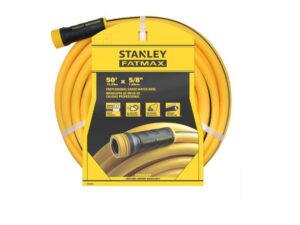 | STANLEY FATMAX Professional Grade Garden Hose | Check Price |
Third Choice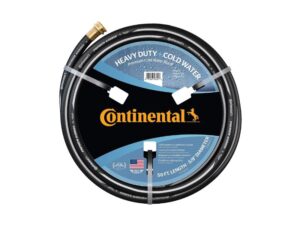 | Continental Premium Garden Heavy Duty 5/8-Inch x 50-Foot Hose | Check Price |
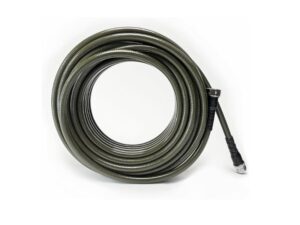 | Water Right 400 Series Polyurethane Garden Hose | Check Price |
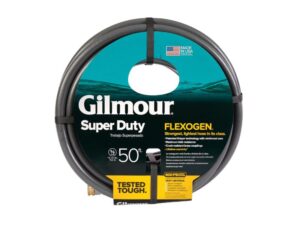 | Gilmour Flexogen 5/8-Inch x 50-Foot Super Duty Garden Hose | Check Price |
1. Dramm ColorStorm Premium Rubber Garden Hose 5/8-Inch x 50-Foot- Best Overall
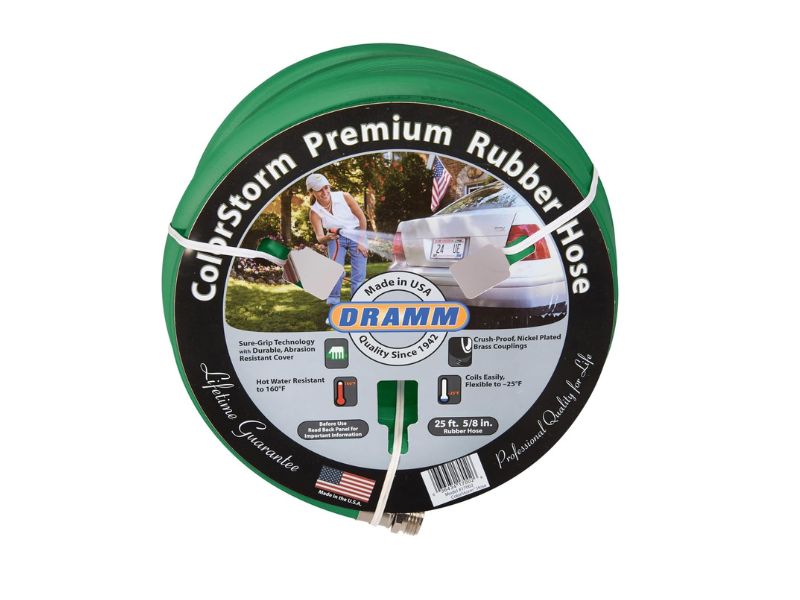
Dramm ColorStorm is my first choice because its specifications match hot-weather use exceptionally well.
The hose is made from EPDM rubber, a synthetic rubber commonly chosen when heat, weather, ozone, and flexibility are important considerations.
Dramm rates the ColorStorm for temperatures ranging from approximately -25°F to 160°F, including hot water up to 160°F. Its maximum operating pressure is listed at 130 PSI, while burst strength is approximately 500 PSI.
That temperature capability does not mean you should intentionally leave a pressurized hose cooking on a concrete driveway all afternoon. It does, however, provide a much stronger performance margin than a lightweight hose made primarily for mild-weather watering.
The hose uses a hexagonal outer profile rather than a perfectly round exterior. Dramm says this construction helps resist kinking, and its Sure-Grip surface makes the hose easier to hold when wet.
The fittings are another major strength.
Instead of thin stamped connectors, Dramm uses machined, nickel-plated brass couplings designed to resist crushing and provide a secure connection at the spigot and nozzle.
That matters in hot climates because coupling areas are common failure points.
Heat softens some hose materials, and the section directly behind the spigot often experiences repeated bending. A strong connection and substantial hose wall reduce the chance of early failure.
The 5/8-inch inside diameter also gives you good general-purpose water flow for sprinklers, watering wands, nozzles, and hand watering.
The biggest disadvantage is weight.
Rubber hoses are heavier than slim polyurethane and modern lightweight woven designs. Independent 50-foot hose testing measured Dramm’s rubber hose at around ten pounds.
That extra weight becomes noticeable when dragging the hose across a large backyard or lifting it onto a reel.
Still, for a property in a climate where summer heat is relentless, I would rather accept additional weight for heat-resistant EPDM construction and heavy-duty fittings.
Best for: Very hot summers, intensive garden watering, patios, lawns, nurseries, and homeowners prioritizing long-term material durability.
Key specs: 5/8-inch diameter, 50-foot length, EPDM rubber, up to 160°F temperature rating, approximately 500 PSI burst strength, nickel-plated brass fittings.
Verdict: Dramm ColorStorm is the strongest overall choice if high temperatures are a primary buying concern and you do not mind the extra weight of premium rubber.
2. STANLEY FATMAX Professional Grade Garden Hose 5/8-Inch x 50-Foot- Best UV-Resistant Pick
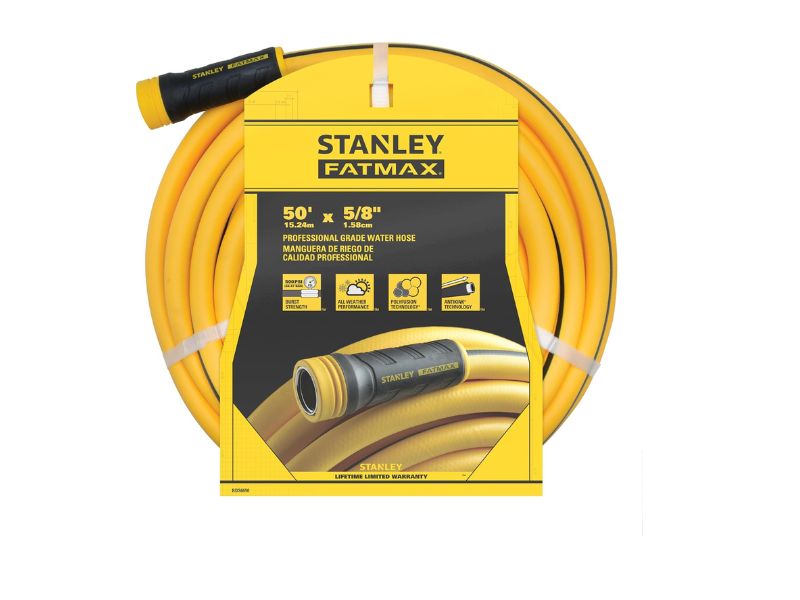
The STANLEY FATMAX makes more sense if your biggest concern is sun exposure rather than hot water.
Its PolyFusion construction combines polyurethane and PVC, allowing the hose to remain lighter and easier to maneuver than traditional heavy rubber while maintaining substantial durability.
STANLEY specifies a 5/8-inch diameter, 50-foot length, AntiKink construction, anodized aluminum couplings, and up to 500 PSI burst strength.
More importantly for this keyword, current technical information describes the hose as having all-weather performance and UV resistance.
UV resistance matters because sunlight can be more damaging than ambient air temperature alone.
Ultraviolet radiation gradually attacks many plastics and elastomers. A cheap hose may lose flexibility, discolor, develop fine cracks, or become sticky after prolonged outdoor exposure.
No garden hose benefits from being abandoned permanently in direct sunlight, but a UV-resistant jacket provides an additional layer of protection when shade is limited.
The bright yellow exterior is also useful in sunny environments.
Dark materials absorb more solar energy, while a highly visible light-colored hose is easy to see across grass, gravel, and driveways.
Its AntiKink technology uses the elasticity of the hose wall to help it straighten under pressure rather than remaining folded.
STANLEY also uses crush-resistant anodized aluminum couplings with enlarged gripping areas, making connection easier without reaching for pliers.
At around seven pounds for the 50-foot model, it occupies a useful middle ground.
It is heavier than ultra-light polyurethane hoses but considerably easier to manage than many traditional rubber hoses.
The main limitation is that STANLEY does not publish the same explicit 160°F hot-water rating that Dramm does for the standard FATMAX garden hose.
So if you’re choosing primarily around extremely hot water, Dramm is the safer specification-driven choice.
For intense sunshine, outdoor exposure, abrasion, and normal cold-water garden use, however, the FATMAX is excellent.
Best for: Sunny yards, exposed patios, desert-style landscaping, driveways, general garden watering, and users wanting less weight than rubber.
Key specs: 5/8 inch x 50 feet, PolyFusion polyurethane/PVC construction, UV-resistant all-weather design, AntiKink technology, aluminum couplings, 500 PSI burst strength.
Verdict: STANLEY FATMAX is my favorite choice when prolonged UV exposure and outdoor handling are bigger concerns than maximum hot-water capability.
3. Continental Premium Garden Heavy Duty 5/8-Inch x 50-Foot Hose- Best Heavy-Duty Rubber Pick
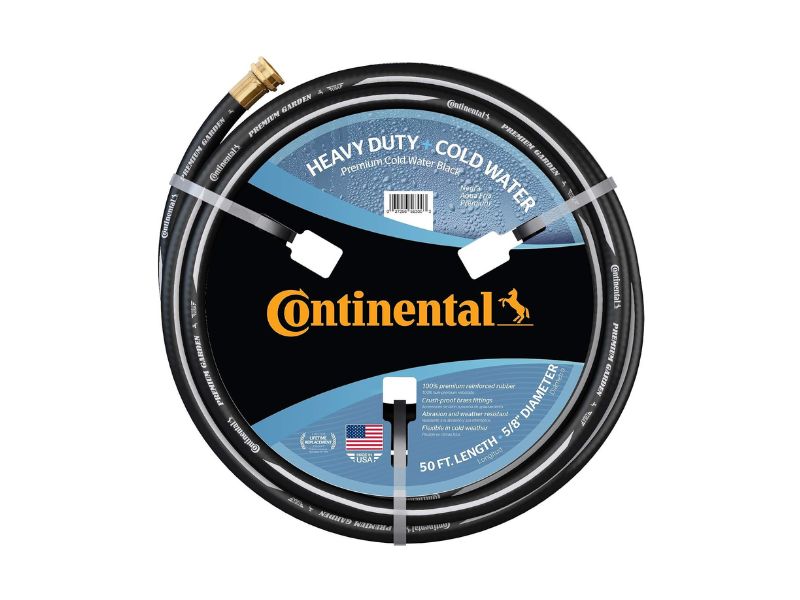
Continental takes a more industrial approach.
This is a substantial EPDM rubber hose rated for a temperature range from approximately -40°F to 160°F. Its working pressure is listed around 130 PSI at normal testing temperatures.
EPDM is an excellent material for exterior environments because it offers useful resistance to heat, ozone, weathering, and many chemicals.
That makes Continental appealing if your hose spends a lot of time in harsh outdoor conditions.
The body is reinforced rather than relying only on a thick layer of rubber, helping it withstand water pressure while limiting expansion.
Brass fittings provide a durable connection at either end.
Independent 50-foot hose testing recorded a flow rate around 9.4 gallons per minute and found that the Continental passed crush-resistance testing.
The main downside is obvious as soon as you pick it up.
This is a heavy hose.
Testing put the 50-foot version at roughly twelve pounds, which makes it noticeably more cumbersome than polyurethane, fabric-jacket, or lightweight hybrid options.
The black exterior also deserves consideration.
Black surfaces can become extremely hot under intense midday sun. I would avoid leaving this hose stretched across concrete or asphalt longer than necessary, particularly if you need to handle it shortly afterward.
That does not undermine the durability of the EPDM material, but it affects comfort.
This is therefore a hose I prefer for demanding users who value rugged construction and temperature resistance over minimum weight.
It can be an excellent match for workshop areas, large gardens, farms, equipment cleanup, and properties where the hose sees more abuse than a lightweight residential model would tolerate.
Best for: Heavy-duty watering, harsh outdoor environments, workshops, large gardens, and users prioritizing reinforced EPDM construction.
Key specs: 5/8 inch x 50 feet, reinforced EPDM rubber, approximately -40°F to 160°F operating range, brass fittings, 130 PSI working pressure.
Verdict: Continental is a durable workhorse for hot climates, although its weight and dark exterior make it less pleasant to carry than STANLEY or Water Right.
4. Water Right 400 Series Polyurethane Garden Hose 7/16-Inch x 50-Foot- Best Lightweight Pick
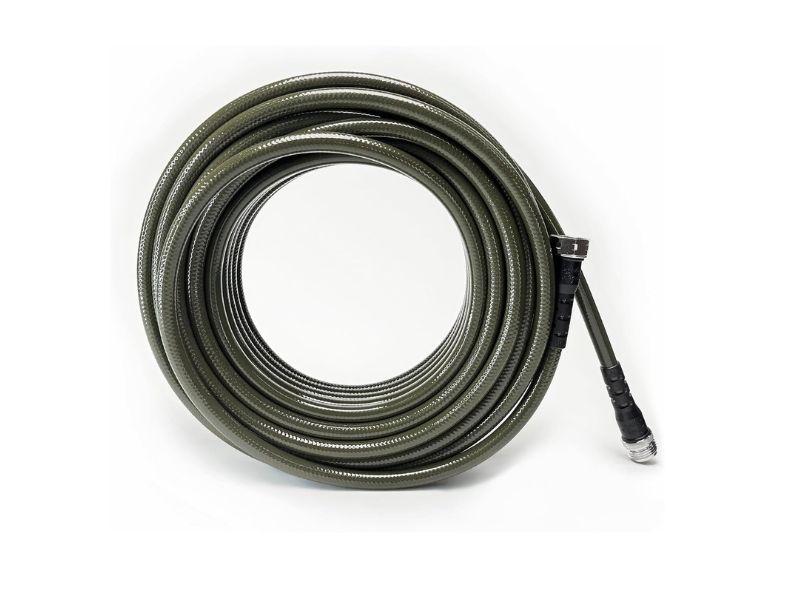
Water Right is the opposite of Continental.
Instead of thick rubber, the 400 Series uses a slim polyurethane hose body designed around low weight and easy handling.
The 50-foot model weighs only about 3.3 pounds, which is a major advantage if you routinely carry a hose between a patio, raised beds, containers, and several sections of the yard.
Its 7/16-inch inner diameter is smaller than the 5/8-inch hoses above.
That reduces weight but also reduces maximum water flow.
For hand watering, raised beds, containers, and normal nozzle use, that tradeoff is often acceptable.
For running a large sprinkler requiring high flow, I would choose one of the 5/8-inch models instead.
The polyurethane material is designed to remain flexible in varying weather conditions, and current specifications list a maximum working temperature around 120°F.
That is lower than the 160°F ratings of the heavy rubber options, so I would not choose Water Right for hot-water use.
Its strength in a hot climate is instead that you get a lightweight polyurethane hose that is pleasant to move during summer watering.
Water Right also manufactures the hose using drinking-water-safe materials without lead, BPA, or phthalates, making it a particularly attractive option around edible gardens, pets, RVs, and outdoor drinking-water applications.
Still, no hose should be treated as a cool-water source after sitting under strong sun.
Water trapped inside any garden hose can become dangerously hot.
Run the water until the temperature returns to normal before watering sensitive plants, filling pet dishes, or allowing skin contact.
Best for: Raised beds, patios, container gardens, users wanting minimum weight, and potable-water-conscious applications.
Key specs: 7/16-inch inside diameter, 50 feet, polyurethane construction, approximately 3.3 pounds, 120°F maximum working temperature, drinking-water-safe materials.
Verdict: Water Right is the best lightweight choice for hot-weather gardeners who value easy carrying and safer materials more than maximum flow rate.
5. Gilmour Flexogen 5/8-Inch x 50-Foot Super Duty Garden Hose- Best Reinforced Value Pick
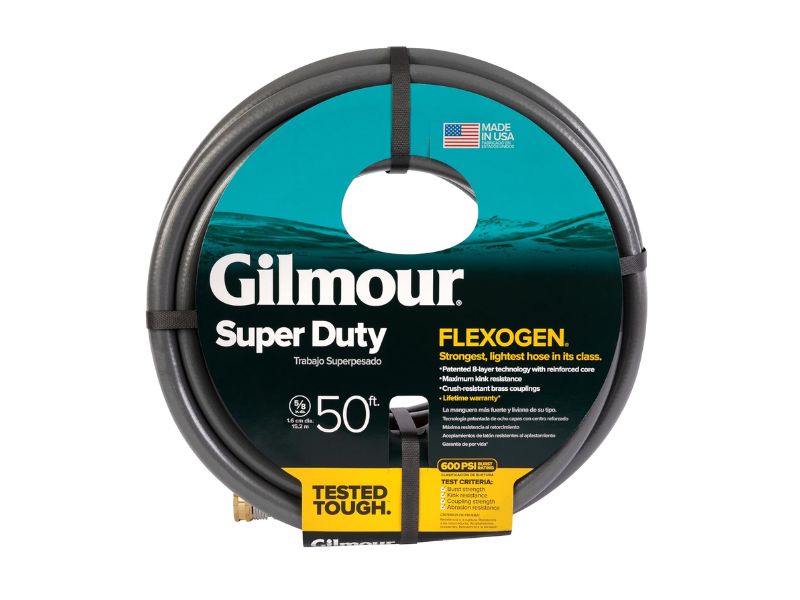
Gilmour Flexogen is a useful middle-ground option for buyers who want traditional hose dimensions and strong reinforcement without moving completely into premium rubber.
The Flexogen design uses an eight-layer construction with a reinforced core, which Gilmour says improves durability and kink resistance.
It also carries a high 600 PSI burst-strength rating, the largest published burst number among these five recommendations.
That does not mean you should operate the hose anywhere near 600 PSI.
Typical household water pressure is dramatically lower.
Burst pressure is better viewed as an indicator of the safety margin built into the hose construction.
The 5/8-inch inside diameter provides good water volume for sprinklers and nozzles.
Gilmour also uses crush- and corrosion-resistant brass connections, with a stainless-steel spring near the faucet to help protect one of the hose’s most vulnerable locations.
Current marketplace specifications put the 50-foot version at a little over seven pounds, so it remains manageable compared with the heavier EPDM choices.
Why doesn’t it rank higher for hot climates?
The manufacturer emphasizes overall seasonal durability rather than publishing the specific high-temperature and UV data available for products such as Dramm, Continental, or STANLEY.
For that reason, I view Flexogen as a strong reinforced general-purpose option rather than a specialist heat hose.
Proper storage becomes more important.
If you can hang the hose in shade after use instead of leaving it in direct sunlight every day, its strong layered construction can offer excellent service.
Best for: General-purpose watering, sprinklers, driveways, homeowners wanting strong reinforcement, and buyers prioritizing burst strength.
Key specs: 5/8 inch x 50 feet, 8-layer reinforced construction, brass couplings, stainless-steel strain-relief spring, 600 PSI burst strength.
Verdict: Gilmour Flexogen is the value-oriented choice when you want a durable conventional hose and are willing to provide better shade and storage during extreme summer conditions.
Best Garden Hose for Hot Climates Comparison
| Product | Material | Heat / Weather Strength | Diameter | Best For |
| Dramm ColorStorm | EPDM rubber | Up to 160°F | 5/8 in. | Best overall |
| STANLEY FATMAX | Polyurethane/PVC | UV-resistant, all-weather | 5/8 in. | Direct sun exposure |
| Continental Premium Garden | EPDM rubber | -40°F to 160°F | 5/8 in. | Heavy-duty use |
| Water Right 400 Series | Polyurethane | Up to 120°F | 7/16 in. | Lightweight watering |
| Gilmour Flexogen | Multi-layer reinforced hose | Heavy-duty seasonal construction | 5/8 in. | Reinforced value |
What Makes a Garden Hose Good for Hot Weather?
Hot-climate performance is not determined by a single specification.
A hose can fail because of UV radiation, excessive surface temperature, internal water temperature, pressure, poor fittings, abrasion, or material fatigue.
The ideal hot-weather hose therefore combines several characteristics.
The outer jacket should tolerate prolonged sunlight reasonably well.
The hose wall should retain strength as temperature rises.
Couplings should not loosen easily.
And the material should remain flexible enough that bending does not create cracks at stress points.
Rubber, EPDM, polyurethane, and quality hybrid materials can all work.
Cheap construction is the bigger problem.
Why UV Resistance Matters in Hot Climates
Heat and UV are different environmental stresses.
A hose can tolerate high water temperatures yet still deteriorate rapidly under ultraviolet light.
UV radiation can break chemical bonds in some polymers, eventually causing fading, hardening, surface checking, cracking, or loss of flexibility.
That is why STANLEY’s explicit UV-resistant construction is useful.
If you live in Arizona, Nevada, Texas, Florida, Southern California, or another high-sun region, UV durability deserves nearly as much attention as temperature rating.
Shade remains valuable even with a UV-resistant hose.
No manufacturer can make outdoor polymer completely immune to years of solar exposure.
EPDM Rubber and Hot Weather
EPDM, or ethylene propylene diene monomer rubber, is particularly useful outdoors.
It is known for resistance to ozone, heat, and weathering, which explains why it appears in demanding outdoor seals, roofing materials, automotive components, and hoses.
Both Dramm and Continental use EPDM-based construction.
For hot-climate durability, this is one of my preferred hose materials.
The drawback is mass.
Traditional rubber and EPDM hoses usually weigh substantially more than polyurethane alternatives.
Does Hose Color Matter in Extreme Heat?
Yes, particularly for surface temperature.
Dark colors absorb more solar radiation.
A black hose lying on asphalt can become extremely hot.
Lighter colors reflect more incoming radiation and may remain more comfortable to handle.
Color does not automatically determine material durability, however.
Continental’s black EPDM hose may tolerate heat structurally better than a poorly made light-colored vinyl hose.
Think of color as a surface-temperature consideration, not a replacement for material quality.
How Hot Can Water Inside a Garden Hose Get?
Hot enough to cause injury.
Water sitting in a hose exposed to direct summer sunlight can become dramatically hotter than the ambient air temperature.
This is particularly dangerous with long dark hoses on concrete, stone, decking, or asphalt.
Never immediately spray children, pets, delicate plants, or yourself after turning on a sun-heated hose.
Let the trapped water discharge first.
You can feel the temperature change at the nozzle as cooler supply water replaces the heated stagnant water.
This habit is important regardless of which hose you buy.
Rubber vs. Polyurethane for Hot Climates
Both materials can be excellent, but they prioritize different qualities.
Rubber or EPDM is my choice when heat tolerance and ruggedness are most important.
It generally feels substantial, handles abuse well, and can perform across wide temperatures.
The disadvantage is weight.
Polyurethane provides excellent durability at much lower mass.
Products such as Water Right are significantly easier to carry, while STANLEY combines polyurethane with PVC for a reinforced hybrid approach.
For an older gardener or anyone moving a hose frequently, reducing weight can be more valuable than buying the heaviest possible rubber hose.
Should You Buy a Metal Garden Hose for Hot Weather?
Metal hoses solve certain problems well.
A stainless-steel outer shell can provide excellent protection against punctures, dragging, and kinking.
However, metal itself is an excellent conductor of heat.
Whether a particular metal hose remains comfortable in sunlight depends on its finish, construction, and internal design.
For a hot-climate-specific purchase, I prefer choosing a hose with documented UV or temperature performance rather than assuming metal automatically solves the problem.
How Much Pressure Do You Need?
Most homes operate far below the burst ratings advertised on premium hoses.
A hose rated at 500 or 600 PSI burst strength is not intended to be used continuously at that pressure.
Normal watering is typically much lower.
High burst strength is still useful because heat can affect material strength.
A large difference between ordinary working pressure and failure pressure provides a useful safety margin.
Dramm, for example, lists approximately 130 PSI operating pressure and around 500 PSI burst pressure.
Is a 5/8-Inch Hose Best for Hot Climates?
Climate does not determine ideal hose diameter.
For most residential watering, 5/8 inch remains the most versatile choice.
It provides enough flow for sprinklers, washing, watering wands, and most nozzles without the bulk of a 3/4-inch hose.
Water Right’s 7/16-inch design is intentionally different.
The smaller diameter helps make the hose extremely light, but it reduces maximum flow.
For hand watering, that may be an excellent trade.
For a large oscillating sprinkler, I would favor 5/8 inch.
Should You Leave a Garden Hose in the Sun?
Even a heat- and UV-resistant hose will usually last longer if you store it out of direct sunlight.
After watering, release the pressure and move the hose onto a reel, hanger, or shaded storage location when practical.
Continuous UV exposure does not provide any benefit.
The goal of buying a UV-resistant hose is to reduce damage during unavoidable sun exposure, not to eliminate the value of proper storage.
Best Hose Storage for Hot Climates
A shaded wall-mounted hanger is one of the simplest options.
A covered reel is even better if it allows adequate airflow and does not force the hose into extremely tight coils.
Avoid enclosed dark storage boxes sitting in full sun if they become excessively hot internally.
Allow the hose to cool before winding it tightly after extreme use.
Also release pressure before storage.
Keeping a hot hose pressurized creates unnecessary stress on the wall and fittings.
Does Hot Weather Cause More Kinks?
Heat can make some hose materials softer.
A soft hose can flatten more easily when sharply bent, particularly when it is unpressurized.
Other materials become stiff or develop permanent coil memory after repeated exposure.
Good reinforcement reduces both problems.
Dramm’s hexagonal wall, STANLEY’s AntiKink construction, and Gilmour’s layered reinforced core address this issue through different designs.
Correct use matters too.
Uncoil the hose before turning sharp corners and avoid pulling tight loops around furniture, planters, and trees.
Are Brass or Aluminum Fittings Better in Hot Weather?
Both can work extremely well.
Brass is robust and commonly used on professional rubber hoses. Dramm uses nickel-plated machined brass, while Continental and Gilmour also rely on substantial metal connectors.
Anodized aluminum reduces weight and resists corrosion. STANLEY uses aluminum couplings as part of its lightweight professional-grade design.
The quality of the fitting matters more than simply choosing brass over aluminum.
Thin, weak connectors are the problem.
How to Make a Garden Hose Last Longer in Extreme Heat
Try to keep the hose shaded whenever it is not being used.
Release pressure after watering.
Do not leave stagnant water inside before using it on sensitive plants or animals.
Avoid dragging the hose across hot sharp asphalt unnecessarily.
Do not drive over couplings.
Use large coils rather than tightly bending the hose around a small hook.
Inspect the section nearest the spigot regularly because this area experiences the most concentrated bending stress.
And if the outer jacket begins becoming sticky, cracked, swollen, or unusually soft, replace the hose rather than waiting for a pressure failure.
Frequently Asked Questions
What is the best garden hose for hot climates?
Dramm ColorStorm is my top overall choice for extremely hot climates.
Its EPDM rubber construction is rated up to approximately 160°F, while the heavy hose wall, kink-resistant shape, substantial pressure rating, and nickel-plated brass fittings make it particularly well suited to demanding summer watering.
What garden hose material is best for extreme heat?
EPDM rubber is one of the strongest choices when heat resistance is the priority.
It handles outdoor weathering, ozone, and elevated temperatures particularly well. Premium polyurethane and properly formulated hybrid hoses can also perform very well while reducing weight.
Is a rubber hose good for hot weather?
Yes, a quality rubber or EPDM hose is an excellent choice for hot climates.
Dramm and Continental both offer products rated to approximately 160°F, although rubber generally weighs more than polyurethane alternatives.
What garden hose is best for direct sunlight?
A hose with documented UV-resistant construction is preferable for prolonged sun exposure.
STANLEY FATMAX is particularly attractive because its all-weather PolyFusion construction is specified as UV resistant while retaining strong abrasion and kink resistance.
Does a black garden hose get hotter?
Yes, dark-colored surfaces generally absorb more solar radiation and can become hotter in direct sunlight.
Material quality still matters more for structural durability, but a black hose may be less comfortable to handle after sitting on a sun-exposed patio or driveway.
Can a garden hose burst because of heat?
Heat can reduce material strength and increase stress, especially if the hose remains pressurized.
Do not leave a hose unnecessarily pressurized in extreme sunlight. Turn off the faucet and release trapped pressure after use.
Is polyurethane hose good in hot weather?
Quality polyurethane can work very well in hot climates, especially when low weight matters.
Water Right uses polyurethane and is rated to approximately 120°F, while premium polyurethane-based constructions can provide excellent weather resistance.
Can water sitting in a hose get too hot for plants?
Yes, sun-heated water can become hot enough to damage sensitive plants or cause burns.
Always flush stagnant water from a hose that has been sitting under strong sunlight before watering plants, pets, or anything involving skin contact.
Should I store my hose inside during summer?
Indoor storage is not necessary, but shade can significantly reduce unnecessary UV and heat exposure.
A shaded reel, covered wall, garage, or sheltered hose hanger can help extend the life of almost any garden hose.
What diameter hose is best for a hot climate?
A 5/8-inch hose is still the best general-purpose diameter for most homes.
Climate affects material choice more than diameter. A 5/8-inch hose provides a strong balance of water flow, weight, and compatibility with sprinklers and watering tools.
Final Verdict
Finding the best garden hose for hot climates means looking beyond ordinary kink resistance. In a high-heat environment, the hose also needs to survive UV exposure, elevated surface temperatures, repeated pressure cycles, abrasive ground, and long summer watering sessions.
Dramm ColorStorm Premium Rubber Garden Hose is my first choice. Its EPDM rubber construction and 160°F rating provide a clear advantage when heat resistance is the main priority, while its heavy-duty brass fittings and kink-resistant design support long-term use.
STANLEY FATMAX Professional Grade Garden Hose is the better option if direct sun and UV exposure are your primary concerns. Its UV-resistant PolyFusion construction is lighter than traditional rubber and easier to drag around a landscaped yard.
Continental Premium Garden Heavy Duty Hose provides another excellent EPDM option for homeowners who want rugged commercial-style construction and do not mind additional weight.
Water Right 400 Series is the lightweight choice for hand watering and edible gardens, while Gilmour Flexogen offers a durable reinforced alternative with excellent burst strength.
For the hottest, sunniest properties, I would start with Dramm ColorStorm. Regardless of which hose you choose, avoid leaving it continuously pressurized in direct sunlight, flush heated stagnant water before use, and store it in shade whenever practical. Those habits can make a major difference in how long even a premium hot-climate garden hose lasts.

I’m Maya L. Greenwood, a lifelong plant lover who believes anyone can grow something beautiful with the right guidance. After years of testing soil mixes, pruning methods, irrigation tricks, and pest-safe solutions, I started EasyGardenTips.com to turn hard-won lessons into step-by-step advice. From seed starting and container gardens to composting and seasonal checklists, my goal is to make gardening simple, sustainable, and fun.