5 Best Weed Barrier Under Gravel for Long-Term Weed Control
The best weed barrier under gravel needs to do more than stop sunlight from reaching weed seeds. A good underlayment should also provide soil separation, puncture resistance, drainage, erosion control, and enough tensile strength to survive the pressure of angular gravel without tearing.
For most residential gravel paths, rock beds, and landscaping projects, my top choice is the Super Geotextile Professional 5oz Geotextile Weed Barrier Fabric 3 x 100 Feet. Its 5-ounce dual-layer construction combines woven strength with a needle-punched nonwoven layer for permeability, making it particularly well balanced for gravel where I want both weed suppression and drainage. Super Geotextile rates this Pro 5 Plus material for up to 25 years and specifically lists patios, sidewalks, landscape stabilization, and weed-control applications.
For a gravel driveway or parking area where aggregate stabilization matters more than garden-bed convenience, I prefer the Mutual Industries WF200 Woven Geotextile Fabric 6 x 300 Feet. It covers an enormous 1,800 square feet and is intended for applications such as roads, pavement stabilization, and erosion control.
If the project is a shorter but heavily loaded gravel driveway, the ArmorLay Commercial Grade Ground Stabilization Fabric 12.5 x 30 Feet is another excellent specialist. ArmorLay specifically designs its stabilization fabric to help reduce ruts, potholes, soil movement, and drainage-related base failure.
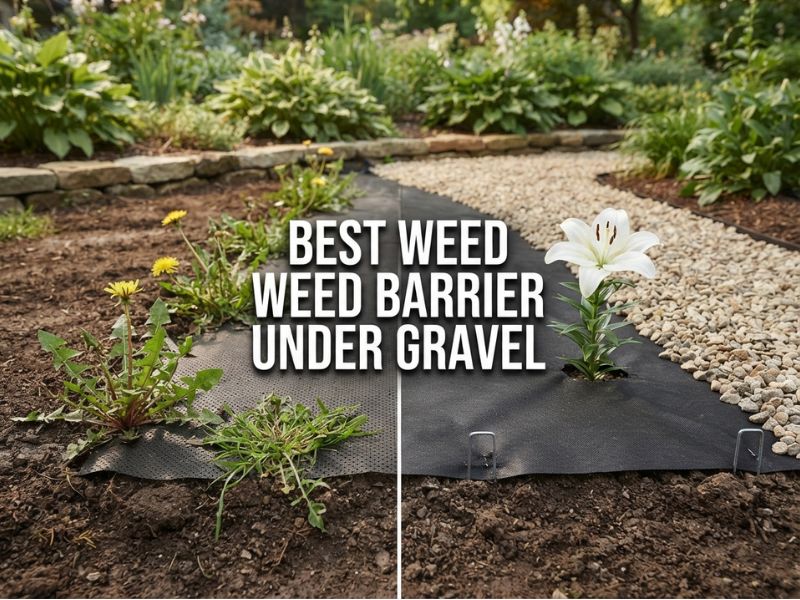
One important expectation to set before installation: even excellent landscape fabric does not guarantee a permanently weed-free gravel surface. UC IPM notes that fabric beneath rock is useful because it separates rock from soil and reduces soil migration, but weed seeds can eventually arrive from above. Regular removal of surface debris and young weeds remains part of maintaining a gravel area.
5 Best Weed Barriers Under Gravel
| Image | Product Name | Check Price |
|---|---|---|
Best Choice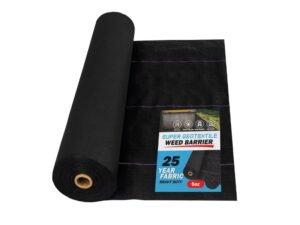 | Super Geotextile Professional 5oz Geotextile Weed Barrier | Check Price |
Second Best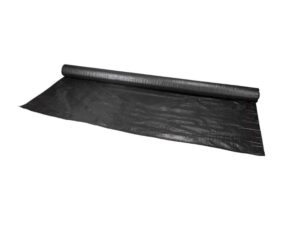 | Mutual Industries WF200 Woven Geotextile Fabric | Check Price |
Third Choice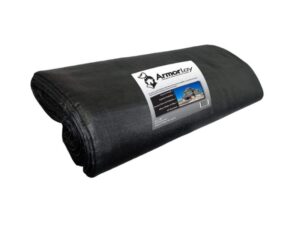 | ArmorLay Commercial Grade Ground Stabilization Fabric | Check Price |
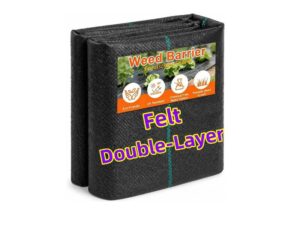 | AMAGABELI GARDEN & HOME Feet Weed Barrier | Check Price |
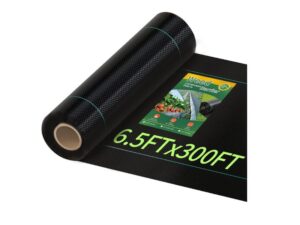 | Pterying 6.5 x 300 Feet 3oz Heavy Duty Weed Barrier | Check Price |
1. Super Geotextile Professional 5oz Geotextile Weed Barrier Fabric 3 x 100 Feet- Best Overall
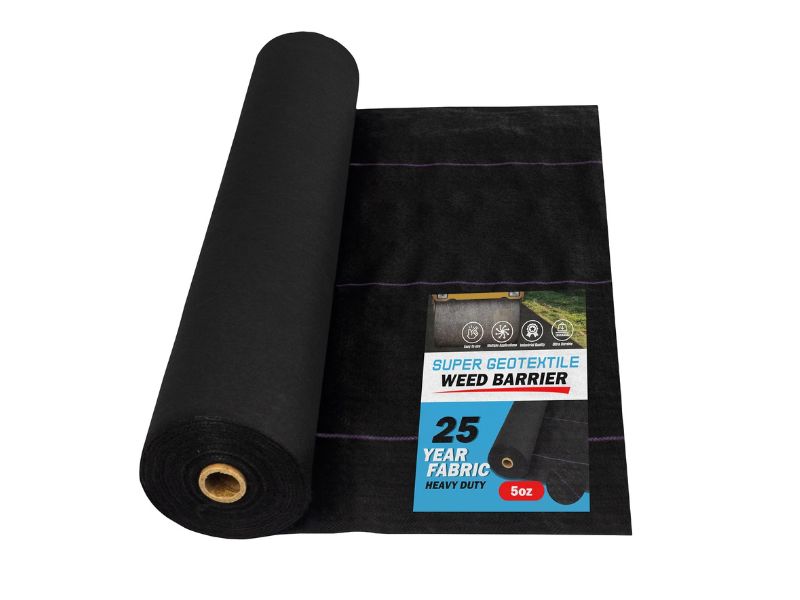
| Specification | Super Geotextile Professional 5oz |
| Size | 3 ft × 100 ft |
| Coverage | 300 sq. ft. |
| Fabric Weight | 5 oz. |
| Construction | Woven + nonwoven |
| Material | Polypropylene |
| Needle-Punched | Yes |
| Rated Life | Up to 25 years |
| Best For | Gravel paths and rock beds |
The Super Geotextile Professional 5oz is my first choice for most residential gravel projects because its construction addresses the two things I care about most under decorative stone: mechanical strength and permeability.
Rather than being a basic thin woven sheet, the Pro 5 Plus combines woven and nonwoven polypropylene layers that are needle-punched together. Super Geotextile describes the design as providing the strength of a woven fabric with the permeability of a nonwoven geotextile.
The 3-foot width is especially convenient for garden paths and narrow rock borders. Many landscape walkways are already around three to four feet wide, meaning you can often install one continuous section instead of creating a seam down the middle.
At five ounces, the material is substantially more robust than lightweight garden weed cloth.
That matters because gravel is hard on underlayment.
Angular crushed stone can concentrate a lot of pressure onto small areas of fabric. Foot traffic then pushes those stones repeatedly against the barrier.
A thin product may puncture or stretch.
The Super Geotextile material feels much more appropriate for a permanent installation.
I also like the dual-layer design where drainage matters. A gravel surface should not act like a shallow swimming pool after rainfall.
Water needs a route downward through the aggregate and fabric.
Super Geotextile specifically identifies permittivity as one of this product’s benefits and lists landscape stabilization, decks, patios, and sidewalks among its intended applications.
The exact 3-by-100-foot Amazon configuration has also accumulated hundreds of reviews, giving it a more established ownership history than many generic geotextile rolls.
For a normal pea gravel path, crushed-stone walkway, river-rock area, fire-pit perimeter, or decorative gravel border, this is the product I would start with.
Best for: Gravel paths, decorative stone beds, patios, walkways, and medium-size residential projects.
Main limitation: For a full gravel driveway carrying vehicles, I prefer a wider stabilization-grade fabric such as Mutual WF200 or ArmorLay.
2. Mutual Industries WF200 Woven Geotextile Fabric 6 x 300 Feet- Best for Gravel Driveways
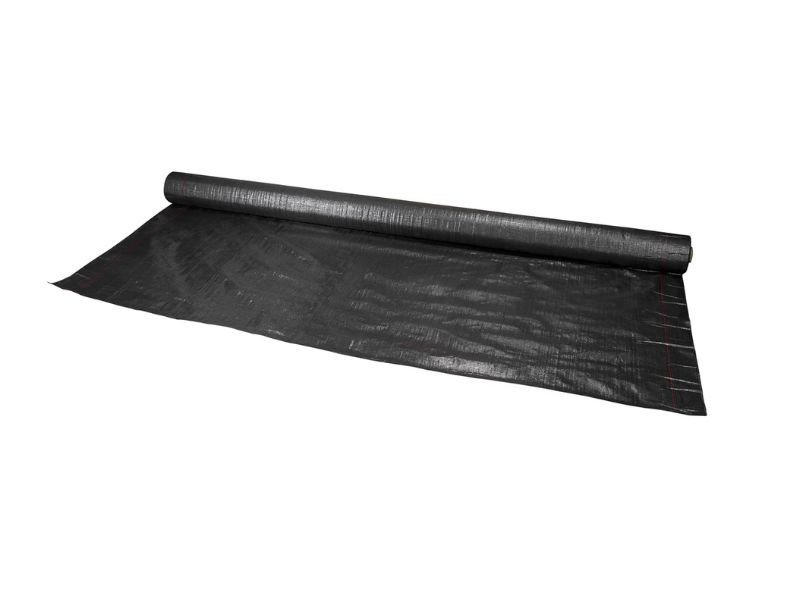
| Specification | Mutual Industries WF200 |
| Size | 6 ft × 300 ft |
| Coverage | 1,800 sq. ft. |
| Material | Woven polypropylene |
| Roll Weight | About 30 lb |
| UV Protection | Yes |
| Primary Function | Separation/stabilization |
| Best For | Gravel driveways |
The Mutual Industries WF200 is less like ordinary garden weed cloth and more like a true civil-style woven geotextile.
That is exactly what I want beneath a large gravel driveway.
The WF200 is a woven polypropylene material sold in a 6-by-300-foot roll, providing approximately 1,800 square feet of coverage. Product specifications identify uses including road stabilization, pavement applications, and erosion control.
The most important job of a geotextile beneath a driveway is not actually killing weeds.
It is separating the aggregate base from the native soil.
Without separation, vehicle loading can gradually push stone downward into softer soil while fine soil migrates upward into the gravel.
Over time, your expensive gravel layer becomes contaminated.
Low areas develop.
Ruts form.
You then purchase more stone just to restore the surface.
A properly installed woven geotextile reduces that mixing.
The dense weave also makes WF200 a much better candidate for angular crushed stone and repeated wheel loads than lightweight flower-bed cloth.
Its six-foot width helps reduce seams on driveways and larger parking pads.
If two sections are needed, I would still overlap them generously rather than installing them edge to edge.
Another reason I like the WF200 is its ownership history. The referenced Amazon product has accumulated roughly 1,350 reviews with a strong overall rating, making it an unusually established product in this specialized category.
The downside is roll size.
Six by 300 feet is absurd if all you are building is a ten-foot garden path.
This is a large-project product.
For a long driveway, RV parking pad, shed base, farm lane, or extensive gravel landscape, however, buying one large continuous roll can simplify installation and reduce seams.
Best for: Gravel driveways, parking areas, road base, shed pads, RV areas, and large hardscape projects.
Main limitation: The 1,800-square-foot roll is excessive for small residential pathways.
3. ArmorLay Commercial Grade Ground Stabilization Fabric 12.5 x 30 Feet- Best for Ground Stabilization
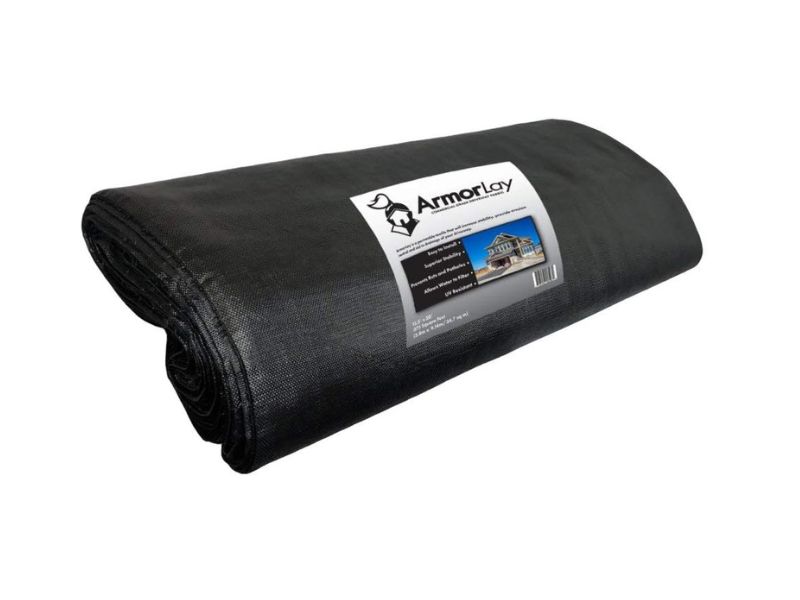
| Specification | ArmorLay Ground Stabilization Fabric |
| Size | 12.5 ft × 30 ft |
| Coverage | About 375 sq. ft. |
| Type | Commercial stabilization fabric |
| Primary Job | Ground/aggregate stabilization |
| Weed Suppression | Yes |
| Erosion Control | Yes |
| Best For | Driveways and parking areas |
The ArmorLay Commercial Grade Ground Stabilization Fabric is designed specifically around a common gravel-driveway problem: the surface keeps developing ruts and potholes because the base underneath is moving.
ArmorLay says its driveway stabilization product helps prevent ruts and potholes while supporting drainage and improving ground strength.
The Amazon configuration measures approximately 12.5 feet by 30 feet, making it convenient for short driveways, parking bays, construction entrances, or other broad areas where using multiple narrow landscape-fabric strips would be inconvenient.
The 12.5-foot width is the key feature.
A standard single-car driveway is often around ten to twelve feet wide.
That means one sheet may span most or all of the driveway width without a long seam running through the traffic area.
Fewer seams generally mean fewer opportunities for the fabric to shift during gravel placement.
ArmorLay is also designed to help keep the stone layer separate from softer subsoil.
That becomes particularly useful on clay soil, soft ground, areas prone to rutting, or locations where gravel seems to disappear into the earth every year.
The product has been on the market for years and has accumulated close to a thousand reviews on its associated Amazon listing.
I would choose ArmorLay over a conventional weed-control cloth when the project involves vehicles.
If your only requirement is keeping weeds beneath decorative pea gravel beside the house, it is probably more structural fabric than you need.
But when the gravel is serving as an actual driveway surface, soil stabilization is just as important as weed suppression.
Best for: Short gravel driveways, vehicle parking areas, soft soil, rut-prone areas, and heavy-use gravel surfaces.
Main limitation: It is designed around structural stabilization, so it can be unnecessarily expensive for a simple ornamental rock bed.
4. AMAGABELI GARDEN & HOME 5.8oz 3 x 50 Feet Weed Barrier Landscape Fabric- Best Heavy-Duty Residential Pick
| Specification | AMAGABELI 5.8oz |
| Size | 3 ft × 50 ft |
| Coverage | 150 sq. ft. |
| Fabric Weight | 5.8 oz. |
| Construction | Woven, needle-punched dual layer |
| Water Permeable | Yes |
| Guide Lines | Yes |
| Best For | Small gravel/stone projects |
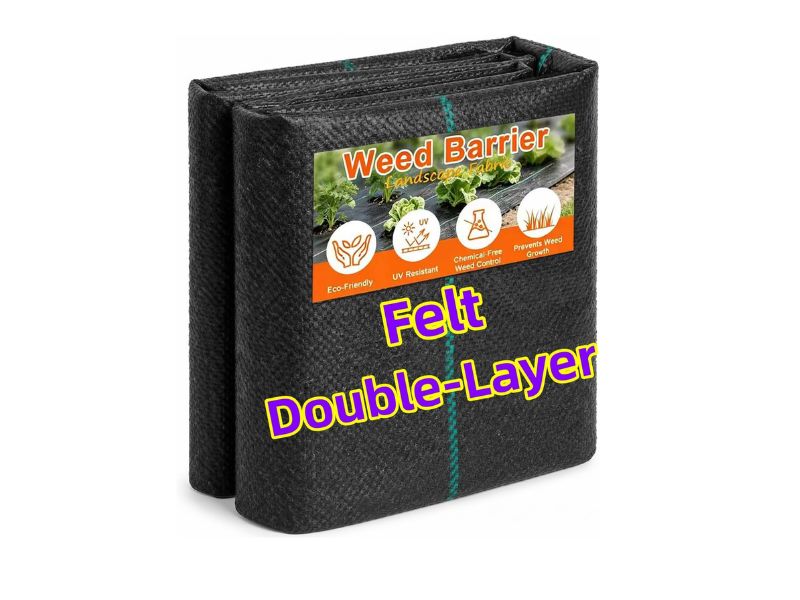
The AMAGABELI 5.8oz Weed Barrier is the product I would choose for a smaller gravel project where I want a particularly thick material without buying a commercial driveway roll.
Its construction combines woven and needle-punched layers, and AMAGABELI rates this version at 5.8 ounces.
The company specifically lists driveways, stone, gravel walkways, patios, ground cover, and general landscaping among its applications.
For DIY work, the 3-by-50-foot roll is much easier to handle than an industrial 300-foot roll.
That makes it a sensible choice for:
side-yard gravel strips, foundation rock, mailbox beds, short garden paths, small patios, and drainage-friendly decorative-stone installations.
The 5.8-ounce weight gives it useful resistance to tearing when gravel is spread across the surface.
AMAGABELI says the material has high tensile strength and is suitable for both foot and vehicle traffic, although for a full driveway I would still move up to a dedicated stabilization geotextile.
The fabric is also designed to remain permeable.
This matters in ornamental rock landscaping because one of the main reasons I avoid solid polyethylene sheeting is water and air restriction.
UC IPM notes that porous geotextiles allow water and air movement, which is one reason they are preferable to solid black plastic in landscape applications.
The exact 3-by-50-foot Amazon configuration has more than a thousand documented reviews, so it is not an untested generic product.
Best for: Small rock beds, decorative gravel, short pathways, patio borders, and homeowners wanting a thick fabric.
Main limitation: At only 150 square feet per roll, larger installations become expensive and seam-heavy.
5. Pterying 6.5 x 300 Feet 3oz Heavy Duty Weed Barrier Landscape Fabric- Best Value for Large Areas
| Specification | Pterying Heavy Duty |
| Size | 6.5 ft × 300 ft |
| Coverage | About 1,950 sq. ft. |
| Fabric Weight | 3 oz. |
| Material | Woven polypropylene |
| Tensile Strength | Up to 600 lb across full width, listed |
| Water Permeable | Yes |
| Best For | Large low-to-medium traffic areas |
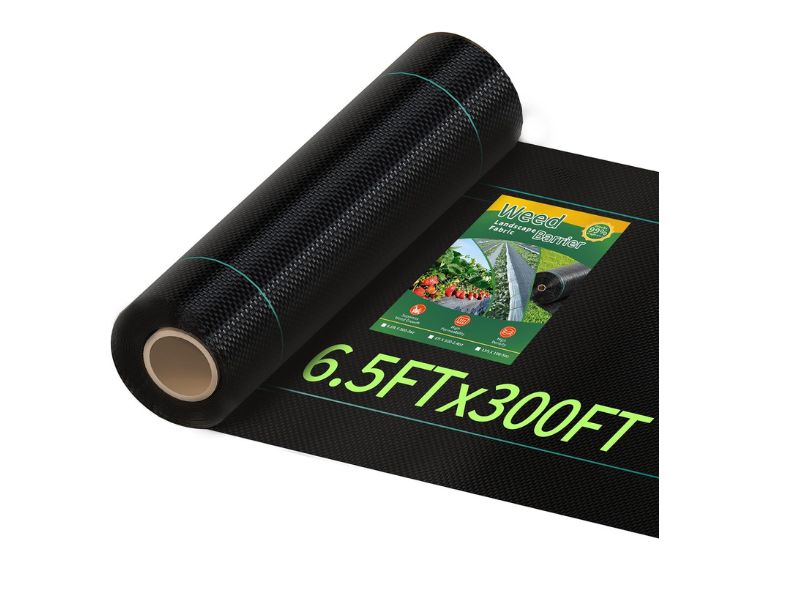
The Pterying 6.5-by-300-foot Weed Barrier takes a different approach from the heavier AMAGABELI and Super Geotextile fabrics.
It uses a lighter 3-ounce woven polypropylene, but gives you an enormous roll for the price.
At 6.5 feet wide and 300 feet long, one roll covers approximately 1,950 square feet.
Pterying lists approximately 146 pounds of tensile strength on a 5-centimeter test strip and up to 600 pounds across the full fabric width. The material is marketed for driveways, erosion control, landscaping, mulch, and gravel applications.
Its biggest advantage is simple: coverage per dollar.
If you have a long gravel walkway, extensive stone landscaping, or several gravel areas around a property, buying lots of 50-foot premium rolls creates unnecessary seams and expense.
The Pterying roll lets you cover long continuous areas.
The 6.5-foot width is also practical for wide pathways and landscaping strips.
Current Amazon marketplace data shows more than 500 ratings on the exact ASIN, with strong ongoing sales activity.
The compromise is thickness.
Three ounces is lighter than the premium 5- and 5.8-ounce products above.
For a pedestrian path or decorative gravel bed, I am comfortable with that trade-off when the subgrade is properly prepared.
For a heavily trafficked driveway with sharp crushed rock and repeated vehicle loads, I would rather spend more on a stabilization-grade geotextile.
Best for: Large gravel areas, long pathways, decorative stone, low-to-medium traffic zones, and budget-conscious installations.
Main limitation: Thinner construction makes it less appealing for heavily loaded gravel driveways.
Best Weed Barrier Under Gravel Comparison
| Product | Type | Weight | Size | Best For |
| Super Geotextile Professional | Woven + nonwoven | 5 oz. | 3 × 100 ft | Best overall |
| Mutual Industries WF200 | Woven geotextile | Heavy-duty | 6 × 300 ft | Driveways |
| ArmorLay Stabilization Fabric | Stabilization geotextile | Commercial grade | 12.5 × 30 ft | Ruts/soft ground |
| AMAGABELI Garden & Home | Dual-layer | 5.8 oz. | 3 × 50 ft | Small gravel projects |
| Pterying Heavy Duty | Woven polypropylene | 3 oz. | 6.5 × 300 ft | Large-area value |
What Type of Weed Barrier Is Best Under Gravel?
For permanent gravel surfaces, I generally prefer a woven geotextile or reinforced dual-layer landscape fabric rather than a thin nonwoven garden sheet.
Under gravel, the fabric performs several jobs simultaneously.
It blocks some weed growth from below.
It creates a separation layer between gravel and soil.
It reduces soil migration.
It helps stabilize aggregate.
And, when properly selected, it still permits drainage.
UC IPM specifically recommends considering landscape fabric beneath rock mulch because the fabric keeps rock from sinking into soil and helps prevent soil from migrating upward into the rock layer.
That soil-separation function is one of the biggest reasons gravel installations benefit from geotextile.
Woven vs. Nonwoven Geotextile Under Gravel
Both types can be useful, but they solve slightly different problems.
Woven Geotextile
Woven polypropylene normally provides excellent tensile strength and soil separation.
I prefer it for:
gravel driveways,
parking pads,
walkways,
shed bases,
and general stone landscaping.
Mutual WF200 is a good example.
The tight woven structure resists stretching while helping keep aggregate and native soil separated.
Nonwoven Geotextile
Nonwoven geotextile generally excels at filtration and water flow.
It is commonly used around:
French drains,
drainage stone,
retaining walls,
erosion-control installations,
and filtration systems.
For example, ArmorLay’s dedicated nonwoven filter fabric is specifically intended to allow water through while keeping sediment separated, and the company lists use beneath pavers and temporary driveways.
For a standard gravel path where weed control and separation are priorities, I usually prefer woven or dual-layer material.
For a drainage project involving gravel, nonwoven geotextile may be the better engineering choice.
Why You Should Not Use Plastic Sheeting Under Gravel
Black plastic can certainly block weeds.
The problem is that it also blocks normal air and water movement.
That can create drainage problems.
Water may pool beneath or on top of the gravel instead of infiltrating normally.
Solid plastic also tends to become brittle or tear over time.
UC IPM specifically notes that solid polyethylene provides weed suppression but lacks porosity, restricting water and air movement; porous geotextiles were developed partly to overcome that limitation.
For most gravel applications, a quality permeable geotextile is the better long-term material.
Is Weed Barrier Necessary Under Gravel?
Not always—but it is often useful.
For a temporary decorative gravel patch on firm, stable ground, fabric may not be essential.
For a permanent gravel path, driveway, rock bed, patio perimeter, or parking area, I generally consider geotextile worthwhile because of the separation benefits.
Interestingly, landscape-fabric recommendations differ depending on where it is used.
Extension experts often advise against fabric in planted perennial beds because roots can become entangled and weed seeds eventually germinate above it.
But pathways and non-planted rock areas are one of the places where fabric is much easier to justify. A 2026 Colorado Extension response specifically distinguishes pathways as an appropriate use compared with planted landscape areas.
Does Weed Barrier Completely Stop Weeds in Gravel?
No.
This is one of the most important things to understand before spending money on landscape fabric.
Fabric blocks many weeds originating in the soil underneath.
But gravel does not remain perfectly clean forever.
Wind carries:
dust, soil particles, leaves, grass clippings, pollen, and weed seeds onto the surface.
Fine organic material gradually accumulates between stones.
Eventually, weed seeds can germinate above the fabric.
Extension sources repeatedly identify this as a common limitation of landscape fabric and rock mulch.
The fabric may still be functioning perfectly underneath.
The weed is simply growing in new material sitting on top.
How Thick Should Weed Barrier Be Under Gravel?
For decorative residential gravel, I generally look around the 3–6 oz. range, depending on construction.
A good 3-ounce woven product can work very well because woven construction provides substantial tensile strength.
A 5-ounce dual-layer fabric gives more puncture resistance.
An 8-ounce nonwoven geotextile may make sense for heavy drainage or specialized construction.
Fabric weight alone does not tell the entire story.
Consider:
weave, tensile strength, puncture resistance, permeability, subgrade condition, gravel size, and expected traffic.
A properly engineered 3-ounce woven road fabric can outperform a soft heavier garden felt in a stabilization application.
How Much Gravel Should Go Over Weed Barrier?
The required gravel depth depends on the application.
A decorative rock bed may need only a few inches.
A pedestrian path generally needs enough compacted base and surface aggregate to remain stable.
A vehicle driveway requires substantially more base preparation.
Do not use landscape fabric as a substitute for a proper gravel base.
The fabric separates materials.
It does not magically turn soft topsoil into a structurally sound driveway.
For a vehicle surface, excavate unsuitable organic material, establish the correct grade, compact the subgrade, install geotextile where appropriate, then add and compact the required aggregate layers.
Should You Remove Grass Before Installing Weed Barrier Under Gravel?
Yes.
Remove sod, large weeds, woody roots, and major organic debris before laying the fabric.
Do not put expensive gravel directly over tall vegetation and expect landscape fabric to fix the base.
Grass and roots underneath will decompose.
That can create voids and settlement.
For pathways and driveways, removing the organic surface layer also improves structural stability.
Level and compact the soil before installing the geotextile.
How to Install Weed Barrier Under Gravel
Start by defining the edge of the project.
Excavate grass, roots, and loose organic soil as needed.
Grade the subsoil so water moves in the intended direction.
Compact the surface.
Unroll the geotextile fabric directly over the prepared ground.
Avoid unnecessary wrinkles.
When you need multiple pieces, overlap them generously instead of installing them edge to edge.
UC IPM also recommends overlapping landscape-fabric sections because weeds can exploit gaps between pieces.
Use landscape staples temporarily where needed to prevent movement.
Then place gravel carefully.
Avoid driving equipment directly over exposed fabric unless the manufacturer specifically permits it.
Spread enough aggregate to protect the barrier before applying heavy loads.
How Much Should Weed Barrier Overlap?
For ordinary landscape gravel, I like approximately 6–12 inches of overlap.
For unstable soil or vehicle applications, more may be appropriate depending on the geotextile manufacturer’s engineering recommendations.
Do not save six inches of fabric only to create a weak seam that opens after gravel placement.
Pay extra attention to slopes.
Arrange overlaps so water movement is less likely to work underneath an exposed edge.
Should Landscape Fabric Go Directly Under Gravel?
Usually, yes, but that does not always mean the entire structural system consists only of soil, fabric, and decorative gravel.
For a garden path, a basic system might be:
compacted soil,
geotextile,
compacted aggregate,
decorative gravel.
A driveway often requires a deeper crushed-stone base.
The exact layer sequence depends on drainage, native soil, expected load, and aggregate specification.
The geotextile’s main purpose is to separate and stabilize—not replace base stone.
Weed Barrier Under Pea Gravel
Pea gravel is rounded and tends to move underfoot.
A fabric beneath it helps prevent those stones from gradually pressing into soil.
Because pea gravel itself does not compact tightly, fines and organic debris can accumulate in the gaps.
This means weeds can eventually germinate above the fabric.
Edge containment is particularly important with pea gravel because the round stones migrate easily.
For a light-use pea-gravel path, the Super Geotextile Professional 5oz is a very good match.
Weed Barrier Under Crushed Stone
Angular crushed stone interlocks more effectively than pea gravel.
That makes it better for paths and driveway bases.
However, angular edges can also apply more concentrated pressure to the fabric.
For crushed stone carrying vehicle loads, I prefer a stabilization-grade product such as Mutual WF200 or ArmorLay.
Do not install very sharp stone aggressively onto a lightweight garden fabric and expect decades of service.
Weed Barrier Under River Rock
Landscape fabric works especially well beneath decorative river rock because one of the biggest problems with rock beds is stones gradually sinking into soil.
The fabric creates a physical separation layer.
Use a permeable barrier so rainfall can still infiltrate.
For foundation beds containing no or very few plants, heavy woven fabric can simplify long-term maintenance.
If the river-rock area contains many shrubs and perennials, remember that future planting and root growth make permanent fabric more complicated.
Weed Barrier Under Gravel Driveways
A driveway is where I stop thinking of the product primarily as “weed fabric.”
I want a geotextile separation and stabilization layer.
Vehicle loading repeatedly pushes aggregate against the subgrade.
Soft clay or wet soil can pump upward into the base.
Once stone and soil begin mixing, the driveway loses structure.
For this application, Mutual WF200 is my first choice among these five.
ArmorLay is another strong option for shorter broad areas.
Weed Barrier Under Gravel Paths
Pedestrian paths are much less demanding.
A quality 3–5-ounce fabric is normally enough when the subgrade is stable and preparation is good.
This is where Super Geotextile and Pterying make the most sense.
The choice mainly comes down to project size.
Use the premium 5-ounce material for a smaller path where durability is the priority.
Use the large Pterying roll if you have hundreds of feet to cover.
Does Water Drain Through Weed Barrier?
A good permeable geotextile should allow water through.
But permeability can decline if fine sediment clogs the surface.
This is especially important in drainage-sensitive projects.
Never assume that every product marketed as “weed barrier” has equal flow characteristics.
If drainage is the main objective—for example around a French drain—I would choose a product specifically designed as a nonwoven filtration geotextile, not simply whichever woven weed mat is cheapest.
Can You Put New Weed Barrier Over Old Fabric?
I generally would not.
If an old fabric is already exposed, torn, clogged, and surrounded by accumulated soil, adding another layer does not repair the underlying base.
Remove failed material where practical.
Clean out soil and organic debris.
Correct drainage problems.
Then rebuild the gravel layer properly.
Multiple buried sheets can make future repairs frustrating.
How Long Does Weed Barrier Last Under Gravel?
Quality fabric buried beneath gravel can last many years because the stone protects it from direct UV exposure.
UV radiation is one of the main factors that degrades exposed polypropylene.
That is why buried installations generally last substantially longer than uncovered fabric sitting in sunlight.
Super Geotextile rates its Pro 5 Plus material for up to 25 years.
Real lifespan still depends on installation, traffic, puncture damage, soil conditions, and product quality.
Frequently Asked Questions
What is the best weed barrier under gravel?
Super Geotextile Professional 5oz is my best overall choice for most residential gravel areas.
Its woven plus needle-punched construction provides a useful combination of tensile strength, weed suppression, and permeability. It is particularly well suited to gravel paths, decorative rock, patios, and other medium-duty hardscape applications.
What is the best fabric under a gravel driveway?
Mutual Industries WF200 is my preferred option for a full gravel driveway.
It is a woven geotextile intended for applications including roads, pavement stabilization, and erosion control, and the 6-by-300-foot roll provides substantial coverage with relatively few seams.
Should I put landscape fabric under gravel?
Yes, it can be especially useful under paths, rock mulch, and gravel surfaces where soil separation matters.
UC IPM notes that landscape fabric beneath rock can prevent rock from sinking into soil and reduce upward soil migration.
What weight landscape fabric should I use under gravel?
Around 3–6 oz. works well for many residential gravel installations, depending on fabric construction and load.
Use heavier or engineered stabilization geotextile where vehicles, sharp aggregate, soft soil, or significant structural loads are involved.
Is woven or nonwoven fabric better under gravel?
Woven geotextile is generally better for stabilization, while nonwoven fabric excels at filtration and drainage.
For a normal gravel driveway, woven fabric is usually my first choice.
For a French drain or drainage-rock application, a nonwoven filtration geotextile may be more appropriate.
Will weeds grow through gravel fabric?
Some weeds can eventually appear even with a good barrier.
Many originate from seeds deposited in dust and organic debris above the fabric rather than growing through it from below.
Is plastic better than landscape fabric under gravel?
No, not for most long-term installations.
Solid plastic restricts water and air movement, while porous geotextile allows drainage. UC IPM specifically identifies this permeability as an advantage of landscape fabric over polyethylene sheeting.
How much gravel should cover landscape fabric?
Use enough gravel for the structural requirements of the project rather than simply enough to hide the fabric.
Decorative beds may need only a few inches, while driveways require a substantially deeper compacted aggregate system.
Do I need to remove weeds before laying gravel fabric?
Yes. Remove existing weeds, sod, roots, and loose organic matter first.
Starting with a clean, stable subgrade improves both weed suppression and the structural performance of the gravel surface.
Can I use weed barrier under pea gravel?
Yes. Fabric is useful beneath pea gravel because it keeps rounded stones separated from the soil.
Use edging as well, because pea gravel moves sideways more easily than angular crushed stone.
What is the best weed barrier for a gravel path?
Super Geotextile Professional 5oz is my preferred premium path fabric, while Pterying offers better value for very long paths.
Both are permeable, but the Super Geotextile material is thicker and better suited to smaller projects where maximum durability matters.
Does geotextile stop gravel from sinking?
It helps significantly by separating aggregate from softer soil.
This is one of the main reasons geotextiles are valuable beneath gravel even when weed prevention is not the primary concern.
Can landscape fabric cause drainage problems?
Poorly selected or clogged fabric can reduce water movement.
Choose a product with suitable permeability for your application.
For drainage-intensive systems, use a geotextile specifically designed for filtration.
Can you drive on gravel over landscape fabric?
Yes, when the fabric and aggregate base are designed for vehicle loading.
Use a stabilization-grade geotextile such as Mutual WF200 or ArmorLay rather than thin garden weed cloth.
The fabric must also be buried beneath an adequately constructed gravel base.
Which Weed Barrier Should You Buy for Gravel?
Choose Super Geotextile Professional 5oz if you want the best all-around product for a residential gravel path, decorative stone area, patio, or rock landscape. Its heavier dual-layer construction offers an excellent balance of strength and drainage.
Choose Mutual Industries WF200 for a gravel driveway, parking area, or larger project where soil separation and load stabilization are the main priorities.
Choose ArmorLay Commercial Grade Ground Stabilization Fabric when rutting, potholes, or soft native soil are your biggest concerns and you want a broad sheet designed specifically around driveway stabilization.
Choose AMAGABELI 5.8oz for smaller residential gravel installations where you want an especially thick weed barrier without purchasing hundreds of feet of material.
Choose Pterying 3oz Heavy Duty Weed Barrier if you need to cover a very large gravel area economically and the installation will see moderate rather than severe vehicle loading.
Final Verdict
For most homeowners looking for the best weed barrier under gravel, the Super Geotextile Professional 5oz provides the most useful balance of weed suppression, puncture resistance, tensile strength, permeability, soil separation, and manageable roll size.
For actual gravel-driveway construction, I would move to the Mutual Industries WF200 because this type of woven geotextile is better suited to stabilizing aggregate over native soil.
ArmorLay is another strong driveway-focused choice, particularly where soft soil and rut development have already become problems.
The AMAGABELI 5.8oz works especially well for smaller, high-quality residential gravel installations, while Pterying’s large 6.5-by-300-foot roll is the cost-effective option for covering extensive paths and rock landscapes.
Most importantly, remember that the barrier is only one layer of the system. Long-lasting gravel surfaces depend on subgrade preparation, drainage, geotextile selection, sufficient overlap, proper aggregate depth, compaction, edging, and surface maintenance.
Install those layers correctly and the fabric will do much more than suppress weeds—it will help keep the gravel and soil separated so the entire surface remains cleaner and more stable for years.

I’m Maya L. Greenwood, a lifelong plant lover who believes anyone can grow something beautiful with the right guidance. After years of testing soil mixes, pruning methods, irrigation tricks, and pest-safe solutions, I started EasyGardenTips.com to turn hard-won lessons into step-by-step advice. From seed starting and container gardens to composting and seasonal checklists, my goal is to make gardening simple, sustainable, and fun.