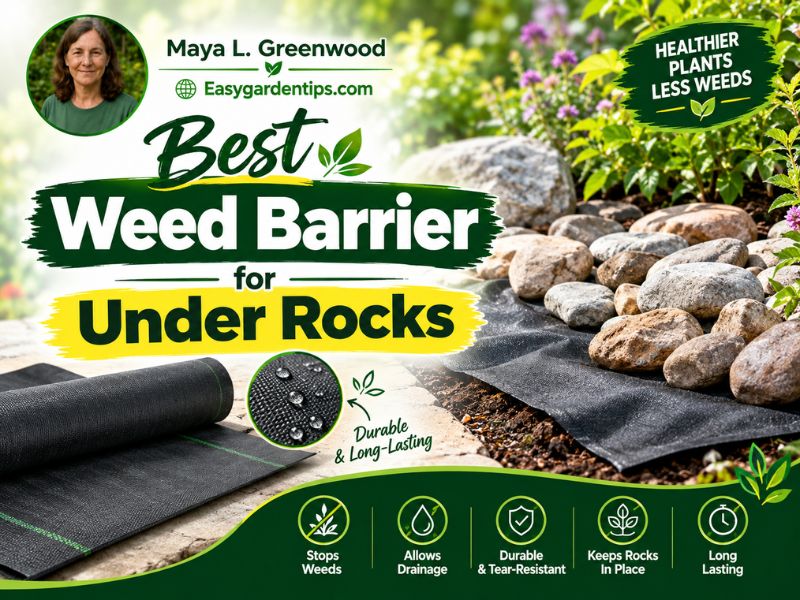
5 Best Weed Barrier for Under Rocks: Heavy-Duty Fabric Picks
Are you looking for the best weed barrier for under rocks because weeds keep appearing between decorative stone, river rock, pea gravel, or crushed gravel?
Choosing the wrong barrier can make the problem worse: lightweight fabric may tear beneath sharp stones, weak seams can open as gravel shifts, and poorly draining material can allow water pooling, soil erosion, and unstable rock beds.
Rock landscaping demands more from a weed barrier than ordinary bark mulch. The material needs enough puncture resistance, tensile strength, water permeability, soil separation, and UV durability to remain buried beneath heavy stone for years.
I researched fabric weight, construction, drainage, roll dimensions, installation requirements, manufacturer information, and current product availability and selected five weed barriers that make the most sense for use underneath rocks.
For the toughest installations, my first choice is the DWALE 13×115 FT 5oz Heavy Duty Driveway Fabric. Its 5-ounce polyethylene geotextile, huge 13-foot width, 800-pound claimed tensile strength, and high permeability make it particularly suitable for large rock beds, gravel pads, pathways, and areas where puncture resistance matters. The wider roll also reduces the number of seams beneath your stone.
For landscaped beds where drainage is especially important, the VIVOSUN 3FT x 100FT 5oz Double-Layered Weed Barrier is my second recommendation. It combines woven and nonwoven layers through a needle-punched construction, giving you a strong base beneath rock while improving water movement compared with many basic woven barriers.
If you prefer a professional landscape product from a geotextile-focused company, the Super Geotextile Professional 5oz Weed Barrier Fabric is another excellent option. The material combines woven strength with needle-punched filtration, and Super Geotextile markets the Pro 5 Plus construction for landscaping, patios, sidewalks, soil stabilization, and long-term weed control.
For maximum fabric weight among these residential-friendly rolls, consider the WAENLIR 5.8oz Heavy Duty Weed Barrier Landscape Fabric. Its 5.8-ounce UV-stabilized woven polypropylene construction is designed for demanding landscaping applications including rocks, pavers, pathways, and driveways.
Finally, the ArmorLay Commercial Grade Driveway Fabric 12.5FT x 60FT is my choice when the barrier also needs to help with soil separation and gravel stabilization. Its extra-wide commercial format minimizes seams across large rock areas, driveways, patios, and stone installations.
Best Weed Barrier for Under Rocks
| Image | Product Name | Check Price |
|---|---|---|
Best Choice | DWALE 13×115 FT 5oz Heavy Duty Driveway Fabric | Check Price |
Second Best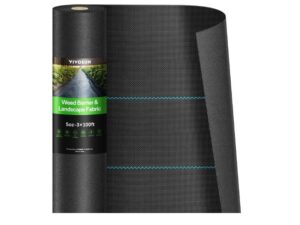 | VIVOSUN 3FT x 100FT 5oz Double-Layered Weed Barrier | Check Price |
Third Choice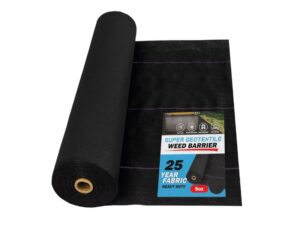 | Super Geotextile Professional 5oz Weed Barrier Fabric | Check Price |
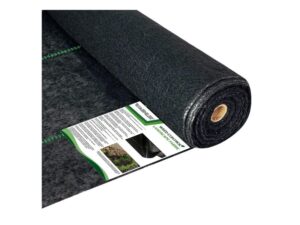 | WAENLIR 5.8oz Heavy Duty Weed Barrier Landscape Fabric | Check Price |
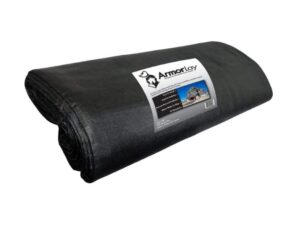 | ArmorLay Commercial Grade Driveway Fabric 12.5FT x 60FT | Check Price |
1. DWALE 13×115 FT 5oz Heavy Duty Driveway Fabric- Best Overall
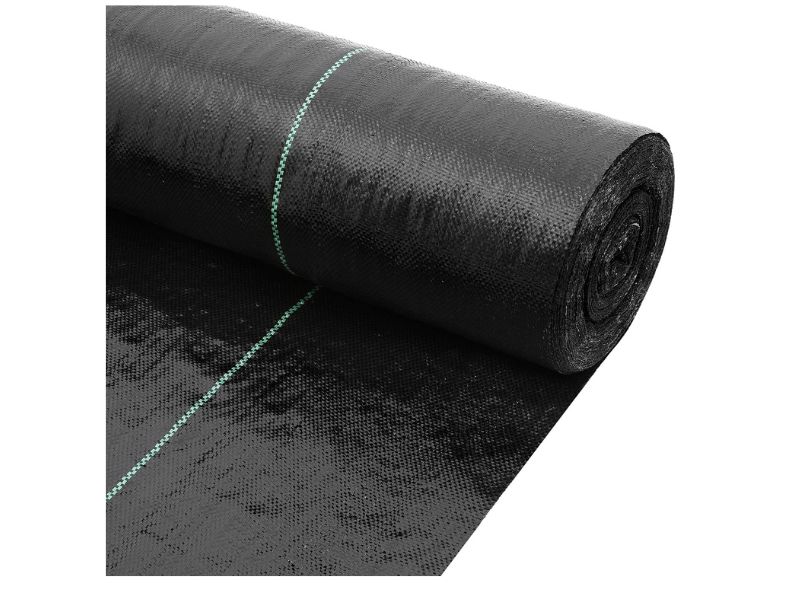
DWALE takes first place because rocks require something tougher than the lightweight landscape cloth commonly sold for flower beds.
This is a 5-ounce heavy-duty geotextile made from polyethylene. The 13-by-115-foot configuration covers approximately 1,495 square feet, allowing a large rock bed or gravel area to be covered with comparatively few seams.
DWALE lists an 800-pound tensile-strength rating for this fabric and specifically recommends it beneath gravel, stones, large rocks, driveways, French drains, retaining-wall areas, and other landscaping or construction projects.
That strength matters because rocks do not sit perfectly still.
Walking over decorative gravel, wheelbarrow traffic, freeze-thaw movement, soil settling, and adding new stone all create friction against the barrier. Thin fabric can develop punctures or tears that eventually become weak points.
The wide roll is another major advantage. Every seam underneath a rock bed is a potential location where soil becomes exposed or aggressive weeds can find a path upward. A 13-foot-wide sheet can cover some beds without a longitudinal seam at all.
Despite the heavy construction, the material remains permeable enough for drainage rather than functioning like solid plastic.
The drawback is handling. A 13-foot-wide, 115-foot-long commercial roll is much less convenient than a small three-foot garden roll. For a narrow decorative border, DWALE is overkill.
Best for: Large decorative rock beds, crushed-stone areas, gravel pads, broad pathways, and heavy-duty installations.
Key features: 5oz geotextile, 13 x 115 ft coverage, approximately 1,495 sq. ft., 800-lb claimed tensile strength, permeable woven construction.
Verdict: Choose DWALE when your priority is preventing the rocks themselves from damaging the barrier while minimizing seams across a large installation.
2. VIVOSUN 3FT x 100FT 5oz Double-Layered Weed Barrier- Best for Drainage
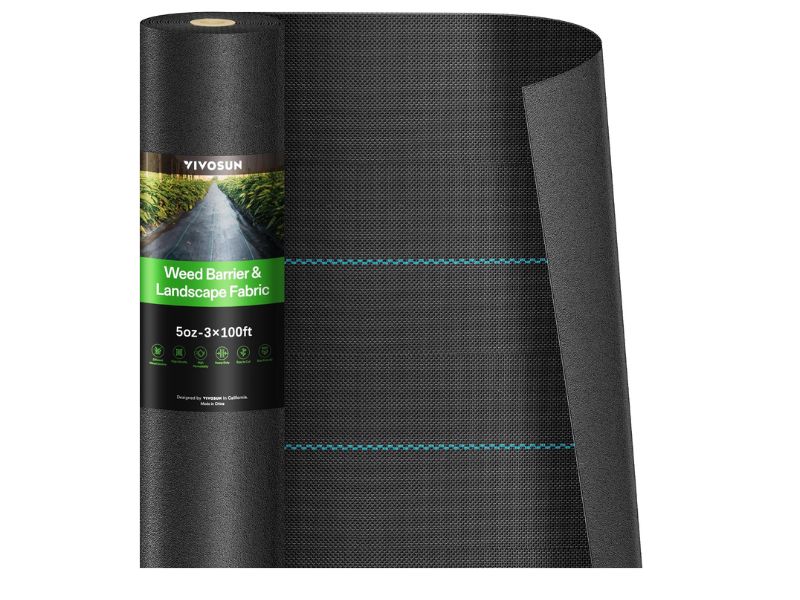
VIVOSUN offers one of the more interesting constructions in this group.
Instead of relying only on a basic woven sheet, its 5-ounce barrier combines a woven layer with a nonwoven layer using needle punching.
The woven component adds structural strength, while the additional layer improves filtration and water movement. The manufacturer promotes substantially improved permeability compared with conventional woven landscape fabric.
That combination makes sense beneath decorative rock around plants.
You want to suppress light reaching the underlying soil, but rainfall and irrigation still need to move toward shrub and perennial roots.
The 3-by-100-foot roll covers 300 square feet and is much easier for one person to handle than DWALE’s commercial-width material.
Green guide lines are another small but helpful feature. They make straight cuts, overlaps, and openings around plants easier to align.
At 5 ounces, the fabric also has enough body to resist ordinary decorative gravel and landscape stone better than lightweight 2- or 3-ounce cloth.
The disadvantage is width. A large open rock bed can require several parallel strips, which means additional overlap and landscape staples.
Best for: Decorative rock around shrubs, landscaped beds, pathways, and areas where water permeability is especially important.
Key features: 5oz weight, dual-layer woven/nonwoven structure, 3 x 100 ft size, high permeability, guide lines.
Verdict: VIVOSUN provides one of the strongest combinations of weed suppression, puncture resistance, and drainage for residential rock landscaping.
3. Super Geotextile Professional 5oz Weed Barrier Fabric- Best Professional-Grade Pick
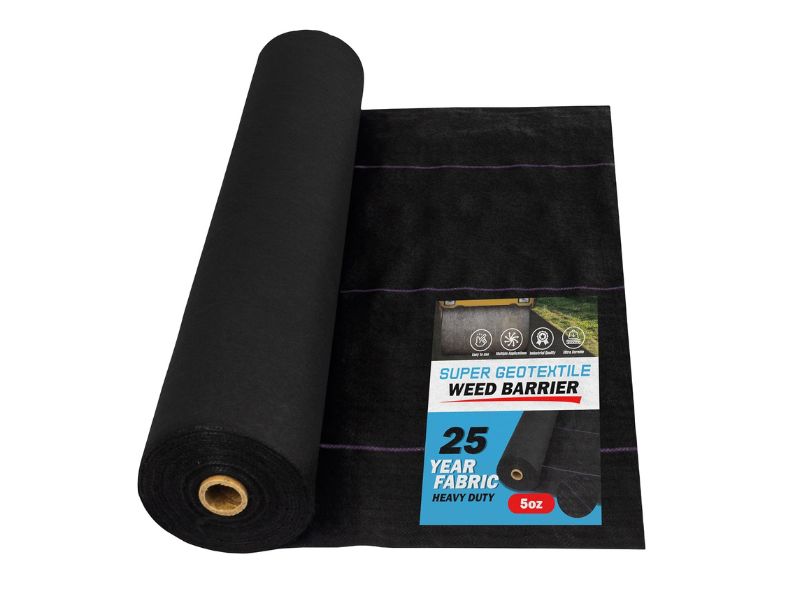
Super Geotextile is particularly appealing if you want a barrier designed around geotextile performance rather than simply inexpensive garden cloth.
The Professional 5oz material uses woven polypropylene combined with needle-punched construction. The manufacturer describes its Pro 5 Plus system as providing the strength of woven fabric with permeability closer to a nonwoven material.
That makes it well suited to stone landscaping.
A rock bed needs the barrier to maintain separation between soil and gravel while allowing rain to drain through.
Keeping soil and stone separated also helps slow one of the biggest long-term problems in gravel landscaping: rocks gradually sinking and mixing into soft ground.
The 3-by-100-foot configuration is manageable for DIY installation, yet the 5oz material is meaningfully heavier than common entry-level landscape cloth.
Super Geotextile also offers the fabric in several additional widths and lengths, which is useful if you need to reduce seams across a larger landscape project.
Current marketplace tracking lists the 3 x 100-foot configuration at around a 4.6-star rating with hundreds of reviews.
It costs more than some basic woven barriers, but this is the type of product I would rather put under stone that I do not intend to remove again soon.
Best for: Professional-style landscape installations, rock beds, patios, sidewalks, permanent beds, and soil separation.
Key features: 5oz construction, woven polypropylene, needle-punched layer, multiple roll sizes, strong drainage and stabilization characteristics.
Verdict: Super Geotextile is a particularly strong choice for permanent residential landscaping where material quality matters more than finding the cheapest square-foot price.
4. WAENLIR 5.8oz Heavy Duty Weed Barrier Landscape Fabric- Best Extra-Heavy Fabric
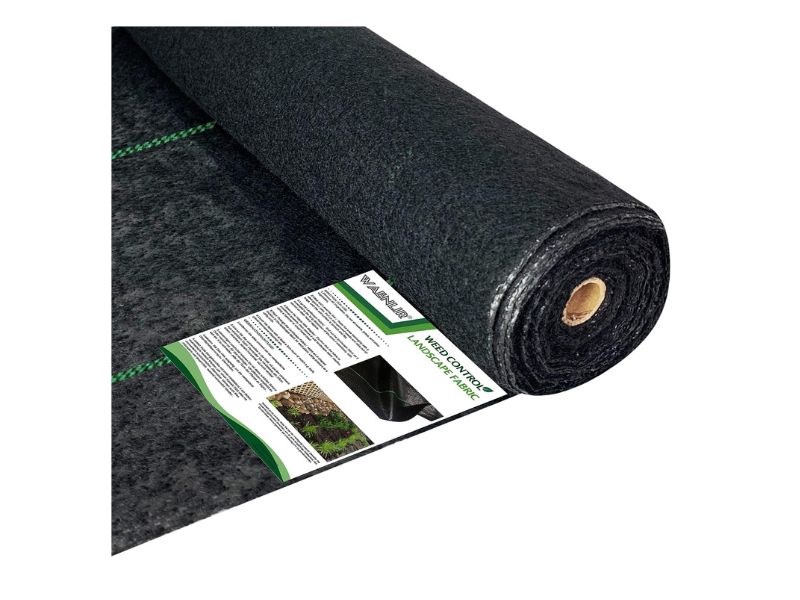
WAENLIR is the heaviest conventional landscape weed barrier in this lineup.
Its 5.8-ounce woven polypropylene construction is needle-punched and UV stabilized, with the manufacturer claiming approximately 98.7% light opacity.
The extra material weight is exactly why I like it under stone.
Sharp gravel can concentrate substantial pressure onto small points in the fabric. Increasing material density gives the barrier a better chance of resisting punctures and root penetration.
WAENLIR specifically lists stones, pavers, paths, rocks, sidewalks, driveways, and general landscaping among intended applications.
Despite its thickness, it remains permeable and breathable rather than completely sealing the underlying soil.
This is particularly important around established trees and shrubs where you do not want to replace an organic soil environment with an impermeable sheet of plastic.
The tradeoff is flexibility.
Very heavy landscape fabric is less pleasant to shape around tight curves, small plants, irrigation lines, and complicated bed edges.
For a straightforward rock border or stone path, though, that stiffness is less problematic.
Best for: Sharp rock, heavy decorative stone, pathways, high-traffic areas, and homeowners wanting maximum fabric weight.
Key features: 5.8oz polypropylene, UV-stabilized construction, high opacity, breathable/permeable weave, heavy-duty tear resistance.
Verdict: WAENLIR is the option I would choose when I want a noticeably heavier barrier than standard 3.2oz landscaping fabric.
5. ArmorLay Commercial Grade Driveway Fabric 12.5FT x 60FT- Best for Gravel Stabilization
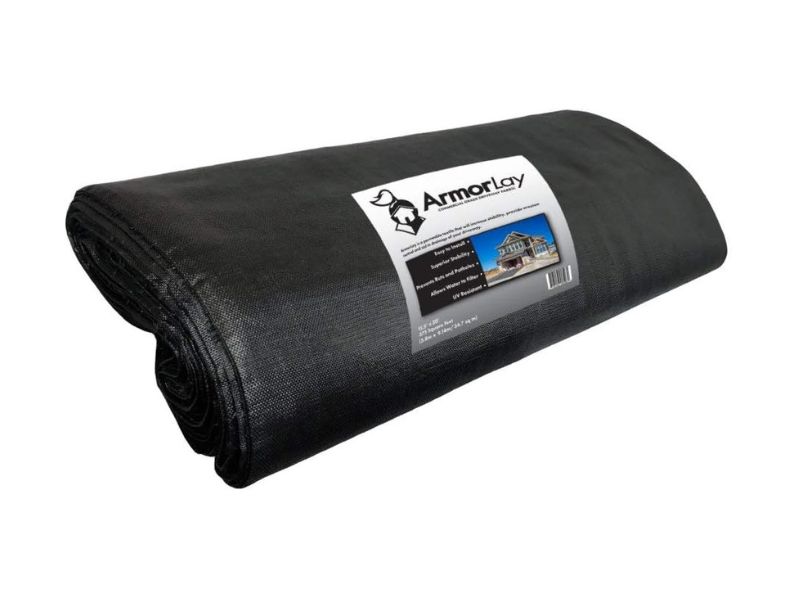
ArmorLay is less like ordinary garden cloth and more like a commercial underlayment material.
The 12.5-foot-wide roll is particularly useful beneath gravel areas because it reduces seams while also separating stone from the underlying soil.
ArmorLay describes the fabric for driveway stabilization, temporary entrances, patios, stone pavers, rocks, riprap, erosion control, and soil separation.
That makes it especially useful where your rock layer serves a structural purpose rather than only decorating a flower bed.
For example, consider a gravel parking area.
Weed suppression matters, but so does preventing gravel from progressively mixing into the soil every time vehicles cross the surface.
A proper geotextile separation layer can help maintain the distinction between those materials.
The same principle applies beneath wider gravel paths, stone patios, shed pads, and utility areas.
The main limitation is that ArmorLay may be excessive for a small flower bed with a few inches of smooth river stone.
It is also a wide roll, so installation is easier with two people.
Best for: Gravel driveways, parking pads, stone foundations, patios, wide paths, and installations requiring soil stabilization plus weed suppression.
Key features: 12.5 x 60 ft commercial format, permeable construction, soil separation, erosion control, gravel stabilization.
Verdict: ArmorLay is the better choice when your weed barrier needs to serve as structural geotextile underlayment as well as block unwanted growth.
Best Weed Barrier for Under Rocks Comparison
| Product | Fabric Type | Weight / Size | Best For | Main Advantage |
| DWALE Heavy Duty Driveway Fabric | Woven PE geotextile | 5oz, 13 x 115 ft | Large rock beds | High strength and fewer seams |
| VIVOSUN Double-Layer Weed Barrier | Woven + nonwoven | 5oz, 3 x 100 ft | Landscaped rock beds | Excellent drainage |
| Super Geotextile Professional | Woven + needle punched | 5oz, 3 x 100 ft | Permanent landscaping | Professional-grade balance |
| WAENLIR Heavy Duty Fabric | Woven polypropylene | 5.8oz | Sharp/heavy stone | Extra-heavy construction |
| ArmorLay Commercial Grade | Woven geotextile | 12.5 x 60 ft | Gravel stabilization | Soil separation and strength |
What Type of Weed Barrier Is Best Under Rocks?
For most permanent decorative rock installations, I prefer a heavy-duty permeable geotextile landscape fabric rather than cheap thin weed cloth.
Three properties are particularly important:
Puncture resistance, drainage, and opacity.
The fabric needs enough physical strength to tolerate the stone sitting and shifting on top of it.
It also needs to prevent enough sunlight from reaching the soil to limit germination beneath the rock.
Finally, water must continue to drain.
Solid polyethylene plastic can initially suppress weeds extremely effectively, but it also blocks normal water movement unless specifically perforated and designed for the application.
For landscaped beds containing trees or shrubs, breathable geotextile is generally the more practical long-term approach.
What Weight Landscape Fabric Should Go Under Rocks?
For decorative rock, I would generally start around 3.2 oz/yd², with 5 oz or heavier being preferable for more demanding permanent installations.
The weight is not an absolute quality rating, but it provides useful context.
Light 2-ounce fabric can work beneath bark mulch because the covering material is relatively soft.
Rock is different.
Angular gravel and crushed stone create concentrated pressure points.
A 5oz landscape fabric gives you a better physical barrier between those sharp edges and the soil.
This is why four of my five recommendations lean heavily toward commercial or 5oz-class construction.
Woven or Nonwoven Fabric Under Rocks?
For ordinary decorative rock beds, woven geotextile or a woven/nonwoven hybrid is often an excellent choice.
Woven material provides high tensile and tear strength.
It handles loads well and can help keep gravel separated from soil.
Nonwoven geotextiles excel at filtration and drainage and are frequently used in applications such as French drains and drainage systems.
Hybrid products such as VIVOSUN and Super Geotextile attempt to combine both characteristics.
The correct choice therefore depends partly on your goal.
Decorative rock bed: Heavy woven or hybrid weed barrier.
Gravel driveway: Strong woven stabilization fabric.
French drain: Appropriate filtration-grade nonwoven geotextile may be preferable.
Do not assume one type of fabric is universally best for every project.
Is Landscape Fabric Better Than Plastic Under Rocks?
For most landscaped rock beds, yes.
Plastic has outstanding opacity.
The problem is water permeability.
Put solid plastic underneath a stone bed and rainfall cannot naturally infiltrate the ground through that area.
Water may instead travel sideways, collect in low points, or create drainage problems along edges.
Permeable landscape fabric suppresses weed growth while still letting water pass downward.
Plastic still has specialized uses, but I would not make it my default weed barrier around ornamental trees, shrubs, or garden beds.
Does Landscape Fabric Completely Stop Weeds Under Rocks?
No weed barrier guarantees a permanently weed-free rock bed.
This is important because many homeowners assume every weed appearing in their gravel has penetrated the fabric from underneath.
That often isn’t what happened.
Leaves, dust, grass clippings, decomposed organic matter, and windblown soil slowly collect on top of the landscape fabric and between the rocks.
Eventually, weed seeds land in that material and germinate above your barrier.
The fabric cannot prevent that.
What it can do is dramatically reduce weeds originating from the original soil and prevent stone from directly mixing with the ground.
Long-term rock-bed maintenance still involves occasionally removing surface weeds and accumulated organic debris.
Should You Remove Existing Weeds Before Installing Fabric?
Yes.
Never use expensive landscape fabric as an excuse to skip site preparation.
Remove existing vegetation first.
Aggressive perennial plants such as Bermuda grass, nutsedge, bindweed, and other rhizomatous weeds can exploit seams and openings.
Remove as much root and rhizome material as practical before installing the barrier.
Level the area afterward and remove sharp sticks or debris that could puncture the underside of the fabric.
Starting with clean soil greatly improves your chances of a long-lasting installation.
How Much Should Landscape Fabric Overlap Under Rocks?
I recommend roughly 6–12 inches of overlap for a permanent rock installation, especially when weed suppression is a priority.
The exact amount depends on the fabric and site.
More overlap is helpful where:
The ground is uneven.
Aggressive weeds are present.
Heavy rock will be spread mechanically.
The fabric may shift during installation.
The slope encourages movement.
Use landscape staples across overlapping areas so the sheets cannot pull apart while gravel is being placed.
Wide products such as DWALE and ArmorLay reduce the number of overlaps needed in the first place.
Which Side of Weed Barrier Goes Down?
Follow the product-specific instructions.
Some basic woven fabrics have very similar sides.
Hybrid fabrics can have a clearly different woven side and fuzzy/nonwoven side.
For products with directional construction, installation orientation can affect grip and drainage performance.
Do not assume every landscape fabric should be installed shiny-side-up or fuzzy-side-down.
Check the manufacturer instructions for the particular roll you buy.
How Do You Install Weed Barrier Under Rocks?
First, remove weeds, roots, sticks, old mulch, and loose debris.
Grade the area so water naturally moves where intended.
Unroll your landscape fabric directly over the prepared ground.
Overlap adjacent sections generously.
Secure them using landscape staples or fabric pins, with additional pins around corners, curves, and seams.
Cut openings only where necessary for existing plants.
Do not create large exposed-soil circles around every shrub. The larger the hole, the easier it becomes for weeds to grow beside the plant.
Once the fabric is secure, add your decorative rock carefully.
Avoid dumping an enormous pile of sharp crushed stone in one spot because the impact can damage even heavy fabric.
Distribute rock gradually and rake it into place.
How Deep Should Rocks Be Over Landscape Fabric?
For many decorative landscaping projects, around 2–3 inches of rock is common, although ideal depth depends on stone size and application.
Larger rock may require greater depth for full coverage.
Gravel paths and driveways also require more sophisticated base-depth calculations than ornamental beds.
The goal is to cover the fabric completely.
Exposed landscape cloth degrades more quickly from UV radiation, looks unattractive, and can eventually work loose.
Maintain rock depth as the bed settles over time.
Should Landscape Fabric Go Under River Rock?
Yes, heavy landscape fabric can be very useful beneath river rock.
River rock is heavy and relatively permanent.
Without a separation layer, stones can gradually settle into the soil.
A strong geotextile helps maintain the rock layer while also reducing weed growth from underneath.
Because smooth river rock is less angular than crushed gravel, puncture risk is lower, but material weight and durability still matter.
What About Pea Gravel?
Landscape fabric also works well underneath pea gravel, particularly for pathways and decorative areas.
The challenge with pea gravel is movement.
The small stones shift easily under foot traffic and can expose edges or seams if the barrier was not secured properly.
Use enough landscape pins and ensure overlapping fabric cannot separate.
For high-traffic pea-gravel paths, soil separation may be just as valuable as weed suppression.
Is Weed Barrier Necessary Under Gravel?
Not always, but it can provide important advantages.
A quality geotextile layer can:
Reduce weed emergence from underlying soil.
Separate soil from gravel.
Reduce stone loss into soft ground.
Improve long-term surface stability.
Reduce mud contamination.
Make future rock-bed renovation easier.
The stabilization benefits are one reason heavy geotextile fabric is used under many gravel surfaces even when weeds aren’t the only concern.
Can You Put Landscape Fabric Over Grass and Cover It With Rocks?
You can, but I do not recommend simply burying a healthy lawn beneath fabric without preparation.
Established turf has dense roots and crowns.
Some grasses can persist around edges, seams, and openings for considerable periods.
Remove or kill the existing turf first according to your preferred landscaping method.
Then level and prepare the soil before installing the fabric.
Doing more work at the beginning is far easier than pulling grass through several tons of rock later.
Can Weed Barrier Damage Trees?
Poor installation can.
Do not wrap landscape fabric tightly around tree trunks.
Trees grow.
A small opening today can constrict against an expanding trunk years later.
Leave appropriate clearance around the root flare, and avoid piling landscape rocks directly against the bark.
Rock landscaping also affects soil temperature and moisture differently from organic mulch.
Landscape fabric is not a substitute for proper tree-care practices.
How Long Does Weed Barrier Last Under Rocks?
A heavy-duty barrier can remain useful for many years because rocks shield most of the material from direct sunlight.
Actual service life depends on:
Fabric weight, UV stabilization, soil movement, stone shape, traffic, drainage, installation quality, and whether the material remains fully covered.
The fabric often deteriorates first around exposed edges or where it has been punctured.
This is another argument for purchasing heavier material when removing the rock later would be expensive.
Saving a few dollars on fabric is much less attractive if replacing it means moving thousands of pounds of gravel.
Is 5oz Landscape Fabric Worth It Under Rocks?
For a permanent stone installation, often yes.
The price difference between lightweight fabric and 5oz heavy-duty geotextile may be small compared with the cost of:
Buying the stone.
Having it delivered.
Preparing the site.
Moving the rock.
Installing edging.
And potentially hiring labor.
The barrier is one of the least expensive components of many rock-landscape projects but one of the hardest to replace afterward.
That is why I prefer heavier fabric for permanent applications.
Common Mistakes When Installing Weed Barrier Under Rocks
The first mistake is using fabric that is too thin.
The second is failing to remove existing aggressive weeds.
The third is using insufficient overlap.
Another common mistake is cutting enormous openings around plants.
And finally, many people expect the fabric to eliminate all future weeds permanently.
Remember that new weed seeds can germinate in debris above the barrier.
Removing leaves and sediment from the rocks periodically is an important part of long-term weed control.
Frequently Asked Questions
What is the best weed barrier for under rocks?
DWALE 13×115 FT 5oz Heavy Duty Driveway Fabric is my top overall pick for demanding rock installations.
Its heavy 5oz geotextile construction, broad 13-foot width, strong tensile rating, permeability, and ability to support gravel and stone make it particularly suitable for large permanent rock beds.
What is the best material to put under rocks to prevent weeds?
A heavy-duty permeable geotextile landscape fabric is usually the most practical choice.
It blocks much of the light reaching the underlying soil while allowing rainfall to drain. Woven and woven/nonwoven hybrid fabrics also provide useful puncture resistance beneath heavy stone.
Is 3.2oz landscape fabric thick enough for rocks?
It can be, but 5oz fabric provides a better margin for heavy or sharp stone.
A good 3.2oz woven barrier is suitable for lighter decorative applications. For crushed stone, significant foot traffic, or permanent installations that would be difficult to redo, I prefer heavier fabric.
Is woven landscape fabric good under rocks?
Yes, woven geotextile is particularly useful beneath gravel and decorative rock.
The interwoven strands provide high tensile strength while maintaining small openings that allow water movement. Heavy woven products are also useful for separating rock from soil.
Should landscape fabric go under river rocks?
Yes, particularly when you want both weed suppression and soil separation.
Without fabric, heavy river rocks can gradually settle into softer ground. A strong barrier creates a separation layer and makes future removal or renovation easier.
Can water drain through weed barrier fabric?
Quality permeable landscape fabric is specifically designed to allow water through.
Drainage performance varies between products. Needle-punched and hybrid materials can be particularly useful where irrigation or heavy rainfall makes water flow a priority.
Is plastic better than landscape fabric under rocks?
Usually not for planted landscape beds because solid plastic restricts normal drainage.
Permeable geotextile provides weed suppression without completely blocking rainfall from reaching the ground.
How much should weed barrier overlap?
About 6–12 inches is a good target for many permanent rock installations.
Use greater overlap where aggressive weeds or ground movement are concerns. Secure seams with landscape staples before adding the rock.
Will weeds eventually grow through rocks and landscape fabric?
Some weeds will eventually appear, but many originate above the fabric rather than penetrating it.
Dust and decomposed organic debris accumulate between rocks over time. Windblown weed seeds can germinate in this new surface layer regardless of how good the barrier underneath is.
What is the best heavy-duty weed barrier under gravel?
DWALE, WAENLIR, Super Geotextile, and ArmorLay are all strong options depending on the application.
DWALE emphasizes heavy rock resistance and wide coverage, WAENLIR offers extra-heavy 5.8oz material, Super Geotextile balances strength and permeability, and ArmorLay is particularly useful where gravel stabilization is part of the project.
Final Verdict
Choosing the best weed barrier for under rocks is different from selecting fabric for ordinary bark mulch. Stone is heavier, more abrasive, and much more difficult to remove if the barrier fails.
DWALE 13×115 FT 5oz Heavy Duty Driveway Fabric is my best overall choice for large or demanding rock installations. Its combination of 5oz material, wide coverage, high tensile strength, permeability, and gravel-stabilization capability makes it particularly difficult to beat.
VIVOSUN 5oz Double-Layered Weed Barrier is my preferred option for smaller landscaped rock beds where water movement around shrubs and ornamental plants is important.
Super Geotextile Professional 5oz Weed Barrier is an excellent professional-style alternative for permanent hardscape and landscape projects, while WAENLIR 5.8oz Heavy Duty Fabric is attractive when maximum material weight and puncture resistance are the priority.
For gravel driveways, parking pads, patios, and other structural stone areas, ArmorLay Commercial Grade Driveway Fabric stands out because weed suppression is only part of its job—it also helps maintain soil separation, erosion control, and gravel stability.
For most permanent rock beds, I would avoid bargain ultra-thin weed cloth. The fabric is buried beneath one of the heaviest and hardest-to-remove landscape materials on your property, so durability, drainage, strong seams, and proper installation are worth prioritizing from the beginning.

I’m Maya L. Greenwood, a lifelong plant lover who believes anyone can grow something beautiful with the right guidance. After years of testing soil mixes, pruning methods, irrigation tricks, and pest-safe solutions, I started EasyGardenTips.com to turn hard-won lessons into step-by-step advice. From seed starting and container gardens to composting and seasonal checklists, my goal is to make gardening simple, sustainable, and fun.