5 Best String Trimmer for Edging: Best Options and Buyer Guidance
Finding the best string trimmer for edging usually comes down to control, not simply cutting power. A trimmer that converts easily to an edger, guides steadily beside a sidewalk, and lets you maintain a clean line without excessive fatigue can make a noticeable difference in routine yard work.
For most homeowners, the WORX 20V 12″ 2-in-1 Cordless String Trimmer is the strongest overall choice. Its support wheels, adjustable spacer guard, tilting head, included batteries, and quick trimmer-to-edger conversion give it an especially complete edging setup. The BLACK+DECKER 20V MAX String Trimmer and Edger is the clear alternative if you prefer automatic line feeding, a lightweight design, and a familiar cordless platform.
The other three models offer different priorities, including longer claimed runtime, wider cutting paths, adjustable ergonomics, detachable shafts, and wheel-supported operation. I compared them by looking at edging control, cutting width, line-feed design, battery setup, maneuverability, comfort, storage, and the practical limitations indicated by the supplied product information.
Best String Trimmer for Edging: Quick Comparison
| Product | Name | Price |
|---|---|---|
 |
WORX 20V 12″ 2-in-1 Cordless String Trimmer | Check Price |
 |
BLACK+DECKER 20V MAX String Trimmer and Edger | Check Price |
 |
Weed Wacker Eater Electric String Trimmer Battery | Check Price |
 |
SEESII 13″ String Trimmer Electric Weed Wacker | Check Price |
 |
21V Cordless String Trimmer with 2 X | Check Price |
1. WORX 20V 12″ 2-in-1 Cordless String Trimmer
The WORX WG163 earns the top position because it is designed around the details that make edging easier. It converts from a string trimmer to a lawn edger in seconds, and its rubberized support wheels help guide the tool along a pavement or garden border. That wheel support can make it easier to produce a straighter line than you might achieve by simply holding a conventional trimmer at an angle.
Its 90-degree tilting head is useful when working on sloped terrain or reaching awkward areas. The adjustable spacer guard adds another layer of control by helping keep the cutting line away from plants, ornaments, and landscape features. Together, these features make the WORX particularly appealing for homeowners who care about neat borders as much as general grass trimming.
The 12-inch cutting diameter is a practical middle ground for residential work, while the 7,600 RPM no-load speed provides appropriate cutting performance for ordinary grass and weeds. At 5.5 pounds, the machine is light enough for many users to handle comfortably. Its push-button command feed gives you immediate line control without needing to bump the head against the ground.
This package includes two 20V Power Share lithium batteries, a charger, spool, support wheels, and safety guard. The batteries can also be used with other tools in the WORX Power Share family, which adds value for owners already invested in that system. Keep in mind that the included 0.065-inch line is better suited to typical residential trimming than severe brush clearing. For clean operation, inspect the spool and guard regularly, and use the wheel assembly when precision edging is the priority.
2. BLACK+DECKER 20V MAX String Trimmer and Edger
The BLACK+DECKER LST300 is a strong second choice because it combines simple controls with a convenient automatic line-feed system. Its two-in-one design changes from trimming to edging in seconds, so it suits homeowners who want one cordless tool for maintaining grass around walkways, driveways, beds, and fences.
Instead of requiring a bump against the ground, the Automatic Feed Spool advances line when needed. That can make edging less disruptive, especially when you are trying to keep the head at a consistent height beside a hard surface. The 6,200 RPM motor uses POWERDRIVE transmission technology to transfer more motor power to the cutting string, and the 12-inch cutting swath is appropriate for normal residential cleanup.
Comfort is another reason this model ranks highly. The lightweight construction, adjustable handle, and adjustable height positions allow users to customize the tool’s balance and reach. It also starts quietly compared with gas-powered equipment and avoids fuel mixing, engine maintenance, and exhaust. A wall-mountable charging base gives the battery a practical storage location between jobs.
The package includes one 2.0Ah lithium-ion battery, which the supplied information says provides 33% more runtime per battery pack than the previous LBXR20 battery. That single-battery setup is convenient, but it may be less flexible than the WORX package for larger properties or users who want a spare charged pack. Buyers should also confirm compatibility before purchasing additional BLACK+DECKER 20V MAX batteries, since battery fit and included capacity vary across tool kits. Choose this model when easy automatic feeding and adjustable handling matter more than having two batteries in the box.
3. Weed Wacker Eater Electric String Trimmer Battery
This battery-powered weed wacker places third because it offers an appealing amount of equipment for small to mid-sized yards, although the supplied information provides less established ownership history than the two higher-ranked options. Its 9,000 RPM cutting head, 12-inch path, two 4.0Ah batteries, and fast charger make it a capable-looking package for homeowners who want extended cordless use without buying an additional battery immediately.
The product supports both trimming and edging, and its line system offers automatic and manual feed modes. The instructions indicate that users should pull the line out to six inches before initial use. During operation, the automatic mode feeds approximately 0.4 to 0.5 inches at a time on startup, while the manual release button can advance about 0.4 inches per press. Understanding that setup is important because an incorrectly prepared spool can make the tool appear not to feed properly.
Two 4.0Ah batteries are claimed to provide 60 to 90 minutes of use, though actual runtime will depend on grass density, cutting technique, battery condition, and how continuously the tool is operated. The 5.95-pound weight is still manageable for many users, and the detachable shaft is useful when storage space is limited. Lower operating noise may also be welcome in neighborhoods where gas-powered equipment would be intrusive.
This is a sensible option for someone who values battery capacity and compact storage. However, the larger motor-speed claim does not automatically make it the best precision edger; a wheel-guided design can still feel more controlled along a long sidewalk. Before buying, review the supplied spool instructions carefully and confirm that replacement line and compatible batteries are readily available for your ownership needs.
4. SEESII 13″ String Trimmer Electric Weed Wacker
The SEESII earns fourth place by emphasizing adjustability, low weight, and multiple ways to position the cutting head. It functions as a string trimmer and lawn edger, and its supportive guide wheels can help maintain a cleaner path along sidewalks, flower beds, and fence lines. The product also describes a mini-mower configuration, giving it broader positioning flexibility than a basic handheld trimmer.
At 4.5 pounds, it is the lightest model in this group according to the supplied specifications. That can be useful for users with limited physical strength or anyone who finds heavier tools tiring during a long edging session. The telescoping pole adjusts from 42 to 56 inches, while an 11-position auxiliary handle and seven-position pivoting head allow substantial customization. Those adjustments can help shorter and taller users maintain a more upright posture.
The 13-inch cutting path covers slightly more ground per pass than the 12-inch models above it. A brushless motor rated at 6,500 RPM and 2mm dual-line trimming mode are intended to handle ordinary grass, dandelions, crabgrass, and tougher perennial weeds. Its auto-feed spool advances line without the jarring bump-feed motion, and manual advancement is also available.
The package includes two 21V 4.0Ah batteries and a fast charger, with a stated total runtime of up to 40 minutes, or approximately 20 minutes per battery. That is useful for many residential edging sessions, but it may be limiting for a large property. The tool breaks down for compact storage, another ownership advantage. Because it has several adjustable components, check that the shaft, handle, head, and wheel assembly are locked securely before use, and expect to spend a little setup time finding the most comfortable configuration.
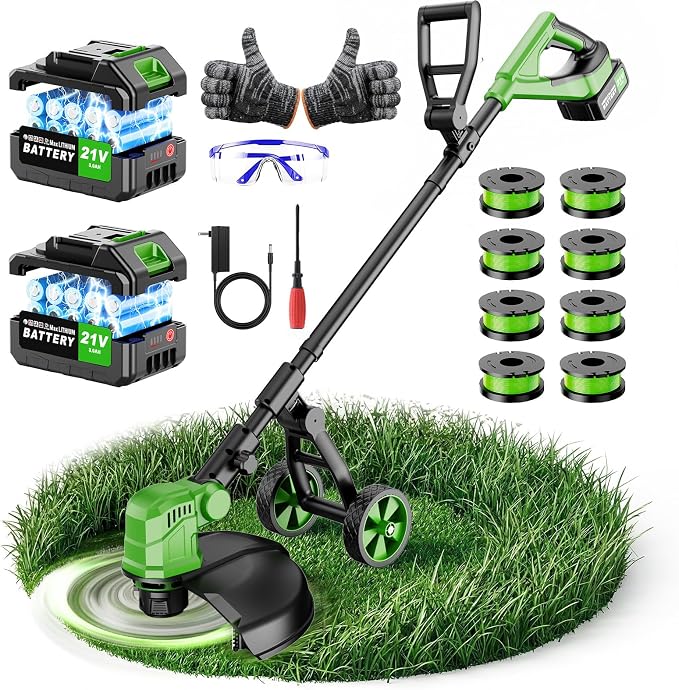
5. 21V Cordless String Trimmer with 2 X
This 21V cordless model takes fifth place but stands out for its unusually wide 14-inch cutting path and extensive adjustment options. It uses a copper-wire motor with a stated no-load speed of up to 20,000 RPM, making it the most aggressive numerical motor-speed claim in this roundup. The tool is intended for small to medium-sized gardens and can trim dense foliage with its included line.
The detachable wheel assembly lets the tool shift between a wheeled mower-style configuration and a handheld trimmer. Its triangular wheel design and larger wheel diameter are intended to improve stability and reduce hand fatigue, which can be helpful when maintaining a long border. The cutting head adjusts through 90 degrees, and the auxiliary handle adjusts through 180 degrees, providing flexibility around slopes, beds, and other obstacles.
Two 3.0Ah 21V batteries and a charger are included, and the package also lists eight spool lines. Having spare line available at the start is convenient, particularly for users who are new to string trimming and may wear through line while learning to edge cleanly. The cordless design avoids fuel and extension cords, while the product information also emphasizes quieter operation than gasoline equipment.
The wider cutting path can reduce passes over open grass, but it is not automatically an advantage beside narrow walkways or crowded planting beds. A wide head may require more care around edging boundaries. The high RPM figure should also be treated as a specification rather than a guarantee of superior finish, since line control and wheel stability matter greatly for edging. Before purchase, verify replacement battery and spool availability and make sure the detachable wheel assembly is securely fitted for guided work. The stated after-sales support offers a contact option if ownership problems occur.
How to Choose the Best String Trimmer for Edging
Edging is different from simply cutting down weeds. Trimming generally involves sweeping the head through grass and weeds, while edging requires a controlled, repeatable position beside a sidewalk, driveway, curb, flower bed, or fence. The most suitable tool is therefore the one that helps you hold the line consistently without forcing your arms and back into an awkward posture.
Start with the edging method
Look first at how the trimmer changes into an edger. A rotating head, pivoting shaft, or repositioned cutting assembly can all work, but they do not provide exactly the same experience. Quick conversion is valuable when a yard needs both open-area trimming and border work in the same session.
Wheel support is especially useful for beginners and for anyone who wants a consistent line. The wheels carry some of the tool’s weight and help keep the head moving at a steady distance from the hard surface. They can also reduce the temptation to twist your wrists while trying to maintain a vertical cutting position. The WORX and SEESII models specifically include supportive wheel features, while the fifth-ranked model uses a detachable wheel assembly.
Without wheels, edging can still be effective, but it depends more on technique. You must keep the head aligned while walking at a steady pace, avoid leaning the line too far onto concrete, and watch for changes in ground height. A wheel-free tool may be more maneuverable around irregular planting beds, though, so guided wheels are not universally better.
Choose a cutting width that matches the yard
The products here range from 12 to 14 inches. A wider cutting path covers more ground with each pass and can shorten work on open stretches of lawn. It may also be useful when the tool will double as a general grass trimmer rather than being used mostly for precision edging.
A narrower path can be easier to control around stepping stones, ornamental plants, posts, and tight borders. It also gives you a little more forgiveness when the edge is uneven or the landscaping is crowded. For many suburban yards, a 12-inch path is a balanced choice. The 13- and 14-inch models may save time on broader areas, but their extra width should not be confused with greater edging accuracy.
Cutting diameter also affects how much line contacts obstacles. Regardless of width, avoid deliberately striking concrete, metal edging, rocks, or tree trunks. Those impacts can consume line quickly and may damage the spool or guard.
Understand line-feed systems
Line feed is one of the most important differences between trimmers. A bump-feed head releases more line when you tap it against the ground. It is familiar and can be inexpensive to maintain, but bumping beside a sidewalk can feel disruptive and may release too much line if done carelessly.
Automatic systems advance line as needed. The BLACK+DECKER uses an Automatic Feed Spool, while the WORX provides a push-button command feed. The SEESII offers auto-feed with manual advancement, and the third-ranked model provides automatic and manual modes. These systems reduce the need to stop and bump the head, but they still require the correct spool, line size, and installation.
When a line-feed system seems faulty, switch off the tool and remove the battery before inspecting it. Check for tangled line, an incorrectly seated spool, or line wound in the wrong direction. Do not pull aggressively on the line while the battery is connected. Some models require a specific initial line length, so follow the supplied setup directions rather than assuming every spool works the same way.
Consider battery capacity and platform compatibility
Cordless equipment is convenient because there is no extension cord to drag along a sidewalk and no fuel to store. The trade-off is that work time depends on battery capacity, cutting conditions, line engagement, and battery age. Thick weeds, frequent stops, and continuous high-speed use generally consume more energy than light trimming around already maintained grass.
Two batteries can be more useful than one even when the total rated capacity is similar, because one pack can charge while the other is in use. The WORX includes two 20V Power Share batteries, the third-ranked tool includes two 4.0Ah batteries, the SEESII includes two 21V 4.0Ah batteries, and the fifth-ranked tool includes two 21V 3.0Ah batteries. BLACK+DECKER includes one 2.0Ah battery in the described package.
Voltage labels alone do not establish compatibility. Batteries from different brands should not be assumed to fit, and even tools within a brand’s lineup may require a particular battery family. WORX identifies its batteries as part of the Power Share family, while BLACK+DECKER identifies its system as 20V MAX. If you already own compatible tools, confirm the exact platform before buying a bare tool or additional battery. Also check whether replacement batteries, chargers, spools, and guards are available through normal retail channels.
Balance power claims with actual edging control
RPM can indicate how quickly the cutting head spins, but it is only one part of performance. A high no-load speed does not explain how the tool behaves when the line encounters dense grass, nor does it guarantee a straighter edge. A stable head, suitable line, comfortable handle, and controlled walking pace often matter more for the finished border.
The listed products span motor-speed claims from 6,200 RPM to 20,000 RPM. The higher figures may appeal to people who regularly face dense growth, but the best choice depends on what you actually cut. A homeowner maintaining ordinary lawn edges may benefit more from a lighter tool with good wheel guidance than from maximum speed.
For heavy brush, woody stems, or large areas of neglected growth, a string trimmer may not be the ideal primary tool. These products are cordless lawn-maintenance tools, not a substitute for specialized brush-clearing equipment. Work gradually, avoid forcing the head into material it cannot cut, and stop when the tool begins to bog down or the line repeatedly breaks.
Prioritize fit, posture, and maneuverability
Edging requires repeated walking and holding. A tool that feels manageable for two minutes in a store or during initial setup may become tiring after a full property perimeter. Weight distribution matters as much as the number on the scale. A lighter model can be easier to carry, while a wheel-supported model may reduce the amount of weight your arms must support during the cut.
Adjustable shafts and handles are useful when more than one person shares the tool or when the user is particularly tall or short. The SEESII offers a telescoping pole, an 11-position handle, and a seven-position pivoting head. The BLACK+DECKER provides adjustable handle and height positions. The fifth-ranked model includes a multi-angle cutting head and adjustable auxiliary handle.
Set the shaft so the cutting head reaches the ground without requiring you to bend forward. Keep both hands in a comfortable position, maintain a stable stance, and let the wheels roll rather than lifting the tool repeatedly. On slopes, use the head adjustment carefully and avoid positioning yourself downhill from unstable debris.
Think about storage and ownership
Storage is easy to overlook with cordless yard tools. A detachable shaft can be useful in a small shed, garage, or apartment storage area. The third-ranked model and SEESII both emphasize compact breakdown, while the BLACK+DECKER charging base can be mounted on a wall. Removable batteries also make it easier to store the tool separately from the charger.
Before putting a trimmer away, remove the battery, clear grass from the guard and head, and inspect the line spool. Do not store the tool with grass packed around the motor housing or ventilation areas. Keep batteries and chargers dry and away from excessive heat. If a battery will not be used for an extended period, follow the manufacturer’s storage guidance rather than leaving it permanently connected to the charger.
Replacement consumables are part of the real cost of ownership. Confirm the correct line diameter and spool style before ordering extras. The WORX package specifies 0.065-inch line, while the SEESII describes 2mm dual-line operation. Those figures are not interchangeable instructions for every product. Using an incorrect line can cause poor feeding, excessive motor load, or damage to the head.
Use a consistent edging technique
For a clean border, mow or trim the lawn first if the grass is tall. Convert the tool to edging mode and set the head or wheels so the line is just beside the hard surface or landscape boundary. Start at a manageable section rather than attempting to correct an entire uneven border in one pass.
Walk slowly and keep the tool moving. Let the line do the cutting instead of pressing the head against concrete. A small amount of grass may remain after the first pass; a second light pass is usually safer than forcing the tool deeper. When edging beside flower beds, use the spacer guard when available and keep an eye out for irrigation tubing, landscape fabric, decorative stones, and low-voltage lighting cable.
Wear eye protection, sturdy shoes, and clothing that covers exposed skin. Keep children and pets away from the work area, and inspect the lawn for rocks, sticks, wire, and other debris before starting. Disconnect the battery before clearing a jam, changing line, adjusting the head, or cleaning the tool.
FAQ About String Trimmers for Edging
What makes a string trimmer good for edging?
A good edging trimmer should convert easily to an edging position and remain stable while moving beside a sidewalk, driveway, or garden bed. Support wheels, a pivoting head, a spacer guard, adjustable handles, and predictable line feeding can all improve control. Cutting speed matters, but it is not as important as keeping the line at a consistent angle and distance from the boundary.
Is a wheel-guided string trimmer better for edging?
Wheel guidance is often helpful because it supports the tool and encourages a straight path. It can reduce wrist fatigue and make the process easier for beginners. However, wheels may be less convenient around irregular borders, roots, rocks, or tightly planted beds. A wheeled design is best when much of the edging follows relatively smooth, continuous surfaces.
Should I choose automatic feed or push-button line feed?
Both designs can work well. Automatic feed reduces interruptions by releasing line as needed, while push-button feed gives you more direct control over when additional line is released. The best option depends on whether you prioritize hands-off operation or precise control. In either case, use the specified spool and line, and disconnect the battery before servicing the head.
How wide should the cutting path be for edging?
A 12-inch cutting path is a practical choice for many residential yards because it balances coverage and maneuverability. A 13- or 14-inch path can reduce passes on broader stretches, but it may feel less precise around narrow beds and landscape features. Choose based on the shape of your borders, not just the largest cutting width.
Are cordless string trimmers powerful enough for edging?
Yes, cordless trimmers are well suited to ordinary lawn edging, grass, and common weeds. Their performance depends on battery charge, line condition, motor design, and the density of the vegetation. They are less appropriate for thick woody brush or large areas of severe overgrowth. For those conditions, a heavier-duty tool may be more suitable than any lightweight edging trimmer.
How long should a battery last while edging?
Runtime varies with battery capacity, grass density, tool speed, line engagement, and how often the head is stopped and restarted. The products in this roundup include different battery configurations, and one model provides a stated estimate of up to 40 minutes while another claims 60 to 90 minutes. Treat such figures as operating estimates rather than guarantees, and consider a spare compatible battery for larger properties.
What maintenance does an edging string trimmer need?
Remove the battery after use, clear grass and dirt from the guard and spool area, inspect the line, and check that wheels, handles, and adjustable joints remain secure. Keep the charger and battery dry. Replace damaged guards or worn spools, and use only the recommended line size. If the line stops feeding, turn the tool off and check for tangles or incorrect winding rather than continuing to run the motor.
Conclusion: The Final Verdict
The WORX 20V 12″ 2-in-1 Cordless String Trimmer is the best overall choice here for controlled, homeowner-friendly edging, thanks to its wheels, spacer guard, tilting head, push-button feed, and two included batteries. The BLACK+DECKER 20V MAX String Trimmer and Edger is the best alternative for users who prefer automatic feeding and adjustable, lightweight handling. The remaining models are worth considering when battery capacity, compact storage, extra adjustability, or a wider cutting path is more important than the most proven all-around edging setup.

I’m Maya L. Greenwood, a lifelong plant lover who believes anyone can grow something beautiful with the right guidance. After years of testing soil mixes, pruning methods, irrigation tricks, and pest-safe solutions, I started EasyGardenTips.com to turn hard-won lessons into step-by-step advice. From seed starting and container gardens to composting and seasonal checklists, my goal is to make gardening simple, sustainable, and fun.