5 Best 2 Inch Soil Blocker: Top Product Picks and Buying Guide
As an Amazon Associate, I earn from qualifying purchases. Learn more
This guide compares all five options, explains the practical differences between four- and eight-cell models, and covers soil consistency, seed-pin selection, block release, cleaning, storage, and common beginner mistakes. The goal is to help you choose a tool that fits your planting volume and working style rather than simply picking the highest-capacity mold. When comparing best 2 inch soil blocker, I look at how each option fits a real buying need, where it performs well, and which trade-offs matter.
My first choice is SOLIGT Soil Blocker 4 Cell 2 Inch Soil Block Maker. Choosing the best 2 inch soil blocker means balancing block-making speed, comfortable handling, seed-hole flexibility, and the number of seedlings you plan to start. A well-matched tool can reduce plastic pot use and make transplanting gentler, but the wrong capacity or a poor soil mix can make the process frustrating.
My second choice is BlumWay 8 Cell 2 Inch Soil Block Maker. Its eight-cell layout makes twice as many blocks per press as the four-cell options, and the included square, short-cylinder, and long-cylinder seed pins add useful flexibility for different seed sizes.
My third choice is nanovi 4 Cell 2 Inch Soil Block Maker. Its 2-inch molds are a practical size for many herbs, vegetables, flowers, and young seedlings, while the sturdy steel construction should appeal to gardeners who want a reusable alternative to disposable trays.
Below, I compare the selected best 2 inch soil blocker options, explain the strengths and trade-offs of each one, and cover the buying factors plus practical setup, use, compatibility, maintenance, longevity, safety, troubleshooting, storage, and common mistakes that matter before choosing.
Best 2 Inch Soil Blocker
I selected these products for their direct relevance to 2-inch soil blocking, useful construction and handling details, included seed-pin options, and available customer-feedback evidence. The ranking also considers practical differences in capacity and design, while keeping several brands in the comparison so buyers can see more than one approach to the same gardening task.
| # | Image | Product | Price on Amazon |
|---|---|---|---|
| 1 |  |
SOLIGT Soil Blocker 4 Cell 2 Inch Soil Block Maker | Check Price |
| 2 |  |
BlumWay 8 Cell 2 Inch Soil Block Maker | Check Price |
| 3 |  |
nanovi 4 Cell 2 Inch Soil Block Maker | Check Price |
| 4 |  |
zukakii Heavy-Duty 4 Cell 2 Inch Soil Block Maker | Check Price |
| 5 |  |
KHAMAL 4 Cell 2 Inch Soil Block Maker | Check Price |
SOLIGT Soil Blocker 4 Cell 2 Inch Soil Block Maker

The SOLIGT model is a strong all-purpose choice for gardeners who want four blocks at a time without handling a bulky production tool. Its rounded handle is intended to eliminate the uncomfortable sharp-edge feel found on some simple metal blockers, which matters when starting many trays of seedlings in one session.
Each press forms four 2-inch cubes, giving the tool a useful balance between speed and control. Four blocks are easy to position on a seed flat, and the smaller batch can be convenient when starting several varieties that need separate labels or sowing depths. The steel construction is described as heavy-gauge, with a rust-resistant design and less operating noise, although buyers should still dry it after cleaning rather than treating it as maintenance-free.
The main appeal is the stated release action. A blocker that separates the cubes without sticking can save time and help preserve the shape of damp blocks. Soil blocking also lets seedlings grow without pulling them from individual plastic cells, potentially reducing root disturbance at transplanting. Still, the result depends heavily on properly moistened, cohesive soil; no mold can compensate for a mix that is too dry or too loose.
Pros
- Comfortable rounded handle for repeated pressing.
- Four 2-inch blocks provide a practical balance of speed and control.
- Heavy-gauge steel construction is intended for repeated use.
- Supports pot-free seed starting and less reliance on disposable trays.
Cons
- Four blocks per press are slower than the eight-cell alternative.
- The supplied data does not specify multiple seed-pin sizes.
- Like other steel tools, it should be cleaned and dried after use.
My Opinion
SOLIGT is the most balanced pick in this group for ordinary home seed starting. It suits buyers who value comfortable handling and dependable four-block batches more than maximum throughput.
BlumWay 8 Cell 2 Inch Soil Block Maker

BlumWay stands out immediately with an eight-cell layout. That capacity can make a meaningful difference for gardeners starting large quantities of vegetables, flowers, or greenhouse plants, because one press produces twice as many 2-inch blocks as the four-cell models here. The trade-off is that a larger working head may feel less nimble when planting only a few varieties or moving between small flats.
Versatility is another notable strength. The package includes square seed pins plus short and long cylinder pins, allowing the user to choose a hole shape and depth that better matches the seed being sown. That does not eliminate the need to follow the seed packet’s depth guidance, but it gives more control than a blocker with one fixed opening.
The stainless-steel construction is described as resistant and suitable for repeated use with different soil types. Its compact, handheld format should be easier to carry than a large commercial-style blocker, though eight formed blocks will still require a flat or work surface that can support the batch as it is released. The maker is intended to separate blocks without sticking, but the quality of the soil mixture remains critical.
For a beginner, the basic workflow is simple: mix soil until moist, install the desired pins, press firmly, and release onto a tray or flat. Buyers should choose this model mainly for volume, not because eight cells automatically make better seedlings.
Pros
- Eight 2-inch cells increase output per press.
- Three seed-pin styles support varied sowing needs.
- Stainless-steel construction is intended for long-term reuse.
- Handheld format remains relatively easy to carry.
Cons
- Higher capacity may be unnecessary for small planting batches.
- A full eight-block batch can require more careful release and tray support.
- More production speed does not replace proper soil preparation.
My Opinion
BlumWay is the best fit for a high-volume home gardener or small greenhouse grower. I rank it second because its output is excellent, but the four-cell SOLIGT is likely easier to manage for a broader range of casual planting jobs.
nanovi 4 Cell 2 Inch Soil Block Maker

nanovi takes a flexible approach to the familiar four-cell format. Its zinc-coated steel body is described as thickened and resistant to deformation, giving buyers a reusable tool that should tolerate regular contact with damp soil. The finish is also intended to make cleaning easier, although removing soil promptly is still the safest way to protect the metal.
Three seed-pin sizes are included, with options intended for different seed dimensions. This is useful when one planting session includes tiny herbs, medium vegetable seeds, and larger seeds that need more room. Choosing the right pin can help keep seeds centered and reduce the temptation to poke holes randomly with a separate tool.
The operating sequence is particularly clear: install the pins, press the blocker firmly into moist soil, set it on a seed flat, and squeeze the handle and palm together to push out four 2-inch cubes. That straightforward process is helpful for first-time users. The blocks are described as 2 by 2 by 2 inches, so buyers should leave enough room in their tray for the finished cubes to stand without crowding.
nanovi is not the fastest option for a large seed-starting program, and the supplied information does not indicate a spring-assisted handle. It makes more sense for gardeners who want pin flexibility and a compact four-block rhythm than for anyone measuring success mainly by blocks per hour.
Pros
- Three seed-pin sizes add useful sowing flexibility.
- Thickened zinc-coated steel is intended for repeated use.
- Rounded handle avoids sharp edges during pressing.
- Clear operating sequence is approachable for beginners.
Cons
- Four-cell capacity is slower for large planting projects.
- It requires firm pressing and suitable moist soil for clean blocks.
- No spring mechanism is specified in the supplied information.
My Opinion
nanovi is a well-rounded alternative for gardeners who want several seed-hole choices in a compact four-cell blocker. It is especially appealing when flexibility matters more than maximum batch size.
zukakii Heavy-Duty 4 Cell 2 Inch Soil Block Maker

zukakii focuses on a heavier-duty build, describing its iron body as 30 percent thicker than comparable blockers and finished with a zinc coating. That emphasis should appeal to frequent users who want a rigid mold that resists deformation. It may also mean the tool feels more substantial in the hand, so buyers who prefer the lightest possible implement should consider the difference between durability and portability.
The four cells form 2-inch cubes a size that gives seedlings more room than tiny starter blocks while still fitting a typical seed-starting workflow The cube shape is intended to maintain even soil fill and protect the root area during transplanting Because the entire block can be moved rather than pulled from a cell the design may help limit root disturbance and avoid the root.
Three seed pins make the blocker useful across a range of seed sizes. The pins are installed on the back, the mold is pressed into wet soil, and the handle is used to release four blocks. That process is simple, but users should avoid forcing a block out when the mixture is too dry or overly sticky; correcting the soil texture is usually better than adding pressure.
This model suits gardens, farms, greenhouses, and propagation areas where a sturdier tool may receive frequent use. Its lower customer rating than the top three options is worth noting, although ratings alone cannot explain whether individual buyers had issues with soil mix, technique, or the tool itself.
Pros
- Heavy-duty iron construction is described as 30 percent thicker.
- Zinc-coated finish is intended to resist rust and deformation.
- Three seed pins accommodate different seed sizes.
- Four-cell format is manageable for home and greenhouse use.
Cons
- Heavier construction may be less comfortable for some users.
- Four blocks per press limit output compared with BlumWay.
- Properly wet, cohesive soil is still necessary for clean release.
My Opinion
zukakii is a logical choice for buyers who place build thickness near the top of their list. I would choose it for repeated seasonal use, while recognizing that a heavier body is not automatically more comfortable for every gardener.
KHAMAL 4 Cell 2 Inch Soil Block Maker
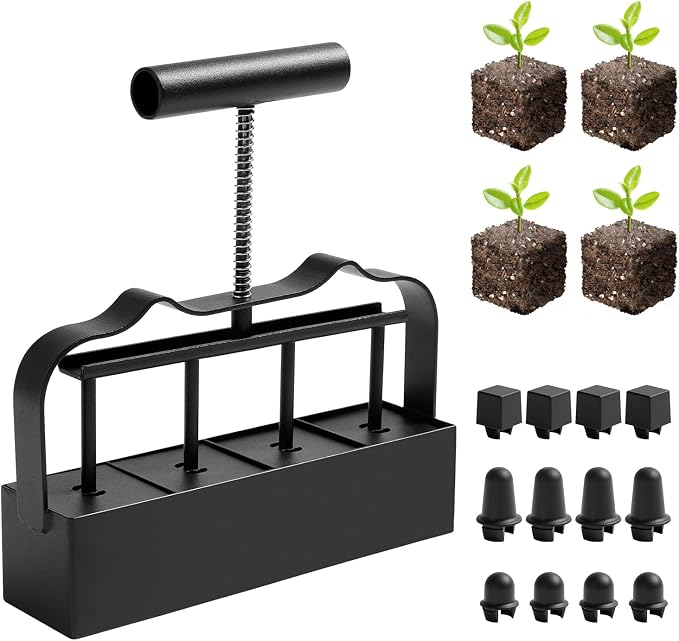
KHAMAL takes a comfort-first approach with an ergonomic spring handle. The supplied information says the spring mechanism reduces pressing force by 50 percent and uses a contoured, non-slip grip. If accurate in everyday use, that design could be valuable for long planting sessions or for gardeners who find repeated squeezing tiring, particularly when working with gloves.
The tool makes four 2-inch blocks in one press and includes three types of seed pins described as cube, cone, and cylinder options. That combination gives the user a way to match the hole to seeds such as basil, chives, beans, or peas rather than relying on one universal opening. Pin storage in side slots is also a practical detail because loose small parts are easy to misplace.
KHAMAL uses premium iron steel and has an 8.7-inch storage height, making its vertical profile relevant to gardeners with narrow shelving or crowded greenhouse workspaces. Its advertised resistance to soil acids suggests an emphasis on longevity, but the supplied information does not provide a formal service-life test or certification. Routine rinsing, drying, and indoor storage remain sensible ownership habits.
The main limitation is the smaller amount of customer-feedback evidence compared with the other options, with 50 listed feedback and a 4.0 rating. That does not make the tool unsuitable, but it gives buyers less feedback history to use when judging long-term consistency.
Pros
- Spring-assisted ergonomic handle may reduce hand fatigue.
- Three seed-pin types support varied seed sizes and shapes.
- Vertical storage height can suit narrow shelves.
- Side slots provide a place for detachable pins.
Cons
- Four-cell capacity is slower for larger seed-starting jobs.
- Customer-feedback volume is lower than the other listed products.
- Long-term durability claims are not supported by supplied testing data.
My Opinion
KHAMAL is the most interesting option for buyers who prioritize hand comfort and compact storage. Its feature set is promising, but the smaller feedback base keeps it behind the more established choices in this comparison.
How I Selected the Best 2 Inch Soil Blocker
My selection process centers on what changes the actual seed-starting experience: block capacity, handle comfort, construction, seed-hole choices, release behavior, and the ease of maintaining a reusable tool. I also considered the available ratings and customer-feedback volume as customer-feedback signals, not as proof of performance in every garden. The exact best 2 inch soil blocker depends on whether a buyer values speed, versatility, durability, or reduced hand strain most.
Capacity is a workflow decision. An eight-cell blocker is attractive when dozens of seedlings are needed, while a four-cell model can be easier to control when sowing several varieties in small batches.
Brand diversity also matters because similar-looking soil blockers can differ in handle shape, metal thickness, pin selection, and storage design. I ranked the products by the usefulness of that combination for a typical US home gardener, while clearly noting where the supplied information leaves a limitation or claim unverified.
Soil preparation is part of the tool choice. Even a sturdy mold with multiple seed pins can produce weak or stuck blocks if the mix cannot hold together when compressed.
How to Choose a 2 Inch Soil Blocker
Start by estimating how many seedlings you normally raise and how often you will use the tool. Then compare cell count, handle design, seed-pin selection, metal construction, and storage needs. The best 2 inch soil blocker for a small balcony garden may not be the same one that suits a greenhouse bench.
- Choose four cells for flexibility and smaller sowing batches.
- Choose eight cells when reducing pressing time is the main goal.
- Look for rounded or ergonomic handles if repeated pressure bothers your hands.
- Select multiple seed pins when you sow both small and large seeds.
- Favor a cleanable metal body and plan to dry it after every session.
Four cells versus eight cells
A four-cell mold gives more control over how each batch is labeled, positioned, and released. It can also be less intimidating for a first-time user. An eight-cell mold is more efficient when the same soil mix and seed type are being used repeatedly, but it can require more tray space and a steadier release motion.
Handle comfort and pressing force
Rounded handles reduce the chance of pressure concentrating against one sharp edge. Spring-assisted designs may further reduce fatigue, though buyers should treat stated force reductions as product claims rather than universal results. Gloves, hand size, and soil firmness all affect comfort.
Seed-pin flexibility
Seed pins determine the openings formed in the top of each block. Multiple shapes and sizes are helpful for moving between fine seeds and larger seeds, but the correct hole should still follow the planting instructions for the crop. A larger hole is not automatically better, and a deep opening can leave a small seed poorly positioned.
Build quality and rust prevention
Steel, iron, stainless steel, and zinc-coated finishes can all support reusable ownership, but damp soil and water still deserve attention. Examine the joints and release surfaces after each session. A tool that stays dirty and wet can become harder to operate regardless of its original finish.
How to Set Up a 2 Inch Soil Blocker
Before the first batch, place the blocker, seed pins, a tray or flat, prepared soil, and labels within reach. Install the selected pins before filling the mold so you do not have to disturb newly formed blocks. A level work surface makes release easier and helps keep the cubes upright.
- Mix the soil with enough water to make it cohesive but not dripping.
- Fit the seed pin style that matches the crop being planted.
- Press the mold firmly into the prepared mix so every cell fills completely.
- Set the filled blocker on a tray or flat before squeezing the handle.
- Release the blocks gently, then label the batch immediately.
The exact squeeze motion varies by handle design. Some models call for pressing with the palm and fingertips together, while a spring handle may open more naturally after compression. If the cubes crumble, add moisture gradually to the mix. If they smear or refuse to release, the mix may be too wet or the mold may need cleaning.
Getting the Soil Moisture Right
Moisture is the foundation of successful soil blocking. The mixture needs enough water for compressed particles to hold a cube shape, but excess water can create slick surfaces, weak edges, and difficult release. Beginners often make the mistake of judging moisture only by appearance; a small squeeze test is more useful.
Take a handful of prepared mix and compress it. It should hold together when released without producing a stream of water. If it falls apart immediately, moisten it in small additions and mix thoroughly. If it feels muddy or leaves heavy residue on the tool, add more dry material appropriate for the mix and blend before forming another batch.
Perlite or other aerating ingredients may help create air spaces in a seed-starting medium, but the supplied products do not require one specific recipe. Use a consistent mix across a batch so blocks have similar strength and moisture behavior.
Using Seed Pins Correctly
Seed pins are most useful when they match the seed rather than being chosen simply because they are available. Tiny seeds generally need a shallow, narrow opening, while larger seeds can need a roomier depression. The cube, cone, square, and cylinder options described across these products give different ways to create that starting point.
Install pins securely and inspect the openings after the first press. If a hole is too deep, reduce pressure or switch pins. If the top of a block tears, the soil may be too wet or the pin may be binding. Keep unused pins together in their supplied storage location or a clearly labeled container so they do not disappear between seasons.
How to Release Blocks Without Crumbling
Clean release depends on three things: adequate compression, complete filling, and the correct soil texture. Press the mold straight down rather than rocking it aggressively. A rocking motion may leave uneven corners or cause one cell to fill more than another.
Place the tool on the receiving flat before activating the handle. Release with a controlled movement and lift the mold vertically when possible. If one block remains inside, do not repeatedly slam the tool against a hard surface. Check for a dry patch, an over-wet spot, or soil compacted around the mold.
New blocks are vulnerable before roots develop, so avoid unnecessary rearranging. Leave enough space for air movement and watering without washing away the corners.
Cleaning and Maintenance
Clean the blocker after each planting session while soil is still soft. Rinse away residue from the cells, seed-pin openings, handle joints, and release surfaces. A soft brush can help remove packed material without scratching the finish excessively.
Dry the tool completely before storage, especially when it is made from iron or heavy-gauge steel rather than clearly identified stainless steel. Check that detachable pins are present and free of buildup. If the handle begins to feel rough or the mold no longer releases evenly, inspect for bent parts, lodged soil, or corrosion before the next batch.
Storage tips
Store the blocker in a dry area rather than beneath a wet sink or in an uncovered greenhouse corner. Models with side slots or compact profiles can make pin organization easier, but any small labeled container works. Avoid stacking heavy objects on the handle or mold, since pressure during storage can affect alignment over time.
Common Mistakes with 2 Inch Soil Blockers
Most problems come from technique rather than from choosing the wrong brand. A few small changes can make blocks stronger, easier to release, and less stressful to transplant.
- Using dry soil: Blocks crumble because the mix cannot bind under pressure.
- Flooding the mix: Muddy soil sticks to the mold and creates weak edges.
- Underfilling the cells: Incomplete molds produce uneven cubes that collapse during release.
- Choosing a pin without checking the seed: A hole that is too deep or wide can lead to poor placement.
- Forcing stuck blocks: Excessive pressure can damage the mold or destroy the cube.
- Leaving the tool wet: Moisture left on metal can encourage corrosion or buildup.
- Overcrowding the flat: Tight spacing makes watering and air movement more difficult.
When a block fails, correct the moisture, fill level, or release angle before assuming the blocker is defective.
When a 2 Inch Blocker Is the Right Size
Two-inch blocks are a useful middle size for seedlings that need more room than a tiny germination cube but are not ready for a large pot. They can suit many herbs, vegetables, flowers, cuttings, and greenhouse starts. The exact timing depends on the crop, temperature, light, and root development.
A two-inch mold may be excessive for very small seeds that are normally started in shallow media, while fast-growing or large-rooted plants may outgrow the block quickly. Consider how long the seedlings will remain indoors and whether you have a larger container or garden bed ready for the next stage.
FAQS About Best 2 Inch Soil Blocker
What is the best 2 inch soil blocker for most home gardeners?
SOLIGT is the strongest general pick in this comparison because it combines four-cell capacity, a rounded comfortable handle, heavy-gauge construction, and a design intended to release blocks cleanly. It offers a manageable balance for common home seed-starting jobs.
Is an eight-cell 2-inch soil blocker better than a four-cell model?
Not for every buyer. BlumWay’s eight-cell design is better when output is the priority, while a four-cell blocker is easier to manage for smaller batches, mixed varieties, and more frequent labeling changes.
Do I need multiple seed pins in a 2-inch soil blocker?
Multiple pins are useful if you sow different seed sizes. They are not essential for a gardener who mostly plants one crop with similar sowing requirements, but they add flexibility and can make hole depth easier to control.
Why do my 2-inch soil blocks crumble?
The mix is usually too dry, the cells were not filled fully, or the soil was not compressed enough. Add moisture gradually, fill each cell completely, and release the mold in a controlled motion rather than forcing it.
How should I clean a 2-inch soil blocker?
Rinse away soil after use, brush residue from the cells and pin openings, and dry the metal thoroughly. Pay particular attention to joints and detachable pins, where damp soil can remain trapped.
Can 2-inch soil blocks replace plastic seed trays?
They can reduce or eliminate the need for individual plastic starter pots during early growth, depending on the crop and your growing setup. Seedlings may still need a larger container or planting bed once the 2-inch block becomes crowded.
Final Thoughts
The best 2 inch soil blocker for most gardeners is SOLIGT Soil Blocker 4 Cell 2 Inch Soil Block Maker, thanks to its balanced capacity and comfortable rounded handle. Choose BlumWay 8 Cell 2 Inch Soil Block Maker when faster batch production matters most, or select nanovi 4 Cell 2 Inch Soil Block Maker for a compact tool with three seed-pin options. Match the mold to your planting volume, prepare the soil carefully, and any of these choices can support a more organized, lower-plastic seed-starting routine.

I’m Maya L. Greenwood, a lifelong plant lover who believes anyone can grow something beautiful with the right guidance. After years of testing soil mixes, pruning methods, irrigation tricks, and pest-safe solutions, I started EasyGardenTips.com to turn hard-won lessons into step-by-step advice. From seed starting and container gardens to composting and seasonal checklists, my goal is to make gardening simple, sustainable, and fun.