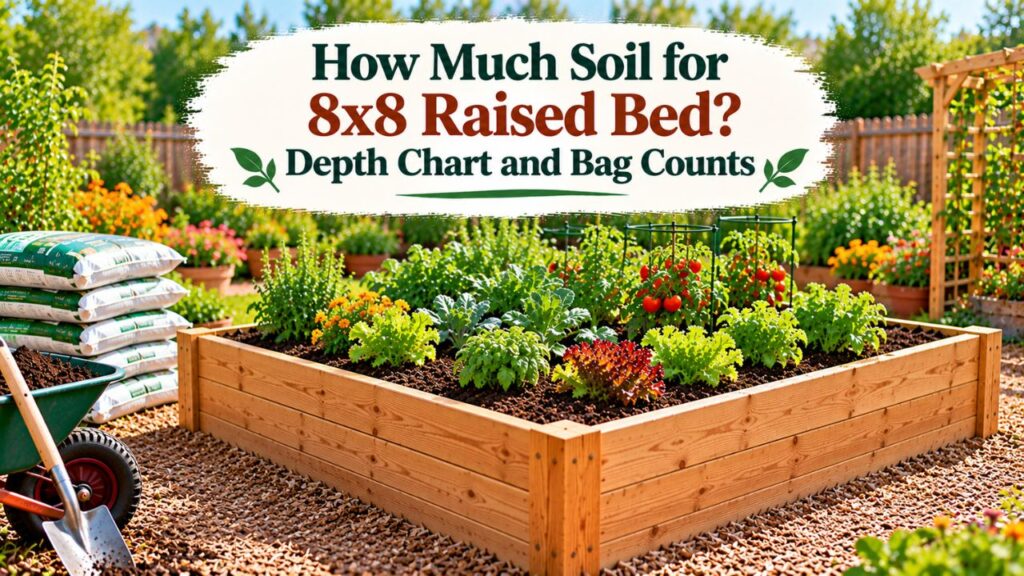
How Much Soil for 8×8 Raised Bed? Depth Chart and Bag Counts
An 8×8 raised bed needs 64 cubic feet of soil, or approximately 2.37 cubic yards, when filled 12 inches deep. If the soil depth is 6 inches, you need 32 cubic feet (1.19 cubic yards). For an 18-inch depth, the requirement increases to 96 cubic feet (3.56 cubic yards).
An 8-by-8-foot raised garden bed provides 64 square feet of growing space. However, the amount of soil needed depends on the actual filling depth, not just the length and width.
This difference matters when purchasing bagged soil or ordering a bulk raised-bed mix. Adding only a few extra inches across such a large planting area can significantly increase the total volume and cost.
You also need to consider what you plan to grow. Lettuce and other shallow-rooted vegetables may need less growing depth than tomatoes, peppers, and larger root crops, particularly when the bed has a solid bottom.
This guide covers soil volume calculations, bag quantities, recommended planting depths, suitable soil mixtures, and practical ways to reduce unnecessary soil purchases.
How Much Soil for 8×8 Raised Bed at Different Depths?
The soil requirement for an 8×8 raised bed changes directly with the filling depth.
The bed covers 64 square feet, so every additional inch of depth adds approximately 5.33 cubic feet of soil.
8×8 Raised Bed Soil Volume Chart
| Soil Depth | Cubic Feet | Cubic Yards | 2-Cubic-Foot Bags |
| 6 inches | 32 | 1.19 | 16 |
| 8 inches | 42.7 | 1.58 | 22 |
| 10 inches | 53.3 | 1.98 | 27 |
| 12 inches | 64 | 2.37 | 32 |
| 16 inches | 85.3 | 3.16 | 43 |
| 18 inches | 96 | 3.56 | 48 |
| 24 inches | 128 | 4.74 | 64 |
These estimates assume the actual interior dimensions are 8 feet by 8 feet and the soil fills the entire area evenly.
The calculations do not include extra soil for settling or space reserved below the top rim.
How Much Soil for an 8×8 Raised Bed 6 Inches Deep?
A 6-inch-deep 8×8 raised bed requires 32 cubic feet of soil, equivalent to approximately 1.19 cubic yards.
That means purchasing:
- 32 bags containing 1 cubic foot each.
- 22 bags containing 1.5 cubic feet each.
- 16 bags containing 2 cubic feet each.
This depth may be suitable for certain shallow-rooted crops if the raised bed sits directly on healthy garden soil and plant roots can extend below the frame.
For beds on concrete or with enclosed bottoms, 6 inches may be too shallow for many vegetables.
How Much Soil for an 8×8 Raised Bed 12 Inches Deep?
An 8×8 raised bed with 12 inches of soil needs 64 cubic feet, or 2.37 cubic yards.
This provides a useful growing depth for many vegetables, especially if the bed sits on permeable ground.
You need 32 bags when each bag contains 2 cubic feet. For bulk soil, the calculated requirement is slightly less than 2.5 cubic yards.
A 12-inch soil layer is a practical starting point, but some crops benefit from more uninterrupted rooting space.
How Much Soil for an 8×8 Raised Bed 18 Inches Deep?
An 18-inch-deep 8×8 raised bed requires 96 cubic feet of soil.
That equals approximately 3.56 cubic yards or 48 bags containing 2 cubic feet each.
This additional depth offers more room for root development, particularly when the bed is built above a hard surface.
However, it also increases the amount of growing medium needed compared with a 12-inch-deep bed.
How Much Soil for an 8×8 Raised Bed 24 Inches Deep?
A 24-inch-deep 8×8 raised bed requires 128 cubic feet of soil, equivalent to 4.74 cubic yards.
If purchasing 2-cubic-foot bags, you need 64 bags before allowing for settling.
Filling such a large structure entirely with bagged soil may be expensive and labor-intensive.
For deep beds built directly on the ground, lower filling materials may reduce the amount of purchased growing mix needed, provided enough suitable rooting depth remains above them.
How to Calculate Soil for an 8×8 Raised Garden Bed
The most reliable way to calculate soil quantity is to use the bed’s actual interior dimensions and intended filling depth.
The formula is:
Soil Volume = Length × Width × Depth
All dimensions must be expressed in feet to calculate cubic feet.
Step 1: Calculate the Raised Bed Area
Multiply the length by the width.
For an 8×8 raised bed:
8 feet × 8 feet = 64 square feet
This is the planting area before accounting for internal paths or other spaces.
Step 2: Convert Soil Depth From Inches to Feet
Divide the intended soil depth in inches by 12.
For example, if you want a 10-inch soil layer:
10 ÷ 12 = 0.833 feet
This conversion is necessary because the length and width are measured in feet.
Step 3: Calculate Total Cubic Feet
Multiply the planting area by the depth in feet.
For a 10-inch-deep 8×8 bed:
64 × 0.833 = approximately 53.3 cubic feet
That is the required growing-medium volume before adding any allowance for settling.
Step 4: Convert Cubic Feet to Cubic Yards
Bulk soil suppliers commonly measure growing media in cubic yards.
One cubic yard contains 27 cubic feet.
Divide the volume by 27:
53.3 ÷ 27 = approximately 1.98 cubic yards
Therefore, an 8×8 raised bed filled 10 inches deep needs about 2 cubic yards of soil.
Step 5: Calculate the Number of Soil Bags
Divide the total required cubic feet by the volume of each bag.
If each bag contains 2 cubic feet:
53.3 ÷ 2 = 26.65
Round up to the next whole bag.
You would need 27 bags of 2-cubic-foot soil for a 10-inch-deep 8×8 raised bed.
The same calculation works for other bag sizes.
How Many Bags of Soil for an 8×8 Raised Bed?
Soil bags are commonly sold in volumes such as 1, 1.5, and 2 cubic feet. Some products use quart measurements instead.
The number of bags required depends on the product’s stated volume.
Soil Bag Quantity by Bed Depth
| Soil Depth | 1-Cu-Ft Bags | 1.5-Cu-Ft Bags | 2-Cu-Ft Bags |
| 6 inches | 32 | 22 | 16 |
| 8 inches | 43 | 29 | 22 |
| 10 inches | 54 | 36 | 27 |
| 12 inches | 64 | 43 | 32 |
| 18 inches | 96 | 64 | 48 |
| 24 inches | 128 | 86 | 64 |
All quantities are rounded up to full bags.
How Many 40-Quart Bags Are Needed?
Some commercial garden soil products are sold in 40-quart bags.
A 40-quart bag contains approximately 1.34 cubic feet.
For a 12-inch-deep 8×8 raised bed:
64 × 29.922 = approximately 1,915 quarts
1,915 ÷ 40 = approximately 47.9 bags
You need 48 bags of 40-quart soil to fill the bed to a depth of 12 inches.
Always check the package label because soil bags of similar physical size may contain different volumes.
Should You Purchase Extra Soil?
Freshly filled raised beds may settle after watering as loose particles shift and organic matter gradually decomposes.
A modest additional purchasing allowance can help avoid running short.
For a 12-inch-deep 8×8 raised bed requiring 64 cubic feet, a 5–10% allowance increases the estimated quantity to approximately 67.2–70.4 cubic feet.
That equals about 34–36 bags containing 2 cubic feet each.
This allowance is a planning estimate, not a guaranteed settling percentage.
If the growing medium is already settled or you can obtain additional soil easily, purchasing the exact calculated amount initially may be reasonable.
How Deep Should Soil Be in an 8×8 Raised Bed?
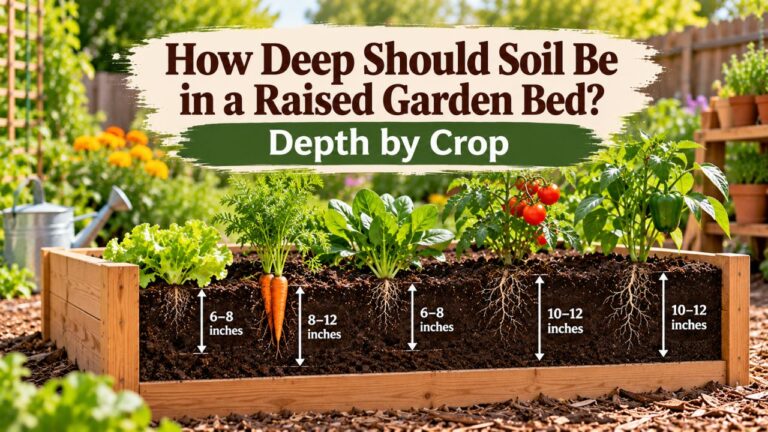
The appropriate soil depth depends on the crops and whether roots can grow into the ground below.
An open-bottom raised bed sitting on suitable garden soil can provide more effective rooting depth than the height of its frame suggests.
A bed with an enclosed bottom must provide the necessary growing space within the container itself.
Soil Depth for Lettuce, Spinach, and Leafy Greens
Leafy greens generally have less demanding rooting-depth requirements than many large fruiting vegetables.
For an open-bottom bed over healthy soil, an 8-inch raised growing layer may be sufficient for many leafy greens.
If the bed is placed on a hard surface, provide enough depth for the crop to grow without relying on the ground below.
The University of Maryland Extension’s raised-bed gardening guidance recommends at least 8 inches of depth for leafy greens, beans, and cucumbers in beds constructed over impermeable surfaces.
For an 8×8 raised bed, an 8-inch soil layer requires approximately 42.7 cubic feet of growing medium.
Soil Depth for Tomatoes, Peppers, and Squash
Tomatoes, peppers, and squash benefit from a deeper growing area because their root systems require space to access moisture and nutrients.
University of Maryland Extension recommends 12–24 inches of growing depth for these crops when raised beds are placed on impermeable surfaces.
In an 8×8 bed, those depths require:
- 12 inches: 64 cubic feet.
- 18 inches: 96 cubic feet.
- 24 inches: 128 cubic feet.
When the bed is open to suitable ground, roots can extend deeper than the raised soil layer.
Soil Depth for Carrots and Other Root Vegetables
Root vegetables need enough loose, unobstructed soil for their edible roots to develop properly.
Short carrot varieties may tolerate shallower conditions than long-rooted varieties.
An 8–12-inch growing layer can work for many root crops when the soil beneath is suitable, but longer varieties may require more uninterrupted depth.
Avoid filling the planting zone with stones, large wood chips, or compacted material that could interfere with root development.
What Is the Best Soil Mix for an 8×8 Raised Garden Bed?
A large raised bed needs a growing medium that balances water retention, drainage, root aeration, and nutrient availability.
The best composition depends on the quality of the existing soil and whether the bed is open to the ground.
Use Quality Topsoil With Finished Compost
For an open-bottom vegetable bed, a mixture of suitable topsoil and finished compost is often practical.
Topsoil supplies mineral soil particles that contribute to structure and water retention.
Finished compost contributes organic matter and can improve how soil handles moisture.
The Oregon State University Extension’s compost guidance recommends using a soil mixture rather than compost alone and describes adding up to 25% compost by volume when filling raised beds.
As an example, a 12-inch-deep 8×8 raised bed could use a mixture containing 75% quality topsoil and 25% finished compost.
| Material | Mix Percentage | Quantity |
| Quality topsoil | 75% | 48 cubic feet |
| Finished compost | 25% | 16 cubic feet |
| Total | 100% | 64 cubic feet |
This example works as a volume estimate, but it is not a universal recipe.
If the purchased topsoil already contains substantial organic matter or compost, additional compost may not be necessary.
Choose a Prepared Raised-Bed Soil Mix
Commercial raised-bed soil is another option.
These products may contain screened mineral soil, compost, bark fines, coconut coir, or other growing-medium ingredients.
Their composition varies by manufacturer, so read the product description before purchasing.
For an 8×8 bed, compare prices using the actual cubic-foot volume.
A prepared bulk raised-bed mix may be convenient when filling a large area, while bagged mixtures offer more flexibility for smaller quantities.
Avoid Using Compost Alone
Compost is useful as a soil amendment, but filling an entire raised bed with compost alone is not generally recommended.
Excess compost can create nutrient imbalances and moisture-management problems.
Use a balanced growing medium that supports plant roots and contains appropriate amounts of organic matter.
For a bed on concrete or another impermeable surface, a properly formulated growing mix and adequate drainage are especially important.
How to Save Money When Filling an 8×8 Raised Bed
An 8×8 bed can require several cubic yards of growing medium.
Choosing the right purchasing method and avoiding unnecessary fill depth can help control costs.
Compare Bulk Soil With Bagged Soil
Bulk soil is commonly sold by the cubic yard, while bagged products are usually measured in cubic feet or quarts.
To compare prices accurately, calculate the cost per cubic foot.
For example, if a 2-cubic-foot bag costs $10:
$10 ÷ 2 = $5 per cubic foot
The equivalent material quantity for a 12-inch-deep 8×8 bed would cost:
64 × $5 = $320
This is an illustrative calculation, not a current market price.
Bulk soil may cost less per unit of volume, but delivery fees and minimum order quantities can change the total.
Check the supplier’s soil composition and quality before selecting the cheapest option.
Use the Actual Filling Depth
A 12-inch-tall frame does not necessarily need 12 inches of soil.
Leaving approximately 1–2 inches below the top rim can provide room for watering and a surface mulch.
If an 8×8 bed has a 12-inch frame but is filled only 10 inches deep, the soil requirement decreases from 64 to approximately 53.3 cubic feet.
That saves around 10.7 cubic feet, equivalent to more than five 2-cubic-foot bags.
However, do not reduce the soil depth below what the intended crops need simply to save money.
Consider Lower Filling Materials in Tall Beds
For a particularly deep, open-bottom bed, some gardeners use clean organic materials beneath the main growing layer.
Possible materials include untreated logs, branches, and clean shredded leaves.
For example, a 24-inch-tall bed containing 12 inches of lower filling material and 12 inches of growing medium requires only 64 cubic feet of purchased growing medium instead of 128 cubic feet.
However, lower organic materials gradually break down and settle. Some additional soil may be needed over time.
This approach is less appropriate for shallow beds, solid-bottom planters, or situations where the materials would restrict the effective root zone.
Is an 8×8 Raised Bed Too Wide for Easy Gardening?
An 8-foot-wide raised bed can be difficult to maintain from its outside edges.
The center is 4 feet away from every side, making it challenging to reach without stepping on the soil.
Walking on the growing surface can compact soil and reduce the air spaces needed for healthy roots.
Divide the 8×8 Space Into Two Planting Sections
If the total available garden footprint is 8 feet by 8 feet, one option is to create two planting sections separated by a central walkway.
For example:
- First planting bed: 3 feet by 8 feet.
- Central walkway: 2 feet by 8 feet.
- Second planting bed: 3 feet by 8 feet.
The combined planted area becomes:
3 × 8 × 2 = 48 square feet
At 12 inches deep, these two beds require:
48 × 1 = 48 cubic feet of soil
That equals approximately 1.78 cubic yards or 24 bags containing 2 cubic feet each.
This arrangement uses less soil because the walkway occupies part of the original 8×8 footprint.
If you build two separate 4×8 beds with a walkway between them, the planting area remains 64 square feet, and the walkway increases the total footprint.
Why the Layout Matters Before Buying Soil
An 8×8 bed without a path and an 8×8 garden layout with an internal path have different soil requirements.
Calculate only the area that will actually contain growing medium.
Measure the completed bed interiors before purchasing material, especially if the design includes walkways, dividers, or unusually thick frame walls.
Mistakes to Avoid When Measuring Soil for an 8×8 Raised Bed
Accurate measurements help prevent both shortages and unnecessary purchases.
Confusing Cubic Feet With Cubic Yards
Cubic feet and cubic yards are different volume measurements.
One cubic yard equals 27 cubic feet.
An 8×8 raised bed filled 12 inches deep requires 64 cubic feet, not 64 cubic yards.
That is approximately 2.37 cubic yards.
Mixing up the units can result in ordering far more soil than necessary.
Measuring the Frame Instead of the Filling Space
The advertised 8×8 dimensions may represent the outside edges of the frame.
Thick boards, blocks, or metal supports can reduce the interior area.
For a precise estimate, measure the distance between the inside walls.
Also measure the actual intended soil depth rather than assuming it matches the frame height.
Ignoring Soil Settling
Soil mixtures containing compost and other organic components may settle after filling and watering.
Allow for some reduction in surface height, especially with loose material.
Water the bed after filling, check the level, and top it off when needed.
Avoid pressing the soil down excessively because compaction can interfere with drainage and root development.
Forgetting the Weight of Wet Soil
A large raised bed can become extremely heavy when filled with moist soil.
If an 8×8 bed will be built on a deck, balcony, rooftop, or other elevated structure, verify that the structure can support the full saturated load.
The actual weight varies considerably with soil type, moisture content, and depth.
A qualified structural professional may be necessary when the load-bearing capacity is uncertain.
Conclusion
Determining how much soil for 8×8 raised bed requires knowing the intended filling depth and actual planting area.
For a standard 8×8 raised bed, a 12-inch soil layer requires 64 cubic feet, approximately 2.37 cubic yards, or 32 bags containing 2 cubic feet each.
A shallower 6-inch layer requires 32 cubic feet, while an 18-inch layer requires 96 cubic feet.
Before buying soil, consider the vegetables you plan to grow, the condition of the ground underneath, and whether the bed includes a walkway.
For many open-bottom vegetable beds, a suitable topsoil and compost mixture provides a practical growing medium. Comparing bagged and bulk quantities can help you purchase the correct volume without wasting money.
FAQs About how much soil for 8×8 raised bed
How Many Cubic Yards of Soil Do I Need for an 8×8 Raised Bed?
An 8×8 raised bed filled 12 inches deep requires approximately 2.37 cubic yards of soil.
For an 8-inch depth, the requirement is approximately 1.58 cubic yards. At 18 inches, it increases to approximately 3.56 cubic yards.
How Many 2-Cubic-Foot Bags Fill an 8×8 Raised Bed?
You need 32 bags containing 2 cubic feet each to fill an 8×8 raised bed 12 inches deep.
For 6 inches, you need 16 bags. For 18 inches, you need 48 bags.
These quantities do not include additional soil for settling.
How Much Soil Do I Need to Add 2 Inches to an 8×8 Raised Bed?
Adding a uniform 2-inch layer over an 8×8 bed requires approximately 10.67 cubic feet of soil.
That equals around 0.40 cubic yards or six bags containing 2 cubic feet each.
This calculation is useful when topping off a bed after settling.
Can I Fill an 8×8 Raised Bed With Regular Garden Soil?
Yes, suitable garden soil can be used in an open-bottom 8×8 raised bed.
However, compacted clay soil or poorly structured material may restrict drainage and root growth.
A balanced mixture of quality topsoil and finished compost is often more suitable than using heavy, unamended soil alone.
Is 12 Inches of Soil Enough for an 8×8 Raised Bed?
Twelve inches can provide adequate growing depth for many vegetables, particularly when the raised bed sits on suitable ground and roots can extend deeper.
For beds built on concrete or other hard surfaces, larger vegetables may benefit from 12–24 inches of growing medium.
Choose the depth according to the crops and the bed’s construction.
Should I Buy 2.5 or 3 Cubic Yards for an 8×8 Raised Bed?
For a 12-inch-deep bed, the calculated requirement is 2.37 cubic yards.
Ordering 2.5 cubic yards provides a small allowance above the calculated volume. Three cubic yards provides considerably more material and may be appropriate only if you also need extra soil for topping off or another planting area.
Check supplier delivery increments and the actual interior dimensions before ordering.

I’m Maya L. Greenwood, a lifelong plant lover who believes anyone can grow something beautiful with the right guidance. After years of testing soil mixes, pruning methods, irrigation tricks, and pest-safe solutions, I started EasyGardenTips.com to turn hard-won lessons into step-by-step advice. From seed starting and container gardens to composting and seasonal checklists, my goal is to make gardening simple, sustainable, and fun.