How Many Bags of Soil for 4×8 Raised Bed? Bag Counts by Depth
A 4×8 raised bed filled 12 inches deep needs 32 cubic feet of soil, which equals 16 bags of 2 cubic feet, 22 bags of 1.5 cubic feet, or 32 bags of 1 cubic foot. A shallower 6-inch bed requires only 16 cubic feet, while an 18-inch-deep bed needs 48 cubic feet.
The right number of bags depends on more than the length and width of your raised garden bed. Soil depth, package volume, and the amount of existing soil all affect how much you need to buy.
One common mistake is calculating soil based on the full height of the frame instead of the actual filling depth. Another is assuming all soil bags contain the same amount. A 40-pound bag, for example, doesn’t always hold the same volume as another bag of equal weight.
Knowing the correct soil quantity helps you avoid extra trips to the garden center, unnecessary expenses, and partially filled planting beds.
The calculations below cover common raised bed depths, standard soil bag sizes, compost mixtures, and bulk soil measurements so you can purchase the right amount for your 4×8 garden.
How Many Bags of Soil for 4×8 Raised Bed at Different Depths?
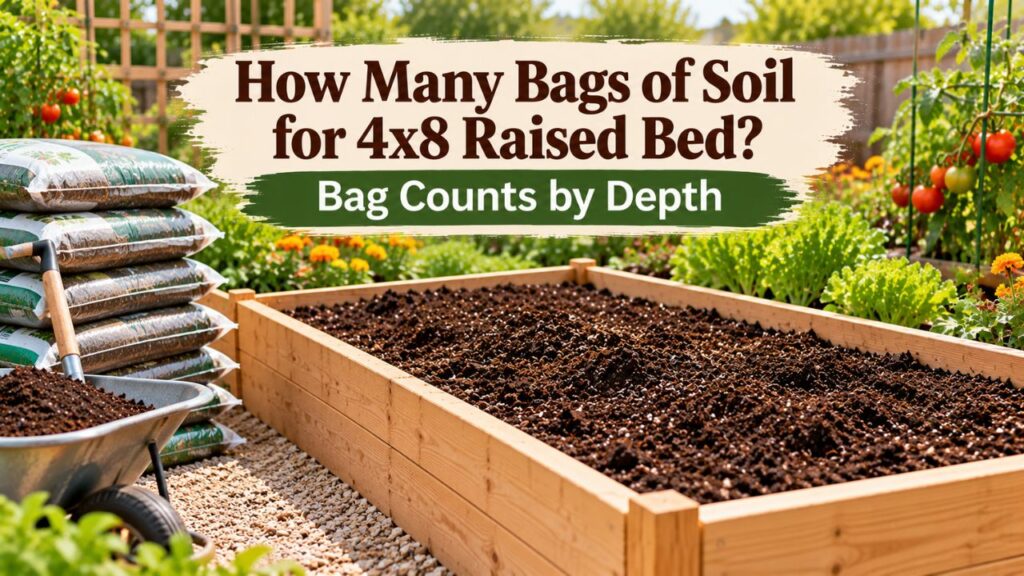
A 4×8 raised garden bed has a surface area of 32 square feet. However, its total soil capacity depends on how deeply you fill it.
The following table shows the required volume and approximate bag count for common filling depths.
| Soil Depth | Total Soil | 1 Cu Ft Bags | 1.5 Cu Ft Bags | 2 Cu Ft Bags |
| 6 inches | 16 cu ft | 16 | 11 | 8 |
| 8 inches | 21.33 cu ft | 22 | 15 | 11 |
| 10 inches | 26.67 cu ft | 27 | 18 | 14 |
| 12 inches | 32 cu ft | 32 | 22 | 16 |
| 16 inches | 42.67 cu ft | 43 | 29 | 22 |
| 18 inches | 48 cu ft | 48 | 32 | 24 |
| 24 inches | 64 cu ft | 64 | 43 | 32 |
All bag counts are rounded up to whole bags. The calculations assume a rectangular bed with interior dimensions of exactly 4 feet by 8 feet and no existing fill.
How Many Bags for a 6-Inch-Deep 4×8 Raised Bed?
A 6-inch soil depth requires 16 cubic feet of soil.
You can fill it with:
- 16 bags of 1 cubic foot
- 11 bags of 1.5 cubic feet
- 8 bags of 2 cubic feet
This shallow depth may work for certain leafy vegetables when the raised bed sits directly over healthy garden soil.
However, plants with larger root systems may need additional soil depth. A shallow bed placed on concrete doesn’t provide the same rooting conditions as an open-bottom bed.
How Many Bags for an 8-Inch-Deep 4×8 Raised Bed?
An 8-inch filling depth requires approximately 21.33 cubic feet.
You need:
- 22 bags of 1 cubic foot
- 15 bags of 1.5 cubic feet
- 11 bags of 2 cubic feet
This depth provides more growing space than a 6-inch bed while requiring less material than a full 12-inch fill.
It’s a practical choice for some vegetables when roots can extend into the existing ground underneath.
How Many Bags for a 12-Inch-Deep 4×8 Raised Bed?
A 12-inch-deep 4×8 raised bed needs 32 cubic feet of soil.
The equivalent quantities are:
- 32 bags of 1 cubic foot
- 22 bags of 1.5 cubic feet
- 16 bags of 2 cubic feet
For standard 2-cubic-foot raised bed soil bags, 16 bags is the calculated quantity.
This depth provides a useful growing area for many vegetables, particularly when the bed is open at the bottom.
How Many Bags for an 18-Inch-Deep 4×8 Raised Bed?
An 18-inch soil depth requires 48 cubic feet.
You would need:
- 48 bags of 1 cubic foot
- 32 bags of 1.5 cubic feet
- 24 bags of 2 cubic feet
At this depth, purchasing bulk soil may be more economical than buying individual bags.
For a 24-inch-deep bed, the requirement increases to 64 cubic feet, equivalent to 32 two-cubic-foot bags.
How to Calculate Soil Bags for a 4×8 Raised Bed
You can determine the number of bags for any filling depth using a simple volume calculation.
Step 1: Measure the Inside Dimensions
First, measure the usable space inside the raised bed frame.
For a standard example:
- Length: 8 feet
- Width: 4 feet
- Filling depth: 12 inches
Use the inside dimensions because wooden boards, metal walls, and corner supports can reduce the actual soil capacity.
Step 2: Convert Soil Depth From Inches to Feet
Divide the desired soil depth in inches by 12.
For example:
12 ÷ 12 = 1 foot
For an 8-inch depth:
8 ÷ 12 = 0.667 feet
This conversion allows you to calculate soil volume in cubic feet.
Step 3: Calculate the Required Soil Volume
Use the formula:
Soil volume (cubic feet) = Length × Width × Depth
For a 4×8 bed filled 12 inches deep:
4 × 8 × 1 = 32 cubic feet
The Mississippi State University Extension guide to constructing raised beds uses the same 4-by-8-by-1-foot example and confirms the requirement of 32 cubic feet of growing mix.
For a different soil depth, substitute the correct measurement in feet.
Step 4: Divide by the Volume of Each Soil Bag
Once you know the required volume, divide it by the size of the bag.
Number of bags = Total soil volume ÷ Volume per bag
For 2-cubic-foot bags:
32 ÷ 2 = 16 bags
For 1.5-cubic-foot bags:
32 ÷ 1.5 = 21.33 bags
Since soil bags are generally sold as complete packages, round up to 22 bags.
This method works for other package sizes as long as their volumes are stated in cubic feet.
How Different Soil Bag Sizes Affect the Number You Need
Raised bed soil is available in various package sizes. Larger bags reduce the total number of packages, but they don’t necessarily provide the lowest price per cubic foot.
For a 4×8 raised bed requiring 32 cubic feet, the calculations are:
| Bag Size | Number of Bags Needed |
| 0.75 cubic feet | 43 |
| 1 cubic foot | 32 |
| 1.5 cubic feet | 22 |
| 2 cubic feet | 16 |
| 3 cubic feet | 11 |
These calculations apply to a 12-inch soil depth.
One-Cubic-Foot Soil Bags
One-cubic-foot bags are convenient for small filling projects and soil replenishment.
However, filling an entire 4×8 bed with them means handling 32 separate bags.
They may be suitable when you need to transport manageable quantities or only add a small amount of soil.
One-and-a-Half-Cubic-Foot Soil Bags
A 1.5-cubic-foot bag provides more soil per package.
You’ll need 22 bags for a full 12-inch-deep 4×8 bed.
Because 22 bags contain 33 cubic feet in total, you’ll have approximately 1 cubic foot beyond the calculated requirement.
Two-Cubic-Foot Soil Bags
Two-cubic-foot bags are a convenient option for a larger raised bed.
At a 12-inch filling depth, 16 bags supply exactly 32 cubic feet based on the labeled package volumes.
Compare the price per cubic foot before purchasing.
For example, divide a bag’s selling price by its labeled cubic-foot volume to compare different sizes fairly.
How Many 40-Pound Bags of Soil for a 4×8 Raised Bed?
There’s no universal answer because pounds measure weight while cubic feet measure volume.
The volume of a 40-pound bag depends on the soil’s density, moisture content, and ingredients.
For example, if a 40-pound bag contains 0.75 cubic feet:
32 ÷ 0.75 = 42.67
You would need 43 bags.
If another 40-pound product contains a different volume, the required number changes.
Always check the package’s stated cubic feet or cubic yards rather than calculating from weight alone.
How Much Soil Does a 4×8 Raised Bed Need in Cubic Yards?
Landscape suppliers often sell bulk soil by the cubic yard rather than by individual bags.
One cubic yard equals 27 cubic feet.
To convert cubic feet into cubic yards:
Cubic yards = Cubic feet ÷ 27
For a 4×8 bed filled 12 inches deep:
32 ÷ 27 = 1.19 cubic yards
Here’s the conversion for common soil depths:
| Soil Depth | Cubic Feet | Cubic Yards |
| 6 inches | 16 | 0.59 |
| 8 inches | 21.33 | 0.79 |
| 10 inches | 26.67 | 0.99 |
| 12 inches | 32 | 1.19 |
| 18 inches | 48 | 1.78 |
| 24 inches | 64 | 2.37 |
Is One Cubic Yard Enough for a 4×8 Raised Bed?
One cubic yard is enough for approximately 10.1 inches of soil in a 4×8 bed.
It isn’t enough for a full 12-inch fill.
A 12-inch-deep 4×8 bed requires 32 cubic feet, while one cubic yard contains only 27 cubic feet.
That leaves a shortage of 5 cubic feet.
You could cover the difference with additional bagged soil or order a larger bulk quantity.
Should You Buy Bagged Soil or Bulk Soil?
Bulk soil is often more cost-effective for larger filling projects.
However, consider the complete purchase cost rather than comparing only the advertised material prices.
Check:
- Total soil volume required
- Price per cubic foot or cubic yard
- Delivery charges
- Supplier minimum orders
- Soil quality and composition
- Accessibility of the delivery location
Bagged soil may be more practical if you only need a small quantity or prefer a specific commercially prepared mixture.
How Much Topsoil and Compost for a 4×8 Raised Bed?
You don’t have to fill a raised bed entirely with one type of packaged soil.
For many open-bottom raised beds placed over suitable garden ground, a mixture of quality topsoil and finished compost can provide a productive growing medium.
A practical starting mixture is:
- Two parts topsoil
- One part finished compost
This gives approximately 67% topsoil and 33% compost by volume.
The University of Maryland Extension’s guidance on soil for raised beds describes compost and topsoil mixtures in 1:2 or 1:1 ratios for certain soil conditions.
The appropriate blend depends on the quality of the original soil, the purchased ingredients, and the type of raised bed.
Topsoil Needed for a 4×8 Bed
For a 12-inch-deep 4×8 bed, the total required volume is 32 cubic feet.
With a two-thirds topsoil mixture:
32 × ⅔ = 21.33 cubic feet of topsoil
If buying 2-cubic-foot bags, round up to 11 bags.
Compost Needed for a 4×8 Bed
The remaining one-third comes from finished compost.
32 × ⅓ = 10.67 cubic feet of compost
If purchasing 2-cubic-foot bags, you’ll need 6 bags.
The complete breakdown is:
| Material | Calculated Volume | 2 Cu Ft Bags |
| Topsoil | 21.33 cu ft | 11 |
| Finished compost | 10.67 cu ft | 6 |
| Total | 32 cu ft | 17 |
The total purchase is 17 bags rather than 16 because each ingredient must be rounded up separately.
These are approximate loose-material volumes. The final volume may change slightly after mixing and watering.
Can You Fill the Entire Bed With Compost?
Filling a raised bed entirely with compost isn’t generally the best choice.
Compost supplies organic matter and can improve soil structure, but excessive amounts may create moisture-management and nutrient-balance problems.
A suitable mineral-soil blend usually provides a more stable growing medium for an open-bottom raised vegetable bed.
Also, avoid assuming that every bag labeled garden soil or raised bed soil contains the same ingredients.
Some products are largely composted organic materials, while others contain mineral soil or soilless growing-medium components.
Read the package label before buying large quantities.
Does a 4×8 Raised Bed Need to Be Filled Completely?
No. The soil doesn’t necessarily need to reach the top edge of the frame.
A 12-inch-tall raised bed can be filled with 10 inches of soil, leaving space for mulch and watering.
For a 4×8 bed filled 10 inches deep:
4 × 8 × (10 ÷ 12) = 26.67 cubic feet
That’s equivalent to 14 two-cubic-foot bags instead of 16.
The correct filling depth depends on the growing conditions and the crops.
Raised Beds on Natural Garden Soil
An open-bottom raised bed allows plant roots to extend into the ground underneath.
If the native soil is healthy, suitable for growing food, and not compacted, a shallower raised layer may work for certain vegetables.
However, poor drainage or severely compacted ground should be addressed before planting.
Raised Beds on Concrete or Patios
A raised bed on a hard surface has no access to deeper natural soil.
It must provide sufficient growing depth within the structure, along with a reliable way for excess water to escape.
Different crops have different rooting needs. Leafy greens may grow in shallower beds, while larger fruiting vegetables often need more depth.
A suitable soilless growing mixture may also be preferable to a heavy topsoil blend in certain bottomed beds.
Tall Raised Beds With Organic Filler
In a tall raised bed, clean, untreated woody materials may sometimes be used in the lower portion to reduce the amount of purchased growing soil.
However, wood and other unfinished organic materials settle as they decompose.
They shouldn’t replace the main rooting zone.
For many vegetable crops, preserving approximately 12–18 inches of prepared soil above bulky filler is a reasonable starting consideration, with more depth where plant requirements or bed construction call for it.
How to Fill a 4×8 Raised Bed After Buying the Soil
Once you have the correct number of bags, follow a simple filling process.
- Prepare the bed location. Remove unwanted vegetation and check that the underlying ground can drain properly.
- Check the interior dimensions. Confirm the usable length, width, and actual soil filling depth.
- Choose the growing medium. Use a suitable prepared raised bed mix or blend quality topsoil with finished compost.
- Add the soil evenly. Empty the bags in manageable amounts, spread the material, and break apart large clumps without heavily compacting it.
- Water the soil gently. Moistening the mixture helps it settle naturally and reveals low areas.
- Check the final level. Add more soil if necessary, leaving suitable space for mulch and watering.
Avoid putting a thick gravel layer under the soil to improve drainage. The quality of the growing medium and the bed’s actual drainage path matter more.
Also, don’t walk inside the filled bed. Keeping the soil loose helps maintain spaces for air, water, and root growth.
Common Mistakes When Buying Soil for a 4×8 Raised Bed
Calculating With the Wrong Depth
A bed that’s 12 inches tall doesn’t necessarily contain 12 inches of soil.
If you leave 2 inches below the rim, the actual fill is only 10 inches.
That changes the required amount from 32 cubic feet to approximately 26.67 cubic feet.
Ignoring the Interior Measurements
A raised bed kit advertised as 4×8 feet may use outside dimensions.
Wooden boards or other wall materials can reduce the available interior area.
Measure the inside of the assembled frame whenever possible.
Confusing Soil Weight With Volume
Soil bags sold by pounds can’t be reliably converted into cubic feet without knowing their density or labeled volume.
Check the package rather than assuming a fixed number of pounds equals one cubic foot.
Forgetting About Existing Soil
If your raised bed already contains usable soil, calculate only the additional depth required.
For example, adding 3 inches of soil to a 4×8 bed requires:
4 × 8 × (3 ÷ 12) = 8 cubic feet
That’s four 2-cubic-foot bags.
Not Allowing for Soil Settling
Loose growing mixes can settle after watering.
If the new bed contains a particularly loose mixture, buying a small additional amount may be useful for future topping up.
For example, an optional 10% allowance on 32 cubic feet increases the purchasing target to 35.2 cubic feet, or 18 two-cubic-foot bags.
This is a purchasing allowance, not a fixed settling rate for every soil product.
Conclusion
Determining how many bags of soil for 4×8 raised bed depends on the depth you plan to fill and the volume of each bag.
For a 12-inch-deep 4×8 raised bed, the calculated amount is 32 cubic feet, equivalent to 16 two-cubic-foot bags, 22 one-and-a-half-cubic-foot bags, or 32 one-cubic-foot bags.
A 6-inch depth requires 16 cubic feet, while an 18-inch depth needs 48 cubic feet.
Before purchasing, measure the actual filling depth and interior dimensions. Then compare bagged soil with bulk delivery, especially if you’re filling a deep bed or several raised beds.
The best approach is to calculate the volume first, choose a suitable growing mixture, and purchase enough soil to maintain the rooting depth your vegetables need.
FAQs About How Many Bags of Soil for 4×8 Raised Bed
How Many 2-Cubic-Foot Bags of Soil Do I Need for a 4×8 Raised Bed?
A 4×8 raised bed filled 12 inches deep requires 16 bags containing 2 cubic feet each.
For an 8-inch depth, you’ll need 11 bags. For an 18-inch depth, you’ll need 24 bags.
These counts exclude optional extra soil for settling.
How Many Bags of Soil for Two 4×8 Raised Beds?
Two 4×8 raised beds filled 12 inches deep require 64 cubic feet of soil in total.
That’s 32 two-cubic-foot bags or approximately 2.37 cubic yards of bulk soil.
Reduce or increase the amount if the actual filling depth differs.
Will One Cubic Yard of Soil Fill a 4×8 Raised Bed?
One cubic yard supplies 27 cubic feet, enough to fill a 4×8 bed approximately 10.1 inches deep.
For a full 12-inch depth, you’ll need approximately 1.19 cubic yards.
How Many Bags Do I Need to Add 3 Inches of Soil to a 4×8 Bed?
Adding a 3-inch layer across a 4×8 bed requires 8 cubic feet of soil.
That’s four 2-cubic-foot bags, six 1.5-cubic-foot bags, or eight 1-cubic-foot bags.
The calculation assumes the existing soil surface is reasonably level.
Can I Mix Different Soil Bag Sizes to Fill My Raised Bed?
Yes. You can combine different bag sizes as long as the products are suitable for the same growing purpose.
For example, 15 bags of 2 cubic feet plus two bags of 1 cubic foot provide 32 cubic feet.
Check that the soil products have compatible ingredients before combining them.
Should I Buy Extra Soil for My 4×8 Raised Bed?
A small additional amount can be useful if you’re working with a loose mix that may settle noticeably.
However, extra soil isn’t always necessary. Start with the calculated volume and consider the mixture’s condition, the desired final fill level, and whether topping up later will be convenient.

I’m Maya L. Greenwood, a lifelong plant lover who believes anyone can grow something beautiful with the right guidance. After years of testing soil mixes, pruning methods, irrigation tricks, and pest-safe solutions, I started EasyGardenTips.com to turn hard-won lessons into step-by-step advice. From seed starting and container gardens to composting and seasonal checklists, my goal is to make gardening simple, sustainable, and fun.