5 Best Soil Blocker: Top Product Picks and Complete Buying Guide
This guide compares all five options, explains which crops and growing situations suit each one, and covers sizing, soil consistency, setup, cleaning, storage, troubleshooting, and common mistakes. The goal is to help you choose a tool that fits your sowing volume instead of simply selecting the largest or most heavily featured model. When comparing best soil blocker, I look at how each option fits a real buying need, where it performs well, and which trade-offs matter.
My first choice is Ladbrooke Micro 20 Soil Blocker. Its corrosion-resistant, black EP-coated steel construction makes twenty 3/4-inch blocks per press, and the blocks nest directly into Ladbrooke Mini 4 blocks as seedlings grow.
My second choice is BlumWay 8-Cell 2-Inch Soil Block Maker. Its stainless-steel construction, comfortable handheld design, and three seed-pin options make it versatile for vegetables, flowers, and repeated indoor sowing.
My third choice is nanovi 4-Cell 2-Inch Soil Block Maker. Choosing the best soil blocker means matching block size, output, seed-hole options, and construction to the crops you actually grow. A compact four-cell tool may be ideal for a small backyard garden, while a high-output blocker can save considerable time for greenhouse sowing.
Below, I compare the selected best soil blocker options, explain the strengths and trade-offs of each one, and cover the buying factors plus practical setup, use, compatibility, maintenance, longevity, safety, troubleshooting, storage, and common mistakes that matter before choosing.
Best Soil Blocker
I selected these products for their direct relevance to soil-block seed starting, useful differences in block size and capacity, construction details, included seed pins, and available customer-feedback evidence. I also included both a premium nesting-system tool and more accessible multi-cell alternatives so gardeners with different budgets, crops, and planting volumes can make a practical comparison.
| # | Image | Product | Price on Amazon |
|---|---|---|---|
| 1 |  |
Ladbrooke Micro 20 Soil Blocker | Check Price |
| 2 |  |
BlumWay 8-Cell 2-Inch Soil Block Maker | Check Price |
| 3 |  |
nanovi 4-Cell 2-Inch Soil Block Maker | Check Price |
| 4 | 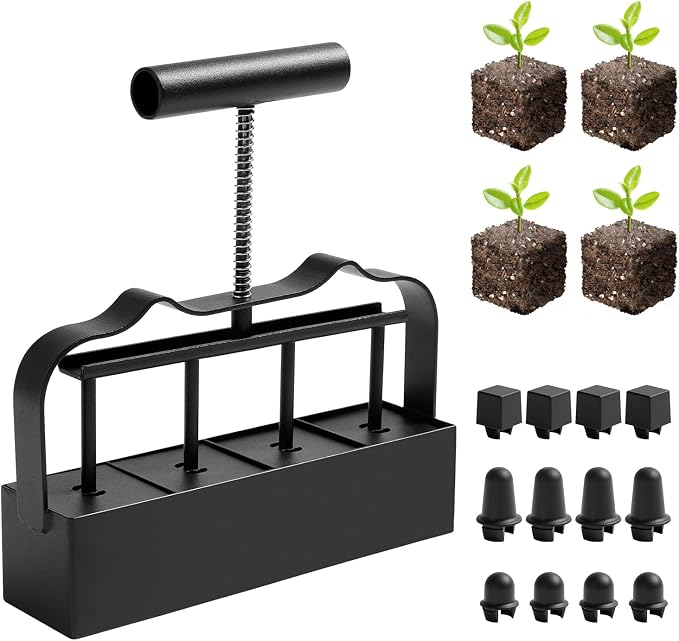 |
KHAMAL 4-Cell 2-Inch Soil Block Maker | Check Price |
| 5 |  |
Jownupp Two-Piece Soil Blocker Set | Check Price |
Ladbrooke Micro 20 Soil Blocker
The Ladbrooke Micro 20 is the most specialized tool in this group, producing twenty 3/4-inch blocks in a single press. That small format is particularly useful for fine seeds such as lettuce, basil, tomato, parsley, celery, and small-seeded flowers. If you start large quantities of these crops under grow lights or in a greenhouse, the high block count can conserve valuable tray and shelf space.
Its strongest long-term advantage is the Ladbrooke nesting system. Micro 20 blocks can nest directly into Mini 4 blocks, allowing seedlings to move into a larger block without being pulled from their original growing medium. That can reduce root disturbance and makes the tool more suitable for a planned seed-starting system than a one-size solution.
The blocker is made in England and uses premium black EP-coated steel intended to resist moisture, corrosion, and soil chemicals. A tool built this way is a sensible choice for gardeners who expect many seasons of use. However, the 3/4-inch cavities are small, so they demand a fine, well-mixed soil-blocking medium with no rocks, twigs, or chunky material. The product information also specifically points beginners growing squash, beans, or cucumbers toward the larger Mini 4 instead.
Pros
- Makes twenty 3/4-inch blocks per press.
- Designed for fine-seeded crops and high-volume sowing.
- Micro blocks nest into Ladbrooke Mini 4 blocks.
- EP-coated steel resists moisture and corrosion.
- Made in England and marked with the Ladbrooke branding.
Cons
- Small cavities require a fine, carefully prepared mix.
- Not the best single tool for large-seeded or vigorous crops.
- The nesting advantage is greatest if you also use compatible Ladbrooke blocks.
My Opinion
This is the strongest choice for serious fine-seed production and the clearest option for gardeners who value a continuous, nestable system. It is less versatile as a lone blocker, but its output, construction, and crop-specific purpose justify the top ranking.
BlumWay 8-Cell 2-Inch Soil Block Maker
BlumWay takes a practical middle position between tiny propagation blocks and lower-capacity four-cell tools. Its eight 2-inch cells let a gardener form more substantial seedlings in one press while still keeping the batch size manageable. That capacity suits repeated sowing of vegetables, herbs, and flowers when four blocks at a time would feel slow but a specialized twenty-block tool would not match the crop mix.
The stainless-steel construction is a useful ownership feature because soil blockers regularly encounter water, damp mix, and fertilizer residues. The heavy-gauge structure is intended for repeated use, while the handheld format makes it relatively easy to carry between a potting bench, greenhouse, or outdoor work area. Cleanup should still be part of the routine rather than something left until the end of the season.
Three included seed-pin styles expand the range of planting jobs. Square, short cylindrical, and long cylindrical pins let the user change the hole shape and depth for different seeds. That flexibility is helpful when one session includes shallow-sown herbs and deeper-sown vegetable seeds, although changing pins adds a small preparation step.
Eight 2-inch blocks are a good general-purpose size, but they will consume more mix and space than the Micro 20’s small blocks. Gardeners with limited shelf room should account for the larger cubes, and those starting extremely tiny seeds in bulk may prefer a specialized fine-seed format instead.
Pros
- Produces eight 2-inch blocks per press.
- Includes square, short cylindrical, and long cylindrical seed pins.
- Stainless-steel construction is suited to damp working conditions.
- Handheld design is portable and relatively easy to clean.
- Good capacity for mixed vegetable, herb, and flower sowing.
Cons
- Eight larger blocks need more mix and growing space than micro blocks.
- Seed-pin changes add an extra setup step.
- It does not provide the dedicated nesting system found with the Ladbrooke option.
My Opinion
BlumWay is a well-balanced alternative for gardeners who want useful volume without committing to a crop-specific blocker. Its eight-cell capacity and varied pins make it one of the easiest options here to recommend for a mixed home garden.
nanovi 4-Cell 2-Inch Soil Block Maker
Nanovi keeps the operating idea simple: press a four-cell mold into moist soil, place it over a seed flat, and use the handle to release four 2-inch cubes. Each block is described as approximately 2 by 2 by 2 inches, giving seedlings a stable growing medium without an individual plastic pot. Four at a time is a comfortable scale for a beginner or for anyone sowing several varieties in modest quantities.
The tool uses thickened zinc-coated steel intended to resist deformation and moisture. That construction should appeal to gardeners who want a reusable blocker rather than a disposable seed-starting system. The rounded handle is another practical touch, especially during repeated pressing, although four-block capacity means larger sowing projects will require more cycles than the BlumWay.
Nanovi includes three seed-pin sizes, with the supplied dimensions covering different planting-hole needs. The pins can be installed before pressing, so a gardener can prepare a batch of blocks for one seed type and then switch for another. A user manual is included, which may be useful for first-time owners learning how firmly to compress the mix and how to release blocks without crumbling them.
This model is a sensible fit for seedlings, cuttings, greenhouse work, and outdoor plant starts. Its main limitation is output rather than capability. Someone raising hundreds of plants may find four blocks per press slow, while someone who values a compact, easy-to-understand tool may prefer the control that lower capacity provides.
Pros
- Makes four 2-inch blocks per press.
- Includes three seed-pin sizes for varied sowing needs.
- Thickened zinc-coated steel is intended for repeated use.
- Rounded handle supports a more comfortable grip.
- Suitable for seedlings, cuttings, greenhouses, and garden starts.
Cons
- Lower output than the eight-cell and twenty-cell options.
- Requires careful moisture and compression control for clean blocks.
- Four-cell production may feel slow for large planting lists.
My Opinion
Nanovi is a sensible starter choice when simplicity and manageable batch size matter more than maximum speed. It offers the essential features most beginners need without tying them to a specialized block-nesting ecosystem.
KHAMAL 4-Cell 2-Inch Soil Block Maker
KHAMAL focuses on handling comfort and organized storage as much as block production. It forms four 2-inch blocks at a time and uses an ergonomic spring-style handle intended to reduce the force needed for pressing. For a gardener planning a long sowing session, that handle design may be more valuable than a small increase in capacity, particularly when working with damp, compact mix.
The included three seed pins are described as cube, cone, and cylinder styles. This gives the user a way to match hole shape to different seed sizes, from small herbs such as basil and chives to larger seeds such as beans or peas. The flexibility is useful, but the tool still makes only four blocks per press, so it is better suited to home-scale batches than high-volume production.
KHAMAL uses premium iron steel and is intended to withstand contact with soil acids over extended use. Its vertical storage height of 8.7 inches and detachable pin storage can help keep a small potting area orderly. Those details matter for gardeners who work from narrow shelves or want to hang the tool near a greenhouse bench rather than leave it in a drawer.
The product data describes an aerated structure with perlite pockets for root oxygenation, but block quality will still depend heavily on the chosen mix and moisture level. The supplied satisfaction-oriented warranty language offers an additional point of contact if questions arise, though buyers should confirm the applicable terms before purchase.
Pros
- Produces four 2-inch blocks in one press.
- Spring-assisted ergonomic handle is intended to reduce pressing effort.
- Includes cube, cone, and cylinder seed pins.
- Vertical design and detachable pin storage suit compact work areas.
- Iron-steel construction is intended for long-term use.
Cons
- Four-block output is modest for large sowing schedules.
- More moving parts may require extra attention during cleaning and storage.
- Buyers should verify warranty details rather than assume coverage.
My Opinion
KHAMAL stands out for gardeners who care about grip comfort, storage, and pin organization. It is a capable small-batch option, though buyers seeking the simplest possible design may prefer Nanovi.
Jownupp Two-Piece Soil Blocker Set
Jownupp is the most varied set in the lineup because it combines two block sizes rather than asking the gardener to choose only one. The larger mold makes six blocks measuring approximately 2 by 1.8 inches, while the smaller mold produces twenty-eight 0.67-inch blocks. That combination can cover both early fine-seed propagation and later, roomier seedling production.
The set also includes a seeding tray six grow tweezers and multiple seed pegs Those extras make it attractive to someone assembling a first soil-block station especially if the goal is to sow delicate small seeds and handle them more precisely Tweezers can be useful with tiny seed although their inclusion does not replace the need for a suitable finely screened mix.
Both blockers are made from metal intended to resist deformation, and the blocks are designed to push out for container-free transplanting. The six-block large mold offers less output than BlumWay’s eight-cell tool, but it gives the user access to the separate 0.67-inch format. That versatility is the main reason to choose Jownupp rather than a single-size blocker.
There are trade-offs. Two molds mean more pieces to clean, store, and keep organized. The smaller blocks also require more careful moisture control because a coarse or loose mix can crumble when ejected. Gardeners who grow only large seedlings may not use half of the set, while those with mixed crop sizes may find the extra equipment worthwhile.
Pros
- Includes both 2-inch and 0.67-inch block makers.
- Produces six larger blocks or twenty-eight smaller blocks.
- Comes with a tray, grow tweezers, and multiple seed pegs.
- Supports both fine-seed propagation and larger seedlings.
- Metal construction is intended for repeated use.
Cons
- Two molds require more cleaning and storage space.
- Small blocks are more sensitive to mix texture and moisture.
- The larger mold has lower output than the eight-cell BlumWay.
My Opinion
Jownupp is the best fit for gardeners who genuinely need two propagation sizes and appreciate an included starter kit. It is less streamlined than a single-purpose tool, but its range makes it a useful value-oriented choice for varied sowing plans.
How I Selected These Soil Blockers
The ranking weighs practical usefulness rather than treating every cell count as interchangeable. I considered the crops each size suits, the number of blocks made per press, material and corrosion-resistance information, seed-pin flexibility, handle design, storage considerations, and whether the product supports a broader growing system. Ratings and customer-feedback counts were also considered as available signals, but they were not treated as proof of performance under every soil mix or gardening style.
Block size is the most important starting point. A tool that excels at 3/4-inch fine-seed blocks may be a poor choice for squash or beans, while a 2-inch blocker may be unnecessarily large for someone raising hundreds of lettuce seedlings.
Brand diversity also shaped the selection. Ladbrooke represents a premium, purpose-built nesting system, while BlumWay, Nanovi, KHAMAL, and Jownupp offer different combinations of capacity, comfort, seed-hole options, and kit contents. This creates a more useful comparison than listing five nearly identical molds.
Customer feedback can help identify whether a product attracts sustained interest, but it cannot remove the need to prepare suitable soil, use the right moisture level, and handle fresh blocks carefully.
How to Choose a Soil Blocker for Your Garden
The right tool depends on your crop list, weekly seed count, available shelf space, and willingness to prepare a suitable mix. Start by selecting the block size, then compare production capacity and handling features. A tool that feels efficient on paper may be frustrating if its blocks are too small, too large, or incompatible with the way you transplant.
- Match block size to the crop: use small blocks for fine seeds and larger blocks for seedlings that need more room.
- Estimate batch volume: higher cell counts reduce pressing cycles but may require more mix and tray space.
- Check seed-hole options: several pin shapes or sizes help when sowing different crops.
- Prioritize construction: coated, stainless, or zinc-coated metal can be more suitable for repeated damp use than fragile materials.
- Consider the whole system: nesting compatibility, storage, cleaning, and included accessories affect ownership.
Choose the Right Block Size
The best soil blocker for fine-seeded crops is not automatically the best choice for large seeds. Small blocks are space-efficient and work well for crops that germinate quickly, but they dry out faster and offer less room for developing roots. Two-inch blocks provide a more forgiving volume for many vegetables, herbs, and flowers, though they occupy more room under lights and use more growing medium.
Consider the transplant timeline as well. If seedlings will move into the garden soon after germination, a small block may be sufficient. If weather delays planting or the crop needs a longer indoor start, a larger block can reduce the pressure on the root system. The Ladbrooke nesting approach is a special solution because it allows a seedling to move into a larger compatible block without being removed from its original block.
Compare Capacity With Your Actual Schedule
Cell count matters most when the same crop is sown in large batches. Ladbrooke’s twenty small blocks are efficient for fine seeds, BlumWay makes eight 2-inch blocks, and Nanovi and KHAMAL make four 2-inch blocks. Jownupp occupies a different category by offering six larger blocks and a separate twenty-eight-cell small mold.
Do not choose capacity in isolation. More blocks per press can mean more mix preparation, more seedlings to label, and more space needed for watering and light. A four-cell tool may be the more comfortable choice if you sow a few varieties every week rather than hundreds of plants in one session.
Look at Handle and Ejection Design
Fresh blocks need enough compression to hold together, but excessive force can make repeated work uncomfortable. Rounded or contoured handles may improve control, and KHAMAL’s spring-style design specifically targets lower pressing effort. A reliable ejection action is equally important because blocks that stick inside the mold can crumble when removed.
When using any handheld tool, press straight down and keep the mold level during release. Twisting or lifting one side early can create uneven blocks. If the tool feels difficult to operate, first check the soil moisture and loading technique before assuming the handle is the problem.
How to Prepare Soil for Clean Blocks
Soil blocking works best with a fine, cohesive medium that holds together when compressed but still contains enough air for roots. The supplied product information is especially clear about the Ladbrooke Micro 20: rocks, twigs, and chunky material are unsuitable because the cavities are very small. The same principle applies to every blocker, with finer molds demanding finer screening.
Moisture is the balance to watch. A dry mix will not bind, while an overly wet mix may smear inside the mold, stick to the metal, or produce weak edges after release. Add water gradually and mix thoroughly rather than soaking the entire batch at once. The finished medium should hold its shape when squeezed without releasing a large amount of free water.
Prepare enough mix for the session, but avoid leaving wet soil inside the tool between uses. If a recipe includes perlite or other aerating material, keep the particles reasonably consistent in size so they do not interfere with the smallest cavities. Before making a full tray, produce one test press and inspect the corners, seed holes, and release behavior.
First-Time Setup and Use
- Read the included instructions and identify the mold, handle, and seed-pin parts.
- Choose the pin style or size that matches the crop being sown.
- Prepare a fine, evenly moist blocking mix.
- Fill the cavities completely, pressing the mix into corners and around the pins.
- Press the blocker firmly and evenly into the mix.
- Position the tool over a tray or flat surface before releasing the blocks.
- Lift the mold carefully and inspect the first group before making more.
- Label each batch with the crop and sowing date.
Do not rush the first few presses. A short practice run reveals whether the mix is too dry, too wet, or too coarse. Once the blocks release cleanly, repeat the same pressure and filling method for a more consistent batch. Keep blocks close together on the tray so they support one another, while still allowing air to reach their sides.
Using Seed Pins Correctly
Seed pins create a starting hole, but the correct depth depends on the seed and the crop. The several included pin types on BlumWay, Nanovi, KHAMAL, and Jownupp make the tools more adaptable, but they do not mean every seed should be planted deeply. Very small seeds often need only a shallow impression, while larger seeds can require a deeper opening.
Install pins before loading the mold and check that each one is seated securely. If a pin becomes clogged with wet mix, remove the residue before the next press. Switching between crops is a good time to clean the pins because dried material can change the hole shape or make removal more difficult.
Watering and Early Seedling Care
Soil blocks can dry from the sides as well as the top, particularly when they are spaced apart under strong lights or near moving air. Check moisture by observing the block surface and the weight of the tray rather than relying only on a fixed watering schedule. Gentle bottom watering can reduce disturbance, while a light top mist may be useful for freshly sown seed when it does not erode the block.
Avoid allowing blocks to sit in stagnant water. Excess moisture can weaken the structure and deprive roots of air. Once seedlings emerge, provide suitable light and airflow for the crop, and rotate the tray if one side receives more light. The blocker creates the growing form, but healthy seedlings still depend on ordinary seed-starting care.
Cleaning, Maintenance, and Storage
Rinse soil from the blocker soon after use, paying particular attention to corners, seed pins, springs, and ejection surfaces. A soft brush can remove material without scratching coated metal. Wipe the tool dry before storage, especially when it is made from steel or includes moving parts.
Do not store the blocker packed with damp soil or leave detachable pins scattered around the potting area. Keep pins with the correct mold so the next setup is quick and so small parts are less likely to disappear. For tools with spring handles, check that the mechanism moves freely and that soil has not collected around the pivot.
Coated, stainless, zinc-coated, and iron-steel construction can all support repeated use, but none eliminates basic care. Moisture, soil acids, and fertilizer residue are easier to manage when removed routinely rather than allowed to dry into a hard layer.
Compatibility with Trays and Growing Systems
Before buying, measure the trays or flats already used in your growing area. A 2-inch block is substantially larger than a 3/4-inch block, and a tray that works for one format may waste space with another. Also check how the blocks will be moved from the pressing surface to the shelf, since a stable flat can make transport easier.
Ladbrooke has the clearest compatibility advantage because the Micro 20 blocks nest into Mini 4 blocks. That is valuable if you want a planned progression from germination to transplanting without disturbing the root ball. The other products are better viewed as independent tools, so the buyer should select trays and flats around the block dimensions and expected batch size.
Common Mistakes to Avoid
Most disappointing results come from technique rather than from the basic idea of soil blocking. A suitable blocker cannot compensate for a coarse mix, inconsistent compression, or a block size that does not match the crop. Avoid these errors when getting started:
- Using chunky soil: stones, twigs, and large particles prevent small cavities from filling evenly.
- Making the mix too dry: blocks may crumble as soon as the mold is lifted.
- Making the mix too wet: the tool may clog and the blocks may smear or collapse.
- Choosing a tiny block for a vigorous crop: large or fast-growing seedlings may outgrow it quickly.
- Overfilling unevenly: missing material around the edges produces weak corners.
- Pulling the mold sideways: twisting can damage fresh blocks before their roots develop.
- Ignoring tray space: larger blocks need more room under lights and during watering.
- Leaving soil on the tool: dried residue can interfere with pins, springs, and clean ejection.
Make one test press before producing an entire tray. If the corners break, adjust moisture and compression first; changing tools may not solve a preparation problem.
Which Soil Blocker Is Best for Different Gardeners?
Best for High-Volume Fine Seeds
Ladbrooke Micro 20 is the clear match for gardeners raising many lettuce, basil, tomato, parsley, celery, or small-flowered seedlings. Its twenty-block output and nesting capability are more important here than general-purpose versatility.
Best General-Purpose 2-Inch Option
BlumWay is the strongest fit for a mixed garden that needs eight larger blocks at a time and several seed-hole styles. It offers more output than the four-cell tools without requiring the buyer to commit to only one specialized size.
Best Simple Small-Batch Tool
Nanovi suits a beginner who wants four 2-inch blocks, a comfortable rounded handle, and three pin sizes without a complicated kit. Its lower capacity is easy to accept when sowing modest quantities.
Best for Handle Comfort and Compact Storage
KHAMAL deserves attention from gardeners who expect repeated pressing and value an ergonomic spring handle, vertical storage, and detachable pin organization. It remains a small-batch tool, but the handling details may improve the work area experience.
Best Multi-Size Starter Set
Jownupp is the logical pick when both fine-seed and larger-seed propagation matter. Its included tray, tweezers, and two mold sizes reduce the need to assemble separate accessories, although the set also requires more storage and cleaning.
FAQS About Best Soil Blocker
What size soil blocker is best for beginners?
A four-cell 2-inch blocker is often the easiest starting point because the blocks are large enough to handle and suit many common garden seedlings. Nanovi and KHAMAL fit that use case, while BlumWay is better when a beginner expects larger batches.
Is a small soil blocker better for tiny seeds?
Yes, small blocks are generally more appropriate for fine seeds because they use less medium and conserve shelf space. The Ladbrooke Micro 20 is specifically intended for 3/4-inch blocks and fine-seeded crops.
How many blocks should a good soil blocker make?
There is no universal ideal count. Four blocks are manageable for small batches, eight improve efficiency for regular sowing, twenty are useful for high-volume fine seeds, and a two-size set may be best when crop requirements vary.
Do soil blockers need special potting mix?
They need a fine, cohesive mix that is free from large debris and moist enough to hold its shape. A standard loose potting mix may not bind reliably unless it is adjusted for soil blocking.
Are soil blockers compatible with all seeds?
They can support many seeds when the block size and hole depth are appropriate, but not every crop suits the same format. Small blocks are not ideal for vigorous seedlings, and large seeds may need a deeper or wider hole.
How do you stop soil blocks from falling apart?
Adjust moisture gradually, compress the mix evenly, fill the mold completely, and lift it straight up. Coarse material, insufficient pressure, and blocks that are too dry are common causes of crumbling.
Final Thoughts
The best soil blocker depends on how many plants you start and how much room each crop needs. Ladbrooke Micro 20 is the top choice for high-volume fine seeds and a nestable system, BlumWay is the strongest general-purpose 2-inch alternative, and Nanovi is the simplest small-batch option. KHAMAL adds ergonomic and storage advantages, while Jownupp is the most versatile choice for gardeners who need both small and large blocks.

I’m Maya L. Greenwood, a lifelong plant lover who believes anyone can grow something beautiful with the right guidance. After years of testing soil mixes, pruning methods, irrigation tricks, and pest-safe solutions, I started EasyGardenTips.com to turn hard-won lessons into step-by-step advice. From seed starting and container gardens to composting and seasonal checklists, my goal is to make gardening simple, sustainable, and fun.