10 Best Heavy Duty Garden Hoses: Best Picks and Key Buying Tips
Finding the best heavy duty garden hoses means looking beyond a thick-looking exterior. The right hose should match your yard size, water pressure, storage space, climate, and the amount of dragging, coiling, and connecting you expect it to handle.
For most homeowners, the Briggs and Stratton 8BS100 100-Foot Premium Heavy-Duty is the strongest overall recommendation in this group. It combines a useful 100-foot reach with heavy-duty rubber construction, crush-proof couplings, industrial-style reinforcement, and nickel-plated brass connections. The Giraffe Tools Garden Hose 5/8″ is the clear alternative if lighter handling, all-weather flexibility, and a swivel handle matter more than choosing a traditional heavy-duty rubber hose.
The ten hoses below were compared by construction, length, flexibility, fitting design, pressure information, weather resistance, kink control, portability, and intended use. The rankings also consider how practical each hose is for ordinary watering, vehicle washing, cleanup, irrigation, and more demanding outdoor work.
Best Heavy Duty Garden Hoses at a Glance
| Product | Name | Price |
|---|---|---|
 |
Briggs and Stratton 8BS100 100-Foot Premium Heavy-Duty | Check Price |
 |
Giraffe Tools Garden Hose 5/8″ | Check Price |
 |
Heavy Duty Garden Hose 25ft | Check Price |
 |
Continental Premium Garden Black Heavy Duty Cold | Check Price |
 |
FEVONE Kink Free Garden Hose 100 Ft | Check Price |
 |
Guitrees 50FT 3/4 Heavy Duty Rubber Garden | Check Price |
 |
Gilmour Pro Commercial 3/4″ X 75′ Heavy | Check Price |
 |
DEWALT Professional Grade Heavy Duty Garden Hose | Check Price |
 |
Orbit Exojacket Heavy Duty Fabric Garden Hose | Check Price |
 |
VEVOR Garden Hose | Check Price |
1. Briggs and Stratton 8BS100 100-Foot Premium Heavy-Duty
The Briggs and Stratton 8BS100 earns the top position because it presents a straightforward heavy-duty design with the kinds of components that matter most for long-term outdoor use. Its 100-foot length is useful for reaching distant garden beds, large lawns, driveways, and multiple areas around a property without joining two hoses together. That reach is also the main trade-off: a hose this long can take more effort to drag, drain, and coil than a compact 25- or 50-foot option.
The hose uses industrial-style reinforcing intended to provide high burst strength, while its crush-proof heavy-duty couplings are designed to withstand the pressure and handling that commonly damage hose ends. The nickel-plated brass male and female couplings add a durable connection point at the faucet and accessory ends. A rubber washer is included for watertight connections, which is an important detail because many apparent hose failures actually begin with a poor washer or loose fitting.
This is a sensible choice for homeowners who prefer traditional rubber-hose construction and want one long hose for general watering, cleaning, or filling tasks. It is also appealing when connection durability is more important than having the lightest possible hose. The conventional coupling arrangement should work with standard garden-hose-thread faucets, nozzles, sprinklers, and similar accessories, provided those accessories use compatible threads.
Before buying, measure the route from the spigot to the farthest work area rather than assuming 100 feet is automatically convenient. Store it drained and coiled without sharp bends, and use a hose hanger or reel capable of supporting its length and weight. If portability is your overriding concern, the Giraffe or another hybrid design may be easier to maneuver; for maximum reach and rugged connection hardware, this remains the most balanced pick.
2. Giraffe Tools Garden Hose 5/8″
The Giraffe Tools Garden Hose 5/8″ takes second place as the clearest alternative to the top-ranked Briggs and Stratton. Its appeal is its combination of 100-foot reach, lightweight handling, and a construction intended for use in changing weather. The hose is made with three layers designed to resist UV exposure, corrosion, and abrasion, giving it a practical profile for homeowners who leave a hose outdoors during much of the watering season.
A swivel handle is one of its most useful ownership features. By helping the connection rotate as the hose moves, it can reduce twisting at the faucet and make pulling the hose around corners less frustrating. The hose also uses 3/4-inch heavy-duty connectors and is described as having a leak-proof design. Those connectors should suit standard outdoor faucet and garden-accessory threads, but it is still wise to verify the thread type on pressure washers or specialty equipment before connecting.
This model is a good fit for someone who needs a long hose but does not want the handling burden associated with some traditional rubber models. It can cover gardens, vehicles, patios, and general outdoor cleaning areas, while the all-weather flexibility is useful in both hot and cold conditions. Its three-layer body also gives it broader everyday utility than a lightweight hose intended only for occasional flower-bed watering.
The trade-off is that lightweight construction does not necessarily feel the same as a thick commercial rubber hose when dragged over rough surfaces or stored carelessly. Keep the hose away from sharp edges, avoid driving over the connectors, and coil it without tight kinks. Choose this model over the Briggs and Stratton when easier carrying and swivel-assisted handling are priorities; choose the top pick when crush resistance and traditional heavy-duty coupling hardware are more important.
3. Heavy Duty Garden Hose 25ft
The Heavy Duty Garden Hose 25ft ranks third because it solves a different problem from the two long hoses above. Its compact length is convenient for small yards, balconies, patios, front steps, raised beds, and spigots located close to the work area. A 25-foot hose is also easier to carry, drain, and store, making it a practical choice for users who do not want a large coil taking up room in a shed or garage.
This is a non-expandable hybrid hose made by blending rubber and PVC around a woven middle layer. That construction is intended to keep the hose light while providing abrasion resistance and flexibility. The available information also describes it as kink resistant in extreme temperatures, which is valuable when a hose must be moved repeatedly around outdoor furniture, planting beds, or a vehicle. Its 5/8-inch standard inner diameter is a familiar size for everyday residential watering.
The connectors are copper-plated aluminum and are described as crush resistant and rust proof. The stated working pressure is 200 PSI, with a 600 PSI burst pressure, although actual performance will still depend on the water source, fittings, and condition of the hose. These specifications make it suitable for residential water pressure and common tasks such as watering, rinsing, and light cleanup rather than automatically making it appropriate for every high-pressure machine.
Its main limitation is reach. A 25-foot hose may require frequent repositioning in a larger yard, and joining it to another hose introduces another connection that can leak. Select it when the spigot is close and easy storage matters more than coverage. For ownership, inspect the plated fittings and washers regularly, avoid leaving the hose under vehicle tires, and drain it before storage. If you need one hose to reach across a large property, the 100-foot choices higher in the ranking will be more convenient.
4. Continental Premium Garden Black Heavy Duty Cold
The Continental Premium Garden Black Heavy Duty Cold is ranked fourth because it emphasizes rubber durability and cold-weather flexibility. It has a 5/8-inch inside diameter and a 100-foot length, giving it the reach needed for broad residential yards, long driveways, and cleanup tasks where moving the spigot repeatedly would be inconvenient. The hose is specifically described as a cold-water hose that maintains flexibility at cold temperatures.
Its heavy-gauge rubber is intended to resist abrasion and corrosion, two common causes of premature wear when a hose is pulled across concrete, soil, or rough landscaping. Brass fittings add strength and corrosion resistance at the connection points. The stated temperature range is particularly notable: -40 to +190 degrees F. That information makes the model attractive to owners who need a hose that remains usable across severe seasonal conditions, though the hose should still be stored thoughtfully rather than exposed unnecessarily to prolonged sun, freezing water, or physical damage.
This hose suits a homeowner who values conventional rubber construction and wants a long, weather-oriented hose for cold-water outdoor work. It can be a strong option for watering, washing, and general property maintenance, especially in regions where winter temperatures make some lightweight hoses stiff or brittle. Its 100-foot length is helpful, but it also means more weight and more storage space than a shorter hose.
The word “cold” in the product name is an important ownership reminder. The supplied information supports cold-water use and a wide temperature range; it should not be treated as a dedicated hot-water hose simply because the listed upper temperature is high. Use compatible garden-hose-thread accessories, check the brass fittings for washer wear, and drain the hose before freezing weather. If you want easier maneuverability or a swivel connection, the Giraffe or VEVOR may be more convenient; if cold-weather rubber performance is the priority, this Continental model deserves consideration.
5. FEVONE Kink Free Garden Hose 100 Ft
The FEVONE Kink Free Garden Hose 100 Ft holds the middle position because it combines long reach with a hybrid polymer body and unusually clear emphasis on maintaining water flow through the fittings. Its true 5/8-inch inner diameter is described as continuing through both the hose body and fittings. That design is intended to reduce restriction from end to end, which can be useful when watering at a distance or using a nozzle that already limits flow.
The hose uses solid brass 3/4-inch garden-hose-thread connectors for standard outdoor faucets, spigots, nozzles, and garden accessories. The hybrid polymer construction is designed to bend smoothly without kinking, while a woven middle layer and abrasion-resistant outer cover add support for dragging and repeated outdoor use. The stated burst-pressure rating is up to 600 PSI, and the firmly attached fittings plus a durable O-ring are intended to support leak-resistant connections.
This model is a good match for someone who wants a 100-foot hose but is especially concerned about kinks, fitting durability, and maintaining a full-size internal passage. It is suitable for larger yards, vehicle washing, irrigation accessories, and general outdoor cleanup. The solid brass fittings should feel reassuring for frequent connection and disconnection, though brass can still be damaged by cross-threading or excessive wrench force.
Its rank reflects a balance rather than a major weakness. The product has a 4.0 rating in the supplied research, lower than several alternatives here, so buyers who place the highest value on established user satisfaction may prefer the higher-ranked choices. A full-length hybrid hose can also remain cumbersome in tight spaces. Set it up by threading the connectors straight onto clean, compatible fittings and checking the O-ring for seating. Drain and coil it loosely after use; if your yard is small, a shorter hose will be easier to live with.
6. Guitrees 50FT 3/4 Heavy Duty Rubber Garden
The Guitrees 50FT 3/4 Heavy Duty Rubber Garden hose ranks sixth as a compact, pressure-oriented option for demanding outdoor tasks. Its 50-foot length provides a useful middle ground: enough reach for many yards and driveways, but less bulk than a 100-foot hose. The 3/4-inch sizing and solid brass 3/4-inch garden-hose-thread fittings make it especially interesting for users who want a robust connection and substantial water delivery for gardening, agriculture, construction, or cleanup.
The hose uses five-layer braiding for durability and is described as kink resistant and flexible in all weather, including temperatures down to -40 degrees. It supports hot and cold water, which broadens its potential applications beyond ordinary plant watering. The supplied specifications mention working pressure of up to 200 PSI and burst pressure above 1,000 PSI. Those are substantial figures, but they should not be interpreted as permission to exceed the pressure limits of a faucet, nozzle, pump, or other connected equipment.
Guitrees is a strong fit for an owner who wants a shorter heavy-duty rubber hose for more strenuous work. The length is easier to control around a work area, and the construction is aimed at resilience rather than ultralight portability. It may also suit someone who needs seasonal flexibility and does not want separate hoses for hot- and cold-water tasks.
The trade-off is that a 3/4-inch rubber hose may be more substantial to carry than a lighter 5/8-inch hybrid hose, especially when filled. It also may be unnecessary for a small garden with modest watering needs. Use a compatible 3/4-inch garden-hose-thread connection, support the hose near the faucet to reduce strain, and drain it before storage. For a broad property, the longer Briggs and Stratton or Giraffe will reduce repositioning; for a sturdy, manageable 50-foot work hose, this model is more appropriate.
7. Gilmour Pro Commercial 3/4″ X 75′ Heavy
The Gilmour Pro Commercial 3/4″ X 75′ Heavy earns seventh place with a commercial-style construction package and a useful 75-foot length. It is made from double-reinforced rubber and vinyl, with a rugged red cover intended to resist abrasion without marring surfaces. That combination gives it a practical profile for homeowners who drag a hose across patios, driveways, landscaping, or work areas and want more protection than a basic lightweight hose provides.
The hose has a stated 400 PSI burst strength and heavy-duty brass couplings with O-rings. Those fittings are designed to create a tight, durable seal with spigots, sprinklers, and nozzles. A protective steel spring coil at the faucet is another notable feature. By supporting the area where the hose commonly bends, it is intended to minimize kinks near the spigot, where repeated sharp flexing can damage both flow and the hose end.
At 75 feet, this Gilmour offers a compromise between the compact 50-foot hoses and the maximum reach of the 100-foot models. It can be easier to store and maneuver than a 100-foot commercial-style hose while still covering much of a typical yard. The product is also identified as being made at a factory in the USA, which may matter to buyers who consider manufacturing origin as part of their purchase decision.
The commercial rubber-and-vinyl design is likely to feel more substantial than lightweight polymer alternatives, so it may not be the best choice for someone who prioritizes effortless carrying. The supplied data also does not describe hot-water use, so treat it as a general outdoor water hose rather than assuming it is rated for hot applications. Confirm that your faucet and accessories use compatible garden-hose threads, keep the spring coil clear of obstructions, and store the hose drained and supported. It is a sensible middle-length choice when durability matters more than minimum weight.
8. DEWALT Professional Grade Heavy Duty Garden Hose
The DEWALT Professional Grade Heavy Duty Garden Hose places eighth because it offers a well-rounded hybrid design, although the available review volume is smaller than that of several higher-ranked products. Its 100-foot length is suited to large yards, landscaping, irrigation, car washing, and general outdoor work. A hybrid polymer blend is intended to keep the hose flexible and manageable in extreme weather, addressing one of the most common complaints about hoses that become stiff in cold conditions or unwieldy in heat.
The reinforced body is rated to withstand up to 500 PSI, and the surface is described as abrasion resistant and non-marring. That makes it a practical option for routine dragging over outdoor surfaces where protecting the hose and the underlying area both matter. Low-memory construction is intended to reduce the tendency to retain tight coils, while easy-grip collars can make attachment and removal more comfortable.
Anodized aluminum couplings provide a wrench-free connection. This is convenient for frequent setup and takedown because users can generally attach the hose by hand without relying on a wrench. The fittings should be used with standard compatible garden-hose-thread faucets and accessories, and care is still needed to avoid cross-threading. Aluminum is lighter than brass, but users who deliberately prefer the heft and traditional feel of brass connectors may favor several other options in this roundup.
This DEWALT is a good fit for homeowners or professionals who need long reach, weather flexibility, and easy handling more than a traditional rubber hose. Its principal limitation is the combination of 100-foot length and the physical demands of storing a long hose. Use a large enough reel or hanger, avoid sharp bends at the couplings, and flush debris from the fittings before connection. If you need the strongest connection emphasis, the Briggs and Stratton or Gilmour may be a better match; if low-memory handling is central, this model remains worth considering.
9. Orbit Exojacket Heavy Duty Fabric Garden Hose
The Orbit Exojacket Heavy Duty Fabric Garden Hose ranks ninth as a lightweight and compact 50-foot choice with an emphasis on exterior protection and easy handling. Its rugged Exojacket outer layer is designed to withstand wear and tear, while the fabric-style construction keeps the hose portable for homeowners who do not want to wrestle with a heavy rubber coil. The 50-foot length is well suited to patios, small and medium yards, gardens, and localized automotive or cleaning tasks.
Orbit’s AntiKink technology is intended to help the hose remain usable as it is rolled out and moved around planting beds or obstacles. Crush-resistant anodized aluminum couplings and heavy-duty easy-twist grips support simpler installation at the spigot. These fittings should be compatible with standard garden-hose-thread connections, though users should always confirm compatibility with specialty accessories and avoid forcing threads that do not align.
The product is listed with a 600 PSI burst strength and is described as suitable for residential watering as well as professional landscaping, automotive, and irrigation applications. That pressure figure speaks to resistance to bursting; it does not mean every connected tool or water source should be operated at 600 PSI. The fabric outer layer and lightweight format make it appealing for users who prioritize portability and compact storage over the dense feel of a commercial rubber hose.
Its main limitation is reach. Fifty feet may be insufficient for a large property unless the hose is used with another length, and additional connections create more potential leak points. The fabric jacket should also be kept away from sharp edges and abrasive hazards even though it is designed for durability. Drain the hose before coiling, use the easy-twist grips rather than pulling on the hose body, and choose this Orbit when portable, compact handling is more important than maximum coverage.
10. VEVOR Garden Hose
The VEVOR Garden Hose rounds out the list with a 100-foot, 5/8-inch hybrid rubber hose that combines long reach with several user-oriented handling features. Its four-layer construction includes a UV-resistant outer layer intended to slow aging in outdoor conditions. The hose is rated for 150 PSI working pressure and 600 PSI burst pressure, giving it a useful specification profile for residential watering, vehicle washing, surface cleaning, pet washing, and similar tasks.
Both ends include ergonomic 360-degree swivel sleeves. These are designed to let the hose change angle more naturally as it moves, helping reduce twists and tangles around the faucet or nozzle. Copper-plated aluminum 3/4-inch fittings and pre-installed leak-proof washers are intended to provide corrosion resistance and a secure connection. The hose weighs 15.43 pounds, or about 7 kilograms, which is relatively manageable for a 100-foot model but still represents a considerable coil when full of water.
The stated flexibility range is -20 to 140 degrees F, so this hose is designed for broad seasonal outdoor use. The manufacturer also recommends draining it and coiling it in a figure-eight shape for quick, tangle-free storage. That is particularly useful with a long hose because a figure-eight coil can reduce the tight twists that make later deployment frustrating.
VEVOR is a sensible choice for someone who wants a long hose with swivel-assisted handling and clear storage guidance, but it ranks below the leading options because the available review base is smaller and its pressure rating is lower than the highest figures listed for some alternatives. Do not confuse burst pressure with recommended operating pressure, and never use it beyond the limits of connected equipment. Drain it after every use, protect the aluminum fittings from impact, and consider a shorter model if most work happens close to the spigot.
How to Choose the Best Heavy Duty Garden Hose
A heavy-duty hose is not automatically the best hose for every property. The most useful choice is the one that supplies enough reach and durability without becoming so heavy or awkward that it is left coiled beside the faucet. Start with the tasks you actually perform, then compare length, materials, fittings, pressure information, flexibility, and storage requirements.
Choose the right length first
Length determines convenience more than many buyers expect. A 25-foot hose is easy to carry and store, but it may need constant repositioning in a large yard. A 50-foot hose is a versatile middle ground for patios, gardens, driveways, and many average outdoor spaces. Seventy-five feet can provide broad coverage without the full bulk of a 100-foot coil, while 100 feet is useful when one spigot must serve distant planting areas or a long driveway.
Measure the actual route, including turns around corners and obstacles. Avoid buying a hose that must be stretched tightly to reach its destination. Tension places extra stress on fittings and makes the hose more likely to catch on landscaping or furniture. At the same time, excessive unused length creates a heavier coil and more storage work. If you regularly work in two separate areas, two shorter hoses may be easier to manage than one very long hose, although every additional connection introduces another place where a leak can develop.
Understand hose diameter and water flow
Most products here use a 5/8-inch inside diameter, a common size for general residential watering. The FEVONE specifically emphasizes a true 5/8-inch flow path through its body and fittings, which is intended to reduce restriction. The Guitrees uses 3/4-inch sizing and 3/4-inch garden-hose-thread fittings, potentially making it more suitable for users who want a larger, more substantial hose for demanding work.
Diameter is only one part of real-world flow. Faucet output, water pressure, nozzle design, hose length, kinks, washers, and connectors all affect how much water reaches the end. A larger diameter does not guarantee that a weak spigot will deliver more water. Conversely, a long narrow hose can lose useful pressure or flow compared with a shorter hose. Match the hose to your source and the accessory you plan to use instead of choosing based on diameter alone.
Compare rubber, hybrid polymer, vinyl, and fabric construction
Traditional rubber hoses are often chosen for their substantial feel, durability, and ability to tolerate regular outdoor handling. The Briggs and Stratton, Continental, Guitrees, and Gilmour models emphasize rubber or rubber-based construction. These hoses can be excellent for frequent use, but their strength may come with additional weight. A filled rubber hose is especially demanding to drag, so consider your physical comfort and whether the hose will be stored on a reel.
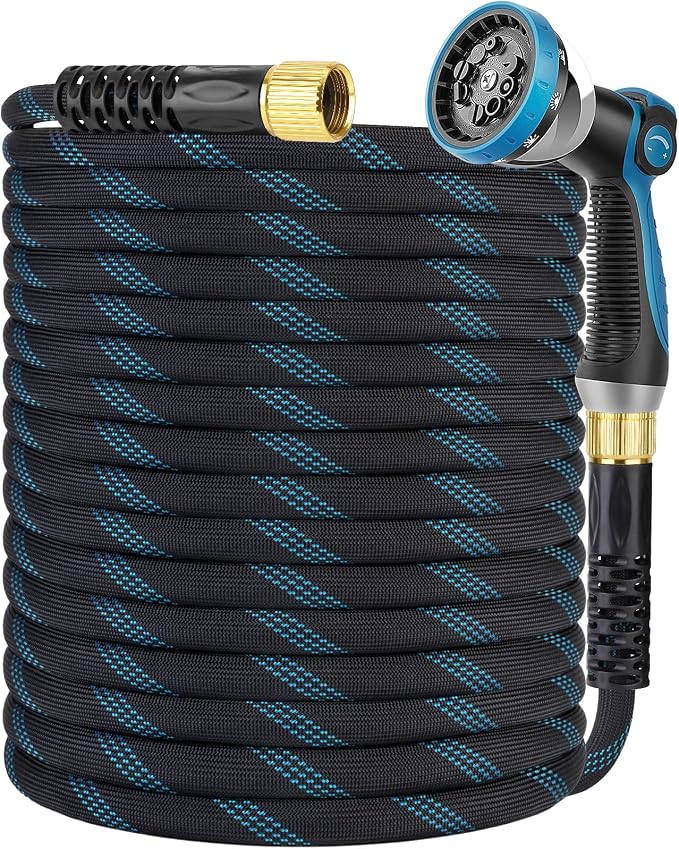
Hybrid polymer hoses try to balance flexibility, low weight, abrasion resistance, and durability. The Giraffe, FEVONE, DEWALT, VEVOR, and the 25-foot EOOIO-style hose use hybrid or blended construction. These models can be easier to move around obstacles and may remain flexible across a wider range of conditions, depending on the individual design.
Fabric-jacketed designs such as the Orbit Exojacket emphasize portability and compact storage. The outer jacket helps shield the hose, but lightweight handling should not be confused with indestructibility. Any hose can be damaged by dragging across sharp metal, pulling around corners under tension, running over it with a vehicle, or leaving it exposed to avoidable abuse.
Pay attention to the fittings
Hose bodies receive much of the marketing attention, but the ends often determine whether ownership is pleasant or frustrating. Brass fittings are valued for strength and corrosion resistance, as seen on the Briggs and Stratton, Continental, Gilmour, FEVONE, and Guitrees models. Aluminum fittings can reduce weight and are used on products such as the Orbit, DEWALT, and VEVOR hoses. Crush-resistant couplings and reinforced collars can help protect the connection during ordinary use.
Verify that the hose uses standard garden-hose-thread connections for your faucet and accessories. A 3/4-inch garden-hose thread is common, but specialty equipment may use different fittings or adapters. Never force a connection that feels misaligned. Cross-threading can damage the faucet or hose fitting and create a leak that a new washer will not solve.
Washers are inexpensive but essential. A missing, flattened, or poorly seated washer can make a sound hose appear defective. Inspect the washer when installing the hose, keep the connection clean, and replace the washer if it becomes hard, cracked, or permanently compressed. Hand-tighten first and use tools only when the product instructions specifically call for them; excessive force can deform fittings.
Use pressure ratings correctly
Several hoses in this roundup list burst-pressure figures ranging from 400 to more than 1,000 PSI. These figures describe resistance to bursting under specified conditions, not the pressure at which the hose should normally be operated. Working pressure is the more relevant number when it is provided. For example, the VEVOR lists 150 PSI working pressure and 600 PSI burst pressure, while the 25-foot hose lists 200 PSI working pressure and 600 PSI burst pressure.
Residential garden faucets usually operate far below the listed burst figures, but connected equipment can change the situation. A pressure washer, pump, irrigation system, or specialized sprayer may have its own requirements and restrictions. Check the hose’s instructions and the equipment manufacturer’s specifications before connecting them. A hose that survives a high burst test is not automatically suitable for hot water, compressed air, chemical solutions, or every pressure-washing setup.
Consider climate and water temperature
Cold weather can make some hose materials stiff, while summer heat and direct sunlight can accelerate aging. The Continental is specifically described as maintaining flexibility at cold temperatures, with a listed range of -40 to +190 degrees F. The Guitrees is described as flexible down to -40 degrees and suitable for hot and cold water. The VEVOR lists a flexibility range of -20 to 140 degrees F, and several hybrid hoses emphasize all-weather performance.
These specifications are useful, but they do not remove the need for sensible maintenance. Drain a hose before freezing weather so water cannot expand inside it. Avoid leaving a filled hose in direct sunlight when it is not in use. Do not assume that a general garden hose is safe for hot water simply because its material tolerates warm outdoor temperatures. Hot-water use should be supported by the specific product information, not inferred from a general temperature claim.
Reduce kinks through setup, not just product design
Anti-kink features, swivel handles, spring coils, low-memory materials, and flexible bodies can all help, but setup still matters. Begin by laying a new hose out straight before its first full use. Attach it to the faucet without twisting the connection, then pull it gradually toward the work area rather than yanking the hose from the spigot.
Do not wrap a hose around a sharp corner or tree trunk. If the hose must pass around an obstruction, use a broad route or a guide that does not pinch it. When finished, turn off the water at the faucet, release pressure through the nozzle, drain the hose, and coil it in broad loops. The VEVOR’s figure-eight storage suggestion can be useful for long hoses that tend to retain twists.
Plan storage before purchasing a long hose
A 100-foot hose needs more storage capacity than a 25-foot model. A reel can reduce tangling, but it must be large and strong enough for the hose’s diameter and weight. A wall hanger or large hook may work for a shorter hose, provided it supports the coil without forcing a tight bend near the fittings. Store the hose in a shaded, protected location when possible.
Never leave a hose pressurized while it is stored. Constant pressure can strain connections and turn a small weakness into a leak. Drain water after use, especially before a freeze. Keep the ends capped or positioned where dirt cannot enter, and avoid placing the coil on sharp gravel, exposed nails, or rough metal edges.
Match the hose to your physical needs
Heavy-duty construction can be helpful for durability but inconvenient for users who have limited strength or mobility. Long hoses become heavier when filled, and dragging them across a lawn can be tiring. The Giraffe, Orbit, DEWALT, and VEVOR emphasize easier handling in different ways, while the rubber-oriented models favor substantial construction and connection durability.
Consider whether you can comfortably lift the stored coil, pull it to the far end of the yard, and return it after every use. A shorter hose, a reel, or a strategically placed second spigot may improve daily convenience more than an especially rugged 100-foot design. A hose that is used consistently is more valuable than one with impressive specifications that is too difficult to deploy.
Inspect and maintain the hose regularly
Before use, look for bulges, cuts, flattened sections, exposed reinforcement, damaged threads, and cracked washers. Run water briefly while the hose is unpressurized enough to identify leaks safely. If a connection leaks, shut off the faucet and inspect the washer and threads before tightening further. Repeatedly tightening a damaged fitting can make the problem worse.
Rinse off mud, fertilizer residue, and other debris before storage. Avoid using a garden hose for chemicals unless the hose is specifically approved for that substance. Do not use a garden hose as a substitute for an air hose, and do not place it where vehicles or heavy equipment can crush it. Good maintenance cannot prevent every failure, but it can extend the useful life of the hose and protect the faucet connections.
Heavy Duty Garden Hose FAQ
What makes a garden hose heavy duty?
A heavy-duty garden hose typically combines a reinforced body with durable fittings, abrasion resistance, and construction intended for repeated outdoor use. Depending on the product, that may mean rubber, hybrid polymer, multiple reinforcement layers, woven material, brass couplings, crush-resistant connectors, or a protective outer jacket. A high burst-pressure number can be useful, but it should be considered alongside flexibility, fitting quality, length, and maintenance needs.
Is a 5/8-inch or 3/4-inch garden hose better?
Neither size is universally better. A 5/8-inch hose is a common choice for general residential watering and is usually easier to handle than a larger hose. A 3/4-inch model may suit users who want a more substantial hose for demanding work or need a larger flow path, but it can be heavier. Faucet output and the connected nozzle or equipment also affect actual performance.
How long should a heavy-duty garden hose last?
Service life depends on material, sunlight, temperatures, pressure, dragging surfaces, storage, and frequency of use. No fixed lifespan can be guaranteed from the supplied specifications. Draining the hose, storing it away from avoidable UV exposure, preventing vehicle damage, and replacing worn washers can help preserve it. Bulges, deep cuts, exposed reinforcement, and persistent leaks are signs that replacement is safer than continued use.
Can heavy-duty garden hoses be used with pressure washers?
Compatibility depends on the pressure washer, hose rating, fittings, and the manufacturer’s instructions. Burst pressure alone is not enough to establish suitability. Check the hose’s working-pressure information and verify that the connector type matches the equipment. Never use a garden hose in a setup that exceeds its stated working pressure or that requires a specialized pressure-washer hose.
Should a garden hose be stored full of water?
No. Turn off the faucet, release pressure through the nozzle, drain the hose, and coil it before storage. Removing water is especially important before freezing temperatures because trapped water can expand and damage the hose or fittings. Drained storage also makes a long hose lighter and less likely to develop unpleasant kinks.
Are brass fittings better than aluminum fittings?
Brass fittings are known for strength and corrosion resistance, while aluminum fittings can reduce overall weight and may still provide durable service when handled properly. The best choice depends on how often the hose is connected, how much weight you want to carry, and whether the fitting is reinforced or crush resistant. Proper alignment and a good washer matter with either material.
Final Verdict
The Briggs and Stratton 8BS100 100-Foot Premium Heavy-Duty is the strongest overall choice for long reach, traditional heavy-duty construction, and durable coupling hardware. The Giraffe Tools Garden Hose 5/8″ is the better alternative for lighter handling and swivel-assisted, all-weather use. From there, choose based on your required length, climate, water pressure, storage space, and comfort rather than selecting the most rugged-looking hose by default.

I’m Maya L. Greenwood, a lifelong plant lover who believes anyone can grow something beautiful with the right guidance. After years of testing soil mixes, pruning methods, irrigation tricks, and pest-safe solutions, I started EasyGardenTips.com to turn hard-won lessons into step-by-step advice. From seed starting and container gardens to composting and seasonal checklists, my goal is to make gardening simple, sustainable, and fun.