10 Best Landscape Fabric to Prevent Weeds for Long-Term Control
Choosing the best landscape fabric to prevent weeds requires more than buying the thickest black material you can find. A good weed barrier needs to block sunlight while maintaining adequate water permeability, air exchange, soil moisture, tear resistance, and UV stability for the way your landscape is actually used.
My best overall choice is the LAVEVE 4FT x 100FT 3.2oz Heavy Duty Weed Barrier Landscape Fabric. Its woven polypropylene construction, 3.2-ounce weight, useful 400-square-foot coverage, permeability, guide lines, and established Amazon sales history make it a well-balanced choice for residential landscaping, flower beds, paths, and mulch. Current Amazon-market data places this exact ASIN among the stronger-selling products in the category.
For tougher permanent installations, I prefer the WAENLIR 5.8oz 5FT x 250FT Heavy Duty Weed Barrier Landscape Fabric. At 5.8 ounces, it is substantially heavier than standard 3.2-ounce woven fabric, and the manufacturer describes it as UV-stabilized, highly opaque, needle-punched, and permeable to water.
If you want a premium weed barrier for established ornamental beds, the Dalen Weed-X Landscape Fabric 3FT x 50FT WS20-50F deserves special attention. Dalen uses a dual-layer porous construction, manufactures Weed-X in the USA, and backs the product line with a 20-year weed-control claim.
10 Best Landscape Fabrics to Prevent Weeds
| Image | Product Name | Check Price |
|---|---|---|
Best Choice | LAVEVE 4FT x 100FT 3.2oz Heavy Duty Weed Barrier Landscape Fabric | Check Price |
Second Best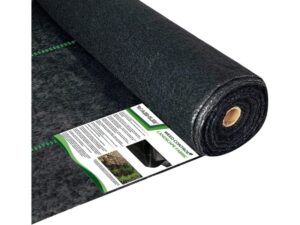 | WAENLIR 5.8oz 5FT x 250FT Heavy Duty Weed Barrier Landscape Fabric | Check Price |
Third Choice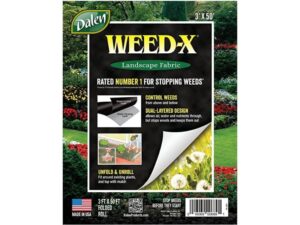 | Dalen Weed-X Landscape Fabric 3FT x 50FT WS20-50F | Check Price |
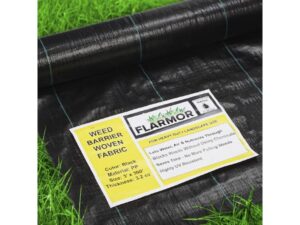 | FLARMOR 3FT x 300FT 3.2oz Heavy Duty Landscape Fabric | Check Price |
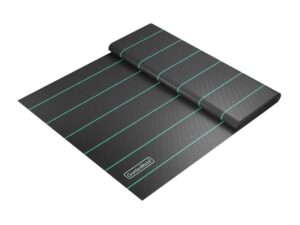 | GardenMate 6 x 33 Feet 3oz Woven Weed Control Fabric | Check Price |
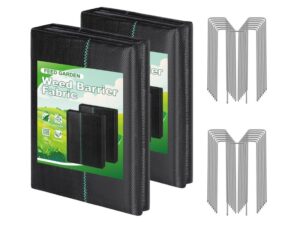 | FEED GARDEN 4FT x 100FT 3.2oz Weed Barrier Landscape Fabric | Check Price |
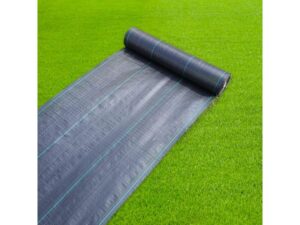 | GDNaid 4FT x 100FT 3.2oz Heavy Duty Weed Barrier Landscape Fabric | Check Price |
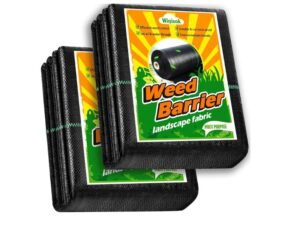 | Winisok 3FT x 100FT 3.2oz Weed Barrier Landscape Fabric | Check Price |
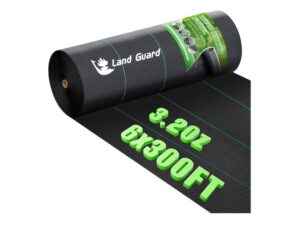 | Land Guard 4FT x 300FT Heavy Duty Weed Barrier Fabric | Check Price |
 | Pattiumo 3FT x 300FT 3.2oz Heavy Duty Weed Barrier Landscape Fabric | Check Price |
1. LAVEVE 4FT x 100FT 3.2oz Heavy Duty Weed Barrier Landscape Fabric- Best Overall
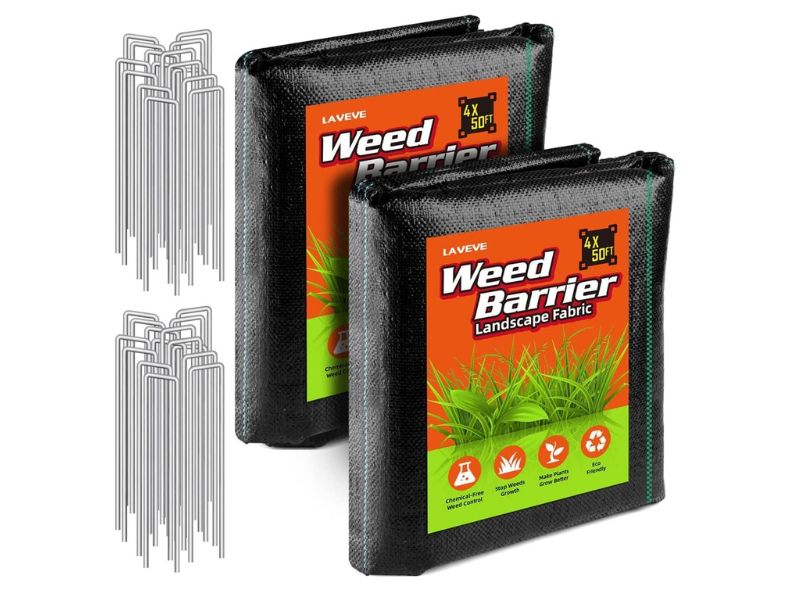
| Specification | LAVEVE |
| Material | Woven polypropylene |
| Fabric Weight | 3.2 oz. |
| Size | 4 × 100 ft |
| Coverage | 400 sq. ft. |
| Water Permeable | Yes |
| UV Resistant | Yes |
| Guide Lines | Yes |
| Best Use | General landscaping |
The LAVEVE 4FT x 100FT landscape fabric is my best overall pick because it balances the characteristics most homeowners actually need rather than maximizing one specification at the expense of everything else.
It uses 3.2-ounce woven polypropylene and provides 400 square feet of coverage. The cross-woven structure is designed to reduce sunlight reaching the soil while still allowing water and air permeability. Green alignment lines make it easier to cut straight sections and arrange planting rows.
I like 3.2-ounce woven fabric for ordinary residential landscaping because it remains manageable with scissors or a utility knife while offering noticeably more durability than extremely light weed cloth.
LAVEVE is particularly practical beneath mulch, decorative stone, garden paths, shrub borders, flower beds, and similar areas that are not constantly being replanted.
Current Amazon-market tracking has the exact B09VGL18TV listing at roughly 4.3–4.4 stars with well over 2,000 ratings and strong ongoing sales, which gives this product a much broader ownership history than many generic landscape fabrics.
The permeability is important.
Weed fabric should suppress light without behaving like a waterproof tarp. Plants still depend on rainfall, irrigation, oxygen, and soil-gas exchange beneath the barrier.
This is why I prefer woven landscape fabric to solid polyethylene sheeting around established landscape plants.
The main limitation is that 3.2 ounces is not contractor-grade thickness. If you plan to install sharp aggregate or expect heavy foot and vehicle traffic, a 5- to 6-ounce product can offer more puncture resistance.
For the average homeowner who needs one fabric for several landscaping jobs, though, LAVEVE offers the best combination of coverage, weed suppression, permeability, installation ease, and value.
Best for: Flower beds, shrub borders, paths, mulch, decorative rock, and general residential landscaping.
Main limitation: Not as thick as premium 5.8-ounce barriers.
2. WAENLIR 5.8oz 5FT x 250FT Heavy Duty Weed Barrier Landscape Fabric- Best Heavy-Duty
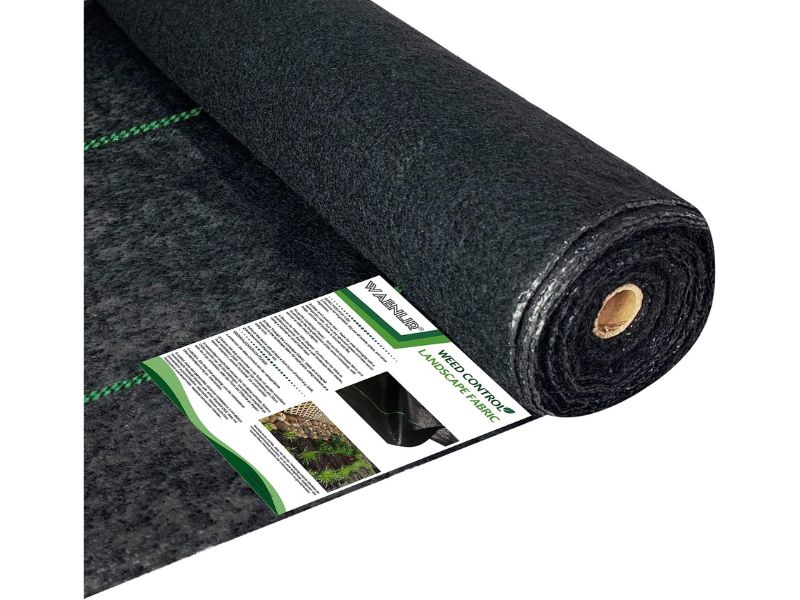
| Specification | WAENLIR |
| Material | Woven polypropylene |
| Weight | 5.8 oz. |
| Size | 5 × 250 ft |
| Coverage | 1,250 sq. ft. |
| Construction | Woven + needle-punched |
| UV Stabilized | Yes |
| Light Blocking | Approx. 98.7% claimed |
| Best Use | Heavy-duty landscaping |
If maximum weed-blocking density and physical durability are higher priorities, the WAENLIR 5.8oz fabric moves ahead of lightweight residential materials.
The 5-by-250-foot roll covers approximately 1,250 square feet, making it appropriate for large garden beds, landscaping projects, greenhouse floors, paths, and areas where installing the fabric once is preferable to repeatedly replacing thin material.
WAENLIR describes the material as 5.8-ounce tightly woven polypropylene with needle punching and UV stabilization. The product specification also claims approximately 98.7% opacity while maintaining sufficient permeability for watering through the fabric.
The higher weight provides two practical advantages.
First, it creates a more substantial physical layer over the soil, making it difficult for emerging weeds to push against the fabric.
Second, thicker fabric generally handles installation abuse better.
When you are moving wheelbarrows, spreading bark, kneeling on the material, cutting planting holes, or laying stone, puncture and tear resistance matter.
That does not mean 5.8-ounce fabric is automatically better everywhere.
A heavier weave can be more cumbersome to cut around complicated perennial beds, and you should always confirm that irrigation penetrates adequately after installation.
I would use WAENLIR primarily in stable landscaping—areas containing shrubs, trees, ornamental grasses, or long-term ground cover where I do not expect to dig and replant every season.
Best for: Permanent beds, large landscapes, high-traffic areas, greenhouse floors, and buyers prioritizing thickness.
Main limitation: More material and weight than small flower beds require.
3. Dalen Weed-X Landscape Fabric 3FT x 50FT WS20-50F- Best Premium Weed Barrier
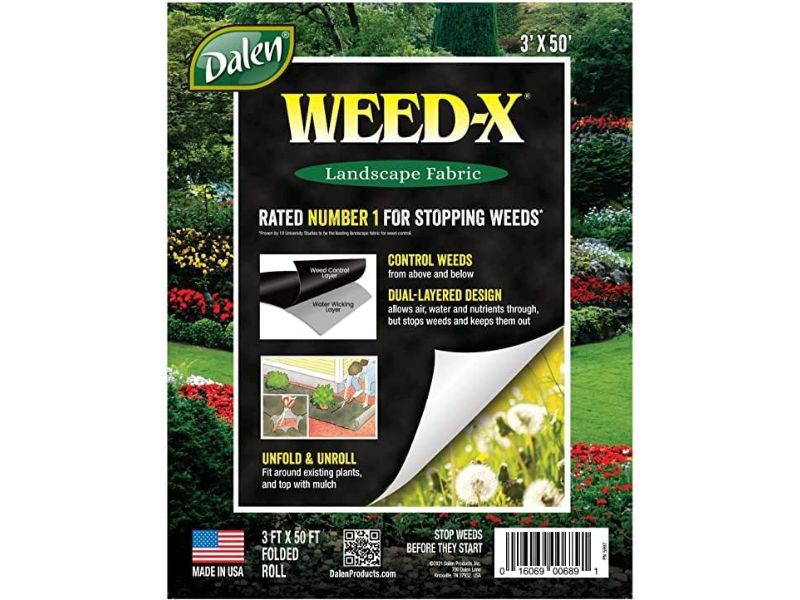
| Specification | Dalen Weed-X |
| Model | WS20-50F |
| Size | 3 × 50 ft |
| Coverage | 150 sq. ft. |
| Construction | Dual-layer porous fabric |
| Water Permeable | Yes |
| Weed Protection | 20-year manufacturer claim |
| Made In | USA |
| Best Use | Permanent ornamental beds |
The Dalen Weed-X takes a different approach from conventional single-layer woven polypropylene.
Dalen uses a dual-layer porous design intended to block light and weeds while allowing water, air, and nutrients to penetrate.
The 3-by-50-foot version provides 150 square feet, making it a good size for a residential foundation bed or ornamental planting rather than a huge commercial project.
Dalen says Weed-X has been evaluated in multiple university studies, and Home Depot currently describes the product as made in the USA and backed by a 20-year weed-control guarantee.
What I like most is the focus on permeability.
Weed prevention is easy if you simply cover soil with an impermeable plastic sheet.
The difficult part is blocking weeds without degrading the growing environment around desirable plants.
The Weed-X structure is intended to continue allowing moisture, oxygen, and nutrient movement toward the soil.
Its shorter roll is also convenient for homeowners.
You are not paying for 1,000+ square feet when the landscaping around your house only needs 100–200 square feet.
I would use it around established hydrangeas, roses, boxwoods, foundation shrubs, ornamental grasses, and similar permanent plantings.
I would be less enthusiastic about using any long-life synthetic fabric in a perennial bed that I constantly divide and redesign.
Best for: Premium ornamental beds, smaller landscaping jobs, shrubs, and homeowners wanting U.S.-made landscape fabric.
Main limitation: Higher cost per square foot than bulk woven rolls.
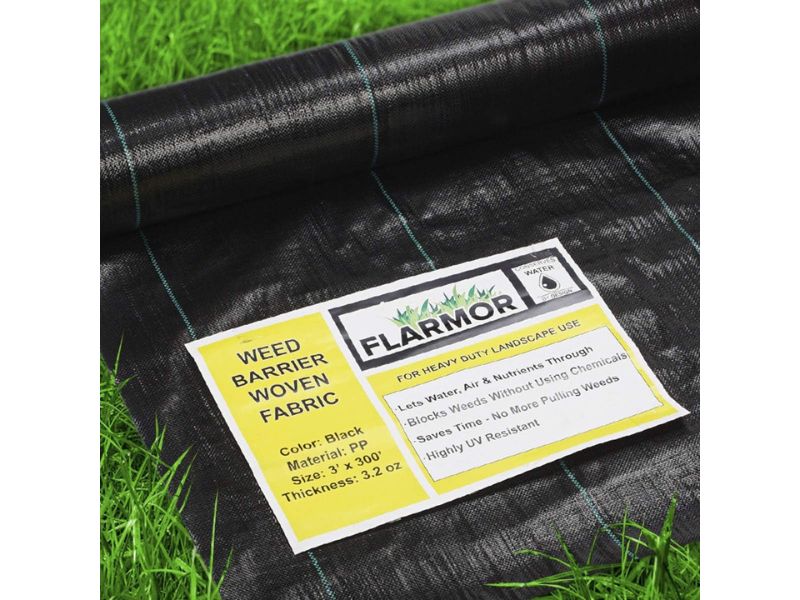
4. FLARMOR 3FT x 300FT 3.2oz Heavy Duty Landscape Fabric- Best for Long Garden Rows
| Specification | FLARMOR |
| Weight | 3.2 oz. |
| Size | 3 × 300 ft |
| Coverage | 900 sq. ft. |
| Primary Function | Weed suppression |
| Best Shape | Long/narrow areas |
| Best Use | Rows, paths, borders |
The FLARMOR 3FT x 300FT roll is useful when your landscaping is long rather than wide.
At three feet wide and 300 feet long, the roll provides approximately 900 square feet while minimizing cross-seams in garden rows, narrow borders, paths, and long foundation plantings.
The Amazon-linked configuration is a 3.2-ounce landscape fabric, and the exact B079VS73L3 listing has accumulated more than 2,000 customer ratings.
A 300-foot continuous roll can dramatically reduce the number of seams in a large installation.
That matters because seams are natural weak points.
If you install several small pieces edge to edge, aggressive weeds can exploit tiny openings.
Using longer sections and generous overlap produces a cleaner barrier.
FLARMOR has also marketed its products around WeedStop technology and chemical-free physical weed control.
At 3.2 ounces, it remains reasonably easy to cut.
I would use a sharp utility knife or scissors, secure the fabric with landscape staples, and immediately cover it with the intended mulch or stone.
Do not leave landscape fabric exposed unnecessarily.
UV exposure and physical disturbance shorten the useful life of many polypropylene materials.
Best for: Long borders, pathways, garden rows, large narrow beds, and projects where minimizing seams matters.
Main limitation: Three-foot width requires multiple strips on broad landscape areas.
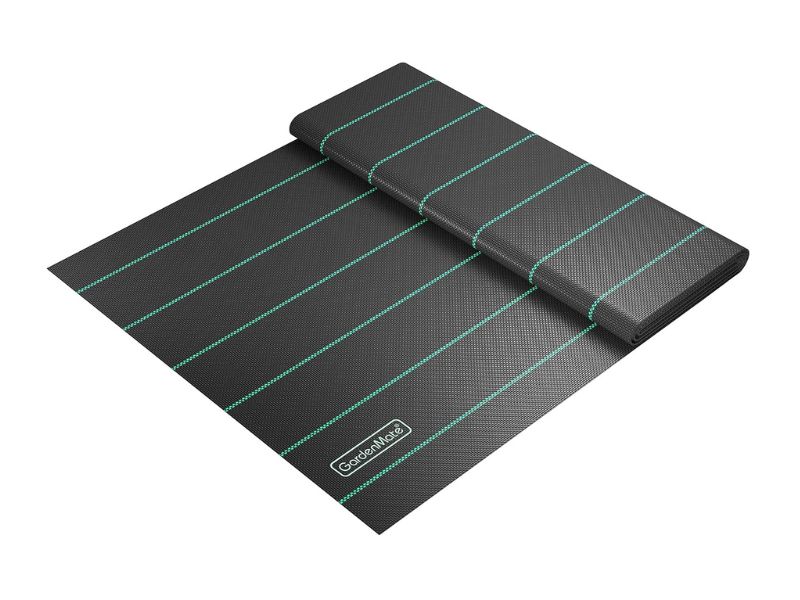
5. GardenMate 6 x 33 Feet 3oz Woven Weed Control Fabric- Best UV-Stabilized Pick
| Specification | GardenMate |
| Material | Woven polypropylene |
| Weight | 3 oz/yd² |
| Size | 6 × 33 ft |
| Coverage | Approx. 198 sq. ft. |
| UV Stabilized | Yes |
| Water Permeable | Yes |
| Best Use | Broad residential beds |
The GardenMate woven weed-control fabric is an interesting alternative for homeowners who want a wider sheet without buying hundreds of feet of material.
It measures approximately 6 feet by 33 feet and uses heavy-duty 3 oz/yd² woven polypropylene.
GardenMate specifically describes the material as UV stabilized, breathable, and water permeable, and lists applications including flower beds, pathways, drives, decking, and landscaping.
The six-foot width is the main selling point.
Imagine a five-foot-wide landscape bed running along your house.
A three-foot roll forces you to install two parallel strips and create a long overlap.
A six-foot sheet may cover the entire width in one section.
Fewer seams mean fewer potential openings for weeds and faster installation.
The fabric is also relatively lightweight, which makes it easier to position around existing shrubs than a huge contractor roll.
GardenMate notes that initial water penetration may become more consistent after the fabric has been thoroughly wetted several times.
That is useful practical information because some new woven polypropylene fabrics exhibit surface tension that temporarily makes water bead before the material becomes fully wetted.
Best for: Wide flower beds, landscape borders, under decking, and buyers wanting a manageable UV-stabilized sheet.
Main limitation: Smaller total coverage than long professional rolls.
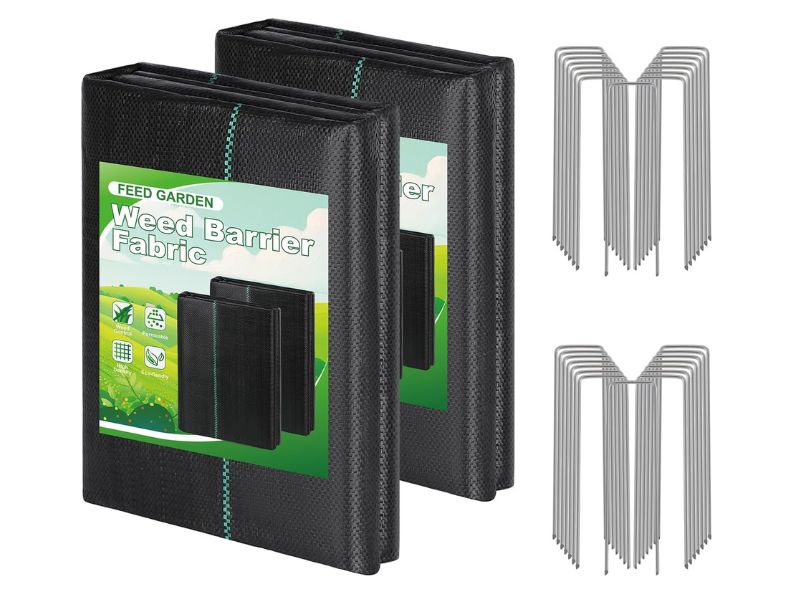
6. FEED GARDEN 4FT x 100FT 3.2oz Weed Barrier Landscape Fabric with Stakes- Best Complete Installation Kit
| Specification | FEED GARDEN |
| Size | 4 × 100 ft |
| Weight | 3.2 oz. |
| Coverage | 400 sq. ft. |
| Stakes Included | Yes |
| Water Permeable | Yes |
| Best Use | DIY installation |
The FEED GARDEN 4FT x 100FT landscape fabric is particularly convenient for first-time installation because the current configuration includes U-shaped securing stakes.
The fabric uses a 3.2-ounce ground-cover construction and covers approximately 400 square feet.
Recent Amazon-market tracking shows the exact B0DPFM4J6S product maintaining roughly a 4.3–4.4-star rating with hundreds of reviews and several thousand estimated monthly sales.
Including stakes may sound unimportant, but correct fastening determines how pleasant the rest of the job will be.
Unsecured landscape fabric shifts while you walk on it.
Wind gets underneath it.
Mulch pushes wrinkles across the surface.
Planting holes stop lining up.
Properly placed landscape staples keep edges, seams, and planting cuts flat until the final ground cover is installed.
The four-foot width is also versatile enough for common garden beds without creating an excessively heavy roll.
This is the one I would consider for a homeowner who wants to order everything needed for a straightforward weed-barrier installation without sourcing pins separately.
Best for: First-time DIY projects, flower beds, pathways, shrub borders, and general landscaping.
Main limitation: Included stakes may not be sufficient for every soil type or complicated installation.
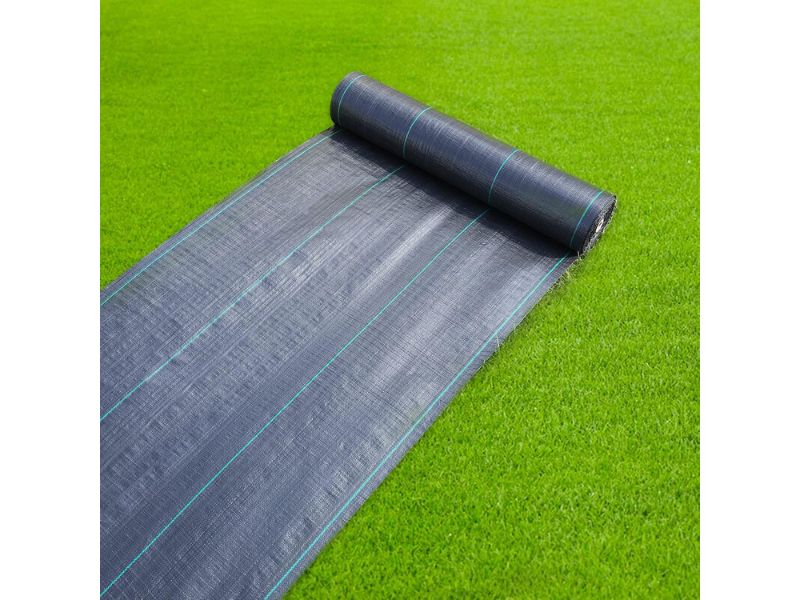
7. GDNaid 4FT x 100FT 3.2oz Heavy Duty Weed Barrier Landscape Fabric- Best Budget Pick
| Specification | GDNaid |
| Model | JHY34100 |
| Material | Polypropylene |
| Weight | 3.2 oz. |
| Size | 4 × 100 ft |
| Coverage | 400 sq. ft. |
| Water Permeable | Yes |
| Best Use | Budget landscaping |
The GDNaid 4FT x 100FT weed barrier is another 3.2-ounce woven product, but its value is its combination of established Amazon history, useful dimensions, and competitive pricing.
The exact B084YVN45L configuration covers 400 square feet and uses polypropylene woven fabric designed to remain permeable to water and nutrients.
Current product data shows well over 1,000 owner ratings associated with this exact ASIN.
The woven construction gives it enough strength for routine garden installation while keeping it easy to cut.
I particularly like this weight beneath bark mulch.
The mulch layer itself provides substantial light suppression, while the woven fabric acts as an additional barrier between weeds and the surface.
For extremely aggressive perennial weeds, however, prepare the bed first.
Landscape fabric should never be considered a shortcut for covering mature quackgrass, bindweed, nutsedge, or other persistent plants and expecting them to disappear permanently.
OSU Extension specifically notes that some perennial weeds and grass rhizomes can eventually exploit landscape fabric or its openings.
Best for: Budget flower beds, mulch installations, normal residential landscapes, and moderate-size projects.
Main limitation: Less puncture resistance than premium 5+ ounce fabric.
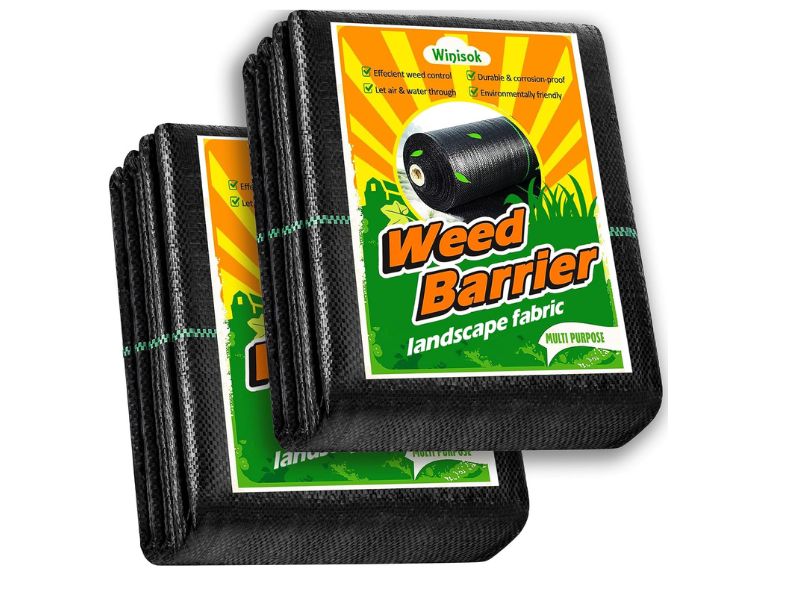
8. Winisok 3FT x 100FT 3.2oz Weed Barrier Landscape Fabric- Best for Mulch Beds
| Specification | Winisok |
| Material | Woven geotextile fabric |
| Weight | 3.2 oz. |
| Size | 3 × 100 ft |
| Coverage | 300 sq. ft. |
| Primary Use | Weed control |
| Best For | Mulch beds |
The Winisok 3FT x 100FT weed barrier is a convenient size for narrow mulched beds and landscape strips.
It provides 300 square feet and uses 3.2-ounce woven geotextile-style fabric intended to remain breathable beneath mulch or other ground coverings.
The exact Amazon ASIN currently has around a 4.5-star rating from more than 700 reviews according to Amazon-market tracking.
Three feet works especially well for landscaping along a fence, sidewalk, porch, or driveway.
You can often lay one continuous strip without trimming much excess material.
I would install it only after removing existing weeds and smoothing the soil.
Then secure the barrier and apply the mulch immediately.
For an organic mulch such as wood chips or shredded bark, expect new weed seeds eventually to germinate above the fabric as the mulch decomposes.
That is not necessarily fabric failure.
OSU Extension explains that landscape fabric blocks many weeds below it, while weed seeds can still establish in the organic material accumulating on top.
Best for: Narrow mulch beds, fence lines, foundation borders, and straightforward residential landscaping.
Main limitation: Narrow width is inefficient for large open areas.
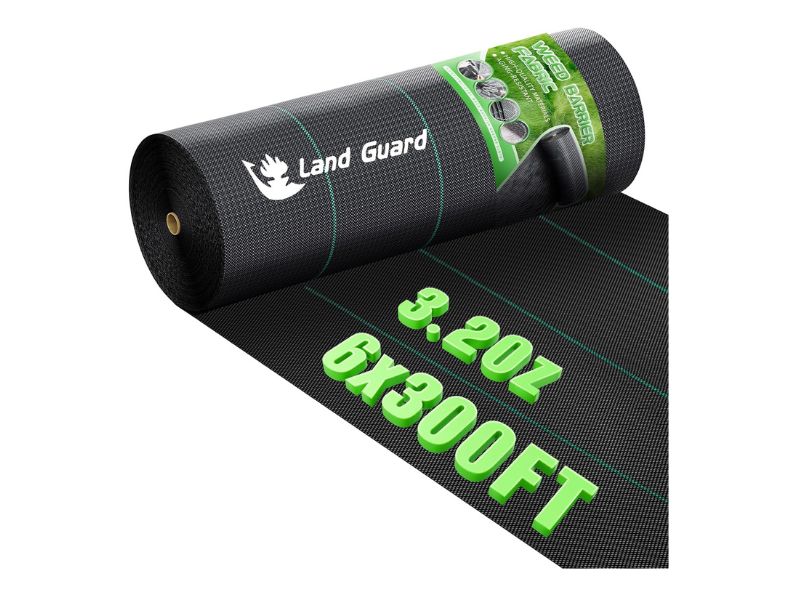
9. Land Guard 4FT x 300FT Heavy Duty Weed Barrier Fabric- Best for Large Landscaping Projects
| Specification | Land Guard |
| Size | 4 × 300 ft |
| Coverage | 1,200 sq. ft. |
| Material | Woven fabric |
| Water Permeable | Yes |
| Guide Lines | Yes |
| Best Use | Large areas |
The Land Guard 4FT x 300FT roll is the product I would consider when total square footage becomes the main concern.
At four feet wide and 300 feet long, it covers approximately 1,200 square feet from a single roll.
Current Amazon-market data associates B0BG8Z9ZZW with roughly 700+ ratings and a 4.3-star average.
Large rolls offer an underrated benefit: fewer seams.
If you are landscaping around an entire house, covering greenhouse aisles, or constructing several large beds, buying six small rolls increases waste and overlap.
One long roll allows you to cut sections based on the actual landscape dimensions.
The woven fabric is designed to let air and water pass through while reducing the sunlight necessary for weed germination. Current reviews of the product also emphasize its value for extensive residential landscaping.
I would not choose it purely because of size if the job involves extreme puncture loads.
A thicker professional geotextile remains a better option beneath sharp aggregate or heavily trafficked surfaces.
For ordinary soil-and-mulch landscapes, however, the coverage is compelling.
Best for: Large yards, multiple beds, greenhouse aisles, long rows, and cost-conscious bulk installations.
Main limitation: Large rolls are harder for one person to handle and position.
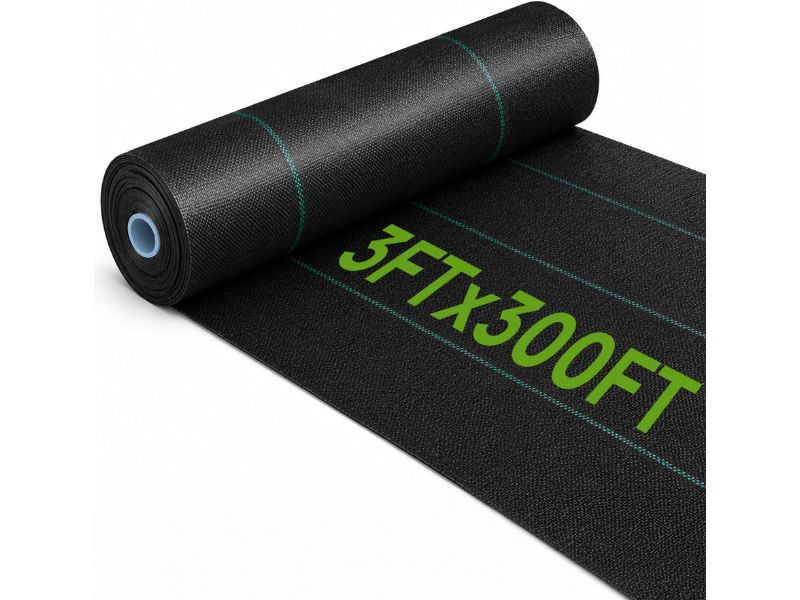
10. Pattiumo 3FT x 300FT 3.2oz Heavy Duty Weed Barrier Landscape Fabric- Best 300-Foot Narrow Roll
| Specification | Pattiumo |
| Material | Woven polypropylene |
| Weight | 3.2 oz. |
| Size | 3 × 300 ft |
| Coverage | 900 sq. ft. |
| Guide Lines | Yes |
| Water/Air Permeable | Yes |
| Best Use | Long garden layouts |
The Pattiumo 3FT x 300FT product finishes the list as another strong choice for long narrow projects.
It uses 3.2-ounce high-density woven polypropylene, covers approximately 900 square feet, and includes guide lines that make cutting and planting alignment easier.
Current Amazon-market data shows roughly 500+ ratings with an average around 4.4 stars on the exact B0CQR6852X ASIN.
Pattiumo markets the material for landscaping, gardens, agriculture, gravel underlayment, and driveways, although I view this particular 3.2-ounce fabric mainly as a landscaping and light underlayment product rather than a true structural driveway geotextile.
For long shrub borders, garden rows, and pathways, it makes far more sense.
The material’s green guide lines also help when cutting repeated plant openings at predictable intervals.
That is useful in nursery rows, vegetable production, berry rows, or formal landscape installations where spacing matters.
Best for: Long garden rows, narrow landscapes, repeated planting layouts, and large linear projects.
Main limitation: Large roll length can be unnecessary for a small suburban bed.
Landscape Fabric Comparison
| Product | Weight / Construction | Size | Coverage | Best For |
| LAVEVE | 3.2 oz woven | 4 × 100 ft | 400 sq. ft. | Best overall |
| WAENLIR | 5.8 oz woven/needle-punched | 5 × 250 ft | 1,250 sq. ft. | Heavy-duty |
| Dalen Weed-X | Dual layer | 3 × 50 ft | 150 sq. ft. | Premium beds |
| FLARMOR | 3.2 oz | 3 × 300 ft | 900 sq. ft. | Long rows |
| GardenMate | 3 oz woven | 6 × 33 ft | 198 sq. ft. | Wide beds |
| FEED GARDEN | 3.2 oz | 4 × 100 ft | 400 sq. ft. | Installation kit |
| GDNaid | 3.2 oz woven | 4 × 100 ft | 400 sq. ft. | Budget value |
| Winisok | 3.2 oz woven | 3 × 100 ft | 300 sq. ft. | Mulch beds |
| Land Guard | Woven | 4 × 300 ft | 1,200 sq. ft. | Large projects |
| Pattiumo | 3.2 oz woven | 3 × 300 ft | 900 sq. ft. | Long projects |
What Is Landscape Fabric?
Landscape fabric is a permeable sheet installed over prepared soil to reduce weed emergence while allowing varying degrees of water and air movement.
Most modern products use polypropylene or polyester.
The two broad categories you will commonly encounter are woven and nonwoven fabrics.
Woven material looks somewhat like tightly interlaced plastic fibers. It usually provides good tensile strength and durability.
Nonwoven material resembles dense felt and often provides excellent filtration and uniform water movement.
Some premium products combine both structures or use needle punching to improve permeability.
How Landscape Fabric Prevents Weeds
Landscape fabric primarily works by blocking sunlight.
Weed seeds already present in soil may germinate, but without enough light their emerging shoots cannot develop normally.
The fabric also creates a physical barrier between the plant and the surface.
This is why opacity matters.
A thin fabric that allows substantial light penetration will generally suppress weeds less effectively than a dense black material.
However, weed fabric does not sterilize soil.
Perennial plants with large underground energy reserves may continue pushing against the barrier or emerge through seams and planting holes.
Does Landscape Fabric Actually Stop Weeds?
It suppresses weeds effectively, but it does not permanently eliminate them.
This distinction is crucial.
Oregon State University Extension notes that geotextile fabric is effective against weeds germinating below the material, but weeds may later germinate in decomposing mulch sitting above the fabric. Grass rhizomes and some perennial weeds can also exploit the material or its openings.
Penn State similarly notes that weed roots can eventually penetrate landscape fabric from the mulch layer above, creating maintenance problems in permanent ornamental landscapes.
So think of fabric as a weed-pressure reduction system, not permanent zero-maintenance landscaping.
Woven vs. Nonwoven Landscape Fabric
Woven Landscape Fabric
For most weed-control installations, woven polypropylene is my default recommendation.
Its advantages include good tensile strength, light blocking, durability, and manageable weight.
Woven fabric works particularly well under:
mulch, decorative stone, pathways, greenhouse aisles, shrub borders, and established ornamental beds.
Its biggest weakness is that cut edges can fray.
Using a sharp blade and making deliberate planting cuts helps.
Nonwoven Landscape Fabric
Nonwoven geotextile is often better for applications where filtration and drainage are particularly important.
Heavy nonwoven material is commonly used in:
French drains,
retaining walls,
erosion-control systems,
drainage stone,
and other construction applications.
For simple weed prevention, however, you usually do not need an 8-ounce drainage geotextile.
Match the material to the job.
Is Thicker Landscape Fabric Better for Weed Control?
Usually, a heavier fabric provides greater opacity, puncture resistance, and durability.
But thicker is not automatically better around plants.
The fabric still needs appropriate permeability.
For ordinary residential landscaping, 3–3.5 ounces is a useful balance between durability and handling.
For permanent beds, high traffic, or more demanding installations, 5–6 ounces provides additional toughness.
This is why the 5.8-ounce WAENLIR is my heavy-duty choice, while the lighter LAVEVE is the more balanced general-purpose option.
Landscape Fabric vs. Plastic Weed Barrier
I generally prefer permeable landscape fabric around living landscape plants.
Solid black plastic also blocks light, but it restricts normal water and gas movement.
Oregon State Extension specifically distinguishes landscape fabric from plastic because quality fabric allows air and water to pass through to the soil.
Solid plastic can be appropriate for specialized applications, but it is not my default under shrubs and ornamental beds.
Should Landscape Fabric Go Under Mulch?
It can.
Landscape fabric beneath mulch creates two different weed-suppression mechanisms:
The fabric blocks weeds from the soil.
The mulch blocks additional sunlight and protects the material.
For organic mulch, I normally want roughly 2–3 inches over the fabric.
Penn State recommends approximately 2–4 inches of organic mulch in landscape plantings and warns against excessively thick applications.
Do not pile mulch against trunks or plant crowns.
Should Landscape Fabric Go Under Gravel?
Landscape fabric is particularly useful beneath gravel and decorative rock, where soil separation becomes important in addition to weed prevention.
The barrier helps prevent stone from gradually mixing into underlying soil.
For light decorative gravel, standard woven fabric can work well.
For vehicle driveways, however, I prefer a dedicated geotextile stabilization fabric engineered for soil separation and structural loads rather than normal garden weed cloth.
Where Landscape Fabric Works Best
I get the most value from landscape fabric in stable, low-disturbance areas.
Examples include established shrub borders, rock beds, foundation landscaping, paths, greenhouse aisles, under decking, and long-term ornamental installations.
These are places where the fabric can remain largely untouched.
The less you cut and disturb the barrier, the better it performs.
Where I Would Avoid Permanent Landscape Fabric
A synthetic barrier becomes inconvenient when the garden changes every season.
I would think carefully before using long-life fabric throughout an intensively managed vegetable garden, annual flower bed, or perennial border where plants are constantly added, divided, transplanted, and removed.
Every new planting requires another hole.
Eventually, the sheet stops functioning as one continuous barrier.
Penn State has also documented the difficulty of removing old landscape fabric after roots and decomposed mulch become integrated with it.
For dynamic beds, organic mulch, cardboard, cultivation, and manual weed control may provide more flexibility.
Remove Existing Weeds Before Installation
Do not simply cover a mature weed infestation.
Start by removing as much existing vegetation as practical.
Pay special attention to perennial weeds with underground storage structures or rhizomes, including bindweed, quackgrass, Bermuda grass, nutsedge, and similar persistent species.
Landscape fabric is much better at preventing new seedlings than instantly killing a mature perennial root system.
OSU Extension specifically recommends controlling perennial weeds before mulching.
How to Install Landscape Fabric Correctly
Prepare the area first by removing weeds, debris, sticks, sharp rocks, and unnecessary surface vegetation.
Rake the soil reasonably smooth.
Unroll the fabric without excessive tension.
Overlap adjacent pieces rather than placing them perfectly edge to edge.
Secure the seams and perimeter with landscape staples.
For plants, make the smallest practical opening that provides adequate clearance.
Do not tightly wrap fabric against trunks, stems, or crowns.
Once installation is complete, apply the intended mulch or stone.
Correct installation usually matters more than whether one brand claims a few percent greater weed blocking.
How Much Should Landscape Fabric Overlap?
For ordinary residential landscapes, approximately 6–12 inches is a practical overlap.
Use more where aggressive perennial weeds are a concern or where sections may shift.
Pay particular attention to corners, curves, and slopes.
A one-inch open seam can undo the benefit of an expensive weed barrier by giving persistent growth a route to the surface.
How Many Landscape Staples Do You Need?
Staple spacing depends on soil, wind exposure, slopes, fabric weight, and layout.
Use staples more frequently along:
edges,
seams,
corners,
planting openings,
and slopes.
On calm flat ground, mulch eventually provides much of the holding force.
During installation, however, insufficient pinning makes fabric extremely frustrating to work with.
Does Water Pass Through Landscape Fabric?
It should.
Quality weed-control fabric is designed to be permeable.
Some woven materials initially allow water through more slowly, especially before they are fully wetted.
GardenMate specifically notes that permeability can improve after repeated watering.
If you are installing fabric around valuable plants, test a sample before covering hundreds of square feet.
Pour water over it and verify that infiltration is reasonable.
Can Landscape Fabric Hurt Plants?
It can create problems when poorly selected or left in place indefinitely without maintenance.
Penn State notes that roots can sometimes concentrate near the moist interface directly beneath landscape fabric and may later be vulnerable when that zone dries.
Another problem develops when mulch decomposes above the fabric.
New weeds root into that organic layer and sometimes penetrate the material, making removal difficult.
These are reasons to use landscape fabric selectively rather than treating it as mandatory under every planting.
Landscape Fabric and Soil Health
A permeable fabric does not completely isolate soil from the atmosphere.
Water and oxygen can still move through quality products.
However, synthetic fabric also prevents organic mulch from integrating with the soil as naturally as it would without a barrier.
If your priority is continuous soil-building and organic matter incorporation, direct wood-chip mulching may be preferable.
If your priority is reducing maintenance in a permanent ornamental landscape, fabric can make more sense.
How Long Does Landscape Fabric Last?
Lifespan varies enormously.
The biggest factors include fabric weight, polypropylene quality, UV stabilization, installation depth, foot traffic, sharp aggregate, soil movement, and whether the material stays covered.
A premium product may function for many years when properly buried.
An inexpensive lightweight sheet exposed to sunlight can deteriorate much sooner.
Never assume a warranty number guarantees that the landscape will remain weed-free for the full period.
Weeds from above remain possible regardless of fabric lifespan.
Frequently Asked Questions
What is the best landscape fabric to prevent weeds?
LAVEVE 4FT x 100FT 3.2oz is my best overall choice for most homeowners.
Its woven polypropylene structure provides a useful combination of light blocking, permeability, durability, manageable weight, and 400-square-foot coverage. It also has an established Amazon sales and review history.
What is the strongest landscape fabric for weeds?
WAENLIR 5.8oz is the heaviest weed-control fabric among my ten recommendations.
Its woven, needle-punched polypropylene construction is designed for stronger physical durability and high opacity while remaining water permeable.
Is 3.2 oz landscape fabric good?
Yes, 3.2-ounce woven polypropylene is a good general-purpose weight for residential landscaping.
It offers better durability than ultra-light cloth while remaining easy enough to cut around beds, shrubs, and paths.
For heavy traffic or sharp aggregate, consider something thicker.
Is 5.8 oz landscape fabric better?
It is generally tougher, but you do not necessarily need it for every garden.
A heavy 5.8-ounce barrier provides better puncture resistance and opacity, but it costs more and can be harder to shape.
Use it when durability justifies the extra material.
Does landscape fabric stop weeds permanently?
No. Landscape fabric suppresses weeds; it does not permanently eliminate them.
Weed seeds can eventually germinate in soil and decomposed mulch accumulating above the fabric.
Can weeds grow through landscape fabric?
Yes, especially aggressive perennial weeds or plants exploiting seams and openings.
Quality fabric greatly reduces weed pressure, but correct site preparation and maintenance are still necessary.
What should I put on top of landscape fabric?
Mulch, bark, wood chips, gravel, or decorative stone can cover landscape fabric depending on the project.
Covering the barrier improves appearance and protects synthetic material from unnecessary UV exposure.
Is landscape fabric better than plastic?
For planted landscapes, permeable fabric is generally preferable because it allows air and water exchange.
Solid plastic can restrict both processes.
Should you put landscape fabric around trees?
Use caution and leave adequate clearance around trunks and root flares.
Never wrap fabric tightly against a growing tree.
Also avoid piling mulch against the trunk.
Is landscape fabric good for flower beds?
It works best in flower beds containing relatively permanent plants.
If you replace annuals or divide perennials constantly, repeated cutting can make the fabric inconvenient.
Can I use landscape fabric in a vegetable garden?
You can, particularly between rows, but permanent fabric is not ideal for every vegetable-growing system.
Penn State notes that landscape fabric can be used between crop rows and reused across seasons.
For intensively cultivated soil, removable seasonal fabric is usually more practical.
Does landscape fabric let rain through?
Quality permeable fabric should allow rain and irrigation water to reach the soil.
Woven and needle-punched designs are specifically engineered to provide some level of infiltration.
Do you need to remove grass before laying landscape fabric?
Yes, removing sod and established weeds produces a much better installation.
Decomposing turf can create unevenness underneath, while strong perennial weeds may continue attempting to grow through openings.
Can landscape fabric go directly over weeds?
I do not recommend simply covering a mature weed infestation.
Remove existing weeds first whenever practical, particularly perennial species with rhizomes or deep root systems.
Is landscape fabric good under rock?
Yes, rock beds are one of the most practical uses for landscape fabric.
Besides weed suppression, fabric helps keep decorative rock separated from the soil.
Which landscape fabric is best for a large area?
Land Guard 4FT x 300FT is my large-area choice among these ten products.
One roll covers approximately 1,200 square feet, reducing the number of seams required across a large landscaping project.
Which Landscape Fabric Should You Buy?
Choose LAVEVE 4FT x 100FT if you want the best general-purpose combination of price, coverage, permeability, durability, and established Amazon popularity.
Choose WAENLIR 5.8oz when physical durability and long-term weed suppression matter more than keeping the fabric lightweight.
Choose Dalen Weed-X for a premium residential ornamental bed where a dual-layer, U.S.-made product is more appealing than a large generic woven roll.
Choose FLARMOR for long narrow garden areas, and choose GardenMate when a broad six-foot sheet can reduce seams.
FEED GARDEN is especially convenient for a first DIY installation because the kit includes securing stakes.
GDNaid provides strong value for standard landscaping, while Winisok is particularly convenient for narrow mulch beds.
Choose Land Guard when total coverage is the priority, and choose Pattiumo for long planting rows or linear landscape installations.
Final Verdict
For most homeowners, the LAVEVE 4FT x 100FT 3.2oz Heavy Duty Weed Barrier is the best landscape fabric to prevent weeds because it balances the factors that matter in real landscaping: light blocking, woven polypropylene strength, water permeability, air movement, installation ease, coverage, and cost.
The WAENLIR 5.8oz fabric is the better choice when you need significantly more thickness and puncture resistance, while Dalen Weed-X stands out for smaller premium installations and its dual-layer design.
For large landscaping projects, Land Guard and Pattiumo provide much greater continuous coverage, reducing the number of seams and separate rolls required.
Whichever product you choose, remember that no landscape fabric can replace good weed management and site preparation. Remove established weeds first, overlap seams properly, secure the material with quality landscape staples, protect it with mulch or stone, and control weeds that later germinate above the barrier.
Used in the right location, landscape fabric can dramatically reduce weed pressure. Used as a permanent answer to every weed problem, it eventually creates its own maintenance issues. The best results come from matching the fabric weight, permeability, material construction, and roll size to the specific landscape rather than simply buying the thickest product available.

I’m Maya L. Greenwood, a lifelong plant lover who believes anyone can grow something beautiful with the right guidance. After years of testing soil mixes, pruning methods, irrigation tricks, and pest-safe solutions, I started EasyGardenTips.com to turn hard-won lessons into step-by-step advice. From seed starting and container gardens to composting and seasonal checklists, my goal is to make gardening simple, sustainable, and fun.