3 Best LED Lights for Grow Room Setups That Need Real Coverage
The best LED lights for grow room setups should do more than produce a bright center hotspot. A serious fixture needs enough PPF, good PPFD uniformity, efficient photon production, useful dimming, reliable thermal management, and a footprint that actually matches the canopy.
For larger indoor rooms, I would prioritize system PPE, total photon output, bar or diode distribution, driver placement, dimming range, electrical load, and environmental control. High wattage can be useful, but only when the room has enough canopy area, airflow, cooling, and plant demand to use it effectively.
My primary recommendation is the Spider Farmer SF7000 650W LED Grow Light. I would choose it for most serious 5×5 grow-room setups because the current listing combines 650W actual power, Samsung LM301B diodes, 2.8 µmol/J efficiency, approximately 1,786 µmol/s PPF, dimming, uniform-PPFD emphasis, and commercial 5×5 coverage.
I would choose the MARS HYDRO FC-E8000 800W LED Grow Light when maximum photon output is the priority. Its current listing specifies 800W input, 2.8 µmol/J system PPE, approximately 2,240 µmol/s PPF, Bridgelux 2835 diodes, Osram 660nm red supplementation, a foldable multi-bar design, and maximum 5×5 coverage.
For growers who want smart operation and multi-fixture scalability, I would choose the
Spider Farmer SE7000 730W LED Grow Light. The current 2026 listing specifies 730W actual power, approximately 2,146 µmol/s photon output, premium Bridgelux diodes, app control, dimming, daisy chaining, a detachable driver, and 5×5/vertical-rack positioning.
3 Best LED Lights for Grow Room Setups Reviewed
| Image | Product Name | Check Price |
|---|---|---|
Best Choice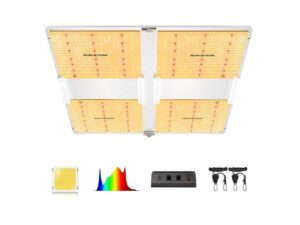 | https://www.amazon.com/dp/B08S7BLRMW?tag=rsl06-20 | Check Price |
Second Best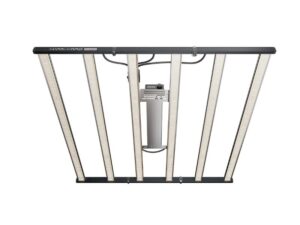 | MARS HYDRO FC-E8000 800W LED Grow Light | Check Price |
Third Choice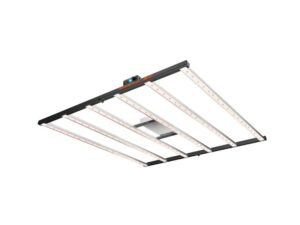 | Spider Farmer SE7000 730W LED Grow Light | Check Price |
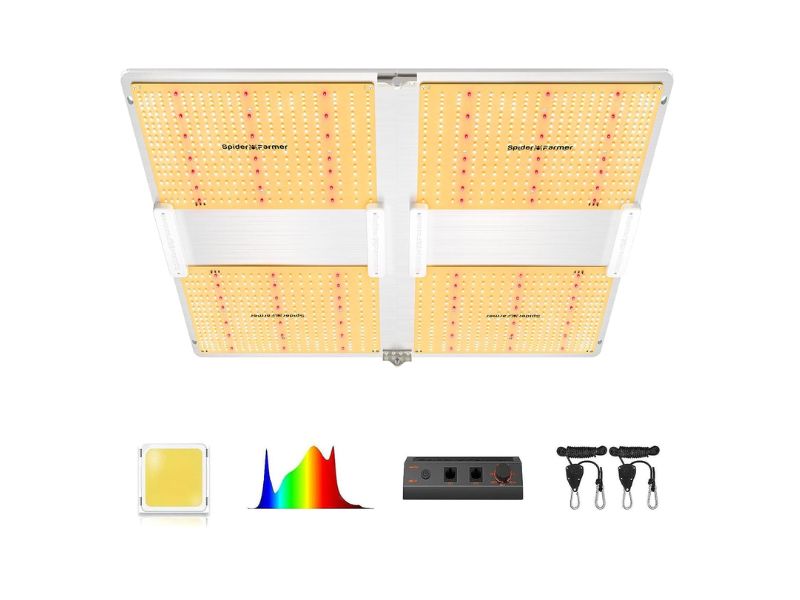
1. Spider Farmer SF7000 650W LED Grow Light
Key Features
- 650W actual power
- Samsung LM301B diodes
- 2.8 µmol/J photon efficiency
- Approximately 1,786 µmol/s PPF
- Full-spectrum output
- Dimmable
- Fanless operation
- Uniform-PPFD design emphasis
- Commercial 5×5 coverage
The Spider Farmer SF7000 is my primary recommendation because it provides a strong balance between photon output and electrical demand.
Its current Amazon listing specifies 650W wall draw, Samsung LM301B diodes, 2.8 µmol/J efficiency, approximately 1,786 µmol/s PPF, and commercial 5×5 coverage.
That combination makes it appropriate for a grow room containing:
- Tomatoes
- Peppers
- Cucumbers
- Large herbs
- Dense houseplant collections
- Hydroponic vegetables
- Other high-light mature canopies
The 650W class is particularly interesting because it provides serious photon capacity without automatically moving into the 800W range.
For a 5×5 area, the rough electrical density is:
650W ÷ 25 sq. ft. = 26W per square foot.
Watts per square foot should not replace PPFD data, but it gives useful scale.
The more important metric is the published 2.8 µmol/J efficiency.
PPE tells you how efficiently electrical energy becomes photosynthetically active photons.
For a grow room running many hours every day, that efficiency matters because it influences:
- Electricity use
- Heat production
- Cooling requirements
The SF7000 also publishes approximately 1,786 µmol/s PPF.
PPF describes the total photosynthetic photon output of the fixture.
That gives the SF7000 substantial capacity for a broad mature canopy without forcing the grower to use an 800W fixture.
Uniformity is another reason I like it.
A grow room should not be judged by the highest center PPFD reading.
What matters is how much of the canopy receives useful light.
Poor distribution can create:
- Overlit center plants
- Weak edge plants
- Uneven growth rates
- Different watering demand
- Different canopy heights
Spider Farmer specifically emphasizes uniform PPFD in the current SF7000 configuration.
Dimming is essential at this power level.
A 650W fixture should not be run at maximum simply because the dimmer can reach 100%.
Young plants intercept much less light than a mature canopy.
A more efficient progression is:
Early growth → lower output
Expanding canopy → moderate output
Mature high-light canopy → increase as needed
That can reduce electricity consumption and unnecessary heat early in the cycle.
The fanless design is also useful.
There are no fixture cooling fans adding noise or another moving component.
However, fanless does not mean heatless.
At full output, 650 watts still contributes substantial heat to the grow room.
You may need:
- Exhaust ventilation
- Circulation fans
- Fresh-air intake
- Dehumidification
- Air conditioning
depending on room size and ambient conditions.
That environmental planning is part of choosing a grow-room light.
What I Like
- Excellent efficiency-to-output balance
- Samsung LM301B diode platform
- Published 2.8 µmol/J efficiency
- Approximately 1,786 µmol/s PPF
- Strong 5×5 suitability
- Dimmable
- Fanless
- Lower heat load than 730W and 800W alternatives
What I Do Not Like
- Still a substantial electrical load
- Too powerful for small grow spaces
- Requires proper environmental ventilation
- Fewer integrated smart-control features than SE7000
The SF7000 is the fixture I would choose for most serious grow rooms that need strong 5×5-class coverage without automatically stepping up to 800W. Its balance of efficiency, output, dimming, and manageable power demand makes it the most broadly practical choice here.
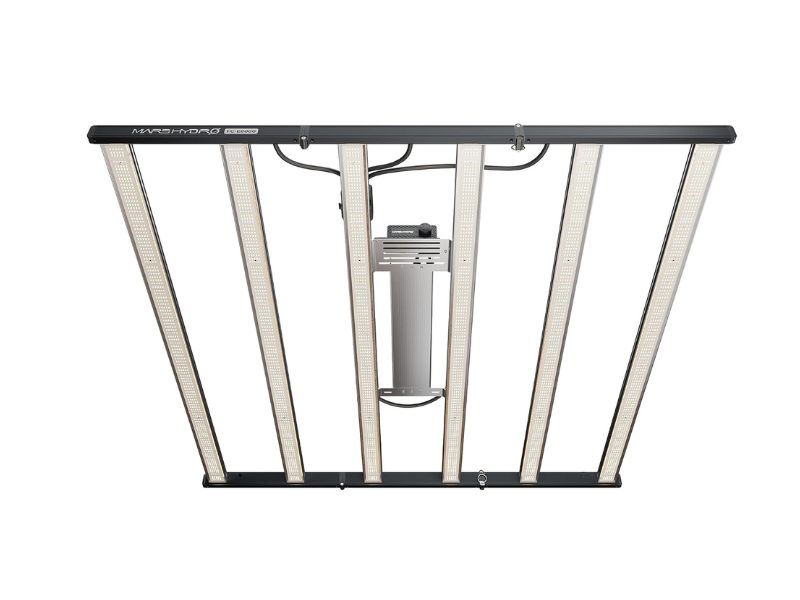
2. MARS HYDRO FC-E8000 800W LED Grow Light
Key Features
- 800W actual input
- 2.8 µmol/J system PPE
- Approximately 2,240 µmol/s PPF
- Bridgelux 2835 LEDs
- Osram 660nm red supplementation
- Foldable multi-bar architecture
- Full-spectrum output
- Dimmable
- Maximum 5×5 coverage
The MARS HYDRO FC-E8000 is my choice when a grow room needs more total photon output than the SF7000 provides.
Its current Amazon listing specifies 800W input, 2.8 µmol/J system PPE, roughly 2,240 µmol/s PPF, Bridgelux 2835 LEDs, enhanced Osram 660nm output, and 5×5 maximum coverage.
At approximately 2,240 µmol/s, it has the highest published photon output of these three selections.
That matters when the room contains a dense, mature canopy.
A fixture with higher PPF can provide more total photons across the same footprint, assuming the optical and physical design distributes them effectively.
The FC-E8000 uses a broad multi-bar layout.
That is particularly useful in a grow room because bars physically spread the LEDs across more of the canopy.
Potential advantages include:
- Better edge coverage
- Better corner coverage
- Reduced center hotspots
- Improved airflow
- Wider heat distribution
At 800W, this distributed architecture is preferable to concentrating output in a compact board.
The 2.8 µmol/J system PPE is another important strength.
That gives the fixture strong efficiency despite its much higher total power.
Still, 800W is a substantial load.
At 12 hours per day:
0.8 × 12 = 9.6 kWh/day
Over 30 days:
288 kWh/month
At 16 hours:
0.8 × 16 = 12.8 kWh/day
Over 30 days:
384 kWh/month
Those figures assume maximum output.
Actual consumption can be lower when dimmed.
The current design also uses Bridgelux 2835 diodes with enhanced Osram 660nm red LEDs.
Deep red can be useful within a broad horticultural spectrum, but I would still prioritize:
PPFD uniformity → PPF → PPE → photoperiod → environment → spectrum refinements.
A better spectrum cannot compensate for a poorly controlled room.
The foldable frame is also practical.
Large bar lights can be awkward to move through:
- Doorways
- Tent openings
- Narrow grow rooms
A foldable fixture simplifies transportation and installation.
The main downside is thermal demand.
An 800W light may require significantly more cooling than a 650W alternative.
The difference is:
800W – 650W = 150W.
Across many hours of daily operation, that extra power affects both electricity use and room temperature.
I would therefore choose FC-E8000 only when the extra photon capacity is actually useful.
What I Like
- Highest published PPF here
- Strong 2.8 µmol/J system PPE
- Broad bar architecture
- Excellent 5×5 output headroom
- Dimmable
- Foldable
- Deep-red supplementation
- Good fit for dense mature canopies
What I Do Not Like
- Highest electrical draw in this comparison
- Larger cooling requirement
- Excessive for many home grow rooms
- Extra output may be wasted if environmental conditions are limiting
The FC-E8000 is the light I would choose when maximum 5×5 photon capacity matters more than minimizing electricity and cooling demand.
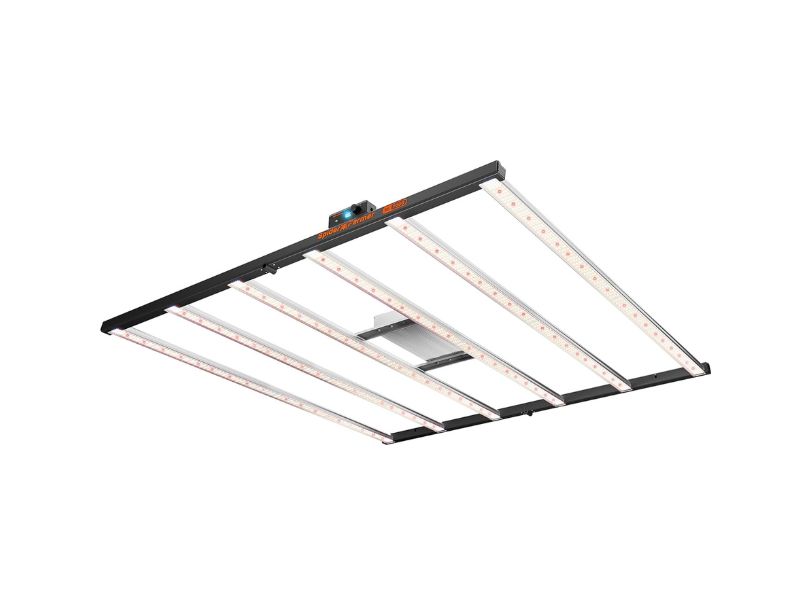
3. Spider Farmer SE7000 730W LED Grow Light
Key Features
- 730W actual power
- Approximately 2,146 µmol/s PPF
- Premium Bridgelux diodes
- Osram Hyper Red supplementation
- Six-bar architecture
- Full-spectrum output
- App control
- Digital dimming
- Daisy-chain functionality
- Detachable driver
- Fits 5×5 grow tents
- Suitable for vertical grow racks
The Spider Farmer SE7000 is the strongest choice here for growers who care about automation and scalability.
Its current Amazon listing specifies 730W input and approximately 2,146 µmol/s photon output, along with app control, dimming, daisy chaining, a detachable driver, and compatibility with 5×5 tents and vertical grow racks.
That combination is especially useful when a grow room contains more than one fixture.
For one light, manual dimming is easy.
For several fixtures, centralized control becomes increasingly valuable.
Smart management can simplify:
- Daily scheduling
- Intensity changes
- Multi-light synchronization
- Stage transitions
- Repeatable grow-room settings
The bar layout is also well suited to broad canopies.
Like FC-E8000, SE7000 physically distributes its diodes across a large frame.
This helps reduce the difference between center and edge intensity.
Spider Farmer also positions the current SE7000 for vertical grow racks, which is useful for commercial-style or multi-tier environments.
Vertical growing places additional importance on:
- Fixture thickness
- Heat placement
- Uniformity
- Remote controls
- Driver positioning
The detachable driver is particularly useful here.
Drivers create heat.
Being able to move the driver outside a tent or away from the immediate canopy can help reduce localized heat around plants.
It is important to understand that this does not reduce total heat produced by the system.
It simply gives you more control over where part of that heat is released.
The current listing specifies approximately 2,146 µmol/s PPF from 730W input.
That works out to roughly:
2,146 ÷ 730 ≈ 2.94 µmol/J
as a simple calculated output-to-input relationship.
I would treat that as an implied calculation rather than a separately published system-PPE certification.
The SE7000’s biggest advantage over SF7000 is not raw wattage.
It is control.
If I were building:
- Multiple tents
- Multiple 5×5 zones
- Vertical racks
- A larger automated room
I would seriously consider SE7000.
For one conventional home grow room, however, SF7000 remains simpler.
What I Like
- High ~2,146 µmol/s output
- Broad six-bar design
- App control
- Digital dimming
- Daisy-chain operation
- Detachable driver
- Strong fit for 5×5 rooms
- Vertical-rack compatibility
What I Do Not Like
- More complex than basic setups need
- 730W still creates substantial heat
- Large physical footprint
- Smart controls may be unnecessary for one fixture
The SE7000 is the light I would choose when a grow room needs high output plus centralized controls, remote dimming, and room to expand into multiple fixtures or vertical growing.
LED Grow Lights for Grow Room Comparison
| Product | Actual Power | Published PPF | Efficiency | Fixture Style | Smart Control | Best Use |
| Spider Farmer SF7000 | 650W | ~1,786 µmol/s | 2.8 µmol/J | Broad distributed fixture | Manual/controller compatible | Balanced 5×5 room |
| MARS HYDRO FC-E8000 | 800W | ~2,240 µmol/s | 2.8 µmol/J | Foldable multi-bar | Controller dependent | Maximum-output 5×5 |
| Spider Farmer SE7000 | 730W | ~2,146 µmol/s | ~2.94 µmol/J implied | Six-bar | App + daisy chain | Smart/scalable rooms |
The SF7000 gives me the most balanced overall setup, FC-E8000 provides the highest published PPF, and SE7000 offers the most advanced integrated control approach.
How to Choose the Best LED Lights for Grow Room Setups
Match the Fixture to the Actual Canopy
Do not choose a light based only on room dimensions.
A 10×10 room containing one small plant does not need 10×10 lighting.
Measure the mature canopy area you expect to illuminate.
That is the useful footprint.
Start With PPF
PPF measures total photosynthetic photon output.
Among these fixtures:
- SF7000: ~1,786 µmol/s
- SE7000: ~2,146 µmol/s
- FC-E8000: ~2,240 µmol/s
Higher PPF provides more total photon capacity, but only if the growing area and plants can use it.
Compare System PPE
PPE tells you how efficiently electricity becomes photosynthetically active photons.
SF7000 and FC-E8000 both publish approximately 2.8 µmol/J.
Higher system efficiency can reduce the amount of electricity required to reach a given photon target.
PPFD Matters at the Canopy
PPF describes total fixture output.
PPFD describes how much photon density reaches a specific point on the plant canopy.
That is why two lights with similar PPF can perform differently.
Fixture design affects where those photons land.
Uniformity Can Matter More Than Peak PPFD
I would rather see strong, useful PPFD across most of a 5×5 canopy than an extreme center reading combined with weak corners.
Uniformity improves:
- Canopy consistency
- Plant-to-plant growth
- Watering consistency
- Production-area efficiency
Distributed bar designs are particularly useful for this reason.
Best LED Light for a 5×5 Grow Room
For most users, I would choose Spider Farmer SF7000.
Its 650W input and roughly 1,786 µmol/s PPF provide substantial 5×5 capacity with lower electrical demand than the other two.
For maximum photon headroom, choose FC-E8000.
For advanced controls, choose SE7000.
Best LED Light for a 4×4 Grow Room
These models are primarily large 5×5-class fixtures.
For many ordinary 4×4 rooms, a smaller 400–600W fixture may be more proportionate.
You can dim these larger models, but permanently buying far more capacity than needed is not always efficient.
Best Grow-Room Light for Maximum Output
FC-E8000 wins on published total PPF.
Its current listing specifies approximately 2,240 µmol/s, compared with about 2,146 µmol/s for SE7000 and 1,786 µmol/s for SF7000.
Best Grow-Room Light for Smart Control
SE7000 is the clear choice.
Its current Amazon configuration includes:
- App control
- Digital dimming
- Daisy-chain functionality
- Detachable driver
That is especially useful in multi-light rooms.
Bar Lights vs Board Lights
For high-power grow-room fixtures, I generally favor distributed bars because they offer:
- Better diode spread
- Improved edge coverage potential
- More airflow
- Less extreme center concentration
However, fixture quality still depends on the complete PPFD map.
A bar design is not automatically good simply because it has bars.
Dimming Is Essential
All three fixtures have much more output than seedlings require.
Dimming allows you to match intensity to:
- Growth stage
- Canopy size
- Environmental conditions
- Target DLI
Do not run full power unless it serves a clear purpose.
Understand DLI
Daily Light Integral describes the total photosynthetic light plants receive over the entire day.
It combines:
- PPFD
- Photoperiod
This means you should not optimize lamp intensity without also considering the number of hours the fixture operates.
Grow-Room Heat Management
All high-power LEDs add heat.
Approximate full-power electrical loads are:
- SF7000: 650W
- SE7000: 730W
- FC-E8000: 800W
The room may require:
- Exhaust
- Intake air
- Circulation
- Air conditioning
- Dehumidification
depending on climate and enclosure size.
Electricity Use at 12 Hours Per Day
SF7000
0.65 × 12 = 7.8 kWh/day
30 days:
234 kWh/month
SE7000
0.73 × 12 = 8.76 kWh/day
30 days:
262.8 kWh/month
FC-E8000
0.8 × 12 = 9.6 kWh/day
30 days:
288 kWh/month
Actual consumption can be lower when dimmed.
Electricity Use at 16 Hours Per Day
SF7000:
10.4 kWh/day — 312 kWh/month
SE7000:
11.68 kWh/day — 350.4 kWh/month
FC-E8000:
12.8 kWh/day — 384 kWh/month
Multiply by your electricity rate to estimate operating cost.
Plan Electrical Capacity for the Whole Room
The lights are only part of the circuit load.
A grow room may also include:
- Exhaust fans
- Circulation fans
- Pumps
- Humidifiers
- Dehumidifiers
- Air conditioning
- Heaters
- Controllers
Use actual wattage for the entire system when planning electrical capacity.
Remote Drivers Can Help
A detachable driver lets you move one concentrated heat source away from the immediate canopy.
SE7000 specifically offers detachable-driver functionality.
This can help with localized temperature management.
It does not reduce total room heat.
Full Spectrum Is the Practical Baseline
Broad full-spectrum white horticultural light works across multiple growth stages.
Supplemental red can be useful, but I would not choose a fixture solely based on extra red LEDs.
The basic hierarchy is:
PPFD → uniformity → DLI → environment → spectral refinements.
Smart Controls Are Convenience Tools
Plants do not need Wi-Fi.
Smart controls are useful when they:
- Save labor
- Improve schedule consistency
- Synchronize several fixtures
- Make dimming easier
For a single room with one light, a reliable timer and manual dimmer may be completely sufficient.
Best Grow-Room Light for Hydroponics
All three can work over a large hydroponic canopy.
I would lean toward SF7000 for balanced power and SE7000 when automation matters.
Pay special attention to room and reservoir temperature because high-wattage lighting increases the overall thermal load.
Best Grow-Room Light for Tomatoes
For a full mature 5×5 tomato canopy, SF7000 is a strong balanced option.
If the environment can use additional intensity, FC-E8000 provides more photon headroom.
Best Grow-Room Light for Peppers
SF7000 and SE7000 are both compelling.
SE7000 becomes particularly useful when a grower wants programmed intensity changes through different growth stages.
Best Grow-Room Light for Seedlings
None of these would be my first purchase for seedlings alone.
They can be dimmed substantially, but a dedicated lower-wattage propagation light is usually more efficient.
These lights make sense when the same seedlings will later mature under the fixture.
Can More Light Increase Yield?
Potentially, but only when other factors are not limiting.
Plant performance can also depend on:
- Genetics
- Temperature
- Humidity
- Nutrition
- Root health
- Water availability
- Carbon dioxide
- Canopy management
More light eventually reaches diminishing returns if another factor becomes limiting.
Common Grow-Room Lighting Mistakes
Buying by Wattage Alone
Compare photon output and efficiency.
Choosing by Peak PPFD
Look at the whole map.
Oversizing the Fixture
Match it to mature canopy area.
Running 100% Power Too Early
Use dimming.
Ignoring Cooling
High-output LEDs still create significant room heat.
Ignoring Circuit Load
Include all equipment, not just lights.
Assuming Smart Controls Improve Biology
They improve convenience and repeatability.
Ignoring Edge Plants
Uniform productive canopy area matters more than the brightest center.
Frequently Asked Questions
What are the best LED lights for grow room setups?
Spider Farmer SF7000, MARS HYDRO FC-E8000, and Spider Farmer SE7000 are my three choices.
They provide different strengths in balanced output, maximum photon capacity, and smart grow-room control.
Which grow-room LED is my primary recommendation?
Spider Farmer SF7000 is my primary choice for most serious 5×5 rooms.
It combines 650W input, Samsung LM301B diodes, 2.8 µmol/J efficiency, and approximately 1,786 µmol/s PPF.
Which grow-room light has the highest PPF?
MARS HYDRO FC-E8000 has the highest published PPF here at about 2,240 µmol/s.
Its current listing also specifies 2.8 µmol/J system PPE.
Which grow-room light has the best smart controls?
Spider Farmer SE7000 is the strongest smart-control choice among these three.
It supports app control, dimming, daisy chaining, and detachable-driver operation.
Is 650W enough for a 5×5 grow room?
Yes, an efficient 650W fixture can provide substantial photon output across a 5×5 canopy.
SF7000 is specifically positioned for commercial 5×5 coverage.
Is 800W too much for a 5×5 grow room?
Not necessarily, but many grows will not need full 800W throughout the crop cycle.
Use dimming and let canopy demand determine output.
Is 730W good for a 5×5?
Yes, 730W provides substantial headroom for a mature high-light 5×5 canopy.
The current SE7000 publishes approximately 2,146 µmol/s output.
What does PPF mean?
PPF measures the total photosynthetically active photons emitted by a fixture each second.
It helps compare total horticultural output.
What does PPE mean?
PPE measures photosynthetic photon output produced per joule of electrical energy.
Higher comparable system PPE generally indicates better efficiency.
What does PPFD mean?
PPFD measures photon density reaching a specific point on the plant canopy.
It changes with distance, dimming, and fixture geometry.
Is PPFD uniformity important?
Yes, uniform PPFD helps more of the grow-room canopy receive similar useful intensity.
That can improve consistency between center and edge plants.
Are bar grow lights better for grow rooms?
Bar fixtures are particularly useful for large canopies because they distribute diodes more widely.
That can improve uniformity, airflow, and thermal distribution.
Do grow-room LED lights need dimmers?
I strongly recommend dimming on high-output fixtures because crop demand changes over time.
It also helps reduce electricity and heat when full intensity is unnecessary.
Do grow-room lights need app control?
No, apps are convenient rather than biologically necessary.
They become more useful when several fixtures or zones need synchronized control.
Do LED grow lights produce heat?
Yes, high-efficiency LEDs still create substantial room heat at 650–800W.
Plan ventilation and cooling around actual electrical draw.
Which grow-room light uses Samsung LM301B diodes?
Spider Farmer SF7000 uses Samsung LM301B LEDs in its current configuration.
Which lights use Bridgelux diodes?
FC-E8000 and SE7000 both currently use Bridgelux-based platforms.
FC-E8000 also includes Osram 660nm red supplementation.
Which grow-room light is best for automation?
I would choose SE7000 when centralized dimming and app control are important.
Its current design is also positioned for multi-light and vertical-rack installations.
Which grow-room light uses the least electricity here?
SF7000 has the lowest maximum input at 650W.
That gives it a lower full-power heat and electricity burden than 730W or 800W alternatives.
Which grow-room light is best for maximum output?
FC-E8000 is the strongest option here when total photon output is the main priority.
Its published output is approximately 2,240 µmol/s.
Which LED grow-room light should I buy?
Choose SF7000 for balance, FC-E8000 for maximum output, or SE7000 for smart scalability.
The right fixture depends on canopy size, cooling capacity, electrical load, and how much automation you actually need.
Conclusion
The best LED lights for grow room setups should deliver strong usable photon output across the entire canopy rather than concentrating impressive numbers in one central hotspot. I would prioritize PPF, system PPE, PPFD uniformity, dimming, fixture geometry, electrical demand, thermal management, and realistic canopy size.
The Spider Farmer SF7000 remains my primary recommendation. Its 650W input, Samsung LM301B diodes, 2.8 µmol/J efficiency, approximately 1,786 µmol/s PPF, dimming, and 5×5 coverage provide the most balanced combination of power and manageability.
The MARS HYDRO FC-E8000 is my choice when maximum photon capacity matters most. Its 800W system publishes approximately 2,240 µmol/s PPF at 2.8 µmol/J and spreads that output through a broad foldable bar architecture.
The Spider Farmer SE7000 is the strongest option for automation and scalability. Its 730W input, approximately 2,146 µmol/s output, app control, digital dimming, daisy chaining, detachable driver, and vertical-rack compatibility make it particularly useful in more complex grow rooms.
For most 5×5 grow-room setups, I would choose Spider Farmer SF7000. For maximum output, I would choose MARS HYDRO FC-E8000. For app-based control and expansion into multiple fixtures, I would choose Spider Farmer SE7000.

I’m Maya L. Greenwood, a lifelong plant lover who believes anyone can grow something beautiful with the right guidance. After years of testing soil mixes, pruning methods, irrigation tricks, and pest-safe solutions, I started EasyGardenTips.com to turn hard-won lessons into step-by-step advice. From seed starting and container gardens to composting and seasonal checklists, my goal is to make gardening simple, sustainable, and fun.