3 Best Quality LED Grow Lights for Serious Indoor Growing
The best quality LED grow lights should deliver more than high wattage. I would look for efficient photon production, strong canopy uniformity, reliable dimming, appropriate thermal management, and enough output to remain useful from early growth through a mature indoor canopy.
Quality also means evaluating the complete fixture rather than focusing on one diode brand or one impressive center PPFD reading. System PPE, PPF, PPFD distribution, driver design, fixture geometry, spectrum, and controls all affect how useful a grow light is in practice.
My primary recommendation is the Spider Farmer SF7000 650W LED Grow Light. I would choose it for buyers who want a proven 5×5-class fixture with Samsung LM301B diodes, 650W actual draw, 2.8 µmol/J photon efficiency, approximately 1,786 µmol/s PPF, dimming, and commercial 5×5 coverage. Its current Amazon listing also has by far the largest customer-rating history among these three selections.
I would choose the MARS HYDRO FC-E8000 800W LED Grow Light when maximum photon output is the priority. Its current configuration specifies 800W input, 2.8 µmol/J system PPE, approximately 2,240 µmol/s PPF, Bridgelux 2835 diodes, Osram 660nm red supplementation, a foldable multi-bar frame, and maximum 5×5 coverage.
For growers who value smart operation and scalable control, I would choose the Spider Farmer SE7000 730W LED Grow Light. The current 2026 version is listed at 730W and approximately 2,146 µmol/s, with premium Bridgelux diodes, a six-bar design, app control, digital dimming, daisy chaining, and 5×5 positioning.
3 Best Quality LED Grow Lights Reviewed
| Image | Product Name | Check Price |
|---|---|---|
Best Choice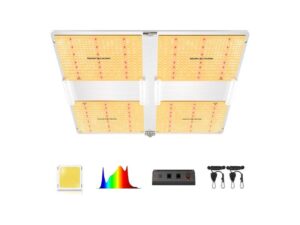 | Spider Farmer SF7000 650W LED Grow Light | Check Price |
Second Best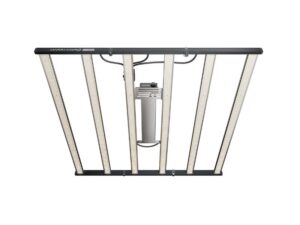 | MARS HYDRO FC-E8000 800W LED Grow Light | Check Price |
Third Choice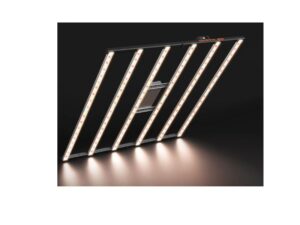 | Spider Farmer SE7000 730W LED Grow Light | Check Price |
1. Spider Farmer SF7000 650W LED Grow Light
Key Features
- 650W actual power draw
- Samsung LM301B diodes
- 2.8 µmol/J photon efficiency
- Approx. 1,786 µmol/s PPF
- Full-spectrum output
- Dimmable
- Fanless operation
- Broad diode distribution
- Commercial 5×5 coverage
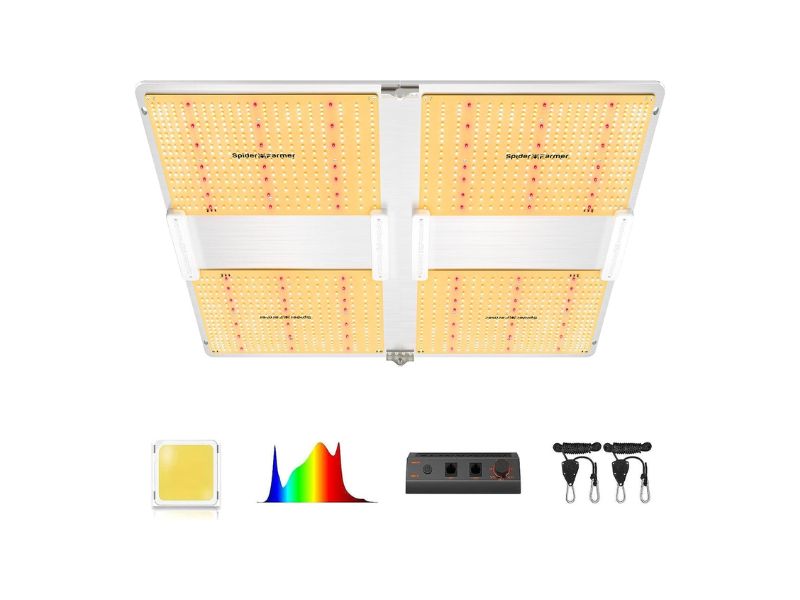
The Spider Farmer SF7000 is my primary recommendation because it combines high-quality components with a sensible amount of power for a serious 5×5 grow.
Its current Amazon listing specifies 650W input, Samsung LM301B LEDs, 2.8 µmol/J photon efficiency, approximately 1,786 µmol/s PPF, and 5×5 commercial coverage.
Those numbers provide a much better picture of quality than a model name alone.
PPE, or photosynthetic photon efficacy, tells you how efficiently the fixture turns electrical energy into plant-usable photons.
PPF, or photosynthetic photon flux, tells you the total number of photosynthetic photons emitted each second.
A high-quality grow light should provide both respectable efficiency and enough total output for its intended footprint.
At 2.8 µmol/J, the SF7000 is an efficient complete horticultural system rather than a fixture relying only on large wattage.
Its roughly 1,786 µmol/s PPF also gives it substantial headroom for a mature indoor canopy.
I would consider it particularly well suited to:
- Tomatoes
- Peppers
- Eggplants
- Large herbs
- High-light houseplants
- Dense vegetable canopies
- Serious 5×5 grow tents
The 650W power class is one of its biggest advantages.
There are stronger 730W and 800W fixtures in this guide, but maximum electrical input is not automatically better.
A quality 650W light can be easier to manage because it creates:
- Less electrical demand
- Less heat
- Lower ventilation burden
while still providing substantial photon output.
That balance matters for home growers.
The SF7000’s broad diode distribution is also important.
High output concentrated in a small central area can create a severe hotspot.
The objective should be to provide useful PPFD across as much of the canopy as possible.
That means paying attention not only to the center but also:
- Edges
- Corners
- Gaps between plants
A productive 5×5 canopy contains 25 square feet.
Weak outer zones reduce the amount of usable growing area even when the center looks excellent.
Dimming is another quality feature I would consider essential at this power level.
A 650W fixture should not be operated at full output automatically.
Young plants generally need much less intensity than a mature high-light canopy.
A better progression is:
Lower output for young plants → moderate output as canopy expands → higher output when mature plants can use it.
That approach can reduce unnecessary electricity and lessen light stress.
The Samsung LM301B diode platform is another reason many growers consider the SF7000 a premium-style fixture.
However, I would not buy it solely because Samsung is printed in the specification.
Diodes are only one part of a complete grow light.
Driver efficiency, thermal behavior, electrical design, bar or board spacing, and overall PPFD distribution all matter.
The fanless architecture helps reduce noise and eliminates fixture cooling fans as moving parts.
That does not make the light heat-free.
At 650W, environmental management is still necessary.
A serious setup may require:
- Exhaust ventilation
- Fresh-air intake
- Canopy circulation
- Temperature monitoring
- Humidity control
The key advantage is that 650W is easier to manage than an 800W fixture while still offering enough output for many demanding 5×5 gardens.
What I Like
- Excellent balance of efficiency and power
- Samsung LM301B diode platform
- Strong 1,786 µmol/s PPF
- Published 2.8 µmol/J efficiency
- 5×5-class coverage
- Dimming
- Large marketplace history
- Lower heat burden than 730–800W alternatives
What I Do Not Like
- Still far too powerful for small shelves
- Large physical footprint
- High output requires careful hanging and dimming
- No advanced integrated control system comparable with newer smart fixtures
The SF7000 is the light I would choose when I want high-quality 5×5 performance without automatically stepping up to 730–800 watts. Its combination of efficient Samsung diodes, strong photon output, dimming, and substantial Amazon history makes it the most balanced recommendation here.
2. MARS HYDRO FC-E8000 800W LED Grow Light
Key Features
- 800W actual power
- 2.8 µmol/J system PPE
- Approx. 2,240 µmol/s PPF
- Bridgelux 2835 diodes
- Osram 660nm red LEDs
- Multi-bar architecture
- Foldable frame
- Full-spectrum output
- Dimmable
- Maximum 5×5 coverage
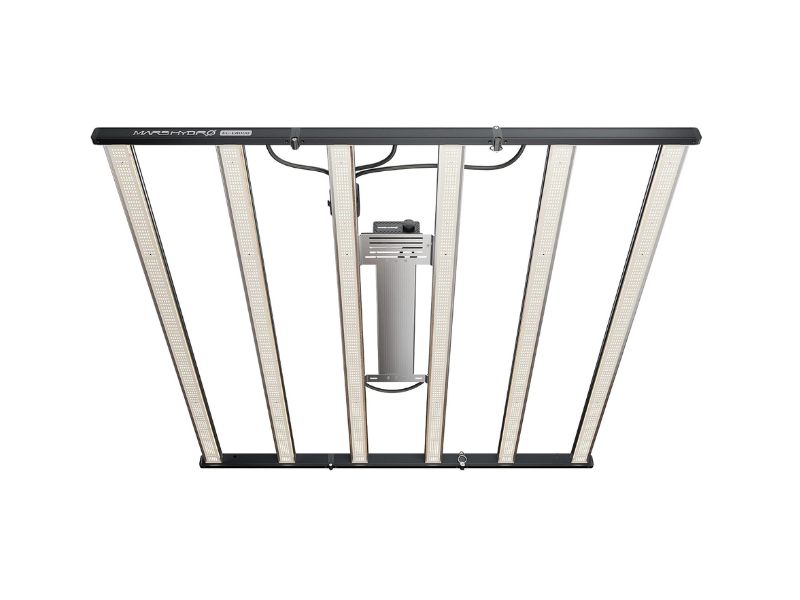
The MARS HYDRO FC-E8000 is my choice when quality means maximum total photon output combined with a distributed bar-style fixture.
Its current Amazon listing specifies 800W input, 2.8 µmol/J PPE and approximately 2,240 µmol/s PPF, with Bridgelux 2835 LEDs and enhanced Osram red supplementation.
That makes it the highest-output fixture in this comparison.
At roughly 2,240 µmol/s, it produces substantially more total photons than the SF7000.
That does not automatically mean better plant performance.
Additional light only helps when plants and the surrounding environment can make productive use of it.
High-intensity growing can become limited by:
- Canopy size
- Temperature
- Humidity
- Irrigation
- Root health
- Nutrition
- Carbon dioxide availability
- Plant genetics
If any of those factors become limiting, simply increasing photon output may produce diminishing returns.
Still, for a well-managed 5×5 canopy, the FC-E8000 provides substantial headroom.
The multi-bar design is an important quality feature.
At 800W, I strongly prefer physically distributed LEDs over a very compact point source.
Spreading diodes across several bars can improve:
- Edge coverage
- Corner PPFD
- Heat distribution
- Airflow
- Overall canopy uniformity
This is especially important because 800W can create an extremely intense center region if the fixture is poorly designed.
The published 2.8 µmol/J system PPE also gives useful context.
A fixture drawing 800W needs strong efficiency to justify that electrical demand.
At the published efficacy, the FC-E8000 converts a substantial portion of its input into photosynthetically useful photons.
MARS HYDRO uses Bridgelux 2835 diodes plus enhanced Osram 660nm red LEDs in the current configuration.
Deep red can be useful as part of a broad horticultural spectrum.
I would still consider it secondary to:
- Adequate PPF
- Uniform PPFD
- Proper DLI
- Environment
- Spectrum refinements
A fixture can advertise many wavelengths and still perform poorly if its distribution is uneven.
The FC-E8000 also folds.
That feature is more useful than it may initially seem.
A full 5×5 bar fixture is physically large.
Foldability simplifies:
- Transport
- Storage
- Installation
- Moving between rooms
Dimming is essential.
There is little reason to run 800W over a small young canopy.
I would use lower output in early stages and reserve full capacity for situations where mature plants and environmental conditions justify it.
This can substantially reduce heat and electricity use.
Thermal management is the biggest practical concern.
At maximum output, the FC-E8000 places 800 watts of electrical energy into the growing environment.
Even with excellent LED efficiency, that creates a serious cooling requirement.
This is not a fixture I would casually place in a small unventilated room.
A quality installation should include proper:
- Exhaust
- Circulation
- Intake
- Temperature monitoring
- Humidity management
The fixture itself may be high quality, but the grow room must be designed to support it.
What I Like
- Highest total PPF of these three
- Strong 2.8 µmol/J system PPE
- Distributed multi-bar architecture
- Excellent 5×5 output headroom
- Bridgelux + Osram component mix
- Foldable design
- Dimming
- Good option for mature high-light canopies
What I Do Not Like
- 800W creates substantial heat
- Highest electricity demand here
- Excessive for many home grow spaces
- Requires careful environmental planning
The FC-E8000 is the model I would choose when raw photon capacity and large-canopy distribution matter more than minimizing power consumption. For a serious 5×5 grow where the room can manage 800W properly, its approximately 2,240 µmol/s PPF provides exceptional headroom.
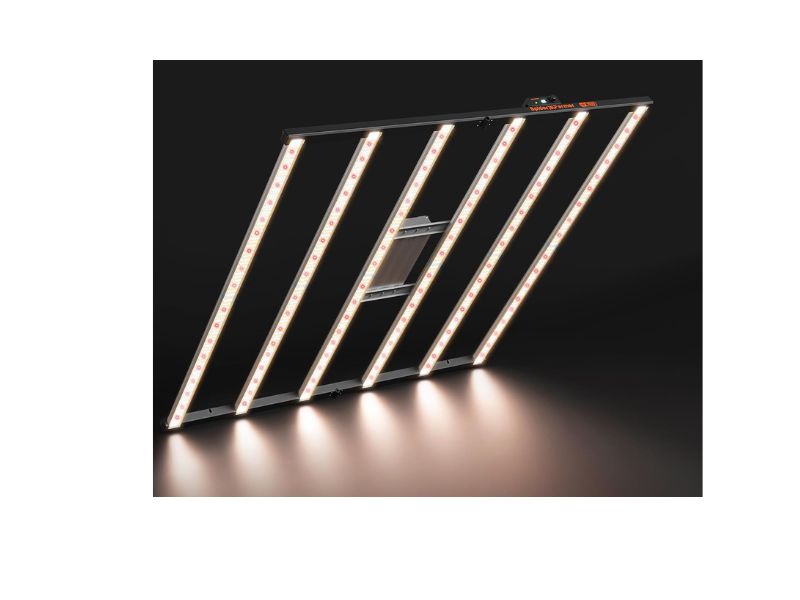
3. Spider Farmer SE7000 730W LED Grow Light
Key Features
- 730W actual power
- Approx. 2,146 µmol/s PPF
- Premium Bridgelux diode platform
- Six-bar construction
- Full-spectrum output
- Enhanced red LEDs
- App control
- Digital dimming
- Daisy chaining
- Detachable driver
- 5×5 coverage
- Five-year listed warranty
The Spider Farmer SE7000 is the most control-focused high-quality fixture in this comparison.
The current 2026 Amazon configuration specifies 730W actual power and approximately 2,146 µmol/s photon output, using premium Bridgelux diodes and a six-bar design.
That combination gives it a strong implied system efficacy of roughly:
2,146 ÷ 730 ≈ 2.94 µmol/J
based on the published PPF and wattage.
I treat that as a calculated figure rather than a direct manufacturer system-PPE claim, but it shows why the SE7000 is technically interesting.
The six-bar format provides wide physical distribution.
This can be particularly useful over a flat 5×5 canopy.
A quality grow light should minimize the difference between:
- Center PPFD
- Mid-canopy PPFD
- Edge PPFD
because the plants at the edges contribute to the final production area just as much as plants in the middle.
Spider Farmer currently positions the SE7000 around both 5×5 grow tents and commercial 4×4 vertical racks.
That rack positioning is important.
Professional-style vertical growing places additional emphasis on:
- Fixture depth
- Heat management
- Uniformity
- Centralized controls
- Scalability
The SE7000 is better prepared for those requirements than a basic manual board light.
Smart control is the most obvious difference.
The current version includes:
- Spider Farmer app control
- Digital dimmer
- Scheduling
- Daisy chaining
and Amazon states that up to 50 compatible fixtures can be linked under master control.
That is unnecessary for most home growers.
For multiple tents or larger installations, however, centralized adjustment becomes valuable.
Instead of manually changing every light, one system can help standardize:
- Photoperiod
- Intensity
- Stage transitions
This improves repeatability.
The detachable driver is another quality feature.
LED drivers create heat.
Moving the driver outside the tent can reduce heat concentrated directly around the canopy.
This does not reduce total heat produced by the electrical system, but it gives you more control over where that heat is released.
The current listing also emphasizes enhanced red output alongside its broad full spectrum.
Again, I would not select the SE7000 purely for red supplementation.
Its real advantages are:
high PPF + broad six-bar coverage + dimming + detachable driver + smart control.
At 730W, the fixture sits between SF7000 and FC-E8000 in electrical demand.
That makes it a useful middle ground.
Compared with the SF7000, you gain more photon output and significantly more control features.
Compared with FC-E8000, you give up some raw PPF but save about 70 watts at full power.
That difference can become meaningful over long operating periods.
What I Like
- Excellent ~2,146 µmol/s PPF
- Broad six-bar architecture
- Strong output from 730W
- Smart app control
- Digital dimming
- Daisy-chain scalability
- Detachable driver
- Suitable for 5×5 tents and vertical racks
What I Do Not Like
- Current Amazon rating average is lower than the other selections
- Smart features add complexity
- Still a large electrical and thermal load
- Overkill for small household plant setups
The SE7000 is the model I would choose when quality includes sophisticated controls and scalability, not just photon output. Its combination of high PPF, broad bars, removable driver, and app-based multi-light management makes it especially attractive for advanced growers.
Best Quality LED Grow Lights Comparison
| Product | Actual Power | Published PPF | Efficiency | Fixture Style | Smart Control | Coverage Focus |
| Spider Farmer SF7000 | 650W | ~1,786 µmol/s | 2.8 µmol/J | Broad LED fixture | Manual dimming | 5×5 |
| MARS HYDRO FC-E8000 | 800W | ~2,240 µmol/s | 2.8 µmol/J | Foldable multi-bar | Controller dependent | 5×5 |
| Spider Farmer SE7000 | 730W | ~2,146 µmol/s | ~2.94 µmol/J calculated | Six-bar | App + digital control | 5×5 / rack |
SF7000 provides the strongest balance of power and efficiency, FC-E8000 offers the greatest photon headroom, and SE7000 provides the most sophisticated control package.
How to Choose the Best Quality LED Grow Lights
Quality Starts With System PPE
Do not evaluate quality only by brand or diode manufacturer.
System PPE tells you how efficiently the entire fixture converts electricity into photosynthetically active photons.
SF7000 and FC-E8000 both publish approximately 2.8 µmol/J.
That is a much more useful comparison than vague “HPS equivalent” numbers.
Look at Total PPF
PPF measures the total photon output of the fixture.
Among these selections:
- SF7000: ~1,786 µmol/s
- SE7000: ~2,146 µmol/s
- FC-E8000: ~2,240 µmol/s
Higher PPF means more available photons, but it also usually means more electricity and heat.
PPFD Shows What Reaches the Plants
PPF describes what leaves the light.
PPFD describes how densely photons reach a particular point on the canopy.
That is why I would always examine the complete PPFD map rather than one center measurement.
A good light should make the whole intended footprint useful.
Uniformity Is a Quality Feature
A cheap fixture may create a very bright center and weak outer zones.
High-quality designs attempt to distribute emitters so that edges and corners receive more consistent light.
Bar-style fixtures are particularly useful here because the LEDs can physically occupy more of the grow area.
Best Quality LED Grow Light for 5×5
For most growers, I would start with Spider Farmer SF7000.
Its 650W input and approximately 1,786 µmol/s PPF provide strong capacity without the maximum electrical demand of the other two.
For the highest photon output, choose FC-E8000.
For advanced automation, choose SE7000.
Best Quality LED Grow Light for 4×4
These are primarily large 5×5-class fixtures.
A 4×4 garden may be better served by a good 450–600W model unless unusually high intensity is required.
You can dim a 650–800W fixture, but permanently buying far more capacity than necessary is not always the most sensible approach.
Are Samsung Diodes Better?
Samsung LM301-series diodes have a strong reputation for horticultural efficiency, but diode brand alone does not determine fixture quality.
The SF7000 uses Samsung LM301B diodes.
FC-E8000 and SE7000 demonstrate that high-quality fixtures can also use Bridgelux and Osram components effectively.
Evaluate the complete system.
Bar Lights vs Board-Style Lights
Bar Fixtures
Potential advantages:
- Wider diode spacing
- Better edge coverage
- More open airflow
- Reduced center hotspots
Compact Board Fixtures
Potential advantages:
- Smaller frame
- Easier hanging
- Simpler installation
For high-power 5×5 lighting, I generally favor physically distributed designs.
Dimming Is Essential
All high-quality high-output grow lights should offer meaningful intensity control.
A 650–800W fixture is far too powerful to treat as a fixed-output lamp for every plant stage.
Dimming can help:
- Reduce electricity use
- Reduce heat
- Prevent excessive seedling intensity
- Match output to canopy size
Detachable Drivers Are Useful
Drivers generate heat.
A detachable or remotely mountable driver lets you move that heat away from the immediate canopy.
SE7000 specifically uses a detachable-driver design.
This can be useful in warm tents and vertical racks.
Smart Control Is Convenient, Not Essential
Plants do not require an app.
They require consistent:
- Intensity
- Photoperiod
- Environment
Smart systems make those variables easier to manage.
SE7000’s app and daisy-chain controls become particularly useful in multi-fixture installations.
For one tent, a manual dimmer and reliable timer can work perfectly well.
Full Spectrum Is the Practical Baseline
Broad white-spectrum LED systems are convenient across multiple plant stages.
Supplemental deep red can be useful, but it should not distract from the basics.
I would prioritize:
PPFD → uniformity → photoperiod → environment → spectrum refinements.
Best Quality Grow Light for Tomatoes
For several mature tomatoes filling a 5×5, I would choose SF7000 for balanced power or FC-E8000 when additional photon headroom is justified.
Large tomato plants can fill the available footprint quickly, so broad coverage becomes important.
Best Quality Grow Light for Peppers
All three provide more than enough potential output for multiple mature pepper plants.
The SE7000 becomes attractive when I want to adjust intensity remotely as the crop develops.
Best Quality Grow Light for Seedlings
These lights only make sense for seedlings when they will later remain in the same large growing area.
For seedling-only use, I would purchase a much smaller fixture.
If using one of these, dim it heavily during early growth.
High-Quality Lights Still Produce Heat
Efficiency does not mean zero heat.
At maximum output:
- 650W is a substantial thermal load.
- 730W is larger.
- 800W is larger still.
Large tents need appropriate exhaust and circulation.
Electricity Use of a 650W Grow Light
At 12 hours per day:
0.65 kW × 12 = 7.8 kWh/day
Over 30 days:
234 kWh/month
Electricity Use of a 730W Grow Light
At 12 hours:
0.73 × 12 = 8.76 kWh/day
Over 30 days:
262.8 kWh/month
Electricity Use of an 800W Grow Light
At 12 hours:
0.8 × 12 = 9.6 kWh/day
Over 30 days:
288 kWh/month
Actual consumption can fall substantially when dimmed.
Build Quality Should Include Electrical Safety
A good grow light should also be used with appropriately rated electrical equipment.
Consider the total load from:
- Grow light
- Exhaust
- Circulation fans
- Humidifier
- Dehumidifier
- Pumps
- Heater
Use actual input watts, not model numbers.
Warranty and Support Matter
A quality fixture is a long-term piece of equipment.
The current SE7000 listing specifies a five-year warranty and U.S. service support.
Serviceability matters more as fixture cost and output increase.
Common Quality Grow-Light Buying Mistakes
Choosing Only by Diode Brand
A premium diode does not automatically create a premium fixture.
Choosing the Highest Wattage
Buy enough output for the canopy, not the largest number available.
Ignoring System PPE
Efficiency matters over thousands of operating hours.
Looking Only at Peak PPFD
Check the edges and corners.
Ignoring Dimming
High-power lights need output flexibility.
Ignoring Driver Heat
Thermal design affects the whole grow environment.
Paying for Smart Features You Will Not Use
Automation should solve a real operational problem.
Buying for Tent Size Instead of Canopy Size
Match the fixture to the actual growing area.
Frequently Asked Questions
What are the best quality LED grow lights?
Spider Farmer SF7000, MARS HYDRO FC-E8000, and Spider Farmer SE7000 are my three choices.
They combine strong photon output, efficient system design, broad 5×5 coverage, and useful intensity controls.
Which quality LED grow light is my primary recommendation?
Spider Farmer SF7000 is my primary choice for balanced 5×5 performance.
It combines 650W input, Samsung LM301B diodes, 2.8 µmol/J efficiency, and approximately 1,786 µmol/s PPF.
Which light has the highest photon output?
MARS HYDRO FC-E8000 has the highest published PPF at approximately 2,240 µmol/s.
It also publishes 2.8 µmol/J complete-system PPE.
Which light has the best smart controls?
Spider Farmer SE7000 offers the strongest smart-control package among these three.
It supports app operation, digital dimming, scheduling, and multi-light daisy chaining.
Which grow light uses Samsung LM301B LEDs?
The Spider Farmer SF7000 uses Samsung LM301B diodes.
Its current listing combines them with 650W input and 2.8 µmol/J photon efficiency.
Which grow lights use Bridgelux diodes?
FC-E8000 and SE7000 both use Bridgelux-based diode platforms in their current configurations.
FC-E8000 also includes Osram 660nm red supplementation.
Is 650W enough for a 5×5?
Yes, a high-efficiency 650W fixture can provide substantial output across a 5×5 canopy.
SF7000 is specifically positioned for commercial 5×5 coverage.
Is 730W good for a 5×5?
Yes, 730W provides substantial high-output headroom for a properly managed 5×5 grow.
The current SE7000 produces approximately 2,146 µmol/s.
Is 800W too much for a 5×5?
Not necessarily, but many growers may not need full power throughout the entire crop cycle.
FC-E8000’s dimming capability makes its extra capacity more manageable.
What is PPE?
PPE measures how efficiently electrical energy becomes photosynthetically active photon output.
Higher comparable system PPE generally means greater horticultural efficiency.
What is PPF?
PPF measures the total photosynthetically active photons emitted each second.
It is useful for comparing overall fixture output.
What is PPFD?
PPFD measures the density of plant-usable photons reaching a particular canopy location.
It changes with hanging distance, dimming, fixture geometry, and position.
Does higher PPF always mean a better light?
No, output must be matched with efficiency, uniformity, canopy size, and plant requirements.
Unused or excessive photons do not automatically increase plant performance.
Are bar grow lights higher quality?
Not automatically, but bar designs often improve distribution in large grow spaces.
They physically spread LEDs over more of the canopy.
Are fanless grow lights better?
Fanless designs eliminate fan noise and moving cooling parts but still release heat into the room.
Ventilation remains necessary for powerful fixtures.
Do I need app control?
No, app control is convenient rather than biologically necessary for plants.
It becomes more useful when several lights or grow zones need centralized management.
Which fixture is best for lower heat?
SF7000 has the lowest total wattage of these three and therefore the lowest maximum electrical heat load.
Its 650W draw is substantially lower than FC-E8000’s 800W.
Which fixture is best for maximum output?
FC-E8000 is the strongest choice when maximum total photon capacity is the goal.
Its current listing publishes approximately 2,240 µmol/s PPF.
Which fixture is best for multiple grow lights?
SE7000 is particularly suitable because its current control system supports daisy chaining.
Spider Farmer lists support for up to 50 compatible units under master control.
Can I use these lights for seedlings?
Yes when heavily dimmed, but all three are oversized for seedlings alone.
Their value comes from continuing to support plants as the canopy becomes much larger.
How do I know if a grow light is genuinely high quality?
Look for system efficiency, meaningful photon data, uniform coverage, dimming, thermal design, and dependable support.
Diode branding and wattage should be only part of the evaluation.
Conclusion
The best quality LED grow lights combine efficient photon production with strong canopy distribution, dependable controls, appropriate thermal design, and enough output for the intended grow area. I would prioritize system PPE, PPF, PPFD uniformity, dimming, fixture geometry, and serviceability rather than choosing solely by wattage or diode brand.
The Spider Farmer SF7000 remains my primary recommendation. Its 650W power draw, Samsung LM301B diodes, 2.8 µmol/J efficiency, approximately 1,786 µmol/s PPF, and 5×5 coverage provide the best balance of output and manageable electrical demand.
The MARS HYDRO FC-E8000 is my choice when maximum photon output matters most. Its 800W system delivers approximately 2,240 µmol/s PPF at a published 2.8 µmol/J and distributes that output through a broad foldable bar architecture.
The Spider Farmer SE7000 is the strongest smart-control option. Its 730W input, approximately 2,146 µmol/s output, six-bar construction, detachable driver, digital dimming, and app-based multi-light management make it particularly attractive for advanced installations.
For balanced 5×5 quality, I would choose Spider Farmer SF7000. For maximum output, I would choose MARS HYDRO FC-E8000. For automation and scalability, I would choose Spider Farmer SE7000.

I’m Maya L. Greenwood, a lifelong plant lover who believes anyone can grow something beautiful with the right guidance. After years of testing soil mixes, pruning methods, irrigation tricks, and pest-safe solutions, I started EasyGardenTips.com to turn hard-won lessons into step-by-step advice. From seed starting and container gardens to composting and seasonal checklists, my goal is to make gardening simple, sustainable, and fun.