3 Best New LED Grow Lights with Smarter Modern Features
Grow-light technology continues to shift toward better diode distribution, smarter controls, more uniform PPFD, and fixtures designed around realistic canopy shapes. The best new LED grow lights are not automatically the models with the highest wattage—they are the newer or refreshed designs that solve practical problems such as hotspots, awkward control systems, inefficient coverage, and difficult installation.
My primary recommendation is the Spider Farmer SF4000 New-Gen 450W LED Grow Light. I would choose it for a serious 4×4 setup because its current listing combines 450W actual power, 2.7 µmol/J system PPE, a new-generation high-efficiency diode layout, dimming, and full-spectrum output, while the refreshed design places more emphasis on even canopy coverage.
I would choose the VIVOSUN T5 1FT 28W 4-Pack for seedlings, shelves, herbs, and smaller indoor gardens. The current configuration combines four 7W bars, 5000K full-spectrum output, four brightness levels, 8/12/18-hour timers, optical lenses, and linkable installation, making it one of the more practical newer compact systems.
For growers who want a modern 4×4 bar fixture with deeper canopy-focused optics, I would choose the VIVOSUN LumaLight 500W. Its current listing emphasizes a 500W distributed light-bar matrix, Micro-Lens Optic System, up to 0.89 listed uniformity, 25–100% dimming, 3000K/5000K/660nm/730nm spectrum, IP65-sealed bars, and GrowHub compatibility.
3 Best New LED Grow Lights Reviewed
| Image | Product Name | Check Price |
|---|---|---|
Best Choice | Spider Farmer SF4000 New-Gen 450W LED Grow Light | Check Price |
Second Best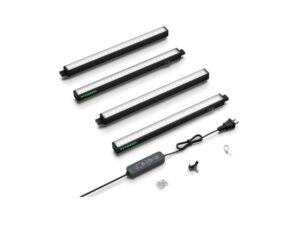 | VIVOSUN T5 1FT 28W 4-Pack Grow Lights | Check Price |
Third Choice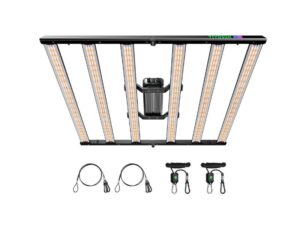 | VIVOSUN LumaLight 500W LED Grow Light | Check Price |
1. Spider Farmer SF4000 New-Gen 450W LED Grow Light
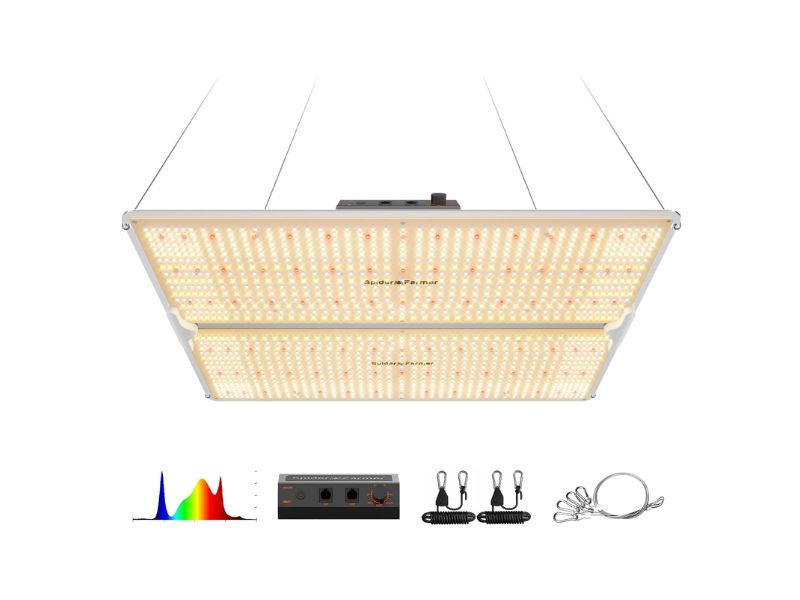
Key Features
- 450W actual power
- 2.7 µmol/J system PPE
- New-generation upgraded LED layout
- Increased diode count
- Full-spectrum output
- Dimmable
- 4×4-oriented coverage
- Fanless design
- Improved edge-distribution emphasis
Spider Farmer’s SF4000 is not a brand-new product name, but the current U.S. Amazon version is a new-generation refresh rather than simply the unchanged older configuration.
Its current listing describes upgraded premium LEDs, increased diode count, and 2.7 µmol/J complete-system PPE. Amazon also positions the fixture as a 450W full-spectrum light for indoor plants in a 4×4 grow tent.
That distinction matters when shopping for a “new” grow light.
A manufacturer does not always replace an established model name when it updates:
- Diodes
- Diode quantity
- Driver arrangement
- Dimming
- PPFD distribution
Sometimes the existing product line receives an internal redesign.
For the grower, the current exact specification matters more than the age of the model name.
The SF4000 is my primary recommendation because 450W is a practical high-output class for a full 4×4 canopy without immediately moving into the electrical and thermal demands of a 700–800W fixture.
A 4×4 growing area contains 16 square feet.
At 450W, rough electrical density is:
450 ÷ 16 = 28.1 watts per square foot.
Watts per square foot does not measure plant light directly, but it provides useful scale.
What matters more is the published 2.7 µmol/J system PPE and how uniformly that photon output reaches the plants.
PPE measures photon output relative to electrical energy consumed.
When comparing newer fixtures, I prefer system PPE over vague equivalent-watt claims because it evaluates horticultural efficiency more directly.
The refreshed diode arrangement also addresses a common weakness of board-style grow lights: center concentration.
Compact panels naturally place many LEDs toward the center of the growing footprint.
That can create:
- Strong center PPFD
- Weaker edges
- Weaker corners
- Uneven plant development
The current SF4000 listing specifically emphasizes an upgraded diode layout intended to provide more even performance.
This becomes useful with several plants sharing a 4×4 space.
I would consider SF4000 for:
- Tomato plants
- Peppers
- Eggplants
- Herbs
- Vegetable seedlings
- Dense houseplant collections
- Larger propagation areas
Dimming makes the fixture considerably more versatile.
A 450W light is unnecessarily intense for a small tray of newly emerged seedlings if run at maximum output and mounted close.
Instead, I would begin at lower intensity and raise output gradually as the canopy develops.
This lets one fixture support:
Seedlings → vegetative growth → mature plants
without forcing the grower to change lighting systems at every stage.
The fanless design is another practical advantage.
Passive cooling means there is no fixture fan generating noise or introducing another moving part.
It is important, however, to distinguish fanless from heatless.
Four hundred fifty watts of electrical power still becomes a meaningful indoor heat load.
A 4×4 tent may need:
- Exhaust ventilation
- Circulation fans
- Fresh-air intake
- Temperature monitoring
depending on room conditions.
The biggest reason to choose SF4000 over a new bar fixture is simplicity.
It is relatively compact and easy to suspend.
A large multi-bar system spreads light more physically but also occupies much more space.
For growers who want a powerful current-generation fixture without a giant frame, SF4000 remains attractive.
What I Like
- Current new-generation diode configuration
- Strong 2.7 µmol/J system PPE
- 450W 4×4-class output
- Dimmable
- Full-spectrum design
- Compact compared with large bars
- Very large Amazon rating history
What I Do Not Like
- Model name itself is established rather than newly introduced
- Board-style design remains less physically distributed than wide bars
- Far more power than a small shelf requires
- Significant ventilation may still be needed
The SF4000 is my primary recommendation for buyers who interpret “new” as current upgraded technology rather than an entirely new product name. Its refreshed diode platform and 450W output give it much more growth headroom than compact newcomers while retaining a straightforward installation.
2. VIVOSUN T5 1FT 28W 4-Pack Grow Lights
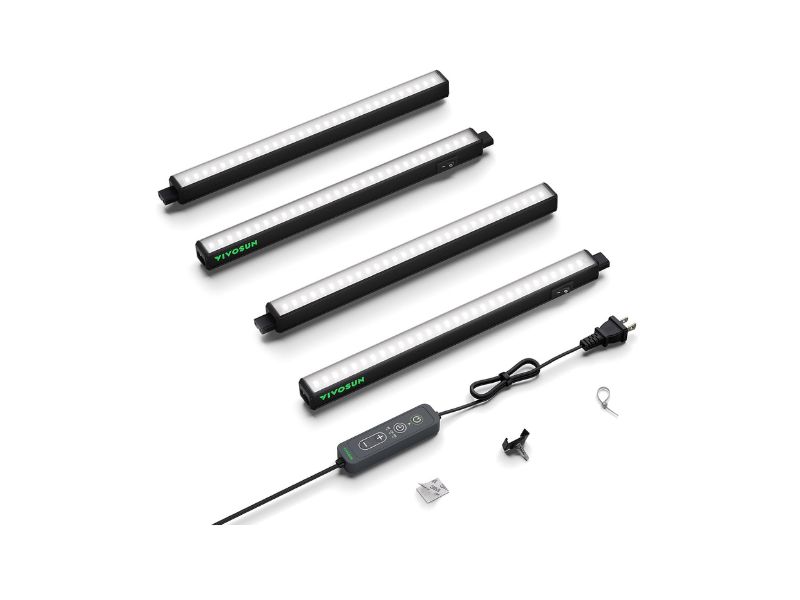
Key Features
- Four 1-foot LED bars
- 7W per bar
- 28W total
- 30 LEDs per fixture
- 5000K full-spectrum output
- Four brightness levels
- 8/12/18-hour timer
- Optical lens system
- Linkable design
- Multiple installation methods
The VIVOSUN T5 1FT 4-Pack represents a very different direction in newer LED grow-light design.
Instead of giving you one powerful panel, VIVOSUN provides four small linear fixtures totaling 28W, with each bar using 7W and 30 LEDs.
The current Amazon listing also specifies 5000K full-spectrum output, four brightness levels, and built-in 8-, 12-, and 18-hour timer choices.
I like this format for:
- Seed starting
- Propagation shelves
- Herbs
- Microgreens
- Small houseplants
- Young vegetables
- Multi-level shelves
because a long shelf rarely needs one concentrated point source.
Linear lights follow the shape of a shelf.
If plants occupy a 3- or 4-foot shelf, several short bars can be distributed along that space rather than forcing seedlings at the ends to lean toward one central lamp.
The newer controller setup is particularly useful.
The 8/12/18-hour timer offers more horticulturally useful flexibility than many inexpensive plant lights that stop at 12 hours.
That makes the 18-hour option particularly relevant to seed-starting applications where a longer daily light period may be useful.
The fixture also provides four brightness levels.
That allows the same shelf installation to adapt as plants develop.
For example:
New seedlings may begin at moderate intensity.
As the plants become established, output can be increased.
If plants also receive strong window light, the LEDs can be reduced again.
The optical lens system is another interesting feature.
VIVOSUN states that the lenses are designed to spread light evenly with high transmittance.
That is more important than it may sound.
Small bar fixtures can otherwise create narrow bright strips with darker spaces between them.
Good diffusion makes the transition between adjacent bars less abrupt.
Installation flexibility is also excellent.
The current system supports multiple mounting approaches and a daisy-chain design with both direct and extension-cable connections.
That means the bars can be arranged:
- End to end
- Across separate shelf sections
- Parallel to each other
- At different levels
depending on the grow rack.
This is the kind of practical flexibility I like seeing in newer consumer grow-light products.
Instead of assuming every buyer owns a grow tent, the system adapts to furniture and shelving.
The major limitation is power.
Twenty-eight watts total is not comparable with SF4000 or LumaLight.
It is not intended to be.
This is primarily a propagation and small-plant system.
Trying to grow several mature, light-demanding fruiting plants beneath four 7W bars would be unrealistic.
What I Like
- Newer modular format
- Excellent for shelves
- 18-hour timer option
- Four brightness levels
- Linkable bars
- Easy installation
- Low electrical demand
- 5000K white light
What I Do Not Like
- Only 28W total
- Not suitable for large mature canopies
- Multiple bars create additional wiring
- Less useful once high-light plants become large
I would choose this VIVOSUN T5 system for seedlings, shelves, and small indoor plants where smart compact coverage matters more than raw wattage. Its timer and modular installation make it one of the more practical newer low-power designs.
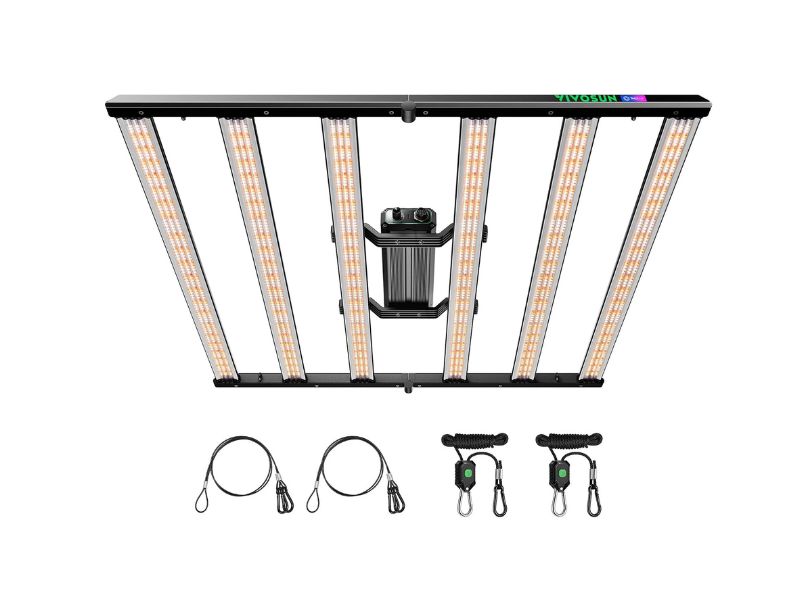
3. VIVOSUN LumaLight 500W LED Grow Light
Key Features
- 500W actual power class
- Distributed light-bar matrix
- Up to 0.89 listed uniformity
- Micro-Lens Optic System
- Claimed PPFD increase up to 20% from optics
- 25/50/75/100% dimming
- 3000K white
- 5000K white
- 660nm red
- 730nm far red
- IP65 sealed bars
- GrowHub/app compatible
- 4×4-foot coverage
The VIVOSUN LumaLight 500W is the newest-style choice here for growers who want a serious bar fixture rather than a refreshed board or compact shelf system.
The current Amazon listing identifies it as a 500W 4×4 full-spectrum grow light with a distributed light-bar matrix and GrowHub compatibility.
The first feature that stands out is uniformity.
VIVOSUN publishes a figure of up to 0.89 uniformity for the light-bar arrangement.
Uniformity is especially important in a 4×4 tent.
Peak center intensity can look impressive on a specification sheet, but the goal of a productive grow light is not to illuminate one plant exceptionally well.
The goal is to provide usable light to:
- Center plants
- Side plants
- Corner plants
at reasonably similar intensities.
The LumaLight’s broad physical frame distributes diodes over more of the footprint.
That helps reduce the tendency for a powerful central hotspot.
The Micro-Lens Optic System is another newer design element.
VIVOSUN states that the curved optics redirect and focus light to increase PPFD by up to 20% while pushing light deeper into the canopy.
I would treat that as a manufacturer claim rather than assuming every setup will see exactly a 20% gain.
Actual canopy PPFD depends on:
- Hanging height
- Tent reflectivity
- Dimmer setting
- Canopy position
- Measurement methodology
Still, using optics deliberately to control photon direction is an interesting development.
Older LED boards often relied mostly on diode output and reflector-free spread.
Modern fixtures increasingly treat where the photons go as seriously as how many photons the LEDs generate.
The spectrum consists of 3000K, 5000K, 660nm, and 730nm components according to the listing.
That gives the fixture broad white output with deep-red and far-red supplementation.
For practical growing, I would still place greater importance on:
PPFD → photoperiod → canopy uniformity → environment → advanced spectral additions.
Far red is an interesting tool, but it cannot compensate for inadequate intensity or poor growing conditions.
Dimming is handled through four levels:
25% → 50% → 75% → 100%.
The current listing also states that the light can integrate with VIVOSUN GrowHub and the mobile app; GrowHub is sold separately.
The staged dimmer is not as fine-grained as a true continuous 0–100% knob, but the four levels cover the major growth stages reasonably well.
For example:
- Young plants: lower setting
- Established vegetative canopy: moderate setting
- Larger mature canopy: higher setting
The GrowHub compatibility adds scheduling and remote control for growers already using VIVOSUN’s ecosystem.
Smart control is useful, but I would not buy the fixture solely because it has an app.
Plants respond to:
- Photon intensity
- Duration
- Spectrum
- Environment
not whether those settings were entered through a phone.
The automation is valuable because it helps maintain consistency.
The IP65 sealed bars are another practical improvement.
VIVOSUN says the bars are protected against dust, mist, and cleaning exposure and pairs that design with integrated heatsink fins.
IP65 does not mean the fixture should be submerged or sprayed carelessly.
Electrical connectors and outlets still require sensible moisture management.
The biggest limitation is scale.
Five hundred watts is far too much for a few herbs on a kitchen counter.
The LumaLight becomes logical when a grower has a genuine 4×4 canopy and wants a modern distributed fixture.
What I Like
- True 500W large-canopy format
- Broad bar architecture
- Strong uniformity emphasis
- Micro-Lens optics
- Full-spectrum plus far red
- IP65-sealed light bars
- GrowHub compatibility
- Four-stage dimming
What I Do Not Like
- Excessive for small gardens
- Four fixed dimming steps rather than continuous adjustment
- GrowHub is separate
- Optical performance claims depend on installation conditions
The LumaLight 500W is the model I would choose when I want a genuinely modern bar-style 4×4 fixture with optics, environmental protection, and smart-system compatibility.
New LED Grow Lights Comparison
| Product | Power | Format | Dimming | Timer/Smart Control | Coverage Focus | Main Advantage |
| Spider Farmer SF4000 New-Gen | 450W | Board-style | Yes | Controller-compatible | 4×4 | Strong current-gen performance |
| VIVOSUN T5 1FT 4-Pack | 28W total | Four linear bars | 4 levels | 8/12/18 hr timer | Shelves/seedlings | Modular compact design |
| VIVOSUN LumaLight | 500W | Distributed bars | 25/50/75/100% | GrowHub compatible | 4×4 | Modern optics + uniformity |
The three products solve very different problems. SF4000 is the strongest all-around current-generation choice, VIVOSUN T5 is designed around modular propagation and shelves, while LumaLight is the more modern large-canopy bar system.
How to Choose the Best New LED Grow Lights
“New” Does Not Always Mean a New Model Name
Grow-light manufacturers frequently refresh existing products.
A current model may receive:
- New diodes
- More diodes
- Better dimming
- New controllers
- Revised optics
- Improved waterproofing
while keeping the established model name.
The current SF4000 is a good example because Amazon explicitly describes it as using all-new upgraded LEDs and increased diode count despite retaining the SF4000 name.
Decide Whether You Need a Shelf Light or Tent Light
This is more important than choosing the newest product.
VIVOSUN T5 totals only 28W and is designed for small-scale lighting.
SF4000 and LumaLight are hundreds of watts and are designed for substantially larger canopies.
A new 500W light is not “better” than a new 28W system when the growing area is one narrow shelf.
New Grow Lights Are Improving Uniformity
One of the most useful trends is more attention to edge-to-edge coverage.
Growers are increasingly looking beyond the highest PPFD value.
A good fixture should reduce the gap between:
center → edges → corners.
LumaLight’s distributed matrix and SF4000’s revised diode arrangement both reflect this design priority.
Bar Lights vs Updated Boards
Board-Style Fixtures
Benefits include:
- Compact size
- Straightforward hanging
- Fewer structural pieces
- Easy installation
SF4000 represents this approach.
Bar Fixtures
Benefits include:
- Wider diode distribution
- Better airflow
- Strong edge coverage potential
- Reduced hotspot concentration
LumaLight represents this approach.
Neither format is universally better.
Why New Optical Systems Matter
Modern LED fixtures increasingly use lenses to control where photons go.
VIVOSUN’s LumaLight uses its Micro-Lens Optic System specifically to redirect light and increase canopy penetration.
This is different from simply installing more LEDs.
Optics attempt to make a larger percentage of existing light useful.
Smart Controls Are Becoming More Common
New consumer grow lights increasingly combine lighting with:
- Timers
- Dimming
- Apps
- Controllers
- Saved settings
The VIVOSUN T5 includes its own timer and brightness controller, while LumaLight integrates with GrowHub and the VIVOSUN app.
Smart controls improve convenience and repeatability.
They do not automatically improve plant biology.
18-Hour Timers Are Useful for Seed Starting
One particularly useful feature on the newer VIVOSUN T5 system is its 18-hour timer option.
Many inexpensive grow lamps stop at 12 hours.
A longer timer provides more flexibility for seedlings and propagation when the LEDs are the primary light source.
IP65 Is Becoming More Common
The LumaLight’s bars use an IP65 sealed design intended to protect the LED system from dust and moisture exposure.
That is useful in humid grow environments.
However, IP65 does not mean submersible.
Keep outlets and connections away from standing water.
Do New Grow Lights Need Far Red?
No.
LumaLight includes 730nm far red, but far red is an advanced spectral addition rather than a basic requirement.
For most growers, I would prioritize:
- Adequate PPFD
- Uniform coverage
- Correct photoperiod
- Temperature
- Watering
- Nutrition
before optimizing supplemental wavelengths.
System PPE Is Better Than “Equivalent Watts”
Modern grow lights should increasingly be evaluated using photon metrics.
Spider Farmer publishes 2.7 µmol/J system PPE for its current SF4000.
That is more informative than saying a fixture “replaces” some much larger traditional lamp.
Best New LED Grow Light for 4×4
For most 4×4 buyers, I would choose Spider Farmer SF4000 if compact installation is important.
If broader bar distribution and newer optical features are priorities, I would choose VIVOSUN LumaLight 500W.
Best New LED Grow Light for Seedlings
The VIVOSUN T5 1FT system is the clear choice here.
Its four short bars, 5000K output, four brightness settings, and 8/12/18-hour timer make much more sense for propagation than a 450–500W tent fixture.
Best New Grow Light for Shelves
Again, VIVOSUN T5.
Its linkable bar format lets you match light placement to rectangular shelves rather than using a large central fixture.
Best New Grow Light for Tomatoes
For mature indoor tomatoes in a full 4×4 canopy, I would choose SF4000 or LumaLight.
The VIVOSUN T5 is better reserved for starting those tomatoes while they are small.
Best New Grow Light for Peppers
The same principle applies.
A 28W shelf system is excellent for propagation, while larger mature pepper plants require more area and intensity.
SF4000 provides a compact 450W solution; LumaLight spreads 500W across a bar architecture.
Electricity Use of New LED Grow Lights
A 28W VIVOSUN T5 system operating 16 hours uses:
0.028 × 16 = 0.448 kWh/day
Over 30 days:
13.44 kWh/month
A 450W SF4000 running 12 hours uses:
0.45 × 12 = 5.4 kWh/day
Over 30 days:
162 kWh/month
A 500W LumaLight running 12 hours uses:
0.5 × 12 = 6 kWh/day
Over 30 days:
180 kWh/month
Actual consumption can be lower when dimming reduces input.
New Does Not Eliminate Heat
Modern LEDs can be highly efficient, but they still produce substantial room heat at higher wattage.
A 28W shelf system creates a small thermal load.
A 450–500W fixture creates a much larger one.
Plan ventilation based on actual input watts, not how cool the fixture housing feels.
Common Mistakes When Buying New LED Grow Lights
Buying New Just Because It Is New
Features should solve a real problem.
Ignoring Exact Current Specifications
Updated models can change under the same name.
Comparing Wattage Alone
Photon efficiency and distribution matter more.
Buying Large Tent Lights for Seedlings
Match power to canopy size.
Ignoring the PPFD Map
One center reading tells only part of the story.
Paying for Smart Features You Will Not Use
A timer and manual dimmer may be enough.
Assuming IP65 Means Waterproof Everywhere
Treat electrical equipment carefully around irrigation.
Prioritizing Far Red Before Basic Lighting
Coverage and intensity come first.
Frequently Asked Questions
What are the best new LED grow lights?
Spider Farmer SF4000 New-Gen, VIVOSUN T5, and VIVOSUN LumaLight are my three current selections.
They cover three distinct uses: a refreshed high-output board, a newer propagation system, and a modern bar-style 4×4 fixture.
Which new LED grow light is my primary recommendation?
Spider Farmer SF4000 is my primary choice for a serious general-purpose 4×4 setup.
Its current new-generation listing specifies 450W power and 2.7 µmol/J system PPE.
Is Spider Farmer SF4000 actually new?
The model name is established, but the current listing uses a new-generation upgraded diode configuration.
Amazon describes upgraded LEDs, increased diode count, and a refreshed 2.7 µmol/J system.
Which new grow light is best for seedlings?
VIVOSUN T5 1FT 4-Pack is my preferred option for seedlings and propagation.
Its four 7W bars provide four brightness levels and 8-, 12-, or 18-hour automatic timing.
Which new grow light is best for a 4×4?
SF4000 suits compact installation, while LumaLight suits growers who prefer distributed bars.
Both are large enough to make sense over serious 4×4-style canopies.
Which new grow light has smart app control?
VIVOSUN LumaLight is compatible with GrowHub and VIVOSUN’s mobile app.
The GrowHub controller is sold separately according to the current listing.
Which new grow light has a built-in timer?
VIVOSUN T5 includes 8-, 12-, and 18-hour timer options.
It also includes four brightness settings through its controller.
Which new grow light has far-red LEDs?
VIVOSUN LumaLight includes 730nm far-red supplementation.
Its listed spectrum also includes 3000K, 5000K, and 660nm components.
Is far red necessary in a grow light?
No, good PPFD, coverage, photoperiod, and environment matter more for most growers.
Far red can be a useful advanced spectrum tool, but it should not compensate for inadequate basic lighting.
Which new LED grow light is IP65?
VIVOSUN LumaLight uses IP65-sealed light bars in the current configuration.
The rating is useful against dust and moisture exposure but does not make the fixture submersible.
Which new grow light is most energy efficient for seedlings?
The 28W VIVOSUN T5 is far more appropriately sized for small propagation areas.
Using a 450–500W fixture for one seedling tray would generally provide unnecessary capacity.
What does 2.7 µmol/J mean?
It describes photosynthetic photon output produced per joule of electrical energy.
Spider Farmer publishes 2.7 µmol/J system PPE for the current SF4000.
Are bar grow lights newer technology than boards?
Not inherently, but modern high-output designs increasingly use bars for broader physical distribution.
Updated boards remain useful when compactness and simple installation matter.
Are optical lenses useful on LED grow lights?
They can help control photon direction and potentially improve useful canopy distribution.
VIVOSUN specifically uses a Micro-Lens Optic System on LumaLight.
Is the VIVOSUN T5 linkable?
Yes, the current system supports daisy-chain connections and multiple mounting arrangements.
That makes it particularly flexible for plant shelves and propagation racks.
Can I grow tomatoes with VIVOSUN T5?
It is better suited to tomato seedlings than large mature tomato plants.
As the canopy expands, move to a fixture with substantially more total output and coverage.
Can I use SF4000 for seedlings?
Yes when appropriately dimmed, but its full 450W capacity is unnecessary for tiny seedlings.
Its value is being able to continue using the fixture as the plants become much larger.
Is 500W enough for a 4×4?
A modern efficient 500W-class fixture provides substantial intensity potential in a 4×4.
Actual suitability depends on PPFD distribution, crop requirements, hanging height, and dimmer setting.
Do newer LED grow lights produce less heat?
Higher efficiency can improve photon output per watt, but total wattage still determines substantial room heat.
A 500W fixture remains a major heat source compared with a 28W shelf light.
Do I need smart controls on a new grow light?
No, smart controls are useful for convenience and scheduling rather than essential plant biology.
A properly configured manual dimmer and timer can still provide an excellent lighting routine.
Should I replace an older grow light just because newer models exist?
Only when the newer fixture offers a meaningful improvement for your actual growing setup.
Better uniformity, efficiency, dimming, coverage, or control can justify an upgrade; novelty alone does not.
Conclusion
The best new LED grow lights are becoming more useful not because manufacturers keep increasing wattage, but because current designs are improving diode distribution, optics, dimming, timers, smart integration, environmental protection, and canopy uniformity.
The Spider Farmer SF4000 New-Gen remains my primary recommendation. Its current 450W configuration combines an updated diode layout with 2.7 µmol/J system PPE, full-spectrum output, dimming, and practical 4×4 capacity. It is the strongest choice here for buyers who want a serious current-generation fixture without moving to an oversized commercial bar frame.
The VIVOSUN T5 1FT 4-Pack is the option I would choose for seedlings and shelves. Its 28W total draw, modular four-bar design, four brightness settings, and 8/12/18-hour timer make it particularly easy to fit into small propagation areas.
The VIVOSUN LumaLight 500W is my choice for buyers who want newer large-fixture technology. Its distributed bars, Micro-Lens optics, 25–100% dimming, IP65 construction, full spectrum with 730nm far red, and GrowHub compatibility provide a notably modern feature set.
For a 4×4 all-around setup, I would choose Spider Farmer SF4000. For seedlings and shelves, I would choose VIVOSUN T5. For a modern optics-focused bar fixture, I would choose VIVOSUN LumaLight 500W.

I’m Maya L. Greenwood, a lifelong plant lover who believes anyone can grow something beautiful with the right guidance. After years of testing soil mixes, pruning methods, irrigation tricks, and pest-safe solutions, I started EasyGardenTips.com to turn hard-won lessons into step-by-step advice. From seed starting and container gardens to composting and seasonal checklists, my goal is to make gardening simple, sustainable, and fun.